Q: When does Water Ways close at the Schack Art Center in Everett?
A: Saturday, May 16, 2026 is the final day. The free exhibition of more than ninety Pacific Northwest artists has been on view in Schack’s Main Gallery and Mezzanine Gallery in downtown Everett (2921 Hoyt Avenue) since March 26. Hours through closing day are Tuesday–Saturday 10 AM–5 PM and Sunday 12–5 PM.
You have six days left to walk into the Schack Art Center and stand in front of the most ambitious group exhibition the building has hung this year.
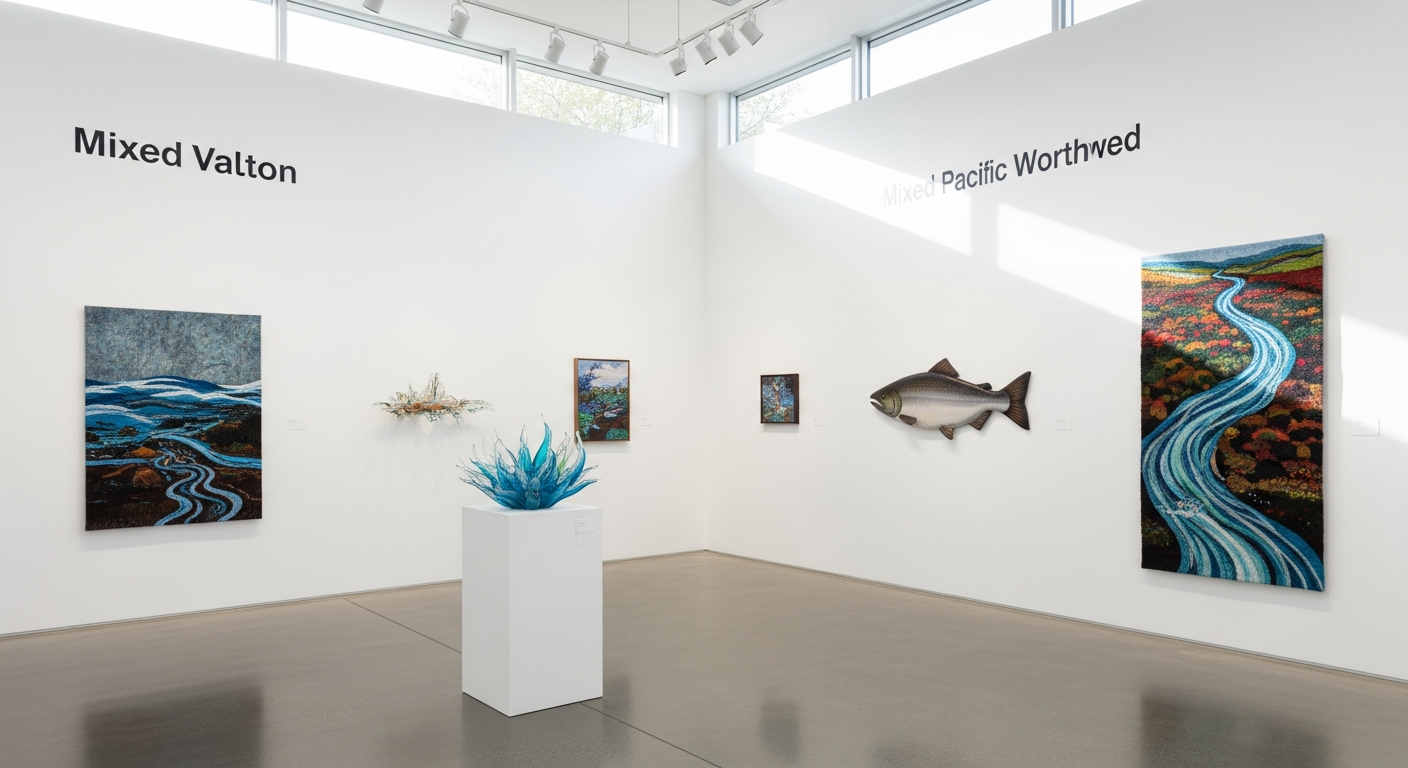
Water Ways: Healing the Circle of Water and Life closes Saturday, May 16, 2026. It is the Schack’s 2026 Arts Education in Action exhibition, and it spans both the Main Gallery and the Mezzanine. Ninety-plus contemporary Pacific Northwest artists answered a single prompt — what does it mean to live next to water that is increasingly under stress — and the resulting wall is one of the more honest reckonings with Puget Sound, the Snohomish River, and the broader watersheds of the region that any local institution has put together in years.
Curation verdict: GO. Free admission. Six days left. If you do one downtown Everett thing this week before lunch on Saturday, make it this.
What you actually see when you walk in
Water Ways is not a quiet exhibition. The Main Gallery wall hits you with Jared Rue’s Here’s the Catch, the lead image the Schack picked to represent the show, and from there the room moves between glass, ceramics, fiber, painting, photography, and sculpture without losing the thread. The list of participating artists reads like a regional Pacific Northwest who’s-who: Dan Friday, David Boxley, Pat McVay, Steve Jensen, Steve Klein, Rik Allen, Shelley Muzylowski-Allen, Georgia Gerber, Kait Rhoads, Lisa McShane, Cynthia Gaub, Christopher Mathie, Jan Hopkins, Chris Hopkins, Joy Hagen. Ninety-plus names, with field-trip-grade interpretive labels next to each.
Standout works flagged on the Schack’s own page include Jeremy Kester’s The Last Drop, Julie C Baer’s Acorn Barnacle, Steve Jensen’s The Fish are Disappearing, Stephen Yates’s Streaming V, Trish Harding’s Sea Stars, and Deborah Singer’s Great Blue Heron Near Aberdeen. The Mezzanine carries additional work and field-trip activity stations.
You can move through the show in twenty minutes. Most people stay an hour. The interpretive copy is excellent and the pieces talk to each other — salmon next to glass next to hand-built relief tile next to photograph — in a way that makes you think harder about what you’re looking at than a single-medium exhibition usually does.
Practical details for the closing week
- What: Water Ways: Healing the Circle of Water and Life
- Where: Schack Art Center, 2921 Hoyt Avenue, Everett, WA 98201
- Closes: Saturday, May 16, 2026
- Hours through closing: Tuesday–Saturday 10 AM–5 PM; Sunday 12–5 PM (closed Mondays)
- Admission: Free
- Parking: Free street parking on Hoyt and California avenues; 2-hour metered on Hewitt
- Phone: (425) 309-7723
Why this exhibition matters more than most regional group shows
Two things separate Water Ways from a typical Schack group hang.
First, the prompt is real. Arts Education in Action is the Schack’s curriculum-anchored programming track. The exhibitions in this series are built to be taught from — school groups walk through, do hands-on response activities, and leave with a mental model that ties what they saw on the wall to a watershed they actually live next to. The Schack’s Education Coordinator, Breannah Gammon, runs the field-trip program out of the show.
That changes what artists submit. When the audience includes seventh-graders who will walk a Snohomish County riverbank that afternoon, you cannot get away with abstract gesture as a substitute for a point of view. Marguerite Goff’s two-panel relief tile, Traveling Upstream: Beauty Returns to Our Rivers, lands harder when you understand it next to a class of kids who just learned what a watershed is. Tiami Hogberg’s Without them there’s no US works on art-school terms and on get-it-immediately terms at the same time. Jeanne Poling’s five photography prints push the show toward documentary and back.
Second, the curatorial framing is honest about what’s happening to our water. The exhibition title — Healing the Circle of Water and Life — is not lukewarm. The Schack’s programming page describes work that “highlights the beauty and interconnectedness of Earth’s water systems, the science behind them, and the effects of environmental change on all forms of life—human, animal, and plant.” A May 2 panel discussion, How We Heal the Circle of Water and Life, brought in Adopt A Stream Foundation and Puget Soundkeeper Alliance to talk watershed restoration, orca pod health, and clean-water supply alongside the artists.
Most regional group shows give you a theme and let the artists respond loosely. Water Ways picks a fight with how the region is letting down its water and asks the artists to put a stake in the ground. Most of them do.
Who you should look for in the gallery
If you have an hour and want to walk out remembering specific work, here are the names worth slowing down for:
- Jared Rue — Here’s the Catch, the show’s lead image, in the Main Gallery
- Dan Friday and David Boxley — Coast Salish work that sits naturally in a watershed-themed room
- Steve Jensen — The Fish are Disappearing, a piece whose title does most of the work and whose execution earns the title
- Pat McVay and Georgia Gerber — sculptural responses with Pacific Northwest provenance
- Kait Rhoads, Rik Allen, and Shelley Muzylowski-Allen — glass work that uses the medium for what it was made for here
- Chris Hopkins and Christopher Mathie — painters working in two very different traditions, both responding to the prompt seriously
- Lisa McShane — landscape painting with a documentary eye
- Marguerite Goff — Traveling Upstream: Beauty Returns to Our Rivers, a relief tile that anchors a corner of the room
The full ninety-plus-artist roster is on the Schack’s exhibition page. The gallery store on the way out carries work by many of the same artists at meaningfully smaller scale and price.
What to pair the visit with
The Schack sits on Hoyt between California and Wetmore, two blocks from Hewitt Avenue. Make a half-day of it: park free on Hoyt, walk through Water Ways, then drop in at the Schack Gallery Store on the way out for Pacific Northwest work you can actually take home. Lunch options within five blocks include Narrative Coffee, Lombardi’s at the marina, the food trucks at Beverly Park, and the steady rotation at Tony V’s Garage if you’re staying for a happier hour.
If you want to make it an arts day, the show closes May 16 at 5 PM, the same evening Geoff Tate is performing Operation: Mindcrime in full at the Historic Everett Theatre and Dana Gould is at HET that same week. Walk Water Ways at 11 AM, lunch on Hewitt, then make a real evening of it.
What’s next at Schack after Water Ways
The Schack’s biggest art week of the spring drops May 28 with the Contemporary Northwest Artists Exhibition and the Summer Auction. Two days later on May 30 the Artists’ Garage Sale spreads 140-plus artists across Wetmore Plaza for the best art-buying day of the year in Everett. The Garden Party, the Schack’s annual summer kickoff, lands Thursday, June 4 from 5–8 PM and opens Sorticulture weekend.
That’s a packed three weeks. Water Ways is what closes the spring run, and after Saturday it’s gone. There is no extension. There is no traveling version. This installation lives at 2921 Hoyt Avenue until 5 PM on May 16 and then it comes down.
Six days. Free admission. Ninety-plus artists. A real point of view about a river system most of us drive over without thinking about. Go.
Frequently Asked Questions
How much does it cost to see Water Ways at Schack Art Center?
Admission to the Schack Art Center is free, including Water Ways. The Schack is a 501(c)(3) nonprofit and accepts donations at the door if you would like to support free programming.
What are the Schack’s hours through May 16?
Tuesday through Saturday 10 AM to 5 PM, Sunday 12 to 5 PM. Closed Mondays. The final day of the exhibition is Saturday, May 16, 2026 — plan to be in the gallery before 5 PM.
Is the exhibition kid-friendly?
Yes. Water Ways is part of the Schack’s Arts Education in Action series and was designed to support school field trips with hands-on response activities. Strollers are welcome and the galleries are stroller-accessible.
Where do I park near the Schack Art Center?
Free street parking on Hoyt Avenue and California Street is usually available within a block. Two-hour metered parking on Hewitt is free after 6 PM. The Wall Street garage is the closest covered option for a longer visit.
Can I buy work from the exhibition?
Most pieces in Water Ways are not for sale through the show, but the Schack’s Gallery Store stocks work from many of the same artists at smaller scale. The annual Schack Summer Auction on May 28 and the Artists’ Garage Sale on May 30 are the next major Schack buying opportunities.
Is the Schack Art Center accessible?
Yes. The Main Gallery is fully ADA-accessible at street level. The Mezzanine has elevator access. Service animals are welcome.
What is the Schack’s relationship to Sorticulture?
The Schack runs Sorticulture, the city’s beloved garden festival, which returns to downtown Everett June 5–7, 2026. The Schack’s Garden Party on Thursday, June 4 from 5–8 PM kicks off the weekend and is the unofficial summer-arts opening night for the building.
Leave a Reply