
What happens when a digital marketing agency owner decides to stop paying for cloud AI and builds 6 autonomous agents on a laptop instead?
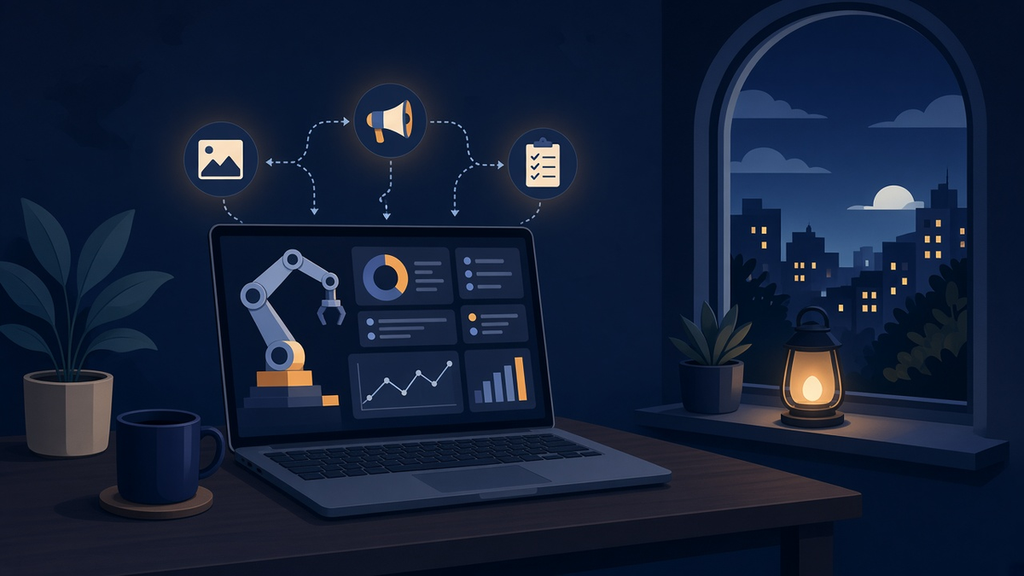
This is the story of a single Saturday night session where I built a full local AI operations stack – six automation tools that now run unattended while I sleep. No API keys. No monthly fees. No data leaving my machine. Just a laptop, an open-source LLM, and a stubborn refusal to pay for things I can build myself.
The Six Agents
Every tool runs as a Windows Scheduled Task, powered by Ollama (llama3.2:3b) for inference and nomic-embed-text for vector embeddings – all running locally:
- Site Monitor – Hourly uptime checks across 23 WordPress sites with Windows notifications on failure
- Nightly Brief Generator – Summarizes the day’s activity across all projects into a morning briefing document
- Auto Indexer – Scans 468+ local files, generates 768-dimension vector embeddings, builds a searchable knowledge index
- Meeting Processor – Parses meeting notes and extracts action items, decisions, and follow-ups
- Email Digest – Pre-processes email into a prioritized morning digest with AI-generated summaries
- SEO Drift Detector – Daily baseline comparison of title tags, meta descriptions, H1s, and canonicals across all managed sites
The Full Interactive Article
I built an interactive, multi-page walkthrough of the entire build process – complete with code snippets, architecture diagrams, cost comparisons, and the full technical stack breakdown.
Read the full interactive article here ?
Why Local AI Matters
The total cost of this setup is exactly zero dollars per month in ongoing fees. The laptop was already owned. Ollama is free. The LLMs are open-source. Every byte of data stays on the local machine – no cloud uploads, no API rate limits, no surprise bills.
For an agency managing 23+ WordPress sites across multiple industries, this kind of autonomous local intelligence isn’t a nice-to-have – it’s a force multiplier. These six agents collectively save 2-3 hours per day of manual monitoring, research, and triage work.
What’s Next
The vector index is the foundation for something bigger – a local RAG (Retrieval Augmented Generation) system that can answer questions about any project, any client, any document across the entire operation. That’s the next build.
{
“@context”: “https://schema.org”,
“@type”: “Article”,
“headline”: “I Taught My Laptop to Work the Night Shift”,
“description”: “How we taught a laptop to run AI automation overnight. Local models, zero cloud cost, and fully autonomous content operations.”,
“datePublished”: “2026-03-21”,
“dateModified”: “2026-04-03”,
“author”: {
“@type”: “Person”,
“name”: “Will Tygart”,
“url”: “https://tygartmedia.com/about”
},
“publisher”: {
“@type”: “Organization”,
“name”: “Tygart Media”,
“url”: “https://tygartmedia.com”,
“logo”: {
“@type”: “ImageObject”,
“url”: “https://tygartmedia.com/wp-content/uploads/tygart-media-logo.png”
}
},
“mainEntityOfPage”: {
“@type”: “WebPage”,
“@id”: “https://tygartmedia.com/laptop-night-shift-local-ai-automation/”
}
}
Leave a Reply