
Last refreshed: October 20, 2026 (Pacific)
The price of a Claude Opus 5.5 output token is $20 per million tokens — and Anthropic prices in US dollars with no regional adjustment, wherever you are in the world. You cannot change that number. What you can change is how many tokens you spend to get the same result, how often you reach for the expensive model when a cheaper one would do, and how much context you burn re-warming Claude on things it already knows.
This guide is the pillar for the Claude on a Budget cluster on Tygart Media. Every tactic below has a dedicated deep-dive article linked from here. The core insight running through all of it: the biggest Claude cost savings are not about using Claude less — they are about using Claude smarter. The goal is the same output quality at a fraction of the token spend.
The 7 Levers That Actually Move the Number

1. Eliminate the Cold Start — Build a Second Brain
Every time you start a Claude session without pre-loaded context, you pay tokens to re-warm it: who you are, what you’re building, what decisions you’ve already made, what your brand voice sounds like. A well-architected second brain — Notion pages, CLAUDE.md files, project knowledge files — eliminates that cost entirely. Claude starts knowing what matters. The first token of every session is productive, not orientation. Full guide: The Cold Start Problem →
2. Route by Task — Don’t Default to Opus
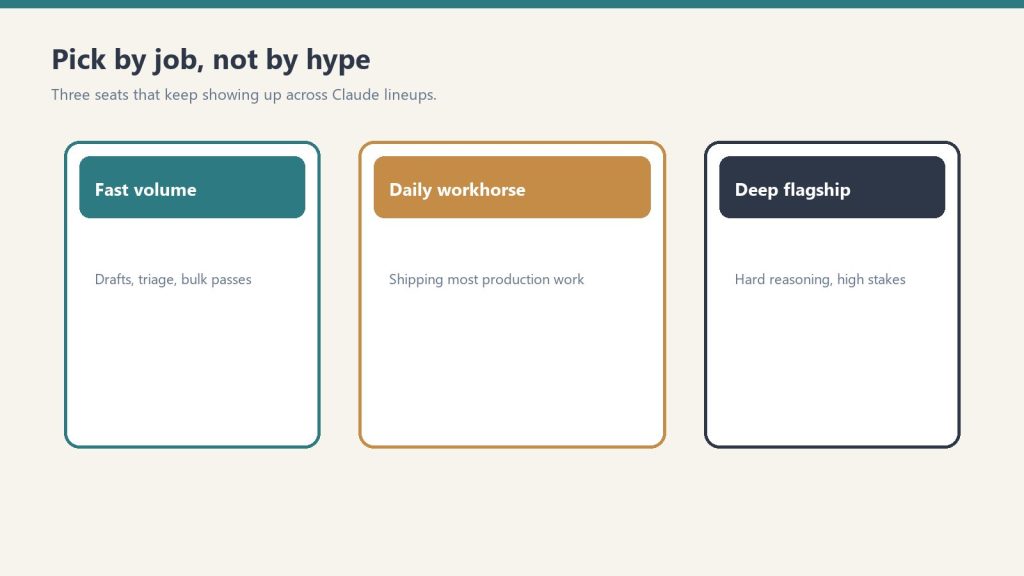
Claude Haiku 4.5 costs roughly a quarter of Claude Opus 5.5 per token. For sorting, classification, summarization, first-pass triage, and simple Q&A, Haiku delivers quality that is indistinguishable from Opus at the task level. The decision tree: Haiku for speed and volume, Sonnet 5.5 for mid-tier reasoning and writing, Opus 5.5 (or Fable 5.1) only when the task genuinely requires maximum capability. Most workflows over-use Opus by a factor of 3–5×. Full guide: Model Routing 101 →
3. Use OpenRouter as the Budget Orchestration Layer
OpenRouter gives you a single API that routes to Claude, GPT-4o, Gemini Flash, Llama, Mistral, and dozens of free-tier models through one endpoint. The practical workflow: use a free or near-free model for first-pass sorting and filtering, route only the items that pass the filter to Claude for reasoning and synthesis. You pay Opus prices for 20% of the work and get Opus-quality output on the parts that matter. Full guide: OpenRouter as the Budget Layer →
4. Run Non-Urgent Work Through the Batch API
Anthropic’s Batch API processes requests asynchronously and costs 50% less than the standard API at every model tier. Any work that does not need an immediate response — content generation, classification runs, analysis jobs, report generation — should run through the Batch API. The only cost is latency: most batches finish in under an hour, with a 24-hour outer limit. For most content and automation workflows, that trade is straightforwardly worth it. Full guide: The Batch API →
5. Cache Your Repeated Context
Anthropic’s prompt caching reduces the cost of repeated context by up to 90% on cached tokens. If you send the same system prompt, knowledge base, or skill file at the start of every session, caching means you pay full price once and a fraction on every subsequent call. The math compounds quickly: a 10,000-token system prompt sent 100 times costs 10× less with caching than without. Most people running Claude at scale are not using this. Full guide: Prompt Caching →
6. Write Concentrated Outputs — Not Full Meals
The single biggest controllable output cost is verbosity. A Claude response that delivers the same information in 200 tokens costs one-fifth as much as one that delivers it in 1,000. Structured output formats — scored lists, run logs, briefings, decision tables — deliver more actionable signal per token than open-ended prose. The discipline of asking for concentrated slices instead of full meals is the fastest zero-cost saving available to any Claude user. Full guide: Output Compression →
7. Shape Content for the Model That Will Cite It
Claude, ChatGPT, and Perplexity cite completely different types of pages. Claude concentrates on factual, access-related, answer-first content. ChatGPT spreads across comparison and geographic content. Perplexity favors research-flavored deep dives. If you are creating content that you want AI assistants to surface, writing for all three models equally is inefficient — you spend more words getting cited less. Shaping content to match the citation pattern of your target model gets more traction at lower content cost. Full guide: Per-Model Content Shaping →
The Numbers Behind These Levers
| Model | Input (per 1M tokens) | Output (per 1M tokens) | Best for |
|---|---|---|---|
| Claude Haiku 4.5 | $1.00 | $5.00 | Triage, classification, simple Q&A |
| Claude Sonnet 5.5 | $2.00 | $10.00 | Writing, mid-tier reasoning, content |
| Claude Opus 5.5 | $4.00 | $20.00 | Complex reasoning, architecture, security |
| Claude Fable 5.1 | $10.00 | $50.00 | Most capable tier — top reasoning, 1M context |
| Batch API (any tier) | 50% off | 50% off | Any non-urgent async work |
| Prompt cache hit | ~90% off | n/a | Repeated system prompts / knowledge bases |
A workflow that currently runs Opus on every call, sends the same system prompt uncached, and generates verbose prose responses could realistically cut its token spend by 70–85% by applying all seven levers — without any reduction in output quality on the tasks that matter.
Who This Is For
This cluster was built with three audiences in mind: Indian developers and teams facing US-dollar Claude pricing on local-currency budgets; independent creators and small teams who cannot justify enterprise-tier spend; and anyone running Claude at scale in production who wants to stop leaving money on the table. The tactics work regardless of where you are — but they matter most where the price-to-income ratio is highest.
Every article in this cluster is self-contained and actionable. Start with whichever lever applies to your situation, or read them in order if you are building a Claude stack from scratch.
Run the numbers on your own workload from the Anthropic Console — API keys, billing, and a token-to-dollar cost estimator.
Related on Tygart Media: model routing · Claude pricing · Pro vs Max.
Get The Signal
What we actually ran, what it measured, and what it means for a restoration shop — every week, including the flops.
Leave a Reply