
· Practitioner-grade
· From the workbench
The Hyper-Local Opportunity Nobody Is Chasing
Every content marketer chases national keywords. High volume, high competition, low conversion. Meanwhile, hyper-local search terms sit wide open with commercial intent that national players cannot touch. That is the thesis behind Exploring Olympic Peninsula — a content site built entirely by AI agents that covers one of the most beautiful and underserved tourism regions in the Pacific Northwest.
The Olympic Peninsula is a place I know personally. The rainforests, the hot springs, the coastal towns, the tribal lands, the seasonal rhythms that determine when you can access certain trails. This is not the kind of content that a generic AI can produce well. It requires local knowledge, seasonal awareness, and genuine familiarity with the terrain.
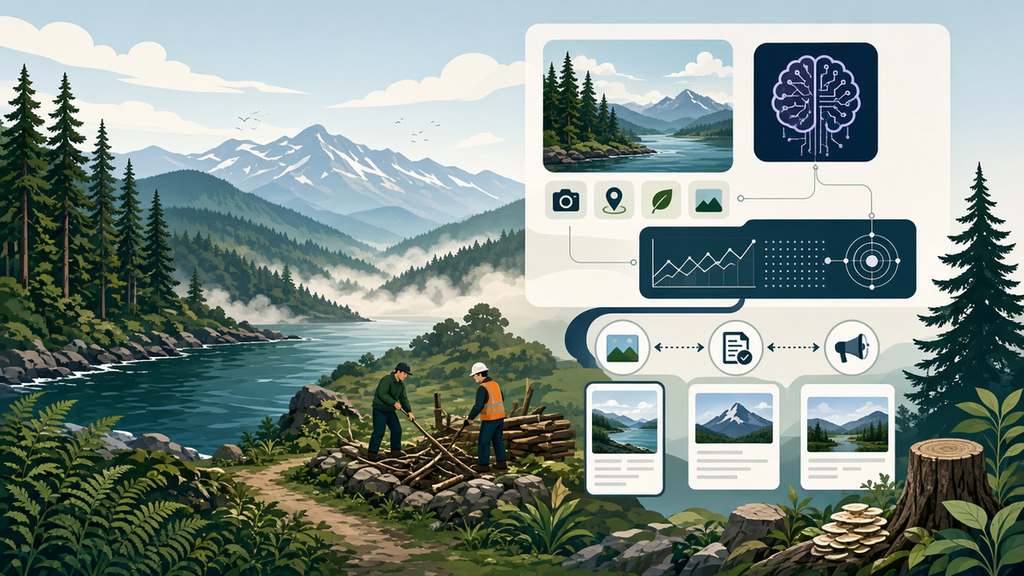
So I built a system that combines my local expertise with AI-powered content generation, SEO optimization, and automated publishing. The result is a site that produces genuinely useful tourism content at a pace no human writer could sustain alone.
The Content Architecture
The site is organized around four content pillars: destinations, activities, seasonal guides, and practical logistics. Each pillar targets a different stage of the traveler’s journey. Destinations capture the dreaming phase. Activities capture the planning phase. Seasonal guides capture the timing decisions. Logistics capture the booking intent.
Every article is built from a content brief that combines keyword research with local knowledge. The AI does not guess about trail conditions or restaurant quality. I seed every brief with firsthand observations, seasonal notes, and insider tips that only someone who has actually been there would know.
The publishing pipeline is the same one I use across the entire portfolio: content brief, adaptive variant generation, SEO/AEO/GEO optimization, schema injection, and automated WordPress publishing through the Cloud Run proxy.
Why Tourism Content Is Perfect for AI-Assisted Publishing
Tourism content has two properties that make it ideal for AI-assisted production. First, it is evergreen with predictable seasonal updates. A guide to Hurricane Ridge hiking does not change fundamentally year to year — but it needs seasonal freshness signals that AI can inject automatically. Second, the long tail is enormous. Every trailhead, every campground, every small-town restaurant is a potential article that serves genuine search intent.
The competition in hyper-local tourism content is almost nonexistent. National travel sites cover the Olympic Peninsula with one or two overview articles. Local tourism boards have outdated websites with poor SEO. The gap between search demand and content supply is massive.
Building the Local Knowledge Layer
The hardest part of this project is not the technology. It is the knowledge layer. AI can write fluent prose about any topic, but it cannot tell you that the Hoh Rainforest parking lot fills up by 9 AM on summer weekends, or that Sol Duc Hot Springs closes for maintenance every November, or that the best time to see Roosevelt elk is at dawn in the Quinault Valley.
I built a local knowledge database in Notion that contains hundreds of these micro-observations. Trail conditions by season. Restaurant hours that differ from what Google shows. Road closures that recur annually. Tide tables that affect beach access. This database feeds into every content brief and gives the AI the context it needs to produce content that actually helps people.
This is the moat. Any competitor can spin up an AI content site about the Olympic Peninsula. Nobody else has the local knowledge database that makes the content trustworthy.
Monetization Without Compromise
The site monetizes through affiliate partnerships with local businesses, display advertising, and eventually, a curated trip planning service. The key constraint is editorial integrity. Every recommendation is based on personal experience. No pay-for-play listings. No sponsored content disguised as editorial.
This matters because tourism content lives or dies on trust. One bad recommendation — a restaurant that closed six months ago, a trail that is actually dangerous in winter — and the site loses credibility permanently. The local knowledge layer is not just a competitive advantage. It is a quality control system.
Scaling the Model to Other Regions
The architecture is designed to be replicated. The same content pipeline, the same publishing infrastructure, the same optimization framework can be deployed to any hyper-local tourism market where I have either personal knowledge or a trusted local partner. The Olympic Peninsula is the proof of concept. The model scales to any region where national content sites leave gaps.
The vision is a network of hyper-local tourism sites, each powered by the same AI infrastructure, each differentiated by genuine local expertise. Not a content farm. A knowledge network.
FAQ
How do you ensure content accuracy for a tourism site?
Every article is seeded with firsthand observations from a local knowledge database. The AI generates the prose, but the facts come from personal experience and verified local sources.
How many articles can the system produce per week?
The pipeline can produce 15-20 fully optimized articles per week. The bottleneck is not production — it is knowledge quality. I only publish what I can verify.
What makes this different from other AI content sites?
The local knowledge layer. Generic AI tourism content is easy to spot and easy to outrank. Content backed by genuine local expertise serves users better and ranks better long-term.
{
“@context”: “https://schema.org”,
“@type”: “Article”,
“headline”: “Exploring Olympic Peninsula: How I Built a Hyper-Local AI Content Engine for Tourism”,
“description”: “Building an AI-powered hyper-local content site for the Olympic Peninsula using automated research, local knowledge, and WordPress publishing.”,
“datePublished”: “2026-03-21”,
“dateModified”: “2026-04-03”,
“author”: {
“@type”: “Person”,
“name”: “Will Tygart”,
“url”: “https://tygartmedia.com/about”
},
“publisher”: {
“@type”: “Organization”,
“name”: “Tygart Media”,
“url”: “https://tygartmedia.com”,
“logo”: {
“@type”: “ImageObject”,
“url”: “https://tygartmedia.com/wp-content/uploads/tygart-media-logo.png”
}
},
“mainEntityOfPage”: {
“@type”: “WebPage”,
“@id”: “https://tygartmedia.com/exploring-olympic-peninsula-how-i-built-a-hyper-local-ai-content-engine-for-tourism/”
}
}
Leave a Reply