Tag: AI in Trades

  • AI Raises the Floor, Not the Ceiling: A Restoration Industry Commentary on the Real AI Story

    AI Raises the Floor, Not the Ceiling: A Restoration Industry Commentary on the Real AI Story

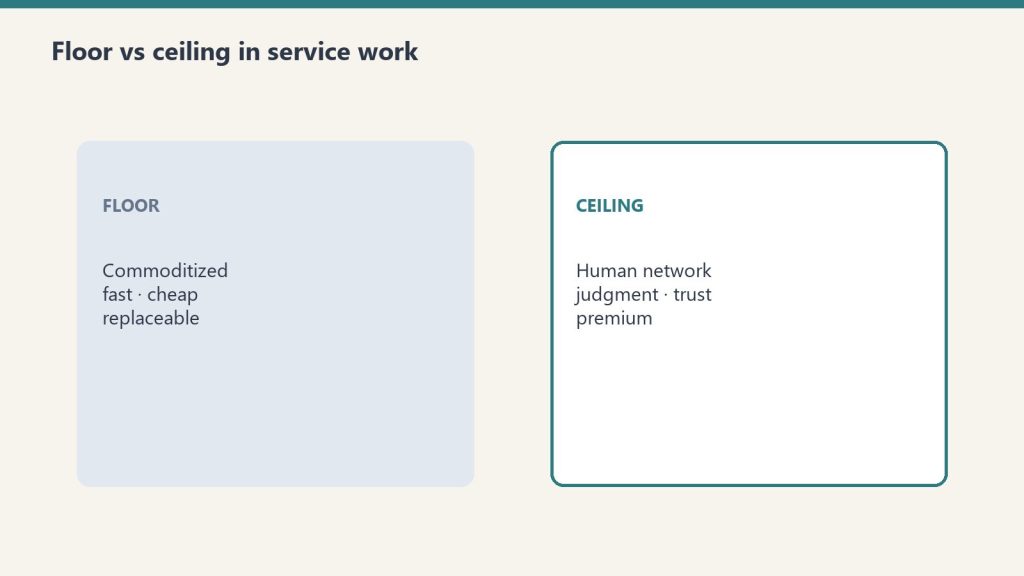
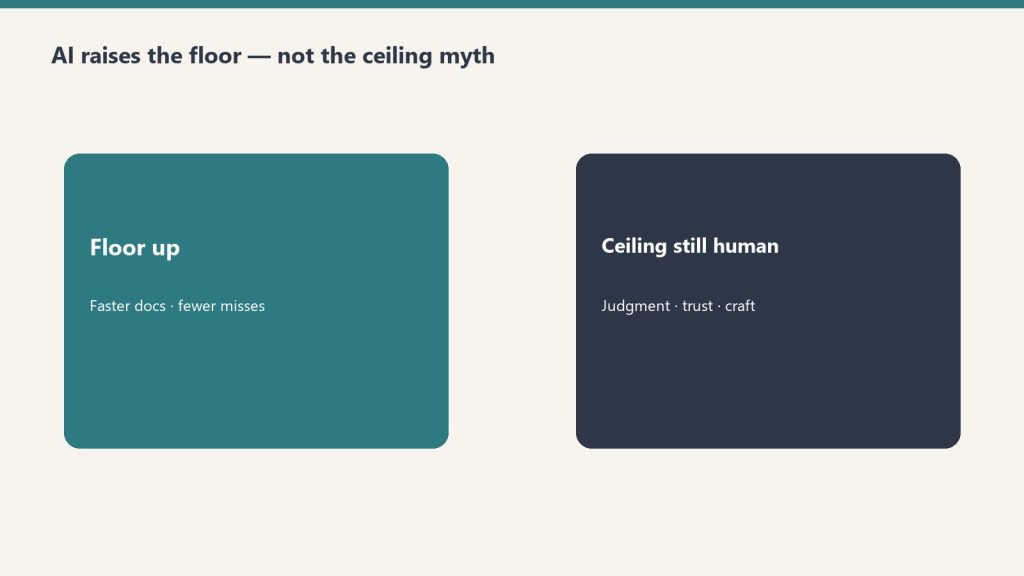
    AI is raising the floor of the restoration industry. It is not raising the ceiling. The ceiling will always belong to the operators who have actually stood in a flooded basement at 2 a.m. and made the call. Once you internalize that distinction, the panic about AI replacing skilled trades collapses, and a more useful question takes its place: what happens to an industry when the floor finally catches up to the people who have been carrying it?

    This is a commentary about restoration. It is also a commentary about AI in general. The two stories are the same story.

    The Floor and the Ceiling

    Every industry has a floor and a ceiling. The floor is the minimum competence a customer can expect from anyone in the trade. The ceiling is what the best practitioners are capable of — the judgment calls, the pattern recognition, the gut feel that comes from doing the work for fifteen years and seeing every kind of failure mode at least twice.

    In restoration, the floor has been embarrassingly low for a long time. There are operators in this industry who genuinely should not be allowed near a moisture meter. They mis-scope projects, they bill for equipment they did not run, they cut corners on containment, and they sell jobs they cannot deliver. They depress the curve for everyone who is trying to do this work properly. Every honest contractor who has ever lost a job to a lowball bid from a fly-by-night competitor knows exactly who I am talking about.

    The ceiling, meanwhile, lives inside the heads of people who have been at this for decades. The Project Manager who can walk into a loss and tell you within ten minutes which insurance adjuster will push back, which trades need to be sequenced first, and which homeowner is going to file a complaint regardless of the outcome. The technician who knows by smell alone whether the mold is active or dormant. The estimator who has internalized the regional cost variance between a Houston hurricane and a Minneapolis ice dam and can write an accurate scope without opening Xactimate. None of that knowledge lives in a database. It lives in the brains of the operators who built it the hard way.

    What AI Actually Does to Skilled Trades

    Here is the part most takes get wrong. AI is not coming for the ceiling. AI is coming for the floor.

    What AI does extremely well is the work that is procedural, well-documented, and pattern-matched against existing data. Writing the initial scope of work. Generating a clean estimate from a photo set. Drafting customer communications. Filling in the IICRC-aligned drying log. Producing the daily progress report. Pulling the right documentation for the carrier. Comparing this loss against the last hundred similar losses in the database and flagging the parts that look off.

    None of that is the hard part of restoration. The hard part of restoration is the judgment that comes after the data is collected. The hard part is knowing that the moisture reading the AI just generated is technically correct but practically wrong because of the building envelope quirk you cannot see from the photo. The hard part is reading the homeowner across the kitchen table and knowing they need to hear the truth a specific way or they will fire you by Thursday. The hard part is the call between mitigation and replacement when the numbers are genuinely close and the carrier is going to fight you either way.

    AI raises the floor by making the procedural part faster, cheaper, and more consistent across the industry. The technician who used to spend two hours writing a sloppy scope now has a clean scope in fifteen minutes. The estimator who used to fight Xactimate now has a draft to react to. The office admin who used to chase signatures now has a workflow that runs itself. All of that is the floor rising.

    The ceiling — the actual judgment, the actual experience, the actual feel for the work — is unmoved. It is still entirely inside the heads of the operators who built it. If anything, it becomes more valuable because the floor is rising fast enough that the only meaningful differentiation left is what the AI cannot replicate.

    Why the Bad Actors Get Starved Out

    This is the part that should make every honest operator in the restoration industry hopeful rather than nervous.

    The rogue restoration company that has been distorting the curve for fifteen years survives on a specific edge. They can underbid the honest operators because they cut corners on the procedural work — they do not document properly, they do not run the right equipment, they do not follow IICRC standards, they do not handle the carrier paperwork with any rigor. The bid they hand a homeowner looks competitive only because the work they are quoting is not the same work an honest contractor would quote.

    When AI raises the floor, that arbitrage disappears. The procedural work becomes table stakes. Any contractor with a smartphone can now produce a clean scope, a defensible drying log, a proper carrier-facing report. The reckless contractor who used to win on speed-by-cutting-corners is suddenly competing on a level surface against operators who have always done the work properly and now have AI making them faster too.

    What the reckless contractor cannot do is the ceiling work. They cannot reproduce the judgment, because they never had it. They cannot reproduce the relationships with adjusters, the reputational depth, the operator instinct. When the floor rises and the differentiation moves up to the ceiling, the bad actors are the first ones starved out. Their entire edge was the floor being low.

    This is the part nobody is telling honest restoration operators clearly enough. AI is not your threat. AI is the thing that finally levels the playing field against the contractors who have been undercutting you on quality for years.

    Data Is Cheap, Fast, and Incomplete

    Right now, in 2026, data is cheap. Compute is cheap. Inference is cheap. Every AI system on the market is leveraging the same approximate pool of public data, the same scraped industry documentation, the same generic training corpus. That is why the AI-generated restoration content flooding the internet right now is so painfully shallow — it can describe what a Category 3 water loss looks like in textbook terms, but it cannot tell you what it actually feels like to walk into one.

    The data is incomplete. It will stay incomplete until somebody systematically extracts the tacit knowledge from the operators who actually have it. That is the part of the AI story almost everybody is missing. The models are not bottlenecked on compute. They are bottlenecked on the kind of experiential, hard-won, in-the-field knowledge that has never been written down and never made it into the training corpus.

    This is true across every industry, not just restoration. It is true in HVAC, in commercial real estate, in healthcare operations, in B2B sales, in any field where the floor is procedural and the ceiling is experiential. The AI floor will continue to rise everywhere. The ceiling will continue to belong to the people who actually did the work.

    The Human Distillery

    This is why the most important AI work happening right now is not building bigger models. It is what we are calling the Human Distillery — the deliberate, structured extraction of tacit knowledge from industry insiders, captured in a form that becomes AI-ready and operator-ready at the same time.

    The way you do this is not with a survey. It is not with a content brief. It is with a long conversation with somebody who has spent twenty years in the field, asking them the questions only an insider would know to ask, then converting their answers into structured artifacts that capture the judgment patterns underneath the words. The scope decisions they make instinctively. The risk signals they read before anyone else sees them. The customer-handling moves they have refined across thousands of jobs. The mistakes they made early in their career and the corrections they internalized.

    That body of knowledge has historically died with the operator who held it. They retire, they sell the business, the kid takes over without the same instincts, and the depth of the operation drops a tier. The industry loses that ceiling-raising knowledge every time a senior operator walks away.

    The Human Distillery is the methodology for stopping that loss. For a direct take on what this moment means specifically for senior operators, see this letter to the older generation of operators in the AI era. You distill the knowledge while the operator is still in the field, you convert it into both AI-ready training data and operator-ready playbooks, and you compound it. The first restoration company that does this systematically will have a competitive moat that no AI system can replicate by ingesting public data, because the knowledge you are encoding was never public in the first place.

    What This Looks Like in Practice

    Imagine a regional restoration operator with thirty years of field experience. Imagine sitting down with that operator for ten hours across a series of structured conversations. Imagine asking them to walk through every category of loss they have ever handled — water, fire, mold, storm, biohazard, commercial, residential, multi-unit — and surface the specific judgment moves they make at each decision point.

    What scope are they running for a Cat 3 with mixed materials in a 1980s slab-on-grade? What changes if the homeowner is elderly and lives alone? What changes if the adjuster is from a specific carrier they have history with? What changes if the loss happened on a Thursday before a holiday weekend?

    None of that is in any database. None of it is in any IICRC standard. It is the ceiling. It is the thing that makes that operator’s company twice as profitable as the regional competitor down the road who has the same trucks and the same equipment and the same certifications.

    The Human Distillery captures it. It becomes a structured artifact the operator can use to train their own next generation of technicians. It becomes AI-ready content that the operator’s own AI tooling can use to outperform every generic restoration-trained model on the market. And critically, it stays inside the operator’s company. It is not training data for the broader model pool. It is the operator’s proprietary ceiling, made durable and transferable.

    Why This Should Give the Industry Faith

    The anxiety about AI in restoration — and in every skilled trade — comes from a flawed mental model. The model says: AI gets better, humans get less valuable, eventually AI does the job. That model is wrong.

    The correct model is: AI raises the floor faster than humans can lower it, so the floor rises. The procedural work that used to differentiate okay operators from bad operators becomes commoditized. The bad operators, who were surviving by underdelivering on the floor, get starved out because the floor is now too high for them to fake. The honest operators get faster and more profitable because their procedural work is now AI-accelerated. And the great operators, the ones with the ceiling-level experience, become the most valuable people in the industry, because the only remaining differentiation is the part AI cannot do.

    That is not a future to fear. That is a future where the people who have always been doing this work properly finally get to compete on the merits.

    The very best of who we are as an industry is about to open up. The contractors who have been holding the line on quality for decades — paying their technicians properly, running their equipment to spec, documenting their work the right way, treating their customers like neighbors — are about to find out that the playing field is finally tilting in their direction. The race to the bottom is ending. The race to the top is starting.

    Have faith. The knowledge will be the value again. It always was. It is just becoming visible again, because the noise is finally getting filtered out.

    Frequently Asked Questions

    Is AI going to replace restoration contractors?

    No. AI is replacing the procedural and documentation work that used to consume hours of a contractor’s day — scoping, estimating, drying logs, carrier paperwork. The judgment work that defines a great restoration operator (reading a loss site, sequencing trades, handling adjusters, managing homeowner expectations) is unchanged and arguably more valuable, because it is now the only meaningful differentiator left.

    What does “AI raises the floor, not the ceiling” actually mean?

    The floor is the minimum competence a customer can expect from any operator in the industry. The ceiling is what the best operators are capable of. AI commoditizes the procedural work, which lifts the minimum baseline across the industry. It does not touch the experiential judgment that defines the top performers. The gap between average and excellent does not close. The gap between bad and average disappears.

    Why will bad actors get pushed out of the restoration industry?

    Bad actors survive on an arbitrage where they underbid honest contractors by cutting corners on procedural work — documentation, equipment, IICRC standards, carrier-facing reports. When AI makes that procedural work fast and cheap for everyone, the underbidding edge disappears. Honest operators get the same speed advantage without sacrificing quality. The bad actors are left competing on judgment and experience, which they never had to begin with.

    What is the Human Distillery?

    The Human Distillery is a structured methodology for extracting tacit, hard-won industry knowledge from experienced operators and converting it into AI-ready and operator-ready artifacts. It captures the judgment patterns, decision frameworks, and field instincts that have historically lived only inside the heads of senior practitioners and disappeared when those people retired. It is how a restoration company turns its founder’s thirty years of experience into a durable competitive asset.

    If AI training data is incomplete, why is AI still useful in restoration today?

    AI is useful today for the procedural floor work — scoping, documentation, customer communication, report generation — because those tasks are pattern-matched against public, well-documented content. The incompleteness shows up the moment you ask AI to make a judgment call that requires tacit field experience. Used inside its actual capability envelope, AI is a force multiplier for any honest operator. Used outside that envelope, it produces the shallow, generic content the industry is currently drowning in.

    How should a restoration company prepare for the AI shift?

    Two parallel moves. First, deploy AI aggressively on the procedural floor — scoping, estimating, documentation, customer-facing communication — to capture the speed and margin advantages. Second, systematically extract the tacit knowledge inside the company’s senior operators using a Human Distillery methodology, and build a proprietary knowledge layer that becomes the company’s defensible ceiling. The companies that only do the first move will be commoditized. The companies that do both will dominate their regions.

    The Bottom Line

    The restoration industry is a perfect commentary on AI in general. Fancy tools and faster calculations are not the gold. The gold, which it always has been, is the learned experience. AI is raising the floor, and the floor needed to be raised. The rogue contractors will be starved out. The reckless ones will go away. The honest operators with real experience will find themselves on a playing field that finally rewards what they have always been doing properly. And the ceiling will keep belonging to the people who actually showed up, did the work, and earned the knowledge the hard way.

    That is when the knowledge will be the value again, just like it always was. The ceiling will start to rise. The very best of who we are as an industry will open up opportunities for the people who built it. Have faith. The floor was the part that was broken. The floor is finally getting fixed.

    The Tacit Knowledge Cluster — Further Reading

    This piece is part of a larger body of writing on what the AI shift and the broader software-platform shift actually mean for service professions and the workers in them. The full cluster:

    The Core Thesis

    For Your Career

    Service Profession Playbooks

    Industry-Specific Trade Answers

    Direct Letters to Each Audience

    For Practitioners

  • Field Operator Seed Kit — Claude AI Starter Pack

    Field Operator Seed Kit — Claude AI Starter Pack

    You bought Claude. This is what you do with it.

    Who This Is For

    Built for contractors, restoration companies, trade shops, and field service businesses who have a Claude subscription and have not figured out how to make it actually useful yet.

    The Problem

    Claude is not plug-and-play for a field service business. It does not know your workflows, your documentation requirements, your adjuster communication patterns, or your crew scheduling rhythms. Most operators who buy it spend a few weeks prompting randomly, get mediocre results, and let it sit. The operators who get real value built their own infrastructure — prompts tuned to their workflows, templates that match their documents, Notion structured so Claude can actually read it. That infrastructure is what this kit delivers.

    What You Get

    • Notion Second Brain template configured for field operations: jobs, crews, equipment, and clients — structured so Claude can read and act on it
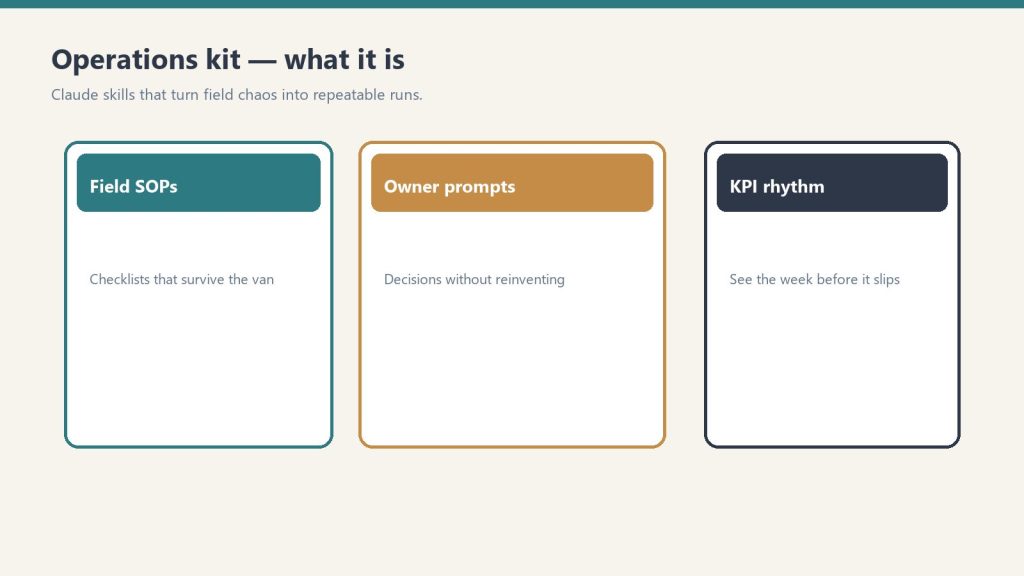
    • 10 pre-built Claude skills for field operator workflows: job documentation, client communication, estimate drafting, crew scheduling, insurance correspondence, and more
    • 50 ready-to-use prompts organized by situation — open the doc, find the situation, copy the prompt
    • Connector checklist: how to wire Claude to WordPress, Google Calendar, Gmail, and your job management system
    • Quick-start guide: your first productive hour with Claude, every step mapped out

    Field Operator Seed Kit

    $47

    Delivered to your inbox within 24 hours — no shipping, no waiting

    Buy Now →

    Secure checkout via Square — all major cards accepted

    Frequently Asked Questions

    How is this delivered?

    Within 24 hours of purchase via email from will@tygartmedia.com. You will receive a download link for the ZIP file and/or Notion duplicate link immediately.

    Do I need any special software?

    A free Notion account is required. No other software needed.

    Can I customize this for my specific business?

    Yes — that is the point. Everything is built to be edited. Swap in your company name, add your specific workflows, remove anything that does not apply. It is a starting point, not a locked template.

    Is there a refund policy?

    Because this is a digital product, all sales are final. If you have a problem with your purchase, email will@tygartmedia.com and we will sort it out.

  • The Context Layer as Job Security: Why the Person Who Briefs the AI Is Irreplaceable

    The Context Layer as Job Security: Why the Person Who Briefs the AI Is Irreplaceable

    Tygart Media Strategy
    Volume Ⅰ · Issue 04Quarterly Position
    By Will Tygart
    Long-form Position
    Practitioner-grade

    Here is a practical observation from running an AI-native content and SEO operation across 27 WordPress sites: AI systems without context are dramatically less useful than AI systems with context. Not marginally. Dramatically. The difference between a cold AI answering a question about a site and an AI with full context about that site’s history, architecture, past decisions, and known failure modes is the difference between generic advice and accurate, actionable guidance.

    The same dynamic applies in every domain where AI is being deployed into complex physical operations. The AI that knows the job history, the property quirks, the adjuster’s patterns, and the crew’s capabilities produces better output than the AI that just knows the job type. The context is the intelligence multiplier.

    For trades workers, this is the career insight that almost nobody is articulating clearly: the person who provides context to an AI system is not a data entry function. They are the intelligence multiplier. And in physical operations where the AI cannot directly observe the environment, that person is structurally irreplaceable.

    What Context Actually Means in Field Operations

    Context in a water damage job includes: the property age and construction type (because these predict concealed damage patterns that the visible inspection doesn’t surface). The adjuster assigned to the claim and their known preferences and pain points. The crew lead’s specific expertise and the tasks they’re most reliable on. The scope items that this type of job in this market typically develops into, beyond what the initial estimate captures. The history of prior claims on the property if available.

    A field technician with 10 years in a market carries most of this as tacit knowledge. They brief an AI system — or a new crew member, or an estimator — not by reciting facts but by flagging the things that are different from the standard case. “This property is going to have issues behind the plaster — always does with this era of construction in this neighborhood.” “This adjuster needs the moisture readings organized by room, not by date.” “This crew lead is great on category 3 but slow on documentation — assign someone else to the paperwork.”

    That briefing — specific, accurate, anticipating the failure modes — is worth more to an AI system than the job file itself. It’s the difference between the AI producing a standard output and producing a calibrated output. The worker who can brief an AI that well is not a data entry function. They’re a force multiplier on the AI’s capability.

    Building Context as a Career Strategy

    The trades worker who understands this reframes their career development accordingly. Domain depth is not just about doing the work well — it’s about building the context library that makes AI-assisted work dramatically better. Every job adds to that library. Every deviation from the expected outcome is data. Every instance of “this is different from what the estimate anticipated, and here’s why” is a piece of context that an AI system needs and can’t generate on its own.

    The practical discipline: log the deviations. Not just “job complete” but “job complete, two scope items added because of X, timeline extended because of Y, adjuster friction on Z.” Over time, this log becomes a context library. The worker who has it produces better AI-assisted outcomes than the worker who doesn’t, in the same way that a well-briefed employee produces better outcomes than one who starts every task cold.

    This is what the context layer as job security actually means. Not a technical architecture. A career behavior: build the context depth that makes AI systems more effective, and position yourself as the person who provides it. That role doesn’t automate. It compounds.


  • Why Judgment Is the Moat: What AI Can’t Replace in the Trades

    Why Judgment Is the Moat: What AI Can’t Replace in the Trades

    Tygart Media Strategy
    Volume Ⅰ · Issue 04Quarterly Position
    By Will Tygart
    Long-form Position
    Practitioner-grade

    The most misunderstood concept in every AI-transition conversation is what “judgment” actually means and why it’s irreplaceable.

    Judgment is not experience. A worker with 20 years in a field has experience. They may or may not have judgment. Experience is the accumulation of situations encountered. Judgment is what happens when a novel situation — one that doesn’t match any template — produces a correct decision anyway. Judgment is pattern recognition operating beyond the edges of the patterns.

    AI systems excel at template matching. Given enough training data, they identify situations that resemble situations they’ve seen and produce outputs that would have been correct in those prior situations. This is genuinely powerful and increasingly capable. What it is not is judgment. When the current situation deviates from the distribution the model was trained on — when the physical reality doesn’t match the documentation — template matching produces confidently wrong outputs. Sometimes visibly wrong. Sometimes silently wrong, which is worse.

    Where AI Template Matching Fails in the Trades

    Every experienced trades worker knows the list implicitly. These are the situations where the estimate is always wrong, where the timeline never holds, where the scope items that weren’t in the original proposal always appear. They’re not random — they follow patterns that experienced workers recognize but that rarely make it into the documentation that trains AI systems.

    In water damage restoration: older properties with non-standard framing, original plaster walls, or retrofitted mechanical systems. Jobs where the visible damage significantly understates the concealed damage. Jobs in markets where certain subcontractor practices are standard even though they’re not in any pricing guide.

    In fire restoration: jobs where the smoke pattern doesn’t match the stated ignition point. Jobs where the client’s account of the event doesn’t match the physical evidence. Jobs where the initial structural assessment missed load-bearing implications of the damage.

    In every trades field: the situation that was described one way in the job intake and turns out to be a different situation when someone is physically present in the space.

    AI systems trained on completed job files learn the average. They don’t learn the deviations that an experienced technician would have recognized before the average outcome materialized. The experienced technician looks at a situation and their pattern recognition — operating below conscious awareness — flags it as an outlier before the data confirms it. That’s the judgment. That’s the moat.

    Why the Moat Deepens as AI Gets Better

    This seems counterintuitive but it’s structural: as AI systems get better at the template-matching layer, judgment becomes more valuable, not less.

    When AI handles the standard cases well, the remaining cases — the ones that require human verification — are disproportionately the non-standard ones. The deviation cases. The outliers. The situations that look standard but aren’t. Handling these correctly requires exactly the kind of judgment that experience builds and AI systems don’t have.

    A company that deploys AI for standard case handling and reserves human judgment for non-standard cases is not degrading the human role. It’s concentrating it on the hardest problems. The worker who handles those problems needs more judgment, not less. And the value of getting them right — because the cost of getting them wrong is concentrated in the deviation cases — is higher than ever.

    This is why the framing “AI will replace workers” is wrong for the trades specifically. AI will replace the template-matching layer of trades work. The judgment layer — the part that operates at the edge of the templates — will remain human until AI systems can be physically present in a space, read it with the full sensory apparatus of an experienced technician, and apply the tacit knowledge that only physical experience builds. That is not an 18-month problem. It may not be a 10-year problem.


    Wire and Fire: The AI Transition Career Cluster

    Related: The Human Distillery — the methodology for capturing the tacit knowledge this cluster describes.

  • The Wire and Fire Guys: Why Trades Workers with Judgment Are the Most Important People in the AI Transition

    The Wire and Fire Guys: Why Trades Workers with Judgment Are the Most Important People in the AI Transition

    Tygart Media Strategy
    Volume Ⅰ · Issue 04Quarterly Position
    By Will Tygart
    Long-form Position
    Practitioner-grade

    There is a version of the AI transition story that gets told constantly, and it goes like this: AI will automate jobs, workers will be displaced, and the people who adapt will be the ones who learn to use AI tools. This version is not wrong exactly. It’s just missing the part that matters most for the people who actually work in the trades.

    The people who build things, fix things, assess damage, run field operations, and carry years of hard-won judgment in their bodies and their hands — these are not knowledge workers whose jobs can be uploaded to a language model. Their work requires physical presence, sensory intelligence, and the kind of contextual judgment that comes from doing something 500 times in conditions that were never twice the same.

    But the transition is real, and it’s happening around them whether they’re paying attention or not. The question isn’t whether AI changes the trades. It’s which trades workers end up on the right side of that change — and why.

    The answer is not “the ones who learn to code.” It’s not “the ones who get an AI certification.” It’s the ones who understand what AI can’t do without them, and position themselves as the irreplaceable layer between the intelligence and the outcome.

    That’s the Wire and Fire Guy. And the window to become one is shorter than most people realize.


    What the Wire and Fire Guy Actually Is

    In electrical work, the wire and fire guys are the experienced field technicians who come in after the rough work is done. They’re not project managers. They’re not estimators. They’re the people who look at what the system is supposed to do, look at what’s actually been installed, and bridge the gap between the plan and the physical reality. They troubleshoot. They adapt. They make judgment calls that no blueprint anticipated.

    The name is an archetype, not a job title. It describes a class of worker who exists in every trades field: the senior technician in water damage who knows from the smell and the color of the staining that the timeline is longer than the moisture readings suggest. The fire restoration veteran who can read a smoke pattern and tell you which rooms were occupied and which weren’t before the alarm triggered. The field supervisor who looks at an estimate and spots the three line items that will blow up into supplements before the job starts.

    These people carry knowledge that cannot be extracted from documentation because it was never documented. It lives in their sensory memory, their accumulated pattern recognition, their feel for how this specific type of situation typically develops. AI systems trained on the documentation don’t have it. AI systems that have processed thousands of job files come closer but still don’t have the physical dimension — the reading of a space that happens in the first ten minutes of being in it.

    That knowledge — embodied, sensory, judgment-based — is the moat. And right now, most of the people who have it don’t know it’s a moat.


    The 18-Month Window

    Here is what is true right now, in April 2026: AI systems can write estimates. They can process moisture readings. They can identify scope items from photos. They can draft communications to adjusters. They can route jobs. They can flag outliers in a dataset of completed claims. They can do all of this faster and cheaper than a human doing the same work.

    Here is what is also true: every one of those AI outputs needs a human to verify it against physical reality before it becomes an action. The estimate needs someone on-site who can see what the AI couldn’t. The moisture readings need someone who can read the environment around the reading — the substrate, the airflow, the odor, the age of the damage. The scope items need someone who can look at the photo and then look at the actual wall and tell you what the photo didn’t capture.

    That verification layer — the human in the loop between the AI’s output and the physical world — is not going away. What is going away, over the next 18 to 36 months, is everything on the other side of that line. The data entry. The scheduling calls. The status updates. The form-filling. The paperwork that currently consumes a significant portion of every field technician’s non-field time.

    The technician who understands this transition has a clear path: move toward the verification layer, away from the data layer. Develop the judgment that makes the AI’s output trustworthy or correctable. Become the person the AI reports to, not the person doing the work the AI can do.

    The technician who doesn’t understand it will find their job slowly hollowed out — not eliminated suddenly, but compressed, devalued, and increasingly focused on the tasks that AI hasn’t gotten to yet, which is a shrinking list.


    Why Judgment Is the Moat

    Judgment is not the same as experience. Experience is a prerequisite for judgment but not a guarantee of it. Judgment is what happens when experience meets a situation that doesn’t match any template and produces a correct decision anyway.

    AI systems are template-matching engines at their core. They are extraordinarily good at situations that resemble situations in their training data. They fail — sometimes silently, which is worse — when the situation deviates from the distribution they’ve seen. A water damage job in a 1920s Craftsman with non-standard framing, original plaster walls, and an HVAC system that was retrofitted twice is a deviation. An AI trained on modern residential restoration data will produce an estimate and a timeline. A Wire and Fire Guy with 15 years of experience will look at the same job and know the estimate is wrong and the timeline is optimistic, because they’ve been inside enough 1920s Craftsmans to know what those walls hold.

    This is the moat. Not the ability to use an AI tool — that’s table stakes within 18 months. The ability to know when the AI tool is wrong, and why, and what to do about it instead. That requires the tacit knowledge that only physical experience builds. It cannot be trained into a model. It cannot be acquired from a certification. It grows from doing the work in conditions the documentation never anticipated, enough times to develop the pattern recognition that operates below conscious awareness.

    The trades worker who wants to be on the right side of the AI transition doesn’t need to compete with the AI on the AI’s terms. They need to become the irreplaceable layer between the AI’s output and the physical world. That layer is called judgment, and building it is a career strategy.


    The Context Layer as Job Security

    There is a more technical version of this argument, and it’s worth understanding even if you never write a line of code.

    AI systems are dramatically more useful when they have context — specific knowledge about the situation, the history, the people involved, and the standards that apply. A generic AI asked to write an estimate for a water damage job produces a generic estimate. An AI given the job address, the property age, the adjuster’s history with this contractor, the specific moisture readings, and the known quirks of the local building code produces something much better.

    The person who provides that context — who knows enough about the job to load the AI with the information that makes its output accurate — is not replaceable. They are, in fact, more valuable as AI systems get better, because better AI systems reward better context. The technician who can brief an AI the way a good editor briefs a writer — specific, accurate, anticipating the failure modes — gets dramatically better results than the technician who types a query and accepts whatever comes back.

    This is what “human in the loop” actually means in practice. It’s not a compliance checkbox. It’s the functional requirement that the AI’s output is verified, corrected, and contextualized by someone who has the embodied knowledge to know when it’s right and when it isn’t. That someone, in the trades, is the Wire and Fire Guy.


    From Field Tech to AI Supervisor: What the Career Path Looks Like

    This is not a story about leaving the trades. It’s a story about moving up the value stack within them.

    The field technician who wants to make this transition has three things to develop, in order of how quickly they compound:

    Domain depth first. The judgment moat requires genuine expertise. The technicians who end up in the verification layer are the ones who actually know the work at the level where deviation from documentation is visible and meaningful. This is built by doing the work, paying attention, and developing the habit of asking “why does this job look different from what the estimate anticipated?”

    AI literacy second. Not coding. Not machine learning theory. The practical ability to give an AI system a useful brief, evaluate its output for the specific failure modes common to your domain, and correct it with the context that changes the answer. This is learnable in weeks, not years, and it compounds quickly once the domain depth is in place to evaluate the output.

    Communication between the two layers third. The ability to translate between the physical world — what you’re seeing in the field — and the data layer that the AI operates on. This is partly documentation discipline (logging what you observe in terms that AI systems can use later) and partly the ability to communicate your corrections and their reasoning so the system improves over time rather than repeating the same errors.

    The career path is not: field tech → project manager → estimator → office. That path still exists but it’s compressing as AI handles more of what project managers and estimators do. The path that compounds in an AI-native industry is: field tech with deep domain knowledge → field tech who understands AI output → field supervisor who runs AI-assisted teams → operations role that owns the verification layer for a company’s AI systems.

    That last role doesn’t have a standard job title yet. In three years it will. The people who get those roles will be the ones who understood the transition early enough to position themselves correctly — and who built the judgment depth that no model can replicate.


    A Note on Pinto

    This is the article I wanted to write since we published the original Wire and Fire Guys piece. That piece named the archetype. This one tries to give it a career map.

    Pinto — who handles the infrastructure layer in this operation, the GCP deployments, the Cloud Run services, the database architecture — is the Wire and Fire Guy of AI infrastructure. He doesn’t just run the code. He understands what it’s supposed to do, sees when it deviates from that, and bridges the gap between the plan and the physical reality of production systems. The AI produces the output. Pinto verifies it against what the system is actually doing and knows why they differ.

    That’s the role. That’s the moat. The window to build it is open. It won’t be open forever.


    Frequently Asked Questions

    Does this apply outside the restoration industry?

    Yes. The Wire and Fire Guy archetype exists in every trades field and every industry where physical reality diverges from documentation. Construction, manufacturing, healthcare, agriculture, logistics — any field where experienced human judgment is applied to physical conditions that AI systems observe indirectly through data. The timeline and the specific skills differ by domain. The structure of the argument is the same.

    What’s the minimum AI literacy a trades worker needs to develop?

    Three things: the ability to give an AI system a specific, accurate brief for a task; the ability to evaluate the output for domain-specific failure modes (the things AI typically gets wrong in your industry); and the discipline to log corrections in a way that builds context over time rather than each correction being one-off. None of this requires programming knowledge. It requires domain expertise applied to a new kind of tool.

    How urgent is the 18-month window?

    The 18–36 month range is where most of the data entry, scheduling, and communication tasks that currently consume field technician time will be substantially automated in adoption-leading companies. The companies that adopt early set the new baseline for what’s competitive. Workers in those companies develop the verification-layer skills first and build the largest knowledge lead. The window is not a cliff — it’s a slope — but the slope is steeper now than it will be in three years when the transition is mostly complete in leading companies and everyone is catching up.

    What about union rules and job protections?

    Job protections can slow the transition but don’t reverse the value dynamics. The worker who has built genuine verification-layer expertise is more valuable whether or not the AI transition is delayed by contract. And the worker who hasn’t built it is less valuable on the same timeline. The protection is in the skill, not the rule.


    Wire and Fire: The AI Transition Career Cluster

    Related: The Human Distillery — the methodology for capturing the tacit knowledge this cluster describes.

  • Wire and Fire Guys: The AI Job Title That Doesn’t Exist Yet

    Wire and Fire Guys: The AI Job Title That Doesn’t Exist Yet

    Tygart Media Strategy
    Volume Ⅰ · Issue 04Quarterly Position
    By Will Tygart
    Long-form Position
    Practitioner-grade

    Before “vibe coding” had a name, Munters had a name for the people who could do it: wire and fire guys. They’re about to be the most valuable humans in the AI era — and I finally found mine.

    The Wire and Fire Guy

    At Munters — which later became Polygon when Triton spun the moisture control services division out in 2010 — there was a specific kind of person the company was built around. We called them wire and fire guys.

    A wire and fire guy could fly into a job site cold. Meet a pile of equipment on a loading dock. Start the generator. Set up the desiccant. Run the lines. Wire in the remote monitoring. Pass the site safety briefing. Know the code. Know the customer. Know how to do it the right way so nobody got hurt and nobody got sued. From A to Z. Solo.

    That’s how Munters ran lean across more than 20 countries. They didn’t need a dispatch team and a tech team and a controls team and a compliance officer all flying out separately. They needed one human who could be all of those people at once, in a Tyvek suit, at 2 a.m., in someone else’s flooded building. The economics of moisture control restoration didn’t work any other way.

    I was one of those guys. I still am. It just looks different now.

    What I Actually Do All Day

    Today I run Tygart Media — an AI-native content and SEO operation managing twenty-seven WordPress sites across restoration contracting, luxury asset lending, cold storage logistics, B2B SaaS, comedy, and veterans services. One human. Twenty-seven brands. The way that math works is the same way it worked at Munters: I’m the wire and fire guy.

    My morning isn’t writing blog posts. It’s connecting Claude to a Cloud Run proxy to bypass Cloudflare’s WAF on a SiteGround-hosted contractor site, then routing a batch of 180 articles through an Imagen pipeline for featured images, then pushing them through a quality gate before they hit the WordPress REST API, then logging the receipts to Notion so I can prove the work to the client on Monday. While Claude drafts the next batch of briefs in the background. While a Custom Agent triages my inbox. While I’m on a call.

    I don’t write code the way a senior engineer writes code. I write enough of it to be dangerous, fix what I break, and ship. I “vibe code” the parts that need vibing. I real-code the parts that need real coding. I know which parts of GCP are the gun and which parts are the holster. I know what to never let an autonomous agent do without me looking. I know how to wire it up and fire it off.

    Same job. Different equipment.

    The Thesis Everyone Is Quietly Circling

    The AI industry spent the last eighteen months selling a story about full autonomy. Agent swarms. Self-healing pipelines. Set it and forget it. Replace the humans, keep the work.

    The data has not been kind to that story.

    Roughly 95% of enterprise generative AI pilots fail to achieve measurable ROI or reach production. Gartner is now openly forecasting that more than 40% of agentic AI projects will be cancelled by 2027 as costs escalate past the value they produce. The dream of the unmanned cockpit isn’t dying because the planes can’t fly. It’s dying because nobody planned for who lands them when the weather turns.

    What’s actually winning, in the labs and the war rooms where this is being figured out for real, is something much closer to the Munters model. The technical literature has started calling it confidence-gated expert routing. An orchestrator model delegates work to a fleet of cheaper, specialized small language models. Those models run autonomously until their confidence drops below a threshold — and at that exact moment, the system kicks the work to a human expert who validates, corrects, and feeds the correction back into the loop as ground truth for the next pass.

    That human expert is not a customer service rep watching a queue. That human expert needs to be able to read what the model is doing, understand why it stalled, fix the technical problem, judge whether the output is actually good or just looks good, and ship the corrected version — all without breaking anything downstream.

    That’s a wire and fire guy. With a laptop instead of a generator.

    Meet Pinto

    The reason I’m writing this today is because I just onboarded mine.

    His name is Pinto. He’s my developer. He runs the GCP infrastructure underneath Tygart Media — the Cloud Run services, the proxy that lets Claude reach client sites that would otherwise block the IP, the VM that hosts my knowledge cluster, the dashboards. He gets a brief from me and turns it into a working endpoint, usually faster than I can write the spec. He wires the thing up. He fires it off. He passes the security review. He doesn’t break the production database. He does it the right way.

    And critically — he can both vibe code and real code. He’ll throw a quick Cloud Function together with Claude in fifteen minutes if that’s what the moment needs. He’ll also sit down and write you something properly architected, properly tested, properly observable, when the moment needs that instead. He knows which moment is which. That judgment is the whole job.

    The last thing I want to say about Pinto in public is this: I’ve worked with a lot of contractors and a lot of devs in twenty-plus years of running operations. Pinto is the human-in-the-loop the industry is going to be paying a premium for inside of two years. He just doesn’t know it yet. So this is me saying it out loud. This guy is the prototype.

    The Job Title That Doesn’t Exist Yet

    Here’s where I want to plant a flag.

    The conversation about AI and work has spent two years swinging between two bad poles. On one side: AI is going to take all the jobs. On the other: AI is just a tool, nothing changes, learn to use it like Excel and you’re fine. Both stories are wrong in the same way. They’re treating AI as a replacement layer or a productivity layer, when what it actually is — for any operation that has to ship real work for real customers — is a workforce of subordinates that needs a foreman.

    The foreman is the wire and fire guy.

    The foreman knows how to brief the agent. Knows how to read the agent’s output and tell what’s solid and what’s hallucinated structure dressed up to look solid. Knows where the agent will fail before the agent fails. Knows the underlying code well enough to crack open the box when the box is wrong, and humble enough to use the box for the 80% of work that doesn’t need cracking. Knows the customer’s business well enough to translate “make me more money” into a thirty-step technical plan that an agent can actually execute.

    That person is not a prompt engineer. Prompt engineering as a job title is already collapsing because the models got good enough that the prompt isn’t the leverage anymore. It’s not a software engineer in the traditional sense either, because traditional software engineering rewards depth in one language and one stack, and the wire and fire guy needs surface-level fluency across about fifteen of them.

    It’s something older than both. It’s the field tech. The plant operator. The site supervisor. The kind of person who used to run a Munters job in a flooded basement at 2 a.m. and now runs an agent fleet from a laptop at the same hour.

    Who This Job Is For

    If you spent the last decade as a working coder and then took a left turn into writing or content or marketing because you got tired of the JIRA tickets — you are the person. The market is about to come back for you, hard. The combination of “I can read the code” plus “I can read the customer” plus “I can write the brief” plus “I can ship” is going to be the most valuable composite skill in the white-collar economy for the next five years.

    If you came up in the trades and you’ve been quietly running circles around the “knowledge workers” because you actually know how things connect to other things — you are the person too. What you learned wiring an HVAC system or setting up a job site translates almost one-for-one to wiring up an agent stack. The mental model is identical. Inputs, outputs, safety, fault tolerance, knowing when to stop and call somebody.

    If you’re a senior engineer who thinks the “AI replacing developers” debate is annoying because you’ve already noticed that the bottleneck on your team isn’t typing code — it’s deciding what code to type — you are the person. Your judgment is the asset. The agents are the labor. Reorient.

    If you’re an operations person who has always been the one who somehow ends up holding the whole business together with duct tape and Google Sheets — you are the person. The duct tape is now Python and the Sheets are now Notion and BigQuery, but the role is the same role, and it’s about to get a real budget for the first time.

    What to Train For

    If I were starting from zero today and I wanted to be a wire and fire guy in the AI era, here’s the stack I’d build, in this order:

    Read code fluently in three languages. Python, JavaScript, and shell. You don’t need to write any of them at a senior level. You need to be able to open someone else’s repo, understand what it does in fifteen minutes, and modify it without breaking it. Claude will do most of the typing. You’re the code reviewer.

    Learn one cloud well enough to deploy and observe. Pick GCP, AWS, or Azure. Learn to deploy a container, set up a database, read logs, set up alerting, and rotate a credential. That’s it. You don’t need to be a certified architect. You need to be able to land at the job site and wire it up.

    Get fluent in at least one orchestration model. Whether that’s LangGraph, an MCP server, a custom Python loop, or just Claude with a bunch of tools — pick one and run it until you understand why it fails, not just how it works.

    Build a real second brain. Notion, Obsidian, whatever. The wire and fire guy’s superpower is context. You need to be able to walk into any conversation with any customer and pull up exactly what was said, decided, shipped, and broken last time. Without that, you’re a generalist with no memory, which is a tourist.

    Do customer-facing work. This is the one most coders skip and it’s the most important. Sit on sales calls. Write the proposal. Take the support escalation. The reason wire and fire guys at Munters were so valuable is because they could talk to a building owner and a generator at the same time. You need both halves of that or you don’t have the job.

    The Real Pitch

    The agent swarm future is real. It’s coming faster than most people in the boardroom are admitting and slower than most people on Twitter are claiming. And it’s going to need a lot of foremen.

    Not millions. The leverage is too high for that. But thousands of these roles, well-paid, in every meaningful industry, sitting at the seam between an autonomous fleet of small models and a human business that needs the work done correctly. The companies that figure out how to find these people first and hire them first are going to run absolute laps around the companies that try to do it with a vendor and a procurement process.

    I’m one of these humans. Pinto is one of these humans. There are more of us than the job listings suggest, because the title for what we do hasn’t been written yet. So here’s a working draft: AI Field Operator. Wire and fire guy. Human in the loop. Agent foreman. Pick whichever one lands.

    If you’re already doing this work — even unofficially, even on the side, even just for yourself — you’re early. Build your reputation now. Write up what you do. Show your receipts. The market is about to find you.

    And Pinto: this one’s for you, brother. Thanks for showing me what the next twenty years of this work is going to look like. Wire it up. Fire it off. Same as it ever was.