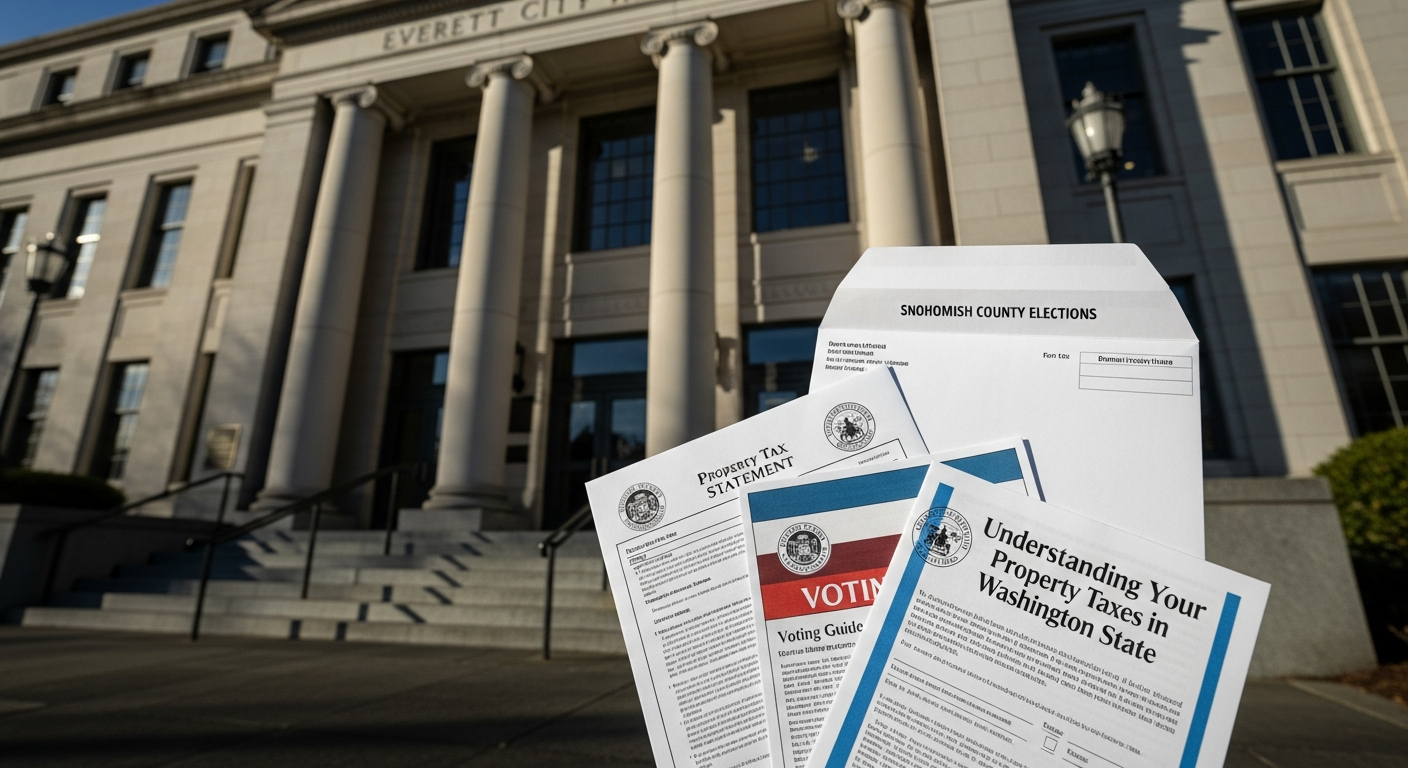
Why does Everett keep putting things on the ballot? Because of Initiative 747, a 2001 Washington voter initiative (RCW 84.55.010) that caps how much property tax revenue any local government can collect from existing properties each year — at 1%. Since fire, EMS, library, and city services cost more than 1% extra each year, the gap between what the levy produces and what services cost grows continuously. When the gap becomes large enough, cities and districts ask voters to restore the original rate in a “lid lift” election. Everett’s EMS lid lift on the August 4, 2026 primary ballot is the third such vote for emergency services since the original EMS levy passed in 2000.
If you live in Everett, you have noticed something: the city keeps asking you to vote on funding for services that already exist. The EMS levy on the August 4, 2026 ballot is the latest. Before it was a library question. Before that, fire services. The question most residents ask is: why does this keep happening? Why can’t the City Council just fund these services without going back to voters?
The answer is one law: Initiative 747. Understanding it takes about ten minutes, and once you understand it, every levy on every Everett ballot for the rest of your life will make immediate sense.
The 1% Problem
In November 2001, Washington voters approved Initiative 747 by a wide margin. The law is codified at RCW 84.55.010. Its core rule: cities, counties, fire districts, library districts, and other taxing districts may not increase the amount they collect from existing properties by more than 1% per year without going back to the voters for approval.
That seems reasonable until you look at what cities actually spend money on. The Everett Fire Department’s biggest costs are firefighter wages, paramedic salaries, pension contributions, health insurance, fuel, and ambulance equipment. Those costs do not grow at 1% per year. They grow at 3% to 7% per year, sometimes more. The arithmetic is relentless. If your revenue is capped at 1% growth and your costs grow at 4%, after ten years you have a 30-point gap. After 25 years — which is roughly how long Everett’s original 2000 EMS levy has been in place — the gap is enormous.
The EMS levy rate has dropped from the original voter-approved rate to approximately $0.36 per $1,000 of assessed value today. The lid lift on August 4 asks voters to restore it to $0.50 per $1,000. For the average Everett homeowner, that is roughly $80 per year. That restoration funds approximately 78 firefighter-paramedic positions at the Everett Fire Department. For more on what this means for your specific tax bill, see the Everett Resident’s Guide to the August 4 EMS Levy.
A Brief History of I-747
Initiative 747 emerged from a sequence of Washington property tax limitation measures. In 1971, the legislature set the regular levy cap at 6% or inflation. In November 1999, Initiative 695 changed the levy limit. In November 2000, Initiative 722 rolled back some levy increases. Then in November 2001 came I-747, which set the 1% cap that has governed Washington property taxes ever since.
In 2007, the Washington Supreme Court ruled I-747 unconstitutional on technical grounds (Washington Citizens Action of Washington v. State). But the legislature reinstated the 1% cap in a special session within weeks of the ruling. It has been in state code ever since. Most recently, Senate Bill 5770 in the 2025 session would have raised the cap to 3%, but it did not pass. The 1% cap appears stable for the foreseeable future.
How the Lid Lift Actually Works
When a taxing district wants to raise its levy rate above the 1%-cap level, it must ask voters to approve a “levy lid lift” under RCW 84.55.050. A lid lift can be temporary or permanent. Here’s the specific mechanism: each year, a district’s maximum levy is the higher of (a) the prior year’s actual levy plus 1%, or (b) the “highest lawful levy” — the highest rate the district was ever authorized to collect. A lid lift restores it from the current depressed rate back up to the voter-approved rate.
Two important nuances: First, the 1% cap is on revenue from existing properties, not on individual tax bills — your bill can rise faster than 1% if your assessed value increases faster than the average. Second, new construction is excluded from the 1% limit, which means growing cities collect more from new buildings without a vote. In a built-out city like Everett where most development is infill and renovation, the new-construction exception doesn’t close the gap by much.
The August 4, 2026 Vote
The measure on the August 4, 2026 primary ballot would restore the EMS levy rate from approximately $0.36 per $1,000 of assessed value to $0.50 per $1,000. For a home assessed at $500,000, that is about $80 additional per year — roughly $6.67 per month. The Voters’ Pamphlet goes to Snohomish County mailboxes in mid-July. For the electoral context alongside other August 4 races, see the Snohomish County 2026 Primary Voter Guide.
Why This Will Keep Happening
Even if voters approve the August 4 lid lift, they are not solving the underlying structural problem — they are resetting the clock. The new $0.50 rate will begin eroding again at 1% per year while costs continue to grow at 3-7%. In another 15 to 25 years, the gap will be large enough to require another lid lift vote. That is not a criticism of the levy or the city. It is simply what Initiative 747 produces: a permanent structural gap between revenue growth and cost growth for every taxing district in Washington.
Frequently Asked Questions
What is Initiative 747 and what does it do?
A 2001 Washington voter initiative (RCW 84.55.010) that caps how much property tax revenue local governments can collect from existing properties at 1% growth per year without voter approval.
Why does Everett keep putting levies on the ballot?
Because service costs grow faster than 1% per year, so the gap between what the levy produces and what services cost expands continuously. When it becomes large enough, the city asks voters to restore the rate in a lid lift election.
What is a levy lid lift?
A voter-approved measure that restores a taxing district’s levy rate from the I-747-reduced level back to the voter-authorized maximum. It does not raise taxes above what voters originally approved; it restores them to that level.
What does the August 4, 2026 EMS lid lift specifically do?
Restores Everett’s EMS levy rate from approximately $0.36 to $0.50 per $1,000 of assessed value — about $80 per year for a typical Everett homeowner — and funds approximately 78 firefighter-paramedic positions at the Everett Fire Department.
Was Initiative 747 ever overturned?
The Washington Supreme Court ruled it unconstitutional on procedural grounds in 2007, but the legislature reinstated the 1% cap in a special session that same year. It has been in state code ever since.
Will the EMS levy raise my property taxes permanently?
A lid lift restores the voter-approved rate and holds it there. Under I-747, the restored rate will then be subject to the 1% growth cap going forward — meaning it will begin to erode again over time.
Where can I read the Voters’ Pamphlet?
Via the Snohomish County Auditor at snohomishcountywa.gov/190/Elections and the City of Everett at everettwa.gov. The pamphlet mails to all Snohomish County households in mid-July 2026.
Leave a Reply