Inspired by The SEO Guy (@theseoguy_). Original post: every local channel requires something owners despise. This is a new Tygart article for restoration contractors. We kept the mechanism, added first-party field knowledge, and did not reprint the thread.
SEO wants reviews. Paid ads want the phone answered in two rings with a human who can book. Social wants the owner on camera. None of that is fun after a 14-hour water day. The shops that treat those three as part of the job — not as a marketing department problem — book the work.
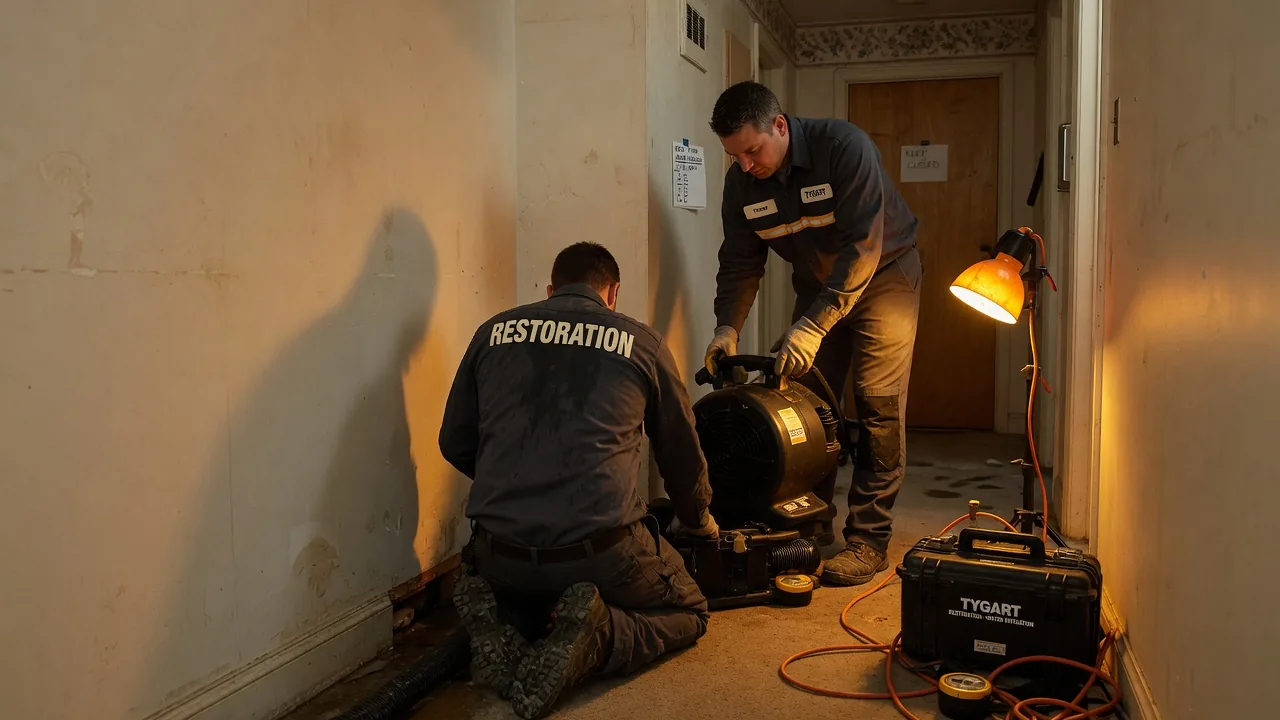
Restoration makes the stack sharper. The review is asked on the driveway. The two-ring rule is the night board. The camera is a 20-second walk-through of containment, not a brand film. Skip any one and the other two leak.
Inspired by Bodhi (@irentdumpsters). Original post: retention beats front-end acquisition. This is a new Tygart article for restoration contractors. We kept the mechanism, added first-party field knowledge, and did not reprint the thread.
The agency version is keep clients for years. The restoration version is keep sources. The plumber who has sent three burst pipes. The property manager with twelve roofs. The adjuster who knows your documentation will not embarrass them.
New-logo marketing is expensive. A source you already earned compounds when you close clean, send the photos the same night, and call after the dry-out instead of disappearing into the next storm.
Put a name on a card. Last loss sent. Last thank-you. Next touch that is not a pitch. That list is the growth plan when Maps is quiet.
Inspired by Bodhi (@irentdumpsters). Original post: the 1-truck vs 8-truck / call-intake thread. This is a new Tygart article for restoration contractors. We kept the mechanism, added first-party field knowledge, and did not reprint the thread.
The original line is simple. The difference between a one-truck operator and an eight-truck fleet is almost never lead generation. It is call intake. If the CSR takes four minutes or fumbles price, a $20,000 marketing budget is expensive noise. The front desk is the highest-leverage sales floor.
That is even more true in restoration than in HVAC or plumbing. The caller is not booking a Tuesday tune-up. They are standing in water, or they are an adjuster who will not leave a voicemail twice.
What “call intake” means on a water board
Answer in two rings. After hours included.
First questions: are you safe, where is the water, is it sewage, can we roll now.
Do not hide behind “let me take a message for the estimator.” The person on the line is the estimator until a PM is assigned.
Price the emergency response honestly. “It depends” without a range loses the job to the shop that will say “we can be there in 45 and start extraction tonight.”
Log source. If you cannot say whether the call came from Maps, LSA, or a plumber referral, you cannot tell which $20k is noise.
The restoration add
A missed ring in this trade is not a lost $189 service call. It is a missed mitigation that would have paid for the rebuild conversation, the contents pack-out, and the next referral from that adjuster. Marketing did its job when the phone lit. Intake is the job after that.
Fix the desk before you raise spend. Record five live calls. Time the pickup. Count how often the caller has to repeat the address. That tape is the growth plan.
Bodhi at @irentdumpsters writes plumber and HVAC stories. Restoration owners should read them as dispatch rules, not as another trade’s marketing tips.
Three recent posts, three different trades, one mechanism.
A Boca homeowner with water across the kitchen called three plumbers off Maps at 7:30 a.m. Voicemail lost. Six-ring menu lost. Ring-two booked a $4,200 repipe that afternoon.
A lead form on a water or plumbing homepage loses the emergency call. Nobody in a puddle types an email and waits.
Most emergency contractor calls happen on a cracked iPhone while the basement is flooding. The About Us paragraph and the hamburger menu are not in the path.
Swap plumber for restorer and the dollar amount goes up, not down. The homeowner is not shopping a $189 service call. They are trying to stop Category 2 or 3 water before the pad and the drywall come out. The shop that makes the local number easiest to tap, then answers it, gets the mitigation and the rebuild conversation that follows.
The call is placed from the loss, not from a desktop contact form.
Reframe: speed-to-lead is part of the estimate
Restoration marketing budgets get judged on cost per lead. That number is a lie if the night board lets three rings dump to voicemail. Maps ranking, LSAs, and SEO are just pipes. The conversion event is a human voice in two rings saying they can roll a crew.
If you are number one on Maps and the CSR is on a seven-minute hold script, you are paying to educate the competitor who picks up.
What to change on the site this week
Header on mobile: local area code, tap-to-call, IICRC or license line. No hamburger hunt.
Homepage and every emergency service page: click-to-call first, form second. Forms are for commercial RFPs and insurance follow-up, not for a burst pipe at 11 p.m.
After-hours path that is a person, not a menu tree. If you use an answering service, the first sentence they say has to be dispatch, not “press 2 for billing.”
Measure answer rate and time-to-answer on Map and LSA calls separately from website forms. If ring-two is not the median, fix staffing before you buy more clicks.
What restoration adds that the plumber post skips
A plumber can book a morning slot. A restorer often has to quote emergency service, set expectations on source identification, and get permission to start dry-out before the adjuster is awake. The first 90 seconds on the phone are not “can we come out.” They are “are you safe, where is the water, is it sewage, can we roll now.” Script that. The marketing post only gets you the ring.
In a Paul trap, a single calcium ion sits in an oscillating electric field—too small to see, easy to lose if you blink at the wrong moment. Cool it anyway. A laser tuned slightly red of the ion’s transition shines on it. When the ion drifts toward the beam, Doppler shift brings the light closer to resonance; it absorbs photons more often. Each absorption kicks a tiny bit of momentum opposite its motion. That is Doppler cooling: velocity stolen photon by photon, direction by direction, until the ion mostly sits still in the trap.
It never hits absolute zero. Random fluorescence puts heat back in. The best you get is the Doppler limit—a floor, not a fantasy of perfect stillness. Stochastic cooling at CERN pushed antiprotons further with timed kicks instead of photons; same moral: you shrink a hot cloud with deliberate impulses, not with wishes.
Your shop has the same shape, minus the vacuum chamber. The leftover pile is the ion: quotes written but not booked, supplements submitted but not approved, inbound rings that became someone else’s water job. Cooling kicks are follow-ups that book or honestly kill. Noise is new quotes, missed calls, ghost rows in the CRM. More leads without follow-up is blue-detuned laser work—more energy in, same jobs out, pile hotter. The physics will not save a broken sales process; it only names what you are already doing wrong.
The four columns on your whiteboard
Think in rates, not vibes. Four symbols are enough for a Monday conversation:
n — open quotes and stalled files you still treat as live.
A− — follow-ups that book work or honestly kill the row (closed-lost with a reason, not “maybe later”).
A+ — everything that adds pile without a matching close: new estimates, voicemails never logged, supplements you forgot to track, adjuster silence you stopped measuring.
Floor — the leftover you will always carry. Speed-of-life, tire-kickers, carriers that pay on geological time. Not shame; physics.
When A− ≈ A+ → pile stays flat. When A+ > A− → pile runs. When you pretend A+ is zero → you predicted a miracle.
Most owners stare at n and feel virtuous. n is a thermometer. A− and A+ are the levers. If you only measure n, you are reading temperature while the laser points the wrong way.
Cooling kicks: quote follow-up that actually moves n
A quote without a cadence is not cooling; it is fluorescence—pretty light that heats the pile. Use a simple clock. Adjust timing to your market; count your own conversion by touch and fix the script, do not copy someone else’s calendar from a podcast.
Day 1 — confirm reality
Within one business day of sending the estimate: call if you have a number, text if that is how the customer reached you. Say what is in the document, what happens next if they say yes, and one clear question (“Do you want us to hold a start window this week, or are you still comparing?”). Log the answer in the row. No answer is data; “still thinking” without a date is A+ wearing a friendly mask.
Day 3 — remove friction
Second touch: one concrete obstacle. Deductible confusion, landlord delay, another contractor’s line item they do not understand. Offer a ten-minute walkthrough of scope—not a lecture on your brand. If they are not the decision-maker, ask who is and whether you may include them on the next call. Still no response: note “attempted day 3” and move the clock.
Day 7 — decision fork
Third touch: binary. “We can mobilize on X or close this file on our side so you are not getting pings—which do you want?” Polite, not passive-aggressive. Restoration is urgent until it is not; your job is to learn which side of that line this file sits on.
Day 14 — honest kill
If nothing after a real fork, close-lost. Reason code: no response, chose competitor, insurance denied, scope withdrawn—pick one that is true. Rotting quotes inflate n and train your team that follow-up is theater. Honest kill is A−. It shrinks the pile you actually work.
Speed-to-lead is the biggest heat source. The unanswered ring is A+ at industrial scale. Answer live when you can. Call back in minutes, not hours. Text-first when the caller already texted. The first 24 hours on a water loss belong to whoever shows up—not whoever sends the prettiest PDF three days later.
Estimator craft still matters: vague scopes cool nothing. If line items fight the adjuster on day one, you added noise before the laser turned on. A tight scope language habit—your own cheat sheet, verified against carrier pushback you have actually seen—feeds A− later. See your Xactimate line-item cheat sheet as cooling prep, not as a substitute for picking up the phone.
Supplements: the unpaid tail nobody plots
Residential files rarely die on the first packet. Several supplement rounds is normal in many shops that measure; your count will differ by carrier mix and how aggressively you document on site. Treat each open supplement as its own row in the pile—not as “part of the job we already won.”
Loop: submit → track → escalate → collect. Every open supplement needs an owner name and a next-action date. No date means A+. The unpaid tail—approved on paper, not in the bank—is pure pile growth while everyone celebrates revenue on a spreadsheet.
Escalation with dates on every step
Adjuster — documented follow-up (email plus call log). Note what you sent and when.
Supervisor — same file, new name, reference prior contact dates.
Carrier escalation — formal, factual, no throat-clearing novellas; timeline of submissions and responses.
If step three is a fantasy because step one never happened, you do not have an escalation problem—you have a tracking problem. Drywall documentation standards on the truck—what S500 in the van means in practice—feeds supplements that survive first review. That is upstream cooling; downstream is still the calendar on each open dollar.
Measuring the pile: Monday one-sheet
Once a week, one page. No dashboard archaeology.
Count open quotes (n at start).
Count new quotes and missed-call rows added (A+ for the week—be honest about voicemails).
Count booked jobs and honest closes from follow-up (A−).
Plot leftover at end of week.
If leftover does not fall over a month while you “follow up,” either follow-up is theater or miss rate is the heat. Voice that texts back in a minute is a kick. Voice that only writes a pretty card is a thermometer.
Pair the sheet with job memory: what repeated on lost files, what line items got kicked back, what adjuster phrases mean “send photos again.” Turning closed jobs into searchable notes—restoration jobs as a knowledge base—cuts A+ from repeated mistakes. It does not replace the cadence above.
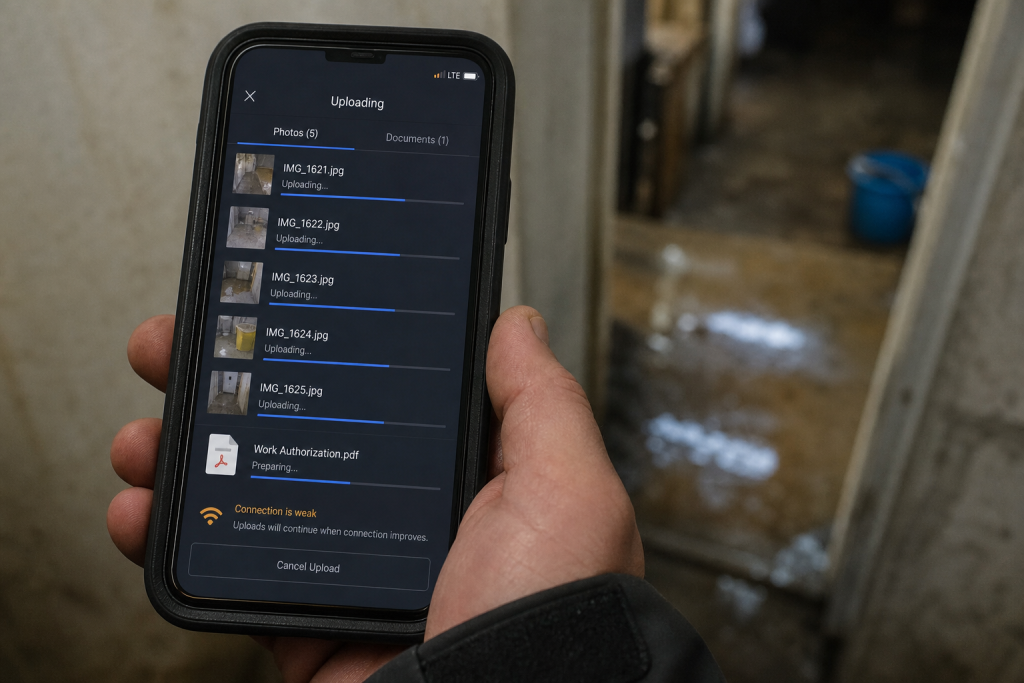
Field connectivity is pile-adjacent: if the crew cannot upload while the homeowner is still anxious, you slow the proof loop and invite competitor speed. Reliable site internet is boring ops; it is also fewer ghost supplements. Worth reading once if you still fight dead zones: Starlink on a water job.
Not this
The metaphor has boundaries. It will not cool your brand. It will not set ad spend. It will not fix hiring. It only describes piles that shrink when kicked and grow when ignored. If your marketing pours leads into a CRM nobody touches, you are not running a trap—you are heating ions on purpose and calling it growth.
Do not overclaim the physics. You are not hitting the Doppler limit on receivables. You are choosing whether A− happens often enough that n is workable. That is enough math for a contractor who would rather dry a wall than derive one.
FAQ
What is the “leftover pile” in plain language?
It is work you already touched but have not collected or closed: open quotes, stalled supplements, and leads you let slip. It is not evil; it is inventory that costs attention until you book it, kill it, or collect it.
Why compare follow-up to laser cooling?
Because each good follow-up removes a little uncertainty the way each absorbed photon removes a little velocity—not all at once, and never to zero. Random noise—new leads, missed calls—puts heat back. The comparison keeps you honest about rates, not miracles.
How many follow-ups before I close a quote as lost?
A common working structure is day 1, day 3, day 7, and a day 14 fork with an honest close if there is still no decision. Count your own bookings by touch; shorten or lengthen only when your numbers say so.
What belongs on a supplement escalation?
Dates, names, and what was submitted each round. Move adjuster → supervisor → carrier escalation with a logged step at each level. Missing dates mean you are guessing, not escalating.
What should the Monday one-sheet prove?
Whether leftover shrank. If new noise and open quotes outrun closes for weeks, your pile is running hot—fix speed-to-lead or cadence before you buy more leads.
Can this framework fix slow insurance pay?
It helps you see unpaid approved work as pile growth and assign owners. It does not change carrier calendars. It keeps you from mistaking “approved on email” for collected cash.
Most restoration companies don’t have a sales process. They have an owner who answers the phone, gives a verbal estimate, and hopes the customer says yes. That works until it doesn’t — usually around the $1.5M revenue line, when the owner can no longer touch every job and the company plateaus.
This is the complete restoration sales playbook for both commercial and residential. The processes, the scripts, the objections, the comp plans, the metrics, and the org structure that turn restoration sales from “the owner’s gut” into a scalable engine.
Why restoration sales is different from other home services
Why restoration sales is different from other home services.
Three things make restoration sales unique. First, most customers don’t want to be there — water on the floor, fire damage, mold smell — and the buying experience is emotional, not transactional. Second, insurance is usually the third party in the room, which means the sale has both a customer-facing dimension and a carrier-facing scope-and-pricing dimension. Third, the urgency window is short — a homeowner with three inches of water in the basement is making a decision in the next sixty minutes, not the next sixty days. A sales process built for HVAC replacement or kitchen remodels doesn’t work in this environment.
The residential restoration sales process
The clean residential process has six steps. First, the inbound call or arrival — set the customer at ease, gather the basics, dispatch the truck. Second, the on-site walk and assessment — physically inspect the loss, document with photos and a moisture map, identify scope. Third, the trust-building conversation — explain what’s happening, what the company will do, what the timeline looks like, what the insurance process will involve. Fourth, the work authorization — get the signature on the work authorization form and the AOB (assignment of benefits) where used, with clear scope language. Fifth, the daily progress update — text or call the customer every day with what was done and what’s next. Sixth, the close-out and review request — final walkthrough, signed completion certificate, immediate ask for the Google review.
The commercial restoration sales process
The commercial restoration sales process.
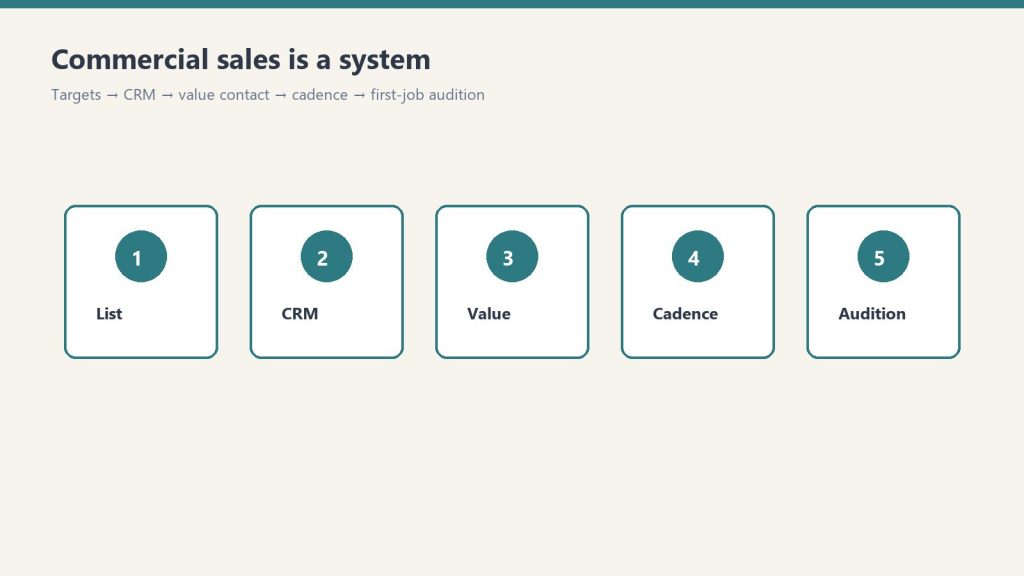
Commercial is fundamentally different — longer sales cycle, multiple stakeholders, RFP and master service agreement structures. The commercial process has eight steps. First, identify and qualify the target (property managers, facility directors, REIT operations teams, healthcare facility managers, hotel chains). Second, cold outreach via email, phone, LinkedIn, or in-person drop-bys. Third, discovery meeting to understand current vendor situation, pain points, and decision criteria. Fourth, capabilities presentation — branded deck, case studies, references, certifications. Fifth, RFP response or vendor application — formal pricing schedules, COI, W-9, MSA negotiation. Sixth, onboarding and first job — usually a small loss to prove the relationship works. Seventh, account management — quarterly business reviews, scorecard tracking, expansion within the account. Eighth, renewal and reference development — turn happy commercial accounts into case studies and references for the next prospect.
The five most common restoration sales objections (and how to handle them)
“I need to call my insurance company first.” This is the most common objection on residential. The honest answer: yes, they should call insurance, but they don’t need to wait for insurance to authorize emergency mitigation. Mitigation is a duty owed by the homeowner under almost every policy, and delaying mitigation usually causes more damage and more denials, not fewer. Explain this calmly, point them to their policy language, and offer to be on the call when they reach the carrier.
“How much is this going to cost?” The wrong answer is a number. The right answer is “it depends on what we find when we open up the affected areas, but I can walk you through how Xactimate pricing works, what your policy typically covers, and what your out-of-pocket exposure is likely to be.” Rebuild trust with transparency, not with an unreliable estimate that you’ll have to retract later.
“My uncle/cousin/neighbor does this kind of work.” Don’t fight it. Acknowledge it, then differentiate: “If they’re certified IICRC and carry the right insurance, that’s great — we’re happy to be the second opinion. If you’d prefer to use them, we still recommend you start mitigation in the next few hours either way.” Sometimes you’ll lose the job. Often the customer will quietly reconsider when they realize what’s actually involved.
“Your competitor quoted me less.” The hidden answer to this objection is almost always scope, not rate. Walk through the scope item by item with the customer. Identify what’s missing in the competitor’s proposal. Explain what gets denied or supplemented later when the carrier reviews. Most price objections in restoration are scope-comparison failures, not pricing failures.
“I want to think about it.” Time is not a luxury in restoration. The honest, professional response: “I understand. The challenge is that every hour we wait, the loss usually gets worse and the carrier may push back on damage that could have been prevented. Can we start emergency mitigation now and you finalize the rest of the scope tomorrow?”
Sales rep compensation: the models that work
Three compensation structures dominate in restoration. Salary plus bonus works for inside sales reps and commercial business development, where the sales cycle is long and the rep needs predictable income. Typical structure: $60K-$90K base plus 1-3% of revenue from accounts they bring in, capped or uncapped depending on territory size. Commission-only works for outside residential sales reps in markets with high enough volume to support it. Typical structure: 5-10% of gross revenue or 10-15% of gross profit, with a draw against commission for the first 90 days. Salary plus team bonus works for production-side sales (project managers who upsell during jobs). Typical structure: production manager salary plus a small percentage of completed job revenue tied to customer satisfaction scores.
The metrics that predict restoration sales performance
The metrics that predict restoration sales performance.
Forget revenue as the primary metric — it’s a lagging indicator. The leading indicators that predict next quarter’s revenue are activity volume (calls made, meetings held, proposals sent), pipeline value (sum of qualified opportunities × probability), conversion rates by stage (lead to qualified, qualified to proposal, proposal to close), average deal size by source, and sales cycle length by deal type. A weekly pipeline review using these five metrics will tell you what’s coming three months out.
When to hire your first sales rep
Most restoration owners hire too late. The right trigger is when you can confidently answer two questions: “do I have a documented sales process I can hand to someone else?” and “do I have enough lead flow to keep a sales rep at 70%+ capacity?” If both are yes and you’re at $1.5M+ in revenue, it’s time. The first sales hire should usually be a residential closer or commercial business development rep, depending on which side of the business has the bigger growth ceiling.
Residential sales reps respond to inbound emergency calls, conduct on-site walks, write scopes, present pricing, secure work authorizations, and manage the customer relationship through completion. Commercial sales reps prospect property managers and facility directors, conduct discovery meetings, deliver capabilities presentations, respond to RFPs, negotiate MSAs, and manage assigned accounts long-term.
How much does a restoration sales rep make?
Residential outside sales reps in restoration typically earn $60K-$120K total compensation, depending on market, lead flow, and commission structure. Commercial business development reps with established books of business often earn $90K-$200K. New hires in their first year usually fall into the $50K-$80K range while building pipeline.
How do you sell commercial restoration services?
Commercial restoration sales is relationship-based business development, not transactional sales. The process: identify target accounts (property managers, facility directors, REITs, healthcare, hospitality), build relationships through outreach and industry events, present capabilities through branded decks and case studies, win small jobs first to prove competence, then expand to MSA-level relationships and preferred vendor status.
What is the close rate for restoration sales?
Healthy close rates by segment: residential emergency leads 40-60% from lead to job; residential planned/estimated work 25-40%; commercial RFPs 15-30%; commercial referral-based opportunities 35-55%. Companies significantly below these ranges usually have a process or speed problem, not a market problem.
Should I hire a restoration sales coach or consultant?
Restoration sales coaching has matured into a real category — there are several specialists who focus exclusively on this industry. Coaching tends to deliver the best ROI for owners who already have lead flow but are struggling with conversion, or for sales reps in their first 12-24 months who need scaffolding on process and objection handling. It’s less useful for foundational issues like lead generation or operational capacity.
How do you train a restoration sales rep?
Effective restoration sales training has four pillars: technical knowledge (water categories, drying science, restoration process, IICRC standards), insurance literacy (policy language, claims process, Xactimate basics, supplements), sales process and scripts (call handling, on-site discovery, scope presentation, objection handling, close), and ride-alongs with the owner or senior rep for the first 60-90 days before independent calls.
Commercial restoration sales is one of the longest, most complex sales motions in the trades. The buying committee can include property managers, asset managers, risk managers, in-house counsel, and procurement. The sales cycle routinely runs 6-18 months from first conversation to first revenue. The deal structures involve MSAs, performance metrics, insurance requirements, and pricing concessions that residential salespeople have never encountered. Companies that try to “sell harder” usually fail; companies that build a disciplined commercial sales process consistently win.
This article is part of our broader restoration sales playbook, which covers the full sales motion across both commercial and residential.
The Six Stages of a Commercial Restoration Sales Cycle
The six stages of a commercial restoration sales cycle.
Stage 1: Account Identification and Prospecting
Commercial restoration prospecting starts with identifying the right accounts — typically property management firms managing 50+ doors in the service area, large commercial buildings, hospital systems, school districts, hotel chains, and corporate campuses. Tools like LoopNet, CoStar, and local commercial real estate databases combined with LinkedIn Sales Navigator surface the buying contacts inside each account.
The activity goal at this stage is consistent outreach volume — typically 20-40 personalized touches per week per BD rep across email, LinkedIn, and phone.
Stage 2: Discovery and Qualification
The first real conversation with a commercial prospect should be discovery, not pitching. Questions to surface in discovery: current vendor relationships, recent loss history, decision-making process, MSA timelines, performance metrics they care about, and pain points with current vendors. Most commercial prospects are not actively looking for a new vendor — qualification is identifying the ones whose current arrangement has friction.
Stage 3: Capability Presentation
The capability presentation in commercial restoration sales is not a generic pitch deck. It is a tailored response to the specific pain points surfaced in discovery — response time guarantees, equipment inventory in their geography, certifications relevant to their property type, sample reporting and documentation, and case studies from similar properties.
Stage 4: Pilot or Trial Engagement
Commercial prospects rarely move directly from capability presentation to MSA. The intermediate step that moves deals forward is a pilot engagement — a small initial job that demonstrates the company’s actual performance under field conditions. Companies that nail the pilot consistently move to MSA negotiation; companies that disappoint on the pilot lose the account permanently.
Stage 5: MSA Negotiation
MSA negotiation involves pricing schedules, response time commitments, performance metrics, insurance requirements, indemnification, dispute resolution, term and termination, and exclusivity provisions. Most restoration companies need legal counsel for MSA review. The negotiation cycle commonly runs 60-180 days.
Stage 6: Account Expansion
The largest revenue from commercial accounts often comes after the initial MSA — through portfolio expansion (more properties), service expansion (mitigation plus reconstruction plus contents plus mold), and referrals to sister property management companies in the same network. The post-MSA account management motion is where commercial restoration revenue actually compounds.
Sales Cycle Math
Sales cycle math.
A commercial restoration BD rep needs to manage the front-end activity volume that produces enough qualified pipeline 6-18 months out to support a steady stream of MSA closes. Most rep performance issues in commercial restoration are caused by insufficient prospecting volume in months 1-6, which produces a pipeline gap in months 7-18 that no amount of late-cycle effort can recover.
Compensation Structure
Compensation structure.
Commercial restoration BD compensation typically combines a base salary that supports the long sales cycle with commission on closed MSAs and a smaller residual on account revenue over time. Pure-commission structures usually fail because the cycle is too long for reps to survive financially during the ramp.
How long is the typical commercial restoration sales cycle?
From first contact to first revenue, commercial restoration sales cycles typically run 6-18 months. From first contact to a fully executed MSA, the cycle can be 12-24 months. Pipeline planning needs to account for this extended timeline.
Can a residential restoration salesperson succeed in commercial?
The skill profiles are different enough that direct transitions usually fail. Commercial sales requires patience, account-based discipline, comfort with long cycles, and ability to navigate buying committees. Most successful commercial reps come from B2B service sales backgrounds rather than residential restoration sales backgrounds.
What is the most common commercial restoration sales mistake?
Pitching too early in the conversation. Commercial buyers tune out generic capability pitches; they engage with reps who clearly understand their specific property type, current vendor pain points, and operational reality. Discovery first, presentation second.
How do I get my first commercial MSA?
The fastest path is usually delivering exceptional performance on a pilot engagement with a smaller commercial account, then leveraging that success into introductions and case studies for larger targets. Cold-pitching a major property management firm without any commercial track record rarely works.
What pricing concessions are typical in commercial MSAs?
Commercial MSA pricing is typically 5-20% below standard residential pricing in exchange for volume guarantees and vendor preference. The exact concession depends on portfolio size, exclusivity terms, and the operator’s negotiating position. Companies entering commercial often over-discount in early MSAs to win business.
Residential restoration sales is won or lost in the first 60 seconds of the inbound call and the first 15 minutes of the in-home estimate. Companies that script these moments tightly close at meaningfully higher rates than companies that wing it. This article walks through the call flow, in-home conversation, and closing language that consistently performs in residential restoration sales operations.
The inbound call is the highest-leverage 3-5 minutes in residential restoration. The script needs to accomplish four things quickly: establish empathy and credibility, qualify the situation, create urgency and book the appointment, and prevent the prospect from continuing to call competitors.
The opening should never be “Hi, can I help you?” — it should be a confident, warm greeting that immediately signals competence: “[Company], this is [Name], how can I help you with your water damage today?”
The qualification questions are simple but specific: What is the source of the water? When did it start? How much area is affected? Is the water still active? Is anyone home? What city are you in? These questions both qualify the lead and demonstrate competence to the homeowner.
The booking close: “We can have a project manager on-site in [time]. Can I confirm the address?” — and then the critical ask: “Just so I can let our PM know, are you also calling other companies, or did you decide to go with us?” This last question, asked warmly and without pressure, reduces shopping behavior dramatically.
The In-Home Arrival
The first 60 seconds on-site set the tone for the entire conversation. The sequence that works: introduce yourself, ask permission to enter, ask the homeowner to walk you through what happened in their own words (don’t immediately start inspecting), then transition into a guided inspection together. Skipping the homeowner’s narrative is a common mistake — they need to feel heard before they will trust the recommendation.
The Inspection Walk-Through
The inspection walk-through.
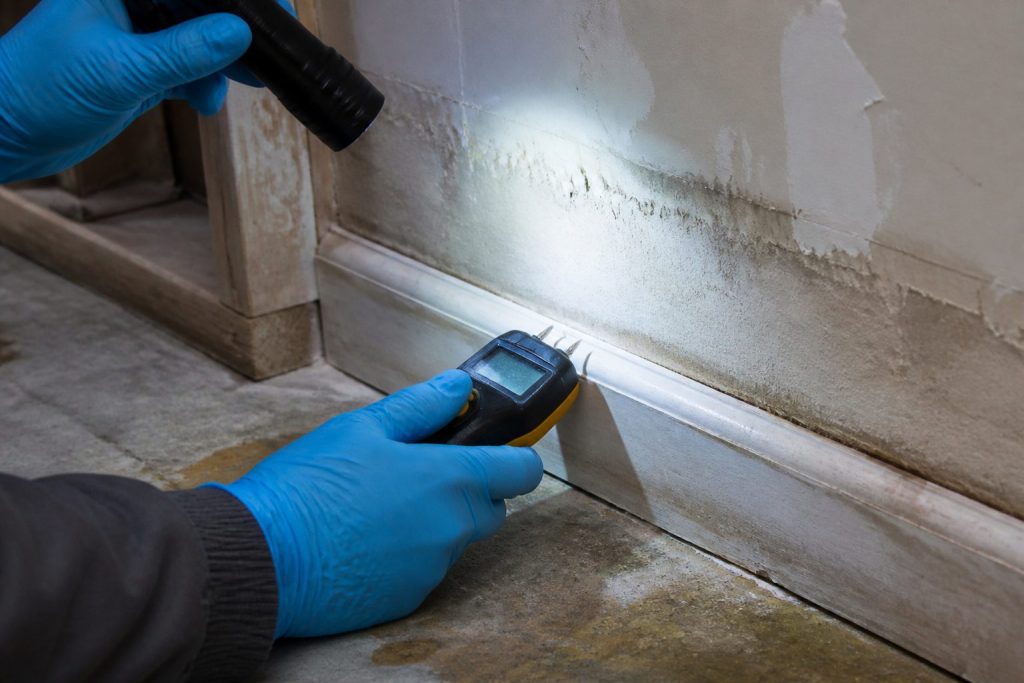
Educational narration during the inspection separates restoration sales pros from amateurs. Rather than silently using a moisture meter, the rep should narrate what the readings mean, what category of water it appears to be, what equipment will be needed, and what the timeline looks like. This builds confidence and pre-frames the price.
Presenting the Scope and Price
The scope presentation should happen at the kitchen table, not standing up. The rep should walk through the scope line by line, explain why each item is necessary, address insurance process clearly, and then present the total — without flinching and without immediately offering a discount. The number is the number.
Common price language that works: “Based on what we found, the scope to dry your home down properly comes to [amount]. Most of this will be covered by your insurance policy, and we’ll work directly with your adjuster on the supplements. The out-of-pocket exposure for you depends on your deductible. Does that match what you were expecting?”
Handling the “Let Me Think About It”
The most common objection in residential restoration is the soft delay: “Let me think about it” or “I need to talk to my spouse.” The script that works addresses the underlying concern without applying pressure: “Of course. The one thing I’d mention is that the longer we wait to start drying, the more secondary damage typically occurs. We can have equipment in place today and you can still cancel within 24 hours if you change your mind. What works better for you?”
The Authorization Close
The authorization close.
The work authorization signature is the actual close. The handoff language: “Let me get this paperwork started — it just authorizes us to begin the mitigation and lets us bill your insurance directly.” Smooth, confident, and assumes the close. Hesitant closing language (“So… do you want to do this?”) signals uncertainty and triggers second-guessing.
Should restoration salespeople use a written script verbatim?
The framework should be scripted; the delivery should be conversational. Reading a script word-for-word feels robotic and erodes trust. Memorizing the structure and language patterns and delivering them naturally is the goal.
How do I train new restoration salespeople on these scripts?
Role-play is the fastest training method. Pair new reps with senior staff for ride-alongs, then run weekly role-play sessions where new reps practice handling the toughest objections. Recording actual customer calls (with consent) and reviewing them as a team also accelerates learning.
What is a reasonable close rate on residential restoration estimates?
Well-trained residential restoration salespeople running emergency mitigation typically close 60-80% of first-on-scene appointments. Reconstruction-only estimates close at much lower rates, often 25-40%, because of the longer decision cycle.
Should I quote prices over the phone?
Generally no for restoration. Phone pricing without seeing the damage triggers price shopping and locks the rep into a number that may not match the actual scope. The phone goal is to book the on-site appointment, not to quote.
How do I handle a homeowner who is getting multiple bids?
Address the underlying concern (they want to make sure they’re not being overcharged) by walking through your scope line-by-line, explaining what each item does, and offering to review competitor scopes side-by-side. Confidence in your scope and price usually wins more often than discounting.
The transition from owner-led selling to a professional sales team is the hardest organizational shift in a growing restoration company. The owner’s selling style is usually charisma-driven and unsystematized; replacing it with reps who sell consistently requires building a hiring profile, training program, compensation plan, and management cadence that the company has never had. Most restoration companies stall at this transition; the ones that get through it are the ones that scale to $10M+.
The two profiles that consistently work in residential restoration sales are former in-home services salespeople (HVAC, roofing, solar, pest) and former restoration project managers with strong customer-facing skills. Pure traditional B2B salespeople usually struggle with the in-home dynamic. Restoration technicians sometimes succeed in sales but more often fail because the skill profile is different.
For commercial restoration BD, the profile shifts toward B2B service sales backgrounds — commercial real estate, facility services, commercial insurance, or B2B SaaS reps with patience for long cycles.
Sourcing Sales Talent
The best sourcing channels for restoration sales talent are LinkedIn outreach to in-home services reps in adjacent industries, employee referrals (current sales reps know other sales reps), and industry events. Indeed and ZipRecruiter produce volume but quality is mixed. Recruiting agencies focused on home services sales can accelerate the process for an investment.
The Training Program
The training program that produces closers.
The minimum viable training program for a new restoration salesperson includes: 1-2 weeks of ride-along with senior reps observing real calls, role-play sessions covering the inbound script and in-home flow, technical product training on water/fire/mold processes (enough to be credible, not enough to be a technician), CRM and operations training, and a defined ramp period of 60-90 days before full quota.
Companies that throw new reps into the field without structured training see attrition rates above 50% in year one. Companies with structured 60-90 day onboarding typically see attrition under 20%.
Compensation Structures That Work
Residential restoration salesperson compensation typically combines a modest base salary ($40K-$60K depending on metro and experience) with commission on closed revenue (often 5-12% on mitigation, lower on reconstruction). Some operations use sliding commission scales that reward higher gross margin work and disincentivize discounting.
Commercial BD compensation usually pairs a higher base salary ($65K-$100K) with smaller commission on closed MSAs and a residual on account revenue. The longer cycle requires the higher base.
Structures that consistently fail: pure 100% commission (drives short-term behavior and high attrition), salary-only (no upside, attracts the wrong profile), and commission tied only to revenue without any margin or quality metric (produces discounting and bad customer outcomes).
Sales Management Cadence
Sales management cadence that sticks.
The management cadence that works includes: daily team huddle reviewing yesterday’s appointments and today’s pipeline, weekly one-on-one with each rep covering pipeline, deal coaching, and personal development, weekly team meeting reviewing key metrics (close rate, average ticket, lead source performance), and monthly business review including compensation reconciliation and quota adjustments.
Retention Practices
Restoration sales rep retention is driven primarily by income predictability, leadership quality, and operational support (good leads, fast estimating tools, clean handoffs to production). Companies that retain reps long-term invest heavily in lead quality, operational efficiency, and middle-management capability — not just in higher commission rates.
When should a restoration company hire its first salesperson?
Most restoration owners should add their first dedicated salesperson when their own selling capacity is becoming the growth constraint — typically when the company hits roughly $1.5M-$3M in revenue and the owner can no longer personally handle every estimate. Hiring earlier often means the owner has to manage someone they cannot afford; hiring later caps growth.
How long does it take a new restoration salesperson to ramp?
A well-onboarded residential rep usually reaches full productivity in 90-120 days. Commercial BD reps typically need 6-12 months to build the pipeline that produces consistent revenue. Companies that expect faster ramps usually see high attrition.
Should we pay restoration salespeople on revenue or gross profit?
Gross profit-based commission produces better behavioral outcomes (less discounting, better job selection) but requires accurate job costing that many restoration companies do not have. Revenue-based commission is simpler but creates incentive misalignment. Hybrid structures that adjust commission rate based on gross margin tier often work best.
How do I prevent salespeople from over-promising on jobs?
Strong handoff processes between sales and production, sales accountability for change orders and customer complaints, and compensation structures that include customer satisfaction or production margin metrics all reduce over-promising. Cultural emphasis from leadership on long-term reputation over short-term commission also matters.
Do restoration sales contests actually work?
Short-term contests can create useful spikes in activity (more appointments, faster follow-up) but should not replace consistent compensation structures. Contests that reward quality metrics (close rate, customer review scores) usually outperform contests that reward pure revenue.
Restoration sales objections fall into a small number of repeating patterns. The same five or six concerns surface in nearly every estimate, and the difference between a 40% close rate and a 70% close rate is largely whether the rep has rehearsed responses to these objections or is improvising in the moment. This article walks through the objections that come up most often and the language that consistently moves the conversation forward.
The price objection is rarely about price in isolation. It is usually about value clarity, comparison shopping, or insurance confusion. The response that works opens with curiosity, not defense: “Help me understand what you’re comparing it to” — then tailor the response to what surfaces.
If the customer has a competitor quote, walk through the scope line by line and identify what is missing in the lower bid (almost always something is). If the customer is reacting to the absolute number, reframe around insurance: “Most of this will be covered. Your out-of-pocket exposure is your deductible. The rest is between us and the carrier.”
Objection 2: “Let Me Think About It”
The soft delay is the most common objection in residential restoration. It usually means the customer has unstated concerns. The response: “Of course. What’s the main thing you want to think through?” — then handle whatever surfaces. If they truly cannot articulate a concern, the urgency framing often works: “I understand. The main thing I’d mention is that the longer we wait to start drying, the more secondary damage typically occurs. We can have equipment running in two hours and you can still cancel within 24 hours if you change your mind.”
Objection 3: “I Need to Talk to My Spouse”
This is a legitimate concern that should not be steamrolled. The response: “That makes total sense. Is your spouse available to FaceTime now? I’m happy to walk them through what we found.” If FaceTime is not possible, schedule a specific follow-up time before leaving — never an open-ended “let me know.”
Objection 4: “I’m Going to Wait and See if It Dries Out on Its Own”
This is the most expensive customer mistake in restoration. The educational response: “That’s a fair instinct. The challenge is that what looks dry on the surface usually isn’t dry inside the wall cavities and subfloor. Within 48-72 hours, that hidden moisture typically grows mold, which becomes a much more expensive remediation later. Let me show you the moisture readings behind the drywall.” Then take a meter reading on camera.
Objection 5: “My Insurance Won’t Cover This”
Objection 5 — my insurance won’t cover this.
Often the customer is wrong about coverage, and the response is education: “Most homeowner policies cover sudden water damage from internal sources — would you mind sharing what your adjuster has said specifically?” If coverage truly is denied, transition to discussing scope reduction or financing options.
Objection 6: “I Don’t Trust You / I’ve Never Heard of Your Company”
Objection 6 — I don’t trust you / I’ve never heard of your company.
Trust objections are rarely stated this directly but often signal through hesitation, intense scrutiny, or refusal to sign authorization. The response is credibility evidence: review counts and links, BBB rating, IICRC certifications, years in business, photos of recent jobs in their neighborhood, and offers to provide references. The defensive response (“Why don’t you trust me?”) fails. The confident response with proof works.
Objection 7: “Can You Give Me a Discount?”
The response that protects margin: “I appreciate the ask, but our pricing is set based on what it actually costs to do this work properly. What I can do is walk through the scope and see if there are any line items you’d want to remove — though I’d advise against cutting any of the drying equipment because that’s where the secondary damage risk lives.” Discounting on demand trains customers to ask every time and eats margin across the entire customer base.
How many objections does a typical restoration estimate include?
A typical residential restoration estimate includes 1-3 objections from the customer before signing. Estimates with zero objections often signal the customer is going to “think about it” silently and then go elsewhere — surfacing objections in the room is actually a sign of engagement.
Should restoration salespeople memorize objection responses?
Memorize the framework, not the words. Word-for-word memorized responses sound robotic. Practiced frameworks delivered conversationally land naturally and protect against improvisation under pressure.
What is the most damaging objection-handling mistake?
Discounting at the first hint of price resistance. The price objection is usually a value clarity question — answering it with a discount confirms that the original price was inflated and trains the customer to expect discounts on future work.
How do I handle objections over the phone before the in-home visit?
Most pricing and scope questions on the phone should be redirected to the in-home visit: “I want to give you an accurate answer, and the only way to do that is to actually see the damage. Can we get a project manager out today?” Quoting blind on the phone usually loses the job and the in-home opportunity simultaneously.
When should I walk away from a customer rather than handle the objection?
Walk away when the customer is asking for scope or pricing that compromises quality (e.g., “skip the dehumidifiers”), demanding discounts that put the job below cost, or signaling distrust that the rep cannot recover. Working unprofitable or unhappy customers damages the business.
The Signal — Tygart Media's weekly brief. What we actually ran, what it measured, and what it means for a restoration shop.