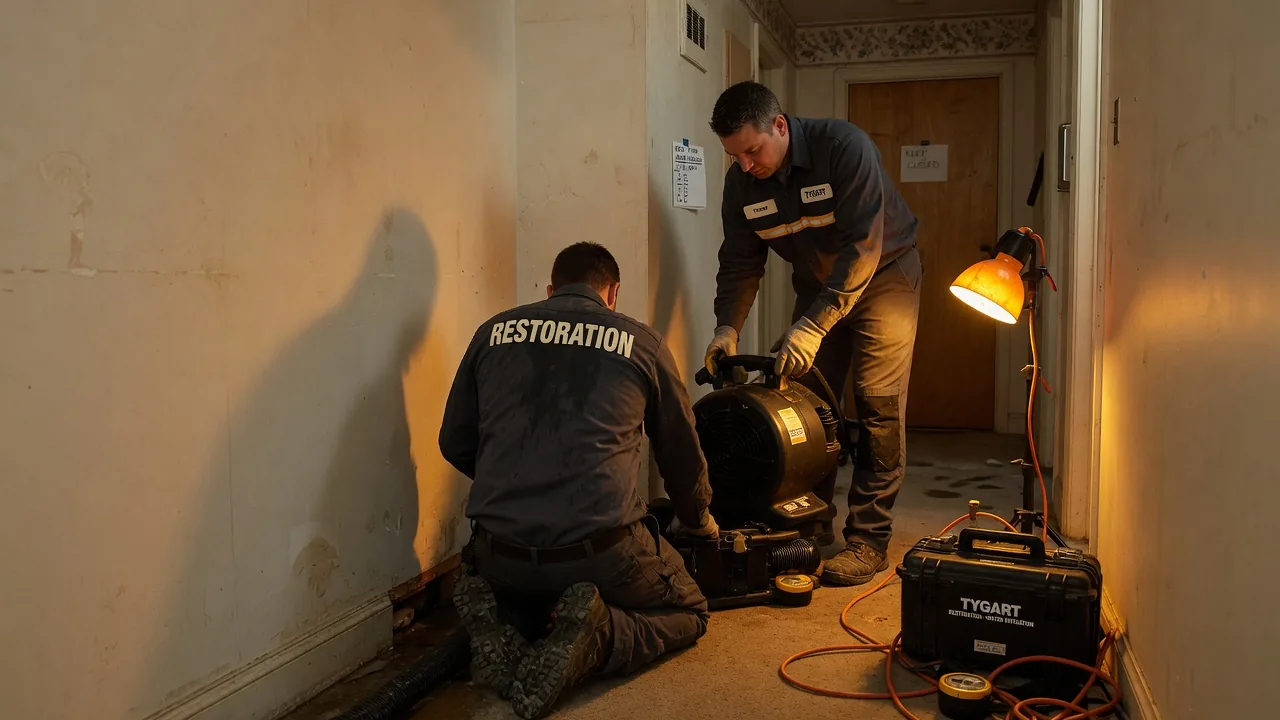
This is the third article in the Crew & Subcontractor Systems cluster under The Restoration Operator’s Playbook. It builds on the labor crisis article and the field retention article.
Scheduling looks simple and is not
From the outside, scheduling a restoration company looks like a logistics problem. Match crews to jobs. Sequence the work to fit the available capacity. Adjust when emergencies happen. Most restoration owners would describe their scheduling function in roughly these terms, and most would not consider it strategically important.
The owners who actually try to scale a restoration operation discover that scheduling is one of the most difficult operational problems the business faces. The complexity is not in any single scheduling decision. The complexity is in the interactions among scheduling decisions, in the cascading effects of any change, in the second-order consequences for crews and customers and carriers, and in the ways that scheduling problems surface as quality problems, retention problems, customer satisfaction problems, and margin problems even when the original cause is invisible to the operator looking at the symptoms.
Scheduling is not a logistics problem. Scheduling is an operating system problem. The companies that have figured out how to run scheduling well treat it as a strategic capability that requires investment, expertise, and ongoing refinement. The companies that have not figured it out treat scheduling as something the dispatcher does and watch the consequences manifest in every other part of the operation without recognizing the underlying cause.
This article is about why scheduling is harder than it looks, what the best companies do differently, and how scheduling discipline interacts with the other operating system disciplines this playbook describes.
Why scheduling is structurally difficult

Several specific characteristics of restoration work make scheduling structurally harder than it appears.
The first is that demand is genuinely unpredictable at the daily level. Most service businesses can forecast demand with reasonable accuracy because the demand pattern is driven by predictable factors. Restoration demand is driven by losses, which are random in timing and variable in scale. A pipe burst on Tuesday morning that requires immediate response will disrupt whatever was scheduled for Tuesday afternoon. A storm event on Friday can produce more work in three days than the company normally handles in two weeks. The scheduling has to absorb this variance without breaking, which is harder than scheduling a service business with predictable demand.
The second is that jobs are heterogeneous in duration, complexity, crew requirements, and sub coordination. A residential water mitigation might take three days with a two-person crew. A commercial fire restoration might take six months with multiple crews and twenty subs across different trades. The scheduling has to handle both of these and everything in between, often simultaneously, without losing visibility into what is happening on each job.
The third is that crew capabilities vary. Not every crew can do every job. Some crews specialize in mitigation. Some specialize in rebuild. Some have specific certifications. Some have specific equipment. The scheduling has to match the right crew to the right job, which adds a constraint that simple capacity scheduling does not face.
The fourth is that sub availability adds a layer of dependency. A rebuild job that requires a specific cabinet installer can only proceed when that installer is available, regardless of when the company’s own crew could start. Sub scheduling has to be coordinated with the company’s own scheduling, often across multiple subs whose calendars are not under the company’s direct control.
The fifth is that customer schedules add another layer of constraint. Homeowners have lives. They have work schedules, travel commitments, health constraints, and personal preferences that affect when work can happen at their property. Some jobs can only be done during specific windows. Some jobs require the homeowner to be present. Some jobs require the homeowner to be absent. The scheduling has to accommodate the customer’s reality without becoming infinitely flexible.
The sixth is that carrier and TPA timeline expectations add yet another layer. The carrier wants the file to close by a certain date. The TPA wants milestones hit on a certain cadence. The scheduling has to deliver against these expectations or accept the consequences in cycle time metrics and program standing.
The seventh is that all of these constraints interact. A change to one schedule cascades into changes elsewhere. A delay on one job can free up a crew for another job, but only if the freed-up crew has the right capabilities for the alternative work. A sub cancellation can shift the entire sequence of dependent work. The scheduling system has to handle the cascading effects without producing chaos.
Each of these characteristics is real. Together they make restoration scheduling one of the hardest operational problems in service businesses. Companies that approach it as a simple logistics function will be perpetually behind the complexity. Companies that approach it as a strategic capability will invest in the systems and people that can actually manage it.
What the best companies do differently
The companies that have built strong scheduling capabilities have invested in a specific combination of practices that the simpler logistics-frame companies have not.
The first practice is dedicated scheduling expertise. The scheduler is not a part-time function fitted around the dispatcher’s other responsibilities. It is a defined role, with a person whose primary job is to manage the schedule and who has been selected and trained for the specific cognitive demands of the work. The scheduler in a serious restoration company is one of the most operationally important people in the building, and the role gets compensated and respected accordingly.
The second practice is a real scheduling system rather than a calendar. Most restoration scheduling lives in some combination of a calendar tool, a spreadsheet, and the scheduler’s head. The companies operating well have invested in software designed for scheduling complex service operations — software that can model crew capabilities, job dependencies, sub coordination, customer constraints, and the cascading effects of changes. The software does not replace the scheduler’s judgment. It supports the judgment with information that would otherwise be impossible to hold in the scheduler’s head simultaneously.
The third practice is reserve capacity that absorbs variance. Companies that schedule themselves to one hundred percent capacity have no slack to absorb the inevitable disruptions. Companies that maintain strategic reserve capacity — usually in the range of fifteen to twenty-five percent — have slack to absorb the storm events, the emergency dispatches, the sub cancellations, and the customer rescheduling that constantly happen. The reserve capacity costs money in the short term and saves operational chaos and customer satisfaction damage in the long term.
The fourth practice is proactive communication about schedule changes. When the schedule has to change, the affected parties — crews, subs, customers, adjusters — are notified promptly and given context for the change. The communication discipline prevents the cascade of confusion that uncommunicated changes produce. The discipline also preserves trust with each affected party, which is what makes future schedule adjustments tolerable.
The fifth practice is structured handoff between scheduling and operations. The schedule that the scheduler produces is communicated to the field crews, the project managers, and the rest of the operations team in a standardized format that everyone understands. Crews know what they are doing tomorrow and the day after. Project managers can see their portfolio of active jobs and plan their attention accordingly. The operations team can plan around the schedule rather than reacting to it.
The sixth practice is post-mortem on scheduling failures. When a schedule decision turns out to have been wrong — a crew was overcommitted, a job was sequenced poorly, a customer was disappointed — the failure is reviewed and the lessons are integrated into future scheduling decisions. The post-mortem discipline is what allows the scheduling capability to improve across years rather than to make the same mistakes repeatedly.
The seventh practice is integration with the operating system as a whole. The scheduling discipline does not operate in isolation. It is connected to the documentation discipline, the carrier relationship work, the field crew retention work, and the AI deployment work. Improvements in any of these areas make scheduling easier, and improvements in scheduling make all of them easier in return. The interconnection is real and is part of what makes scheduling a strategic capability rather than a logistics function.
The scheduler as a strategic role
The role of the scheduler in a serious restoration company deserves more attention than it typically receives. The scheduler in this kind of company is doing work that is qualitatively different from what a dispatcher in a less-developed company is doing.
The strategic scheduler is making decisions that have implications for crew utilization, customer satisfaction, carrier cycle time, sub relationships, and margin per job. Each scheduling decision is, in effect, a decision about how the company allocates its operational resources across competing demands. The decisions are made under uncertainty, with incomplete information, and with consequences that may not be visible for days or weeks. The cognitive demands of doing this well are significant.
The strategic scheduler also has to navigate human dynamics constantly. Crew leads who want certain assignments. Subs who want certain timing. Customers who want certain accommodations. Adjusters who want certain timelines. Senior operators who want their preferred jobs handled in their preferred ways. The scheduler is the person who absorbs these competing demands and converts them into a workable plan, while preserving the relationships with each party in the process.
The strategic scheduler also has to communicate constantly. Schedule changes have to be communicated to the affected parties. New schedules have to be distributed to the team. Conflicts have to be surfaced to the people who can resolve them. Concerns have to be raised before they become problems. The communication load on a strategic scheduler is significant and is part of what makes the role difficult.
Companies that recognize the scheduler as a strategic role select for these capabilities, train for them, compensate appropriately, and protect the scheduler’s calendar from being consumed by tasks that should belong to someone else. Companies that treat the scheduler as a dispatcher staff the role accordingly and get dispatcher-quality outcomes.
What scheduling failures actually cost
When restoration scheduling fails, the costs are usually visible in places other than scheduling. Operators looking at the symptoms often do not trace them back to the underlying scheduling causes.
Crew burnout is often a scheduling problem. Crews that are consistently overcommitted, that are consistently asked to work weekends without notice, that are consistently rotated through the worst jobs without fair distribution will burn out. The burnout shows up as attrition, which is then attributed to compensation or culture problems, when the actual cause was the scheduling pattern.
Quality problems are often scheduling problems. Jobs that are sequenced too tightly, that do not allow appropriate time for prep work, that put crews on jobs they are not the right fit for, will produce quality problems. The quality problems show up at the close-out walkthrough, where they are attributed to crew quality or training gaps, when the actual cause was the scheduling decision that put the wrong crew on the job at the wrong time.
Customer satisfaction problems are often scheduling problems. Customers who are surprised by changes to their work schedule, who have to reschedule their lives multiple times because the company kept rescheduling theirs, who feel the company did not respect their time will produce dissatisfaction. The dissatisfaction shows up in reviews and complaints, where it is attributed to communication failures or service issues, when the actual cause was the scheduling instability.
Margin compression is often a scheduling problem. Jobs that take longer than they should because of crew assignments that did not match the work, that incur extra cost because of sub coordination failures, that produce overtime because of capacity miscalculations will compress margin. The margin compression shows up in financial reports, where it is attributed to estimating errors or labor cost increases, when the actual cause was the scheduling decisions that drove the avoidable costs.
Carrier program standing problems are often scheduling problems. Files that close late because of scheduling delays, that produce customer complaints because of scheduling chaos, that miss program milestones because of scheduling failures will damage program standing. The damaged standing shows up in routing decisions and program reviews, where it is attributed to operational quality issues, when the actual cause was the scheduling failures upstream.
Each of these costs is significant. None of them is recognized as a scheduling problem in most companies. The scheduling function gets credit for the jobs it sequences successfully and is not held accountable for the cascading consequences of the jobs it sequences poorly. The companies that have made the leap to treating scheduling as a strategic capability are the ones that have started tracing these costs back to their scheduling origins and investing accordingly.
The interaction with AI
One specific interaction worth highlighting is the relationship between scheduling and the AI capabilities described in the AI economics article.
Scheduling is one of the operational capabilities where AI is most likely to add real value over the next several years. The combinatorial complexity of restoration scheduling is exactly the kind of problem that current AI tools are well-suited to support. An AI system that can hold the full set of scheduling constraints in its working context, that can simulate the cascading effects of scheduling decisions, and that can produce schedule recommendations that the human scheduler reviews and refines is a capability that materially improves a strong scheduler’s productivity and that materially helps a less-experienced scheduler approach senior-scheduler quality.
This is one of the highest-leverage AI applications available to restoration companies in 2026. It is also one that requires the operational substrate to be in place — documented scheduling logic, captured constraints, structured data about crew capabilities and customer preferences. Companies that have not done the underlying documentation work cannot deploy AI usefully to support scheduling. Companies that have done the work can.
The combination of a strong human scheduler, a serious scheduling software system, and AI augmentation that supports the scheduler’s work is the configuration that the most operationally advanced restoration companies are converging toward. The companies that get there will have a scheduling capability that the simpler-frame companies cannot easily match.
What this means for owners
If you run a restoration company and your scheduling is being handled as a logistics function rather than as a strategic capability, the practical implication of this article is that the costs of the current setup are real and largely invisible to you, and that the investment in upgrading the scheduling capability will pay back across operations, retention, customer satisfaction, carrier relationships, and margin.
The starting point is to assess where the scheduling function actually stands. Is the role staffed by someone with the appropriate capabilities and protected calendar? Is the system supporting the role with appropriate tooling? Is reserve capacity built into the schedule or is the company perpetually running at one hundred percent? Is communication discipline strong? Are scheduling failures being reviewed and learned from?
The medium-term work is to invest in the dimensions where the assessment reveals the most room. The investment in the scheduler role itself is usually the highest-leverage starting point because the role’s quality drives so much of what follows.
The long-term result is a scheduling capability that supports the rest of the operating system rather than constraining it. Companies that build this kind of capability look measurably different from competitors who are still operating from the logistics frame, and the difference compounds across years into a structural operational advantage.
Scheduling is not a logistics problem. Scheduling is an operating system problem. Owners who recognize this and invest accordingly will run companies that the simpler-frame competitors cannot easily match.
Next in this cluster: quality control as a continuous practice rather than an end-of-job inspection — what continuous quality discipline looks like, why it produces better outcomes than inspection-based quality control, and how to install it without creating bureaucratic overhead.
Related: How Claude Cowork Can Train Every Role on a Restoration Team — estimators, PMs, admins, technicians, and sales managers each learn different project management skills.
Leave a Reply