Category: AI in Restoration

AI is not coming to the restoration industry — it is already here. From automated estimating to AI-powered content generation to predictive analytics on storm seasons, the companies that adopt intelligently will dominate the next decade. We cut through the hype and show what is real, what works, and what is just noise. No fluff, no fear — just the tools and strategies that give restoration operators an unfair advantage.

AI in Restoration covers artificial intelligence applications, machine learning tools, automation workflows, AI-powered estimating, predictive analytics, chatbot deployment, content generation, operational AI, and technology adoption strategies for water damage, fire restoration, mold remediation, and commercial restoration companies.

  • How Claude Cowork Can Train Every Role on a Restoration Team

    How Claude Cowork Can Train Every Role on a Restoration Team

    Your estimator just scoped a fire damage job at $47,000. Your PM disagrees. Your admin is chasing the adjuster. Your technician already started demo. Your sales manager is quoting the next job before the first one is closed out. Sound familiar?

    Restoration companies run on controlled chaos. Every job is a mini-project with overlapping roles, shifting timelines, and constant dependencies — and the people filling those roles were rarely trained in structured project thinking. They learned by doing. That is fine until the volume outpaces what tribal knowledge can hold.

    The short answer: Claude Cowork visibly decomposes complex tasks into sequenced, dependency-aware subtasks delegated to sub-agents — the same cognitive skill every role in a restoration company needs but rarely gets formal training on. Running Cowork on a real restoration scenario and watching how it plans is a training exercise for estimators, PMs, admins, technicians, and sales managers alike.

    Why Restoration Teams Need This More Than Most

    A restoration job is not a single task. It is a cascade: initial assessment, scope documentation, insurance communication, material ordering, crew scheduling, demo, mitigation, rebuild coordination, final walkthrough, invoicing. Every step depends on something upstream, several steps can run in parallel, and new information lands constantly — the adjuster changes the scope, the homeowner adds a room, the subcontractor pushes back a date.

    This is exactly the kind of work that Claude Cowork was built to handle. And watching how Cowork handles it teaches your team how to think about it.

    What Each Role Learns From Watching Cowork

    The Estimator

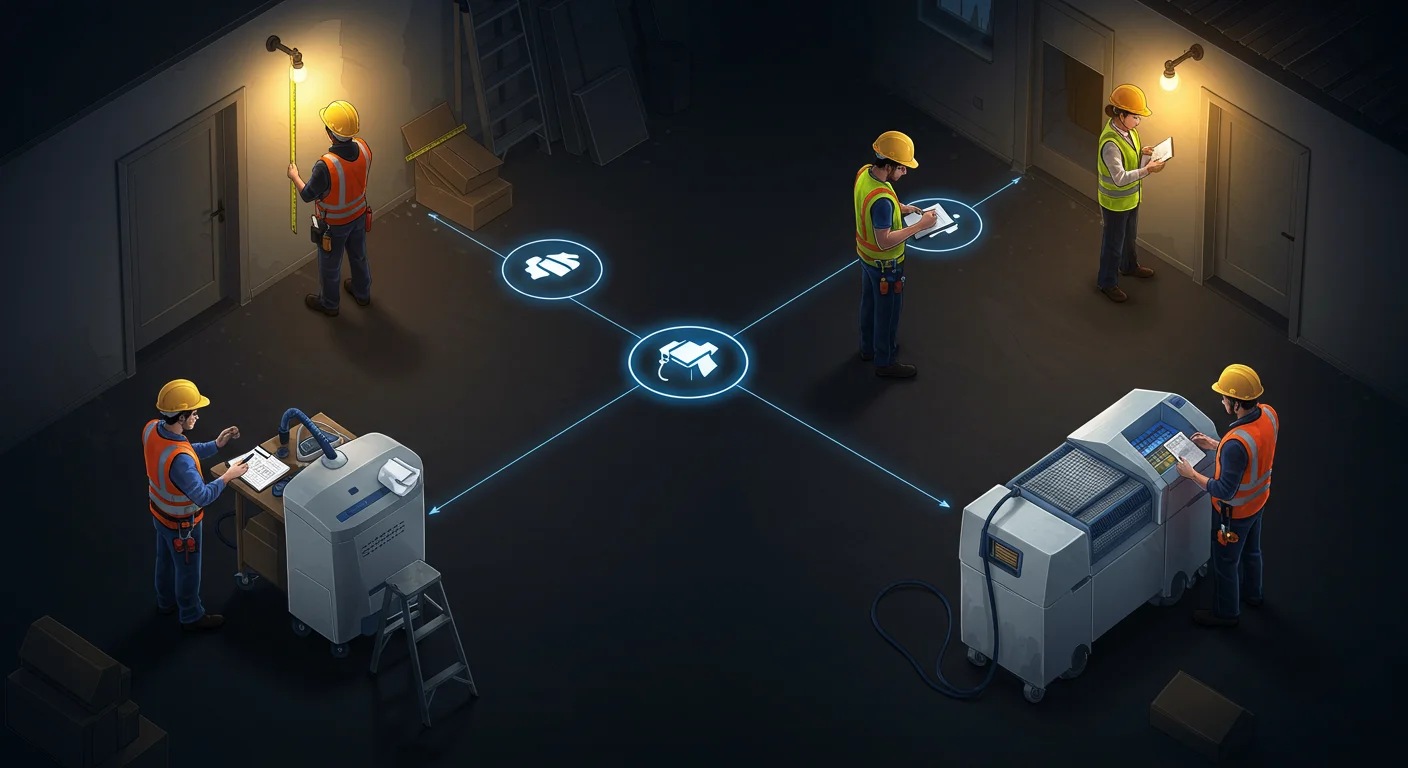
    An estimator’s job is fundamentally a decomposition exercise: walk a property, break the damage into line items, sequence the repair logic, and price each piece. When you run a Cowork task like “build a comprehensive scope for a Category 2 water loss in a 2,400 sq ft ranch with finished basement,” you can watch the lead agent break that into sub-tasks — structural assessment, contents inventory, moisture mapping zones, material takeoffs, labor estimates. The estimator sees their own mental process made visible, and more importantly, they see what steps they might be skipping.

    The Project Manager

    This is the role Cowork maps to most directly. A restoration PM juggles the timeline, the crew, the adjuster, and the homeowner simultaneously. Cowork’s lead agent does the same thing — it holds the master plan, delegates to sub-agents, manages dependencies, and absorbs mid-flight changes without losing the thread. When a PM watches Cowork queue a new requirement that came in during execution and slot it into the plan at the right moment, that is a live lesson in change order management.

    The Admin and Job Coordinator

    Admin staff are the connective tissue. They are tracking certificates of completion, chasing supplement approvals, scheduling inspections, and making sure nothing falls through the cracks. Cowork shows how a lead agent maintains awareness of all parallel workstreams and flags when one is blocking another. For an admin learning to manage a board of active jobs, watching Cowork’s progress view is a masterclass in status tracking.

    The Technician

    Technicians often focus on execution — set the equipment, run the demo, do the work. But the best techs think upstream and downstream: what do I need before I start, and what does my work unlock for the next person? Cowork makes these dependencies visible. When a sub-agent finishes a task and the lead immediately kicks off the next dependent task, a technician can see how their piece connects to the whole.

    The Sales Manager

    Sales in restoration is about managing the pipeline while jobs are still in flight. A sales manager watching Cowork tackle a complex multi-step task sees how a good orchestrator never loses sight of the big picture even while individual pieces are being executed. It is the same skill needed to track leads, follow up on referrals, and manage relationships while active jobs demand attention.

    A Training Exercise You Can Run Tomorrow

    Pick a real scenario your team handled last month — a complex water loss, a fire damage job with contents, a mold remediation with an access issue. Strip the confidential details and feed it to Cowork as a planning task: “Break down the full project plan for a Category 3 water loss in a two-story commercial building with active tenant occupancy.”

    Then sit with your team and watch it work. Pause at each stage. Ask: did Cowork sequence this the way we would? Did it catch a dependency we might have missed? Did it run things in parallel that we run sequentially? Did it handle the mid-task change the way our PM would?

    The conversation that follows is worth more than most training seminars.

    The Conductor Metaphor Hits Different in Restoration

    In our original article on Cowork as a training tool, we compared Cowork’s lead agent to an orchestra conductor — one agent directing the whole ensemble without playing any instrument itself. In restoration, the metaphor becomes concrete: the PM is the conductor, the estimator is first chair, the admin is keeping score, the technician is the section player, and the sales manager is booking the next gig before the curtain call.

    When everyone on the team can see the conductor’s score — which is exactly what Cowork’s plan view gives you — the whole operation tightens up.

    More in This Series

    Frequently Asked Questions

    Can Claude Cowork handle restoration-specific scenarios?

    Yes. Cowork decomposes any complex, multi-step task you describe to it. You can input a restoration scenario like a water loss scope, a fire damage project plan, or a mold remediation coordination task and watch it break the work into sequenced, dependency-aware subtasks. The output is a structured plan, not industry-specific software, but the planning logic transfers directly.

    Which restoration roles benefit most from Cowork training?

    Project managers benefit most directly because Cowork’s lead agent mirrors their core function — holding the master plan and managing dependencies. But estimators learn scope decomposition, admins learn status tracking across parallel workstreams, technicians see how their work connects to the full project chain, and sales managers learn pipeline orchestration.

    Does this replace restoration project management software?

    No. Cowork is not a replacement for tools like Xactimate, DASH, or jobber platforms. It is a training and planning tool that helps your people think in structured, decomposed, dependency-aware ways. Better thinking produces better use of whatever PM software you already run.

    How do I run a Cowork training session with my restoration team?

    Pick a real job your team completed recently, strip confidential details, and input it as a Cowork task. Watch together as Cowork decomposes the plan. Pause and discuss at each stage — compare Cowork’s sequencing to how your team actually handled it. Focus on dependencies, parallel workstreams, and how mid-task changes were absorbed.

    Is Claude Cowork available for restoration companies?

    Cowork is available through the Claude desktop app on Pro, Max, Team, and Enterprise plans. It is not industry-specific — any team that handles complex, multi-step work can use it. Restoration companies are a natural fit because every job is essentially a project with overlapping roles and shifting dependencies.


  • How Every Role on a Restoration Team Can Learn to Think Like a PM Using Claude Cowork

    How Every Role on a Restoration Team Can Learn to Think Like a PM Using Claude Cowork

    Every restoration company has the same problem: the estimator thinks one way, the technician works another way, the PM juggles both, and the office admin is the only person who sees the whole picture.

    Claude Cowork — Anthropic’s agentic desktop AI — might be the most unlikely training tool the restoration industry has ever stumbled into. Not because it does restoration work, but because it shows every person on your team exactly how a well-run job should be decomposed, delegated, and managed.

    The short answer: Claude Cowork visibly breaks complex tasks into sub-tasks and delegates them to specialized sub-agents in real time. That process — plan, decompose, delegate, track, adjust — is the exact workflow a restoration project manager needs to master. Watching Cowork do it live is like watching a senior PM narrate their thought process.

    Why Restoration Teams Struggle With Task Decomposition

    A water damage job is not one job. It is an inspection, a moisture reading, a scope of work, an insurance estimate, a mitigation plan, a materials order, a labor schedule, a documentation trail, a customer communication cadence, and a final walkthrough — all running on overlapping timelines with interdependencies that change when the adjuster moves a number or the homeowner changes their mind.

    Most restoration employees learn this by doing it wrong a few times. The estimator forgets to document something the technician needs. The PM double-books a crew. The admin discovers at invoicing that the scope changed three times and nobody updated the file. The learning curve is expensive — in rework, in customer trust, and in insurance relationships.

    What if there was a way to show every person on the team what good decomposition looks like before they have to learn it through failure?

    How Cowork Maps to Every Role on a Restoration Team

    The Estimator

    Give Cowork a prompt like: “A homeowner reports water damage in their finished basement after a sump pump failure. The basement has carpet, drywall, and a home office with electronics. Build me a complete inspection and documentation plan.”

    Watch what happens. Cowork does not respond with a single block of text. It builds a plan: identify affected areas, document moisture readings at specific points, photograph damage progression, catalog affected materials, note potential secondary damage indicators, create the scope of work outline, flag items that need adjuster attention. Each task has a sequence. Each task feeds the next one.

    An estimator watching this process sees — visually, in real time — how a thorough inspection plan is structured. Not as a checklist someone hands them, but as a plan that emerges from thinking about what the downstream consumers of that inspection need.

    The Office Admin

    Admins are often the most underserved role in restoration training. They handle intake calls, schedule crews, manage documentation, track certificate of completions, follow up on invoicing, and keep the CRM updated — and most of their training is “watch Sarah do it for a week.”

    Give Cowork a task like: “A new water damage claim just came in. The homeowner called, insurance info is confirmed, and the estimator is heading out tomorrow. Build me the complete administrative workflow from intake through final invoice.”

    Cowork will decompose this into a multi-track plan: the documentation track (claim number, photos, moisture logs), the communication track (homeowner updates, adjuster correspondence, crew scheduling), the financial track (estimate submission, supplement tracking, invoice preparation), and the compliance track (certificates of completion, lien waivers if applicable). The admin watches these tracks unfold in parallel and sees how their daily tasks connect to the larger job lifecycle.

    The Project Manager

    This is where Cowork shines brightest for restoration. The PM is the lead agent on every job. They are the conductor. And most PMs in restoration were promoted from technician or estimator roles — they know the technical work but were never formally trained in project orchestration.

    Give Cowork a complex scenario: “We have three active water damage jobs, a fire damage mitigation starting Monday, and two reconstruction projects in progress. One of the water jobs just had a scope change from the adjuster. Build me a weekly coordination plan.”

    Cowork will show the PM what a senior operations manager would do: prioritize by urgency and revenue, identify resource conflicts, flag the scope change as a dependency that blocks downstream work, and sequence the week’s actions across all jobs. The PM sees how to think about multiple concurrent projects — not just react to whichever phone rings loudest.

    The Technician

    Technicians often see their work as task execution — set up equipment, monitor readings, tear out materials. What they rarely see is how their documentation feeds the estimator’s supplement, how their moisture readings affect the PM’s timeline, and how their work quality determines whether the final walkthrough results in a sign-off or a callback.

    Give Cowork a mitigation task: “Day 3 of a category 2 water loss in a two-story home. Drying equipment is in place. Build me the technician’s complete daily workflow including documentation, monitoring, communication, and decision points.”

    The technician watches Cowork build out not just the physical tasks but the information tasks — the readings that need to be recorded and where they go, the photos that need to be taken and what they prove, the communication checkpoints with the PM. It connects the dots between doing the work and documenting the work in a way that a training manual never does.

    The Sales Manager

    Restoration sales — whether it is commercial accounts, TPA relationships, or plumber referral networks — involves pipeline management that most salespeople in the industry handle with a spreadsheet and memory. Give Cowork a business development task: “We want to build relationships with property management companies that manage fifty or more residential units within thirty miles. Build me a ninety-day outreach plan.”

    Cowork breaks this into research, qualification, outreach sequences, follow-up cadences, and tracking — the same structured approach a sales operations manager would build. The sales manager sees that prospecting is not just “make calls” but a planned, multi-stage process with measurable milestones.

    The Training Unlock Nobody Expected

    Here is what makes this genuinely different from handing someone a training manual or a process document: Cowork shows the thinking, not just the result.

    A process document tells you what steps to follow. Cowork shows you why those steps exist, what depends on what, and how a change in one area cascades through the rest. It shows the conductor at work — not just the sheet music.

    For a restoration company that struggles with inconsistent job quality, scope creep, communication breakdowns between field and office, or PMs who are technically skilled but operationally reactive — Cowork is a training layer that works alongside the people, not instead of them.

    Your technician does not become a project manager by watching Cowork. But they start thinking like one. And that shift in perspective — from task executor to system thinker — is the hardest training outcome to achieve and the most valuable one a restoration company can develop.

    Frequently Asked Questions

    Can Claude Cowork actually help train restoration employees?

    Yes. Cowork visibly decomposes tasks into sub-tasks, delegates them to sub-agents, and shows progress in real time. That decomposition mirrors exactly how a restoration project manager should plan and track a job. Watching Cowork work through a restoration scenario teaches the planning skill, not just the technical steps.

    Which restoration roles benefit most from watching Cowork?

    Project managers benefit most because Cowork’s lead-agent pattern directly mirrors the PM role. But estimators learn thorough documentation planning, admins see how their workflows connect to the full job lifecycle, technicians understand how their documentation feeds downstream processes, and sales managers see structured pipeline management.

    Does Cowork replace restoration project management software?

    No. Cowork is not a project management tool and does not replace platforms like DASH, Xactimate, or your PSA. It is a thinking tool that shows people how to plan and decompose work. Use it to train the thinking, then apply that thinking inside your existing systems.

    How would a restoration company actually use Cowork for training?

    Run a real restoration scenario through Cowork during a team meeting. Let the team watch it decompose the job, then discuss what it got right, what it missed, and how each person’s role connects to the plan. The plan Cowork generates becomes a discussion artifact — a living training aid rather than a static document.

    Is Claude Cowork available for restoration businesses?

    Claude Cowork is available through the Claude desktop app on Pro, Max, Team, and Enterprise plans. Any restoration company with a subscription can start using it immediately. It runs on Mac and Windows.

    ]+>’,’ ‘,sys.stdin.read()); print(len(text.split()))”


  • The Financial Visibility Gap: Why Most Restoration Owners Are Flying Blind on Job Economics

    The Financial Visibility Gap: Why Most Restoration Owners Are Flying Blind on Job Economics

    This is the first article in the Restoration Financial Operations cluster under The Restoration Operator’s Playbook. The previous clusters describe the operational disciplines that produce excellent restoration work. This cluster is about whether those disciplines are actually producing the financial results the owner needs — and how to see the answer clearly.

    The financial visibility gap is the most common operational blind spot in restoration

    Most restoration owners can answer a simple set of financial questions at any given time. What was last month’s revenue. What was last quarter’s gross margin, approximately. How much cash is in the account today. Whether the company is profitable this year, roughly. These are the numbers most owners track, and tracking them feels like financial management.

    It is not financial management. It is financial reporting, delivered at a cadence and a level of detail that tells the owner what happened in the past but not what is happening now. The gap between what the owner can see and what the owner needs to see is the financial visibility gap, and it is the most common operational blind spot in the restoration industry.

    The visibility gap is not about accounting. Most restoration companies have competent accountants who produce accurate financials on a reasonable cadence. The gap is about operational financial visibility — the ability to see, in something approaching real time, what each active job is doing to the company’s financial health, where margin is being gained or lost, which decisions are producing which financial consequences, and whether the trajectory of the active book of work is heading toward a profitable quarter or a disappointing one.

    Most owners cannot answer these questions with any specificity until weeks or months after the relevant period has closed. By then, the opportunity to change the outcome has passed. The owners who can answer these questions in real time are the ones making different decisions, producing different outcomes, and building different companies across years.

    This article is about what the financial visibility gap actually looks like, why it persists even in companies that are otherwise operationally serious, and what closing it requires.

    What the gap actually looks like

    To see the gap clearly, consider the specific financial questions that matter most for a restoration company’s operating decisions and how long each question takes to answer under the typical setup versus the ideal setup.

    The first question is: what is the current margin on each active job? In the typical setup, this question cannot be answered with confidence until the job is closed and the final costs have been tallied. During the life of the job, the project manager may have a rough sense of whether the job is running profitably, but the rough sense is usually based on intuition rather than on live cost data. In the ideal setup, this question can be answered at any moment, for any active job, because the costs incurred to date are tracked against the approved scope in a system that the project manager and the operations leader can access.

    The second question is: across all active jobs, what is the aggregate margin trajectory? In the typical setup, this question cannot be answered at all during the period. It can be reconstructed after the quarter closes by the accountant. In the ideal setup, this question can be answered at any time, because the job-level margin data feeds into a portfolio-level view that shows the aggregate picture.

    The third question is: where is margin being lost? In the typical setup, this question can be answered only in retrospect and only with significant detective work. The accountant can identify that margin was lower than expected across the quarter, but tracing the underperformance to specific decisions on specific jobs requires pulling files, talking to project managers, and reconstructing what happened. In the ideal setup, this question can be answered in real time, because margin variances are flagged as they occur and attributed to specific causes.

    The fourth question is: what is the company’s cash position going to look like in thirty, sixty, and ninety days? In the typical setup, this question is answered through the owner’s informal mental model of what is coming in and what is going out, supplemented by whatever the accountant can project. In the ideal setup, this question is answered by a cash flow projection that draws on the active job data, the expected payment timing, and the known obligations across the coming months.

    The fifth question is: are the operational investments we are making — in documentation, in AI, in training, in the operating system as a whole — producing measurable financial returns? In the typical setup, this question cannot be answered at all because the financial data is not granular enough to connect operational investments to financial outcomes. In the ideal setup, this question can be answered, at least approximately, because the financial data is organized in a way that allows the comparison.

    Each of these questions matters for operational decision-making. Each of them is unanswerable in the typical setup and answerable in the ideal setup. The gap between the two setups is the financial visibility gap.

    Why the gap persists

    The financial visibility gap persists even in companies that are otherwise operationally serious for several specific reasons.

    The first reason is that the accounting function and the operations function are usually separate and operate on different cadences. The accountant works on a monthly or quarterly cycle, producing financials that are accurate but that reflect the past. The operations team works on a daily cycle, making decisions that affect the financial future. The two cycles are not connected in real time, which means the operations team is making financial decisions without current financial data.

    The second reason is that job-level cost tracking is hard. Tracking the cost of every line item on every job as it is incurred, in a way that can be compared against the approved scope in real time, requires operational discipline and software integration that most restoration companies have not invested in. The alternative — waiting until the job closes to calculate the margin — is dramatically simpler and has been the industry default for decades.

    The third reason is that most restoration owners came up through operations, not finance. The operational instincts that make a great PM or a great GM are not the same instincts that make a great financial operator. The owner who is operationally brilliant may be financially competent but not financially disciplined in the way that closing the visibility gap requires. The gap persists because the owner’s natural attention goes to the operational work rather than to the financial visibility that would make the operational decisions better.

    The fourth reason is that the software tools available to restoration companies have historically been poor at operational financial visibility. Most restoration operations software is designed around job management, not financial management. The financial features that exist are typically bolt-ons rather than core capabilities, and they often require manual data entry that the operations team does not consistently perform. Better tools are emerging but are not yet universally adopted.

    The fifth reason is that closing the gap requires behavior change across the team, not just a software purchase. The project manager has to enter cost data as it is incurred. The supervisor has to track labor hours against job budgets. The estimator has to maintain the scope-versus-cost comparison throughout the life of the job. Each of these behaviors is additional work for people who are already busy. Without owner commitment to the behavior change and sustained enforcement, the gap persists regardless of what software is in place.

    What closing the gap requires

    Closing the financial visibility gap requires investment across three dimensions simultaneously. Software alone is not sufficient. Behavior change alone is not sufficient. Process redesign alone is not sufficient. All three together produce the visibility.

    The first dimension is the system. The company needs a system — whether operations software, a financial overlay, or a purpose-built reporting capability — that can track job-level costs in real time, compare them against approved scope, and surface variances as they occur. The system does not need to be expensive. It does need to be designed for operational use rather than for accounting use, which means it needs to be fast to update, easy to query, and integrated into the tools the operations team already uses.

    The second dimension is the process. The company needs a defined process for how financial data gets into the system. Who enters labor hours. When material costs are recorded. How sub invoices are matched to jobs. How scope changes are reflected in the financial model. Each of these process questions has to be answered specifically and the answers have to become part of how the company operates. The process is what makes the system usable.

    The third dimension is the behavior. The team has to actually follow the process. This requires owner commitment, sustained enforcement, and cultural reinforcement that the financial visibility matters. The first few months of any financial visibility initiative are the hardest, because the behaviors are new and the team is uncertain about whether the effort is worth it. The companies that push through the initial resistance and establish the behaviors as normal produce the visibility. The companies that let the initiative fade produce a partly-populated system that no one trusts.

    The owner’s role in closing the gap is to commission the system, design the process, and sustain the behavior. The owner does not need to do the data entry. The owner does need to visibly use the data the system produces, in daily and weekly decisions, so that the team understands the data matters. Owners who commission the system but do not use the data produce teams that enter the data grudgingly and eventually stop.

    What visibility produces when it exists

    Companies that have closed the financial visibility gap describe a consistent set of effects.

    The first effect is better in-flight decision-making on active jobs. Project managers who can see the margin position of their active jobs in real time make different decisions than project managers who are guessing. They intervene earlier when a job is trending toward margin erosion. They prioritize differently when multiple jobs are competing for attention. They negotiate scope changes with more confidence because they know what the financial stakes are.

    The second effect is earlier identification of systemic margin problems. When the aggregate portfolio view shows a pattern of margin compression across a category of jobs — a specific type of work, a specific carrier, a specific geography — the operations leader can investigate the cause while it is still actionable. Without the aggregate view, the same pattern continues for months or quarters before it becomes visible in the accounting reports, by which time significant margin has been lost.

    The third effect is better operational investment decisions. When the company can connect operational investments to financial outcomes — the documentation improvement that reduced estimator rework, the training investment that improved first-pass quality, the AI deployment that accelerated scope review — the owner can make rational decisions about where to invest next. Without the connection, operational investments are made on instinct and defended on faith.

    The fourth effect is better conversations with stakeholders. Owners who can speak to the financial performance of their companies in real time have better conversations with bankers, investors, carriers, and anyone else who cares about the company’s financial health. The conversations are more credible, more detailed, and more productive.

    The fifth effect is reduced financial stress. Owners who can see what is happening financially in real time experience less anxiety than owners who are guessing until the quarterly reports arrive. The psychological benefit of financial visibility is real and affects the owner’s decision quality across every other dimension of the business.

    Each of these effects is meaningful. Together they produce a company that operates with a financial sophistication that the typical restoration company does not have. The sophistication does not require the owner to become a financial expert. It requires the owner to invest in the system, process, and behavior that produce the visibility and to use the visibility in their decisions.

    Where to start

    If you run a restoration company and you recognize the financial visibility gap in your own operations, the starting point is smaller than the full ideal described above.

    The first step is to implement job-level margin tracking on the next ten jobs the company opens. Not the full book. Ten jobs. The goal is to learn what the tracking process needs to look like, what data needs to be captured, and what the barriers to consistent capture are. The ten-job pilot produces lessons that inform the broader rollout.

    The second step is to build the aggregate portfolio view from the pilot data. What does the margin picture look like across the ten jobs? Where is margin being gained or lost? What patterns emerge? The aggregate view, even on a small sample, demonstrates the value of the visibility and generates the organizational energy to expand the pilot.

    The third step is to expand the tracking to the full book of active work, with the process and behavior refinements that the pilot surfaced. The expansion takes sustained owner attention across several months. By the end of the expansion period, the company has financial visibility that the typical competitor does not, and the decisions that flow from the visibility start producing measurable financial benefits.

    The financial visibility gap is the most common operational blind spot in restoration. Closing it is not technically difficult. It requires sustained investment in system, process, and behavior. The companies that close it operate with a financial sophistication that their competitors cannot see and cannot easily replicate. The companies that do not are making their most important decisions in the dark.

    Next in this cluster: job-level WIP discipline — the specific financial practice that separates growing companies from treading-water companies, and what it takes to implement it well.

    Related: How Claude Cowork Can Train Every Role on a Restoration Team — estimators, PMs, admins, technicians, and sales managers each learn different project management skills.

  • The Sub Bench: Building the Reserve Capacity That Lets a Restoration Company Say Yes

    The Sub Bench: Building the Reserve Capacity That Lets a Restoration Company Say Yes

    This is the fifth and final article in the Crew & Subcontractor Systems cluster under The Restoration Operator’s Playbook. It builds on the previous four articles in this cluster.

    The companies that say yes have something the others do not

    In any restoration market, two kinds of companies coexist. The first kind says yes to opportunities as they arrive. The storm event that requires immediate response. The complex commercial loss that requires rapid scaling. The carrier program expansion that requires capacity in a new geography. The high-value residential job that requires specialized capabilities. The first kind of company finds a way to take on the work, executes it well, and benefits from the strategic positioning that follows.

    The second kind of company says no, regretfully, because it does not have the capacity. The opportunity goes to the first kind of company. The relationship that would have followed from saying yes never develops. The strategic positioning that the first kind of company captures becomes a positioning the second kind of company will need to compete against for years.

    The difference between the two kinds of companies is not necessarily quality. Both can do excellent work when staffed appropriately. The difference is reserve capacity. The first kind of company has built the sub bench that allows it to surge when conditions demand surging. The second kind of company has not, and the absence is the structural reason it cannot say yes.

    The sub bench is one of the most strategically important capabilities a restoration company can build, and it is also one of the most underdiscussed. This article is about what the sub bench actually is, why it cannot be assembled in the moment when capacity is needed, and what the long-term work to build one looks like.

    What the sub bench actually is

    The sub bench is the collection of qualified subcontractors that a restoration company can call on, beyond its inner-circle network described in the end-in-mind subcontracting article, when the work volume exceeds what the inner circle can handle. The bench is structured. It is intentional. It is maintained. It is not a list of phone numbers in a project manager’s contacts that happen to be subs the company has worked with.

    The bench has several specific characteristics that distinguish it from a casual sub list.

    The first characteristic is qualified relationships. Every sub on the bench has been worked with previously, has met the company’s standards on prior jobs, and has a documented track record that the company can refer to when assessing whether to deploy them on a particular job. The bench is not aspirational. It is empirical.

    The second characteristic is layered structure. The bench has tiers. The inner circle is one tier. The next tier is the second-call subs — qualified, capable, used regularly enough to be trusted but not deeply integrated into the company’s operating system. The next tier is the third-call subs — qualified for specific kinds of work but used infrequently enough that significant briefing is needed when they are called. The next tier is the surge tier — subs identified through reputation or vetting but not yet deployed, available for emergency capacity scaling. Each tier has different deployment protocols, different oversight requirements, and different roles in the bench’s overall capacity.

    The third characteristic is geographic and capability coverage. The bench includes subs across the company’s geographic footprint and across all the trades the company performs work in. The coverage is deliberate. Gaps in the coverage are recognized and worked on. The company knows where its bench is thin and where it is deep.

    The fourth characteristic is active maintenance. Subs on the bench are deployed with some frequency, even when capacity is not the constraint, to keep the relationship warm and to maintain the company’s familiarity with their work. A bench that is not exercised becomes stale. Subs lose the working relationship with the company. The company loses confidence in the sub’s current capability. By the time capacity is needed, the bench that was not maintained is no longer functional.

    The fifth characteristic is professional administration. Subs on the bench are paid promptly, communicated with respectfully, and treated as professionals whose work matters. The administrative discipline is what keeps subs willing to be on the bench. Subs who are paid late, communicated with poorly, or treated transactionally drop off the bench, often without telling the company. By the time capacity is needed, the bench has eroded silently.

    Each of these characteristics requires deliberate work to maintain. The work is not large in any single moment. It is constant in aggregate. Companies that do the work have benches that can be deployed when needed. Companies that do not have lists of phone numbers that may or may not produce capacity when called.

    Why the bench cannot be assembled in the moment

    The most common reason restoration companies do not have functional benches is that they expect to assemble capacity reactively when needed. The expectation is that when a major loss event happens, the company can call subs they have heard of, vet them quickly, and bring them onto the job. The expectation is wrong, and the reasons are structural.

    The first reason is that good subs are busy when capacity is most needed. The storm event that creates the surge demand for the restoration company also creates surge demand for every other restoration company in the region, all of whom are calling the same potentially available subs. Subs with strong reputations are committed to longstanding customers first. The casual caller without an existing relationship is at the back of the line.

    The second reason is that vetting takes time the surge moment does not allow. Confirming that a sub has the right insurance, the right certifications, the right capability for the specific work, the right references, and the right alignment with the company’s standards takes hours or days. The surge moment requires capacity now. Companies trying to vet subs in the moment either deploy unvetted subs and accept the quality risk or fail to deploy capacity and lose the work.

    The third reason is that briefing takes time and trust. A sub who has worked with the company before knows the company’s standards, the documentation expectations, the communication norms, and the operational rhythm. A sub who is being deployed for the first time has to be briefed on all of these, in a moment when the company’s senior team is least able to provide thorough briefing. The brief that should have happened over months of normal-volume work is being attempted in a single conversation under time pressure, and the result is predictably uneven.

    The fourth reason is that the operational integration that makes sub work go well does not exist on first deployment. The familiarity with the company’s processes. The relationships with the company’s project managers. The understanding of what the company’s customers expect. The knowledge of how the company handles common situations. These are built through repeated interaction, not through a single emergency deployment.

    The companies that have figured out reserve capacity have understood that the bench has to exist before it is needed. The work to build the bench is done in normal-volume periods, when the company has time and attention to invest in the relationships. The bench then exists when the surge moment arrives, and the company can deploy it confidently rather than trying to assemble it on the fly.

    What building the bench looks like in practice

    Building a real sub bench is a multi-year discipline that follows a specific pattern in the companies that have done it well.

    The first piece is identifying the subs to invest in. The senior team identifies, across each trade and each geography, the subs who would be valuable to have on the bench. The identification draws on existing relationships, on industry reputation, on referrals from other contractors, and on direct outreach to subs the company has not previously worked with. The list is curated rather than indiscriminate.

    The second piece is initial deployment on appropriate work. New subs are deployed first on jobs that are not high-stakes — work that allows the company to evaluate the sub’s quality, communication, and reliability without exposing the company to significant risk if the sub does not perform. The initial deployments produce data about whether the sub belongs on the bench at all and at what tier.

    The third piece is deliberate progression up the tiers. Subs who perform well on initial deployments are moved to more frequent and more significant work. The progression continues across months and years, with each successful deployment building the relationship deeper and earning the sub a higher position in the bench structure.

    The fourth piece is documentation of the bench itself. Each sub on the bench has a documented record — what trades they perform, what geographies they serve, what their capacity looks like, what jobs they have completed for the company, what their performance has been, what their preferences are about communication and coordination, what their pricing looks like, what notes are relevant from the senior team’s experience with them. The documentation lives in a system that the operations team can access, not in any single person’s head.

    The fifth piece is regular review of the bench’s overall health. The senior team reviews the bench periodically — usually quarterly — to identify gaps, to assess whether subs at each tier are being deployed appropriately, to identify subs whose performance has slipped and who need to be addressed, and to identify new subs who should be added to the development pipeline. The review keeps the bench from drifting into staleness.

    The sixth piece is investment in the relationships beyond the immediate work. The same investment patterns that build the inner-circle network apply to the broader bench, scaled appropriately. Inner-circle subs warrant the deepest investment. Bench subs warrant proportionally lighter but still real investment. The investment is what keeps the bench warm and functional over years.

    The seventh piece is realistic expectations about bench depth. The bench does not need to include every possible sub in the local market. It needs to include enough subs in each trade and each geography to absorb the kinds of surge demand the company expects to face. Companies that try to build infinite benches dilute their attention and produce thin relationships across many subs rather than strong relationships across the right number. The right number is bench-by-bench specific and depends on the company’s typical work volume and surge patterns.

    The strategic value of having the bench

    For companies that have built strong benches, the bench represents a strategic asset whose value shows up in specific ways across the year.

    The asset enables saying yes to surge opportunities. Storm events. Catastrophe response. Carrier program expansions. Large commercial losses. Each of these creates moments when the company can either capture significant strategic value by saying yes or watch the value go to a competitor. The bench is what makes the yes possible.

    The asset enables predictable cycle times even during peak demand. Companies without benches see cycle times stretch dramatically when work volume rises. Carriers and TPAs notice the cycle time degradation. Customer satisfaction declines. Companies with benches absorb the volume with less cycle time impact and preserve the operational metrics that drive program standing.

    The asset enables strategic geographic expansion. Companies considering opening in a new geography can use bench relationships in the new market to get started without immediately building a full inner circle. The bench provides the bridge capacity while the inner circle is being developed. Companies without bench relationships in new markets have to build everything from scratch, which slows expansion considerably.

    The asset enables strategic vertical expansion. Companies considering entering a new service line — historic restoration, large-loss commercial, specialty work — can use bench subs with the relevant capabilities to test the market without immediately building the in-house capability. The bench is the optionality that allows the company to explore.

    The asset enables resilience during inner-circle disruption. When an inner-circle sub goes through a period of difficulty — staffing problems, financial stress, owner transition — the bench provides backup capacity until the inner-circle relationship recovers or until a replacement is identified. Companies without bench depth experience inner-circle disruption as immediate operational pain.

    The asset enables negotiating leverage with all subs, including the inner circle. Subs who know the company has alternatives operate differently than subs who know the company has no alternatives. The bench’s existence keeps every sub relationship healthy in ways that the company-with-no-alternatives cannot replicate.

    None of these benefits is captured by simply having phone numbers for additional subs. All of them require the bench to be real, vetted, maintained, and ready for deployment.

    What this means for owners

    If you run a restoration company and your sub capacity is essentially the inner circle plus whoever you can call in an emergency, the practical implication of this article is that the absence of a real bench is constraining what your company can say yes to and what strategic positioning you can capture.

    The starting point is to recognize the bench as a strategic asset that deserves deliberate investment, not as something that exists incidentally. The recognition itself is often the missing piece.

    The medium-term work is to begin building the bench through the practices described above. Identify the subs to invest in. Deploy them on appropriate work. Document the bench. Maintain the relationships. Review the bench’s health regularly. The work takes years to produce a fully functional bench, and the work has to start now if the bench is going to exist when it is needed.

    The long-term result is a company that can say yes to opportunities other companies have to decline. The strategic value of being the company that can say yes compounds across years and produces market positions that the perpetually-stretched companies cannot easily reach.

    The cluster ends here

    The five articles in this cluster describe the labor and execution layer of the restoration operating system. The labor environment has changed structurally. Field retention is its own discipline. Scheduling is an operating system problem. Quality is a continuous practice. The sub bench is what allows the company to say yes.

    Each of these capabilities can be built deliberately. None of them is built quickly. All of them compound across years into a company that operates measurably differently from competitors who have not invested in them.

    The Crew & Subcontractor Systems cluster is closed. The remaining clusters in The Restoration Operator’s Playbook address financial operations and the modern restoration marketing stack. Each cluster compounds with the others. The full body of work, when complete, gives operators a durable mental architecture for the most consequential decade in the industry’s history.

    The companies that read this body of work and act on it will know what to do. The rest will find out later.

    Related: How Claude Cowork Can Train Every Role on a Restoration Team — estimators, PMs, admins, technicians, and sales managers each learn different project management skills.

  • Quality Control as a Continuous Practice, Not an End-of-Job Inspection

    Quality Control as a Continuous Practice, Not an End-of-Job Inspection

    This is the fourth article in the Crew & Subcontractor Systems cluster under The Restoration Operator’s Playbook. It builds on the previous three articles in this cluster.

    Inspection-based quality control is structurally too late

    The dominant model of quality control in restoration is inspection-based. The work is performed. At the end of the work, a supervisor walks the job and identifies anything that does not meet the company’s standards. The identified items are added to a punch list. The crew returns to address the punch list. The walkthrough is repeated. The job is signed off when the punch list is complete.

    This model has been the industry default for decades. It is also structurally inadequate for what restoration companies need from their quality function in 2026. The inadequacy is not in any single inspection. It is in the timing. By the time the inspection happens, the work has been done. Whatever quality problems exist are problems that have to be corrected through rework rather than prevented through better execution. The cost of rework is higher than the cost of getting the work right the first time. The cost of customer dissatisfaction at discovering rework is higher still. And the cost of the underlying conditions that produced the quality problem in the first place — the gaps in training, the gaps in supervision, the gaps in operational discipline — continues to produce problems on the next job and the job after that, because the inspection model surfaces problems but does not address their causes.

    The companies that have moved beyond the inspection model treat quality as a continuous practice that is built into how the work is performed rather than as an event that happens after the work is done. The continuous model produces measurably better outcomes than the inspection model, costs less to operate, and produces less stress for everyone involved. This article is about what continuous quality discipline actually looks like, why it produces better outcomes than inspection, and how to install it without creating bureaucratic overhead.

    What continuous quality discipline actually looks like

    Continuous quality discipline is built into the way the work is performed at every stage rather than added as an inspection at the end. Several specific practices distinguish the continuous model from the inspection model.

    The first practice is clear standards communicated before work begins. The crew knows what good looks like for the work they are about to perform. The standards are documented in the same form as the prep standard described in the prep standard article, applied to rebuild work and finish work. Crews who know what they are aiming for produce work that hits the standard more often than crews who are guessing.

    The second practice is in-process checks at defined moments rather than only at the end. The cabinet installer checks their hanging level before moving to the next cabinet, not after the kitchen is fully installed. The painter checks the color match in the actual lighting conditions of the room, not after the entire wall is painted. The trim carpenter checks the miter cuts on the first joint before completing the rest of the trim run. The in-process checks catch problems early when they are cheap to address. The end-of-job inspection catches problems late when they are expensive to address.

    The third practice is peer accountability within crews. Crew members are encouraged and expected to flag issues in each other’s work in real time, professionally and constructively. This is a cultural practice as much as a procedural one. In healthy crews, the flag is received as helpful and acted on. In unhealthy crews, the flag is received as criticism and resisted. The companies that have built strong continuous quality have invested in the crew culture that makes peer accountability functional.

    The fourth practice is supervisor presence during the work, not just at the end. The supervisor visits the job during execution, not just for the close-out walkthrough. The visits are short and frequent rather than long and rare. The supervisor is checking in on conditions, answering questions, identifying issues that need attention before they become problems. The supervisor’s role during execution is to support quality production, not to inspect after the fact.

    The fifth practice is rapid feedback when issues are identified. When a quality issue is flagged — whether by a crew member, a supervisor, or in an in-process check — it gets addressed immediately or as close to immediately as conditions allow. The longer an issue sits before being addressed, the more expensive it becomes to fix. Companies that have continuous quality discipline have built the operational rhythms that allow rapid response to flagged issues.

    The sixth practice is documentation of issues and their resolution. Quality issues that are flagged and addressed get documented, not as a punitive record but as data that informs the company’s standards, training, and operational improvements. The documentation is what allows the company to learn from issues across jobs rather than fixing the same kinds of issues over and over without surfacing the underlying patterns.

    The seventh practice is integration with the feedback loop described in the feedback loop article. Quality issues that surface patterns get fed back into the company’s operational standards. The standards evolve. Training is updated. The next generation of work is performed against sharper standards. The continuous improvement compounds across years.

    Why continuous quality produces better outcomes

    The continuous quality model produces measurably better outcomes than the inspection model for several specific reasons.

    The first reason is that continuous quality catches problems when they are cheap. A misaligned cabinet caught before the next cabinet is hung is corrected in five minutes. The same misalignment caught at the end-of-kitchen walkthrough may require unhanging multiple cabinets to correct. The cost differential is significant per incident and significant in aggregate across thousands of incidents per year.

    The second reason is that continuous quality prevents the cascading effects of unaddressed problems. A trim joint that is set wrong, if not caught immediately, affects every subsequent trim joint that depends on it. By the time the problem is discovered, multiple feet of trim may need to be replaced. Continuous quality prevents the cascade.

    The third reason is that continuous quality builds craftsmanship in the crews. A crew that is constantly receiving and acting on real-time feedback about their work develops better judgment about quality over time. The judgment becomes part of the crew’s working competence. The crew produces better work going forward as a result of the continuous feedback loop.

    The fourth reason is that continuous quality reduces the dramatic moments that damage customer relationships. The customer who arrives at the close-out walkthrough and encounters a long punch list is having a worse experience than the customer who arrives at the close-out walkthrough and finds the work substantially complete. The customer experience implications of the two models are significant and contribute to the customer satisfaction differential between continuous-quality and inspection-quality companies.

    The fifth reason is that continuous quality reduces stress for everyone involved. The crew is not waiting anxiously for a punch list to be created. The supervisor is not facing a long inspection at the end of every job. The customer is not surprised by problems they did not know about. The senior team is not constantly managing quality recovery. The aggregate stress reduction has implications for retention, for engagement, and for the operational sustainability of the company.

    The sixth reason is that continuous quality produces better data about the work. The documentation of issues caught and addressed in real time provides a much richer data set for operational improvement than the end-of-job punch lists. Companies operating from continuous quality have a more accurate picture of where their operational gaps actually are than companies operating from inspection.

    What continuous quality is not

    It is worth being explicit about what continuous quality is not, because the phrase is sometimes used loosely.

    It is not a constant series of formal inspections. The continuous model is not about inspecting more often. It is about building quality into the execution so that inspection is mostly unnecessary. The companies operating from continuous quality have less inspection activity than the companies operating from the inspection model, not more.

    It is not a bureaucratic overhead burden. The continuous model is not about adding paperwork or process steps to the crew’s day. It is about embedding quality awareness into the natural flow of the work. When done well, continuous quality reduces overall operational overhead rather than increasing it.

    It is not a culture of nitpicking. The continuous model is not about flagging every minor imperfection. It is about catching the issues that matter — the ones that will affect the customer experience, the ones that will require expensive rework, the ones that signal underlying operational gaps — and addressing them efficiently. The companies operating from continuous quality have a clear sense of what is worth flagging and what is not.

    It is not a replacement for senior judgment. The continuous model does not eliminate the need for the senior team to be involved in quality. It complements that involvement by surfacing issues at the field level so that the senior team’s attention can go to the issues that actually require senior judgment rather than to the routine catches that the field crews can handle themselves.

    How to install continuous quality without creating overhead

    The most common reason continuous quality fails as an initiative is that companies try to install it by adding process steps without addressing the cultural and structural conditions that make the practices sustainable. The result is bureaucracy that the crews resist, that produces mediocre adoption, and that gets quietly abandoned within a year.

    The companies that have successfully installed continuous quality have done it through a different approach.

    The first piece is leadership commitment that is visible in leadership behavior. Owners and senior operators visibly value quality, talk about it consistently, and model the kind of attention to detail they want the crews to bring. Leadership commitment that is verbal but not behavioral does not produce the cultural change that continuous quality requires.

    The second piece is investment in the supervisors who are the cultural transmission mechanism. Supervisors who genuinely believe in the continuous quality approach and who model it in their daily work make the practices stick. Supervisors who are skeptical or inconsistent undermine the practices regardless of formal training. The supervisor selection and development described in the retention article is also the foundation of continuous quality.

    The third piece is making the in-process checks part of the work rather than additional to it. The check happens as the crew is moving from one piece of work to the next, not as a separate activity that interrupts the flow. The check takes seconds, not minutes. The crew member who has internalized the check does it automatically as part of how they work.

    The fourth piece is removing the inspection-era practices that the continuous model makes unnecessary. Long end-of-job punch list walkthroughs. Formal inspection sign-offs. Quality control departments separate from operations. These artifacts of the inspection era can persist alongside the continuous practices and create the bureaucratic overhead that companies are trying to avoid. The continuous model works best when it replaces the older practices, not when it sits on top of them.

    The fifth piece is celebrating the catches. When a crew member catches a quality issue early and prevents downstream rework, that catch is recognized. The recognition reinforces the cultural value of the practice and produces more catches over time. Recognition does not have to be elaborate. It has to be specific and authentic.

    The sixth piece is patience. Continuous quality is not installed in a quarter. It develops across a year or two as the cultural and operational pieces come together. Companies that expect immediate transformation get discouraged when the early returns are modest. Companies that commit to the multi-year journey see the practices mature into a genuine operational advantage.

    The interaction with customer experience

    One specific interaction worth highlighting is the relationship between continuous quality and the customer experience described throughout the customer lifetime frame article.

    The customer who has a continuous-quality experience encounters a job that has been done with care from the beginning. There are few surprises at the close-out walkthrough because the issues have been addressed during execution. The crew that performed the work has demonstrated craftsmanship that the customer can see. The supervisor who visited the job during execution has been present to the customer in ways that build trust. The aggregate experience is one of competence and care.

    The customer who has an inspection-quality experience encounters a different job. There may be a punch list. There may be visible issues that the customer notices before the punch list is generated. There may be friction at the close-out walkthrough as items are negotiated. Even when the inspection eventually catches everything and the work is fully completed, the customer’s experience of the process includes the moments of doubt that the visible issues produced. The aggregate experience is one of work that needed correction.

    The customer experience differential between the two models is real and shows up in customer satisfaction scores, in reviews, and in referral behavior. Companies that have made the shift to continuous quality see the differential in their customer experience metrics within twelve months of the shift. The differential compounds across years into a measurable difference in market reputation.

    What this means for owners

    If you run a restoration company and your quality function is built around end-of-job inspection, the practical implication of this article is that the inspection model is leaving customer experience and operational efficiency on the table that the continuous model would capture.

    The starting point is to recognize the inspection model for what it is and to commit to the multi-year work of building the continuous alternative. This commitment includes leadership behavior, supervisor investment, cultural development, and patience with the timeline.

    The medium-term work is to install the practices described above gradually. Start with the standards and the in-process checks for the highest-impact categories of work. Build the supervisor presence model. Develop the peer accountability culture in healthy crews first and extend it from there. Replace the inspection-era practices with continuous-era ones as the new practices mature.

    The long-term result is a quality function that produces better outcomes for less operational cost than the inspection model can produce. Companies operating from continuous quality have a structural advantage in customer experience, operational efficiency, and team morale that competitors operating from inspection cannot easily match.

    Quality is not an event at the end of a job. Quality is a continuous practice that runs throughout the work. The companies that have made the shift know this. The companies that have not are about to learn it the long way.

    Next and final in this cluster: the sub bench — building the reserve capacity that lets a restoration company say yes to opportunities the perpetually-stretched companies cannot accept.

  • The Restoration Scheduling Problem Is an Operating System Problem

    The Restoration Scheduling Problem Is an Operating System Problem

    This is the third article in the Crew & Subcontractor Systems cluster under The Restoration Operator’s Playbook. It builds on the labor crisis article and the field retention article.

    Scheduling looks simple and is not

    From the outside, scheduling a restoration company looks like a logistics problem. Match crews to jobs. Sequence the work to fit the available capacity. Adjust when emergencies happen. Most restoration owners would describe their scheduling function in roughly these terms, and most would not consider it strategically important.

    The owners who actually try to scale a restoration operation discover that scheduling is one of the most difficult operational problems the business faces. The complexity is not in any single scheduling decision. The complexity is in the interactions among scheduling decisions, in the cascading effects of any change, in the second-order consequences for crews and customers and carriers, and in the ways that scheduling problems surface as quality problems, retention problems, customer satisfaction problems, and margin problems even when the original cause is invisible to the operator looking at the symptoms.

    Scheduling is not a logistics problem. Scheduling is an operating system problem. The companies that have figured out how to run scheduling well treat it as a strategic capability that requires investment, expertise, and ongoing refinement. The companies that have not figured it out treat scheduling as something the dispatcher does and watch the consequences manifest in every other part of the operation without recognizing the underlying cause.

    This article is about why scheduling is harder than it looks, what the best companies do differently, and how scheduling discipline interacts with the other operating system disciplines this playbook describes.

    Why scheduling is structurally difficult

    Several specific characteristics of restoration work make scheduling structurally harder than it appears.

    The first is that demand is genuinely unpredictable at the daily level. Most service businesses can forecast demand with reasonable accuracy because the demand pattern is driven by predictable factors. Restoration demand is driven by losses, which are random in timing and variable in scale. A pipe burst on Tuesday morning that requires immediate response will disrupt whatever was scheduled for Tuesday afternoon. A storm event on Friday can produce more work in three days than the company normally handles in two weeks. The scheduling has to absorb this variance without breaking, which is harder than scheduling a service business with predictable demand.

    The second is that jobs are heterogeneous in duration, complexity, crew requirements, and sub coordination. A residential water mitigation might take three days with a two-person crew. A commercial fire restoration might take six months with multiple crews and twenty subs across different trades. The scheduling has to handle both of these and everything in between, often simultaneously, without losing visibility into what is happening on each job.

    The third is that crew capabilities vary. Not every crew can do every job. Some crews specialize in mitigation. Some specialize in rebuild. Some have specific certifications. Some have specific equipment. The scheduling has to match the right crew to the right job, which adds a constraint that simple capacity scheduling does not face.

    The fourth is that sub availability adds a layer of dependency. A rebuild job that requires a specific cabinet installer can only proceed when that installer is available, regardless of when the company’s own crew could start. Sub scheduling has to be coordinated with the company’s own scheduling, often across multiple subs whose calendars are not under the company’s direct control.

    The fifth is that customer schedules add another layer of constraint. Homeowners have lives. They have work schedules, travel commitments, health constraints, and personal preferences that affect when work can happen at their property. Some jobs can only be done during specific windows. Some jobs require the homeowner to be present. Some jobs require the homeowner to be absent. The scheduling has to accommodate the customer’s reality without becoming infinitely flexible.

    The sixth is that carrier and TPA timeline expectations add yet another layer. The carrier wants the file to close by a certain date. The TPA wants milestones hit on a certain cadence. The scheduling has to deliver against these expectations or accept the consequences in cycle time metrics and program standing.

    The seventh is that all of these constraints interact. A change to one schedule cascades into changes elsewhere. A delay on one job can free up a crew for another job, but only if the freed-up crew has the right capabilities for the alternative work. A sub cancellation can shift the entire sequence of dependent work. The scheduling system has to handle the cascading effects without producing chaos.

    Each of these characteristics is real. Together they make restoration scheduling one of the hardest operational problems in service businesses. Companies that approach it as a simple logistics function will be perpetually behind the complexity. Companies that approach it as a strategic capability will invest in the systems and people that can actually manage it.

    What the best companies do differently

    The companies that have built strong scheduling capabilities have invested in a specific combination of practices that the simpler logistics-frame companies have not.

    The first practice is dedicated scheduling expertise. The scheduler is not a part-time function fitted around the dispatcher’s other responsibilities. It is a defined role, with a person whose primary job is to manage the schedule and who has been selected and trained for the specific cognitive demands of the work. The scheduler in a serious restoration company is one of the most operationally important people in the building, and the role gets compensated and respected accordingly.

    The second practice is a real scheduling system rather than a calendar. Most restoration scheduling lives in some combination of a calendar tool, a spreadsheet, and the scheduler’s head. The companies operating well have invested in software designed for scheduling complex service operations — software that can model crew capabilities, job dependencies, sub coordination, customer constraints, and the cascading effects of changes. The software does not replace the scheduler’s judgment. It supports the judgment with information that would otherwise be impossible to hold in the scheduler’s head simultaneously.

    The third practice is reserve capacity that absorbs variance. Companies that schedule themselves to one hundred percent capacity have no slack to absorb the inevitable disruptions. Companies that maintain strategic reserve capacity — usually in the range of fifteen to twenty-five percent — have slack to absorb the storm events, the emergency dispatches, the sub cancellations, and the customer rescheduling that constantly happen. The reserve capacity costs money in the short term and saves operational chaos and customer satisfaction damage in the long term.

    The fourth practice is proactive communication about schedule changes. When the schedule has to change, the affected parties — crews, subs, customers, adjusters — are notified promptly and given context for the change. The communication discipline prevents the cascade of confusion that uncommunicated changes produce. The discipline also preserves trust with each affected party, which is what makes future schedule adjustments tolerable.

    The fifth practice is structured handoff between scheduling and operations. The schedule that the scheduler produces is communicated to the field crews, the project managers, and the rest of the operations team in a standardized format that everyone understands. Crews know what they are doing tomorrow and the day after. Project managers can see their portfolio of active jobs and plan their attention accordingly. The operations team can plan around the schedule rather than reacting to it.

    The sixth practice is post-mortem on scheduling failures. When a schedule decision turns out to have been wrong — a crew was overcommitted, a job was sequenced poorly, a customer was disappointed — the failure is reviewed and the lessons are integrated into future scheduling decisions. The post-mortem discipline is what allows the scheduling capability to improve across years rather than to make the same mistakes repeatedly.

    The seventh practice is integration with the operating system as a whole. The scheduling discipline does not operate in isolation. It is connected to the documentation discipline, the carrier relationship work, the field crew retention work, and the AI deployment work. Improvements in any of these areas make scheduling easier, and improvements in scheduling make all of them easier in return. The interconnection is real and is part of what makes scheduling a strategic capability rather than a logistics function.

    The scheduler as a strategic role

    The role of the scheduler in a serious restoration company deserves more attention than it typically receives. The scheduler in this kind of company is doing work that is qualitatively different from what a dispatcher in a less-developed company is doing.

    The strategic scheduler is making decisions that have implications for crew utilization, customer satisfaction, carrier cycle time, sub relationships, and margin per job. Each scheduling decision is, in effect, a decision about how the company allocates its operational resources across competing demands. The decisions are made under uncertainty, with incomplete information, and with consequences that may not be visible for days or weeks. The cognitive demands of doing this well are significant.

    The strategic scheduler also has to navigate human dynamics constantly. Crew leads who want certain assignments. Subs who want certain timing. Customers who want certain accommodations. Adjusters who want certain timelines. Senior operators who want their preferred jobs handled in their preferred ways. The scheduler is the person who absorbs these competing demands and converts them into a workable plan, while preserving the relationships with each party in the process.

    The strategic scheduler also has to communicate constantly. Schedule changes have to be communicated to the affected parties. New schedules have to be distributed to the team. Conflicts have to be surfaced to the people who can resolve them. Concerns have to be raised before they become problems. The communication load on a strategic scheduler is significant and is part of what makes the role difficult.

    Companies that recognize the scheduler as a strategic role select for these capabilities, train for them, compensate appropriately, and protect the scheduler’s calendar from being consumed by tasks that should belong to someone else. Companies that treat the scheduler as a dispatcher staff the role accordingly and get dispatcher-quality outcomes.

    What scheduling failures actually cost

    When restoration scheduling fails, the costs are usually visible in places other than scheduling. Operators looking at the symptoms often do not trace them back to the underlying scheduling causes.

    Crew burnout is often a scheduling problem. Crews that are consistently overcommitted, that are consistently asked to work weekends without notice, that are consistently rotated through the worst jobs without fair distribution will burn out. The burnout shows up as attrition, which is then attributed to compensation or culture problems, when the actual cause was the scheduling pattern.

    Quality problems are often scheduling problems. Jobs that are sequenced too tightly, that do not allow appropriate time for prep work, that put crews on jobs they are not the right fit for, will produce quality problems. The quality problems show up at the close-out walkthrough, where they are attributed to crew quality or training gaps, when the actual cause was the scheduling decision that put the wrong crew on the job at the wrong time.

    Customer satisfaction problems are often scheduling problems. Customers who are surprised by changes to their work schedule, who have to reschedule their lives multiple times because the company kept rescheduling theirs, who feel the company did not respect their time will produce dissatisfaction. The dissatisfaction shows up in reviews and complaints, where it is attributed to communication failures or service issues, when the actual cause was the scheduling instability.

    Margin compression is often a scheduling problem. Jobs that take longer than they should because of crew assignments that did not match the work, that incur extra cost because of sub coordination failures, that produce overtime because of capacity miscalculations will compress margin. The margin compression shows up in financial reports, where it is attributed to estimating errors or labor cost increases, when the actual cause was the scheduling decisions that drove the avoidable costs.

    Carrier program standing problems are often scheduling problems. Files that close late because of scheduling delays, that produce customer complaints because of scheduling chaos, that miss program milestones because of scheduling failures will damage program standing. The damaged standing shows up in routing decisions and program reviews, where it is attributed to operational quality issues, when the actual cause was the scheduling failures upstream.

    Each of these costs is significant. None of them is recognized as a scheduling problem in most companies. The scheduling function gets credit for the jobs it sequences successfully and is not held accountable for the cascading consequences of the jobs it sequences poorly. The companies that have made the leap to treating scheduling as a strategic capability are the ones that have started tracing these costs back to their scheduling origins and investing accordingly.

    The interaction with AI

    One specific interaction worth highlighting is the relationship between scheduling and the AI capabilities described in the AI economics article.

    Scheduling is one of the operational capabilities where AI is most likely to add real value over the next several years. The combinatorial complexity of restoration scheduling is exactly the kind of problem that current AI tools are well-suited to support. An AI system that can hold the full set of scheduling constraints in its working context, that can simulate the cascading effects of scheduling decisions, and that can produce schedule recommendations that the human scheduler reviews and refines is a capability that materially improves a strong scheduler’s productivity and that materially helps a less-experienced scheduler approach senior-scheduler quality.

    This is one of the highest-leverage AI applications available to restoration companies in 2026. It is also one that requires the operational substrate to be in place — documented scheduling logic, captured constraints, structured data about crew capabilities and customer preferences. Companies that have not done the underlying documentation work cannot deploy AI usefully to support scheduling. Companies that have done the work can.

    The combination of a strong human scheduler, a serious scheduling software system, and AI augmentation that supports the scheduler’s work is the configuration that the most operationally advanced restoration companies are converging toward. The companies that get there will have a scheduling capability that the simpler-frame companies cannot easily match.

    What this means for owners

    If you run a restoration company and your scheduling is being handled as a logistics function rather than as a strategic capability, the practical implication of this article is that the costs of the current setup are real and largely invisible to you, and that the investment in upgrading the scheduling capability will pay back across operations, retention, customer satisfaction, carrier relationships, and margin.

    The starting point is to assess where the scheduling function actually stands. Is the role staffed by someone with the appropriate capabilities and protected calendar? Is the system supporting the role with appropriate tooling? Is reserve capacity built into the schedule or is the company perpetually running at one hundred percent? Is communication discipline strong? Are scheduling failures being reviewed and learned from?

    The medium-term work is to invest in the dimensions where the assessment reveals the most room. The investment in the scheduler role itself is usually the highest-leverage starting point because the role’s quality drives so much of what follows.

    The long-term result is a scheduling capability that supports the rest of the operating system rather than constraining it. Companies that build this kind of capability look measurably different from competitors who are still operating from the logistics frame, and the difference compounds across years into a structural operational advantage.

    Scheduling is not a logistics problem. Scheduling is an operating system problem. Owners who recognize this and invest accordingly will run companies that the simpler-frame competitors cannot easily match.

    Next in this cluster: quality control as a continuous practice rather than an end-of-job inspection — what continuous quality discipline looks like, why it produces better outcomes than inspection-based quality control, and how to install it without creating bureaucratic overhead.

    Related: How Claude Cowork Can Train Every Role on a Restoration Team — estimators, PMs, admins, technicians, and sales managers each learn different project management skills.

  • Building a Restoration Crew That Stays: Retention at the Field Level

    Building a Restoration Crew That Stays: Retention at the Field Level

    This is the second article in the Crew & Subcontractor Systems cluster under The Restoration Operator’s Playbook. It builds on the labor crisis article.

    Field retention is its own discipline

    The retention conversation in restoration usually focuses on senior operators — project managers, estimators, supervisors. The retention article in the Senior Talent cluster of this playbook addressed those conversations in depth. The field-level retention conversation is different in important ways and deserves its own article.

    Field retention — keeping mitigation techs, rebuild crew members, helpers, and other line-level workers in the company across years rather than months — is its own discipline with its own dynamics, its own failure modes, and its own practices that produce results. Owners who apply senior-operator retention thinking to field retention will get partial results because some of the dynamics overlap. Owners who recognize the differences and address field retention on its own terms will get materially better results.

    This article is about what makes field retention different, what the practices that produce it actually look like, and why the companies that have built strong field retention have done it through a specific combination of investments that owners can replicate.

    What field workers are actually evaluating

    The field worker who is deciding whether to stay at a restoration company across years is evaluating a different set of factors than the senior operator who is deciding the same question.

    The first factor is the daily working experience. The field worker spends most of their working time in physical conditions that vary by job — different homes, different damage types, different weather, different customers, different teammates. The aggregate experience of the daily work is the largest determinant of whether the worker is satisfied with the job. A worker whose daily experience is consistently respectful, well-organized, and fairly paced will tolerate occasional bad days. A worker whose daily experience is consistently chaotic, disrespectful, or unfairly paced will leave even when other factors are favorable.

    The second factor is the relationship with the immediate supervisor. The field worker’s supervisor is the person who has the largest direct influence on the worker’s daily experience. A supervisor who treats the worker with respect, communicates clearly, manages the schedule fairly, and addresses problems honestly produces a working relationship that the worker values. A supervisor who is inconsistent, disrespectful, or who plays favorites produces a working relationship that the worker eventually exits, regardless of company-level conditions.

    The third factor is the relationship with peers. The field worker spends meaningful time with the same crew members across many jobs. The crew dynamics matter enormously. A crew that supports each other, communicates well, and handles the inevitable frictions professionally is a crew the worker wants to be part of. A crew that has unresolved conflicts, persistent personality issues, or a culture that the worker does not want to be associated with is a crew the worker will leave.

    The fourth factor is the predictability and fairness of the schedule. Field workers usually have lives outside of work — families, second jobs, school, hobbies — that depend on knowing when they will be working. Schedules that are predictable, communicated in advance, and managed fairly when changes are necessary respect the worker’s life. Schedules that are chaotic, last-minute, or that consistently put the same workers on the worst shifts disrespect the worker’s life and produce attrition.

    The fifth factor is whether the work feels meaningful. Restoration work has a meaningful dimension that some companies bring out and others do not. The worker is helping a homeowner during a difficult time. The worker is contributing to making something whole again. The worker is part of a crew producing something visible and durable. Companies that make this dimension visible to the field worker — through how the work is talked about, how the worker’s contribution is recognized, how customer outcomes are shared back to the team — produce field workers who feel their work matters. Companies that treat the work as transactional production produce field workers who feel like production capacity.

    The sixth factor is the path forward. The field worker who can see a path from where they are to a more senior role, with associated growth in compensation and responsibility, has a reason to stay and develop. The field worker who cannot see a path tends to view the current job as a stepping stone to something else and to leave when the stepping-stone purpose is fulfilled.

    Each of these factors operates differently than the factors that drive senior operator retention. The compensation comparison matters but is rarely the dominant factor. The career path matters but is differently shaped than the senior-operator path. The relationship with leadership matters but is mediated through the supervisor rather than experienced directly with the owner. Owners who design field retention programs around senior-operator logic miss most of what actually matters at the field level.

    What the practices that produce field retention look like

    The companies that have built strong field retention have invested in specific practices that address the factors above directly.

    The first practice is supervisor selection and training. The supervisor is the most important single variable in field retention. Companies with strong field retention have invested heavily in choosing supervisors well — selecting for the interpersonal skills and judgment that produce strong working relationships, not just for the technical competence that produces good work. They have also invested in training supervisors in the specific people-management skills that the role requires, which are often skills that the supervisor did not develop on their way up through the field. The investment in supervisors is one of the highest-leverage investments a company can make in field retention.

    The second practice is schedule discipline. Field schedules are managed with respect for workers’ lives. Schedules are communicated in advance — usually at least one week, sometimes two. Last-minute changes are handled fairly, with the same workers not always being the ones asked to absorb the disruption. Workers’ personal commitments are accommodated when possible. The schedule discipline does not require that the company become inflexible. It requires that the flexibility be applied fairly and that workers feel respected by how the schedule is managed.

    The third practice is consistent and respectful daily operations. Trucks are stocked properly. Equipment is in good working order. Job briefings are clear. Communication during the day is professional. Workers are treated as competent adults who do not need to be micromanaged but who do need to be informed. The aggregate of these small operational details produces a daily working experience that workers value or do not value, and the value compounds across years into retention or attrition.

    The fourth practice is recognition that lands. Workers whose good work is recognized — by name, in front of the team or in a way that the worker values — feel seen. Recognition does not have to be elaborate. It does have to be specific and authentic. Generic praise that feels like a manager going through the motions does not land. Specific recognition of a particular thing the worker did well, communicated in a way that the worker experiences as genuine, lands.

    The fifth practice is honest conversations about pay. Field workers know what they are worth in the local labor market. Companies that pay competitively and that talk about pay openly retain workers. Companies that underpay and that avoid pay conversations lose workers. The conversations do not have to be complicated. They have to happen. Annual reviews that include explicit pay discussions, with reference to market data and to the worker’s specific contribution, produce different retention outcomes than annual reviews that do not address pay directly.

    The sixth practice is visible career paths. Companies with strong field retention have explicit paths from entry-level field roles to more senior field roles, from senior field roles to supervisor or lead positions, and from supervisor positions into roles that intersect with the senior team. The paths are documented. The criteria for moving along them are clear. Workers can see the next step from where they are. The visibility of the path is what allows the worker to invest in their development at the company rather than viewing the job as transitional.

    The seventh practice is investment in the worker’s professional development. Cross-training across job types. Certification support. Skill-building opportunities. Tuition assistance. Each of these investments signals to the worker that the company cares about their long-term development, not just about their current production. Workers who feel invested in tend to invest back, in the form of years of contribution that the investment is otherwise unavailable to capture.

    The eighth practice is benefit structures that meet contemporary expectations. Health insurance that is actually usable. Retirement plans with company matching. Paid time off that workers can actually take. Family leave when life events warrant it. The benefits do not have to be lavish. They have to be real, and they have to communicate that the company treats its workers as people whose lives extend beyond the work.

    The supervisor question is everything

    Among the practices listed above, the supervisor question deserves additional emphasis because it is the single highest-leverage variable in field retention.

    A great supervisor can produce strong retention even in a company with otherwise mediocre field practices. A poor supervisor can destroy retention even in a company with otherwise excellent field practices. The variance produced by supervisor quality is larger than the variance produced by any other single variable in field retention.

    This means that supervisor selection deserves more rigorous attention than most companies give it. The default in restoration is to promote the technically strongest field worker into the supervisor role. This default produces supervisors who can do the work but who often cannot lead the people doing the work. The technical excellence and the leadership capability are different skills, and the second is rarer than the first.

    The companies that have figured this out have developed distinct evaluation criteria for supervisor candidates that include the people-management dimensions explicitly. They look for candidates who communicate well, who handle conflict constructively, who have the judgment to balance competing demands fairly, and who genuinely respect the workers they will be supervising. Technical competence is necessary but is treated as a baseline rather than as the primary criterion.

    These companies have also invested in training new supervisors in the specific people-management skills the role requires. Conflict resolution. Constructive feedback. Schedule management. Difficult conversations. Recognition. The training is not a one-time event. It is an ongoing investment in the development of supervisors throughout their tenure in the role.

    The companies have also developed mechanisms for surfacing supervisor problems early. Anonymous worker feedback channels. Regular supervisor reviews that include input from the workers being supervised. Senior leadership engagement with field workers that creates opportunities for honest feedback about supervisor quality. The mechanisms allow the company to address supervisor problems before the problems produce widespread attrition.

    The companies have also been willing to remove supervisors who are not working out, even when those supervisors are technically competent. The cost of keeping a poor supervisor in place — measured in worker attrition, customer satisfaction problems, and team morale — is higher than the cost of making a difficult personnel decision. The companies that understand this make the decisions. The companies that do not pay the cost in retention.

    The economics of field retention

    The investments described in this article cost money. The economic case for them is similar to the case made in the previous article about labor adaptation more broadly.

    The cost of replacing a field worker who leaves is meaningful. Recruiting time. Onboarding time. Productivity ramp-up time. The cost of mistakes during the ramp-up period. The cost of the supervisor’s attention during the ramp-up. Across all of these, the fully loaded cost of replacing a field worker is typically several months of that worker’s compensation, depending on the role and the company’s training infrastructure.

    The investments that improve retention reduce the frequency of these replacement costs. A company with twenty percent annual field turnover has very different economics than a company with eighty percent annual field turnover, even when both companies are paying similar wages. The lower-turnover company is replacing one in five workers per year and absorbing the cost five times. The higher-turnover company is replacing four in five workers per year and absorbing the cost twenty times. The difference funds significant investment in retention practices and still leaves the lower-turnover company with better economics.

    The investments also improve the productivity of the workers who stay. Experienced workers are more productive than new workers. Crews that have worked together for years are more productive than crews that are constantly being reformed. The productivity gain from retention is not large per worker per day, but compounded across thousands of crew-days per year, it is meaningful.

    The investments also improve quality. Experienced workers make fewer mistakes than new workers. Stable crews produce more consistent work than rotating crews. The quality benefit translates into customer satisfaction, into carrier program standing, into referral flow, and into all of the second-order effects that flow from quality across the rest of the company’s operations.

    The honest economic comparison includes all of these factors, and when included, the case for investing in field retention is clear. The companies that make the investments produce stronger economics than the companies that do not, even after accounting for the cost of the investments themselves.

    What this means for owners

    If you run a restoration company and your field retention is below where you want it, the practical implication of this article is that field retention is a discipline that can be improved deliberately and that the improvement is worth the investment.

    The starting point is to assess where the company actually stands on the practices described above. Are the supervisors selected and trained for the people-management dimensions of the role? Is the schedule managed with respect for workers’ lives? Are the daily operations consistent and respectful? Is recognition specific and authentic? Are the pay conversations honest? Are the career paths visible? Are the benefits competitive and usable?

    The honest assessment will reveal the practices where the company has the most room to improve. The investment in those practices over the following twelve to twenty-four months will produce measurable improvement in retention metrics and in the second-order operational effects that flow from retention.

    The medium-term work is to build the supervisor selection and development discipline that holds field retention together. This is the highest-leverage investment available, and it requires sustained owner attention because the natural defaults in supervisor selection produce mediocre outcomes that the company has to consciously override.

    The long-term result is a field workforce that is stable, productive, and engaged in ways that the chronically high-turnover companies cannot match. The companies that build this kind of workforce have a structural operational advantage that compounds across years. The owners who recognize this and invest in it will, in five years, be operating a company that the chronically high-turnover competitors cannot easily replicate.

    Next in this cluster: the scheduling problem is an operating system problem — why scheduling is harder than it looks, what the best companies do differently, and how scheduling discipline interacts with the other operating system disciplines this playbook describes.

    Related: How Claude Cowork Can Train Every Role on a Restoration Team — estimators, PMs, admins, technicians, and sales managers each learn different project management skills.

  • The Restoration Labor Crisis Is Real and the Companies Adapting to It Look Different

    The Restoration Labor Crisis Is Real and the Companies Adapting to It Look Different

    This is the first article in the Crew & Subcontractor Systems cluster under The Restoration Operator’s Playbook. The previous clusters describe operational discipline, AI deployment, senior talent strategy, the end-in-mind decision frame, and the carrier relationship. This cluster goes deep on the labor execution layer — the crews and subs whose work, in the end, is what the homeowner experiences.

    The labor problem is not a temporary cycle

    For most of the restoration industry’s history, the labor question was straightforward. There were enough people who wanted the work, the work could be learned on the job, and the companies that paid fairly and treated their crews reasonably could maintain the staffing they needed without much strategic effort. Crews came and went, but the underlying labor pool was deep enough that turnover was an operational annoyance rather than a strategic threat.

    That structural condition has changed. The shift has been gradual enough that owners can sometimes still talk themselves into believing it is a temporary cycle that will revert. The honest assessment is that it is not. The labor pool that restoration has historically drawn from has shrunk and is continuing to shrink for reasons that are demographic, cultural, and competitive. The companies operating in 2026 are operating in a labor environment that is structurally different from the one they were operating in five years ago, and that environment will continue to evolve in directions that favor the companies that adapt and disadvantage the ones that do not.

    This article is about what has actually changed in the restoration labor landscape, what the changes mean for how a company has to operate, and why the companies that are adapting deliberately look measurably different from the ones that are still operating from the old assumptions.

    What has actually changed

    Several specific shifts in the restoration labor environment have aggregated into the structural change that operators are now feeling.

    The first shift is generational. The cohort of workers entering trade work today is significantly smaller than the cohort that is exiting through retirement, in absolute numbers and as a share of the working-age population. This shift is well-documented across all skilled trades, and restoration is not insulated from it. The total pool of people who are available for, qualified for, and interested in restoration work is structurally smaller than it was even five years ago.

    The second shift is competitive. The pool of available trade workers is being competed for more aggressively by adjacent industries — new construction, commercial construction, manufacturing, logistics, energy work — that have historically not pulled as heavily from the trade labor pool as they are now. Each of these industries has gotten more sophisticated about recruiting, more willing to pay premiums for reliable workers, and more flexible about how they structure work. Restoration companies that compete with these industries for labor are competing against more capable competitors than they used to.

    The third shift is cultural. The cultural status of trade work in the United States has shifted in ways that are complicated. On one hand, awareness of the financial viability and dignity of trade careers has improved over the last decade and continues to improve. On the other hand, the social pathways that traditionally directed young people into trade work — family connections, vocational training programs, military veterans entering civilian work — have weakened or evolved in ways that produce fewer entrants per year than they used to.

    The fourth shift is in worker expectations. The workers who are entering or remaining in trade work today have higher expectations about working conditions, schedule flexibility, communication, professional development, and culture than the workers who occupied the same roles a decade ago. This is partly generational and partly the result of broader cultural shifts in workplace norms. Restoration companies that operate the way they did ten years ago are a less attractive employer to the current labor pool than they were to the labor pool of a decade ago.

    The fifth shift is in workforce stability. Workers move between jobs more frequently than they used to, across the entire economy. Restoration is not exempt. The expectation that a good worker will stay for a decade, which was reasonable in 2010, is no longer reasonable in 2026. Companies have to either accept higher turnover and design around it or work harder than they used to at retention, which is the subject of the next article in this cluster.

    Each of these shifts is real and is continuing. None of them is reversing. The companies that operate as if the labor environment were the labor environment of 2015 are operating against conditions that no longer exist.

    What the adapting companies look like

    The companies that are adapting deliberately to the new labor environment look different from the companies that are not, in ways that are visible to anyone who knows what to look for.

    The adapting companies have invested in compensation that reflects the current labor market rather than the historical one. This does not always mean dramatically higher base pay. It often means more thoughtfully structured total compensation — better benefits, more predictable schedules, performance-based pay structures, retention bonuses, opportunities for advancement that translate into income growth over time. The point is that the compensation package is competitive against the alternatives the worker actually has, not against the historical norms of the industry.

    The adapting companies have invested in working conditions that match contemporary expectations. Safety equipment that is current and well-maintained. Vehicles that are reliable and properly stocked. Schedules that respect the worker’s life outside of work. Communication systems that keep the worker informed about what is coming. None of these investments is dramatic individually. Together they produce a working environment that the contemporary labor pool experiences as professional rather than tolerable.

    The adapting companies have invested in training that takes new workers from green to competent in less time than the industry default. Documented standards. Structured onboarding. Senior operators whose explicit role includes training new hires. Scenario-based skill development. The training infrastructure is not optional in a labor environment where the company cannot afford to lose new hires to competitors during a long ramp-up period.

    The adapting companies have invested in operational systems that allow each worker to be more productive than workers in less-systematized companies. The documented standards described in the prep standard article. The AI-augmented documentation described in the AI cluster. The integrated workflows that reduce the routine cognitive load on the field crew. These investments mean that each worker can do more with the same effort, which improves the company’s productivity, which allows the company to pay competitively without compromising margin.

    The adapting companies have invested in cultural environments that contemporary workers want to work in. Respect for the worker as a person. Honest communication about company direction. Recognition for good work. Opportunities for input. The cultural environment is not soft. It is part of the value proposition the company offers in exchange for the worker choosing this company over the alternatives.

    None of these investments is exotic. All of them require the owner to recognize that the labor environment has changed and that the company has to change with it. Owners who recognize the shift and invest deliberately produce companies that can staff and grow. Owners who do not produce companies that perpetually struggle to fill positions and that lose ground to competitors who have adapted.

    What the non-adapting companies look like

    The companies that have not adapted to the new labor environment also look distinct, and the pattern is recognizable.

    The non-adapting company has chronic open positions. There is always a hiring need. The need does not get filled in the timelines the company hopes for. The company eventually fills positions with whoever is available, often at compensation that has crept upward without corresponding investment in the rest of the value proposition.

    The non-adapting company has high turnover. New hires arrive with optimism, encounter the gap between current expectations and the company’s working conditions, and leave within months. The departures consume operational bandwidth and sap morale among the workers who stay. The retention metrics are bad and the leadership talks about them as if they were a temporary problem rather than a structural one.

    The non-adapting company has compromised quality. Crews are stretched, training is rushed, supervision is thin, and the work product reflects the strain. Customer satisfaction drifts downward. Carrier complaints increase. The senior team spends increasing amounts of time on quality recovery instead of on the operational improvements that would prevent the quality problems in the first place.

    The non-adapting company has stalled growth. Even when there is demand for more work, the company cannot take it on because it cannot staff it. Revenue plateaus, then declines as the labor problem feeds back into the customer experience problem and the customer experience problem reduces referral flow.

    The non-adapting company has demoralized leadership. Owners and senior operators spend their time on labor problems instead of on the strategic work that would move the company forward. The cumulative effect on the senior team is exhausting. Senior operators leave, which makes the labor problem worse at every level.

    This pattern is recognizable in the restoration industry today. Many companies are in some stage of it. Most of them describe their situation as a temporary problem with the labor market. The honest assessment is that the labor market is unlikely to revert to a state where the non-adapting company can comfortably staff itself again. The adaptation is required.

    The cultural piece is the hardest

    Of all the dimensions of adaptation, the cultural piece is usually the hardest for owners to do well. Compensation can be adjusted by writing checks. Working conditions can be improved by buying equipment. Training can be built by allocating time and budget. Culture is harder.

    The cultural shift required is not the same as the surface-level cultural changes that get discussed in human resources conversations. It is not about adding a ping-pong table to the break room or putting up motivational posters or renaming the foreman role to “team leader.” It is about whether the company genuinely treats its workers as people whose time, contributions, and dignity matter, and whether that treatment is visible in how leadership behaves day to day.

    This is harder than it sounds because most owners genuinely believe they already do this. The honest assessment is more nuanced. A worker can experience an owner who genuinely cares about them as someone who occasionally yells at crews when stress is high, who lets supervisors enforce schedules in ways that disrespect the worker’s life outside of work, who tolerates senior staff who treat the field crews as expendable, who uses language about workers in private that the workers would not appreciate hearing. The owner who does these things while believing they care is producing a culture that the contemporary labor pool reads correctly and rejects.

    The cultural adaptation requires the owner to see the company through the workers’ eyes and to address the gaps honestly. This work is uncomfortable. It is also non-negotiable for a company that wants to staff itself well in the current labor environment.

    The companies that have done this work well have usually done it with deliberate help from outside their own leadership — senior operators who have been on both sides of the field-leadership divide, advisors who have done this kind of cultural work elsewhere, or honest conversations with workers who have left and are willing to share why. The work cannot be done in a single retreat or workshop. It is a multi-year orientation that has to be sustained by ongoing leadership attention.

    The economic case for adaptation

    The investments described in this article cost money. Owners considering them deserve to understand the economic case clearly.

    The cost of the investments is real but is mostly in the form of better compensation, better equipment, better training, and the time of senior leadership. Each of these is meaningful. Together they typically increase the company’s labor cost by ten to twenty percent compared to the non-adapting baseline.

    The benefit of the investments is also real and tends to outweigh the cost over time. Lower turnover reduces the recurring cost of recruiting, onboarding, and bringing new workers up to productivity. Higher retention means the experienced crews who are most productive stay longer. Better culture attracts higher-quality candidates, which improves the average quality of new hires. Better operations produce better customer outcomes, which produce better referrals and higher carrier program standing. The aggregate effect of these benefits typically more than compensates for the cost of the investments within twelve to twenty-four months.

    The companies that have made the investments and that are now realizing the benefits report margin profiles that are at least as good as the non-adapting companies in their markets, often better. The non-adapting companies sometimes have lower per-job labor costs in their reporting, but the per-job number does not capture the cost of turnover, the cost of quality recovery, the cost of customer attrition, and the cost of stalled growth that the adaptation investments prevent.

    The honest economic comparison includes all of these costs, and when included, the adaptation case is clear. The owners who make the investments produce companies that are economically stronger than they would be without them. The owners who do not produce companies that are economically weaker than they appear in any single quarter and that compound the weakness across years.

    What this means for owners deciding now

    If you run a restoration company and you are still operating under the assumption that the labor problem is a temporary market condition, the practical implication of this article is that the assumption is wrong and that the cost of operating from it is increasing every year.

    The starting point is to assess honestly where the company stands on the dimensions described above. Is the compensation competitive against the actual alternatives the workers have? Are the working conditions current with contemporary expectations? Is the training infrastructure producing competent workers in reasonable time? Are the operational systems supporting per-worker productivity? Is the culture one that the contemporary labor pool wants to be part of?

    The honest assessment will reveal the dimensions where the company has work to do. The work is rarely complete in any single dimension. The point of the assessment is to know which dimensions to invest in first.

    The medium-term work is to make the investments deliberately and to track the effects over the following twelve to twenty-four months. Retention metrics. Quality metrics. Productivity metrics. Customer satisfaction metrics. The investments produce measurable effects, and tracking the effects keeps the work funded and the leadership focused.

    The long-term result is a company that can staff itself in a labor environment that will continue to be tight for years to come. The companies that adapt now will be able to grow as opportunities arise. The companies that do not will be increasingly constrained by their inability to staff the work that comes to them.

    The labor environment has changed. The companies that recognize the change and adapt to it deliberately will be visibly stronger in three years than the companies that continue to operate under the assumptions that no longer hold. The cost of the adaptation is meaningful. The cost of not adapting is larger and growing.

    Next in this cluster: building a crew that stays — retention at the field level, the practices that produce it, and why field retention is its own discipline distinct from senior operator retention.

    Related: How Claude Cowork Can Train Every Role on a Restoration Team — estimators, PMs, admins, technicians, and sales managers each learn different project management skills.

  • The Documentation Layer That Makes Every Carrier Conversation Easier

    The Documentation Layer That Makes Every Carrier Conversation Easier

    This is the fifth and final article in the Carrier & TPA Strategy cluster under The Restoration Operator’s Playbook. It builds on the previous four articles in this cluster.

    Documentation is the substrate of the entire carrier relationship

    Reading across the previous four articles in this cluster, a single underlying theme emerges. The carrier relationship is built on operational discipline. The scope discipline is built on documentation. The TPA relationship rewards documentation. Program standing is anchored in documentation. The pieces of the carrier relationship that contractors most commonly experience as friction — disputes, delays, denials, audits — are almost always traceable to documentation that was thinner or messier than it needed to be.

    This is not a coincidence. Documentation is the substrate of the entire carrier relationship. Every conversation between contractor and carrier ultimately comes back to what the file shows. Every decision the carrier makes about a contractor’s work, a contractor’s standing, or a contractor’s program access is informed by the patterns visible in the contractor’s files over time. Contractors with strong documentation produce conversations that go well, decisions that go their way, and reputations that compound. Contractors with weak documentation produce the opposite.

    The investment in documentation pays back across the entire carrier relationship in ways that no other single investment can match. This article is about what the documentation layer that makes every carrier conversation easier actually contains, why the investment produces such durable returns, and how contractors who have not yet built it should approach the work.

    What complete file documentation actually contains

    A file that supports the carrier relationship at the highest level contains a defined set of documentation artifacts, organized in a way that makes the file easy for the adjuster, the supplemental reviewer, the quality auditor, the program manager, and any subsequent reviewer to understand the loss, the work performed, and the reasoning behind the decisions made.

    The first artifact is the loss documentation. Photos and notes that establish what happened, when, and what the affected areas were at the time of the contractor’s first arrival. This documentation has to be complete enough that anyone reviewing the file later can understand the loss without having been there. Date and time stamps. Multiple angles of each affected area. Wide establishing shots that give context. Close-ups that document specific damage. Notes that capture what was observed and any pre-existing conditions that bear on the claim.

    The second artifact is the mitigation documentation. Photos and notes that capture the work performed, the equipment placed, the moisture readings taken, and the conditions revealed during demo. The mitigation documentation should be timeline-organized so a reviewer can follow what was done and when. Equipment placement records that show what was where for how long. Moisture readings at consistent intervals at consistent locations. Photos of conditions discovered during demo, captured before any further work was done.

    The third artifact is the scope documentation. The original scope, written with clear references to the documentation that supports each line item. Any subsequent supplemental scopes, with their supporting documentation. The pricing reasoning where pricing deviates from program defaults. Any communications with the adjuster about scope decisions, captured in the file rather than only in email.

    The fourth artifact is the production documentation. Photos and notes that capture the work performed during the rebuild. Daily progress documentation. Documentation of any unexpected discoveries during execution. Documentation of any homeowner-requested changes and the resolution of those changes. Sub work documentation showing what was done by which sub on what dates.

    The fifth artifact is the customer communication documentation. Records of significant communications with the homeowner — initial scope discussions, schedule conversations, change discussions, problem resolution conversations. The documentation does not need to capture every casual conversation. It needs to capture the conversations that have implications for the file or that might be referenced later if a customer satisfaction issue arises.

    The sixth artifact is the close-out documentation. The final walkthrough, the punch list resolution, the warranty documentation handed to the homeowner, the final photos that document the completed work, and any post-completion communications.

    Each artifact is its own discipline. The complete file is the integration of all of them.

    Why the investment is structurally underrated

    Most restoration owners look at the documentation work and see effort that does not directly produce revenue. The mitigation crew is taking photos instead of placing more equipment. The estimator is writing detailed scope notes instead of moving to the next file. The project manager is updating documentation instead of solving the next operational problem. The time spent on documentation feels, in any single moment, like time taken away from production.

    This perspective is structurally wrong, but the wrongness is invisible quarter to quarter. The returns from documentation investment do not show up in the same period as the investment. They show up across the carrier relationship over years.

    The returns include faster scope approvals because adjusters have what they need to approve. They include fewer disputes because the documentation supports the contractor’s positions. They include faster supplements because the conditions are already documented. They include cleaner audit outcomes because the files survive scrutiny. They include stronger program standing because the contractor’s work consistently meets the bar. They include better customer satisfaction outcomes because the documentation supports clean execution. They include fewer customer disputes because the documentation establishes what was agreed to and when.

    Each of these returns is meaningful. None of them is dramatic in any single quarter. All of them compound across years into a relationship profile that is structurally different from the relationship profile of contractors who have not made the documentation investment.

    The structural underrating happens because the costs are visible (time spent) and the benefits are diffuse (relationship quality, dispute reduction, faster approvals across many files). Owners who are looking for direct ROI on documentation investment are looking in the wrong place. The ROI is in the second-order effects, and the second-order effects are large.

    What the documentation discipline produces internally

    The carrier-facing benefits of strong documentation discipline are significant. The internal benefits are at least as significant and are sometimes overlooked.

    The first internal benefit is operational consistency. A contractor whose team has been trained to document at a consistent standard produces consistent operational outcomes across crews and across time. The documentation discipline forces a shared understanding of what the work should look like, which produces work that consistently looks like that.

    The second internal benefit is faster training of new operators. New mitigation techs, new estimators, new project managers, new supervisors can be trained against the documented files of past jobs. The training material is built into the company’s everyday operations. Companies without documentation discipline have to invent training material from scratch, which is expensive and inconsistent.

    The third internal benefit is faster review of completed jobs. When a senior operator wants to understand what happened on a job — for training purposes, for retrospective analysis, for customer issue resolution — they can pull the file and understand the job without having to track down the people who worked it. Documented operations are reviewable operations. Undocumented operations require detective work every time someone wants to understand what happened.

    The fourth internal benefit is the substrate for AI deployment described in the AI cluster. AI tools can only operate on the captured information they have access to. Strong documentation discipline produces the captured information that makes meaningful AI deployment possible. Companies without the documentation cannot deploy AI usefully regardless of how much they spend on tools.

    The fifth internal benefit is institutional memory that survives staff turnover. When a senior operator leaves, the company loses some of their judgment regardless of how much was documented. But the documented files, standards, and decisions survive their departure. Companies with strong documentation discipline are less fragile to senior departures than companies without it.

    These internal benefits compound across years in the same way the carrier-facing benefits do. The investment in documentation is, in effect, an investment in nearly every other operational capability the company has.

    How to build the documentation discipline

    Building documentation discipline that actually holds across a team is harder than it looks. The standards are easy to write. The consistent execution is the hard part.

    The first piece is having a clear written standard for what documentation each role is expected to produce on each job. Not a vague encouragement to document well. A specific list of artifacts, with examples of what good looks like for each. The standard has to be specific enough that an operator who is trying to follow it knows exactly what is expected.

    The second piece is training new hires against the standard from day one. Documentation is not an afterthought to teach later. It is part of the core competency of the role. New operators who learn the standard in their first weeks internalize it as part of how the work is done. New operators who learn it later experience it as a bureaucratic add-on and resist it.

    The third piece is consistent senior reinforcement. Senior operators who consistently produce strong documentation themselves and who consistently expect strong documentation from their teams produce teams that meet the standard. Senior operators who let documentation slide on their own work cannot expect the rest of the team to hold the standard. The reinforcement is cultural and ongoing, not episodic.

    The fourth piece is regular file review. Senior operators should be reviewing recently completed files on a regular cadence and providing specific feedback to the team about documentation quality. The review does not have to cover every file. It has to cover enough files that the team understands documentation quality is being watched and that feedback is regular.

    The fifth piece is integration with operational metrics. Documentation quality should be one of the metrics that the team is measured on. Not the only metric. One of them. Operators who consistently produce strong documentation should be recognized. Operators who consistently produce weak documentation should be coached or, if coaching does not work, reassigned. The integration with metrics is what holds the discipline over years.

    The sixth piece is technology that supports rather than burdens the documentation. Operations software that requires excessive clicks or that produces documentation in formats that the team cannot easily use will be worked around. Software that integrates the documentation into the natural flow of the work will be adopted. The technology choice matters, and contractors should evaluate it specifically against whether it supports or impedes documentation discipline.

    The path for contractors who do not yet have it

    For contractors whose documentation discipline is uneven, the path to building it is meaningful but not impossibly long.

    The first six months should focus on writing the standard, training the senior team against it, and establishing the review cadence. This is foundation work. It does not produce visible improvement in the carrier relationship in the short term. It produces the substrate that the longer-term work will build on.

    The next six to twelve months should focus on the line crews — mitigation techs, estimators, project managers, supervisors. The training has to be sustained, the reinforcement has to be consistent, and the feedback loops have to be tight. By the end of this period, the documentation quality of recent files should be measurably better than the baseline.

    The next twelve months should focus on the carrier-facing benefits beginning to materialize. Faster approvals on the better-documented files. Fewer disputes. Stronger audit outcomes. The team starts to feel the benefits in their daily work, which reinforces the discipline and makes it easier to maintain.

    By the end of the second year, the documentation discipline is part of the company’s operating culture. The carrier-facing benefits are visible in the relationship metrics that the contractor tracks. The internal benefits are visible in operational consistency and in the company’s ability to absorb new hires and new technology.

    By year three, the documentation discipline is the substrate for everything the company does. AI deployment becomes possible. Senior team development becomes more efficient. Carrier relationships compound in value. The investment that felt like overhead in year one is producing visible operational and financial returns.

    The cluster ends here

    The five articles in this cluster describe the carrier and TPA relationship as it actually exists in 2026. The framing of the relationship as a strategic asset rather than an operational burden. The discipline of scope that defends defensible numbers without burning the relationship. The mental model of TPA incentives that turns reactive engagement into strategic engagement. The understanding of program standing and how it is actually won. And the documentation discipline that underlies all of the above.

    Owners who internalize this body of work will operate the carrier relationship as the strategic asset it is. They will defend their numbers professionally. They will engage TPAs deliberately. They will build program standing across years. They will invest in the documentation that makes everything else easier. The compound effect across the rest of this decade will be significant.

    The Carrier & TPA Strategy cluster is closed. The remaining clusters in The Restoration Operator’s Playbook will address crew and subcontractor systems, restoration financial operations, and the modern restoration marketing stack. Each compounds with the others. The companies that read the full body of work and act on it will know what to do. The rest will find out later.

  • Program Standing and How It Is Actually Won: The Unpublished Criteria That Determine Restoration Work Flow

    Program Standing and How It Is Actually Won: The Unpublished Criteria That Determine Restoration Work Flow

    This is the fourth article in the Carrier & TPA Strategy cluster under The Restoration Operator’s Playbook. It builds on the strategic asset article, the scope discipline article, and the TPA game article.

    Program standing is real, even though it is rarely visible

    Most carrier and TPA programs that restoration contractors participate in have a published structure. There are tiers, or panels, or preferred status designations, or some other formal indicator of where the contractor stands inside the program. Contractors are usually told what tier they are in. They are sometimes told what criteria are used to evaluate movement between tiers. They are rarely told what the tier actually means in terms of work flow, pricing flexibility, or strategic standing inside the program.

    What the published structure obscures is that program standing is more granular and more consequential than the tier system reveals. Inside any tier, there are contractors who get the best work, contractors who get the worst work, and a long middle. Contractors who get the best work do not necessarily have a different formal designation than contractors in the middle. They have a different reputation inside the program, and the reputation produces routing decisions that the formal structure does not capture.

    The contractors who understand this are competing for something different than the contractors who do not. The first group is competing for reputation that produces work flow. The second group is competing for the formal designations that the published structure offers. The two competitions overlap but are not identical, and the first competition matters more.

    This article is about how program standing actually works, what the unpublished criteria really are, and what contractors should be doing across years to build the standing that determines the volume and quality of work they receive.

    What the published criteria capture

    The published criteria for most carrier and TPA programs include a recognizable set of metrics. Cycle time. Customer satisfaction scores. Quality audit results. Compliance with documentation requirements. Adherence to pricing guidelines. Dispute and complaint frequency. Some programs include additional metrics like financial stability, insurance coverage, geographic capacity, and certification status.

    These metrics are real. Contractors who consistently miss them will lose program standing, sometimes lose program access entirely. Contractors who consistently hit them maintain their formal status and avoid the worst program decisions.

    The published metrics are also incomplete. They capture what is easy to measure and defensible to publish. They do not capture what actually drives the program decisions that determine whether a contractor gets the best work in their market or the work that other contractors did not want.

    The relationship between the published metrics and the work flow is, in most programs, weaker than the published structure suggests. A contractor who is at the top of the published metrics may still be in the middle of the work flow. A contractor who is at the middle of the published metrics may still be at the top of the work flow. The published metrics are necessary but not sufficient.

    What the unpublished criteria actually are

    The unpublished criteria that drive routing decisions inside programs are usually some version of the following.

    The first is the contractor’s track record on complex jobs. Carriers and TPAs route the easy work to whoever has capacity, but they route the complex work — the high-value losses, the difficult customers, the politically sensitive files — to contractors who have demonstrated they can handle complexity. The track record on complex jobs is not captured in the standard metrics. It lives in the institutional memory of the program managers and senior adjusters who make routing decisions. Contractors who have built this track record over years receive the work that less-proven contractors do not.

    The second is the contractor’s reputation for handling difficult customers. Some homeowners are harder than others — high expectations, communication challenges, contentious histories with insurers, complicated personal circumstances. Contractors who handle these customers well, without producing complaints back to the carrier, accumulate reputation that produces continued referrals of difficult customers. Contractors who produce complaints when handling difficult customers stop receiving them.

    The third is the contractor’s responsiveness in moments that matter. The carrier’s emergency dispatch on a Saturday night. The TPA’s request for a clarification at the end of a quarter. The adjuster’s question that came in at four pm on Friday. Contractors who respond promptly and well in these moments build a reservoir of goodwill that pays back in routing decisions. Contractors who respond slowly or not at all in these moments build the opposite.

    The fourth is the contractor’s behavior when they make a mistake. Every contractor makes mistakes. The contractors who handle their mistakes well — owning the issue, addressing it directly, communicating proactively, ensuring it does not repeat — preserve relationships even when the underlying mistake was significant. The contractors who deflect, blame, or hide mistakes damage relationships even when the underlying mistake was modest.

    The fifth is the contractor’s strategic engagement with the program. Programs that the contractor participates in actively — through advisory groups, beta testing, feedback channels, or informal relationships with program leadership — receive engagement back in the form of preferential routing, advance information about program changes, and consideration when program structures are revised. Contractors who engage transactionally with the program receive transactional treatment in return.

    The sixth is the contractor’s geographic and capability fit for the program’s needs. Programs need certain kinds of contractors in certain markets at certain times. A contractor who fits a current program need — capacity in a market that is short, capability in a vertical that is growing, presence in a geography the program is expanding — gets routing favoritism that has nothing to do with the contractor’s quality and everything to do with the program’s needs at the moment.

    None of these criteria appear in the published structure. All of them shape the routing decisions that determine the contractor’s actual work flow.

    What it takes to win standing across years

    Program standing built well is built across years through sustained behavior, not through any single intervention. Contractors who try to short-cut the process — through gifts to adjusters, aggressive lobbying, or one-time pushes for tier upgrades — usually fail and sometimes damage the relationships they were trying to improve.

    The behaviors that build program standing across years are the same behaviors that produce operational excellence in the rest of the company’s work. Reliable cycle times. Strong documentation. Defensible scope. Customer satisfaction. Professional communication. Discipline in managing the small things that aggregate into the large things.

    The companies that have built strong program standing in any given carrier or TPA usually have several years of consistent operational excellence behind them. The standing is the visible result of the underlying operational discipline. Companies that try to build standing without the underlying discipline cannot sustain the appearance long enough to produce the standing.

    The companies that have built strong standing also tend to have specific senior team members who own the relationship. Not as a part-time responsibility for a busy operations leader. As an explicit role for someone whose calendar reflects the commitment. The owner of the carrier relationship engages program managers regularly, surfaces issues proactively, brings opportunities to the program’s attention, and serves as the institutional point of contact that the program can rely on. This role is often invisible from the outside but is consistently present in companies with strong standing.

    The companies that have built strong standing also tend to have invested in being useful to the program in ways that exceed the contractor relationship. They participate in pilot programs the carrier is testing. They provide feedback on guideline changes the carrier is considering. They share data when the carrier is studying patterns. They make themselves useful as institutional partners rather than just as production capacity. Programs reward this kind of engagement over years.

    The signals that standing is changing

    Program standing changes gradually, in directions that contractors can usually detect if they pay attention. The signals of improving or deteriorating standing are visible in the work flow before they show up in any formal program decision.

    Improving standing manifests as routing of more complex jobs, more high-value losses, more politically sensitive files, more emergency assignments. The contractor starts seeing work that previously would have gone to other contractors in the market. The adjusters start engaging the contractor on questions and judgments rather than just on file processing. The program manager starts including the contractor in conversations about program direction.

    Deteriorating standing manifests as routing of easier jobs, lower-value losses, more remote files, fewer emergency assignments. The contractor starts seeing work that has the feel of being routed because no one else wanted it. The adjusters become more transactional in their interactions. The program manager becomes harder to reach. Routine requests start taking longer to answer.

    Most contractors notice these signals only when the deterioration has become severe. Contractors who are paying attention notice them earlier and can address the underlying causes before the standing damage becomes structural. The earlier the intervention, the easier the recovery.

    The intervention usually begins with an honest conversation between the contractor’s senior leadership and the program manager. The conversation is not defensive. It is exploratory. What is the program seeing in our recent work that has changed the routing pattern? What can we address? What feedback would help us recalibrate? Program managers usually respond well to this kind of inquiry and are often willing to share information that helps the contractor course-correct.

    The conversation is often uncomfortable. The information shared is sometimes pointed. Contractors who can absorb the feedback constructively, address the underlying issues, and demonstrate change over the following quarter usually recover their standing. Contractors who become defensive when the feedback is shared usually accelerate the deterioration.

    The strategic value of standing

    For contractors who have built strong program standing, the standing represents a strategic asset whose value is meaningful in any given quarter and significant across years.

    The asset includes a more predictable revenue stream than competitors who are not in the same standing. Work routed by the program flows in regularly, allowing the contractor to plan capacity, hire ahead of demand, and invest in the operating system without the cash flow uncertainty that contractors without standing have to manage.

    The asset includes pricing flexibility. Programs that trust the contractor are willing to approve scope items and pricing structures that less-trusted contractors would have to fight for. The pricing flexibility is not large per item but is meaningful across thousands of files per year.

    The asset includes access to the most desirable work in the market. The complex jobs, the high-value losses, the politically sensitive files. These jobs are usually the most profitable per file and the most professionally interesting for the senior team. Contractors with strong standing get more of them.

    The asset includes resilience against program changes. When carriers restructure programs, change pricing, or tighten guidelines, contractors with strong standing are usually consulted in advance, given time to adapt, and given input into the changes. Contractors without strong standing find out about changes after they are imposed.

    The asset includes a competitive moat. Other contractors in the same market cannot easily replicate the standing. The years of operational excellence and relationship investment that produced the standing in the first place cannot be compressed into a quarter. New entrants and weaker competitors are structurally disadvantaged in any market where the contractor has built strong standing.

    None of this is captured in the published program structure. All of it is the operational reality of what strong program standing actually produces.

    What this means for owners

    If you run a restoration company that does meaningful program work, the practical implication of this article is that program standing is built deliberately or it drifts unintentionally. The behaviors that build it are the operational disciplines this playbook describes throughout. The investments that maintain it are the relationship investments described in this cluster. The owner who treats program standing as an outcome of doing the underlying work well will build standing that compounds. The owner who treats it as a separate marketing or relationship project will struggle to make progress.

    The starting point is to know where the company actually stands in each program it participates in. Not the published designation. The actual routing pattern, the actual quality of work being received, the actual depth of the relationship with program leadership. This honest assessment is uncomfortable for most companies because it surfaces standings that are weaker than the published designation suggests.

    The medium-term work is to invest in the behaviors and relationships that build standing across years. This is not a quarterly initiative. It is a multi-year orientation that has to be built into how the company operates.

    The long-term result is a portfolio of program standings that produce predictable, high-quality work flow and that constitute a meaningful strategic asset of the business. The companies that have built this asset are quiet about it. The owners who recognize it as an asset and invest in it deliberately will, in five years, be operating with a significant advantage over competitors who continued to treat program standing as something that happens automatically based on the published criteria.

    Next and final in this cluster: the documentation layer that makes every carrier conversation easier, and how investments in documentation produce returns that compound across the entire carrier relationship for years.

    Related: How Claude Cowork Can Train Every Role on a Restoration Team — estimators, PMs, admins, technicians, and sales managers each learn different project management skills.