The Short Answer
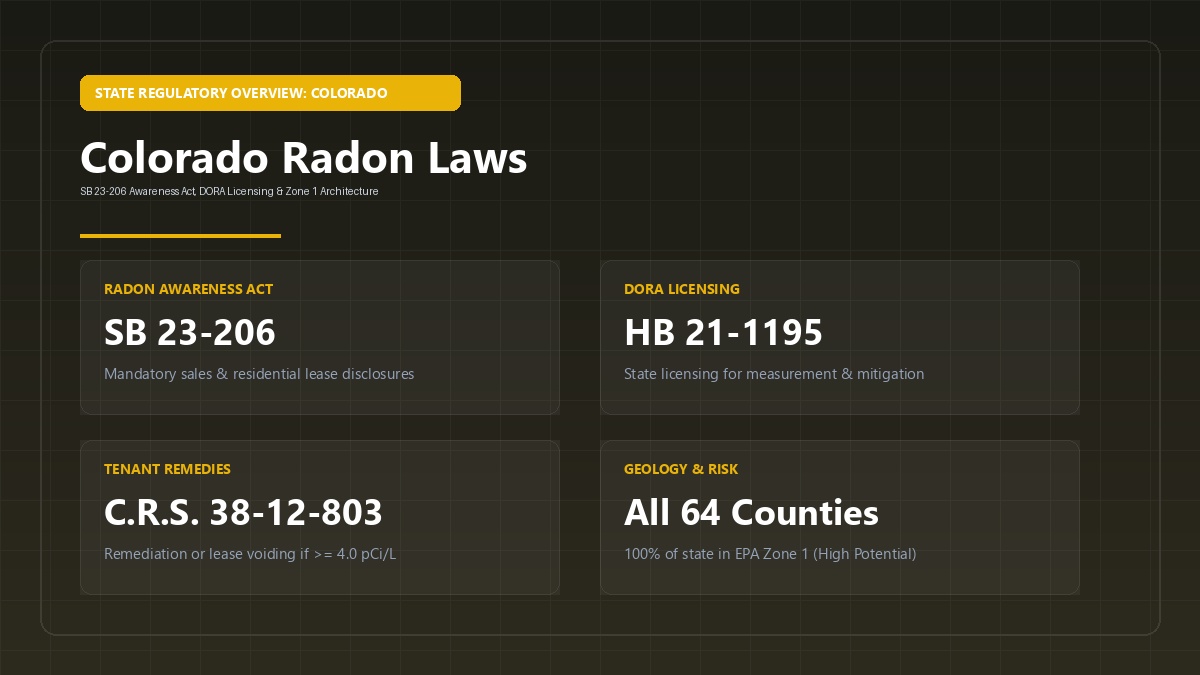
Colorado has enacted some of the most aggressive radon protection statutes in the United States, extending robust statutory rights to both home buyers and residential tenants. Under Senate Bill 23-206 (C.R.S. §§ 38-35.7-112 and 38-12-803), sellers and residential landlords must provide mandatory statutory radon warning statements, disclose all known test and mitigation records, and provide state educational publications. In rental properties, an unmitigated radon test meeting or exceeding 4.0 pCi/L constitutes a statutory breach of the warranty of habitability, permitting tenants to terminate leases or withhold rent. Furthermore, all radon professionals must hold active state licenses issued by the Colorado Department of Regulatory Agencies (DORA).
Testing Requirements
Testing is voluntary for private single-family homeowners; no state statute mandates that an existing homeowner test their dwelling. However, Colorado law establishes powerful statutory incentives in residential rental properties: if a tenant conducts a test that reveals radon concentrations at or above 4.0 pCi/L and notifies the landlord in writing, the landlord has a statutory deadline to retain a DORA-licensed mitigation contractor to install an active system, or the tenant may terminate the lease without penalty under C.R.S. § 38-12-803. For public schools, testing is voluntary under local school board discretion, supported by Colorado Department of Public Health and Environment (CDPHE) technical guidance.
Real-Estate Disclosure
Real estate disclosure in Colorado is among the strictest in the nation. Under C.R.S. § 38-35.7-112 (effective August 7, 2023), every contract for the purchase and sale of residential real property must include a bold, statutory Radon Warning Statement. Sellers must disclose: whether a radon test has occurred; the most recent test concentrations; whether an active mitigation system is installed; and provide the prospective buyer with the most recent CDPHE radon informational publication. Residential landlords are subject to parallel statutory disclosure obligations under C.R.S. § 38-12-803 before signing any lease agreement.
Mitigator & Tester Certification
Under House Bill 21-1195 and Colorado Revised Statutes §§ 12-165-101 et seq., commercial radon activity is strictly regulated by the Office of Radon Professionals within the Colorado Department of Regulatory Agencies (DORA). Performing radon measurement, mitigation, or operating a radon mitigation business for compensation without an active DORA license is unlawful. To obtain a Colorado license, contractors must be certified by the NRPP or NRSB, submit background checks, provide proof of general liability insurance, and adhere to ANSI/AARST national consensus standards.
New Construction
Colorado is a home-rule state and does not enforce a single, unified statewide residential building code. Building codes are adopted and enforced locally by individual municipal and county building departments. However, because the entire state has high radon potential, numerous Colorado jurisdictions—including Denver, Boulder, Fort Collins, Colorado Springs, and Pitkin County—have adopted International Residential Code (IRC) Appendix F, making passive or active radon-resistant new construction (RRNC) mandatory for new residential construction in those jurisdictions.
Radon Zones & the Action Level
Colorado exhibits extraordinary geological radon potential: all 64 counties in Colorado are classified by the EPA as Zone 1 (High Potential), with predicted average indoor screening levels greater than 4.0 pCi/L. Statewide testing data maintained by CDPHE indicates that approximately 50% of all tested homes in Colorado test above the EPA action level. Colorado strictly adheres to the EPA action level of 4.0 pCi/L, and state law incorporates this threshold directly into residential rental habitability standards. Review regional geological context on our EPA Radon Zone Map guide.
The State’s Radon Program
The state’s lead public health radon entity is the Colorado Department of Public Health and Environment (CDPHE) — Radon Program (cdphe.colorado.gov/radon). CDPHE administers a free test kit distribution program for Colorado homeowners (funded by state and federal grants), provides low-income radon mitigation financial assistance programs, and collaborates with DORA to protect consumer interests.
Sources & Limits
This regulatory summary is provided for educational and informational purposes only and does not constitute formal legal or engineering advice. Colorado landlord-tenant law, building codes, and licensing rules are subject to legislative amendment. Consult CDPHE, DORA, or a licensed Colorado attorney for specific legal guidance.
Primary Official Sources: Colorado Department of Public Health and Environment (CDPHE); Colorado Department of Regulatory Agencies (DORA) Office of Radon Professionals; Colorado Revised Statutes §§ 12-165-101, 38-35.7-112, 38-12-803; U.S. Environmental Protection Agency (Map of Radon Zones for Colorado).
Return to our national guide on Radon Regulations in the United States or inspect national county risk rankings on the EPA Radon Zone Map.
Get The Signal
What we actually ran, what it measured, and what it means for a restoration shop — every week, including the flops.
Leave a Reply