· Senior Advisory
· Operator-grade intelligence
Fire and smoke restoration generates the most variable Scope 3 emissions of any restoration job type. A contained single-room smoke job and a multi-floor structural fire with hazmat abatement and full reconstruction can both appear on your P&L as “fire restoration” — but their emissions differ by a factor of 20 or more. This guide gives you the emission factors, the calculation methodology, and a complete worked example to produce an accurate per-job figure regardless of where on that spectrum your job falls.
Job Classification: Phase and Scope
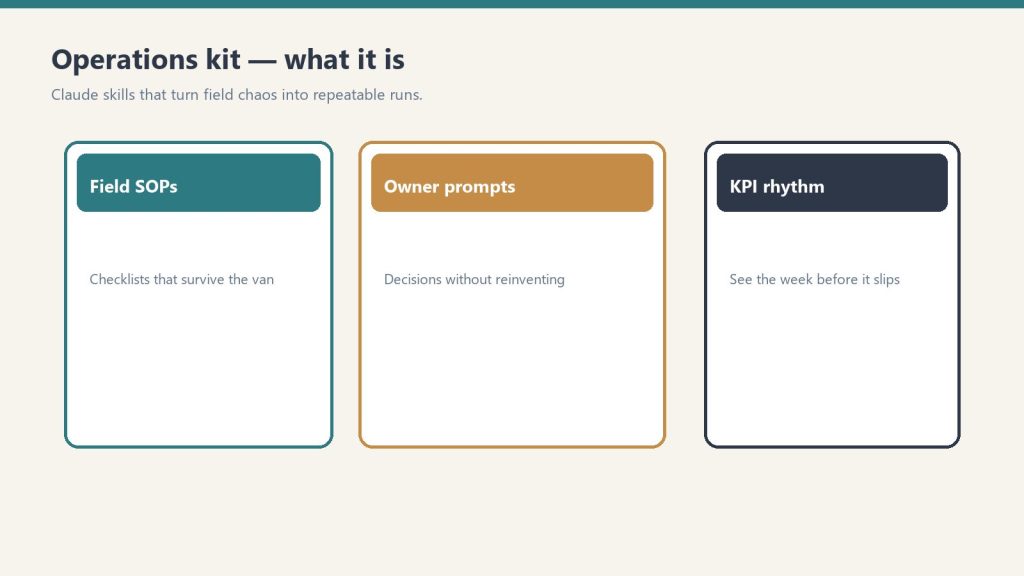
Before calculating, identify which phases are in your scope of work and document them separately. Emissions from mitigation and reconstruction phases should be tracked separately even if invoiced together — they may occur in different reporting years.
| Phase | Dominant Emission Categories | Typical Range |
|---|---|---|
| Mitigation only (no structural demolition) | Cat 4 transportation, Cat 1 materials, Cat 5 debris | 1.0–6.0 tCO2e |
| Mitigation + selective demolition (1 room/suite) | All four categories, Cat 12 significant | 3.0–12.0 tCO2e |
| Large-scale fire + ACM abatement + reconstruction | All four categories, Cat 5 hazmat dominant | 15.0–100+ tCO2e |
Category 4: Transportation Emission Factors
Fire restoration deploys more vehicle types per job than any other restoration category. Account for each separately.
| Vehicle Type | kg CO2e per mile | Common Use in Fire Restoration |
|---|---|---|
| Light truck / work van | 0.503 | Crew transportation, initial response |
| Medium equipment trailer | 1.084 | Air scrubbers, ozone generators, thermal foggers |
| Box truck / pack-out truck | 1.084 | Content pack-out and storage transport |
| Heavy dump truck (unloaded) | 1.612 | Debris removal mobilization |
| Heavy dump truck (loaded) | 2.25 | Debris removal trips to landfill/transfer |
| Specialty hazmat transport (ACM) | 2.80 | Asbestos or lead waste to permitted facility |
Content pack-out note: Pack-out is frequently the second-largest transportation source on large fire jobs. Track pack-out truck trips separately from crew mobilization and debris removal trips. Pack-out involves loaded trucks going to storage and returning empty — apply loaded emission factor for outbound, unloaded for return.
Category 1: Materials Emission Factors
| Material | Unit | kg CO2e per unit | Notes |
|---|---|---|---|
| Chemical sponge (dry soot sponge) | Each | 0.15 | EPA EEIO — cleaning products |
| Dry ice (CO2 pellets for blasting) | kg | 0.85 | Industrial CO2 production — use with caution; CO2 is released on use, but EPA factors cover production |
| Hydroxyl generator treatment (per day-unit) | Day-unit | 0.40 | Equipment embodied carbon, negligible per use |
| Ozone generator treatment (per day-unit) | Day-unit | 0.35 | Equipment embodied carbon, negligible per use |
| Encapsulant / sealant (smoke blocking primer) | Gallon | 4.2 | EPA EEIO — paint and coating manufacturing |
| Thermal fogging agent | Liter | 2.1 | EPA EEIO — chemical manufacturing |
| HEPA filter (air scrubber) | Each | 3.2 | EPA EEIO — industrial machinery |
| Full Tyvek suit (Level C) | Each | 1.2 | EPA EEIO — apparel manufacturing |
| Half-face respirator with organic vapor/P100 cartridges (pair) | Pair | 0.8 | EPA EEIO — medical equipment |
| Nitrile gloves (pair) | Pair | 0.3 | EPA EEIO — rubber/plastics |
Reconstruction phase materials — installed building components: If your scope includes reconstruction, the embodied carbon of installed materials belongs in Category 1. Use these EPA EEIO factors: drywall $0.42 per board foot × board feet; dimensional lumber $0.55 per board foot; paint and primer $4.2 per gallon. For complex reconstruction, request embodied carbon data from your materials supplier or use the Athena Impact Estimator for buildings as a secondary source.
Category 5: Waste Emission Factors
| Waste Type | Disposal Method | tCO2e per ton | Source |
|---|---|---|---|
| Smoke-contaminated C&D debris (non-hazardous) | Standard landfill | 0.16 | EPA WARM v16 |
| Smoke-contaminated C&D debris (regulated) | Licensed C&D landfill | 0.20 | EPA WARM + transport premium |
| Asbestos-containing materials (ACM) | Licensed hazmat landfill | 0.38 | EPA WARM + hazmat transport + licensed facility |
| Lead paint debris (regulated) | Licensed hazmat landfill | 0.35 | EPA WARM + hazmat premium |
| PCB-containing materials | Licensed hazmat incineration | 1.85 | EPA hazardous waste incineration factors |
| Disposable PPE and consumables | Standard landfill | 0.25 | EPA WARM v16 — mixed plastics |
ACM identification rule: If the building was constructed before 1980 and your demolition scope touches floor tiles, ceiling tiles, pipe insulation, or joint compound, assume ACM until tested. Apply the ACM emission factor (0.38 tCO2e/ton) to all potentially ACM-containing demolition waste in buildings where testing was not completed before demolition. Document the assumption in your data quality notes.
Category 12: Demolished Building Materials

| Material | tCO2e per ton landfilled | Notes |
|---|---|---|
| Gypsum drywall | 0.16 | EPA WARM v16 |
| Dimensional lumber | -0.07 | Carbon storage credit (if landfilled, not incinerated) |
| Carpet + pad | 0.33 | EPA WARM v16 |
| Acoustic ceiling tile | 0.12 | EPA WARM v16 — ceiling tile category |
| Fiberglass insulation | 0.33 | EPA WARM v16 |
| Electrical components (non-hazardous) | 0.28 | EPA WARM v16 — mixed electronics |
| Structural steel (salvaged) | -0.85 | EPA WARM v16 — recycled metal credit |
Complete Worked Example: Commercial Suite Fire — Single Floor
Job profile: Kitchen fire in a 3,200 sq ft commercial restaurant. Scope: smoke damage treatment throughout, selective demolition of kitchen (800 sq ft, including drywall, ceiling tiles, hood system). No ACM (post-1985 building). Reconstruction not in contractor scope. Pack-out of kitchen equipment. Crew: 4 technicians, 6 days. Facility: 31 miles from job site.
Category 4 — Transportation
Crew trucks: 2 light trucks × 62 mi RT × 8 trips (6 work days + mobilization + equipment pickup) = 992 mi × 0.503 = 499 kg CO2e
Equipment trailer (air scrubbers, ozone gen): 1 × 62 mi × 2 trips = 124 mi × 1.084 = 134 kg CO2e
Pack-out truck (kitchen equipment): 1 loaded trip × 62 mi = 62 mi × 2.25 + 1 return trip × 62 mi × 1.612 = 140 + 100 = 240 kg CO2e
Debris dump truck: 2 loads to transfer station × 18 mi × 2.25 kg/mi = 81 kg CO2e
Category 4 total: 954 kg CO2e = 0.95 tCO2e
Category 1 — Materials
Chemical sponges: 3,200 sq ft ÷ 50 sq ft/sponge = 64 sponges × 0.15 kg = 10 kg CO2e
Encapsulant/smoke blocking primer (kitchen surfaces): 12 gallons × 4.2 kg/gallon = 50 kg CO2e
Thermal fogging agent: 6 liters × 2.1 kg/L = 13 kg CO2e
HEPA filters replaced: 3 air scrubbers × 2 filter changes = 6 × 3.2 kg = 19 kg CO2e
PPE: 4 technicians × 6 days × 1.5 Tyvek/day = 36 × 1.2 kg = 43 kg; gloves: 4 × 6 × 3 pairs = 72 × 0.3 = 22 kg; respirator cartridges: 4 × 6 × 1 pair = 24 × 0.8 = 19 kg. PPE total: 84 kg CO2e
Category 1 total: 176 kg CO2e = 0.18 tCO2e
Category 5 — Waste
Kitchen demolition debris (drywall, ceiling tiles, hood components): estimated 2.8 tons × 0.16 tCO2e/ton = 0.45 tCO2e
PPE and consumables waste: ~0.08 tons × 0.25 = 0.02 tCO2e
Category 5 total: 0.47 tCO2e
Category 12 — Demolished Materials
Kitchen drywall (800 sq ft): 0.91 tons × 0.16 = 0.15 tCO2e
Acoustic ceiling tiles: 800 sq ft × 1.8 lbs/sq ft = 0.65 tons × 0.12 = 0.08 tCO2e
Category 12 total: 0.23 tCO2e
Job Total
| Category | tCO2e |
|---|---|
| Category 4 — Transportation | 0.95 |
| Category 1 — Materials | 0.18 |
| Category 5 — Waste disposal | 0.47 |
| Category 12 — Demolished materials | 0.23 |
| Total | 1.83 tCO2e |
How does the presence of asbestos-containing materials change the total emissions?
Significantly. In the example above with no ACM, Category 5 waste totals 0.47 tCO2e. If the same job involved 1.5 tons of ACM abatement, that adds 1.5 × 0.38 = 0.57 tCO2e to Category 5 alone — a 121% increase in waste emissions — plus additional transportation for hazmat hauling. Always identify ACM status before calculating.
Are dry ice blasting emissions included in Category 1 or treated differently?
Use the dry ice production emission factor (0.85 kg CO2e/kg) for Category 1. The CO2 released when dry ice sublimates during blasting is not separately counted — it’s included in the production emission factor. Note in your data quality section that dry ice CO2 release is accounted for through production factors per EPA guidance.
How do I calculate emissions when reconstruction is performed by a separate GC?
The reconstruction contractor calculates their own RCP emissions separately. Your calculation ends at the boundary of your scope of work. Note in your job report that reconstruction was performed by a separate contractor and reference their separate RCP report if available.
Charred and Fire-Damaged Wood Debris: A Critical Correction to Standard Landfill Factors
The standard EPA WARM v16 landfill emission factor for wood debris assumes significant anaerobic decomposition and methane generation in landfill. For fire-damaged and charred structural wood, this assumption is materially incorrect and overstates emissions.
Peer-reviewed measurement studies have established that actual carbon conversion in landfilled wood is 0–19.9% (average ~5%), compared to the IPCC default DOC degradation factor of 50% (Barlaz et al., 2011, Environmental Science & Technology; O’Dwyer et al., 2018, Waste Management). For charred and pyrolyzed wood — the specific material type generated in fire restoration — the correction is even more dramatic. Charring converts cellulose and hemicellulose into stable aromatic carbon structures (chars and graphene-like materials) that are highly resistant to microbial decomposition. Charred wood debris disposed in a landfill produces near-zero methane.
The practical implication for RCP calculations: When calculating Category 5 and Category 12 emissions for fire-damaged structural wood, use the following corrected factors rather than the standard EPA WARM wood debris value:
| Material Condition | tCO₂e per short ton (landfill) | vs. EPA WARM Default | Basis |
|---|---|---|---|
| Unburned dimensional lumber (standard) | 0.039 (WARM v16) | Baseline | EPA WARM v16 |
| Fire-damaged, smoke-affected (partial char) | 0.008–0.015 | ~65–80% lower | Barlaz et al. 2011; O’Dwyer et al. 2018 |
| Fully charred/pyrolyzed structural members | ~0.002–0.005 | ~87–95% lower | O’Dwyer et al. 2018; char degradation studies |
For RCP calculations, use 0.010 tCO₂e per short ton as the default for fire-damaged wood debris when charring is visually confirmed. Document the char condition in the job notes. This correction can meaningfully reduce reported Category 5 and Category 12 emissions on structural fire jobs — in some cases by 60–80% on the wood debris component.
Odor Elimination Equipment: Energy and Emission Data
The Category 1 table above assigns nominal values to ozone and hydroxyl generators. Actual manufacturer specifications reveal a significant difference between the two technologies that affects both emission calculation and equipment selection decisions.
Ozone Generators
Commercial ozone generators used in smoke remediation draw far less power than their effectiveness suggests. The Queenaire QT Hurricane — one of the most widely used units in the industry — operates at 52 watts (0.5A at 120V), covering up to 16,000 sq ft and producing up to 1,600 mg/hr of ozone. Over a typical 24-hour treatment cycle, a single unit consumes only 1.25 kWh. A whole-house treatment using two or three units over two to three days totals approximately 7.5–11.25 kWh. At the national grid emission factor, this yields less than 4 kg CO₂e per treatment — negligible relative to transportation and debris disposal.
Hydroxyl Radical Generators
Hydroxyl generators are a different energy profile. The Odorox Boss draws 230 watts maximum (1.9A at 120V) and treats 1,500–2,500 sq ft. Unlike ozone, hydroxyl generators run continuously while crews are present (safe for occupied spaces during treatment), typically operating three to seven days continuously on larger fire jobs. A single Odorox Boss running five days continuously consumes 27.6 kWh. Multiple units on a commercial job or residential whole-house treatment reach 55–110 kWh per job — a meaningful Domain 1 contribution that should be logged in equipment runtime records.
Updated proxy values replacing EPA EEIO equipment embodied carbon factors:
| Equipment | Power Draw | kWh per 24-hr day | kg CO₂e per day (national grid) |
|---|---|---|---|
| Ozone generator (e.g., Queenaire QT Hurricane) | 52W | 1.25 | 0.44 |
| Hydroxyl generator (e.g., Odorox Boss) | 230W | 5.52 | 1.93 |
Blasting Media: Corrected Emission Factors
Sodium Bicarbonate (Soda Blasting)
The EPA EEIO chemical manufacturing proxy previously applied to soda blast media significantly understates the actual production footprint. Per a 2019 study in Industrial & Engineering Chemistry Research (Lee et al., KAIST), the Solvay soda ash carbonation process yields approximately 1.69 tonnes CO₂ per tonne NaHCO₃ with full upstream accounting. A simplified proxy via direct carbonation captures 0.32 kg CO₂ per kg. The RCP default for sodium bicarbonate blasting media is 0.5–0.7 kg CO₂e/kg pending manufacturer-specific Environmental Product Declaration data.
Dry Ice Blasting: Corrected Accounting
The FAQ entry above states that CO₂ released during dry ice blasting is included in the production emission factor. This requires a clarification. If the CO₂ used to produce the dry ice is sourced from an industrial byproduct stream — the typical case for commercial dry ice production — only the liquefaction and solidification energy represents a net Scope 3 emission. The sublimated CO₂ itself is not newly generated. Liquefaction adds approximately 39 kWh per tonne of CO₂ processed. At the national grid factor, this adds 13.7 kg CO₂e per tonne of dry ice for energy overhead. The RCP default of 0.85 kg CO₂e/kg remains appropriate as a conservative aggregate estimate but should be updated with supplier-specific data where available.
Generator Fuel: Reference Table for Large Fire Jobs
Extended fire restoration jobs on properties with disrupted electrical service require temporary generator power. Generator fuel consumption is a direct Category 4 emission source and frequently the largest single emission contributor on multi-week structural fire projects.
| Generator Size | Fuel consumption at 75% load | kg CO₂ per hour | kg CO₂ per 10-hr day |
|---|---|---|---|
| 8 kW diesel | 0.54 gal/hr | 5.5 | 55 |
| 15 kW diesel | 0.94 gal/hr | 9.6 | 96 |
| 20 kW diesel | 1.30 gal/hr | 13.3 | 133 |
| 30 kW diesel | 2.40 gal/hr | 24.5 | 245 |
Source: Hardy Diesel Generator Fuel Consumption Chart; diesel combustion factor 10.21 kg CO₂e/gallon (EPA 2025 EF Hub).
Scale illustration: A typical 20 kW diesel generator running at 75% load for 10 hours per day over a three-week fire restoration project consumes approximately 273 gallons of diesel, producing roughly 2,782 kg CO₂. On a large structural fire job, generator emissions frequently exceed demolition debris disposal as the second-largest emission source after vehicle transportation. Log generator fuel receipts and daily runtime at the job level.
Sources and References — Fire and Smoke Technical Additions
- Barlaz, M.A. et al. (2011). “Is Current Bioreactor Landfill Technology Sustainable?” Environmental Science & Technology 45(16).
- O’Dwyer, T.F. et al. (2018). “Methane generation from wood waste in landfills.” Waste Management 76.
- Lee, S. et al. (2019). “Technoeconomic and Environmental Evaluation of Sodium Bicarbonate Production Using CO₂.” Industrial & Engineering Chemistry Research. ACS Publications.
- Hardy Diesel. Diesel Generator Fuel Consumption Chart. hardydiesel.com
- Queenaire Technologies. QT Hurricane Product Specifications. ozoneexperts.com
- Odorox Boss Product Specifications. Aramsco. aramsco.com
Leave a Reply