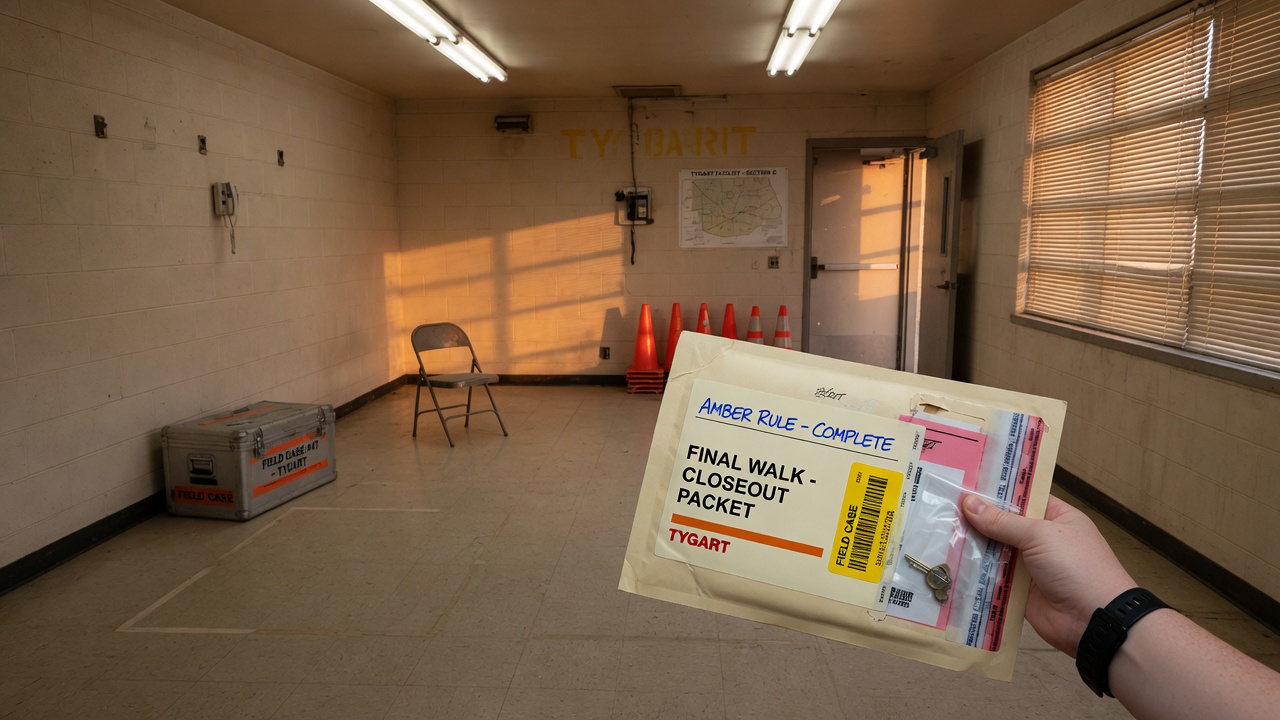
The magazine piece tells the facility manager why the gap exists. This is the shop version. Same week. Different door.
A water job ends when the last air mover comes off the truck, not when the invoice hits QuickBooks. After that, the only carbon record most shops have is a line item and a memory. The FM who hired you will get asked for Category 1 and Category 5 numbers. They will call you. You will not have them.
What actually has to leave with the crew
Not a sustainability essay. A dozen fields, written while the floor is still wet:
If a tech cannot fill it in five minutes, the form is wrong. If it waits for the office on Monday, it will be invented.
Put it on the invoice trigger
Nobody fills a questionnaire after the trucks have gone. They fill what stands between them and getting paid.
One clause in the work auth or the master: the per-job record is a condition of final invoice. Same shape as a moisture log. Same habit as photos. The Restoration Carbon Protocol is the open mapping if you do not want to invent the buckets. Use it, rename it, or steal the twelve fields. The standard is not the point. The timestamp is.
Who this is for
Commercial water, fire, mold, and the one-off mechanical swap. The FM inside the building is the only person who can demand the data at the door. You are the only person who can produce it at the job.
IFMA just ran the occupier-side argument. Closing the Scope 3 Data Gap is theirs. This is the field note that makes that article usable when the next pipe opens.
The sentence that pays
“We capture the job record before we leave. You can hand it to whoever asks.”
Scope 3 is leaving the voluntary pile. California SB 253 and the EU CSRD pull Category 1 onto a deadline. Facility managers cannot close that inventory without data from the vendors who actually do the work — water, fire, mold, emergency mechanical. Those crews are high-intensity and almost never on a reporting stack, because they were procured as an emergency, not as a supplier program.
Spend-based estimates are a stopgap. Updated GHG Protocol guidance wants primary data.
Vendor pledges and AI principles are not a control. A policy the vendor can rewrite alone does not survive an auditor.
The occupier’s FM team holds the leverage: RFPs, MSAs, and the closeout packet.
A real control is standardized, job-level emissions data demanded in the contract — fuel, miles, waste, equipment hours — against a named methodology.
Who this is for
Facility managers and sustainability leads who will be asked for Category 1 numbers and do not currently get them from restoration or specialty trades. Restoration operators who want to be the vendor that can produce the packet instead of the vendor that gets swapped at renewal. Same gap. Opposite desks.
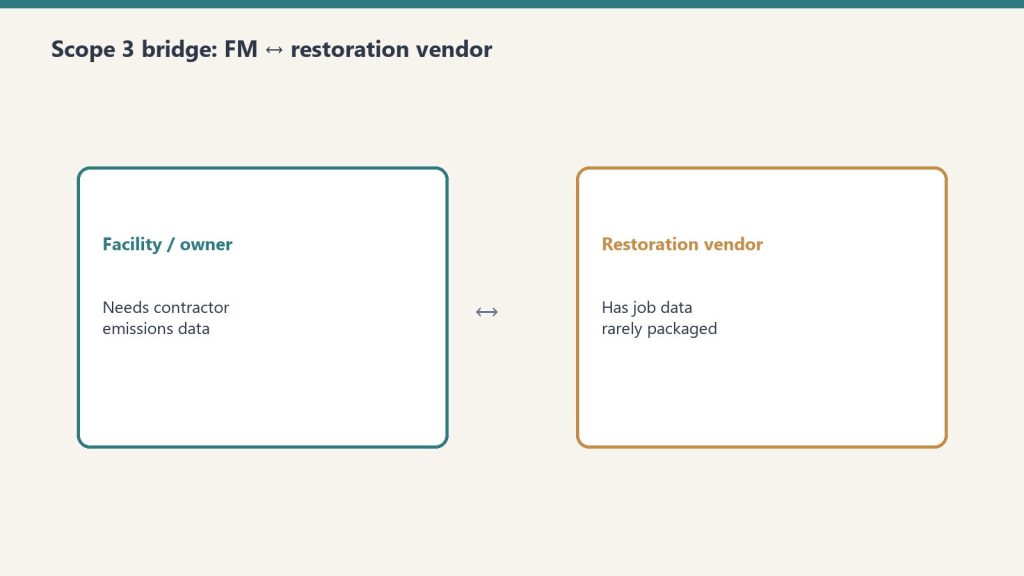
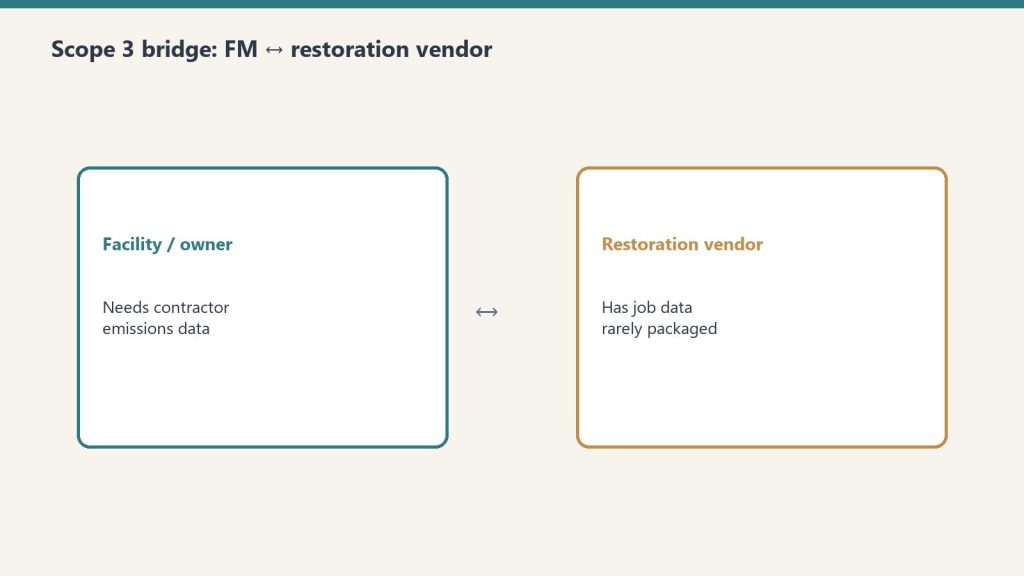
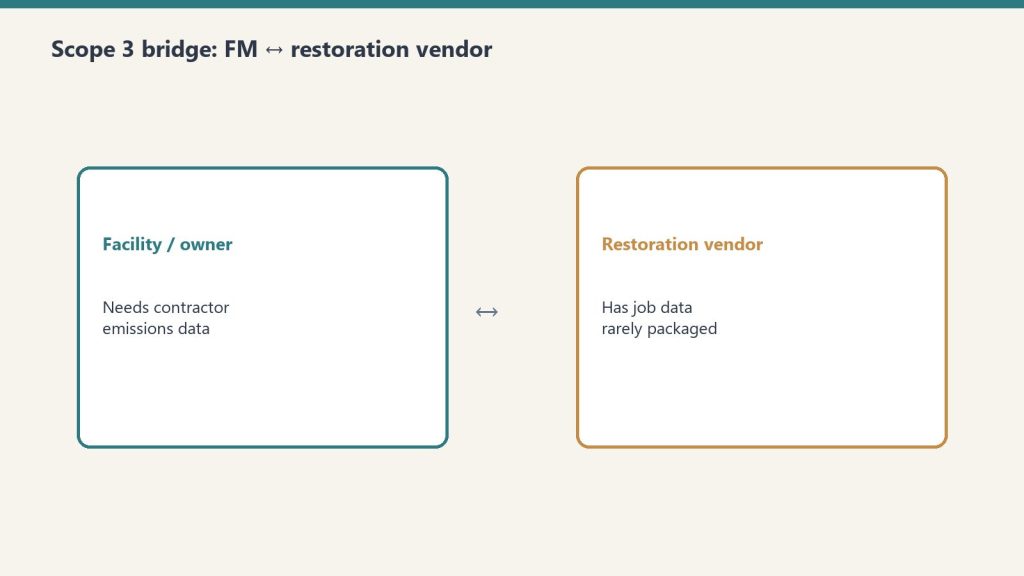
The missing control is the bridge: the FM needs the number; the vendor already has the job file.
What you do next
Do not wait for a software RFP. The sequence is short:
Read the FMJ piece — the case to the profession, on IFMA’s site.
Run the workbook — five phases, live scoring, a paste-ready contract clause, and an exportable program summary. Work email unlocks the clause.
Property owners managing large commercial real estate portfolios have made significant progress on Scope 1 and Scope 2 emissions. Energy management systems, green building certifications, and utility procurement strategies have given asset managers real tools for reducing and reporting direct and indirect energy emissions. Scope 3 Category 1 — the contractor supply chain — has been the persistent blind spot.
The Restoration Carbon Protocol (RCP) is designed to close the most acute piece of that gap: the emissions generated by restoration contractors during loss events and emergency response projects. This article explains what the RCP covers, how it generates the data property owners need, and how to integrate it into your ESG program and vendor management processes.
Why Restoration Contractors Are a Unique Scope 3 Challenge
Why restoration contractors are a unique Scope 3 challenge.
Most contractor Scope 3 challenges can be addressed through procurement policy — adding ESG reporting requirements to RFPs, master service agreements, and annual vendor reviews. This works for planned, recurring vendor relationships where you control the selection process and the contract terms.
Restoration contractors operate differently. They are engaged reactively, after a loss event. The property manager calls whoever is on the emergency vendor panel. The contractor mobilizes immediately. There is no competitive procurement, no ESG pre-qualification review, and no time to negotiate reporting requirements before work begins. The emissions happen regardless of whether data is collected.
This is why the RCP matters: it establishes the data collection methodology on the contractor’s side, before the loss event. A contractor who has adopted the RCP arrives at your property already equipped to generate the emissions data you need — no negotiation required at the time of loss.
What the RCP Measures
What the RCP measures.
The Restoration Carbon Protocol covers four primary emissions categories for a typical restoration project. Equipment fuel consumption — diesel generators, drying equipment, dehumidifiers, extraction units, and vehicles — is measured against hours of operation and fuel consumption logs. Materials with embedded carbon — replacement drywall, flooring, insulation, and structural components — are estimated using industry-standard embodied carbon factors. Waste generation — demolition debris, contaminated materials, and packaging — is tracked by weight and disposal method. Transportation — contractor vehicle miles, equipment hauling, and materials delivery — is calculated using distance and load data.
The RCP output is a project-level emissions report expressed in metric tons of CO2 equivalent, broken down by category. That format maps directly to GHG Protocol Scope 3 Category 1 reporting requirements — making it usable for GRESB data submissions, CDP supply chain responses, and SB 253 Scope 3 inventory filings.
How to Ask Your Vendors About RCP
For property owners building RCP adoption into their vendor management process, the conversation with restoration contractors has three components. First, ask whether the contractor has adopted the RCP or an equivalent GHG reporting methodology — this establishes whether data collection infrastructure exists. Second, ask what the output format looks like and whether it maps to GHG Protocol Category 1 — this determines whether the data is actually usable for your reporting obligations. Third, ask about the delivery timeline — GRESB, CDP, and SB 253 all require annual inventory data, and you need project-level data within the fiscal year it occurred.
Contractors who have not adopted RCP but are aware of it may be willing to do so if a significant client requests it. The RCP is an industry self-standard, not a certification program with fees or audits — the barrier to adoption is methodology, not cost.
Integrating RCP Data into Your ESG Program
Integrating RCP data into your ESG program.
Once you have RCP-compliant contractors on your preferred vendor panel, the data integration is straightforward. Each completed project generates an emissions report. Those reports are aggregated annually by property and portfolio. The totals feed into your Scope 3 Category 1 inventory alongside data from other contractor categories. The result is a documented, methodology-backed contractor emissions number — not a spend-based estimate — that satisfies the evidentiary standard for GRESB, CDP, and SB 253 reporting.
For BOMA members managing portfolios under institutional ESG frameworks, this is the difference between a defensible Scope 3 inventory and a gap that investors, auditors, and regulators will flag. The RCP does not solve the entire contractor Scope 3 problem — but it solves the most unpredictable piece of it, and it does so in a format property owners can actually use.
If you manage facilities for a corporate occupier and you have been trying to figure out how to get Scope 3 emissions data from your restoration contractors, the Restoration Carbon Protocol (RCP) exists to answer that question. This article explains what the RCP is, how it works, and what IFMA members specifically need to know about using it as a procurement and compliance tool.
What the Restoration Carbon Protocol Is
What the Restoration Carbon Protocol is.
The RCP is an industry self-standard published by Tygart Media that defines how restoration contractors should calculate, document, and report the greenhouse gas emissions associated with each project they complete. It is built on the GHG Protocol’s Corporate Value Chain (Scope 3) Standard — the same framework used by most corporate ESG reporting programs and required by SB 253 and CSRD.
The RCP fills a specific void: no restoration industry body — not IICRC, not RIA, not any trade association — had previously published a Scope 3 reporting methodology for restoration work. Commercial property managers and corporate FM teams asking their restoration vendors for emissions data were getting blank stares. The RCP gives contractors the methodology and gives FM procurement teams the standard to reference.
The Five Core Restoration Job Types and Their Scope 3 Mapping
Five core job types and their Scope 3 mapping.
The RCP maps each of the five primary restoration job types to the relevant GHG Protocol Scope 3 categories:
Water damage restoration: Category 1 (services purchased), Category 5 (waste from extracted water and contaminated materials)
Fire and smoke restoration: Category 1 (services), Category 5 (soot, char, and demolition debris waste streams)
In all five cases, the primary Scope 3 category for the FM client is Category 1 — Purchased Goods and Services. The emissions are generated by the contractor performing work on your behalf at your facility.
The 12 Data Points: What to Ask Your Contractor to Track
Twelve data points to ask your contractor to track.
The RCP defines 12 data points that a restoration contractor should capture on each job to enable a complete Scope 3 calculation. As an FM procurement professional, these are the data fields you should be requiring in your vendor agreements:
Total diesel consumed by drying and dehumidification equipment (gallons)
Total propane or natural gas consumed by heat drying equipment (cubic feet or gallons)
Total vehicle miles traveled to and from the site by all crew vehicles
Number of crew vehicle trips and vehicle types (van, pickup, box truck)
Total equipment operating hours (by equipment category)
Weight of water extracted and removed from the site (gallons or pounds)
Weight and type of contaminated materials removed (drywall, insulation, flooring, etc.)
Disposal method for each waste stream (landfill, recycling, hazardous waste facility)
Refrigerants used, recovered, or vented (for HVAC-adjacent work)
Materials installed by type and weight (for reconstruction phases)
Cleaning agents and chemical products used by product category
Total project duration in days
Not every data point is relevant to every job type. The RCP provides job-type-specific templates that pre-populate the relevant fields for water, fire, mold, hazmat, and biohazard jobs respectively.
How FM Teams Can Use the RCP Framework
There are three practical ways IFMA members can incorporate the RCP into their FM operations:
1. Vendor Qualification
Add RCP awareness to your restoration vendor qualification checklist. Ask prospective vendors whether they have adopted the RCP framework. Vendors who can demonstrate RCP familiarity are already capturing the data you need; vendors who cannot are a data gap risk for every job they complete.
2. Contract Language
Include a Scope 3 data provision clause in restoration vendor agreements referencing the RCP as the accepted methodology standard. This gives vendors a concrete deliverable (the RCP Job Carbon Report) rather than an open-ended “emissions data” request they have no idea how to fulfill.
3. Scope 3 Inventory Integration
Route the per-job RCP carbon reports from your restoration vendors into your Scope 3 Category 1 data collection system. Most ESG reporting platforms (Watershed, Persefoni, Salesforce Net Zero Cloud, etc.) accept Category 1 supplier data in standardized formats. The RCP report is designed to map directly to these platforms’ input requirements.
The RCP Is Free to Use
The Restoration Carbon Protocol is published as an open industry standard. There is no licensing fee, no certification requirement, and no vendor lock-in. FM teams can share the RCP framework directly with their restoration vendors at no cost. Contractors can adopt the RCP’s data capture templates and calculation methodology without purchasing anything.
The goal is adoption — the more restoration contractors who begin tracking RCP-compliant data, the more complete FM Scope 3 inventories become across the industry.
Frequently Asked Questions
Is the RCP recognized by IICRC or RIA?
The RCP is an independent industry self-standard published by Tygart Media. It is not currently endorsed by IICRC or RIA, as neither body has published a competing ESG standard. The RCP fills the void those bodies have not addressed. FM teams and restoration contractors can adopt it independently without waiting for official industry body endorsement.
How does a restoration contractor become RCP-certified?
The RCP v1.0 includes a self-certification checklist. Contractors complete the checklist to demonstrate they have implemented the required data capture processes and calculation methodology. Third-party verification is available for organizations that require audited certification. Details are published at tygartmedia.com/category/esg-restoration/.
By Will Tygart• Long-form Position
• Practitioner-grade
When Google launched the Universal Commerce Protocol at NRF in January 2026, the announcement was framed as an e-commerce story. Shopify, Walmart, Target, Visa — merchants and payment processors getting their systems ready for AI agents that shop, compare, and execute purchases without human intervention. That framing is correct but incomplete. UCP is not just a commerce standard. It is a template for how open protocols create movements.
The Restoration Carbon Protocol is a different kind of standard in a completely different industry. But when you understand what UCP actually does architecturally — and why it succeeded where dozens of previous e-commerce APIs failed — you start to see exactly how RCP gets from a 31-article framework on tygartmedia.com to an industry-wide adopted standard that BOMA, IFMA, and institutional ESG reporters actually depend on.
The mechanism is the same. The domain is different. And there is a version two of RCP that plugs directly into the UCP trust architecture — if the restoration industry moves in the next 18 months.
What UCP Actually Does That Previous Commerce APIs Didn’t
What UCP actually does that previous commerce APIs didn’t.
The history of e-commerce is littered with failed attempts at standardization. Every major platform — Amazon, eBay, Shopify, Magento — built its own API. Merchants implemented each one separately. Integrators spent years building custom connectors. The problem was not technical. The problem was trust and authentication. Every API required a bilateral relationship: the merchant trusted this specific buyer’s agent, that agent trusted this specific merchant’s data. Scaling to the open web required n² trust relationships. It never worked.
UCP solved this with a different architecture. Instead of bilateral trust, it established a protocol layer — a shared standard that any compliant agent and any compliant merchant can speak without a pre-existing relationship. An AI agent that implements UCP can query any UCP-compliant catalog, check any UCP-compliant inventory, and execute against any UCP-compliant checkout — not because it has a relationship with that merchant, but because both parties speak the same authenticated protocol.
The authentication is the product. UCP’s standardized interface means that a merchant’s decision to implement the protocol is simultaneously a decision to trust any UCP-authenticated agent. The trust is embedded in the standard, not in the bilateral relationship.
Google’s Agent Payments Protocol (AP2), which sits alongside UCP, formalized this with “mandates” — digitally signed statements that define exactly what an agent is authorized to do and spend. The mandate is the credential. Any merchant who accepts UCP mandates accepts a verifiable statement of agent authorization without knowing anything specific about the agent that issued it.
That architecture — open protocol, embedded authentication, mandate-based trust — is exactly what the restoration industry needs for Scope 3 emissions data. And RCP v1.0 has already built the content layer. The question for v2 is whether to build the authentication layer.
The RCP Authentication Problem (That UCP Already Solved)
The RCP authentication problem UCP already solved.
RCP v1.0 produces per-job emissions records — JSON-structured Job Carbon Reports that restoration contractors deliver to commercial property clients for their GRESB, SBTi, and SB 253 reporting. The framework is solid. The methodology is sourced and auditable. The schema is machine-readable.
But right now, there is no authentication layer. A property manager who receives an RCP Job Carbon Report from a contractor has no way to verify that the contractor actually follows the methodology, uses the current emission factors, or has gone through any validation process. They have to trust the contractor’s word — which is exactly the problem that makes Scope 3 data from supply chains unreliable for ESG auditors.
This is the bilateral trust problem all over again. The property manager trusts this specific contractor’s data. That contractor trusts this specific property manager’s reporting process. It does not scale to a portfolio of 200 contractors across 800 properties.
UCP solved the equivalent problem in commerce. The RCP organization — whoever formally governs the standard — can solve the same problem in ESG supply chain reporting with an analogous architecture.
What RCP Certification Could Look Like in a UCP-Style Architecture
Imagine a restoration contractor completes an RCP certification process. They demonstrate that they collect the 12 required data points, apply the current emission factors, produce Job Carbon Reports in the RCP-JCR-1.0 schema, and maintain source documents for seven years. The RCP organization validates this and issues a cryptographically signed certification credential — an RCP Mandate.
The RCP Mandate is the contractor’s credential. It is not issued to a specific property manager. It is not dependent on a bilateral relationship. It is a verifiable statement, signed by the RCP authority, that this contractor’s emissions data meets the methodology standard. Any property manager, ESG platform, or auditor who accepts RCP Mandates can trust the data from any RCP-certified contractor — not because they know that contractor, but because the standard’s authentication is embedded in the credential.
This is precisely how UCP mandates work in commerce. The signed statement creates protocol-level trust that does not require a pre-existing relationship.
The downstream effects are the same as in commerce:
For contractors: RCP certification becomes a competitive signal that travels with the data. An RCP Mandate delivered with a Job Carbon Report tells the property manager’s ESG team: this data does not need to be validated separately. It has already been validated by a recognized standard.
For property managers: They can accept RCP-certified contractor data directly into their ESG reporting workflows without manual review. The certification is the audit trail. Measurabl, Yardi Elevate, and Deepki — the ESG data management platforms most of them use — can be built to accept RCP Mandate credentials alongside RCP JSON records and flag them automatically as verified-methodology data.
For ESG auditors: A property portfolio where all restoration contractor data comes from RCP-certified vendors is auditable without going back to each contractor. The mandate chain is the evidence. Limited assurance under CSRD or SB 253 becomes a single check — are these vendors RCP-certified? — rather than a vendor-by-vendor methodology review.
For the industry: Certification creates a selection mechanism. Property managers who require RCP-certified vendors in their preferred contractor agreements are no longer asking for a one-off document. They are asking for protocol compliance — the same way a merchant asking for UCP compliance is not asking for a custom integration, they are asking for standards adoption.
The Protocol Stack for RCP v2
Following the UCP architecture model, a complete RCP v2 would have three layers — matching the commerce, payments, and infrastructure layers of the agentic commerce stack:
Layer 1: The Data Layer (Already Built — RCP v1.0)
The methodology, emission factors, JSON schema, five job type guides, audit readiness documentation, and public API. This is the equivalent of UCP’s catalog query and inventory check layer — the standardized interface for what data is produced and how it is structured. RCP v1.0 is complete at this layer.
Layer 2: The Authentication Layer (RCP v2 Target)
The certification program, the mandate credential, the verification mechanism. This is the equivalent of UCP’s trust and authentication architecture — the layer that makes data from one party trusted by another without a bilateral relationship. Key components:
RCP Contractor Certification: documented audit of data capture practices, schema compliance, emission factor vintage, and source document retention
RCP Mandate: cryptographically signed certification credential, issued per contractor, versioned to the RCP release used, with an expiration and renewal cycle
Mandate verification endpoint: a public API (building on the existing tygart/v1/rcp namespace) where any platform can POST a mandate token and receive a verified/not-verified response with credential metadata
Certified contractor registry: a public directory of RCP-certified organizations, queryable by name, state, and certification status
Layer 3: The Infrastructure Layer (RCP v2 Target)
The machine-to-machine data exchange infrastructure — the equivalent of MCP and A2A in the agentic commerce stack. A contractor’s job management system (Encircle, PSA, Dash, Xcelerate) that natively implements RCP can transmit certified Job Carbon Reports directly to a property manager’s ESG platform without human intermediation. The report travels with the mandate credential. The platform verifies the credential, ingests the data, and flags it as RCP-verified — automatically. No email, no manual upload, no data entry.
This is what makes it a movement rather than a document standard. The data flows automatically between authenticated parties. The human steps are eliminated. The protocol becomes infrastructure.
Why Open Protocol Architecture Enables Movements
UCP didn’t succeed because Google built good documentation. It succeeded because Google made it open — any merchant can implement it, any agent can speak it, no license fee, no bilateral negotiation, no approval required. Shopify and a regional boutique retailer are equal participants in the UCP ecosystem because the protocol is the credential, not the relationship with Google.
That openness is what creates network effects. Every new UCP-compliant merchant makes the protocol more valuable for every agent. Every new UCP-compliant agent makes the protocol more valuable for every merchant. The standard grows because participation is self-reinforcing.
RCP v1.0 is already open. The framework is CC BY 4.0 — free to use, implement, and build upon. The API is public. The emission factors are published with sources. Any restoration company can implement it today without permission.
What RCP v2 adds is the authentication layer that makes open participation verifiable. The difference between “any company claims to follow RCP” and “any company can prove they follow RCP” is the difference between a document standard and a protocol. And the difference between a protocol and a movement is whether the infrastructure layer — the machine-to-machine data exchange — gets built.
The agentic commerce stack took 18 months from UCP’s launch to meaningful adoption in production commerce systems. The RCP timeline is not 18 months from today — it’s 18 months from the moment RIA, IICRC, or a major industry insurer formally endorses the standard. That endorsement is the equivalent of Shopify and Walmart signing on to UCP at NRF. It’s the signal that tells the rest of the ecosystem: this is the standard, build to it.
The Restoration Industry’s Unique Position
The restoration industry’s unique position.
BOMA and IFMA are working the problem from the property owner side — how do we get our vendor supply chains to report Scope 3 data? They don’t have the answer because the answer requires contractor-side infrastructure that commercial real estate organizations cannot build. They can mandate data. They cannot build the methodology.
The restoration industry can. The 12 data points are already defined. The five job type methodologies are already published. The JSON schema is live. The API is running. The audit readiness guide exists. The only missing component is the formal certification program and the mandate credential that makes all of it protocol-grade rather than document-grade.
This is what positions restoration as the leading industry in commercial property Scope 3 compliance — not just a participant but the infrastructure provider. The industry that built the standard that the property management industry depends on. That is a fundamentally different value proposition than “we report our emissions.”
The parallel to UCP is exact: Google didn’t just participate in e-commerce. They built the protocol layer that made agentic commerce possible at scale. The restoration industry, through RCP, can build the protocol layer that makes supply chain Scope 3 compliance possible at scale for commercial real estate. And unlike Google, the restoration industry doesn’t need to be invited to the table. The table was already set at tygartmedia.com/rcp.
What RIA Savannah Should Start
The conversation at RIA Savannah on April 27 isn’t about persuading the industry to care about carbon. It’s about presenting the infrastructure that already exists and asking whether the industry wants to formally govern it. The RCP v1.0 framework, the public API, the certification roadmap — these are things that exist today. The question for RIA leadership is whether they want the restoration industry to own the protocol layer for commercial property Scope 3 compliance, or whether they want to watch a property management trade association or a Canadian software company build something proprietary in their place.
The window is real. ESG data platforms are making vendor integration decisions now. Property managers are establishing preferred contractor Scope 3 requirements now. California SB 253’s Scope 3 deadline is 2027. GRESB assessments with contractor data coverage scoring are active this year. The infrastructure moment is not coming. It is here.
A movement needs three things: an open standard, an authentication layer, and a network effect. RCP v1.0 is the standard. The authentication layer is the RCP v2 roadmap. The network effect starts the moment an industry organization formally endorses the protocol and restoration contractors have a reason to get certified rather than merely compliant.
That is what UCP teaches us about RCP. The protocol is not the product. The authenticated, machine-readable, verifiable data infrastructure that emerges from the protocol is the product. And the industry that builds that infrastructure owns the category.
The RCP REST API endpoint allows software developers, ESG platforms, and job management systems to programmatically access the full Restoration Carbon Protocol framework — all articles, emission factors, schema documentation, and article relationships — without scraping the site. This endpoint is part of the Tygart Media REST API and is publicly accessible without authentication.
Base URL:https://tygartmedia.com/wp-json/tygart/v1/rcp
Endpoints
RCP API endpoints at a glance.
GET /wp-json/tygart/v1/rcp
Returns the complete RCP framework index: all published articles with metadata, their relationship type within the framework, and links to full content.
Request:
GET https://tygartmedia.com/wp-json/tygart/v1/rcp
Accept: application/json
Returns the full RCP-JCR-1.0 JSON Schema for a Job Carbon Report — the machine-readable data standard for per-job Scope 3 emissions records. This is the canonical schema endpoint for software developers implementing native RCP data capture.
Request:
GET https://tygartmedia.com/wp-json/tygart/v1/rcp/schema
Accept: application/json
Returns all RCP emission factors as structured JSON — vehicle emission factors, material factors, waste disposal factors, demolished building material factors, and the eGRID subregional table. This allows ESG platforms and carbon calculators to pull the current RCP factor set programmatically rather than hardcoding values.
Request:
GET https://tygartmedia.com/wp-json/tygart/v1/rcp/factors
Accept: application/json
Returns articles filtered by framework type. Valid type values: job_type_guide, regulatory, data_standard, technical, strategy, introduction, commercial.
Example — get all job type guides:
GET https://tygartmedia.com/wp-json/tygart/v1/rcp/articles/job_type_guide
Response: Array of article objects matching that type, with title, URL, excerpt, and job_types array (e.g., ["water_damage", "category_2", "category_3"]).
Existing WordPress REST API — RCP Queries
Existing WordPress REST API queries for RCP.
While the tygart/v1/rcp endpoints above are planned for v1.1 deployment, the existing WordPress REST API at /wp-json/wp/v2/ already supports filtered RCP queries using tag and category IDs.
Get all RCP articles
GET https://tygartmedia.com/wp-json/wp/v2/posts?tags=409&per_page=50
# Tag 409 = "RCP" — returns all 30 published RCP articles
Get RCP articles by sub-type
# Developer/technical articles only (tag 411 = Developer Reference)
GET https://tygartmedia.com/wp-json/wp/v2/posts?tags=409,411&per_page=20
# Regulatory articles (tag 369 = SB 253)
GET https://tygartmedia.com/wp-json/wp/v2/posts?tags=409,369&per_page=20
Get a specific article with full content
# RCP v1.0 Full Framework Document (post ID 2976)
GET https://tygartmedia.com/wp-json/wp/v2/posts/2976
# Returns: id, title, content.rendered, excerpt.rendered,
# link, slug, date, modified, tags, categories
Get the RCP hub page
GET https://tygartmedia.com/wp-json/wp/v2/pages?slug=rcp
# Returns the hub page at /rcp/ with full content and navigation structure
Response fields available per post
Field
Type
Description
id
integer
WordPress post ID — stable across updates
slug
string
URL slug — permanent, do not rely on for API queries (use ID)
title.rendered
string
HTML-decoded article title
content.rendered
string
Full article HTML — includes all tables, methodology, worked examples
excerpt.rendered
string
Summary paragraph — suitable for search result snippets
link
string
Canonical URL
modified
datetime
Last updated — use to detect emission factor version updates
tags
array[int]
Tag IDs — use 409 (RCP), 411 (Developer) for filtering
RCP Tag ID Reference
RCP tag ID reference for developers.
Tag ID
Name
Use
409
RCP
All RCP articles — primary filter for the full framework
The following endpoints are targeted for deployment in RCP v1.1, pending implementation by the infrastructure team. The spec above defines the intended response format.
GET /wp-json/tygart/v1/rcp — Framework index with article type classification
GET /wp-json/tygart/v1/rcp/schema — RCP-JCR-1.0 JSON Schema as a clean API response
GET /wp-json/tygart/v1/rcp/factors — All emission factors as structured JSON with vintage metadata
GET /wp-json/tygart/v1/rcp/factors/{category} — Filtered factor sets (transportation, electricity, waste, materials)
GET /wp-json/tygart/v1/rcp/articles/{type} — Articles filtered by framework type
Software vendors who want to implement the planned endpoints ahead of formal deployment, or who have implementation questions, contact: rcp@tygartmedia.com
Every RCP article published so far covers how to measure and report the Scope 3 emissions your restoration work generates. This article introduces a complementary concept: carbon avoidance — the quantified emissions that did not happen because of deliberate operational choices made on a specific job.
Avoided emissions are not the same as offsets. They are not purchased credits. They are not estimates of what another contractor might have done. They are documented, job-level calculations showing that a specific decision — dry in place instead of demolish, drywall recycled instead of landfilled, electric van instead of diesel truck — produced a measurable reduction from what the baseline calculation would have shown. When delivered alongside a standard RCP Job Carbon Report, avoided emissions data transforms the contractor from a Scope 3 data source into a Scope 3 reduction partner.
Why Avoided Emissions Matter to Your Commercial Clients
Why avoided emissions matter to commercial clients.
A commercial property manager with an SBTi commitment needs two things from their restoration contractor supply chain: the actual emissions figure for their Scope 3 inventory, and evidence that those emissions are declining. The actual figure alone satisfies a disclosure requirement. Evidence of decline satisfies a reduction target.
SBTi supplier engagement targets — which require companies to show that their supply chain partners are actively reducing emissions — are best evidenced not by a contractor’s promise to do better but by documented proof that specific jobs generated fewer emissions than the counterfactual. An RCP Job Carbon Report that includes an avoided emissions summary gives the property manager exactly that evidence in a form their ESG team can cite in annual reporting.
Under the GRESB GH1 indicator’s data coverage scoring, a client who can show that a contractor’s actual job data consistently outperforms the spend-based benchmark is in a stronger scoring position than one using estimates. Avoided emissions documentation supports that narrative directly.
The Three Categories of Restoration Carbon Avoidance
Three categories of restoration carbon avoidance.
Category A: Dry-In-Place vs. Demolish-and-Replace
The most material avoidance opportunity in restoration is also the most consequential clinical decision: dry in place or tear it out. When a Category 2 water damage job achieves successful in-place drying of drywall that would otherwise have been demolished and replaced, the avoided emissions include:
Category 12 avoided: embodied carbon of the drywall that was not demolished (0.16 tCO₂e/ton landfilled, plus the embodied carbon of new drywall not manufactured)
Category 5 avoided: disposal emissions from the demolition debris that was not generated
Category 4 partial: some debris hauling trips eliminated
Calculation methodology: Document the affected area that was successfully dried in place (square footage). Calculate the weight of drywall that would have been demolished using the standard proxy (2.5 lbs/sq ft for 1/2″ drywall). Apply the landfill emission factor plus the embodied carbon of new drywall avoided. Sum across Categories 5 and 12.
Example: A 400 sq ft wall assembly successfully dried in place instead of demolished: 400 × 2.5 lbs = 1,000 lbs = 0.45 tons avoided demolition. At 0.16 tCO₂e/ton (landfill) + 0.12 kg CO₂e/kg for new drywall embodied carbon (ICE Database), total avoided emissions ≈ 0.127 tCO₂e for this decision alone.
Category B: Waste Diversion from Landfill
When demolished materials are diverted from landfill to recycling — drywall to a gypsum recycler, clean wood to a biomass facility, metal to a scrap recycler — the difference between the landfill emission factor and the recycling emission factor represents avoided emissions.
EPA WARM v16 avoidance factors for key restoration materials:
Material
Landfill (tCO₂e/ton)
Recycled (tCO₂e/ton)
Avoided per ton diverted
Gypsum drywall
0.160
0.020
0.140
Carpet and pad
0.330
0.050
0.280
Dimensional lumber (uncharred)
0.039
-0.150
0.189
Vinyl/LVP flooring
0.280
0.080
0.200
Metals (mixed)
0.025
-0.420
0.445
Source: EPA WARM v16. Negative recycling values reflect avoided virgin production emissions — recycling metals and wood avoids more emissions than landfilling would have produced.
Calculation methodology: Obtain a weight receipt from the recycling facility documenting the material type and weight diverted. Subtract the recycling emission factor from the landfill emission factor. Multiply by tons diverted. This is the avoided emission attributable to the diversion decision.
Category C: Low-Emission Equipment or Material Substitution
When a contractor deploys a lower-emission alternative to what would otherwise have been used — an electric monitoring vehicle instead of a diesel truck, R-32 dehumidifiers instead of R-410A units, cellulose insulation instead of fiberglass during reconstruction — the emission difference is an avoidance claim, provided the counterfactual (what would otherwise have been used) is documented and defensible.
Calculation methodology: Document the actual equipment or material used and its emission factor. Document the standard counterfactual (e.g., diesel equivalent, standard drywall, fiberglass insulation). Calculate the emission factor difference and multiply by the activity quantity. This is the avoided emission attributable to the substitution decision.
Important boundary condition: Category C avoidance claims require that the counterfactual is a realistic alternative — not an implausible worst case. Using “diesel heavy truck” as the counterfactual for a small cargo van trip, or “virgin nylon carpet” as the counterfactual when the client specified recycled carpet, overstates avoidance and will not survive audit scrutiny. The counterfactual should be the standard industry practice for that task, not the worst possible option.
How to Structure an Avoided Emissions Disclosure
How to structure an avoided emissions disclosure.
Avoided emissions should be reported as a supplementary section of the RCP Job Carbon Report, clearly separated from the actual emissions inventory. The structure prevents confusion in client ESG reporting — actual emissions go into their Scope 3 inventory; avoided emissions go into their Scope 3 narrative as evidence of supplier reduction activity.
Recommended disclosure format within an RCP Job Carbon Report:
"avoided_emissions": {
"total_avoided_tco2e": 0.267,
"avoidance_actions": [
{
"action_type": "dry_in_place",
"description": "400 sq ft wall assembly dried in place — demolition avoided",
"counterfactual_tco2e": 0.127,
"actual_tco2e": 0.000,
"avoided_tco2e": 0.127,
"documentation": "psychrometric log confirming dry standard achieved, no demolition performed"
},
{
"action_type": "waste_diversion",
"description": "0.91 tons gypsum drywall diverted to regional gypsum recycler",
"counterfactual_tco2e": 0.146,
"actual_tco2e": 0.018,
"avoided_tco2e": 0.128,
"documentation": "recycling facility weight receipt #REC-2026-04847",
"recycler_name": "National Gypsum Recycling, Portland OR"
},
{
"action_type": "low_emission_vehicle",
"description": "Electric monitoring van used for 3 monitoring visits (84 miles total) — diesel counterfactual",
"counterfactual_tco2e": 0.042,
"actual_tco2e": 0.013,
"avoided_tco2e": 0.029,
"documentation": "GPS trip log, vehicle: 2026 Ford E-Transit, charging location WECC subregion"
}
],
"methodology_note": "Counterfactuals based on standard RCP proxy values for the applicable job type. Avoidance calculations follow GHG Protocol guidance on avoided emissions disclosure as supplementary information, distinct from the Scope 3 inventory.",
"audit_note": "Avoided emissions are supplementary disclosures and do not reduce the reported actual emissions total. They are not offsets and should not be subtracted from the client Scope 3 inventory."
}
What Avoided Emissions Are Not
Avoided emissions in the RCP framework are supplementary disclosures, not inventory adjustments. Three critical distinctions:
They do not reduce the reported actual emissions total. The Scope 3 inventory reports what happened. Avoided emissions report what didn’t happen because of a deliberate choice. A client cannot subtract avoided emissions from their Scope 3 total — that would be double-counting avoidance as a reduction. The GHG Protocol treats avoided emissions as supplementary information outside the inventory boundary, and RCP follows this treatment.
They are not carbon offsets. Offsets are purchased credits representing reductions achieved elsewhere. Avoided emissions are reductions achieved on the specific job being reported. A contractor cannot sell avoided emissions credits, trade them, or use them to offset other emissions unless they go through a formal carbon credit verification process, which is a separate and complex undertaking outside the RCP framework.
They require documentation at the same standard as actual emissions. An avoided emissions claim with no supporting documentation is worthless for ESG reporting and creates liability under FTC Green Guides for any contractor who markets it. Every avoided emissions entry in an RCP Job Carbon Report needs a source document: a recycling facility weight receipt, a GPS trip log, a psychrometric log, a materials delivery receipt. The same audit trail required for actual emissions is required for avoidance claims.
The Commercial Property Manager Perspective
When a property manager with a GRESB or SBTi commitment receives an RCP Job Carbon Report that includes an avoided emissions summary, they receive something most of their restoration vendors cannot provide: evidence that their contractor is actively contributing to their Scope 3 reduction trajectory, not just generating a number.
The practical use cases for property managers:
Annual sustainability report narrative: “In 2026, our restoration contractor network documented 47.3 tCO₂e of avoided emissions through waste diversion and dry-in-place techniques across 83 commercial property claims.”
SBTi supplier engagement evidence: Documented avoidance demonstrates that the contractor is taking action aligned with the client’s science-based targets, satisfying supplier engagement target requirements.
GRESB Management Component: Evidence of contractor sustainability practices supports management component indicators on supply chain engagement and vendor ESG requirements.
RCP v1.1 Roadmap: Formal Avoidance Framework
RCP v1.0 establishes the measurement standard. The avoided emissions framework described in this article is RCP guidance, not yet a formal v1.0 schema element. The following items are targeted for formalization in RCP v1.1:
JSON schema extension: avoided_emissions object with required fields for action_type, counterfactual_tco2e, actual_tco2e, avoided_tco2e, and documentation reference
Standardized counterfactual table: default counterfactual values for each of the three avoidance categories, analogous to the RCP proxy value table for actual emissions
Dry-in-place protocol: specific documentation requirements for Category A claims, including psychrometric log format, dry standard reference (IICRC S500), and affected area measurement methodology
Certified recycler registry: integration with a verified recycler directory (analogous to EcoClaim’s recycler directory) so that weight receipts from listed facilities carry a higher data quality designation than receipts from unlisted facilities
Portfolio avoidance summary: annual summary format that aggregates per-job avoided emissions across a client’s property portfolio, suitable for GRESB and SBTi supplier engagement reporting
Contractors who want to begin documenting avoided emissions now can use the JSON structure and methodology described above. Records generated under this guidance will be compatible with the v1.1 formal schema.
If you are generating avoided emissions data and would like to contribute to the v1.1 methodology development, contact rcp@tygartmedia.com. Primary data on actual avoidance outcomes — tons of drywall recycled, square footage successfully dried in place — is exactly what the RCP needs to build defensible proxy counterfactual tables for the next version.
Sources and References
GHG Protocol. Corporate Value Chain (Scope 3) Accounting and Reporting Standard, Chapter 9: Avoided Emissions. ghgprotocol.org/scope-3-standard
EPA WARM v16. Waste Reduction Model Documentation. epa.gov/warm
ICE Database v3.0. University of Bath / Circular Ecology. Embodied carbon factors for gypsum, lumber, metals.
Third-party verification of Scope 3 emissions data is no longer theoretical. California SB 253 requires limited assurance for Scope 3 emissions beginning in 2030. CSRD requires limited assurance for all emissions including Scope 3 from the date of initial reporting. GRESB added GHG data assurance as a newly scored metric in 2025. The direction of travel is clear: the per-job carbon data restoration contractors deliver to commercial clients will eventually be subject to external verification — not as a direct requirement on the contractor, but because the client’s verifier will examine the quality and traceability of the supplier data the client used to build their Scope 3 inventory.
This guide explains what verifiers actually look for in Scope 3 contractor data, how the RCP framework satisfies those requirements by design, and what documentation you need to retain to be audit-ready when your clients’ verifiers come asking.
The Two Levels of Assurance and What They Mean for Contractor Data
Two levels of assurance for contractor Scope 3 data.
Understanding assurance levels prevents confusion about what is actually being asked of you.
Limited assurance is a negative assurance — the verifier is confirming they found nothing that makes the report materially wrong. It involves reviewing methodologies, sampling data points, and checking for internal consistency. For Scope 3 data from restoration contractors, a limited assurance engagement will typically review: whether the methodology is documented and consistent with the GHG Protocol, whether proxy values are sourced and labeled, and whether the total reported figure is internally consistent with the underlying calculation inputs.
Reasonable assurance is a positive assurance — the verifier actively confirms the data is accurate. It involves re-performing calculations from source documents, testing internal controls, and in some sectors, site visits. For Scope 3 contractor data under reasonable assurance, verifiers will request the underlying source documents — GPS trip logs, waste manifests, purchase receipts — and verify that the calculation produces the reported number from those inputs.
The practical implication: for limited assurance, methodology documentation and labeling of proxy data are sufficient. For reasonable assurance, you need the source documents. The RCP 12-point data capture standard is designed to collect exactly those source documents at the time of the job, making reasonable assurance retroactively possible without extra effort.
The GHG Protocol’s Five Audit Principles — Applied to RCP Records
The GHG Protocol Corporate Value Chain Standard specifies five principles that a Scope 3 inventory — and by extension, the contractor data that feeds it — must satisfy for assurance purposes. Understanding how RCP records satisfy each principle makes audit preparation straightforward.
1. Relevance
What verifiers check: Whether the emissions sources included reflect the actual emissions generated on behalf of the client, and whether any exclusions are documented and justified.
How RCP satisfies this: The scope boundary section of the RCP Full Framework Document explicitly lists what is included and excluded, with justification for each exclusion. The job_type and damage_category fields in the RCP JSON schema ensure the correct emission domains are applied for each job type. No RCP-compliant record silently excludes a material emission source — exclusions must be documented in the data_quality.notes field.
2. Completeness
What verifiers check: Whether all material Scope 3 categories are covered and whether the reporting boundary is consistently applied across all jobs in the portfolio.
How RCP satisfies this: The RCP portfolio summary covers all jobs at a client’s properties during the reporting period. The four GHG Protocol categories covered (Cat. 1, 4, 5, 12) are documented in the framework as the complete set of material categories for restoration work. A verifier can confirm completeness by checking that every invoiced job appears in the portfolio summary.
3. Consistency
What verifiers check: Whether the same methodology and emission factors are applied across all jobs, and whether year-over-year comparisons are valid.
How RCP satisfies this: The schema_version field (“RCP-JCR-1.0”) ensures every record uses the same schema. The emission factor vintage is documented in the framework (“EPA 2025 EF Hub, EPA eGRID 2023, EPA WARM v16”). When CARB or EPA updates emission factors, the RCP patch version increments, creating a clear record of when methodology changed. Verifiers can request the emission factor table used and verify it matches the published RCP version for that reporting year.
4. Transparency
What verifiers check: Whether methodology is fully disclosed, proxy values are labeled, and the calculation can be reproduced from the disclosed inputs and factors.
How RCP satisfies this: The data_quality section of every RCP Job Carbon Report explicitly lists which data points are primary and which are proxy-estimated. The calculation_method field in each domain section identifies whether primary or proxy methodology was used. The emission factors are published in the RCP Emission Factor Reference Table with source citations. A verifier provided with an RCP JSON record, the proxy value table, and the raw source documents can reproduce the reported number independently.
5. Accuracy
What verifiers check: Whether the quantification is systematic, consistent, and not materially biased toward over- or under-reporting.
How RCP satisfies this: The proxy value hierarchy (primary > derived primary > job-specific proxy > national average proxy) ensures that the calculation uses the most accurate available data for each input. The data_quality section’s primary_data_points list lets verifiers assess what fraction of the total is based on primary data. The systematic use of EPA-sourced emission factors — not custom or proprietary factors — provides a defensible, auditor-recognized basis for every number.
What Source Documents to Retain and for How Long
What source documents to retain — and for how long.
The following source documents underpin each of the 12 RCP data points. Retain these at the job level, linked to the job ID, for a minimum of seven years. This covers the typical verification lookback period under CSRD (5 years) plus margin.
Data Point
Source Document to Retain
Assurance Level Required
1 — Vehicle log
GPS trip export or odometer log with vehicle ID, date, start/end location, miles
Reasonable assurance
2 — Waste transport
Disposal facility weight receipt or manifest with facility name, date, weight, material type
Reasonable assurance
3 — Equipment power source
Job notes confirming building power or generator fuel purchase receipt
Limited assurance
4 — Chemical treatments
Purchase order or supply requisition for chemicals used on this job, with quantities
Limited assurance
5 — PPE consumption
Supply order by job or proxy rate table reference if job-specific data unavailable
Limited assurance (proxy acceptable)
6 — Containment materials
Close-out notes with quantities or proxy rate table reference
Limited assurance (proxy acceptable)
7 — Debris volume
Disposal facility weight receipt (see Data Point 2) or dumpster manifest
Reasonable assurance
8 — Disposal method/facility
Disposal facility receipt naming the facility and disposal method
Reasonable assurance
9 — Demolished materials
Demolition scope from job file (Xactimate estimate or written scope), photo documentation
Reasonable assurance
10 — Replacement materials
Purchase orders or materials delivery receipts with quantities
Reasonable assurance (if in scope)
11 — Job classification
Initial assessment documentation with damage category, class, and affected area
Limited assurance
12 — Job timeline
Job management system record with start and completion dates
Limited assurance
How RCP Records Are Treated by Verifiers Under Limited vs. Reasonable Assurance
When a property manager’s verifier reviews their Scope 3 inventory under limited assurance, they will typically sample a subset of vendor records — often 10–20% of the total by value — and check for: consistency with stated methodology, that proxy records are labeled as such, and that the calculation produces a plausible number given the stated activity. An RCP JSON record satisfies all three checks without additional preparation, because the schema enforces methodology documentation, proxy labeling is required in the data_quality section, and the calculation is transparent and reproducible.
Under reasonable assurance, the verifier may specifically request source documents for the sampled records. This is where the seven-year document retention requirement becomes material. A contractor who can produce the disposal facility receipt, the GPS trip log, and the Xactimate estimate for a job from 18 months ago has converted a potential audit finding into a zero-question pass.
The most common Scope 3 audit finding for contractor data is: proxy data used without documentation of why primary data was unavailable. The RCP data_quality.notes field is specifically designed to prevent this. Every proxy-based data point should have a note explaining why primary data was unavailable: “Vehicle mileage estimated from dispatch records — GPS fleet system not yet deployed” is a valid and audit-acceptable explanation. Silence is not.
The Chain of Custody for RCP Data
The chain of custody for RCP data.
Verifiers are increasingly attentive to the chain of custody for supplier data — how data traveled from the source activity to the reported number in the client’s inventory. For RCP records, the chain of custody is:
Data entry: Job management system (Encircle, PSA, Dash, manual log)
RCP calculation: Activity data × emission factor = kg CO₂e per domain
RCP Job Carbon Report: JSON record with emissions summary and data quality metadata
Client delivery: Email, ESG platform upload, or API transmission
Client inventory: Aggregate Scope 3 figure in GRESB/CDP/SB 253 disclosure
Each link in this chain should be documentable. When a verifier asks “how did this number get into the inventory?” you should be able to walk from step 1 to step 7 for any sampled job.
Conducting Your Own Pre-Audit Review
Before your clients face their first verified Scope 3 disclosure cycle, run a pre-audit review of your own RCP records. The GHG Protocol explicitly recommends that inventory preparers treat each verification cycle as a learning process. For restoration contractors, a practical pre-audit review involves:
Pull the portfolio summary for your largest commercial client for the most recent year. Count the total jobs and total tCO₂e reported.
Sample 5 jobs — pick 2 large, 2 medium, 1 small by affected area. For each, verify you can locate all 12 data point source documents.
Check proxy labeling. For every job where a proxy was used, confirm the data_quality section identifies the proxy data points and the notes field explains why.
Reproduce one calculation. Take one job record and manually calculate the emissions from the source documents. Verify it matches the reported total within rounding.
Check version consistency. Verify all records in the portfolio used schema_version “RCP-JCR-1.0” and the same emission factor vintage. Mixed vintages require disclosure.
Document your findings. A one-page internal review memo noting what you checked and what you found creates a quality control record that verifiers view favorably as evidence of internal controls.
The Version Control Requirement
If a Job Carbon Report is corrected after delivery — because a waste manifest weight was updated, a vehicle mileage was corrected, or a proxy value was replaced with primary data — the corrected record must be issued as a new version. The version increment convention for RCP Job Carbon Reports is appending a revision suffix to the job ID: JOB-2026-04847-R1, JOB-2026-04847-R2, etc. The data_quality.notes field must document what changed and why. The original record should be retained alongside the revision — verifiers may ask why a record was corrected.
Assurance Standards Your Clients’ Verifiers Will Use
Different verifiers use different professional standards for GHG assurance. The most common frameworks your clients’ verifiers will reference:
ISAE 3000: The International Standard on Assurance Engagements (Revised) — the dominant framework for GHG assurance in the EU and used by the Big Four accounting firms globally
ISO 14064-3: Specification with guidance for the validation and verification of GHG statements — widely used in the US and internationally
AA1000AS: AccountAbility Assurance Standard — common in voluntary sustainability reporting contexts
CSAE 3410: Canadian standard, referenced by SB 253 as an acceptable framework
None of these standards create requirements that a contractor must meet directly — they govern how the verifier conducts the engagement. But understanding them helps you know what questions to expect if a client’s verifier contacts you directly about sampled records.
The EU Corporate Sustainability Reporting Directive (CSRD) is already in effect for large EU companies and is progressively expanding to cover more organizations through 2026. For US-based restoration contractors, CSRD becomes relevant not because they fall under the directive themselves — they almost certainly don’t — but because their clients might. If your commercial property clients include EU-listed entities, US subsidiaries of EU parent companies, or US real estate funds with EU institutional investors who are themselves CSRD-obligated, the data quality standard they need from you is different from and more demanding than GRESB or California SB 253 alone.
What CSRD Is and Who It Covers
What CSRD is and who it covers.
The CSRD requires companies to report on their environmental, social, and governance impacts under European Sustainability Reporting Standards (ESRS). It applies to large EU-based companies (those with over 250 employees, €40M revenue, or €20M balance sheet), all companies listed on EU-regulated markets regardless of size, and — importantly — non-EU companies with substantial EU operations or revenues above €150M within the EU.
The EU implementation timeline: Large companies already subject to the Non-Financial Reporting Directive (NFRD) began reporting under CSRD in 2024 for their 2023 data. Large companies not previously subject to NFRD report from 2025 (for 2024 data). Listed SMEs and certain financial institutions follow from 2026.
In February 2025, the European Commission adopted an Omnibus package proposing to limit mandatory CSRD reporting to companies with more than 1,000 employees, reducing the number of companies in scope. This proposal is moving through the EU Parliament and Council. Until formally adopted, the existing CSRD obligations remain in force.
The Double Materiality Concept and Why It Matters for Contractors
The double materiality concept for contractors.
CSRD introduces the concept of double materiality — companies must assess both how their activities impact climate and society (impact materiality) and how climate and social factors affect their business financially (financial materiality). This is a more demanding standard than the financial-only materiality used by US frameworks.
For restoration contractors serving CSRD-obligated property clients, double materiality means the client must assess not just the financial risk of the contractor’s emissions to the property portfolio, but also the actual environmental impact of restoration work on climate systems. This makes the per-job emissions calculation — not just a portfolio-level estimate — more important in the CSRD context.
ESRS E1: The Specific Standard Where Restoration Contractor Data Is Used
European Sustainability Reporting Standard E1 (Climate Change) is the ESRS standard that governs GHG emissions reporting under CSRD. ESRS E1 requires companies to disclose:
Gross Scope 1, 2, and 3 GHG emissions in metric tons CO₂e
Total GHG emissions (Scope 1 + 2 + 3)
GHG intensity metrics
Disclosure of significant Scope 3 categories and the methodology used to calculate them
The percentage of Scope 3 emissions calculated using primary data vs. spend-based or other estimation approaches
That last point — the percentage of Scope 3 calculated using primary data — is where RCP creates direct value for CSRD-reporting clients. ESRS E1 explicitly rewards primary data quality. A client that can say “67% of our Scope 3 Category 1 emissions from restoration contractors are calculated from primary job-level data using a standardized methodology” is in a materially better ESRS E1 position than one relying on spend-based estimates.
How to Identify Whether Your Client Has CSRD Exposure
Signs that a commercial property client may have CSRD obligations or exposure:
They are a US subsidiary of a European parent company — the EU parent’s CSRD reporting will include the US subsidiary’s supply chain emissions
They are a US REIT or property fund with EU institutional limited partners — the EU LPs may be CSRD-obligated and require portfolio-level supply chain data from their investments
Their annual sustainability report references CSRD, ESRS, double materiality, or EU taxonomy compliance
They are a multinational with EU revenues above €150M — potentially directly in scope for CSRD’s non-EU company provisions
Their ESG team has asked for supplier Scope 3 data with methodology disclosure (a common CSRD data collection pattern)
What CSRD-Obligated Clients Need from RCP Records
What CSRD-obligated clients need from RCP records.
For a CSRD-reporting client, the RCP Job Carbon Report provides the following ESRS E1 inputs:
GHG emissions by Scope 3 category: The emissions_summary section maps directly to ESRS E1 Scope 3 category disclosure
Primary data percentage disclosure: The data_quality section’s primary_data_points list enables the client to calculate what percentage of your reported emissions are primary-data-backed
Methodology disclosure: The reporting_standard field (“Restoration Carbon Protocol v1.0, GHG Protocol Corporate Value Chain Standard”) provides the methodology reference ESRS E1 requires
Emission factor vintage: ESRS E1 requires disclosure of the emission factors used. RCP’s emission factor reference table provides this with source citations
One important difference for CSRD vs. GRESB: ESRS E1 requires gross emissions, not net. Do not apply any offset or renewable energy credit adjustments to RCP records delivered to CSRD-reporting clients. Deliver the gross calculation only.
The Practical Implication: Methodology Documentation Matters More
For SB 253 or GRESB, a well-structured number with a plausible methodology is generally acceptable. For CSRD, the methodology disclosure itself is a reporting requirement — auditors will examine whether the stated methodology is credible and consistently applied. The RCP framework’s explicit source citations for every emission factor, its defined proxy hierarchy, and the data_quality section of the Job Carbon Report are not administrative overhead — they are the audit trail that CSRD-reporting clients need.
If you serve clients with CSRD exposure, ensure that every RCP Job Carbon Report delivered to them is fully populated through the data_quality section, with primary vs. proxy data points explicitly flagged and any unusual circumstances noted in the free-text notes field.
Sources and References
European Commission. Corporate Sustainability Reporting Directive (CSRD). eur-lex.europa.eu
European Financial Reporting Advisory Group (EFRAG). ESRS E1 — Climate Change. efrag.org
European Commission. Omnibus Package — Proposed CSRD Amendments. February 2025.
Science Based Targets initiative (SBTi) commitments have reached 10,000 validated companies globally as of January 2026. Among those companies are many of the commercial property owners, REITs, and institutional real estate operators who hire restoration contractors. When your client has an SBTi commitment, the data quality standard they need from your RCP Job Carbon Reports is materially higher than what GRESB or CDP alone require. This article explains the difference, what it means for the data you deliver, and how the SBTi landscape is changing through 2028.
What SBTi Is and Why It Affects Your Clients
What SBTi is and why it affects your clients.
The Science Based Targets initiative is a collaboration between CDP, the UN Global Compact, the World Resources Institute, and WWF. It provides a framework for companies to set emissions reduction targets that are scientifically aligned with limiting global warming to 1.5°C. Companies that commit to SBTi submit their targets for validation and are required to report progress annually.
The current operative standard is the Corporate Net-Zero Standard V1.3, released September 2025. These updates are non-substantive minor revisions improving clarity and alignment with the GHG Protocol — they do not alter the ambition level or intent of the Standard. Companies may continue setting targets under V1.3 through 2027. Version 2.0 is expected to become mandatory for new targets from January 1, 2028, following publication in 2026.
The 67% Rule: Why Scope 3 Coverage Is Mandatory
The 67% rule — why Scope 3 coverage is mandatory.
Here is the specific SBTi requirement that makes restoration contractors relevant to their clients’ climate programs: to be in line with SBTi Criteria, companies must set Scope 3 targets — supplier engagement targets and/or reduction targets — that collectively cover at least 67% of total Scope 3 emissions, if those emissions represent over 40% of their total Scope 1, 2, and 3 emissions.
For commercial real estate companies, Scope 3 emissions represent well over 40% of their total footprint — typically 85–95%. This means every commercial property owner with an SBTi commitment is required to set supplier engagement targets covering at least 67% of their Scope 3. Restoration contractor work sits in their Scope 3. If restoration spend is material enough to be in that 67% coverage boundary — and for large property portfolios with significant loss history, it can be — they need your emissions data.
Supplier engagement targets require suppliers to set SBTi-approved targets themselves, usually within 3–5 years. This is the escalation path: right now, your clients need your per-job carbon data. Within 3–5 years, some will require you to set your own science-based targets as a condition of preferred vendor status.
What SBTi Data Quality Requirements Mean for RCP Records
What SBTi data quality requirements mean for RCP records.
The SBTi Corporate Net-Zero Standard V1.3 states that companies must collect high-quality primary data from suppliers and other value chain partners for Scope 3 activities. This is a stricter bar than GRESB or CDP, which accept supplier-estimated data with appropriate disclosure. For SBTi-committed clients, the preference hierarchy is:
Primary data: Metered kWh, weighed waste manifests, GPS-derived vehicle miles. RCP records flagged as “primary_data_points” in the data_quality section.
Activity-based secondary: Calculated from documented activity (miles × mpg × emission factor). Still a defensible RCP record with proper calculation_method flagging.
Spend-based or proxy: Acceptable for initial Scope 3 inventory building, but not sustainable as a primary data source for SBTi reporting. RCP proxy records should be actively replaced with primary data as job management systems improve.
The practical implication: if your largest commercial clients have SBTi commitments, prioritize metered equipment energy and manifest-confirmed waste weights on their properties. The RCP data_quality section explicitly distinguishes primary from proxy data points — use it to show your SBTi-committed clients that their records are primary-data quality where possible.
SBTi V2.0: What’s Coming and What It Means
The draft V2.0 standard moves away from fixed percentage thresholds, instead encouraging companies to prioritize Scope 3 emissions based on intensity of activities and where they have the greatest influence. This is a meaningful shift. Under V1.3, clients must cover 67% of Scope 3 by emissions volume. Under V2.0, they may need to cover the categories where they have the most procurement influence — which may or may not include restoration, depending on their portfolio.
The new standard may require companies to set supplier engagement targets with the goal of increasing the number of Tier 1 suppliers transitioning to net-zero compatible performance. Restoration contractors are Tier 1 suppliers for their commercial property clients. Being RCP-certified and showing a documented emissions reduction trajectory positions you as a net-zero-compatible vendor before your clients are required to ask.
How to Identify Whether Your Client Has an SBTi Commitment
The SBTi maintains a public Target Dashboard at sciencebasedtargets.org/target-dashboard. Any company with a validated SBTi target or a commitment to set one appears there. Search your top commercial clients by company name before your next renewal conversation. If they appear on the dashboard, the data quality bar is higher than if they are GRESB-only reporters.
Signs a client has or is moving toward an SBTi commitment: they have a net-zero pledge on their website with a year attached, they reference “science-based targets” in procurement communications, they are a GRESB “Green Star” participant, or their investor base includes institutional investors with their own SBTi commitments (who in turn pressure portfolio companies).
The RCP as Pre-Positioning for SBTi Supplier Engagement
When a commercial client with an SBTi commitment initiates a supplier engagement program — asking vendors to provide emissions data and eventually set their own targets — the contractors with established RCP records are in a fundamentally different position than those starting from zero. You already have the data infrastructure. You already know your per-job emissions. You already have a documented trajectory if you have implemented any reduction levers from the RCP Carbon Reduction Playbook.
The contractor who can respond to a supplier engagement questionnaire with two years of RCP portfolio data and a documented 15% reduction in per-job emissions is not a compliance burden to the client — they are evidence that the engagement program works.