
Saturday, 9 PM. The Agents Are Running. The Music Is Playing.
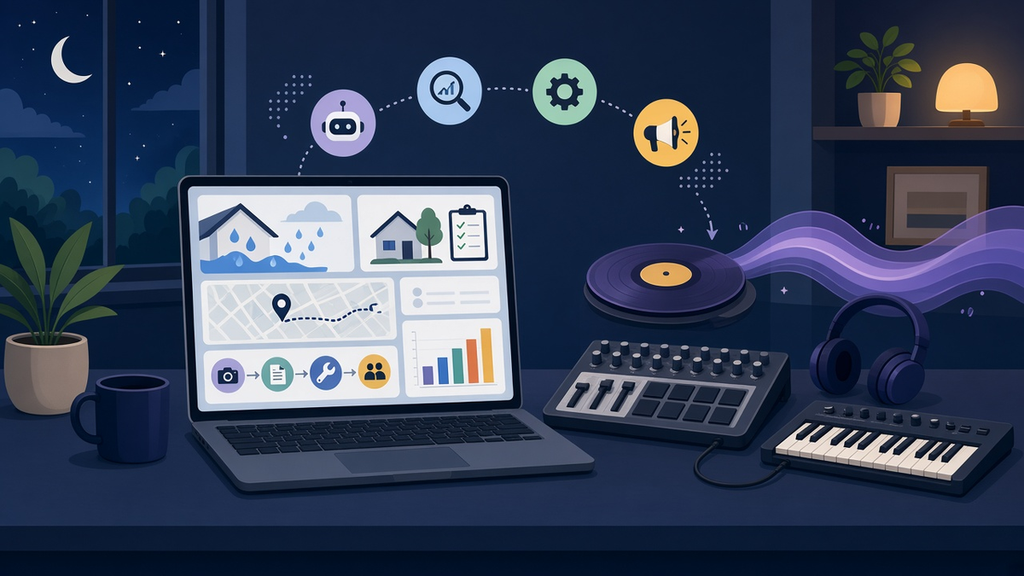
It is a Saturday night in March. On one screen, SM-01 is running its hourly health check across 23 websites. The VIP Email Monitor caught an urgent message from a client at 7 PM and routed it to Slack before I finished dinner. The SEO Drift Detector flagged two pages on a lending site that slipped 4 positions this week – already queued for Monday refresh.
On the other screen, I am making music. Not listening to music. Making it. On Producer.ai, I just finished a track called Evergreen Grit: Tahoma’s Reign – heavy West Coast rap with cinematic volcanic rumbles about the raw power of Mt. Rainier. Before that, I made a Bohemian Noir-Chanson piece called The Duty to Mitigate. Before that, a Liquid Drum and Bass remix of an industrial synthwave track.
Both screens are running AI. One is running my businesses. The other is running my creativity. And the line between the two has completely disappeared.
The Catalog Nobody Expected
I have a growing catalog on Producer.ai that would confuse anyone who tries to categorize it. Bayou Noir-Folk Jingles. Smokey Jazz Lounge instrumentals. Pacific Northwest G-Funk. Jazzgrass Friendship Duets. Chaotic Screamo. Luxury Deep House. Kyoto Whisper Pop. Lo-fi Lobster Beats. A cinematic orchestral post-rock piece. Soulful scat jazz.
These are not random experiments. Each one started with an idea, a mood, a reference point. Producer.ai is an AI music agent – you describe what you want in natural language and it generates full tracks. But the quality depends entirely on the specificity and creativity of your input. Saying make a rock song gets you generic garbage. Saying heavy aggressive West Coast rap with cinematic volcanic rumbles, focus on the raw power of Mt. Rainier, distorted 808s, ominous cinematic strings, and a fierce commanding vocal delivery – that gets you something that actually moves you.
The same principle applies to every AI tool I use. Specificity is the multiplier. Vague inputs produce vague outputs. Precise, creative, contextual inputs produce results that surprise you with how good they are.
What Music and Business Automation Have in Common
The creative process on Producer.ai mirrors the operational process on Cowork mode in ways that are not obvious until you do both in the same evening.
Iteration is the product. Grey Water Transit started as a somber cello solo. Then I remixed it into a moody atmospheric rap track with boom-bap percussion. Then a grittier version with distorted 808s. Then an underground edit with lo-fi aesthetic and heavy room reverb. Four versions, each building on the last, each finding something the previous version missed. That is exactly how I build AI agents – the first version works, the second version works better, the fifth version works automatically.
Constraints produce creativity. Producer.ai works within the constraints of its model. Cowork mode works within the constraints of available tools and APIs. In both cases, the constraints force creative problem-solving. When SSH broke on my GCP VM, I could not just SSH harder. I had to find the API workaround. When a music prompt does not produce the right feel, you cannot force it. You reframe the description, change the genre tags, adjust the mood language. Constraint is not the enemy of creativity. It is the engine.
The best results come from combining domains. Active Prevention started as an industrial EBM track. Then I added cinematic sweep. Then rhythmic focus. Then a liquid DnB remix. The final version combines industrial, cinematic, and dance music in a way no single genre could achieve. My best business automations work the same way – the content swarm architecture combines SEO, persona targeting, and AI generation in a way that none of those disciplines could achieve alone.
This Is Not a Side Project. This Is the Point.
Most people separate work and creativity into different categories. Work is the thing you optimize. Creativity is the thing you do when work is done. AI is collapsing that boundary.
On a Saturday night, I can run business operations that used to require a team of specialists AND make a G-Funk album AND write articles about both AND publish them to a WordPress site AND log everything to Notion. Not because I am working harder. Because the tools have caught up to how creative people actually think – in bursts, across domains, following energy rather than schedules.
The seven AI agents running on my laptop are not replacing my creativity. They are protecting my creative time by handling the operational overhead that used to consume it. When SM-01 monitors my sites, I do not have to. When NB-02 compiles my morning brief, I do not have to. When MP-04 processes my meeting transcripts, I do not have to. Every minute those agents save is a minute I can spend making music, writing, building, or simply thinking.
The Tracks That Tell the Story
If you want to hear what AI-assisted creativity sounds like, the catalog is on Producer.ai under the profile Tygart. Some highlights:
The Duty to Mitigate – Bohemian Noir-Chanson with dusty nylon-string guitar and gravelly vocals. Named after an insurance concept I was writing about that day. Work bled into art.
Evergreen Grit: Tahoma’s Reign – Heavy aggressive rap with volcanic rumbles. Made after a long session optimizing Pacific Northwest client sites. The geography got into the music.
Active Prevention – Industrial synthwave that went through five remixes including a liquid DnB version. Started as background music for a coding session. Became its own project.
Grey Water Transit – Cinematic orchestral rap that evolved from a cello solo through four increasingly gritty remixes. The iteration process is the creative process.
Frequently Asked Questions
What is Producer.ai exactly?
It is an AI music generation platform where you describe what you want in natural language and it creates full audio tracks. You can remix, iterate, change genres, add effects, and build a catalog. Think of it as Midjourney for music – the quality depends entirely on how well you can describe what you hear in your head.
Do you use the music professionally?
Some tracks become background audio for client video projects and social media content. Others are purely personal creative output. The line is intentionally blurry. When you can generate professional-quality audio in minutes, the distinction between professional asset and personal expression stops mattering.
How does making music make you better at business automation?
Both require the same core skill: translating a vision into specific instructions that a machine can execute. Prompt engineering for music and prompt engineering for business operations use identical cognitive muscles. The person who can describe Bohemian Noir-Chanson with dusty nylon-string guitar to a music AI can also describe a content swarm architecture with persona differentiation to a business AI. Specificity transfers.
The Future Is Not Work-Life Balance. It Is Work-Life Integration.
Saturday night used to be the time I stopped working. Now it is the time I do my most interesting work – the kind that crosses boundaries between operations and creativity, between business and art, between discipline and play. The AI handles the mechanical layer. I handle the vision. And the result is a life where building a business and making a G-Funk album are not competing priorities. They are the same Saturday night.
{
“@context”: “https://schema.org”,
“@type”: “Article”,
“headline”: “One Saturday Night I Built 7 AI Agents, Made a G-Funk Album, and Realized This Is the Future”,
“description”: “On a single Saturday I deployed autonomous agents, optimized 18 websites, generated AI music on Producer.ai from Tacoma G-Funk to Bohemian Noir-Chanson,.”,
“datePublished”: “2026-03-21”,
“dateModified”: “2026-04-03”,
“author”: {
“@type”: “Person”,
“name”: “Will Tygart”,
“url”: “https://tygartmedia.com/about”
},
“publisher”: {
“@type”: “Organization”,
“name”: “Tygart Media”,
“url”: “https://tygartmedia.com”,
“logo”: {
“@type”: “ImageObject”,
“url”: “https://tygartmedia.com/wp-content/uploads/tygart-media-logo.png”
}
},
“mainEntityOfPage”: {
“@type”: “WebPage”,
“@id”: “https://tygartmedia.com/one-saturday-night-i-built-7-ai-agents-made-a-g-funk-album-and-realized-this-is-the-future/”
}
}
Leave a Reply