
Owner Bottleneck Self-Assessment
$29
Delivered by email after checkout.
Secure checkout via Square — all major cards accepted
You can copy this method and do it yourself. Score yourself across five areas. Total the checks. Write your top 3 things to delegate first. Buy Now is the packaged Notion page you duplicate, so you are not rebuilding the 25-statement score from a blank doc.
Tool #2 of the Restoration Leadership Toolkit. Find out where your company still depends on you. An owner bottleneck exists when growth, decision speed, and consistency are limited by your personal involvement in day-to-day decisions. You become both the most important and the most constraining person in the business.
Check the box for each statement that is true of your business today. Count the checks in each section, then total them at the bottom. Be honest. The value is in the truth.
How to run it
- Work the five sections. Check only what is true today, not what used to be true or what you plan to fix.
- Total the checks (range is 0-25). Read your band.
- Write your top 3 to delegate first. Those become Weeks 1-2 of a 90-day doer-to-leader plan.
- For one full week after you score, log every interrupt for a decision. Sort into Delegate now / Delegate after training / Keep (truly owner-only).
- Re-run it at the end of 90 days and compare to Week 1. The number matters less than the trend.
1. Decisions only you make
- Estimate / pricing approvals over a set dollar amount run through me
- Hiring and firing decisions are all mine
- Vendor and supplier choices need my sign-off
- Which jobs we take is my call alone
- Refunds, credits, and customer concessions require me
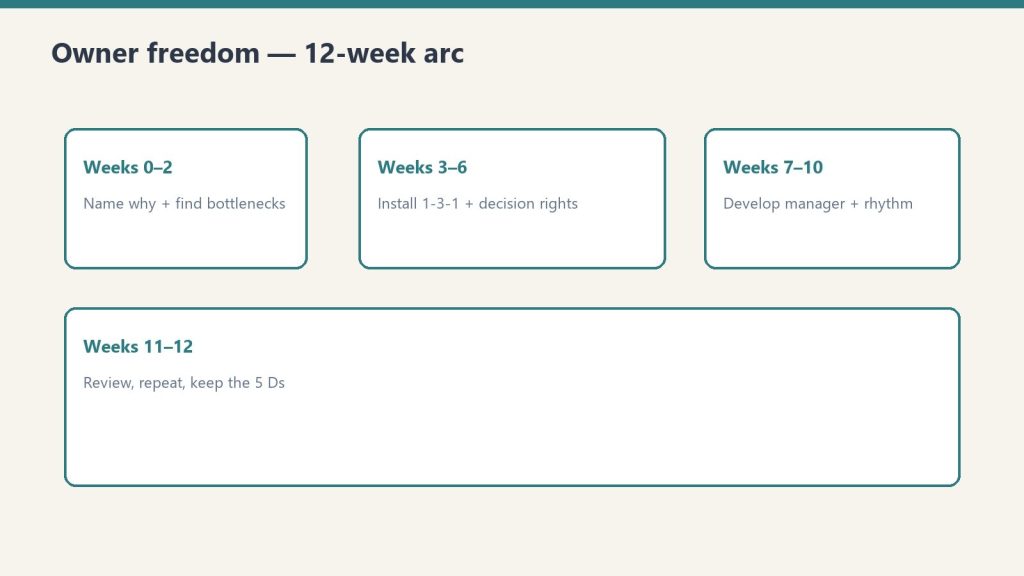
If this section is heavy, your next move is a Decision-Rights list: 10-15 recurring decisions, a dollar or scope threshold people can decide under without asking you, and who owns it when you are not in the room. Walk the team through it: “Under this line, you do not need me. Decide and tell me after.” Hand off one decision completely this month and do not take it back.
Starter rows if you need them: approve a job estimate over $25k; authorize overtime / call-in crew; issue a refund or credit; hire or fire; approve a vendor / sub payment; take an out-of-area or unusual job; sign a contract or insurance scope; pull a crew off one job for another; spend on new equipment; set or discount a price.
2. Interruptions by department
- Production calls me daily with questions
- Office / admin pulls me into billing or scheduling
- Sales / estimating checks pricing with me before quoting
- Technicians call me from job sites
- I get pulled into customer complaints personally
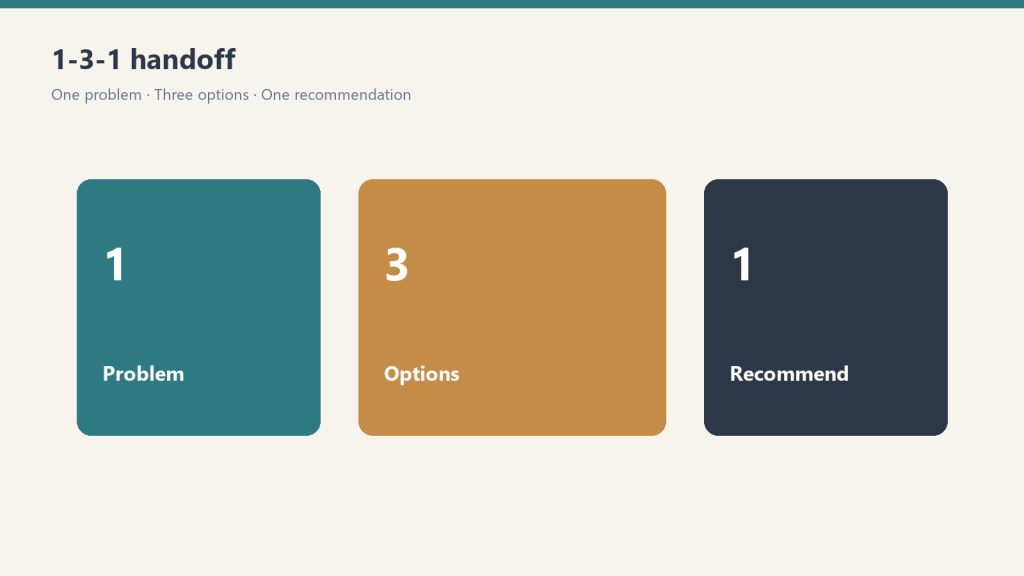
Tally the interrupts for one week. The department with the most checks is this quarter’s target. Install 1-3-1 there first: one issue, three options with pros/cons/cost, one recommendation, and a default if they do not hear back by a deadline. When someone brings a raw problem, ask: “What are your three options, and which do you recommend?” Then wait.
3. Recurring questions that come back to you
- The same operational questions reach me every week
- People wait for me to decide instead of deciding themselves
- “Ask the owner” is the default answer here
- I re-explain the same processes over and over
- Things stall when I am unavailable
Recurring questions are undocumented decisions. Write the answer once. Put it where the question gets asked (truck, office, group chat). If you re-explain the same process, that process needs an SOP or a named owner, not another explanation from you.
4. Tasks that should be delegated
- I still write estimates I could hand off
- I handle scheduling / dispatch
- I chase collections / AR myself
- I order equipment and supplies
- I personally produce things others could
These are doer tasks wearing an owner badge. Pick one. Hand the outcome, not the task. “You own scheduling this month. I will sit in the first week. After that, bring me 1-3-1s, not the board.” Name the 1-2 skills they most need and how you will help (ride-along, training, a stretch job). Set a weekly 30-minute 1-on-1 and protect it.
5. Areas with no backup
- No one else can run production if I am out
- Only I hold the key carrier / adjuster relationships
- Only I can see the full financial picture
- There are no written SOPs for the things I do
- If I am gone a week, something breaks
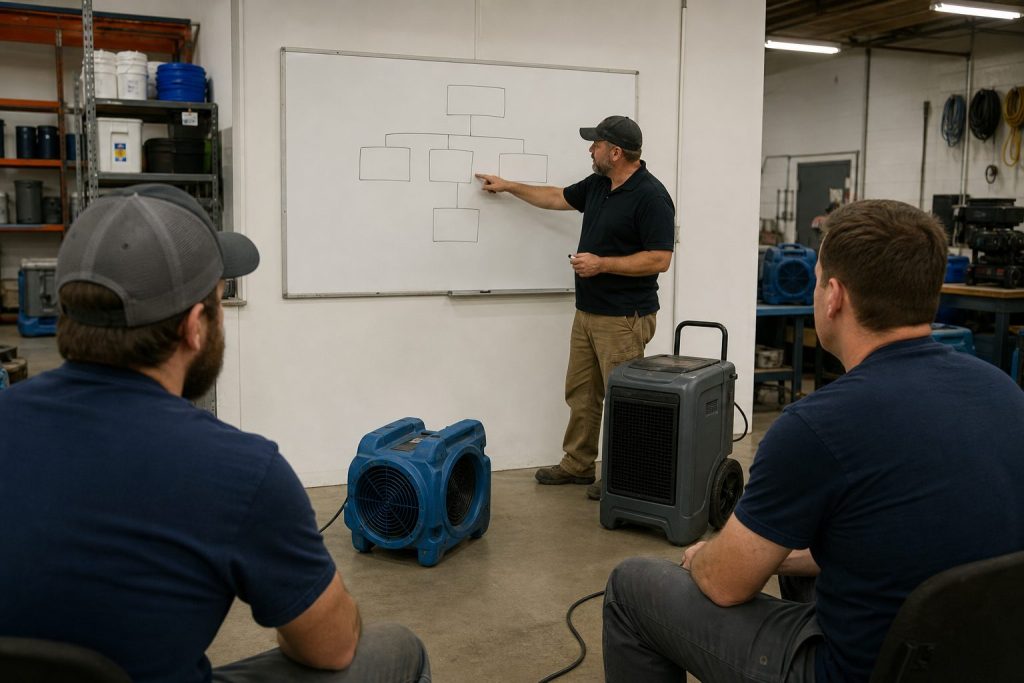
A checked box here is a single point of failure. Name the backup, or name the blank. A blank candidate is itself a finding. Put each exposed function on a bench list: current owner, future-leader candidate, backup depth (None / Thin / Solid), the skill gap, one observable 90-day action, a weekly or biweekly check-in.
This section is the short version of the Owner Dependency Audit (nine areas, Low/Med/High, what breaks if you vanish 30 days) and the 5 Ds Disease / Departure boxes (vacation test, backup estimator, relationships not owned by one person).
Your score
Total checks: ___ / 25
- 0-6 Mild. You have delegated well. Tighten the few remaining gaps.
- 7-13 Moderate. You are the bottleneck in one or two areas. Fix the worst one first.
- 14-19 Heavy. The business runs through you. Start delegating now, deliberately.
- 20-25 Severe. You ARE the business. This is the #1 risk to your growth and your exit.
Write your top 3 to delegate first. Take the worst section into a 90-day doer-to-leader plan. Run the Owner Dependency Audit for the full picture (nine areas, Decision-Rights Map, 30-day disappear test).
Tell the team the shift is coming: “I am working a 90-day plan to push decisions down. Expect me to hand more back to you.” Then do it. Re-score at Week 12. Take a planned half-day fully off and note what broke. That is the next bottleneck.
If you want the packaged assessment
You can run the 25 statements on a legal pad. Buy Now is the Notion page delivered by email after checkout. Duplicate it (··· → Duplicate) so the original stays clean for next quarter. The five sections, the score table, and the top-3 lines are already laid out. Same Square button at the top of this page.
Pairs with the Owner Dependency Audit (deeper diagnostic) and the 90-Day Doer-to-Leader Transition Plan (Weeks 1-2). Matching Claude skill: owner-bottleneck-assessment. Coaching and operational tool only. Not legal or HR advice.
Related: Restoration Leadership Toolkit — Claude Edition. Also 1-3-1 Delegation Worksheet.
Leave a Reply