Tag: Tacit Knowledge

  • Your Partner Is Sitting on the Most Valuable Asset of Their Career: A Letter to the Families of Veteran Operators

    Your Partner Is Sitting on the Most Valuable Asset of Their Career: A Letter to the Families of Veteran Operators

    If you are married to, the child of, or close to someone who has spent thirty or forty years building expertise in a skilled trade or industry, they are sitting on the most valuable asset of their entire career — and most of them have no idea. This article is for you. The people who can see it from the outside. The ones who have watched them carry this knowledge for decades without ever fully understanding what was being built. The ones who can help them see what the market is finally about to pay them for.

    This is not about flattery. This is about a structural shift in the economics of skilled work, and a quiet conversation happening in households across every industry right now between veterans who feel obsolete and families who can see something the veterans cannot see about their own value. The shift is real. The conversation matters. Your read of the situation may matter more than your partner’s, because you can see it more clearly from the outside.

    What You Have Watched Them Build

    You have probably watched your partner come home from job sites for decades. You have watched them solve problems in their head over dinner, walk through difficult customer situations out loud while doing the dishes, replay the day’s calls during the drive home from the kids’ practices. You have heard the names of the same colleagues and adjusters and suppliers and competitors for so many years that you could probably handle the introductions yourself at the industry holiday party.

    You have watched them get phone calls at unreasonable hours from younger people in their field who needed help thinking through something. You have watched them come home from a job and quietly mention that the situation was handled, without ever explaining that “handled” meant they had drawn on twenty years of pattern recognition that nobody else on that crew could have produced. You have watched them downplay their own competence in front of family, in front of social settings, in front of younger relatives who asked what they did for a living.

    You have probably noticed, at some level, that what they actually do for a living is harder and more skilled than the way they describe it. You have probably also noticed that they have never been compensated at the level that matches what they actually carry. That has been frustrating to watch. It has probably been frustrating for them to live, even if they have never said it directly.

    The thing they carry — the knowledge that took them thirty years to build — is called tacit knowledge. It is the hands-on, judgment-laden, in-the-field expertise that has never been written down in any textbook, never been captured in any manual, never been measurable on any certification exam. It lives inside their head, where it has lived for decades, mostly invisible to the world outside their industry. And it is about to become the most valuable thing in their field.

    Why the Market Is Finally Catching Up

    For most of their career, the market has not paid your partner what their knowledge was actually worth. The reason is structural. The economics of skilled industries have, for forty years, undervalued tacit expertise because it was hard to measure, hard to credential, and competed against a flood of documented knowledge that was easier to value. The senior operator with thirty years of judgment was paid roughly the same as the senior operator with the same job title and ten years of mediocre experience, because the industry could not reliably tell the difference from the outside.

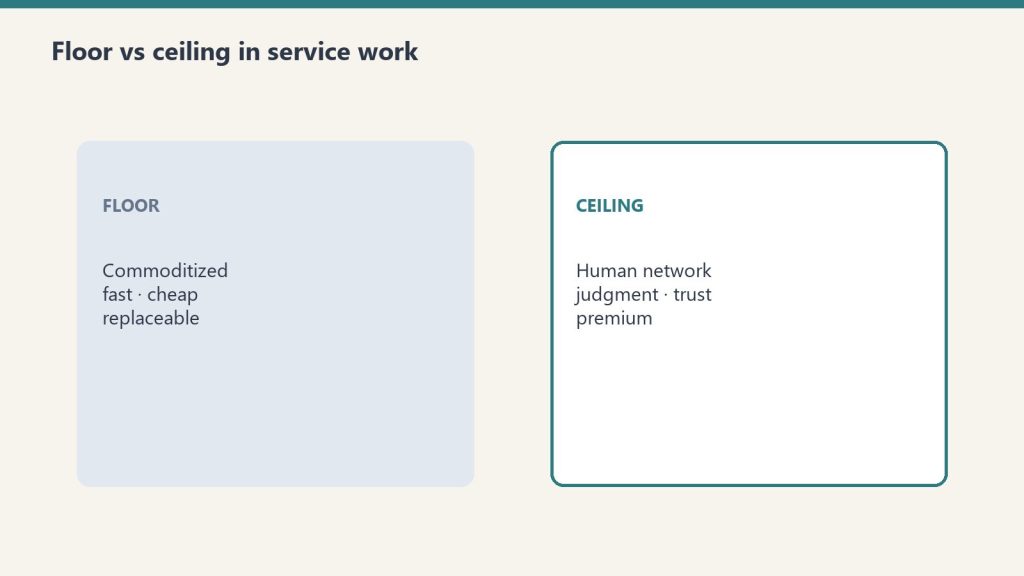
    The AI shift changes that. The documented, procedural floor of every skilled industry is now accessible to anyone with a smartphone and a willingness to use modern tools. AI is making the floor commoditized. What is left, the only meaningful differentiation in any skilled industry, is the tacit knowledge that AI cannot replicate. And the only people who have it are the veterans like your partner.

    This is not a small repricing. It is a structural inversion. The people who have been undervalued for decades are about to be revalued at premium rates, because the rest of the work is being commoditized down to them. The veterans who are not paying attention are going to continue undercharging for their time and selling themselves short out of habit. The ones whose families help them see what is happening are going to charge appropriately and capture the value they have always deserved.

    This is where you come in.

    What Your Partner Probably Cannot See

    The thing that makes this conversation hard is that the people who built their expertise the hardest are usually the worst at recognizing what they have. The veterans in skilled industries did not build their knowledge by going to a fancy school and earning credentials. They built it by showing up to a thousand difficult job sites, making mistakes, fixing the mistakes, internalizing the corrections, and gradually accumulating a kind of competence that they cannot fully explain even to themselves.

    Because it accumulated slowly and invisibly, most veterans do not see how much they have actually built. They see only the day-to-day, where they are still solving problems that have come to feel routine to them. They have stopped noticing that the problems they consider routine are problems that no junior operator on their team could solve at all. They calibrate to their own current capability and assume that everyone in their field operates at the same level, because they cannot remember what it was like to not have the knowledge they have now.

    You can see it more clearly. You have watched the trajectory. You know how much more capable they are now than they were twenty years ago. You have seen who calls them for help and who does not. You have heard the way the younger people in their field talk about them. You have noticed when industry peers defer to their judgment in conversations.

    What you can do is name it for them. Not in a way that feels like flattery, which they will dismiss. In a way that feels like accurate observation. “The thing you handled today is not something most people in your industry could handle. I have been watching for thirty years. You are at a level very few people get to.” That kind of grounded reflection from a partner is something a veteran will hear in a way they cannot hear it from anyone else.

    The Conversations That Matter Right Now

    There are a small number of conversations worth having with your partner over the next few months. They do not all have to happen at once. They are the conversations that help them recognize the moment they are in and act on it before the window closes.

    The first conversation is about retirement timing. The traditional model assumes senior operators retire on a schedule built around age, savings, and a relatively standardized exit from the workforce. The new economics suggest that timing should be reconsidered. The most valuable years of your partner’s career may be the next ten, not the last ten. Encourage them not to rush an exit they were planning around outdated assumptions about the value of their work.

    The second conversation is about pricing their time. Most veterans chronically underprice their advisory and judgment work because they have been doing it for free for decades. Help them think about what their time is actually worth in the new market. The hourly value of senior-operator judgment in skilled industries is climbing rapidly. The veterans who adjust their rates capture the upside. The ones who keep charging their old rates leave most of the value on the table.

    The third conversation is about teaching and mentoring. Your partner has likely been informally mentoring younger people in their field for years. That work has historically been unpaid. It does not need to be. The same time spent in a formal apprenticeship or advisory arrangement, with appropriate compensation, is some of the highest-leverage work available to senior operators in any industry. Encourage them to formalize what they have been doing informally.

    The fourth conversation is about capturing the knowledge. If your partner retires in the next ten years without anyone deliberately capturing what is in their head, an enormous amount of irreplaceable expertise will simply disappear. There are now structured methodologies for converting that knowledge into transferable form — long-form structured conversations that surface the judgment patterns underneath their work and convert them into useful artifacts. Encourage them to participate in this kind of process, either internally at their company or independently. The output is something their family, their successors, and their industry can keep long after they are gone.

    The fifth conversation is about belief. Many veterans have been told, directly or indirectly, that they are becoming obsolete. Some of them have started to believe it. You can be the voice that pushes back. The market is in the process of revaluing exactly what they hold. The veterans who hear that from someone they trust — and your partner trusts you in a way they trust very few people — internalize it faster and act on it sooner.

    What This Means for Your Household

    The financial implications of this shift are real. A veteran whose work is properly repriced in the new market may see significant income changes over the next five years — through higher rates, advisory contracts, structured retirement packages with consulting components, or in some cases acquisition opportunities for their company or stake in it. These changes will not happen automatically. They require deliberate action.

    The household conversations that match this moment are different from the ones that match a traditional retirement runway. Instead of planning a wind-down, you may be planning a peak. Instead of optimizing for time off, you may be optimizing for the deliberate capture of value that has been building for thirty years and is finally going to be paid out. Instead of asking when they can stop working, you may be asking how long they want to keep working in their new and more valuable role.

    This is a good conversation to have. It is the conversation of a household that has supported a career through a long arc and is now arriving at the moment when the support pays back. It is also, frankly, the conversation that recognizes the support you have given. The career you have watched them build was not built alone. The repricing that is about to happen is not just their win. It is yours too.

    Frequently Asked Questions

    How do I help my partner see the value of their experience?

    Name what you have observed accurately and specifically. Not flattery — observation. Point to specific situations where they handled something that nobody else in their field could have handled. Reflect back what you have watched them build over decades. The veterans who hear this from a partner they trust internalize it in a way they cannot internalize it from anyone else.

    Should my partner delay retirement because of AI changes?

    Possibly. The traditional retirement schedule assumed senior operators were a cost to be reduced. The new economics value them as the highest-leverage asset in their industries. Their most valuable years may be the next ten. Encourage them to reconsider any retirement timeline that was built around outdated assumptions.

    How do I encourage a veteran to charge more for their time?

    Start with the observation that the market is shifting and that hourly rates for senior judgment work are climbing across skilled industries. Most veterans underprice from habit. Sometimes the most effective conversation is asking what they would charge a stranger for the same advice, then comparing that to what they actually charge their current clients. The gap is usually significant.

    What is tacit knowledge and why does it matter for my family?

    Tacit knowledge is the practical, judgment-based expertise that veterans build over decades and that has never been written down in any manual. It matters for your family because it is the asset your partner has been building their entire career, it is about to be revalued sharply upward by the market, and it is finite — it disappears when they retire if nobody deliberately captures it.

    How do we capture my partner’s knowledge before they retire?

    There are structured methodologies for extracting tacit knowledge through long-form interviews and converting it into transferable artifacts. Some operators do this through their company. Some do it independently. The output is a durable record of expertise that the operator’s successors, family, or business can keep long after retirement. The process is most valuable while the operator is still active and accessible.

    What if my partner is resistant to recognizing their own value?

    This is common. The veterans who built their expertise the hardest are usually the worst at recognizing it. Stay patient. Stay grounded. Continue to name what you observe accurately. Point to specific evidence — who calls them for help, who defers to their judgment, what they have handled that others could not. Over time the accumulated weight of accurate reflection lands.

    The Bottom Line

    Your partner has spent decades building something that has been undervalued by the market for most of that time, and is about to be sharply revalued upward. The thirty years of tacit knowledge sitting in their head is, in the new economics of skilled work, the most valuable asset they will ever own. Most veterans cannot see it clearly from the inside. You can see it from where you sit.

    You have watched them build it. You have supported the career that produced it. You are in the best possible position to help them see what the market is finally about to pay them for. The conversations you can have with them in the next few months — about timing, about pricing, about teaching, about capturing the knowledge, about belief — may be the most consequential conversations of their professional life.

    They are not aging out of relevance. They are aging into their peak value. The market is in the process of catching up to something you have probably understood about them for years. Help them see it. The household you have built together is about to find out that the long career was even more valuable than either of you knew.


  • The Apprenticeship Is the Curriculum: A Letter to Industry Trainers and Educators in the AI Era

    The Apprenticeship Is the Curriculum: A Letter to Industry Trainers and Educators in the AI Era

    If you train operators in any skilled industry — through formal certification programs, in-house training departments, trade schools, association curricula, or corporate development tracks — the AI shift is about to make most of your existing infrastructure obsolete, and the model you probably abandoned forty years ago is about to become the real curriculum again. This is not a small adjustment. This is a structural rewrite of how skilled industries develop their next generation of operators.

    The thesis is simple. Every certification program, classroom curriculum, and standardized training regime in skilled industries was built around documented, explicit knowledge — the procedures, the standards, the technical specifications, the regulatory requirements. That body of knowledge is exactly what AI has just commoditized. AI raises the floor of every industry, and the floor is precisely what your formal curriculum has been teaching.

    The ceiling — the tacit knowledge that defines great operators — has never lived in any classroom. It lives in apprenticeship relationships, in proximity to senior practitioners, in the kind of learning environment that the modern training-industrial complex deliberately moved away from in the name of scale and professionalization. The shift now reverses that. The training infrastructure that scales does not transfer the knowledge that matters anymore.

    What Your Existing Curriculum Actually Teaches

    If you run a formal training program in any skilled trade or industry, look at your current curriculum honestly. The bulk of what you teach is documented, codified, and standardized. The IICRC body of knowledge. The trade certification standards. The OSHA regulations. The technical specifications of the equipment your industry uses. The customer-service scripts. The compliance requirements. The reporting frameworks.

    All of that material exists because it can be written down. That is exactly why it is now also accessible to anyone with an AI tool. A new technician with a phone can pull up the entire body of explicit knowledge in your industry in seconds, get it explained at whatever level of depth they need, and apply it competently within weeks. The information advantage that formal training used to provide has collapsed.

    What your curriculum does not teach — because curriculum cannot teach it — is the judgment that senior operators apply when the documented procedure does not match the actual situation. The pattern recognition that lets a thirty-year veteran walk onto a job site and know within ten minutes which parts of the standard scope are wrong for this specific case. The customer-handling instinct that defuses a difficult homeowner. The supplier-relationship knowledge that determines who actually delivers on Friday afternoons. The failure-mode memory that lets a senior operator predict where this specific job is going to go wrong before the crew has even started.

    That knowledge is the ceiling of your industry. It cannot be taught in a classroom. It can only be transferred through proximity to people who already have it. And the formal training infrastructure that your industry has built over the last forty years was specifically designed to move away from that model, in favor of something that scales.

    Why the Classroom Model Was Adopted in the First Place

    The formalization of skilled-industry training was a rational response to the conditions of the late twentieth century. The apprenticeship model, while it produced great operators, did not scale. It was slow. It was geographically constrained. It was uneven in quality. It was dependent on the personal commitment of senior operators who were not always good at teaching. And it was opaque to regulators, insurers, and customers who wanted standardized credentials they could trust.

    Classroom-based certification solved real problems. It standardized the floor. It made the explicit body of knowledge accessible to a much larger population. It produced credentials that customers and insurers could trust. It allowed industries to scale faster than the slow, organic apprenticeship system would have permitted.

    But it also introduced a structural blind spot. The training-industrial complex got very good at teaching what could be written down, and progressively worse at transmitting what could not. The graduating technician now has the certification, but does not have the judgment. The certification used to be a proxy for judgment because it took years of apprenticeship to earn. Now the certification is just a credential, and the judgment is missing. Most of the industry has been quietly aware of this for two decades and has not had a structural solution for it.

    The AI shift makes the structural problem unavoidable. The credentials are now equivalent across operators because AI can teach anyone the explicit body of knowledge equally well. The only remaining differentiation is the judgment that the formal training infrastructure was never designed to transfer. The training programs that recognize this and adapt will produce the next generation of operators who can actually compete at the ceiling. The training programs that do not will produce certified operators with no judgment, all of whom are interchangeable, all of whom will be commoditized.

    What the New Curriculum Actually Looks Like

    The training program that fits the AI era is not a curriculum reform. It is a structural rearrangement of how operators develop. Here is what it looks like.

    The explicit body of knowledge gets delivered by AI. The standards, the procedures, the regulations, the technical specifications — all of that gets handed off to AI tutoring systems that can teach any individual operator at their own pace, with full personalization, and unlimited patience. This is what AI is genuinely good at. Let it do that part. Stop spending classroom hours on material that AI teaches better than any human instructor ever could.

    The classroom time gets converted to practicum and judgment work. The hours saved from explicit-knowledge instruction get reallocated to structured exposure to real situations — case studies of actual jobs, walk-throughs of judgment calls, exposure to senior operators in the field. The classroom becomes a place where the tacit knowledge of the industry gets surfaced and discussed, not where the textbook gets reviewed.

    The apprenticeship becomes a deliberate, structured program. Each trainee gets paired with a senior operator for a meaningful period — months or years, not days — working alongside them on real jobs, with explicit conversation about why each decision is being made. The program is structured. The conversations are deliberate. The trainee is expected to absorb judgment, not just procedures. This puts senior operators back in the center of training, where they should have been all along.

    The senior operators get compensated for teaching. The traditional apprenticeship model collapsed in part because senior operators were not paid to teach. They taught because they wanted to or because their employer expected it, and the quality varied accordingly. The modern apprenticeship model treats senior operators as paid instructors whose teaching is a recognized, compensated, valued part of their role. The economics finally align with the importance of the function.

    The certification incorporates judgment assessment, not just knowledge assessment. The traditional certification exam tested whether you knew the documented body of knowledge. The modern certification needs to test whether you can apply judgment to novel situations. This is harder to design and harder to grade, but it is the only certification that will actually differentiate competent operators from interchangeable ones in an AI-saturated industry.

    Why This Is an Opportunity, Not a Threat

    If you run a training organization in a skilled industry, the natural reaction to this analysis is anxiety. The infrastructure you built — the classrooms, the curriculum, the certification programs, the instructional staff — is at risk of becoming obsolete. That anxiety is understandable but misplaced.

    The opportunity is that you are uniquely positioned to be the bridge between AI tooling and senior operators. Your existing relationships with the industry, your credibility with certification bodies, your access to both senior practitioners and developing operators — all of that is exactly what is needed to build the new training infrastructure. The organizations that move quickly to redefine their role will become more important to their industries than they have ever been. The ones that resist will be displaced by new entrants who build the new model from scratch.

    The training organization of the AI era is not a school. It is a brokerage. It connects senior practitioners with developing operators, provides the structural scaffolding for deliberate apprenticeship, delivers AI-tutored explicit-knowledge instruction at scale, designs judgment-assessment certification, and captures the tacit knowledge of senior operators into transferable forms before they retire. That is a more valuable institution than the classroom-based credentialing organization that came before it.

    What to Do in the Next Twelve Months

    If you run a training program in a skilled industry, here are the moves that match the moment.

    Pilot an AI-delivered explicit-knowledge curriculum on one segment of your training population. Use one of the modern AI tutoring systems to deliver the standards, procedures, and technical specifications, and measure how the learning outcomes compare to classroom delivery. In most pilots the AI delivery outperforms the classroom on knowledge retention while taking a fraction of the instructional time.

    Reallocate the freed instructional hours to structured judgment work. Build case-study sessions, walk-throughs of complex real jobs, conversations with senior operators about their decision frameworks. Treat these sessions as the high-value core of your curriculum, not the supplementary material.

    Build deliberate apprenticeship pairings. Identify the senior operators in your industry network who are good at teaching and are willing to take on structured mentoring. Pair them with developing operators in a formal, time-bounded, compensated arrangement. Track the outcomes. The data on apprenticeship effectiveness will quickly justify expanding the program.

    Develop judgment-assessment instruments. Work with senior operators to design assessment scenarios that test whether a developing operator can apply judgment to novel situations, not just recite documented knowledge. Pilot these alongside your existing certification exams. The judgment instruments will quickly become more predictive of actual job performance than the knowledge-recall instruments.

    Run a Human Distillery process with the most respected senior operators in your industry network. Extract their tacit knowledge in structured form. Use the output as core teaching material for your apprenticeship program. The senior operators get a durable artifact of their expertise. Your training program gets curriculum material that no competitor can replicate.

    Frequently Asked Questions

    Will AI replace human instructors in skilled-industry training?

    AI will replace instructors for the documented, explicit body of knowledge — standards, procedures, regulations, technical specifications. AI cannot replace the human transfer of tacit, judgment-based knowledge, which has always required proximity to senior practitioners. The instructional role shifts from delivering documented content to facilitating judgment development and apprenticeship.

    What is wrong with the current classroom-based training model?

    It was designed to teach explicit knowledge at scale, which AI now does better. It was never designed to transfer the tacit, judgment-based knowledge that defines great operators, and the absence of that transfer has been a structural problem in skilled industries for decades. The AI shift exposes the problem and forces a structural response.

    How do you design an apprenticeship program that actually works?

    Pair developing operators with senior practitioners who are both skilled at their work and willing to teach. Structure the time around real jobs, not classroom exercises. Build explicit conversation about decision frameworks into the work. Compensate the senior operator for teaching. Make the program long enough — months or years — for tacit knowledge to actually transfer.

    Can judgment be tested in a certification exam?

    Yes, but with different instruments than traditional knowledge-recall exams. Scenario-based assessments that present novel situations and evaluate the operator’s reasoning are far more predictive of actual job performance than multiple-choice tests of documented knowledge. Several certification bodies are beginning to pilot these formats, with strong early results.

    What happens to existing certification credentials in the AI era?

    Knowledge-recall certifications will lose value because the underlying knowledge is now equally accessible to everyone via AI tools. Judgment-based certifications and verified-apprenticeship credentials will gain value because they signal something AI cannot replicate. Certification bodies that adapt early will set the standards for the new era.

    How do you compensate senior operators for teaching?

    Treat teaching as a paid, recognized, valued part of the senior operator’s role rather than an unpaid expectation. Build instructor stipends, mentorship bonuses, or fractional teaching contracts into the structure. The most respected senior operators in most industries are willing to teach if the economics and the respect dynamic are right.

    The Bottom Line

    The training and certification infrastructure that skilled industries built over the last forty years was optimized for explicit knowledge transfer at scale. AI just made explicit knowledge cheap. The infrastructure that matters now is the one that transfers tacit knowledge — and that infrastructure looks a lot more like the apprenticeship model the industry abandoned than the classroom model it adopted.

    This is not a return to the past. It is an upgrade. Modern apprenticeship combines AI-delivered explicit-knowledge instruction at scale with deliberate, structured, compensated tacit-knowledge transfer from senior operators to developing ones. It is more effective than either the classroom model or the traditional apprenticeship alone. It produces operators who can compete at both the floor and the ceiling. And it puts the senior operators of every industry back in the center of training, where they have always belonged.

    The training organizations that recognize this and adapt are about to become more important to their industries than they have been in decades. The apprenticeship is the curriculum. The senior operators are the faculty. The AI tools deliver the textbook. The certification rewards judgment, not recall. The model is simple. The window to lead the shift is open right now. Step into it.


  • The Asset Sitting in Their Head: How to Value and Acquire Tacit Knowledge Before It Walks Out the Door

    The Asset Sitting in Their Head: How to Value and Acquire Tacit Knowledge Before It Walks Out the Door

    If you own a skilled-industry business, or you buy them, the most valuable asset on your balance sheet is not on your balance sheet at all. It is the tacit knowledge sitting inside the heads of your senior operators — the judgment patterns, the relationship maps, the failure-mode instincts, the customer-handling moves that took thirty years to develop and have never been written down. That asset is about to be repriced sharply upward, and most owners and buyers have not adjusted their thinking yet.

    This article is for the people who control capital in skilled industries. The owners, the operators, the private-equity buyers, the acquirers, the strategic investors. The thesis is simple. The AI shift is making the procedural floor of every industry cheap. The ceiling — the tacit knowledge that defines the great operators — is becoming the only durable competitive moat. If you do not have a deliberate strategy for valuing, protecting, and acquiring that asset, you are leaving the most important variable in your business unmanaged.

    What Has Changed in the Economics of Expertise

    For most of the last forty years, the economic narrative around skilled industries was that experienced operators were a cost center. Senior labor was expensive. The instinct of professionalized management was to push experience toward retirement, replace it with cheaper junior labor backed by software, and capture the difference as margin. That playbook worked in an era when the documented, procedural knowledge of an industry was the bulk of what made a company functional.

    That era ended sometime in the last twenty-four months. The arrival of capable AI systems collapsed the cost of doing the procedural floor work. AI raises the floor of every industry, but it cannot touch the ceiling. The procedural work that used to consume hours of each senior operator’s day — scoping, documentation, communication, reporting — can now be done by software in a fraction of the time. What is left of the senior operator’s role is the part that cannot be automated. The judgment. The relationships. The pattern recognition. The tacit knowledge.

    That residual is now the entire game. And it lives inside heads, not inside systems. The companies that built defensible positions on the back of senior expertise are sitting on the most undervalued asset in their balance sheet. The companies that pushed senior expertise out the door to optimize margin have just discovered that the operators they replaced cannot actually be replaced.

    How to Recognize the Asset in Your Business

    Most owners do not have a clear picture of where the tacit knowledge in their company actually lives. Here is how to find it.

    Look at who gets called when something goes sideways. Every company has a small number of operators who are the de facto resolution layer for unusual problems. The job that confuses the project manager. The customer who is about to fire you. The technical situation the team has never seen. The senior people who handle those situations are sitting on the institutional judgment. Most of them have been at the company a long time. Most of them are underleveraged in formal management hierarchies because their value does not show up on a traditional org chart.

    Look at who customers ask for by name. The senior operators who get specifically requested by repeat customers are carrying brand equity that does not belong to the company. It belongs to them personally. If they leave, that customer revenue is at meaningful risk. Most companies do not track this. They should.

    Look at who the younger employees informally consult. In every skilled-industry business, there is a shadow advisory structure underneath the formal one. Junior employees know which senior operators actually understand the work and quietly route their hardest questions to those people. Identify those informal advisors. They are the carriers of the company’s real expertise.

    Look at who solves problems that the documentation does not solve. The procedure manual covers the common cases. The unusual cases get solved by senior operators using judgment that is not in any document. The people who solve those cases are the ones whose departure would create the largest knowledge gap.

    Once you have identified the carriers, you have identified the asset. The next question is how much it is worth.

    What Tacit Knowledge Is Actually Worth

    The economic value of tacit knowledge in a skilled-industry business is most easily measured by what happens when it walks out the door. Specifically — what does it cost to replace a senior operator who carries deep institutional judgment, and how long does the replacement take?

    In most skilled industries the answer is genuinely surprising. Replacing a senior operator with thirty years of experience usually takes between two and five years of ramp time before the replacement reaches comparable judgment capacity, and often the replacement never fully gets there. During that ramp period, the business carries elevated error rates, lower margins on complex jobs, and customer-relationship risk that is invisible until something goes wrong.

    A rough way to value a senior operator who carries tacit knowledge — multiply their fully loaded annual cost by the number of years of ramp time their replacement would require, then add the contribution margin on the complex work that only they can currently handle. That number is the floor on the asset value sitting in their head. In many cases it is meaningfully larger than the asset value of any piece of equipment the company owns.

    For acquirers, this calculus changes how due diligence should be done. The standard due diligence checklist focuses on equipment, contracts, customer concentration, and financials. The most important variable — the bench strength of senior operators who carry institutional judgment — is rarely scrutinized with the same rigor. That is the variable that determines whether the acquired business is actually durable post-close, or whether the value evaporates the moment the founder or senior operators walk.

    The Acquisition Playbook for Tacit Knowledge

    If you are buying a skilled-industry business, the deal structure has to reflect where the actual value lives. Here is the modern playbook.

    Structure earnouts around senior operator retention, not just revenue. The traditional earnout ties contingent payment to revenue or EBITDA milestones. The modern earnout should also tie payment to keeping specifically named senior operators in place and engaged for a minimum number of years. If the senior operator walks, the earnout drops, because the asset you actually bought walked with them. This protects you. It also signals to the seller that you understand what you are buying.

    Negotiate explicit knowledge transfer requirements. The acquisition agreement should require structured knowledge transfer from senior operators to identified successors over a defined window. This is not a soft commitment. It is a specific, scheduled, documented apprenticeship program built into the deal terms. The seller has incentive to comply because their earnout depends on it. The buyer has protection because the institutional knowledge is being captured in transferable form.

    Identify and lock in the carriers before close. In the diligence phase, identify the specific senior operators who carry the most institutional judgment. Then build retention packages for them, contingent on the deal closing. Communicate to them directly that they are recognized as critical to the business and that the acquirer values their role. The most common failure mode in skilled-industry acquisitions is that the carriers feel undervalued post-close, get a better offer from a competitor six months later, and walk. The business value goes with them.

    Run a Human Distillery process on the founder. If the founder is a senior operator with decades of experience, run a deliberate, structured extraction of their tacit knowledge before they exit the business. This is a specific methodology — a series of long-form, structured conversations that surface the judgment patterns underneath their work and convert them into operator-ready playbooks and AI-ready training data. The output is a durable knowledge asset the company owns even after the founder departs.

    Price the deal accordingly. A business whose senior operators are committed to staying and whose tacit knowledge has been extracted into transferable form is worth materially more than a business with identical financials but no knowledge-transfer infrastructure. Acquirers who understand this can pay premium multiples to sellers who have done the work, and still capture more value than buyers who pay lower multiples for undurable assets.

    The Owner Playbook If You Are Not Selling

    If you own a skilled-industry business and you are not planning to sell, the strategic implications are different but equally important.

    Identify your carriers and treat them as the highest-leverage asset in your company. The senior operators who carry institutional judgment should be the highest-paid, most-respected, longest-retained employees in your business, regardless of where they sit on a formal org chart. If your compensation system rewards management layers and underrewards senior operator depth, your compensation system is misaligned with the actual economics of your industry.

    Build apprenticeship structures around them. Pair each senior operator with one or two younger employees in a deliberate apprenticeship model. The younger employees work alongside the senior on real jobs, absorbing the judgment patterns in context. This is not training in the classroom sense. It is the traditional craft model, applied deliberately to capture knowledge that would otherwise leave with retirement. The career path this creates for younger employees is a meaningful retention tool in its own right.

    Document the patterns that can be documented. Some tacit knowledge cannot be written down, but a meaningful fraction of it can be surfaced through structured conversation. Have someone — internal or external — sit with each senior operator and run them through their judgment patterns systematically. The output is an internal playbook. It does not replace the senior operator. It captures enough of their judgment to accelerate the next generation and to maintain consistency if the senior departs unexpectedly.

    Plan retirement transitions over years, not months. The traditional retirement model assumed senior labor was overhead. The modern model recognizes senior operators as carriers of institutional capital. Plan their transitions over three to five years, with reduced hours and explicit advisory roles, so the knowledge has time to transfer. Most senior operators will accept a reduced-hours advisory arrangement for years longer than they would accept the traditional retirement schedule.

    The Strategic Window

    This shift is happening now. The owners and acquirers who recognize it in the next twenty-four months are going to capture significant economic value. The ones who continue operating on the assumption that senior labor is a cost center are going to find themselves losing the carriers, losing the institutional capability, and competing on a commoditized floor against everyone else.

    The window is open right now because most of the industry has not yet adjusted to the new economics. Senior operators are still being valued at pre-AI rates. Acquisition multiples are still being calculated on pre-AI frameworks. The companies that move quickly can build moats their competitors will not understand for years.

    The asset is sitting in their heads. The market is in the process of figuring out what it is worth. The operators who control the asset are about to be the most valuable people in their industries. The owners and buyers who understand this first are going to control the next decade of skilled-industry consolidation.

    Frequently Asked Questions

    How do you put a dollar value on tacit knowledge?

    Calculate the fully loaded annual cost of replacing a senior operator who carries deep institutional judgment, multiply by the number of years of ramp time the replacement would require to reach comparable judgment, then add the contribution margin on the complex work only that operator can currently handle. The result is a floor on the asset value, which in many cases is larger than the value of equipment the company owns.

    What is a Human Distillery and why does it matter to an acquirer?

    The Human Distillery is a structured methodology for extracting tacit knowledge from senior operators through long-form, deliberate conversations, converting their judgment patterns into operator-ready playbooks and AI-ready training data. For acquirers, it converts institutional knowledge from an at-risk asset into a durable, company-owned asset that survives the founder’s exit.

    Should earnouts be tied to senior operator retention?

    Yes. In a skilled-industry acquisition where the value is concentrated in senior operator judgment, traditional revenue-based earnouts under-protect the buyer. Tying earnout payments to keeping specifically named senior operators in place for a defined period aligns the seller’s incentive with the actual value being transferred and protects the acquirer from the most common post-close failure mode.

    How do I identify the carriers of tacit knowledge in my business?

    Look for the operators who get called when things go sideways, who customers ask for by name, who younger employees informally consult, and who solve problems the documentation does not cover. These are the carriers. They are usually long-tenured and often underleveraged in formal hierarchies because their value does not show up on a traditional org chart.

    What if a senior operator refuses to transfer their knowledge?

    The most common reason senior operators withhold knowledge transfer is that they correctly perceive themselves as being treated as a cost rather than an asset. The fix is to reposition them as the highest-leverage asset in the business, compensate them accordingly, and make the apprenticeship of younger operators a recognized and rewarded part of their role. Most resistance evaporates when the underlying respect dynamic changes.

    How does this affect acquisition multiples in skilled industries?

    Businesses with strong senior operator bench strength, deliberate knowledge-transfer infrastructure, and documented institutional playbooks should command meaningfully higher multiples than businesses with identical financials but undocumented tacit knowledge concentrated in at-risk individuals. The market is still in the process of pricing this differential, which means there is a window for sophisticated buyers and sellers to capture asymmetric value.

    The Bottom Line

    The most valuable asset in a skilled-industry business is no longer the equipment, the contracts, or the territory. It is the tacit knowledge in the heads of senior operators. AI is making everything else commoditized. The carriers of that knowledge are about to be the most valuable people in their industries, and the businesses that have deliberately captured and protected their tacit knowledge are about to be the most valuable companies.

    If you are an owner, treat your senior operators as the highest-leverage asset on the balance sheet. Build apprenticeship structures around them. Run a Human Distillery process to convert what is in their heads into durable, company-owned intellectual property. If you are an acquirer, restructure your diligence and deal terms around senior operator retention and knowledge transfer. The standard playbook is out of date.

    The asset is real. It is large. It is sitting inside heads that have, on average, ten or fifteen good working years left in them. The owners and buyers who move now will be the ones who control the next decade of every skilled industry. The ones who do not will be left wondering why their AI investments did not generate the moat they expected. The moat was never the AI. It was always the knowledge that lived in the people the AI cannot replicate.


  • Go Find the Veterans Now: A Letter to the Younger Operators in the AI Era

    Go Find the Veterans Now: A Letter to the Younger Operators in the AI Era

    If you are under forty and serious about a long career in any skilled industry, the most valuable thing you can do this year is find a veteran and get yourself into their orbit. Not for the resume. Not for the connections. For the knowledge that lives in their head and has never been written down anywhere — the part of expertise that AI cannot replicate by ingesting more public data, because the data was never public in the first place.

    This is the companion to a piece I wrote for the older generation, telling them this is their moment. That article explained why the veterans are about to become the most valuable people in their industries. This one is for you, the younger operator. It explains what to do about it before the window closes.

    What You Are Actually Competing Against

    If you came into your trade or industry in the last ten years, your training environment was fundamentally different from the one the veterans came up in. You had software for the procedural work. You had documented processes. You had AI tools that wrote the first draft of nearly everything. The tools are good. They are getting better. The floor of competence in your industry is rising fast because of them.

    Here is the part you might not have noticed yet. The same tools that made you fast are training your competition to be fast in exactly the same way. Every other operator in your generation has access to the same models, the same documentation, the same automation. Your edge over the next person is shrinking by the month, because the things you can do that they cannot do are mostly things AI is making available to everyone.

    The veterans had to build their expertise without those tools. AI raised the floor, not the ceiling. The ceiling still belongs to the people who built it the hard way. And the hard way produced a kind of expertise that the modern training environment is not producing in your generation, no matter how much software you stack.

    You are not in a worse position. You are in a different position. The difference is that the foundational depth you need to compete at the ceiling has to be acquired from someone who already has it, because the modern training pipeline does not produce it on its own.

    Why the Veterans Are Actually Findable Right Now

    Here is something most people in your generation have not realized yet. The veterans are not hard to find. They are sitting in their offices, on their job sites, in their shops, in their trucks, doing the work they have always done. Most of them are wide open to a younger operator who shows up with genuine respect and real interest.

    The reason most of them are not already mentoring half a dozen people is not because they are unwilling. It is because almost nobody from your generation has asked. The cultural assumption has been that the veterans are obsolete and the younger generation will figure it out with software. That assumption is wrong, and the veterans know it is wrong, and most of them are quietly waiting for somebody to figure that out.

    The window is open right now. It will not stay open forever. The smart operators in your generation are starting to figure this out, and once that signal spreads, the veterans are going to get crowded. Right now you can pick up the phone, drive to a job site, or send a thoughtful message and likely get time with a senior operator who has thirty years of experience inside their head.

    Do it this week. Do not wait until you have a perfect plan. The plan is to show up.

    How to Approach a Veteran Without Insulting Them

    This is the part younger operators get wrong most often. You cannot approach a veteran like they are a content asset to be extracted. You cannot show up with a checklist of questions and treat them like a podcast guest. You cannot ask them to “teach you everything they know.” All of those framings position you as the buyer and them as the supplier of a commodity, and the commodity is the most carefully built thing in their professional life.

    Approach them as a craftsperson approaching another craftsperson. Acknowledge what they have built. Be specific about why their work caught your attention. Ask if you can buy them coffee or lunch and be genuinely curious about the parts of the work that are not in any manual. Then shut up and listen.

    The right opening sounds like this. “I have been in this industry for X years. I am trying to build something durable. I noticed how you handle Y, and I would love to learn how you actually think about it. Can I buy you lunch?” That works. It works because it is honest, specific, and positions you as a serious operator who recognizes another serious operator.

    The wrong opening sounds like this. “I am working on a thing and I would love to pick your brain about the industry.” That is the opening of someone who wants free consulting. Veterans recognize it immediately. They will be polite. They will not give you the real knowledge. The real knowledge only comes out for people who have demonstrated they can be trusted with it.

    What to Do Once You Are In

    If a veteran gives you their time, here is what to do with it.

    Work alongside them on real jobs whenever possible. The knowledge you actually need is not the knowledge they can tell you over coffee. It is the knowledge they cannot articulate because it operates below conscious thought. You only see it by watching them work, asking them in real time why they made a specific call, and absorbing the reasoning in context. Tacit knowledge transfers through proximity, not through documentation.

    Bring real problems. Veterans want to help solve actual situations, not give generic advice. If you are stuck on a specific job, a specific customer dynamic, a specific scoping decision, bring that to them. They will engage with the real thing far more deeply than they will engage with a hypothetical.

    Take notes after the conversation, not during. Writing things down in front of a veteran turns the conversation into a transaction. Listen first. Capture the patterns afterward, when you have time to think about what you actually heard.

    Bring something back. Whatever the veteran helped you with, follow up a week later with what you did with it and what happened. That follow-up is the single highest-leverage thing you can do to build the relationship, because it shows you treated the advice as real and applied it. Most mentees never do this. The ones who do become the ones the veteran starts inviting into bigger conversations.

    Pay for time when it makes sense. If a veteran is giving you a significant amount of time, offer to pay for it. Most will say no for the first few hours. After that, the conversation should shift toward something that respects their professional rate. Treat their judgment as a paid product. It is.

    What You Can Offer Back

    The relationship has to be mutual to last. Here is what younger operators can authentically offer a veteran in exchange for their time.

    You can run the AI side of their work. Most veterans are not naturally suited to AI tooling, and many of them resent the learning curve of yet another software stack. You can offer to handle the procedural floor of their business — the scoping, the documentation, the customer communication, the AI-leveraged side of operations — in exchange for time alongside them on the judgment work. This is a real career path that is starting to emerge in field operations.

    You can document their knowledge in a form that serves them, not just you. If you sit with a veteran for ten hours and produce a clean internal playbook that captures their judgment patterns, you have just given them something genuinely valuable — a transferable artifact of expertise they can use to train their next generation of technicians or to package as the intellectual asset of their company before a sale.

    You can be the connective tissue. Many veterans have decades of relationships and reputation but limited capacity to leverage modern channels. You can run their online presence, their content output, their newer client acquisition channels, in a way that respects their voice and amplifies their authority. They get reach without having to learn a new platform. You get their endorsement and the proximity to their network.

    You can be loyal. This sounds soft, but it is the most strategically valuable thing on the list. Most younger operators churn through relationships. The one who stays — who shows up consistently for years, who keeps the trust intact, who does not leverage the relationship for short-term wins — becomes the natural successor. Successorship is the most powerful career move available in any skilled industry, and almost nobody plays it deliberately.

    The Long Game

    If you are twenty-eight or thirty-two or thirty-five right now, you have a thirty-year career in front of you. The decisions you make in the next two years about who you learn from will shape the next three decades. The veterans who are open to teaching right now will not all still be available in five years. Some will retire. Some will get acquired. Some will simply close their availability because the right successor showed up and they no longer have capacity for another mentee.

    The younger operators who treat this moment seriously — who go find the veterans now, who build genuine relationships, who absorb the ceiling-level knowledge while it is still accessible — are going to be the ones running their industries in 2040. The ones who keep stacking AI tools without ever sitting next to a veteran will be commoditized along with everyone else operating at the same procedural floor.

    The market is splitting. There will be a large middle class of AI-leveraged operators who are technically competent but functionally interchangeable. And there will be a much smaller group of operators who carry both AI fluency and tacit, veteran-transferred expertise. The first group will be commoditized. The second group will be the next generation of ceiling-holders.

    You get to choose which group you are in. The choice is being made in the next twelve months, whether you make it deliberately or not. Make it deliberately.

    Frequently Asked Questions

    How do I find a veteran in my industry to learn from?

    Start with the people you already know about. The senior operators whose work or company you have admired from a distance. Reach out directly with a specific, honest opening. Offer to buy coffee or lunch. Do not ask for “general advice.” Ask about a specific aspect of their work that you genuinely want to understand. Most veterans are more accessible than younger operators assume.

    What if the veteran I want to learn from is a competitor?

    Most skilled-industry veterans are surprisingly generous with competitors who approach respectfully, because competitor relationships at the senior level are often collaborative, not zero-sum. Be transparent about what you do and that you respect their work. If they are not interested, they will tell you. If they are, you have just opened the most valuable relationship in your professional life.

    How much should I pay for a veteran’s mentorship?

    The first few conversations are usually informal. Once the relationship is established and you are getting significant judgment-level help, treat their time as a paid product. Hourly advisory rates for senior operators in skilled industries are climbing rapidly. Expect to pay something in the range of professional consulting rates, and consider it the highest-leverage spend of your career.

    Can I just learn what I need from books, courses, and AI tools?

    No. Books, courses, and AI tools cover the documented, explicit knowledge — the floor. The ceiling is tacit knowledge that has never been written down and exists only inside practitioners. You can become competent through study. You cannot become exceptional without proximity to people who already are.

    What if I do not have a clear career direction yet?

    That is the strongest argument for finding a veteran. Senior operators in any industry have seen which career paths actually compound and which ones do not. A conversation with a thirty-year veteran is worth more than a year of career-strategy reading, because they have watched the long-term outcomes play out in real people, including themselves.

    How do I avoid wasting a veteran’s time?

    Bring real problems, not hypotheticals. Apply what they tell you and follow up with results. Respect their schedule. Do not ask for the same kind of help twice — find a different mentor for that topic, or pay for the second round. Do not leverage the relationship for short-term wins. The veterans who feel respected continue mentoring. The ones who feel used disappear quietly.

    The Bottom Line

    The AI shift in your industry is not the threat to your career that some people are framing it as. It is a clarifying event. It is making the procedural floor of your work commoditized, which means the only meaningful differentiation left is the kind of judgment-level expertise that lives inside veterans.

    You have two real paths in the next decade. Path one is to keep stacking AI tools, work on the floor, and accept that you will be operating in a commoditized middle class for the rest of your career. Path two is to go find the veterans, get yourself into their orbit, absorb the ceiling-level knowledge they carry, and position yourself as one of the small group of operators who hold both AI fluency and tacit expertise.

    Path one is the default. Path two requires deliberate action this year. Go find the veterans now. The market is about to start paying a premium for exactly what they hold, and you can be the person they choose to pass it to. Pick up the phone today. Drive to the job site this week. Buy the lunch this month. The window is open.


  • This Is Your Moment: A Letter to the Older Generation of Operators in the AI Era

    This Is Your Moment: A Letter to the Older Generation of Operators in the AI Era

    If you have spent thirty or forty years building expertise in a skilled trade or industry, the AI moment everyone is panicking about was built for you. Not against you. The decades of pattern recognition, hard-won judgment, and tacit knowledge you carry — the stuff you cannot articulate but always know is true — just became the most valuable asset in your field. This article is for you. The veteran. The lifer. The operator who has been quietly raising the ceiling of your industry for longer than most of the people writing about AI have been alive.

    You have probably been told, directly or indirectly, that AI is coming for your job. That the younger operators with fancy software will outflank you. That the database will replace what is in your head. That your experience is becoming obsolete.

    None of that is true. The exact opposite is true, and the next decade is going to prove it.

    What You Have Been Carrying All Along

    Stop for a moment and inventory what actually lives inside your head. Not the credentials. Not the certifications. Not the equipment list. The real stuff.

    You know what a job site smells like when something is wrong before anyone else on the crew can articulate why. You know which customers are going to be a problem from the first phone call. You know which suppliers are reliable on a Tuesday morning and which ones will fail you on a Friday afternoon. You know when an estimate is off by ten percent just from looking at it. You know which subcontractors will show up and which ones will burn you. You know how to read a room of skeptical homeowners and which one is the actual decision maker. You know the failure modes of every piece of equipment you have ever owned, including the ones you do not own anymore.

    You have a working mental model of your entire industry that took you decades to build, and you cannot fully write it down because most of it lives below conscious thought. You see a situation and the right answer surfaces. You cannot always explain why.

    That body of knowledge has a name in the academic world. It is called tacit knowledge. It is the knowledge that lives in the practitioner, not in the textbook. It is the difference between a great surgeon and an average one. It is the difference between a great chef and a good cook. It is the difference between a senior operator who has run two thousand jobs and a junior estimator who has read all the right books.

    For most of your career, tacit knowledge has been undervalued because it is invisible. The credentialing systems in your industry measure the explicit knowledge — the certifications, the courses, the documented procedures. The tacit part has always been treated as a soft skill, a feel for the work, an unwritten thing that everyone knows is important but nobody pays for directly.

    That is about to change.

    Why AI Makes Your Knowledge More Valuable, Not Less

    Here is the part that should reframe everything for you. The AI systems currently scaring everyone are extraordinarily good at one specific thing — pattern-matching against publicly available, well-documented data. Anything that has been written down in a textbook, a manual, a code book, a regulation, an industry standard, a procedure document — AI ingests it, organizes it, and reproduces it on demand, instantly, for free.

    That category of knowledge — the explicit, written-down stuff — is being commoditized in front of our eyes. The young operator with a laptop now has access to the same documented body of knowledge as the senior operator with a library. The procedural floor of every industry is rising fast because the documented knowledge is no longer scarce.

    But here is what AI is genuinely bad at, and will remain bad at for the foreseeable future. The tacit, in-the-field, judgment-laden knowledge that has never been written down anywhere. The pattern recognition built from doing the work, watching the outcomes, and adjusting. The instincts that fire before conscious reasoning catches up. The contextual reads that come from having actually been there.

    AI cannot ingest what is not in the training data. The vast majority of your real expertise has never been in any training data, anywhere, because it has never been written down. It exists only in your head. And as the explicit, documented knowledge becomes commoditized, the tacit knowledge becomes the only meaningful differentiator left in skilled work.

    Read that again. The thing AI is making cheap is the thing you already had to compete against from everyone else with the same certifications. The thing AI cannot touch is the thing you alone possess. The market is about to invert, and the inversion favors you.

    The Last Generation Who Did the Work Differently

    There is something specific about your generation that the younger operators in your field cannot replicate, and it is not just years of experience. It is the way you learned.

    You came up before everything was logged in a software system. You came up when you had to remember what you saw on the last job because there was no app to retrieve it. You came up watching mentors do the work and absorbing their judgment by proximity, not by reading their documentation. You came up when failure modes were taught by being there when they happened, not by reading a case study.

    That learning environment produced a kind of practitioner that the modern systems do not produce anymore. You internalized things at a level that does not happen when the software is doing the remembering for you. The younger operators have access to better tools and faster information, but they are not building the same depth of internal model that you built when the tools did not exist.

    This is not a nostalgia argument. This is an observation about how human cognition works. When a tool offloads a task from your brain, your brain stops developing the capacity to do that task without the tool. The senior operators in every industry right now are the last generation that had to build the cognitive infrastructure from scratch. The next generation is being trained on top of tools that do the foundational work for them.

    That foundational depth is what makes your ceiling so high. You have it because you had no choice. The younger operators are not lazy — they are simply being trained in an environment that does not require them to develop the same depth. When the AI floor rises high enough that everyone is operating on top of automated tooling, the only people left who actually understand the foundations are the veterans.

    You are not the old guard. You are the keepers of the only knowledge that AI cannot replicate, in a moment when that knowledge is about to become the most valuable thing in your field.

    Why Younger Operators and Buyers Are About to Come Looking for You

    The shift is already starting in a few industries, and it will spread. Younger operators who built businesses on AI-leveraged speed are hitting the ceiling of what AI can do for them. They can move fast on the procedural work. They can scope quickly. They can document beautifully. But the second a job goes sideways in a way the training data did not anticipate, they are exposed.

    The clients who notice this — the carriers, the sophisticated buyers, the customers who have been around long enough to know the difference — start asking a different question. They stop asking “who is the cheapest?” or “who is the fastest?” because the AI floor made those questions less important. They start asking “who actually knows what they are doing when it gets weird?”

    That question has exactly one answer. The veteran with thirty years of experience. The lifer who has seen the weird case before. The senior operator who has the failure modes memorized and the recovery moves rehearsed. You.

    This is going to manifest in several specific ways over the next five years, and you should expect them.

    Younger operators will start showing up to ask for your time. Not to take your job. To learn the things their AI tools cannot teach them. The smart ones will offer to pay for it. The smartest ones will offer to partner with you and let you take the senior role on the high-judgment work while they handle the procedural floor.

    Acquirers will start showing up to buy companies specifically for the senior operators inside them. Not for the equipment. Not for the territory. For the heads of the people who hold the institutional judgment. Earnouts will start getting structured around keeping the veteran in place long enough to transfer what is in their head to the next generation.

    Clients will start specifying senior operator involvement in contracts. They have been burned by the AI-only operators on enough jobs that they will start writing language like “the project must be supervised by an operator with twenty-plus years of field experience.” That language did not exist five years ago. It is going to be standard within ten.

    The industries that have most aggressively pushed senior operators toward retirement to save labor costs are going to find themselves in an embarrassing position when they realize they cannot replace what they let walk out the door. Some of them will come looking to hire you back as consultants, advisors, or fractional executives. Take the meetings.

    What to Do With This Knowledge, Starting Now

    If you are forty-five or older and you have meaningful field experience in any skilled trade or industry, here are the moves that match this moment.

    Start writing things down. Not for AI. For your own clarity. Pick the ten judgment calls you make most often that nobody around you knows how to make. Sit down at a table with a recorder or a notebook and walk through how you actually do it. The conditions you check. The signals you read. The decision tree that runs in your head. The mistakes you used to make and the corrections that fixed them. This is not a memoir. It is an inventory of the asset that lives between your ears.

    Find a younger operator and start transferring it. Not by handing them the document. By working alongside them on real jobs and letting them watch you make the calls. Explain the judgment in real time, in context, on actual work. This is how the trades have always worked, and it is more valuable now than ever because so few people are doing it anymore.

    Charge for it. Your time, your judgment, your presence on a job site, your review of a scope before it goes to a customer — all of that is worth more than it was five years ago, and the price is going to keep climbing. If you have been undercharging for advisory time because you did not think of it as a product, start thinking of it as a product. The market is in the process of repricing what you do.

    Refuse to retire on the schedule the corporate world wants you to retire on. The traditional retirement age was built for an economy where senior operators were considered overhead. That economy is dying. The new economy will pay a premium to keep you in the field, in some form, for as long as you want to be there. Do not let the old assumptions force you out of the most valuable years of your career.

    Be selective about what you share publicly and what you keep proprietary. The general philosophy of your craft can be shared freely — it builds your reputation and your authority. The specific judgment patterns that make you uniquely valuable should stay inside your company or your direct apprenticeship relationships. Your real expertise is now intellectual property. Treat it that way.

    Pay attention to the people who suddenly want your time. The acquirer asking polite questions about the business. The younger operator offering to take you to lunch. The consultant looking for a few hours of your insight. Some of these are legitimate opportunities. Some are extraction attempts. The discernment that has served you for decades on job sites works just as well in the conference room.

    The Reframe That Changes Everything

    For most of the last twenty years, the cultural narrative around AI and skilled work has been some version of “the machines are getting smart enough to replace humans.” That framing was always wrong, but it took a long time for the wrongness to become obvious.

    The correct framing is this. AI is a leveler. It raises the floor of every industry by making the documented, procedural knowledge available to everyone instantly. That is good for customers. It is good for honest operators who have always been doing the work properly. It is fatal for the bad actors who were surviving by underdelivering on the floor.

    And it elevates the ceiling. Or more precisely, it elevates the people who hold the ceiling. When the floor rises and the only remaining differentiator is the part AI cannot do, the value of the people who can do that part goes up dramatically. Those people are not the young technologists building AI tools. They are the veterans who actually did the work for thirty years and have the tacit knowledge to prove it.

    You are not being made obsolete. You are being made scarce. The two things look identical from the outside if you do not know what to look for, but they are economic opposites. Obsolete means falling demand and falling price. Scarce means rising demand and rising price.

    Every economic signal in skilled trades and skilled industries right now points to scarcity, not obsolescence. The wages for senior tradespeople are rising. The retention bonuses for experienced operators are climbing. The buyers of small businesses are paying premiums for ones with strong senior bench strength. The clients are starting to specify experience in contracts. The younger workers are starting to seek out mentors who have never been in such high demand.

    You are not aging out of relevance. You are aging into your peak market value, in a market that is finally learning to recognize what you have always been carrying.

    Frequently Asked Questions

    Why is older-generation experience becoming more valuable in the AI era?

    AI commoditizes documented, procedural knowledge — anything that has been written down in textbooks, manuals, or standards. It cannot commoditize tacit knowledge, the in-the-field judgment built from decades of practice. As the procedural floor of every industry rises, the only remaining differentiator is the experiential ceiling that lives inside senior operators. The market is repricing experience upward because the rest of the work is being commoditized downward.

    Is AI going to replace skilled trades and experienced professionals?

    No. AI is replacing the procedural and documentation work that consumed hours of every workday — scoping, estimating, paperwork, routine communication. The judgment work that defines a great senior operator is unchanged and arguably more valuable. The veteran who can read a job site, sequence the work, manage the client, and handle the unexpected is now the only meaningful differentiator left after AI does everything else.

    What is tacit knowledge and why does it matter for AI?

    Tacit knowledge is the practical, hands-on knowledge that lives inside a practitioner and has never been fully written down. It is the difference between knowing the textbook answer and knowing what to actually do on a specific job. AI systems train on documented data, and the vast majority of real expertise in skilled trades was never documented. Tacit knowledge is the part of human expertise that AI structurally cannot replicate by ingesting more public data.

    Should an older operator retire to make room for younger talent?

    Not on the old timeline. The traditional retirement age assumed senior operators were overhead. The current market values them as the highest-leverage asset in their companies. Veterans should consider semi-retirement structures, advisory roles, partner arrangements with younger operators, and fractional executive positions before stepping away entirely. The market is paying premium prices to keep experience accessible, and that premium is rising.

    How can a younger operator learn from a senior practitioner?

    Not by reading their documentation, but by working alongside them on real jobs and watching the judgment calls in real time. The senior operator should explain the reasoning as decisions are being made, in context, on actual work. This is the apprenticeship model that built every skilled trade. It is more valuable now than ever because so few people are practicing it, and AI cannot replace the in-person knowledge transfer.

    How should veterans price their expertise differently now?

    Treat time, judgment, and review work as a paid product rather than free advice. Advisory hours, scope review, on-site supervision, and apprenticeship engagements should command premium rates because they cannot be replicated by AI tools. If you have been underpricing this work because it never felt like a real product, the market is now ready to pay accordingly. Start with rates that feel slightly uncomfortable and adjust based on demand.

    The Bottom Line

    If you are a senior operator in any skilled trade or industry, the next decade will be the most valuable years of your career. The AI shift everyone is anxious about is actually the moment your work finally gets recognized at its true price. The documented, procedural floor that diluted your expertise for decades is being commoditized. The tacit, experiential ceiling you have always carried is the only thing left that cannot be commoditized.

    The young operators with fancy tools are not your competition. They are your future apprentices, business partners, or acquirers, depending on which path you choose. The clients who used to push for the lowest bid are about to start asking for the senior operator by name. The retirement schedule that was supposed to push you out the door is being rewritten in real time.

    You are the lifetime of experience that is suddenly the new value. You always were. The market is just finally catching up. Charge accordingly. Train your replacements deliberately. Stay in the game as long as you want to be in it. The ceiling has always been yours, and you are about to start getting paid for it.

    This is your moment. Step into it.

    The Tacit Knowledge Cluster — Further Reading

    This piece is part of a larger body of writing on what the AI shift and the broader software-platform shift actually mean for service professions and the workers in them. The full cluster:

    The Core Thesis

    For Your Career

    Service Profession Playbooks

    Industry-Specific Trade Answers

    Direct Letters to Each Audience

    For Practitioners

  • The Context That Lives Between People

    The Context That Lives Between People

    There’s a simple version of the AI-in-organizations problem that’s wrong: you build the system, give it access to the right data, write a thorough system prompt, and it operates in your organizational context. The prompt is the context. The context is the prompt.

    This framing is everywhere. It’s also the reason most organizational AI deployments produce work that is technically correct and somehow off.

    The context that matters — the context that determines whether a decision lands right, whether a draft feels aligned, whether a flagged opportunity is genuinely actionable — is not stored anywhere. It lives between people.


    Every organization operates on a layer of standing assumptions that nobody explicitly maintains and nobody could fully articulate on request. Not values, not principles, not priorities — something below those. The interpretive substrate that makes the documented values mean anything.

    When someone joins a team and violates one of these assumptions — proposes the wrong thing in the wrong meeting, pushes a decision that is technically within their authority but somehow not theirs to make, surfaces a priority the organization agreed to de-emphasize without announcing it — everyone feels it. The violator usually doesn’t. The substance was fine. Something else was wrong.

    That something else is the context AI systems don’t have.


    Documentation can encode explicit knowledge. It cannot encode the community that makes the documentation mean anything.

    A system prompt can say “this organization prioritizes speed over perfect.” What it cannot encode is whether that norm has actually been consistent for the last six months, or whether leadership has been quietly walking it back after three bad launches, or whether it applies to customer-facing work but not internal infrastructure, or whether the one person whose approval you need is the one exception to the norm.

    The standing assumptions are not stored. They are enacted. They show up in what gets committed to and what sits in the inbox for thirty days.

    Watch a team’s queue long enough and you can read the context. Not from the items themselves — from the pattern of what moves and what doesn’t. Stalled items tell you which commitments have real backing and which are aspirational. Rapid movement in one lane tells you where the actual authority is concentrated. The gap between what the organization says it prioritizes and what it actually processes is a map of the standing assumptions it hasn’t named.

    A single operator can solve this. They can read the board, feel the friction, and say: the predicate is wrong. The item needs to be reframed before it moves. They can do this because they hold the context in their own head, accumulated over months, updated daily.

    A team cannot do this as easily. The context is distributed. Each person holds part of it. The standing assumptions live in the gaps between what anyone would say individually. Ask the team to write down why something has been stalled for thirty days and you’ll get five different answers, each of which is partially true, none of which is sufficient.


    The naive solution is documentation. Write the standing assumptions down. Build a better system prompt. Give the AI more context.

    This helps at the margins. It doesn’t solve the problem.

    Documentation of standing assumptions produces a different artifact — a curated version of the context, shaped by whoever did the writing, frozen at the moment of writing, immediately in tension with the organizational reality it was supposed to encode. It becomes a reference document. The context moves on. The document does not.

    The less naive solution — the one organizations rarely take — is to treat context as an ongoing artifact rather than a static one. Not a document but a practice. Something that gets updated not when someone decides to update it, but when a decision is made that the prior version couldn’t have predicted.

    Every time a team makes a decision that would have surprised an outside observer, that decision contains information about the organizational context. The surprise is the data. The question is whether anyone captures it — not as documentation but as signal, living in the same system as the work itself.

    This is not how most organizational AI deployments are built. They treat context as given — encoded once, referenced forward. The system prompt goes stale six weeks in and nobody notices because the outputs are still technically correct. The work product is fine. The alignment is drifting.


    A system that can only read your context is a tool. A system that reads the gaps between your documented context and your actual decisions is starting to understand something harder to name.

    The implication isn’t that AI systems need more access. More access to documented context doesn’t help if the relevant context isn’t documented. The implication is that organizational deployment requires a different architecture: one where the context layer is treated as a first-class input that needs active maintenance, and where the signal for updating it is not a calendar prompt but a decision that contradicts the prior version.

    This is harder to build than a thorough system prompt. It requires the organization to treat its own implicit knowledge as an artifact worth maintaining — which means surfacing it, which requires the uncomfortable process of naming standing assumptions that everyone was benefiting from not naming.

    The systems that work at organizational scale will have solved this. Not by encoding context better but by treating context as a process rather than a state.


    Prior pieces in this series have addressed the individual operator: memory as infrastructure, capture versus commitment, the discipline of waiting. Those all assumed a single person holding the context in their own head, updated daily, acted on personally.

    The team changes the shape of the problem. Not because teams are harder — though they are — but because the context is no longer located anywhere. It exists only in the aggregate of how the team behaves, and that aggregate is not readable from any single vantage point, including the AI’s.

    The context lives between people. You cannot put it in the prompt. The first step is admitting that.

    The second step — what an organization can actually do about it — is less clean than any framework suggests, and probably requires a different piece.

  • The Context Layer as Job Security: Why the Person Who Briefs the AI Is Irreplaceable

    The Context Layer as Job Security: Why the Person Who Briefs the AI Is Irreplaceable

    Tygart Media Strategy
    Volume Ⅰ · Issue 04Quarterly Position
    By Will Tygart
    Long-form Position
    Practitioner-grade

    Here is a practical observation from running an AI-native content and SEO operation across 27 WordPress sites: AI systems without context are dramatically less useful than AI systems with context. Not marginally. Dramatically. The difference between a cold AI answering a question about a site and an AI with full context about that site’s history, architecture, past decisions, and known failure modes is the difference between generic advice and accurate, actionable guidance.

    The same dynamic applies in every domain where AI is being deployed into complex physical operations. The AI that knows the job history, the property quirks, the adjuster’s patterns, and the crew’s capabilities produces better output than the AI that just knows the job type. The context is the intelligence multiplier.

    For trades workers, this is the career insight that almost nobody is articulating clearly: the person who provides context to an AI system is not a data entry function. They are the intelligence multiplier. And in physical operations where the AI cannot directly observe the environment, that person is structurally irreplaceable.

    What Context Actually Means in Field Operations

    Context in a water damage job includes: the property age and construction type (because these predict concealed damage patterns that the visible inspection doesn’t surface). The adjuster assigned to the claim and their known preferences and pain points. The crew lead’s specific expertise and the tasks they’re most reliable on. The scope items that this type of job in this market typically develops into, beyond what the initial estimate captures. The history of prior claims on the property if available.

    A field technician with 10 years in a market carries most of this as tacit knowledge. They brief an AI system — or a new crew member, or an estimator — not by reciting facts but by flagging the things that are different from the standard case. “This property is going to have issues behind the plaster — always does with this era of construction in this neighborhood.” “This adjuster needs the moisture readings organized by room, not by date.” “This crew lead is great on category 3 but slow on documentation — assign someone else to the paperwork.”

    That briefing — specific, accurate, anticipating the failure modes — is worth more to an AI system than the job file itself. It’s the difference between the AI producing a standard output and producing a calibrated output. The worker who can brief an AI that well is not a data entry function. They’re a force multiplier on the AI’s capability.

    Building Context as a Career Strategy

    The trades worker who understands this reframes their career development accordingly. Domain depth is not just about doing the work well — it’s about building the context library that makes AI-assisted work dramatically better. Every job adds to that library. Every deviation from the expected outcome is data. Every instance of “this is different from what the estimate anticipated, and here’s why” is a piece of context that an AI system needs and can’t generate on its own.

    The practical discipline: log the deviations. Not just “job complete” but “job complete, two scope items added because of X, timeline extended because of Y, adjuster friction on Z.” Over time, this log becomes a context library. The worker who has it produces better AI-assisted outcomes than the worker who doesn’t, in the same way that a well-briefed employee produces better outcomes than one who starts every task cold.

    This is what the context layer as job security actually means. Not a technical architecture. A career behavior: build the context depth that makes AI systems more effective, and position yourself as the person who provides it. That role doesn’t automate. It compounds.


  • Why Judgment Is the Moat: What AI Can’t Replace in the Trades

    Why Judgment Is the Moat: What AI Can’t Replace in the Trades

    Tygart Media Strategy
    Volume Ⅰ · Issue 04Quarterly Position
    By Will Tygart
    Long-form Position
    Practitioner-grade

    The most misunderstood concept in every AI-transition conversation is what “judgment” actually means and why it’s irreplaceable.

    Judgment is not experience. A worker with 20 years in a field has experience. They may or may not have judgment. Experience is the accumulation of situations encountered. Judgment is what happens when a novel situation — one that doesn’t match any template — produces a correct decision anyway. Judgment is pattern recognition operating beyond the edges of the patterns.

    AI systems excel at template matching. Given enough training data, they identify situations that resemble situations they’ve seen and produce outputs that would have been correct in those prior situations. This is genuinely powerful and increasingly capable. What it is not is judgment. When the current situation deviates from the distribution the model was trained on — when the physical reality doesn’t match the documentation — template matching produces confidently wrong outputs. Sometimes visibly wrong. Sometimes silently wrong, which is worse.

    Where AI Template Matching Fails in the Trades

    Every experienced trades worker knows the list implicitly. These are the situations where the estimate is always wrong, where the timeline never holds, where the scope items that weren’t in the original proposal always appear. They’re not random — they follow patterns that experienced workers recognize but that rarely make it into the documentation that trains AI systems.

    In water damage restoration: older properties with non-standard framing, original plaster walls, or retrofitted mechanical systems. Jobs where the visible damage significantly understates the concealed damage. Jobs in markets where certain subcontractor practices are standard even though they’re not in any pricing guide.

    In fire restoration: jobs where the smoke pattern doesn’t match the stated ignition point. Jobs where the client’s account of the event doesn’t match the physical evidence. Jobs where the initial structural assessment missed load-bearing implications of the damage.

    In every trades field: the situation that was described one way in the job intake and turns out to be a different situation when someone is physically present in the space.

    AI systems trained on completed job files learn the average. They don’t learn the deviations that an experienced technician would have recognized before the average outcome materialized. The experienced technician looks at a situation and their pattern recognition — operating below conscious awareness — flags it as an outlier before the data confirms it. That’s the judgment. That’s the moat.

    Why the Moat Deepens as AI Gets Better

    This seems counterintuitive but it’s structural: as AI systems get better at the template-matching layer, judgment becomes more valuable, not less.

    When AI handles the standard cases well, the remaining cases — the ones that require human verification — are disproportionately the non-standard ones. The deviation cases. The outliers. The situations that look standard but aren’t. Handling these correctly requires exactly the kind of judgment that experience builds and AI systems don’t have.

    A company that deploys AI for standard case handling and reserves human judgment for non-standard cases is not degrading the human role. It’s concentrating it on the hardest problems. The worker who handles those problems needs more judgment, not less. And the value of getting them right — because the cost of getting them wrong is concentrated in the deviation cases — is higher than ever.

    This is why the framing “AI will replace workers” is wrong for the trades specifically. AI will replace the template-matching layer of trades work. The judgment layer — the part that operates at the edge of the templates — will remain human until AI systems can be physically present in a space, read it with the full sensory apparatus of an experienced technician, and apply the tacit knowledge that only physical experience builds. That is not an 18-month problem. It may not be a 10-year problem.


    Wire and Fire: The AI Transition Career Cluster

    Related: The Human Distillery — the methodology for capturing the tacit knowledge this cluster describes.

  • The Wire and Fire Guys: Why Trades Workers with Judgment Are the Most Important People in the AI Transition

    The Wire and Fire Guys: Why Trades Workers with Judgment Are the Most Important People in the AI Transition

    Tygart Media Strategy
    Volume Ⅰ · Issue 04Quarterly Position
    By Will Tygart
    Long-form Position
    Practitioner-grade

    There is a version of the AI transition story that gets told constantly, and it goes like this: AI will automate jobs, workers will be displaced, and the people who adapt will be the ones who learn to use AI tools. This version is not wrong exactly. It’s just missing the part that matters most for the people who actually work in the trades.

    The people who build things, fix things, assess damage, run field operations, and carry years of hard-won judgment in their bodies and their hands — these are not knowledge workers whose jobs can be uploaded to a language model. Their work requires physical presence, sensory intelligence, and the kind of contextual judgment that comes from doing something 500 times in conditions that were never twice the same.

    But the transition is real, and it’s happening around them whether they’re paying attention or not. The question isn’t whether AI changes the trades. It’s which trades workers end up on the right side of that change — and why.

    The answer is not “the ones who learn to code.” It’s not “the ones who get an AI certification.” It’s the ones who understand what AI can’t do without them, and position themselves as the irreplaceable layer between the intelligence and the outcome.

    That’s the Wire and Fire Guy. And the window to become one is shorter than most people realize.


    What the Wire and Fire Guy Actually Is

    In electrical work, the wire and fire guys are the experienced field technicians who come in after the rough work is done. They’re not project managers. They’re not estimators. They’re the people who look at what the system is supposed to do, look at what’s actually been installed, and bridge the gap between the plan and the physical reality. They troubleshoot. They adapt. They make judgment calls that no blueprint anticipated.

    The name is an archetype, not a job title. It describes a class of worker who exists in every trades field: the senior technician in water damage who knows from the smell and the color of the staining that the timeline is longer than the moisture readings suggest. The fire restoration veteran who can read a smoke pattern and tell you which rooms were occupied and which weren’t before the alarm triggered. The field supervisor who looks at an estimate and spots the three line items that will blow up into supplements before the job starts.

    These people carry knowledge that cannot be extracted from documentation because it was never documented. It lives in their sensory memory, their accumulated pattern recognition, their feel for how this specific type of situation typically develops. AI systems trained on the documentation don’t have it. AI systems that have processed thousands of job files come closer but still don’t have the physical dimension — the reading of a space that happens in the first ten minutes of being in it.

    That knowledge — embodied, sensory, judgment-based — is the moat. And right now, most of the people who have it don’t know it’s a moat.


    The 18-Month Window

    Here is what is true right now, in April 2026: AI systems can write estimates. They can process moisture readings. They can identify scope items from photos. They can draft communications to adjusters. They can route jobs. They can flag outliers in a dataset of completed claims. They can do all of this faster and cheaper than a human doing the same work.

    Here is what is also true: every one of those AI outputs needs a human to verify it against physical reality before it becomes an action. The estimate needs someone on-site who can see what the AI couldn’t. The moisture readings need someone who can read the environment around the reading — the substrate, the airflow, the odor, the age of the damage. The scope items need someone who can look at the photo and then look at the actual wall and tell you what the photo didn’t capture.

    That verification layer — the human in the loop between the AI’s output and the physical world — is not going away. What is going away, over the next 18 to 36 months, is everything on the other side of that line. The data entry. The scheduling calls. The status updates. The form-filling. The paperwork that currently consumes a significant portion of every field technician’s non-field time.

    The technician who understands this transition has a clear path: move toward the verification layer, away from the data layer. Develop the judgment that makes the AI’s output trustworthy or correctable. Become the person the AI reports to, not the person doing the work the AI can do.

    The technician who doesn’t understand it will find their job slowly hollowed out — not eliminated suddenly, but compressed, devalued, and increasingly focused on the tasks that AI hasn’t gotten to yet, which is a shrinking list.


    Why Judgment Is the Moat

    Judgment is not the same as experience. Experience is a prerequisite for judgment but not a guarantee of it. Judgment is what happens when experience meets a situation that doesn’t match any template and produces a correct decision anyway.

    AI systems are template-matching engines at their core. They are extraordinarily good at situations that resemble situations in their training data. They fail — sometimes silently, which is worse — when the situation deviates from the distribution they’ve seen. A water damage job in a 1920s Craftsman with non-standard framing, original plaster walls, and an HVAC system that was retrofitted twice is a deviation. An AI trained on modern residential restoration data will produce an estimate and a timeline. A Wire and Fire Guy with 15 years of experience will look at the same job and know the estimate is wrong and the timeline is optimistic, because they’ve been inside enough 1920s Craftsmans to know what those walls hold.

    This is the moat. Not the ability to use an AI tool — that’s table stakes within 18 months. The ability to know when the AI tool is wrong, and why, and what to do about it instead. That requires the tacit knowledge that only physical experience builds. It cannot be trained into a model. It cannot be acquired from a certification. It grows from doing the work in conditions the documentation never anticipated, enough times to develop the pattern recognition that operates below conscious awareness.

    The trades worker who wants to be on the right side of the AI transition doesn’t need to compete with the AI on the AI’s terms. They need to become the irreplaceable layer between the AI’s output and the physical world. That layer is called judgment, and building it is a career strategy.


    The Context Layer as Job Security

    There is a more technical version of this argument, and it’s worth understanding even if you never write a line of code.

    AI systems are dramatically more useful when they have context — specific knowledge about the situation, the history, the people involved, and the standards that apply. A generic AI asked to write an estimate for a water damage job produces a generic estimate. An AI given the job address, the property age, the adjuster’s history with this contractor, the specific moisture readings, and the known quirks of the local building code produces something much better.

    The person who provides that context — who knows enough about the job to load the AI with the information that makes its output accurate — is not replaceable. They are, in fact, more valuable as AI systems get better, because better AI systems reward better context. The technician who can brief an AI the way a good editor briefs a writer — specific, accurate, anticipating the failure modes — gets dramatically better results than the technician who types a query and accepts whatever comes back.

    This is what “human in the loop” actually means in practice. It’s not a compliance checkbox. It’s the functional requirement that the AI’s output is verified, corrected, and contextualized by someone who has the embodied knowledge to know when it’s right and when it isn’t. That someone, in the trades, is the Wire and Fire Guy.


    From Field Tech to AI Supervisor: What the Career Path Looks Like

    This is not a story about leaving the trades. It’s a story about moving up the value stack within them.

    The field technician who wants to make this transition has three things to develop, in order of how quickly they compound:

    Domain depth first. The judgment moat requires genuine expertise. The technicians who end up in the verification layer are the ones who actually know the work at the level where deviation from documentation is visible and meaningful. This is built by doing the work, paying attention, and developing the habit of asking “why does this job look different from what the estimate anticipated?”

    AI literacy second. Not coding. Not machine learning theory. The practical ability to give an AI system a useful brief, evaluate its output for the specific failure modes common to your domain, and correct it with the context that changes the answer. This is learnable in weeks, not years, and it compounds quickly once the domain depth is in place to evaluate the output.

    Communication between the two layers third. The ability to translate between the physical world — what you’re seeing in the field — and the data layer that the AI operates on. This is partly documentation discipline (logging what you observe in terms that AI systems can use later) and partly the ability to communicate your corrections and their reasoning so the system improves over time rather than repeating the same errors.

    The career path is not: field tech → project manager → estimator → office. That path still exists but it’s compressing as AI handles more of what project managers and estimators do. The path that compounds in an AI-native industry is: field tech with deep domain knowledge → field tech who understands AI output → field supervisor who runs AI-assisted teams → operations role that owns the verification layer for a company’s AI systems.

    That last role doesn’t have a standard job title yet. In three years it will. The people who get those roles will be the ones who understood the transition early enough to position themselves correctly — and who built the judgment depth that no model can replicate.


    A Note on Pinto

    This is the article I wanted to write since we published the original Wire and Fire Guys piece. That piece named the archetype. This one tries to give it a career map.

    Pinto — who handles the infrastructure layer in this operation, the GCP deployments, the Cloud Run services, the database architecture — is the Wire and Fire Guy of AI infrastructure. He doesn’t just run the code. He understands what it’s supposed to do, sees when it deviates from that, and bridges the gap between the plan and the physical reality of production systems. The AI produces the output. Pinto verifies it against what the system is actually doing and knows why they differ.

    That’s the role. That’s the moat. The window to build it is open. It won’t be open forever.


    Frequently Asked Questions

    Does this apply outside the restoration industry?

    Yes. The Wire and Fire Guy archetype exists in every trades field and every industry where physical reality diverges from documentation. Construction, manufacturing, healthcare, agriculture, logistics — any field where experienced human judgment is applied to physical conditions that AI systems observe indirectly through data. The timeline and the specific skills differ by domain. The structure of the argument is the same.

    What’s the minimum AI literacy a trades worker needs to develop?

    Three things: the ability to give an AI system a specific, accurate brief for a task; the ability to evaluate the output for domain-specific failure modes (the things AI typically gets wrong in your industry); and the discipline to log corrections in a way that builds context over time rather than each correction being one-off. None of this requires programming knowledge. It requires domain expertise applied to a new kind of tool.

    How urgent is the 18-month window?

    The 18–36 month range is where most of the data entry, scheduling, and communication tasks that currently consume field technician time will be substantially automated in adoption-leading companies. The companies that adopt early set the new baseline for what’s competitive. Workers in those companies develop the verification-layer skills first and build the largest knowledge lead. The window is not a cliff — it’s a slope — but the slope is steeper now than it will be in three years when the transition is mostly complete in leading companies and everyone is catching up.

    What about union rules and job protections?

    Job protections can slow the transition but don’t reverse the value dynamics. The worker who has built genuine verification-layer expertise is more valuable whether or not the AI transition is delayed by contract. And the worker who hasn’t built it is less valuable on the same timeline. The protection is in the skill, not the rule.


    Wire and Fire: The AI Transition Career Cluster

    Related: The Human Distillery — the methodology for capturing the tacit knowledge this cluster describes.

  • Replacing the Interviewer: What the Human Distillery App Can and Cannot Do

    Replacing the Interviewer: What the Human Distillery App Can and Cannot Do

    Tygart Media Strategy
    Volume Ⅰ · Issue 04Quarterly Position
    By Will Tygart
    Long-form Position
    Practitioner-grade

    The extraction protocol works. The pivot signal lexicon is learnable. The four-layer descent can be taught. The question is whether it can be deployed without a trained human interviewer in the room — and if so, how much of the value survives the translation.

    This is the duplication problem at the center of the Human Distillery business model. Will can run an extraction session. An app cannot run the same session. But an app can run a version of the session — and for a large subset of extraction use cases, the version is sufficient.

    Understanding what transfers and what doesn’t is the whole architectural question.

    What Transfers to an App

    The four-layer question structure is codifiable. A stateful conversational agent — not a chatbot, a system that maintains a running knowledge map of what’s been surfaced and what’s still needed — can execute the question sequences in order, navigate the domain-specific question libraries for a given vertical, and detect the linguistic markers of pivot signals in real time.

    “It’s hard to explain” is detectable by NLP. Hedging patterns are detectable. Energy shifts in voice are detectable by acoustic analysis. Deflection to process — “the policy says…” — is detectable. The app can recognize these signals and adjust its question path, slowing down at tacit knowledge boundaries and applying the correct follow-up from the signal response library.

    The processing pipeline from transcript to structured concentrate is fully automatable: chunking by topic boundary, entity extraction, claim isolation, confidence scoring, contradiction flagging across multiple sessions, multi-model distillation rounds. This is where AI earns its keep. A human doing this manually would take days per session. The pipeline does it in minutes.

    Domain-specific question libraries can be built from prior extractions and expanded with each new session. The more sessions the app runs in a given vertical, the richer its question library becomes. This is the compounding effect that makes the app more valuable over time.

    What Doesn’t Transfer

    Three things resist automation in ways that won’t be resolved by better models:

    Micro-hesitation reading. The half-second pause before an answer that signals the subject knows more than they’re about to say. The slight change in phrasing when someone moves from what they’re comfortable saying to what they actually think. These are real-time, embodied, relational signals. A text-based app misses them entirely. A voice app gets closer but still lacks the visual channel that carries a significant portion of this information.

    Protocol abandonment. The decision to stop following the four-layer sequence because the subject just said something unprompted that is more important than anything in the protocol. Expert interviewers make this call constantly. They recognize the thread that, if followed, goes somewhere the protocol would never reach. An app will follow the signal response library. It won’t recognize when the library should be put down.

    Trust calibration. Whether the subject is performing for the recording or actually sharing. This is not detectable from content analysis. It requires the social intelligence to know when to lower the formality, when to match the subject’s energy, when to say something self-deprecating to signal that this is a peer conversation and not an evaluation. Subjects share differently with someone they trust. The app cannot build that trust.

    The Honest Architecture

    The tiered model that emerges from this analysis:

    Tier 1 — App-led extraction. Well-mapped domains with accessible knowledge. The subject is cooperative. The question library is deep. The knowledge being sought is in Layers 1 and 2. The app handles the session. Will reviews the concentrate before delivery.

    Tier 2 — Human-led extraction with app processing. High-stakes sessions. Guarded subjects. Knowledge at the outer edge of verbalization (Layer 3 and 4). Will conducts the session. The app runs the processing pipeline. Will reviews and approves the concentrate.

    Tier 3 — Full human extraction and distillation. Strategic engagements. Subjects who will only speak candidly to a person they know. Knowledge so embedded that it requires real-time relational judgment to surface at all. Will does everything.

    The business model implication: Tier 1 is volume. Tier 3 is premium. The ratio shifts over time as the app’s question libraries deepen and its signal detection improves. What begins as mostly Tier 2 and 3 eventually becomes mostly Tier 1, with Will’s direct involvement reserved for the sessions where only a human can get the door open.

    The app is not a replacement for the protocol. It’s a multiplier for the protocol — allowing it to run at a scale that a single human operator never could, while preserving the human layer for the cases that actually require it.