Tag: Commercial Restoration

  • Closing Techniques for Restoration Sales: Emergency, Planned, and Commercial

    Closing Techniques for Restoration Sales: Emergency, Planned, and Commercial

    Closing in restoration sales is contextual. The technique that closes a 2am emergency water mitigation call at the kitchen table will not close a planned mold remediation project that involves comparison bids, and neither will close a commercial MSA negotiation. Effective restoration salespeople carry a small toolkit of closing techniques and the judgment to apply the right one to each situation.

    This article is part of our restoration sales playbook.

    The Assumptive Close (Emergency Mitigation)

    The assumptive close is the workhorse for emergency restoration sales. Rather than asking “Do you want to move forward?” — which invites delay — the rep transitions to logistics: “I’ll have the crew here in two hours with equipment. While we’re waiting, let me get this paperwork going so we can bill your insurance directly.” This works because in true emergencies the customer wants the problem solved, and the rep is simply removing friction.

    The assumptive close fails when the customer has not bought into the value yet — using it too early in the conversation triggers resistance.

    The Urgency Close (Time-Sensitive Damage)

    The urgency close uses the actual operational reality of restoration: secondary damage compounds rapidly. “If we wait another 24 hours, we’ll likely need to add demolition to the scope and the cost goes up significantly. Starting now keeps it contained at the current scope.” This works because it is true — restoration genuinely is time-sensitive — and reframes the decision as cost avoidance rather than spending.

    The Alternative Close (Commercial and Planned Work)

    The alternative close offers two acceptable paths rather than a yes/no decision: “Would you prefer we start Monday or next Wednesday?” or “Do you want us to handle the contents pack-out, or would you rather your team manage that piece?” This works because both options are progress; only refusal of the entire framing rejects the close.

    The Summary Close (Comparison Bid Situations)

    When the customer has explicitly mentioned getting other bids, the summary close walks back through everything that was just covered: “Let me make sure I have this right. You need [scope], you want it done by [date], you’re concerned about [issue], and you’re working with [insurance carrier]. Based on that, our scope at [price] covers everything we discussed and we can start [timeline]. Where does that leave us?” The summary creates a clear comparison framework against any competitor and surfaces remaining concerns directly.

    The Trial Close (Throughout the Conversation)

    Trial closes are temperature checks throughout the conversation rather than dedicated closing moves. Examples: “Does this scope match what you were thinking?” or “How does the timeline work for you?” These surface objections early when there is still room to handle them rather than letting concerns accumulate silently.

    The Pilot Close (Commercial New Logo)

    For commercial restoration sales, the pilot close shifts the decision from “do you want to give us all your work” to “would you give us one job to demonstrate our performance.” This dramatically reduces buyer risk and is often the only viable close for prospects without prior experience with the company. Successful pilots almost always lead to expanded relationships.

    When to Walk Away

    Sometimes the right close is no close. Walking away protects margin and reputation when: the customer demands pricing that puts the job below cost, the scope being requested is technically unsound (skipping critical drying or testing), the customer is signaling distrust that cannot be repaired, or the property condition is outside the company’s actual capability. Polite, confident exits (“I don’t think we’re the right fit for this project — best of luck”) preserve relationships for future opportunities.

    Frequently Asked Questions

    What is the most effective close in restoration sales?

    There is no single most effective close — different situations call for different approaches. The assumptive close dominates in emergency mitigation, the urgency close works for time-sensitive damage, the alternative close fits planned work, and the pilot close opens commercial accounts. The judgment to match technique to situation matters more than mastering any single close.

    How do I close without sounding pushy?

    Confidence comes from genuine belief that the recommendation is right for the customer. Salespeople who feel pushy usually do because they are not fully convinced of the value. Spending time deeply understanding the work and outcomes makes confident closing feel natural rather than aggressive.

    Should restoration salespeople create false urgency?

    No. Real urgency exists in most restoration scenarios — secondary damage, mold growth, structural compromise — and using it honestly is appropriate. Inventing urgency that does not exist erodes trust and damages the company’s reputation when the customer figures it out later.

    What do I do when the customer says “send me a quote and I’ll think about it”?

    Resist sending a quote and disappearing. Either close the conversation in person (“Let me walk you through it now while I’m here”), schedule a specific follow-up call within 24 hours, or politely surface the actual concern: “I’m happy to send something — what’s the main thing you’d want to think through?”

    How do I close commercial restoration deals when there is a buying committee?

    Identify the actual decision-maker and the influencers, present to all of them when possible, and propose a pilot engagement to demonstrate performance rather than pushing for an immediate MSA. Most commercial closes happen in stages over months — the goal of any single meeting is to advance to the next stage.


  • Starting and Scaling a Restoration Company: The Founder’s Guide

    Starting and Scaling a Restoration Company: The Founder’s Guide

    Starting a restoration company is easier than most people think. Scaling one past $2M in revenue is harder than almost anyone admits. The same instincts that get a founder from zero to one truck — hustle, personal customer service, doing whatever it takes — actively block growth past the first ceiling.

    This is the complete founder’s guide for 2026: what it actually costs to start, what licenses and certifications you need, the staffing path, the revenue milestones where the operating model has to change, and the operational shifts that separate restoration companies that scale from the ones that stay stuck at the same revenue line for a decade.

    The honest startup math

    Realistic capital required to launch a one-truck residential restoration company in 2026: $50,000-$120,000. The breakdown: equipment package (dehumidifiers, air movers, HEPA filters, moisture meters, basic tools) $20,000-$40,000; truck (used cargo van or box truck, lettered) $25,000-$45,000; insurance (general liability, auto, workers’ comp, pollution liability) $8,000-$15,000 first-year; licensing and certifications (state contractor license, IICRC WRT for the founder, business setup) $2,000-$5,000; software (Xactimate subscription, basic CRM, accounting) $3,000-$6,000 first-year; working capital reserve to bridge first 90 days of receivables $15,000-$30,000.

    Companies that try to start under $40K usually run into cash crisis within six months when insurance receivables stretch beyond 60 days and equipment fails. Companies that overcapitalize at $200K+ often do it by buying gear they don’t need yet.

    Legal structure and licensing

    Most restoration companies form as LLCs (limited liability companies) for the liability protection and tax flexibility. S-corp election is common as revenue grows past the $250K mark for tax efficiency. A handful of larger operators are structured as full C-corps, particularly those planning institutional capital or eventual sale.

    Licensing requirements vary dramatically by state. State contractor licenses are required in most states for general restoration work, often at multiple levels (residential, commercial, mold, etc.). Mold remediation licenses are required in Florida, Texas, New York, Louisiana, and several other states. Asbestos and lead certifications are federal (EPA RRP) and required for renovation in pre-1978 housing. Biohazard or trauma cleanup licensing is regulated state-by-state. The first task for any new operator is a clean inventory of what licenses are required in your state and county.

    The certifications you need before you take the first job

    Minimum credentials before opening for residential mitigation: IICRC WRT for the founder (and any other technician), state contractor license, EPA RRP certification if any reconstruction work involves pre-1978 properties, OSHA 10 for all personnel. Add AMRT before any mold work, FSRT before any fire work. Add general liability insurance with at least $1M per-occurrence and $2M aggregate; pollution liability with at least $1M; workers’ comp for every employee; commercial auto with full coverage on the truck.

    The five revenue milestones (and what changes at each)

    Restoration companies hit predictable plateaus. The five milestones and the operational shifts they require:

    $0-$500K (the founder phase). The founder does everything: sales, estimating, production, billing, collections. The operating model is “the founder’s calendar.” Limit: the founder’s hours.

    $500K-$1.5M (the first hire phase). The founder hires a lead technician and a part-time office or bookkeeper. The operating model becomes “founder + small team.” Limit: the founder is still the only salesperson and project manager. Burnout is the most common reason companies stall here.

    $1.5M-$3M (the systems phase). The first dedicated salesperson and a project manager are hired. The founder transitions from doing the work to designing the work. CRM and job management software become essential. Cash management discipline becomes critical because receivables grow faster than cash. Most companies that fail to scale fail here because the founder won’t let go of the work.

    $3M-$8M (the multi-truck operation). Multiple production crews, dedicated estimating, formal sales team, in-house training program, controller-level financial oversight. The founder’s job is now strategic — sales leadership, key accounts, growth planning, hiring. Operating model is “leadership team runs the business.”

    $8M+ (multi-location or large single-location). Either geographic expansion to additional locations or vertical depth in commercial and large loss work. CFO, dedicated marketing leader, regional managers. Founder transitions to CEO role or owner-investor role.

    The hiring sequence that works

    The proven hiring sequence for a growing restoration company: first hire, lead technician (so the founder can stop being the only field person); second hire, office administrator or bookkeeper (to handle the receivables and paperwork chaos); third hire, second technician (capacity to run two crews); fourth hire, project manager or estimator (separate the field execution from the field estimating); fifth hire, salesperson (the founder stops being the only salesperson); sixth hire, second salesperson or production manager (depending on growth direction); seventh+, controller, marketing manager, additional crews, dedicated commercial account manager.

    The financial discipline most founders skip

    The financial systems that have to be in place before $1.5M revenue: monthly P&L review (not just bank balance), aged receivables report (you cannot manage what you don’t measure — and restoration receivables stretch), job costing per project (revenue minus actual costs by job), cash flow forecast looking 90 days out, annual budget with monthly tracking. Companies that scale without these systems usually crash on cash management even when they’re profitable on paper.

    The exit options worth knowing

    Restoration companies have several viable exit paths. Strategic acquisition by a larger restoration company or franchise group (BluSky, ServiceMaster, ATI, BELFOR, and various PE-backed roll-ups have been active acquirers). Private equity for larger operators (typically $10M+ revenue with strong commercial mix). Internal sale to existing management (with seller financing common). Family transition to children or family members. Typical valuation multiples have been 3-6x adjusted EBITDA depending on size, growth, customer concentration, and commercial mix percentage.

    Frequently Asked Questions

    How much does it cost to start a restoration business?

    A realistic startup cost for a one-truck residential restoration company in 2026 ranges from $50,000 to $120,000. The major components are equipment ($20K-$40K), a truck ($25K-$45K), insurance ($8K-$15K first year), licensing and certifications ($2K-$5K), software ($3K-$6K), and working capital to bridge initial receivables ($15K-$30K).

    How do you start a restoration business?

    The compressed startup checklist: form an LLC, obtain state contractor license, secure general liability and pollution liability insurance plus workers’ comp and commercial auto, complete IICRC WRT certification at minimum, purchase initial equipment package and a service vehicle, set up Xactimate subscription and basic accounting software, build initial referral relationships with local plumbers and insurance agents, establish a Google Business Profile and basic website, and begin marketing through Local Service Ads and direct outreach.

    How profitable is a restoration business?

    Healthy restoration companies run 8-15% net profit margin on revenue. Gross margins by service line range from 25-40% on reconstruction up to 50-65% on mold remediation. A well-run $2M restoration company should produce $160K-$300K in net profit. The most profitable operators tend to have strong commercial mix, disciplined supplement workflows, and tight job costing.

    What is the average revenue of a restoration company?

    Restoration company revenue ranges enormously. Single-truck residential operators typically run $400K-$1.2M. Established multi-truck residential companies $1.5M-$5M. Companies with significant commercial work or multiple service lines $5M-$25M. Multi-location operators and franchises $25M-$300M+. The industry median is around $1.5M-$2M.

    How long does it take to scale a restoration company?

    The typical path from startup to $5M revenue runs 5-10 years for organic growth. Faster growth is possible through acquisition, geographic expansion, or aggressive commercial business development. The most common stalling point is the $1.5M-$2M range, where the founder has to transition from doing the work to leading the team. Companies that successfully make that transition often double again in the following 3-5 years.

    Can you franchise a restoration business?

    Yes, the major restoration franchise groups (ServPro, ServiceMaster, BELFOR, Rainbow International, PuroClean, and others) all sell franchise territories. Franchise costs vary widely: initial franchise fees typically $40K-$75K, equipment and startup costs $100K-$300K, and ongoing royalties of 6-10% of revenue plus marketing fees. The franchise vs. independent decision depends on access to commercial work, brand recognition value in your market, and tolerance for ongoing royalty cost.


  • Restoration Sales CRM and Pipeline Operations

    Restoration Sales CRM and Pipeline Operations

    Sales operations is the difference between a restoration company that grows on individual heroics and one that grows on system. Without CRM discipline, defined pipeline stages, weekly reporting cadence, and clean handoffs between sales and production, even talented salespeople cannot scale the business. With those systems in place, average salespeople produce above-average results because the operating environment supports them.

    This article is part of our restoration sales playbook.

    CRM Selection

    The CRM landscape for restoration companies splits into general-purpose systems (HubSpot, Pipedrive, Salesforce) and restoration-specific platforms (DASH, Encircle, ServiceTitan, Restoration eAcademy CRM, others). Each has trade-offs.

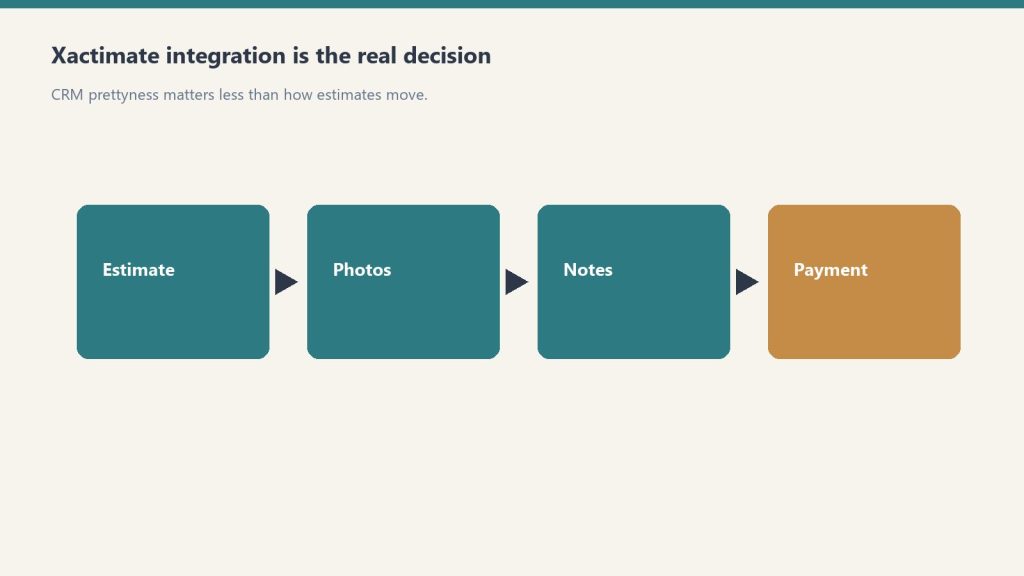
    General-purpose CRMs offer flexibility and strong sales features but require customization for restoration workflows. Restoration-specific platforms offer pre-built workflows and integrations with Xactimate and accounting systems but often have weaker sales functionality.

    For most restoration companies under $5M, a well-configured general-purpose CRM (HubSpot or Pipedrive) paired with restoration-specific job management software produces better results than trying to make a single tool do both jobs.

    Pipeline Stage Definitions

    Clear pipeline stage definitions make sales reporting useful. A workable residential restoration pipeline structure: New Lead → Appointment Set → Estimate Completed → Authorization Pending → Authorization Signed → In Production → Closed-Won. Each stage needs an explicit definition (what makes a lead “Appointment Set” vs “New Lead”) and an explicit advancement criterion.

    For commercial restoration, pipeline stages need to be longer-cycle: Suspect → Prospect → Qualified Conversation → Capability Presented → Pilot Discussed → MSA Negotiation → MSA Signed → Account Active. The longer cycle requires more granular stages so management can see where deals are stuck.

    Sales Activity Tracking

    Activity tracking matters because revenue is a lagging indicator. Leading indicators that should be tracked daily or weekly: appointments set, appointments held, estimates delivered, follow-up calls and texts completed, and authorization signatures collected. Reps who are missing revenue targets are usually missing activity targets weeks earlier — fixing the activity issue is faster than waiting for revenue to recover.

    Lead Source Attribution

    Every lead in the CRM needs a clean source field — Google Ads, LSA, organic, referral (with sub-source), lead vendor (with vendor name), repeat customer, etc. Without clean attribution, marketing budget allocation is guessing. The most common CRM hygiene failure is sloppy lead source data, which makes ROI analysis impossible.

    Weekly Sales Reporting

    The weekly sales report that drives behavior includes: leads received and lead-to-appointment conversion, appointments held and appointment-to-estimate conversion, estimates delivered and estimate-to-close rate, average ticket size by rep and by lead source, and pipeline value by stage with weighted forecast. The report should be reviewed by the sales team together every week, not buried in an email.

    Sales-to-Production Handoff

    The handoff from sales to production is where many restoration companies leak quality. Clean handoff requires standardized scope documentation, customer expectations clearly captured (timeline, communication preferences, special concerns), insurance information complete, and a defined moment when ownership transfers from sales to production with explicit acknowledgement from both sides.

    Sloppy handoffs produce production surprises, customer complaints, and over-budget jobs. Sales should be partially accountable for production outcomes through compensation structure to align incentives.

    Frequently Asked Questions

    What CRM do most restoration companies use?

    The CRM mix in restoration is fragmented. Common choices include HubSpot, Pipedrive, ServiceTitan, DASH, Encircle, and various restoration-specific platforms. There is no dominant industry standard. The right choice depends on company size, technical sophistication, and existing tool stack.

    How often should sales pipeline be updated in the CRM?

    Pipeline data should be updated daily by reps and reviewed weekly in management meetings. CRM data that is updated less than weekly produces unreliable forecasting and obscures emerging issues until they become critical.

    Should restoration sales reps own data entry or have admin support?

    Most restoration sales operations run more efficiently when reps own their own data entry, supported by mobile-friendly CRM tools that reduce friction. Outsourcing data entry to admin staff creates lag, errors, and accountability gaps. The exception: lead intake admins handling inbound calls and routing.

    What sales metrics matter most for restoration?

    The leading indicators that matter most are appointment-to-estimate conversion, estimate-to-close rate, average ticket, and lead source ROI. Lagging indicators like total revenue and gross profit by rep matter for compensation and forecasting but rarely surface fixable issues in time to course-correct.

    How do I get my sales team to actually use the CRM?

    CRM adoption is driven by three things: tools that are mobile-friendly and fast (no clunky desktop-only systems), management cadence that uses CRM data in every weekly meeting (so reps know it matters), and compensation tied to deals that exist in the CRM (no CRM record, no commission credit). Without all three, adoption stays low.


  • Restoration Insurance Programs: TPAs, Carriers, and Vendor Networks

    Restoration Insurance Programs: TPAs, Carriers, and Vendor Networks

    The insurance ecosystem in restoration is its own universe with its own language: TPAs, carriers, preferred vendor programs, MSAs, scorecards, audits, performance guarantees, network certifications. Most restoration owners have a vague sense of what these programs are and a stronger opinion about whether to join them, often without knowing the actual economics.

    This is the complete operator’s guide to restoration insurance programs in 2026: what TPAs actually do, how carrier preferred vendor programs work, what MSAs require, the real margin economics, and the framework for deciding which programs deserve your application.

    The four players in the insurance restoration ecosystem

    Every insurance restoration job involves up to four parties. Understanding which is which is the first step to navigating the system.

    The carrier is the insurance company that issued the policy and pays the claim — State Farm, Allstate, USAA, Liberty Mutual, Travelers, Nationwide, Farmers, Progressive, Chubb, and dozens of regionals. Carriers either have in-house claims handling or contract claims management out to TPAs.

    The TPA (third-party administrator) is a company that manages claims on behalf of carriers — Sedgwick, Crawford & Company, Contractor Connection, Code Blue Restoration Services, CCMSI, ESIS, and others. TPAs handle adjuster assignments, vendor management, scope review, payment processing, and customer communication on behalf of the carrier.

    The vendor network is a managed roster of restoration contractors that the carrier or TPA assigns work to. Some networks are operated by TPAs (Contractor Connection is the largest); some are operated directly by carriers (Allstate Premier Service, USAA STARS).

    The independent adjuster is a contracted adjuster (not a carrier employee) hired to assess specific claims, often for catastrophe events or to supplement carrier capacity. Independents work for IA firms like Eberl, Pilot Catastrophe, and Crawford.

    What a TPA program actually requires

    Joining a major TPA vendor network typically requires: a multi-year track record in restoration (most require 3+ years), specific IICRC certifications (firm-level plus individual technicians for relevant service lines), insurance coverage at higher limits than standard (often $2M+ general liability, $1M+ pollution liability, $1M+ professional liability), background checks and drug testing for technicians, vehicle and uniform standards, technology compatibility (use of TPA-approved estimating and reporting platforms), 24/7 dispatch capability with documented response time SLAs, monthly reporting and KPI tracking, and a signed master service agreement that defines pricing, scope, performance standards, and termination conditions.

    The application process typically takes 60-180 days, includes facility audits, reference checks, and may require a probationary period of supervised job assignments before full network status.

    The pricing economics of TPA work

    The honest economics: TPA work pays less than direct retail work. Most TPA agreements include some form of pricing concession — typically 10-20% off published Xactimate pricing, restrictions on overhead and profit, capped supplements, or fee schedules that cap certain line items. The trade-off is volume and predictability: a vendor in good standing on a major TPA network may receive 30-100+ assignments per month depending on territory.

    The math that matters: net margin per TPA job, after pricing concessions, after the operational overhead of TPA-required reporting and SLAs, and after slower payment terms (45-90 days is common). Companies that profitably run TPA programs typically have lean overhead, disciplined estimating, and the operational scale to absorb the lower per-job margin with higher volume. Companies with high overhead burden often lose money on TPA jobs they think are profitable.

    Major TPAs and vendor programs to know

    Contractor Connection (subsidiary of Crawford & Company) is the largest restoration vendor network, managing claims for many major carriers including Allstate, Liberty Mutual, and others. Network membership is tightly managed with strict performance standards and capacity targets.

    Code Blue Restoration Services is a major restoration-specific TPA serving multiple carriers, with significant residential mitigation volume.

    Sedgwick is one of the largest TPAs overall, serving commercial and residential property claims for many major carriers. Sedgwick’s vendor network is more decentralized than Contractor Connection’s.

    Crawford & Company operates both adjusting services and Contractor Connection, with significant CAT (catastrophe) capacity.

    Allstate’s Premier Service Program is a direct-from-carrier preferred vendor program for water mitigation and reconstruction.

    USAA STARS is USAA’s preferred vendor program serving its policyholder base.

    State Farm Premier Service is State Farm’s similar program (formerly Service First).

    Numerous regional and specialized TPAs exist — Sedgwick CCMSI, Cunningham Lindsey (now Sedgwick), various large loss specialty firms, and carrier-specific direct programs.

    Master Service Agreements (MSAs)

    An MSA is the contract that governs the relationship between the contractor and the TPA or carrier. Key MSA terms to scrutinize: pricing schedule (Xactimate concession amount, capped line items, fee schedules); territory definition (geographic scope, exclusivity provisions, right of first refusal); performance metrics (response time SLAs, completion timelines, scorecard targets); payment terms (net days, retention, hold-back provisions); insurance and indemnification requirements; termination provisions (notice periods, performance-based termination, transition obligations); customer ownership (whether you can market to customers post-job, whether the carrier owns the customer relationship); audit rights (TPA rights to review your job files, scope, photos, and pricing).

    MSAs are negotiable in some areas (especially territory and performance metrics) and rarely negotiable in others (pricing concessions, audit rights). Operators should have an attorney with restoration industry experience review any MSA before signing.

    The decision framework: which programs to join

    Whether to join a TPA program depends on four factors. Operational capacity: do you have the SLA capability, technology stack, and management bandwidth to meet program requirements? Market lead flow: is your direct lead generation strong enough that you can be selective, or do you need TPA volume to fill the calendar? Cost structure: is your overhead lean enough to make money at the program’s pricing concessions? Strategic mix: what percentage of revenue comes from TPA programs vs. direct? Most healthy operators target 30-50% TPA revenue mix — enough volume to leverage operations, not so much that the company is captive to a single TPA’s decisions.

    How to win at TPA performance scorecards

    Once on a TPA network, performance metrics determine assignment volume. The metrics that matter on most scorecards: response time (minutes from assignment to first contact, hours to first on-site), customer satisfaction scores (post-job surveys), cycle time (days from assignment to job completion), scope variance (how often supplements are needed and whether they’re approved), complaint rate (formal customer complaints per 100 jobs), quality scores (file documentation, photo quality, scope accuracy on TPA audits). Top-quartile performers on these metrics receive disproportionate assignment volume; bottom-quartile performers get reduced assignments and eventual termination.

    Frequently Asked Questions

    What is a TPA in restoration?

    A TPA (third-party administrator) is a company that manages claims on behalf of insurance carriers. In restoration, TPAs handle adjuster assignment, vendor selection, scope review, payment processing, and customer communication. Major restoration TPAs include Sedgwick, Crawford & Company, Contractor Connection, Code Blue, and CCMSI.

    How do you get on a carrier preferred vendor program?

    The application process typically requires: 3+ years in business, specific IICRC firm and individual certifications, higher insurance limits than standard, background-checked technicians, 24/7 dispatch capability, monthly KPI reporting, and signing a master service agreement that defines pricing concessions and performance standards. Applications take 60-180 days and often include facility audits and reference checks.

    Are TPA programs profitable for restoration companies?

    It depends on cost structure. TPA work typically pays 10-20% less than direct retail work due to pricing concessions, capped overhead and profit, and other restrictions. Companies with lean overhead and high operational discipline can run profitable TPA programs at high volume. Companies with high overhead burden often lose money on TPA jobs while believing they’re profitable.

    What is an MSA in restoration?

    An MSA (Master Service Agreement) is the contract between a restoration contractor and a TPA, carrier, or commercial customer that governs the relationship — pricing schedules, territory, performance metrics, payment terms, insurance requirements, audit rights, and termination provisions. MSAs should be reviewed by an attorney with restoration industry experience before signing.

    What percentage of revenue should come from TPA work?

    Most healthy restoration operators target 30-50% of revenue from TPA and preferred vendor programs. Below that range, the company isn’t leveraging program volume; above that range, the company is operationally captive to a few TPAs and vulnerable to program changes, pricing reductions, or termination.

    How do restoration vendor scorecards work?

    TPA performance scorecards typically measure response time (minutes to first contact, hours to on-site), customer satisfaction scores, cycle time (days from assignment to completion), scope variance and supplement approval rates, complaint rates, and quality scores from TPA file audits. Top-quartile performers receive disproportionate assignment volume; bottom-quartile performers face reduced assignments and eventual network termination.


  • Water Damage Restoration Marketing: A Complete Channel Guide

    Water Damage Restoration Marketing: A Complete Channel Guide

    Water damage restoration is unlike almost any other home service. The buying decision happens in minutes, not weeks. The customer is panicked, often dealing with an active leak or flood, and they will hire whoever shows up first with credibility. Marketing for water damage restoration is therefore less about persuasion and more about presence — being visible at the exact moment a homeowner or property manager opens their phone and types “water damage near me.”

    This guide covers the full channel stack that profitable water damage restoration companies use to capture that demand and build a referral engine that keeps producing between emergencies. For the broader strategic context, see our complete restoration marketing guide, which sits above this article in the hub-and-spoke architecture.

    Why Water Damage Marketing Is Different

    Three structural realities shape every marketing decision in this category. First, intent is overwhelmingly bottom-funnel. Almost no one searches “water damage restoration company” out of curiosity. They search because they have a problem. That collapses the funnel and rewards channels that intercept high-intent searches.

    Second, the competitive set is dominated by Google. Google Search, Google Maps, Local Service Ads, and Google Business Profile collectively account for the majority of net-new water damage leads in most metros. If a restoration company is not visible across all four, it is competing for table scraps.

    Third, insurance and TPA dynamics shape lead economics. A water damage job paid through a carrier preferred vendor program has a different margin profile than a cash retail job sourced from Google. Marketing has to be tuned to the mix the operator actually wants.

    The Five Channels That Drive Most Water Damage Leads

    1. Google Local Service Ads (LSAs)

    LSAs sit at the top of the search results page above traditional paid ads and the map pack. For water damage queries, LSAs produce leads at a cost per acquisition that is typically lower than Google Ads in most markets, though margins vary by metro. The Google Guaranteed badge is a meaningful conversion lever for cold homeowners. Setup requires background checks, license verification, and insurance documentation — friction that becomes a moat once cleared.

    2. Google Ads (Search)

    Traditional pay-per-click on emergency keywords (“water damage restoration,” “flooded basement,” “burst pipe cleanup”) remains the workhorse channel for most restoration companies. Campaign structure matters enormously here. Single-keyword ad groups, hyperlocal geo-targeting, call-only ads after hours, and aggressive negative keyword lists separate profitable accounts from money pits.

    3. Google Business Profile and the Map Pack

    Map pack visibility is essentially free traffic, but it is also the most competitive surface in local search. Ranking in the three-pack for “water damage restoration [city]” requires consistent NAP citations, a steady stream of authentic reviews with keyword-rich responses, regular GBP posts, geo-tagged photo uploads, and proximity to the searcher.

    4. Organic SEO and Content

    Organic search is a longer-term play but produces the cheapest leads at scale. Service pages targeting “[service] in [city]” combinations, neighborhood landing pages for high-value zip codes, and educational content answering insurance and restoration process questions all stack into a moat that competitors struggle to replicate.

    5. Insurance Adjuster and Plumber Referrals

    Marketing is not only digital. The most profitable restoration companies invest heavily in offline relationships with adjusters, plumbers, property managers, and real estate agents. A single plumber referral relationship can produce more revenue than a full year of paid search.

    Budget Allocation: Where to Put the First Marketing Dollar

    For a restoration company spending under $5,000 per month on marketing, the priority order is usually: GBP optimization first (it is free), then LSAs (lowest CAC for verified businesses), then a tightly scoped Google Ads campaign on emergency keywords, then organic content investment. Social media and display should generally come last in the water damage category because intent is too immediate for those channels to convert efficiently.

    For companies spending $10,000-$50,000 per month, the channel mix expands to include programmatic display for retargeting, YouTube for brand awareness in target zip codes, and a content marketing operation that produces 4-8 SEO-targeted pieces per month.

    Tracking and Attribution

    Water damage marketing fails when leads cannot be tracked back to source. Every campaign should use call tracking numbers (CallRail, CallTrackingMetrics, or WhatConverts), every form should fire a conversion event, and every job should be tagged in the CRM with its origin channel. Without this, marketing decisions are guesses.

    Frequently Asked Questions

    How much should a water damage restoration company spend on marketing?

    Most healthy restoration companies invest between 5% and 12% of revenue on marketing, with a higher share during the first three years while organic and referral channels are still being built. Companies relying primarily on paid acquisition often run closer to the higher end of that range.

    Are Google Local Service Ads worth it for water damage?

    For most water damage restoration companies in mid-sized and major metros, yes. LSAs typically produce a lower cost per lead than traditional Google Ads and the Google Guaranteed badge improves close rates on cold inbound calls. The qualifying process is the main barrier.

    What marketing channels work best for commercial water damage?

    Commercial water damage leans more on relationships, MSAs with property management firms, LinkedIn outreach, and association involvement than on paid search. Paid search still matters but a larger share of commercial pipeline comes from offline business development.

    How long does SEO take for a restoration company?

    Local SEO results — map pack visibility, branded search, and a handful of city service pages — typically begin to compound in 90-180 days. Building a competitive organic presence on the most valuable water damage keywords in a major metro often takes 12-24 months of consistent content and link building.

    Should a restoration company hire an agency or build marketing in-house?

    Companies under roughly $3M in revenue usually get more value from a specialized restoration marketing agency than from an in-house hire, because the talent pool of operators who understand both restoration and digital marketing is thin. Above $5M, an internal marketing leader paired with specialist agencies is often the best mix.


  • Restoration Google Ads: How Profitable Operators Run PPC

    Restoration Google Ads: How Profitable Operators Run PPC

    Google Ads is the channel where most restoration companies either build or lose their marketing program. Run well, paid search produces a predictable flow of high-intent water damage and fire damage leads at a cost per acquisition that supports the unit economics of the business. Run poorly, it incinerates marketing budget faster than any other channel in the stack. The difference is rarely talent — it is structure, discipline, and tracking.

    This article covers the operational mechanics of running Google Ads for a restoration company. For the broader marketing context, see our restoration marketing guide.

    Why Restoration Google Ads Are Hard

    Two structural challenges make restoration PPC tougher than most home service categories. First, click costs on emergency restoration keywords are among the highest in Google Ads — competitive metros routinely see cost per click in the double digits for terms like “water damage restoration” and “emergency flood cleanup.” Second, lead quality varies wildly. A “water damage” search at 2pm on a Tuesday is often a homeowner researching options, while the same search at 11pm during a storm is almost always a real emergency.

    Profitable restoration PPC requires architecture that separates these intents and bids accordingly.

    Campaign Architecture That Works

    The structure that consistently outperforms in restoration accounts uses tightly themed campaigns split by service line and intent stage. A typical structure might include: emergency water damage (highest bids, call-only ads, after-hours dayparting), planned water mitigation (lower bids, form fills acceptable), fire damage, mold remediation, biohazard, contents and pack-out, and reconstruction.

    Within each campaign, single-keyword ad groups (SKAGs) or tightly themed ad groups outperform broad themed groups in this category because of how varied the search query intent is. “Burst pipe water damage” and “ceiling water stain” deserve different ads.

    Bidding and Budget Strategy

    Restoration Google Ads accounts typically perform best on either Maximize Conversions with a target CPA cap or Manual CPC with portfolio bidding. Smart Bidding strategies need 30-50 conversions per month per campaign to learn effectively, which most restoration accounts do not have at the campaign level. Pooling conversions through a portfolio bid strategy across related campaigns is one workaround.

    Budget should be concentrated rather than spread thin. A restoration company spending $3,000 per month on Google Ads will almost always get better results from a single campaign focused on the highest-intent emergency terms than from spreading $300 across ten different services.

    Ad Copy That Converts Restoration Leads

    The highest-converting restoration ad copy emphasizes three things in this order: response time (“On-site in 60 minutes”), credibility (IICRC certified, BBB rated, years in business), and risk reversal (free estimates, work directly with insurance, 24/7 availability). Generic “water damage experts” copy underperforms specific, operational claims.

    Call-only ads on emergency keywords often outperform standard text ads with a website destination, because the customer wants to call now, not browse a site. After-hours dayparting that switches all campaigns to call-only between 6pm and 7am captures emergency demand efficiently.

    Geo-Targeting Discipline

    Sloppy geo-targeting is the most common reason restoration accounts hemorrhage budget. The default radius targeting setting in Google Ads is too generous for most restoration businesses. Tighter zip-code-level or hyperlocal radius targeting around the actual service area, combined with location bid adjustments that bid up on high-value zip codes and bid down on low-value ones, often cuts cost per lead by 30-50%.

    Call Tracking and Conversion Setup

    Restoration leads come in primarily by phone, and Google Ads accounts that do not import call conversions are flying blind. Every account needs Google Forwarding numbers configured, call extensions enabled, and call conversions imported into the bidding algorithm. Pairing this with a third-party call tracking platform (CallRail, CTM, or WhatConverts) for call recording and lead scoring closes the attribution loop.

    Negative Keywords: The Hidden Performance Lever

    The single most effective ongoing optimization in restoration accounts is aggressive negative keyword work. Common waste sources include “DIY,” “free,” “how to,” “training,” “course,” “jobs,” competitor brand names (unless deliberately bidding on them), and product searches like “water damage paint.” A mature restoration account typically has a negative keyword list in the thousands.

    Frequently Asked Questions

    What is a good cost per lead for restoration Google Ads?

    Cost per lead varies enormously by metro, service line, and lead quality definition. Emergency water damage leads in major metros often run between $80 and $250, while less competitive markets and services can come in well below that. Cost per acquisition for a closed job is the more important number to track.

    Should I bid on competitor brand names?

    Bidding on competitors can be profitable if the competitor brand has high search volume and your offer is genuinely competitive, but it tends to invite reciprocal bidding and increases costs across the category. Most restoration companies get better ROI from defending their own brand terms aggressively than from attacking competitors.

    Do Performance Max campaigns work for restoration?

    Performance Max can work for restoration companies with mature conversion data and strong creative assets, but it generally underperforms tightly structured Search campaigns for emergency-intent restoration queries because it gives up control of placement and audience targeting.

    How do I keep Google Ads from running during business off-hours when no one can answer?

    Use ad scheduling to either pause campaigns or significantly reduce bids during hours when no one can answer the phone. Even better, set up after-hours call routing so that emergency calls reach an answering service or on-call technician, since most restoration revenue happens outside 9-to-5.

    How long should I run a Google Ads test before deciding it works?

    Restoration Google Ads campaigns generally need at least 30-60 days of meaningful spend to produce statistically reliable performance data. Killing a campaign after two weeks of poor performance is a common mistake that prevents accounts from finding their winners.


  • Breaking Into Commercial Restoration: A Market-Entry Guide

    Breaking Into Commercial Restoration: A Market-Entry Guide

    Most residential restoration shops that try to add commercial work fail. Not because the work is too hard. Because they treat commercial as a larger version of residential, and it is not. It is a different business with a different sales motion, different pricing math, and a different operational model.

    This is a market-entry guide for the residential-led restoration shop that has decided commercial is the next growth direction. It is written to surface the structural differences before you commit, and to give you a sequence that has worked for operators who made the transition successfully.

    The Five Structural Differences

    Before the sequencing, the differences. Each one becomes a failure mode if ignored.

    1. The buyer is not the property manager alone. Commercial buying decisions involve a buying committee — property manager, asset manager, risk manager, facilities, sometimes a TPA. Selling to one persona and ignoring the others is the most common reason commercial bids are lost.
    2. The sales cycle is months, not minutes. Commercial accounts are cultivated over six to eighteen months. Residential FNOL response can close a job in hours. The patience and process required are different.
    3. The documentation expectation is materially higher. Commercial work, particularly larger losses and any litigation-adjacent work, demands documentation discipline that residential workflows do not require. Shops without documented production processes get exposed quickly.
    4. The pricing model varies. Commercial work mixes carrier-priced jobs, time-and-material, master service agreements, and TPA-program rates. The line-item-only pricing model that works residentially does not translate.
    5. The capacity demands spike. A single commercial loss can require equipment and technician deployment that exceeds a residential shop’s standing capacity. The decision of whether to surge, decline, or partner is structural.

    The Six-Stage Market-Entry Sequence

    The shops that have made the residential-to-commercial transition successfully tend to follow a recognizable sequence. The order matters.

    Stage 1: Operational Readiness Audit

    Before any commercial sales effort, audit the operational baseline. The questions: do your production processes produce documentation that would survive a litigation review? Do you have the equipment capacity to handle a commercial loss without disrupting residential service? Do your technicians hold the certifications — IICRC ASD, AMRT, FSRT — that commercial buyers expect to see? Do you carry the insurance limits and safety documentation commercial onboarding will request?

    If any of these answers is no, fix the gap before approaching commercial accounts. A shop that wins commercial work it cannot deliver damages its reputation in a small market.

    Stage 2: Network Membership

    Join the chambers, BOMA chapter, IFMA chapter, and CoreNet local group in your market. The commercial buying community is networked. The shop with no presence in those rooms is invisible. The shop with a regular, trusted presence over twelve to twenty-four months becomes a recognized name in the local commercial property community.

    Stage 3: Insurance Broker and Agent Relationships

    Identify the insurance brokers and agents who write commercial property in your market. They are gatekeepers to a meaningful share of commercial restoration work. The relationship is not transactional — it is a long-cycle introduction-and-trust process. Brokers introduce restoration vendors to their commercial clients only after they trust the work product.

    Stage 4: Named-Account Cultivation

    Build a target list of 40 to 75 commercial accounts in your market — property management groups, large owner-occupiers, healthcare and food service operators, and corporate real estate teams. This is the named-account list that will produce your commercial pipeline over the next 18 months. The list is more important than any single account on it. Cultivate the list quarterly with risk-framed educational content, pre-loss site walks, and tabletop exercises.

    Stage 5: First Commercial Job

    The first commercial job is the trial. It does not need to be large. A small after-hours response or a moderate water mitigation for a managed property is enough to prove the operational claims made during cultivation. Treat the first job with disproportionate care — documentation, communication, and post-job review — because it produces the reference that unlocks subsequent work.

    Stage 6: Account Expansion

    The second commercial job at the same account is more valuable than the first. Account expansion — moving from one property to a portfolio, from one persona to the buying committee — produces the long-term revenue compounding that justifies the commercial entry decision. A 30-day post-job review with the property manager and the risk contact is the most undervalued account-expansion tool in commercial restoration.

    The Common Failure Modes

    The failures cluster into recognizable patterns:

    • Sales effort without operational readiness. Winning work the shop cannot deliver damages reputation.
    • Single-threaded relationships. Selling only to the property manager and missing the buying committee.
    • Underestimating the cycle length. Treating a commercial cultivation cycle as a residential FNOL response and abandoning effort after 90 days.
    • Mispricing the first job. Pricing the trial job to win at any cost and establishing an unsustainable rate baseline for the account.
    • Capacity surprise. Winning a commercial loss the shop cannot resource without disrupting residential service, then under-delivering on both.

    Each of these failures is avoidable with deliberate sequencing. Each of them is common in shops that treated commercial as residential at scale.

    How Long Does the Transition Take?

    Realistic timeline for a residential-led restoration shop to build a meaningful commercial revenue stream: 18 to 36 months from the operational readiness audit through the third or fourth commercial account producing recurring work. Faster transitions are possible with a senior commercial sales hire, but the underlying market-entry mechanics do not compress below 12 months.

    The shops that report disappointing results from commercial entry typically committed to the effort for 12 months or less, then concluded that commercial does not work for their market. The structural answer is that commercial cultivation cycles outlast 12-month commitments.

    The Honest Investment Question

    Commercial restoration entry is an investment, not a marketing campaign. The investment includes a senior commercial sales hire (or substantial owner time), conference and chamber memberships, target-account research tools, and the operational upgrades the readiness audit surfaces. Operators who treat the investment as discretionary marketing spend rarely follow through on the cultivation cycle long enough to see the return.

    The operators who do follow through tend to build a commercial revenue stream that becomes the most stable and highest-margin part of the business. The math works. The patience is the constraint.

    Frequently Asked Questions

    Can a residential restoration shop add commercial work?

    Yes, but treat it as a market-entry project, not a marketing tactic. The buyer, sales cycle, documentation expectation, pricing model, and capacity demands all differ from residential work. Shops that follow a deliberate market-entry sequence — operational readiness, network membership, broker relationships, named-account cultivation, first job, account expansion — succeed at meaningfully higher rates than shops that approach commercial as larger residential.

    How long does it take to break into commercial restoration?

    A realistic timeline is 18 to 36 months from operational readiness audit through the third or fourth commercial account producing recurring work. Faster transitions are possible with senior sales investment, but the underlying market-entry mechanics do not compress below 12 months.

    What certifications do I need for commercial restoration?

    Commercial buyers expect IICRC certifications appropriate to the work — WRT and ASD as a baseline, with AMRT, FSRT, and the higher-tier credentials adding credibility for specialty work. Insurance limits, safety documentation, and OSHA-compliant practices are also typical onboarding requirements.

    How big should my target account list be?

    Most shops manage a target list of 40 to 75 named commercial accounts per sales rep, with quarterly touchpoint cadence. Higher counts dilute the relationship depth that the commercial sales motion depends on.

    Should I hire a dedicated commercial sales rep?

    If commercial is a serious growth direction and the owner cannot personally maintain quarterly touchpoints across the named-account list, a dedicated sales rep is the structural answer. Below that threshold, the owner can usually carry the pipeline directly.

    Continue with the Restoration Operator’s Playbook for more on operationalizing commercial work.


  • The Commercial Restoration Sales Stack: From Prospecting to Close

    The Commercial Restoration Sales Stack: From Prospecting to Close

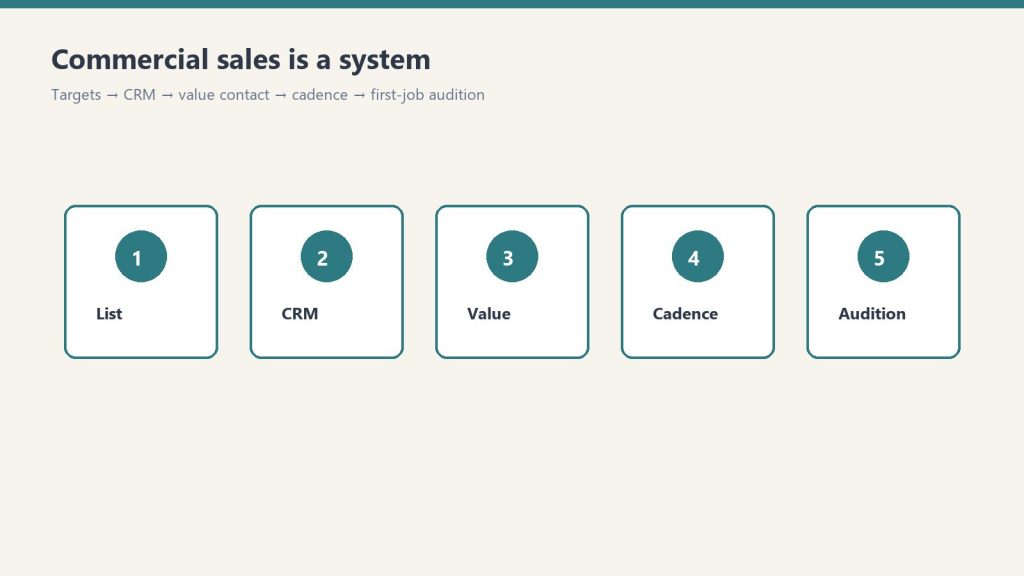
    “How do I increase commercial restoration sales?” is the wrong question. The right question is whether you have a sales stack at all — a connected sequence of stages with exit criteria, owners, and measurement. Most restoration shops do not.

    This is a working playbook for the commercial restoration sales stack as it operates in 2026. It assumes you already do residential work, already hold the IICRC certifications carriers expect, and have decided commercial is a serious growth direction. What follows is the structure that turns commercial intent into commercial pipeline.

    Stage 1: Prospecting

    Prospecting is the activity of identifying buildings and people you have not yet met. It is the front of the funnel, and most restoration sales programs do this badly because they confuse prospecting with referrals. Referrals are an output of relationships you already have. Prospecting is how you find the relationships you do not.

    The four prospecting channels that produce reliable commercial restoration pipeline in 2026:

    • BOMA, IFMA, and CoreNet chapter membership and event participation — where commercial property managers, facilities engineers, and corporate real estate teams gather.
    • Property tax records and CoStar-equivalent data — the source of building-level ownership, square footage, and management company information that lets you build a target list.
    • Insurance broker and agent relationships — the broker often controls the carrier-restoration vendor relationship at mid-market commercial accounts.
    • Cold structured outreach to named accounts — outbound that is research-based and persona-specific, not spray-and-pray.

    Stage exit criteria: a documented account profile with at least one named contact, a current vendor (if known), and a reason to engage.

    Stage 2: Qualification

    Qualification is the activity of deciding which prospects deserve cultivation effort. Not every commercial building is a good fit for your shop. The qualifiers that matter:

    • Geographic proximity to your operational base — response time is a sales asset.
    • Building portfolio size — a property management group with 30 buildings is more leverage than a single owner-occupier.
    • Loss history and risk profile — older buildings, occupied basements, healthcare and food service tend to generate more restoration work.
    • Vendor relationships — accounts already locked into a carrier program may be hard to dislodge; accounts in vendor-review cycles are buying windows.

    Stage exit criteria: a written go/no-go decision with the rationale captured. The discipline of writing it down is what stops sales reps from chasing every conversation.

    Stage 3: Account Mapping

    Account mapping is the work of identifying every decision-maker and influencer at a qualified account. Commercial restoration sales fails most often because the rep sold to one person at a five-person buying committee. The map fixes that.

    A complete account map for a commercial restoration prospect identifies: the property manager, the asset manager or owner representative, the risk manager or insurance buyer, the facilities or chief engineer, the procurement contact (if separate), the broker of record, and the TPA program manager (if the account routes work through one). Not every account has all seven roles, but the exercise of asking which exist forces clarity.

    Stage exit criteria: at least three named contacts at the account, with role, contact information, and a notes field that captures what each contact actually cares about.

    Stage 4: Cultivation

    Cultivation is the long middle of the commercial sales cycle — the six to eighteen months between first introduction and signed agreement. It is where most restoration sales programs leak pipeline because they do not have a defined cadence.

    A working cultivation cadence runs on a quarterly rhythm: a pre-loss educational meeting in Q1, a tabletop or response-plan walkthrough in Q2, an industry-event touchpoint in Q3, and a renewal-cycle conversation in Q4. The exact content matters less than the discipline of staying present in the account’s calendar.

    Effective cultivation content is risk-framed, not capability-framed. “Here is how a Category 3 loss in your basement mechanical room would unfold and what it would cost you” outperforms “Here are our certifications and our truck count” every time.

    Stage exit criteria: a documented sales-qualified opportunity — a buying signal, a vendor review, an MSA request, or a small first job.

    Stage 5: Close

    The close in commercial restoration is rarely a single moment. It is the conversion of cultivation into either a preferred-vendor agreement, a TPA program enrollment, or a first significant job that establishes the operational relationship.

    The deliverables that move a close:

    • A written response plan tailored to the building, not a generic capabilities deck.
    • Insurance and safety document package ready to submit on request.
    • A clear differentiator that survives the first procurement conversation — response time, technical capability, documentation quality, or pricing model.
    • A reference call or site visit with a comparable account, offered before it is requested.

    Stage exit criteria: a signed MSA, a program enrollment confirmation, or a first job that the account treats as a trial.

    Stage 6: Land and Expand

    The first job is not the end of the sale. Commercial accounts that produce one loss typically produce another, and the operators who win the long-term revenue treat the first job as the start of an account-development relationship rather than the close. A 30-day post-job review with the property manager and the risk contact is the most undervalued account-expansion tool in commercial restoration.

    Connecting the Stack

    Each stage above only matters if it connects to the next. A restoration sales program that prospects without qualifying, qualifies without account-mapping, or cultivates without a close trigger leaks pipeline at every handoff. The connector is a documented stage exit criterion and a single owner accountable for moving accounts through the stack.

    Most commercial restoration sales programs in 2026 are run with a sales rep, a sales manager, and an owner who reviews the named-account list monthly. The bigger the operation, the more critical the connector discipline. Without it, the stack collapses into a referral list with optimistic narration.

    Frequently Asked Questions

    How long should a commercial restoration sales cycle take?

    Six to eighteen months from introduction to signed MSA or first significant job is typical for direct-to-owner commercial accounts. TPA program enrollment moves faster, generally 60 to 120 days.

    What is the difference between prospecting and qualification?

    Prospecting is identifying buildings and people you have not met. Qualification is deciding which of those prospects deserve cultivation effort. Conflating the two is the most common reason commercial pipelines stall — reps cultivate accounts that should not have passed qualification.

    How many named contacts should I have at a target account?

    At least three. A single-threaded relationship at one persona — usually the property manager — is the most common cause of lost commercial bids when procurement runs.

    What is the right cadence for cultivating a commercial restoration account?

    Quarterly is the working baseline. The exact touchpoint matters less than the discipline of staying present across a buying cycle that may run a year or longer.

    Should I hire a dedicated commercial sales rep?

    If commercial is a serious growth direction and the owner cannot personally maintain quarterly touchpoints across 40 to 75 named accounts, a dedicated rep is the structural answer. Below that threshold, the owner can usually carry the pipeline.

    For more sales playbooks and operational systems, browse the Restoration Operator’s Playbook archive.


  • How Restoration Companies Are Winning Commercial Accounts in 2026

    How Restoration Companies Are Winning Commercial Accounts in 2026

    Commercial restoration sales no longer rewards the most aggressive cold caller. It rewards the operator who has mapped the building, named every decision-maker, and arrived with a written plan before the loss happens.

    The restoration companies gaining commercial market share in 2026 are not necessarily the ones with the largest equipment fleets. They are the ones who treat commercial accounts like enterprise sales — with named accounts, multi-year cultivation cycles, and a recognition that the buyer is rarely the property manager you first meet.

    Why Commercial Restoration Sales Looks Different in 2026

    Three structural shifts have rewritten the commercial restoration playbook over the last 24 months. First, third-party administrators (TPAs) and program work now route a larger share of insurance-driven commercial losses, which means the carrier relationship matters as much as the property relationship. Second, large property management groups have consolidated, which concentrates buying power into fewer hands. Third, post-loss litigation pressure has made documentation discipline a sales asset rather than a back-office expense.

    Operators who treat commercial restoration as a transactional, lead-by-lead business are losing ground to firms that treat it as a relationship discipline. The difference shows up in close rates, average job size, and the willingness of property managers to call before they tender to a competitor.

    The Five Buyer Personas in Commercial Restoration

    Most restoration sales reps pitch the property manager and stop there. The firms winning commercial work in 2026 are pitching all five of the following decision-makers, often simultaneously, and tailoring their materials to each:

    • Property manager. Operates the building day to day. Cares about disruption, tenant complaints, and being able to say the response is handled.
    • Asset manager or owner representative. Owns the financial outcome. Cares about loss-of-use exposure, capital preservation, and avoiding insurance disputes.
    • Risk manager or insurance buyer. Often a corporate function. Cares about preferred-vendor compliance, carrier relationships, and standardized documentation.
    • Facilities or chief engineer. Holds the technical relationships. Cares about contractor competence, building system knowledge, and clean handoffs.
    • TPA case manager. Routes the work after the FNOL. Cares about responsiveness, daily updates, and clean billing.

    A quote, a brochure, or a referral sheet that speaks to one of these personas does not move the other four. Operators with mature commercial sales programs maintain at least three persona-specific decks and tailor their account-development outreach accordingly.

    The Account Map Is the Sales Asset

    The most undervalued tool in commercial restoration sales is the written account map. It is not a CRM record. It is a one-page document for each target account that captures the building portfolio, current vendor relationships, known pain points, the people in each of the five personas above, and the trigger events that would create a buying moment.

    Account maps are how a sales rep stops chasing leads and starts cultivating a territory. They are also how restoration company owners answer the most important commercial sales question: do we actually know who buys at this account, or are we just hoping the property manager remembers our name?

    The TPA Channel: Asset, Liability, or Both

    Third-party administrators have become a structural feature of commercial restoration. For some operators they represent 30% or more of revenue. The honest assessment in 2026 is that TPA work is a sustainable channel only if you understand its tradeoffs.

    The benefit is volume and predictability — once a TPA program approves you, the work flows. The cost is margin compression, scope-of-work constraints, and the risk that the TPA, not the property owner, becomes the customer who can fire you. Operators with the strongest commercial sales results in 2026 use TPA programs as a base load for crew utilization, while building a parallel direct-to-owner pipeline at higher margin.

    What a Commercial Restoration Sales Cycle Actually Looks Like

    A residential water-loss sales cycle can close in hours. A commercial sales cycle — meaning the path from first introduction to a preferred-vendor agreement or program enrollment — typically runs six to eighteen months. The sales activity that fills that window matters more than the pitch itself. A representative cycle includes:

    • Initial introduction, often through a chamber, BOMA event, or warm referral.
    • Educational meeting framed around a specific risk the property faces — not a capabilities pitch.
    • Pre-loss site walk and documentation of building systems relevant to water, fire, and biohazard response.
    • Tabletop exercise or response-plan review with facilities and risk teams.
    • Vendor onboarding, insurance and safety document submission, master service agreement.
    • First small job or after-hours response that proves out the operational claims made during the cycle.

    Operators who try to compress this cycle into a single quote almost always lose to the firm that walked the building twelve months earlier.

    What to Measure

    The commercial pipeline metrics that matter are not the same as residential. The four that the strongest sales programs track in 2026 are:

    • Named accounts in active cultivation — a target list with quarterly touchpoint cadence.
    • Pre-loss site walks completed — a leading indicator of pipeline health 6–12 months out.
    • MSAs and preferred-vendor agreements signed — the conversion event that actually moves revenue.
    • Average commercial job size and gross margin trend — the proof that the cultivation is producing the right kind of work.

    The 2026 Commercial Restoration Sales Stack

    Putting it together, the operators winning commercial accounts in 2026 share a recognizable stack: a named-account target list reviewed monthly by ownership; a CRM with persona-tagged contacts at each account; a documented sales cycle with stage exit criteria; pre-loss documentation as a standard sales motion; a TPA program strategy that complements rather than replaces direct sales; and clear ownership of which leader on the team drives commercial pipeline health.

    The firms missing one or more of these elements tend to describe their commercial revenue as inconsistent or referral-dependent. The firms that have all of them describe their pipeline as crowded.

    Frequently Asked Questions

    How long does it take to win a commercial restoration account?

    The full sales cycle from introduction to first paid work typically runs six to eighteen months for direct-to-owner accounts. TPA program enrollment can move faster, often 60 to 120 days from application to first dispatch.

    What is the most common reason restoration companies lose commercial bids?

    Single-threaded relationships. Most losses come from selling only to the property manager and missing the asset manager, risk manager, or facilities engineer who actually controls vendor selection.

    Should restoration companies pursue TPA work?

    TPA work is a viable revenue channel if treated as a base-load contributor, not the entire pipeline. Margin is compressed, but volume is predictable. The risk is becoming dependent on a single TPA program, which can revoke status with little notice.

    What is a preferred-vendor agreement worth?

    A signed MSA or preferred-vendor agreement does not guarantee work, but it removes the procurement and onboarding friction that would otherwise block dispatch when a loss occurs. Operators report that conversion from MSA to actual revenue typically takes another 90 to 180 days.

    How many named accounts should a commercial sales rep manage?

    Most restoration sales programs in 2026 cap active named accounts at 40 to 75 per rep, with a quarterly touchpoint cadence. Higher counts dilute the relationship depth that the commercial sales motion depends on.

    For more on the operational side of running a commercial restoration business, see the Restoration Operator’s Playbook archive on Tygart Media.


  • The Mitigation-to-Reconstruction Handoff: Where Restoration Companies Quietly Lose Half Their Margin

    The Mitigation-to-Reconstruction Handoff: Where Restoration Companies Quietly Lose Half Their Margin

    This is the first cluster article in the Mitigation-to-Reconstruction Intelligence series, published under The Restoration Operator’s Playbook. If you haven’t read the pillar piece yet, start there.

    The most expensive moment in restoration is invisible

    Walk a restoration job from the first call through the final walkthrough and ask an honest operator where the money is actually made or lost. The answers come back in different orders depending on who you ask, but one moment shows up on almost every list and almost never gets the attention it deserves.

    It is the moment the mitigation crew packs up the last air mover and the reconstruction estimator opens the file for the first time.

    Nothing dramatic happens in that moment. There is no signature. There is no transition meeting. On most jobs, the two teams never speak. The mitigation supervisor uploads the dryout report, the file moves into a different bucket in the operations system, and someone on the reconstruction side picks it up the next morning and starts trying to figure out what they are looking at.

    That moment, repeated across every loss the company touches in a year, determines more about whether the business runs at twelve percent net or twenty-two percent net than almost any other operational variable. And it is treated, in most companies, as a logistics problem.

    It is not a logistics problem. It is the most expensive economics problem in the industry.

    What the mitigation crew is actually doing — and why it costs the rebuild

    To see the economics clearly, watch the mitigation crew make the small decisions they make hour by hour on a Cat 3 water loss in a residential structure.

    The lead tech walks the affected area and decides what gets removed. Baseboards or no baseboards. Bottom two feet of drywall or full sheets. Carpet pad or carpet and pad. Cabinet kicks or cabinet boxes. Each of these decisions takes ninety seconds. Each of them is being made by a tech whose training, incentives, and tools are entirely oriented toward one thing: getting the structure dry as fast and as defensibly as possible.

    None of those decisions are being made with the reconstruction job in mind. The tech is not thinking about whether the homeowner has a continuous run of luxury vinyl plank that will need to be tied back into the unaffected area. The tech is not thinking about whether the cabinet line was a discontinued profile that the rebuild team is going to spend three weeks trying to source. The tech is not thinking about whether the drywall cut line they just made twenty-eight inches off the floor is going to look like a scar on a finished wall in a hallway with raked lighting. The tech is thinking about moisture content, about evaporation rates, about whether they have enough air movers staged. They are doing exactly the job they were trained and paid to do.

    Meanwhile, two days later, the reconstruction estimator opens the file and finds out what the tech decided. They find out that the cabinet kicks were removed but the boxes were left, which means the cabinets cannot be repaired in place and the homeowner is now looking at a full kitchen cabinet replacement instead of a partial one. They find out that drywall was cut at twenty-eight inches across three rooms with different ceiling heights, which means three different fix-up details and three different paint scopes instead of one. They find out that the LVP was removed from the affected area but not floated out to a natural transition line, which means a t-strip in a doorway the homeowner is going to notice every time they walk through it for the next ten years.

    None of these are mitigation mistakes. The crew did the mitigation correctly. They are reconstruction problems created by mitigation decisions made without reconstruction knowledge in the room.

    The estimator now has three choices. They can write the scope to do the job properly, which means a higher number than the carrier was expecting and a fight to get it approved. They can write the scope to fit what the carrier expects and absorb the difference internally, which means margin gets eaten on the reconstruction side. Or they can write a scope that cuts corners to hit the number, which means the homeowner ends up with a finished product that does not match what they had before, which means a complaint, a callback, or a one-star review.

    All three of those outcomes are the result of the same upstream cause: a mitigation decision made by someone who was not thinking about the rebuild.

    Why the industry has accepted this for so long

    The mitigation-to-reconstruction handoff problem is not new. Senior operators have known about it for decades. The reason the industry has lived with it is structural.

    For most of the industry’s history, mitigation and reconstruction were treated as two different businesses. Mitigation was the high-velocity, lower-margin response work. Reconstruction was the longer-cycle, higher-margin build-back work. Different skills, different equipment, different scheduling rhythms, often different licensing and insurance. A lot of companies chose to specialize in one or the other on purpose.

    That specialization made sense at the unit level. It still does, in many ways. But it also created an industry where the two halves of the same job evolved separately, with their own training pipelines, their own software, their own measurement systems. Mitigation companies got measured on dryout time and equipment efficiency. Reconstruction companies got measured on cycle time and gross margin. Almost no one got measured on whether the handoff between the two created or destroyed value.

    The handoff fell into a measurement gap. And anything that falls into a measurement gap in a service business eventually becomes the place where money quietly leaks.

    The other reason the industry has lived with this is that the leak is hard to see on a single job. A few extra hours of estimator time. A small upcharge that gets eaten somewhere. A homeowner who is mostly satisfied but writes a four-star review instead of a five-star. None of it is dramatic. None of it shows up as a single line item on a P&L. But across two thousand jobs a year, it adds up to a number that is large enough to be the difference between a company that is reinvesting in its operating system and a company that is treading water.

    What the best companies are actually doing

    The companies that have figured this out have made one of three structural moves. Each works. They are not the same move, and the choice depends on the company’s geography, capital position, and operational maturity.

    The first move is to bring both functions in-house. The same company does the mitigation and the reconstruction. The handoff becomes an internal handoff between two crews who answer to the same operations leader and whose incentives can be aligned by leadership choice. This is the cleanest solution and also the most expensive to set up. It requires the company to be good at two genuinely different operational disciplines instead of one. Companies that pull it off tend to dominate their markets, partly because of the operational integration and partly because the marketing story it produces — “the team that handed you back your home was the same team that responded the night of the loss” — is a strong story that resonates with homeowners who have been burned before.

    The second move is to keep mitigation and reconstruction separate but build deliberate handoff standards and train mitigation partners on them. This is the move that gets used by reconstruction-heavy companies who do not want to run a 24/7 mitigation operation but who depend on a network of mitigation partners. The reconstruction firm publishes a documented set of mitigation prep standards — how to cut, where to cut, what to remove, what to leave, how to document — and trains the mitigation companies they work with on those standards. The mitigation companies adopt the standards because the reconstruction firm is a reliable referral source for jobs they could not finish themselves. The reconstruction firm gets jobs that come in pre-prepped for the rebuild. Both sides benefit. The relationship is sticky.

    The third move is the inverse: a mitigation-heavy company builds the standards and trains its reconstruction partners on what kind of mitigation prep they have done so the rebuild side can take advantage of it. This is rarer because it requires the mitigation company to think like a reconstruction company, which most do not. But the few that do are differentiating themselves with reconstruction firms in their market who quickly learn that jobs prepped by this particular mitigation company are easier to estimate, easier to scope, and easier to close out. The mitigation company gets preferred status in the referral flow.

    All three moves reflect the same underlying insight. The handoff is too important to leave to chance. It has to be designed.

    What “designing the handoff” actually looks like

    The phrase “design the handoff” sounds abstract. In practice it is concrete and unglamorous. The companies doing it well have built their solution around five things.

    The first is a documented mitigation prep standard. Not a binder. A living document, version-controlled, that specifies how to make the cut decisions that have downstream reconstruction consequences. Where to cut drywall, how to handle baseboard removal, how to treat trim, how to manage flooring transitions, how to document existing conditions, how to handle cabinetry, how to handle ceiling textures, how to capture the small finish details that the rebuild team is going to need to match. The standard is written by someone who has done both sides of the job and updated whenever a recurring rebuild problem traces back to a mitigation decision.

    The second is photo and documentation discipline that is built around what the rebuild team needs to see, not just what the carrier needs to see. The mitigation crew is photographing for two audiences. The first is the adjuster who needs to validate the loss. The second is the estimator who needs to scope the rebuild. The photo set the rebuild team needs is different from the photo set the adjuster needs. Companies that have figured this out have a documented photo capture protocol that satisfies both. Companies that have not figured it out are still relying on whatever the mitigation tech happened to remember to shoot.

    The third is a structured handoff artifact. Some companies use a template form. Some use a software-driven handoff package. Some use a brief synchronous conversation between the mitigation supervisor and the reconstruction estimator at a defined point in the job lifecycle. The format matters less than the existence of the handoff. The point is that the rebuild team is not picking up a file and starting from a cold read.

    The fourth is a feedback loop. When the rebuild team encounters a problem that traces back to a mitigation decision, that information has to flow back to the mitigation team and into the standard. Without a feedback loop, the same mistakes get made on the next job. With a feedback loop, the standard gets sharper every quarter and the company’s effective handoff quality compounds over time.

    The fifth is shared metrics. The mitigation team and the reconstruction team need to share at least one number that they are both accountable for. The number that works in most companies is total job cycle time and total job margin, measured at the job level not the function level. Once both teams are sharing the same scoreboard, the conversations about the handoff stop being political and start being operational.

    None of these five things require new technology. They require operational seriousness. The technology, when it shows up, makes them faster and more consistent — but the underlying discipline has to exist first.

    Why this matters more in 2026 than it did in 2022

    The handoff problem is not new. The reason to address it now is that the consequences of ignoring it are getting more expensive every year.

    Carriers have been steadily tightening on scope discipline. The room a contractor used to have to absorb a couple of hours of estimator rework is shrinking as TPAs get more sophisticated about pattern detection across files. Homeowners have access to public reviews that travel further and faster than they did a decade ago, and a four-star review on a complex water loss tells the story of a handoff that did not quite work. Labor costs in both mitigation and reconstruction have continued to climb, which means every hour of avoidable rework is more expensive than it was. And the gap between the operationally serious companies and the operationally casual ones is becoming visible to the carriers in ways that translate into program placement and referral flow.

    The companies that fix the handoff in 2026 are going to compound the advantage for the rest of the decade. The companies that keep treating it as a logistics problem are going to wake up in 2028 and find that their margin profile has slowly drifted in the wrong direction without any single dramatic event they can point to.

    The honest place to start

    If you run a restoration company and you have read this far, the honest place to start is not a software purchase. It is a single afternoon spent walking the last ten completed reconstruction jobs with both the rebuild lead and the mitigation supervisor in the room.

    Pull the files. Walk the timelines. For each job, ask one question: was there a moment in the rebuild where we did extra work, made a concession, or had a homeowner complaint that traced back to a decision the mitigation team made — or didn’t make — at the front of the job?

    Most operators who run that exercise honestly come away with the same reaction. They knew the handoff was costing them. They did not know it was costing them this much. The afternoon turns into a working session on what a documented prep standard would actually look like, and the company starts the journey.

    It is one afternoon. It is the most valuable afternoon most restoration owners will spend this year.

    This is the first article in the Mitigation-to-Reconstruction Intelligence cluster under The Restoration Operator’s Playbook. Future articles in the cluster will go deeper on the documented prep standard, photo protocols, the feedback loop architecture, and the carrier and TPA dynamics that reward companies who get this right.