Tag: Commercial Restoration

  • Restoration Insurance Programs: TPAs, Carriers, and Vendor Networks

    Restoration Insurance Programs: TPAs, Carriers, and Vendor Networks

    The insurance ecosystem in restoration is its own universe with its own language: TPAs, carriers, preferred vendor programs, MSAs, scorecards, audits, performance guarantees, network certifications. Most restoration owners have a vague sense of what these programs are and a stronger opinion about whether to join them, often without knowing the actual economics.

    This is the complete operator’s guide to restoration insurance programs in 2026: what TPAs actually do, how carrier preferred vendor programs work, what MSAs require, the real margin economics, and the framework for deciding which programs deserve your application.

    The four players in the insurance restoration ecosystem

    Every insurance restoration job involves up to four parties. Understanding which is which is the first step to navigating the system.

    The carrier is the insurance company that issued the policy and pays the claim — State Farm, Allstate, USAA, Liberty Mutual, Travelers, Nationwide, Farmers, Progressive, Chubb, and dozens of regionals. Carriers either have in-house claims handling or contract claims management out to TPAs.

    The TPA (third-party administrator) is a company that manages claims on behalf of carriers — Sedgwick, Crawford & Company, Contractor Connection, Code Blue Restoration Services, CCMSI, ESIS, and others. TPAs handle adjuster assignments, vendor management, scope review, payment processing, and customer communication on behalf of the carrier.

    The vendor network is a managed roster of restoration contractors that the carrier or TPA assigns work to. Some networks are operated by TPAs (Contractor Connection is the largest); some are operated directly by carriers (Allstate Premier Service, USAA STARS).

    The independent adjuster is a contracted adjuster (not a carrier employee) hired to assess specific claims, often for catastrophe events or to supplement carrier capacity. Independents work for IA firms like Eberl, Pilot Catastrophe, and Crawford.

    What a TPA program actually requires

    Joining a major TPA vendor network typically requires: a multi-year track record in restoration (most require 3+ years), specific IICRC certifications (firm-level plus individual technicians for relevant service lines), insurance coverage at higher limits than standard (often $2M+ general liability, $1M+ pollution liability, $1M+ professional liability), background checks and drug testing for technicians, vehicle and uniform standards, technology compatibility (use of TPA-approved estimating and reporting platforms), 24/7 dispatch capability with documented response time SLAs, monthly reporting and KPI tracking, and a signed master service agreement that defines pricing, scope, performance standards, and termination conditions.

    The application process typically takes 60-180 days, includes facility audits, reference checks, and may require a probationary period of supervised job assignments before full network status.

    The pricing economics of TPA work

    The honest economics: TPA work pays less than direct retail work. Most TPA agreements include some form of pricing concession — typically 10-20% off published Xactimate pricing, restrictions on overhead and profit, capped supplements, or fee schedules that cap certain line items. The trade-off is volume and predictability: a vendor in good standing on a major TPA network may receive 30-100+ assignments per month depending on territory.

    The math that matters: net margin per TPA job, after pricing concessions, after the operational overhead of TPA-required reporting and SLAs, and after slower payment terms (45-90 days is common). Companies that profitably run TPA programs typically have lean overhead, disciplined estimating, and the operational scale to absorb the lower per-job margin with higher volume. Companies with high overhead burden often lose money on TPA jobs they think are profitable.

    Major TPAs and vendor programs to know

    Contractor Connection (subsidiary of Crawford & Company) is the largest restoration vendor network, managing claims for many major carriers including Allstate, Liberty Mutual, and others. Network membership is tightly managed with strict performance standards and capacity targets.

    Code Blue Restoration Services is a major restoration-specific TPA serving multiple carriers, with significant residential mitigation volume.

    Sedgwick is one of the largest TPAs overall, serving commercial and residential property claims for many major carriers. Sedgwick’s vendor network is more decentralized than Contractor Connection’s.

    Crawford & Company operates both adjusting services and Contractor Connection, with significant CAT (catastrophe) capacity.

    Allstate’s Premier Service Program is a direct-from-carrier preferred vendor program for water mitigation and reconstruction.

    USAA STARS is USAA’s preferred vendor program serving its policyholder base.

    State Farm Premier Service is State Farm’s similar program (formerly Service First).

    Numerous regional and specialized TPAs exist — Sedgwick CCMSI, Cunningham Lindsey (now Sedgwick), various large loss specialty firms, and carrier-specific direct programs.

    Master Service Agreements (MSAs)

    An MSA is the contract that governs the relationship between the contractor and the TPA or carrier. Key MSA terms to scrutinize: pricing schedule (Xactimate concession amount, capped line items, fee schedules); territory definition (geographic scope, exclusivity provisions, right of first refusal); performance metrics (response time SLAs, completion timelines, scorecard targets); payment terms (net days, retention, hold-back provisions); insurance and indemnification requirements; termination provisions (notice periods, performance-based termination, transition obligations); customer ownership (whether you can market to customers post-job, whether the carrier owns the customer relationship); audit rights (TPA rights to review your job files, scope, photos, and pricing).

    MSAs are negotiable in some areas (especially territory and performance metrics) and rarely negotiable in others (pricing concessions, audit rights). Operators should have an attorney with restoration industry experience review any MSA before signing.

    The decision framework: which programs to join

    Whether to join a TPA program depends on four factors. Operational capacity: do you have the SLA capability, technology stack, and management bandwidth to meet program requirements? Market lead flow: is your direct lead generation strong enough that you can be selective, or do you need TPA volume to fill the calendar? Cost structure: is your overhead lean enough to make money at the program’s pricing concessions? Strategic mix: what percentage of revenue comes from TPA programs vs. direct? Most healthy operators target 30-50% TPA revenue mix — enough volume to leverage operations, not so much that the company is captive to a single TPA’s decisions.

    How to win at TPA performance scorecards

    Once on a TPA network, performance metrics determine assignment volume. The metrics that matter on most scorecards: response time (minutes from assignment to first contact, hours to first on-site), customer satisfaction scores (post-job surveys), cycle time (days from assignment to job completion), scope variance (how often supplements are needed and whether they’re approved), complaint rate (formal customer complaints per 100 jobs), quality scores (file documentation, photo quality, scope accuracy on TPA audits). Top-quartile performers on these metrics receive disproportionate assignment volume; bottom-quartile performers get reduced assignments and eventual termination.

    Frequently Asked Questions

    What is a TPA in restoration?

    A TPA (third-party administrator) is a company that manages claims on behalf of insurance carriers. In restoration, TPAs handle adjuster assignment, vendor selection, scope review, payment processing, and customer communication. Major restoration TPAs include Sedgwick, Crawford & Company, Contractor Connection, Code Blue, and CCMSI.

    How do you get on a carrier preferred vendor program?

    The application process typically requires: 3+ years in business, specific IICRC firm and individual certifications, higher insurance limits than standard, background-checked technicians, 24/7 dispatch capability, monthly KPI reporting, and signing a master service agreement that defines pricing concessions and performance standards. Applications take 60-180 days and often include facility audits and reference checks.

    Are TPA programs profitable for restoration companies?

    It depends on cost structure. TPA work typically pays 10-20% less than direct retail work due to pricing concessions, capped overhead and profit, and other restrictions. Companies with lean overhead and high operational discipline can run profitable TPA programs at high volume. Companies with high overhead burden often lose money on TPA jobs while believing they’re profitable.

    What is an MSA in restoration?

    An MSA (Master Service Agreement) is the contract between a restoration contractor and a TPA, carrier, or commercial customer that governs the relationship — pricing schedules, territory, performance metrics, payment terms, insurance requirements, audit rights, and termination provisions. MSAs should be reviewed by an attorney with restoration industry experience before signing.

    What percentage of revenue should come from TPA work?

    Most healthy restoration operators target 30-50% of revenue from TPA and preferred vendor programs. Below that range, the company isn’t leveraging program volume; above that range, the company is operationally captive to a few TPAs and vulnerable to program changes, pricing reductions, or termination.

    How do restoration vendor scorecards work?

    TPA performance scorecards typically measure response time (minutes to first contact, hours to on-site), customer satisfaction scores, cycle time (days from assignment to completion), scope variance and supplement approval rates, complaint rates, and quality scores from TPA file audits. Top-quartile performers receive disproportionate assignment volume; bottom-quartile performers face reduced assignments and eventual network termination.


  • Water Damage Restoration Marketing: A Complete Channel Guide

    Water Damage Restoration Marketing: A Complete Channel Guide

    Water damage restoration is unlike almost any other home service. The buying decision happens in minutes, not weeks. The customer is panicked, often dealing with an active leak or flood, and they will hire whoever shows up first with credibility. Marketing for water damage restoration is therefore less about persuasion and more about presence — being visible at the exact moment a homeowner or property manager opens their phone and types “water damage near me.”

    This guide covers the full channel stack that profitable water damage restoration companies use to capture that demand and build a referral engine that keeps producing between emergencies. For the broader strategic context, see our complete restoration marketing guide, which sits above this article in the hub-and-spoke architecture.

    Why Water Damage Marketing Is Different

    Three structural realities shape every marketing decision in this category. First, intent is overwhelmingly bottom-funnel. Almost no one searches “water damage restoration company” out of curiosity. They search because they have a problem. That collapses the funnel and rewards channels that intercept high-intent searches.

    Second, the competitive set is dominated by Google. Google Search, Google Maps, Local Service Ads, and Google Business Profile collectively account for the majority of net-new water damage leads in most metros. If a restoration company is not visible across all four, it is competing for table scraps.

    Third, insurance and TPA dynamics shape lead economics. A water damage job paid through a carrier preferred vendor program has a different margin profile than a cash retail job sourced from Google. Marketing has to be tuned to the mix the operator actually wants.

    The Five Channels That Drive Most Water Damage Leads

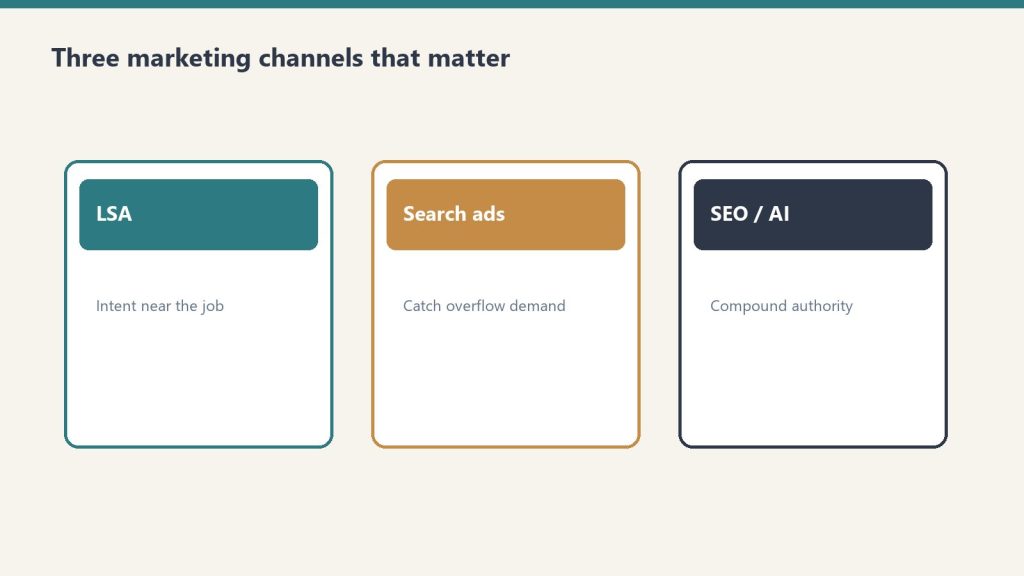
    1. Google Local Service Ads (LSAs)

    LSAs sit at the top of the search results page above traditional paid ads and the map pack. For water damage queries, LSAs produce leads at a cost per acquisition that is typically lower than Google Ads in most markets, though margins vary by metro. The Google Guaranteed badge is a meaningful conversion lever for cold homeowners. Setup requires background checks, license verification, and insurance documentation — friction that becomes a moat once cleared.

    2. Google Ads (Search)

    Traditional pay-per-click on emergency keywords (“water damage restoration,” “flooded basement,” “burst pipe cleanup”) remains the workhorse channel for most restoration companies. Campaign structure matters enormously here. Single-keyword ad groups, hyperlocal geo-targeting, call-only ads after hours, and aggressive negative keyword lists separate profitable accounts from money pits.

    3. Google Business Profile and the Map Pack

    Map pack visibility is essentially free traffic, but it is also the most competitive surface in local search. Ranking in the three-pack for “water damage restoration [city]” requires consistent NAP citations, a steady stream of authentic reviews with keyword-rich responses, regular GBP posts, geo-tagged photo uploads, and proximity to the searcher.

    4. Organic SEO and Content

    Organic search is a longer-term play but produces the cheapest leads at scale. Service pages targeting “[service] in [city]” combinations, neighborhood landing pages for high-value zip codes, and educational content answering insurance and restoration process questions all stack into a moat that competitors struggle to replicate.

    5. Insurance Adjuster and Plumber Referrals

    Marketing is not only digital. The most profitable restoration companies invest heavily in offline relationships with adjusters, plumbers, property managers, and real estate agents. A single plumber referral relationship can produce more revenue than a full year of paid search.

    Budget Allocation: Where to Put the First Marketing Dollar

    For a restoration company spending under $5,000 per month on marketing, the priority order is usually: GBP optimization first (it is free), then LSAs (lowest CAC for verified businesses), then a tightly scoped Google Ads campaign on emergency keywords, then organic content investment. Social media and display should generally come last in the water damage category because intent is too immediate for those channels to convert efficiently.

    For companies spending $10,000-$50,000 per month, the channel mix expands to include programmatic display for retargeting, YouTube for brand awareness in target zip codes, and a content marketing operation that produces 4-8 SEO-targeted pieces per month.

    Tracking and Attribution

    Water damage marketing fails when leads cannot be tracked back to source. Every campaign should use call tracking numbers (CallRail, CallTrackingMetrics, or WhatConverts), every form should fire a conversion event, and every job should be tagged in the CRM with its origin channel. Without this, marketing decisions are guesses.

    Frequently Asked Questions

    How much should a water damage restoration company spend on marketing?

    Most healthy restoration companies invest between 5% and 12% of revenue on marketing, with a higher share during the first three years while organic and referral channels are still being built. Companies relying primarily on paid acquisition often run closer to the higher end of that range.

    Are Google Local Service Ads worth it for water damage?

    For most water damage restoration companies in mid-sized and major metros, yes. LSAs typically produce a lower cost per lead than traditional Google Ads and the Google Guaranteed badge improves close rates on cold inbound calls. The qualifying process is the main barrier.

    What marketing channels work best for commercial water damage?

    Commercial water damage leans more on relationships, MSAs with property management firms, LinkedIn outreach, and association involvement than on paid search. Paid search still matters but a larger share of commercial pipeline comes from offline business development.

    How long does SEO take for a restoration company?

    Local SEO results — map pack visibility, branded search, and a handful of city service pages — typically begin to compound in 90-180 days. Building a competitive organic presence on the most valuable water damage keywords in a major metro often takes 12-24 months of consistent content and link building.

    Should a restoration company hire an agency or build marketing in-house?

    Companies under roughly $3M in revenue usually get more value from a specialized restoration marketing agency than from an in-house hire, because the talent pool of operators who understand both restoration and digital marketing is thin. Above $5M, an internal marketing leader paired with specialist agencies is often the best mix.


  • Breaking Into Commercial Restoration: A Market-Entry Guide

    Breaking Into Commercial Restoration: A Market-Entry Guide

    Most residential restoration shops that try to add commercial work fail. Not because the work is too hard. Because they treat commercial as a larger version of residential, and it is not. It is a different business with a different sales motion, different pricing math, and a different operational model.

    This is a market-entry guide for the residential-led restoration shop that has decided commercial is the next growth direction. It is written to surface the structural differences before you commit, and to give you a sequence that has worked for operators who made the transition successfully.

    The Five Structural Differences

    Before the sequencing, the differences. Each one becomes a failure mode if ignored.

    1. The buyer is not the property manager alone. Commercial buying decisions involve a buying committee — property manager, asset manager, risk manager, facilities, sometimes a TPA. Selling to one persona and ignoring the others is the most common reason commercial bids are lost.
    2. The sales cycle is months, not minutes. Commercial accounts are cultivated over six to eighteen months. Residential FNOL response can close a job in hours. The patience and process required are different.
    3. The documentation expectation is materially higher. Commercial work, particularly larger losses and any litigation-adjacent work, demands documentation discipline that residential workflows do not require. Shops without documented production processes get exposed quickly.
    4. The pricing model varies. Commercial work mixes carrier-priced jobs, time-and-material, master service agreements, and TPA-program rates. The line-item-only pricing model that works residentially does not translate.
    5. The capacity demands spike. A single commercial loss can require equipment and technician deployment that exceeds a residential shop’s standing capacity. The decision of whether to surge, decline, or partner is structural.

    The Six-Stage Market-Entry Sequence

    The shops that have made the residential-to-commercial transition successfully tend to follow a recognizable sequence. The order matters.

    Stage 1: Operational Readiness Audit

    Before any commercial sales effort, audit the operational baseline. The questions: do your production processes produce documentation that would survive a litigation review? Do you have the equipment capacity to handle a commercial loss without disrupting residential service? Do your technicians hold the certifications — IICRC ASD, AMRT, FSRT — that commercial buyers expect to see? Do you carry the insurance limits and safety documentation commercial onboarding will request?

    If any of these answers is no, fix the gap before approaching commercial accounts. A shop that wins commercial work it cannot deliver damages its reputation in a small market.

    Stage 2: Network Membership

    Join the chambers, BOMA chapter, IFMA chapter, and CoreNet local group in your market. The commercial buying community is networked. The shop with no presence in those rooms is invisible. The shop with a regular, trusted presence over twelve to twenty-four months becomes a recognized name in the local commercial property community.

    Stage 3: Insurance Broker and Agent Relationships

    Identify the insurance brokers and agents who write commercial property in your market. They are gatekeepers to a meaningful share of commercial restoration work. The relationship is not transactional — it is a long-cycle introduction-and-trust process. Brokers introduce restoration vendors to their commercial clients only after they trust the work product.

    Stage 4: Named-Account Cultivation

    Build a target list of 40 to 75 commercial accounts in your market — property management groups, large owner-occupiers, healthcare and food service operators, and corporate real estate teams. This is the named-account list that will produce your commercial pipeline over the next 18 months. The list is more important than any single account on it. Cultivate the list quarterly with risk-framed educational content, pre-loss site walks, and tabletop exercises.

    Stage 5: First Commercial Job

    The first commercial job is the trial. It does not need to be large. A small after-hours response or a moderate water mitigation for a managed property is enough to prove the operational claims made during cultivation. Treat the first job with disproportionate care — documentation, communication, and post-job review — because it produces the reference that unlocks subsequent work.

    Stage 6: Account Expansion

    The second commercial job at the same account is more valuable than the first. Account expansion — moving from one property to a portfolio, from one persona to the buying committee — produces the long-term revenue compounding that justifies the commercial entry decision. A 30-day post-job review with the property manager and the risk contact is the most undervalued account-expansion tool in commercial restoration.

    The Common Failure Modes

    The failures cluster into recognizable patterns:

    • Sales effort without operational readiness. Winning work the shop cannot deliver damages reputation.
    • Single-threaded relationships. Selling only to the property manager and missing the buying committee.
    • Underestimating the cycle length. Treating a commercial cultivation cycle as a residential FNOL response and abandoning effort after 90 days.
    • Mispricing the first job. Pricing the trial job to win at any cost and establishing an unsustainable rate baseline for the account.
    • Capacity surprise. Winning a commercial loss the shop cannot resource without disrupting residential service, then under-delivering on both.

    Each of these failures is avoidable with deliberate sequencing. Each of them is common in shops that treated commercial as residential at scale.

    How Long Does the Transition Take?

    Realistic timeline for a residential-led restoration shop to build a meaningful commercial revenue stream: 18 to 36 months from the operational readiness audit through the third or fourth commercial account producing recurring work. Faster transitions are possible with a senior commercial sales hire, but the underlying market-entry mechanics do not compress below 12 months.

    The shops that report disappointing results from commercial entry typically committed to the effort for 12 months or less, then concluded that commercial does not work for their market. The structural answer is that commercial cultivation cycles outlast 12-month commitments.

    The Honest Investment Question

    Commercial restoration entry is an investment, not a marketing campaign. The investment includes a senior commercial sales hire (or substantial owner time), conference and chamber memberships, target-account research tools, and the operational upgrades the readiness audit surfaces. Operators who treat the investment as discretionary marketing spend rarely follow through on the cultivation cycle long enough to see the return.

    The operators who do follow through tend to build a commercial revenue stream that becomes the most stable and highest-margin part of the business. The math works. The patience is the constraint.

    Frequently Asked Questions

    Can a residential restoration shop add commercial work?

    Yes, but treat it as a market-entry project, not a marketing tactic. The buyer, sales cycle, documentation expectation, pricing model, and capacity demands all differ from residential work. Shops that follow a deliberate market-entry sequence — operational readiness, network membership, broker relationships, named-account cultivation, first job, account expansion — succeed at meaningfully higher rates than shops that approach commercial as larger residential.

    How long does it take to break into commercial restoration?

    A realistic timeline is 18 to 36 months from operational readiness audit through the third or fourth commercial account producing recurring work. Faster transitions are possible with senior sales investment, but the underlying market-entry mechanics do not compress below 12 months.

    What certifications do I need for commercial restoration?

    Commercial buyers expect IICRC certifications appropriate to the work — WRT and ASD as a baseline, with AMRT, FSRT, and the higher-tier credentials adding credibility for specialty work. Insurance limits, safety documentation, and OSHA-compliant practices are also typical onboarding requirements.

    How big should my target account list be?

    Most shops manage a target list of 40 to 75 named commercial accounts per sales rep, with quarterly touchpoint cadence. Higher counts dilute the relationship depth that the commercial sales motion depends on.

    Should I hire a dedicated commercial sales rep?

    If commercial is a serious growth direction and the owner cannot personally maintain quarterly touchpoints across the named-account list, a dedicated sales rep is the structural answer. Below that threshold, the owner can usually carry the pipeline directly.

    Continue with the Restoration Operator’s Playbook for more on operationalizing commercial work.


  • The Commercial Restoration Sales Stack: From Prospecting to Close

    The Commercial Restoration Sales Stack: From Prospecting to Close

    “How do I increase commercial restoration sales?” is the wrong question. The right question is whether you have a sales stack at all — a connected sequence of stages with exit criteria, owners, and measurement. Most restoration shops do not.

    This is a working playbook for the commercial restoration sales stack as it operates in 2026. It assumes you already do residential work, already hold the IICRC certifications carriers expect, and have decided commercial is a serious growth direction. What follows is the structure that turns commercial intent into commercial pipeline.

    Stage 1: Prospecting

    Prospecting is the activity of identifying buildings and people you have not yet met. It is the front of the funnel, and most restoration sales programs do this badly because they confuse prospecting with referrals. Referrals are an output of relationships you already have. Prospecting is how you find the relationships you do not.

    The four prospecting channels that produce reliable commercial restoration pipeline in 2026:

    • BOMA, IFMA, and CoreNet chapter membership and event participation — where commercial property managers, facilities engineers, and corporate real estate teams gather.
    • Property tax records and CoStar-equivalent data — the source of building-level ownership, square footage, and management company information that lets you build a target list.
    • Insurance broker and agent relationships — the broker often controls the carrier-restoration vendor relationship at mid-market commercial accounts.
    • Cold structured outreach to named accounts — outbound that is research-based and persona-specific, not spray-and-pray.

    Stage exit criteria: a documented account profile with at least one named contact, a current vendor (if known), and a reason to engage.

    Stage 2: Qualification

    Qualification is the activity of deciding which prospects deserve cultivation effort. Not every commercial building is a good fit for your shop. The qualifiers that matter:

    • Geographic proximity to your operational base — response time is a sales asset.
    • Building portfolio size — a property management group with 30 buildings is more leverage than a single owner-occupier.
    • Loss history and risk profile — older buildings, occupied basements, healthcare and food service tend to generate more restoration work.
    • Vendor relationships — accounts already locked into a carrier program may be hard to dislodge; accounts in vendor-review cycles are buying windows.

    Stage exit criteria: a written go/no-go decision with the rationale captured. The discipline of writing it down is what stops sales reps from chasing every conversation.

    Stage 3: Account Mapping

    Account mapping is the work of identifying every decision-maker and influencer at a qualified account. Commercial restoration sales fails most often because the rep sold to one person at a five-person buying committee. The map fixes that.

    A complete account map for a commercial restoration prospect identifies: the property manager, the asset manager or owner representative, the risk manager or insurance buyer, the facilities or chief engineer, the procurement contact (if separate), the broker of record, and the TPA program manager (if the account routes work through one). Not every account has all seven roles, but the exercise of asking which exist forces clarity.

    Stage exit criteria: at least three named contacts at the account, with role, contact information, and a notes field that captures what each contact actually cares about.

    Stage 4: Cultivation

    Cultivation is the long middle of the commercial sales cycle — the six to eighteen months between first introduction and signed agreement. It is where most restoration sales programs leak pipeline because they do not have a defined cadence.

    A working cultivation cadence runs on a quarterly rhythm: a pre-loss educational meeting in Q1, a tabletop or response-plan walkthrough in Q2, an industry-event touchpoint in Q3, and a renewal-cycle conversation in Q4. The exact content matters less than the discipline of staying present in the account’s calendar.

    Effective cultivation content is risk-framed, not capability-framed. “Here is how a Category 3 loss in your basement mechanical room would unfold and what it would cost you” outperforms “Here are our certifications and our truck count” every time.

    Stage exit criteria: a documented sales-qualified opportunity — a buying signal, a vendor review, an MSA request, or a small first job.

    Stage 5: Close

    The close in commercial restoration is rarely a single moment. It is the conversion of cultivation into either a preferred-vendor agreement, a TPA program enrollment, or a first significant job that establishes the operational relationship.

    The deliverables that move a close:

    • A written response plan tailored to the building, not a generic capabilities deck.
    • Insurance and safety document package ready to submit on request.
    • A clear differentiator that survives the first procurement conversation — response time, technical capability, documentation quality, or pricing model.
    • A reference call or site visit with a comparable account, offered before it is requested.

    Stage exit criteria: a signed MSA, a program enrollment confirmation, or a first job that the account treats as a trial.

    Stage 6: Land and Expand

    The first job is not the end of the sale. Commercial accounts that produce one loss typically produce another, and the operators who win the long-term revenue treat the first job as the start of an account-development relationship rather than the close. A 30-day post-job review with the property manager and the risk contact is the most undervalued account-expansion tool in commercial restoration.

    Connecting the Stack

    Each stage above only matters if it connects to the next. A restoration sales program that prospects without qualifying, qualifies without account-mapping, or cultivates without a close trigger leaks pipeline at every handoff. The connector is a documented stage exit criterion and a single owner accountable for moving accounts through the stack.

    Most commercial restoration sales programs in 2026 are run with a sales rep, a sales manager, and an owner who reviews the named-account list monthly. The bigger the operation, the more critical the connector discipline. Without it, the stack collapses into a referral list with optimistic narration.

    Frequently Asked Questions

    How long should a commercial restoration sales cycle take?

    Six to eighteen months from introduction to signed MSA or first significant job is typical for direct-to-owner commercial accounts. TPA program enrollment moves faster, generally 60 to 120 days.

    What is the difference between prospecting and qualification?

    Prospecting is identifying buildings and people you have not met. Qualification is deciding which of those prospects deserve cultivation effort. Conflating the two is the most common reason commercial pipelines stall — reps cultivate accounts that should not have passed qualification.

    How many named contacts should I have at a target account?

    At least three. A single-threaded relationship at one persona — usually the property manager — is the most common cause of lost commercial bids when procurement runs.

    What is the right cadence for cultivating a commercial restoration account?

    Quarterly is the working baseline. The exact touchpoint matters less than the discipline of staying present across a buying cycle that may run a year or longer.

    Should I hire a dedicated commercial sales rep?

    If commercial is a serious growth direction and the owner cannot personally maintain quarterly touchpoints across 40 to 75 named accounts, a dedicated rep is the structural answer. Below that threshold, the owner can usually carry the pipeline.

    For more sales playbooks and operational systems, browse the Restoration Operator’s Playbook archive.


  • How Restoration Companies Are Winning Commercial Accounts in 2026

    How Restoration Companies Are Winning Commercial Accounts in 2026

    Commercial restoration sales no longer rewards the most aggressive cold caller. It rewards the operator who has mapped the building, named every decision-maker, and arrived with a written plan before the loss happens.

    The restoration companies gaining commercial market share in 2026 are not necessarily the ones with the largest equipment fleets. They are the ones who treat commercial accounts like enterprise sales — with named accounts, multi-year cultivation cycles, and a recognition that the buyer is rarely the property manager you first meet.

    Why Commercial Restoration Sales Looks Different in 2026

    Three structural shifts have rewritten the commercial restoration playbook over the last 24 months. First, third-party administrators (TPAs) and program work now route a larger share of insurance-driven commercial losses, which means the carrier relationship matters as much as the property relationship. Second, large property management groups have consolidated, which concentrates buying power into fewer hands. Third, post-loss litigation pressure has made documentation discipline a sales asset rather than a back-office expense.

    Operators who treat commercial restoration as a transactional, lead-by-lead business are losing ground to firms that treat it as a relationship discipline. The difference shows up in close rates, average job size, and the willingness of property managers to call before they tender to a competitor.

    The Five Buyer Personas in Commercial Restoration

    Most restoration sales reps pitch the property manager and stop there. The firms winning commercial work in 2026 are pitching all five of the following decision-makers, often simultaneously, and tailoring their materials to each:

    • Property manager. Operates the building day to day. Cares about disruption, tenant complaints, and being able to say the response is handled.
    • Asset manager or owner representative. Owns the financial outcome. Cares about loss-of-use exposure, capital preservation, and avoiding insurance disputes.
    • Risk manager or insurance buyer. Often a corporate function. Cares about preferred-vendor compliance, carrier relationships, and standardized documentation.
    • Facilities or chief engineer. Holds the technical relationships. Cares about contractor competence, building system knowledge, and clean handoffs.
    • TPA case manager. Routes the work after the FNOL. Cares about responsiveness, daily updates, and clean billing.

    A quote, a brochure, or a referral sheet that speaks to one of these personas does not move the other four. Operators with mature commercial sales programs maintain at least three persona-specific decks and tailor their account-development outreach accordingly.

    The Account Map Is the Sales Asset

    The most undervalued tool in commercial restoration sales is the written account map. It is not a CRM record. It is a one-page document for each target account that captures the building portfolio, current vendor relationships, known pain points, the people in each of the five personas above, and the trigger events that would create a buying moment.

    Account maps are how a sales rep stops chasing leads and starts cultivating a territory. They are also how restoration company owners answer the most important commercial sales question: do we actually know who buys at this account, or are we just hoping the property manager remembers our name?

    The TPA Channel: Asset, Liability, or Both

    Third-party administrators have become a structural feature of commercial restoration. For some operators they represent 30% or more of revenue. The honest assessment in 2026 is that TPA work is a sustainable channel only if you understand its tradeoffs.

    The benefit is volume and predictability — once a TPA program approves you, the work flows. The cost is margin compression, scope-of-work constraints, and the risk that the TPA, not the property owner, becomes the customer who can fire you. Operators with the strongest commercial sales results in 2026 use TPA programs as a base load for crew utilization, while building a parallel direct-to-owner pipeline at higher margin.

    What a Commercial Restoration Sales Cycle Actually Looks Like

    A residential water-loss sales cycle can close in hours. A commercial sales cycle — meaning the path from first introduction to a preferred-vendor agreement or program enrollment — typically runs six to eighteen months. The sales activity that fills that window matters more than the pitch itself. A representative cycle includes:

    • Initial introduction, often through a chamber, BOMA event, or warm referral.
    • Educational meeting framed around a specific risk the property faces — not a capabilities pitch.
    • Pre-loss site walk and documentation of building systems relevant to water, fire, and biohazard response.
    • Tabletop exercise or response-plan review with facilities and risk teams.
    • Vendor onboarding, insurance and safety document submission, master service agreement.
    • First small job or after-hours response that proves out the operational claims made during the cycle.

    Operators who try to compress this cycle into a single quote almost always lose to the firm that walked the building twelve months earlier.

    What to Measure

    The commercial pipeline metrics that matter are not the same as residential. The four that the strongest sales programs track in 2026 are:

    • Named accounts in active cultivation — a target list with quarterly touchpoint cadence.
    • Pre-loss site walks completed — a leading indicator of pipeline health 6–12 months out.
    • MSAs and preferred-vendor agreements signed — the conversion event that actually moves revenue.
    • Average commercial job size and gross margin trend — the proof that the cultivation is producing the right kind of work.

    The 2026 Commercial Restoration Sales Stack

    Putting it together, the operators winning commercial accounts in 2026 share a recognizable stack: a named-account target list reviewed monthly by ownership; a CRM with persona-tagged contacts at each account; a documented sales cycle with stage exit criteria; pre-loss documentation as a standard sales motion; a TPA program strategy that complements rather than replaces direct sales; and clear ownership of which leader on the team drives commercial pipeline health.

    The firms missing one or more of these elements tend to describe their commercial revenue as inconsistent or referral-dependent. The firms that have all of them describe their pipeline as crowded.

    Frequently Asked Questions

    How long does it take to win a commercial restoration account?

    The full sales cycle from introduction to first paid work typically runs six to eighteen months for direct-to-owner accounts. TPA program enrollment can move faster, often 60 to 120 days from application to first dispatch.

    What is the most common reason restoration companies lose commercial bids?

    Single-threaded relationships. Most losses come from selling only to the property manager and missing the asset manager, risk manager, or facilities engineer who actually controls vendor selection.

    Should restoration companies pursue TPA work?

    TPA work is a viable revenue channel if treated as a base-load contributor, not the entire pipeline. Margin is compressed, but volume is predictable. The risk is becoming dependent on a single TPA program, which can revoke status with little notice.

    What is a preferred-vendor agreement worth?

    A signed MSA or preferred-vendor agreement does not guarantee work, but it removes the procurement and onboarding friction that would otherwise block dispatch when a loss occurs. Operators report that conversion from MSA to actual revenue typically takes another 90 to 180 days.

    How many named accounts should a commercial sales rep manage?

    Most restoration sales programs in 2026 cap active named accounts at 40 to 75 per rep, with a quarterly touchpoint cadence. Higher counts dilute the relationship depth that the commercial sales motion depends on.

    For more on the operational side of running a commercial restoration business, see the Restoration Operator’s Playbook archive on Tygart Media.


  • Build Your Own KnowHow — And Then Go Further

    Build Your Own KnowHow — And Then Go Further

    Tygart Media Strategy
    Volume Ⅰ · Issue 04Quarterly Position
    By Will Tygart Long-form Position Practitioner-grade

    KnowHow is one of the most important things happening in the restoration industry right now. If you’re not familiar with it: it’s an AI-powered platform that takes your company’s operational knowledge — your SOPs, your onboarding materials, your hard-won process documentation — and turns it into an on-demand resource every team member can access from their phone. Your best technician’s knowledge stops walking out the door when they leave. Your new hire in Iowa follows the same protocol as your veteran in Texas. Your managers stop being human FAQ machines.

    It solves a real problem that has cost restoration companies enormous amounts of money in inconsistent work, slow onboarding, and institutional knowledge that evaporates with turnover.

    But KnowHow solves the internal problem. The knowledge stays inside your organization. And there is a second problem — the external one — that nobody has solved yet.

    The Internal Problem vs. The External Problem

    The internal problem is: your people don’t have access to what your company knows when they need it. KnowHow fixes that. The knowledge becomes accessible, searchable, consistent, and deliverable at scale across every location and every shift.

    The external problem is different: your clients, prospects, and contracting authorities have no way to verify that your company knows what it claims to know. They can read your capabilities statement. They can check your certifications. They can call references. But they can’t look inside your organization and confirm that your documented protocols are current, specific, and actually practiced — not just written down for the sake of winning a bid.

    In commercial restoration, that verification gap is expensive. Facility managers, FEMA contracting officers, insurance carriers, and national property management companies are making vendor decisions based on trust signals that are largely unverifiable. The company with the best pitch often wins over the company with the best protocols.

    An external knowledge API changes that dynamic completely.

    What an External Knowledge API Actually Is

    An external knowledge API is a structured, authenticated, publicly accessible feed of your operational knowledge — not your trade secrets, not your pricing, not your internal communications, but your documented protocols, your methodology, your standards, and your verified expertise. Published. Structured. Machine-readable. Available to anyone who needs to evaluate whether your company is the right partner for a complex job.

    Think of it as the difference between telling a client “we follow IICRC S500 water damage protocols” and showing them a live, structured endpoint where they can pull your actual documented water mitigation process — with timestamps that confirm it was updated last month, not in 2019.

    The internal KnowHow platform is the source. The external API is the window — carefully curated, access-controlled, and designed to answer the questions that matter to the people evaluating you.

    Who Cares About Your External Knowledge

    The list is longer than most restoration contractors realize.

    Commercial property managers and facility directors. A national hotel chain or healthcare system evaluating restoration vendors for their approved vendor program needs more than a certificate of insurance and a reference list. They want to know that your protocols are consistent across every job, that your team follows the same process whether the project manager is on-site or not, and that your documentation standards will hold up in a claim. An external knowledge feed — showing your water damage, fire damage, and mold remediation protocols in structured, current form — answers those questions before the conversation even starts.

    FEMA and government contracting. Federal disaster response contracts are awarded to companies that can demonstrate organizational capability at scale. The RFP process rewards documentation. A company that can point to an externally published, structured knowledge base as evidence of their operational maturity is presenting something most competitors don’t have. It’s not just a differentiator — it’s proof of the kind of institutional infrastructure that large government contracts require.

    Insurance carriers and TPAs. Third-party administrators and carrier programs are increasingly using AI tools to evaluate and route claims to preferred vendors. A restoration company whose documented protocols are structured and machine-readable — available for an AI system to pull and verify against claim requirements — is positioned for the way preferred vendor selection is heading, not the way it used to work.

    Commercial real estate and institutional property owners. REITs, hospital systems, university facilities departments, and large corporate real estate portfolios are all moving toward vendor relationships that have verifiable documentation standards. An external knowledge API gives them something they can actually audit — not just a sales presentation.

    How to Build It: The Two-Layer Stack

    The stack that makes this work has two layers, and KnowHow already gives you the first one.

    Layer one — internal capture and organization (KnowHow’s job). Use KnowHow, or an equivalent internal knowledge platform, to capture and organize your operational knowledge. Document your protocols rigorously. Keep them current. Assign ownership so they don’t go stale. The discipline required here is real, but it’s also the discipline that makes your company better operationally regardless of what you do with the knowledge externally. This layer is the foundation.

    Layer two — external publication and API distribution (the next layer). Select the knowledge that is appropriate to share externally — your methodology, your standards, your certifications, your documented approach to specific job types — and publish it in a structured, consistently maintained form. This can be as simple as a well-organized section of your company website with current protocol documentation, or as sophisticated as a full REST API endpoint that clients and AI systems can query directly. The key requirements are structure (consistent format, clear categorization), currency (updated when protocols change, timestamped), and accessibility (easy for a prospect or evaluator to find and verify).

    The gap between layer one and layer two is smaller than it sounds. If you’ve already done the internal documentation work in KnowHow, the editorial work of curating an external-facing version of that knowledge is incremental. You’re not building from scratch — you’re deciding what to show and building the window to show it through.

    The Credential That No Certificate Can Replace

    Certifications are static. An IICRC certification tells a client you passed a test. It doesn’t tell them what your company actually does when a technician encounters a Category 3 water loss in a 1960s commercial building with asbestos-containing materials in the subfloor.

    External knowledge does. It shows the specific, documented, currently-maintained thinking your company applies to that situation. It’s living proof of operational maturity, not a snapshot from the last time someone studied for an exam.

    In the commercial restoration market, where the jobs are large, the documentation requirements are significant, and the clients are sophisticated, that distinction is worth money. The companies that build this layer now — while most competitors are still treating knowledge as purely internal — will have a credential that can’t be quickly replicated.

    The Practical Starting Point

    You don’t need a full API to start. The minimum viable version of an external knowledge layer is a structured, well-maintained “Our Methodology” section on your website — not a generic “our process” marketing page, but actual documented protocols organized by job type, with clear version dates and enough specificity that an evaluator can see you’ve actually done the work.

    From there, the path to a structured API is incremental: add consistent categorization, ensure each protocol document has a permanent URL, and eventually expose that structure through a queryable endpoint. Each step makes the credential more verifiable and more valuable.

    KnowHow got the industry to take internal knowledge seriously. The companies that figure out how to take the next step — making that knowledge externally verifiable and machine-readable — will have something the market has never seen before in restoration.

    What is the difference between internal and external knowledge in restoration?

    Internal knowledge (what KnowHow manages) is operational documentation accessible to your own team — SOPs, onboarding materials, process guides. External knowledge is a curated version of that same expertise published in a structured, verifiable form for clients, contracting authorities, and AI systems to access and evaluate.

    Why would a restoration company publish its knowledge externally?

    Because commercial clients, FEMA, insurance carriers, and institutional property managers need to verify operational maturity before awarding contracts. A structured, current, machine-readable knowledge base is a stronger credential than certifications or capabilities statements — it shows documented, maintained expertise rather than a static snapshot.

    What is an external knowledge API for a restoration company?

    A structured, authenticated feed of your documented protocols, methodology, and standards — published in a format that clients, evaluators, and AI systems can query directly. It turns your operational knowledge into a verifiable, market-facing credential rather than keeping it purely internal.

    Who specifically benefits from a restoration company’s external knowledge API?

    Commercial facility managers building approved vendor programs, FEMA and government contracting officers evaluating organizational capability, insurance carriers and TPAs using AI tools to route claims to preferred vendors, and institutional property owners who need auditable vendor documentation standards.

    Does a restoration company need KnowHow to build an external knowledge API?

    No — any internal knowledge platform or even rigorous in-house documentation works as the foundation. KnowHow accelerates the internal capture work, which makes the external publication step more realistic. But the two-layer stack works with any internal knowledge infrastructure that produces well-documented, current, organized protocols.

  • From $0 to $31,000: The Upper Restoration SEO Story

    From $0 to $31,000: The Upper Restoration SEO Story

    Tygart Media / Content Strategy
    The Practitioner JournalField Notes
    By Will Tygart
    · Practitioner-grade
    · From the workbench

    The easiest way to explain what a content program actually does for a restoration company is to show one.

    Upper Restoration serves New York City and Long Island — Nassau and Suffolk counties. Competitive market, established players, the full range of water damage, fire, mold, and storm work. When we started working together, their SpyFu profile looked like most restoration contractors: effectively zero organic search presence, no meaningful keyword rankings, no measurable traffic from search.

    Today their monthly SEO value — the estimated cost to replicate their organic traffic through paid search — sits above $31,000 per month. That number is verified, tracked, and continues to move.

    This is what happened, in the order it happened, and why each step mattered.

    Step One: The Baseline Audit

    Before a single article was written, we ran a complete site audit. Not a surface-level crawl — a structured inventory of every post, every page, every category and tag, every piece of metadata. What existed, what was missing, what was broken, what was thin.

    The audit answers the foundational question: what does Google currently think this site is about? In Upper Restoration’s case, the answer was: not much. Thin content, minimal taxonomy, no internal link architecture, no schema markup. The domain existed but carried no topical authority signal in any specific category.

    This is the starting line for almost every restoration contractor we work with. The audit doesn’t reveal a problem — it reveals the opportunity. A site with no established authority can build it faster than a site with entrenched wrong signals, because there’s nothing to undo.

    Step Two: Architecture Before Content

    The temptation after an audit is to start publishing immediately. The right move is to design the architecture first.

    For Upper Restoration, that meant establishing the category structure: Water Damage, Fire Restoration, Mold Remediation, Storm Damage, Commercial Restoration, Insurance Claims. Every piece of content would live inside one of these buckets. The buckets would become the topical pillars Google associates with the domain.

    It meant identifying the hub pages — one pillar article per service category, written to be the most comprehensive resource on that topic in their market. Every supporting article would link back to the relevant hub. The hubs would link out to supporting articles. The internal link graph would make the site’s topical organization explicit and navigable.

    It meant mapping the service areas: every neighborhood in New York City, every town across Nassau and Suffolk with meaningful search volume for restoration services. Each would get its own page. The geographic coverage would signal to Google exactly where this company operates and for which locations it deserves to rank.

    This work takes time before it produces any visible results. It’s also what separates a content program that compounds over time from one that generates a temporary traffic bump and then plateaus.

    Step Three: The Content Sprint

    With the architecture established, the content sprint began. The goal: achieve topical authority in the core service categories as quickly as possible by covering every meaningful query a restoration customer in Upper Restoration’s market might search.

    Not generic coverage — hyper-local, hyper-specific coverage. Water damage restoration in Flushing. Mold remediation in Hempstead. Fire damage cleanup in Babylon. Each piece of content targeting the specific geographic and service intersection where a real customer with a real problem would be searching.

    The volume matters for a specific reason: Google’s topical authority model rewards comprehensive coverage. A site with one excellent article about water damage restoration ranks below a site with one hundred well-structured articles about water damage restoration in every neighborhood of its service area, because the latter site demonstrates deeper expertise. The sprint isn’t about quantity for its own sake — it’s about covering the topic space completely enough that Google has no reason to prefer a competitor with thinner coverage.

    Every article was optimized before publishing: title tag, meta description, slug, heading structure, schema markup, internal links to the relevant hub page. Not as an afterthought — as part of the production process.

    Step Four: Schema and Structured Data

    Schema markup is the metadata layer that tells Google what type each piece of content is and how to categorize it. Article schema for editorial content. LocalBusiness schema on the homepage and service pages. FAQ schema on content that answers specific questions. BreadcrumbList schema to signal the site’s navigational hierarchy.

    The impact of schema is less visible than rankings but measurable in search result appearance: FAQ dropdowns, star ratings, rich snippets, knowledge panel information. These take up more real estate in search results and convert at higher rates than standard blue links, because they answer the user’s question before the click.

    More importantly, schema accelerates Google’s ability to categorize the site correctly. Without it, Google infers content type from the raw text. With it, you’re providing structured data that removes ambiguity. For a restoration contractor trying to establish authority in multiple service categories simultaneously, removing ambiguity is significant.

    Step Five: The Measurement Layer

    SEO without measurement is guesswork. The measurement layer for Upper Restoration runs through SpyFu for organic value tracking and DataForSEO for keyword-level ranking data across the specific locations and queries that matter.

    SpyFu’s monthly SEO value metric is the headline number — it’s what shows the overall trajectory and what makes the clearest case to a client that the program is working. But the keyword-level data underneath it tells the more granular story: which service categories are ranking, which locations are performing, which queries have moved to page one, which still have room to climb.

    The measurement layer also drives the ongoing program. When keyword data shows a cluster gaining traction, you add more content in that cluster. When a hub page is ranking but not converting, you look at the content structure and the call to action. When a service area is generating impressions but not clicks, you look at the title tag and meta description. The program is a feedback loop, not a one-time campaign.

    What $31,000 in SEO Value Actually Means

    The SpyFu number is an estimate of traffic value, not revenue. A site with $31,000 in monthly SEO value is generating organic traffic that would cost $31,000 per month to replicate through Google Ads. The actual revenue generated depends on conversion rates, average job values, close rates — variables that differ for every company.

    What the number does tell you, clearly and verifiably, is that the content program has built genuine search presence. Keywords are ranking. Pages are generating clicks. The site exists, from Google’s perspective, in a way it didn’t before.

    For Upper Restoration, that presence is geographically concentrated in exactly the markets where they operate, for exactly the services they provide, targeting exactly the search queries that produce calls. The traffic is not vanity traffic — it’s potential customers with active problems looking for someone to call.

    The program that produced this result started from $0. It required an audit, an architecture phase, a content sprint, schema implementation, and an ongoing measurement and iteration cycle. It did not require a large agency, a significant paid media budget, or anything other than a structured approach to building topical authority in a specific market.

    That’s the story. The starting line for any restoration contractor who wants to tell a similar one is a baseline audit — understanding exactly where $0 is before building toward something different.


    Tygart Media builds content programs for restoration contractors. Every engagement starts with a SpyFu and DataForSEO baseline audit of your market — so the starting line is documented and the trajectory is measurable from day one.

    {
    “@context”: “https://schema.org”,
    “@type”: “Article”,
    “headline”: “From $0 to $31,000: The Upper Restoration SEO Story”,
    “description”: “Upper Restoration went from zero search presence to $31,000 in monthly SEO value. Here is exactly what happened, in what order, and why each step mattered.”,
    “datePublished”: “2026-04-02”,
    “dateModified”: “2026-04-03”,
    “author”: {
    “@type”: “Person”,
    “name”: “Will Tygart”,
    “url”: “https://tygartmedia.com/about”
    },
    “publisher”: {
    “@type”: “Organization”,
    “name”: “Tygart Media”,
    “url”: “https://tygartmedia.com”,
    “logo”: {
    “@type”: “ImageObject”,
    “url”: “https://tygartmedia.com/wp-content/uploads/tygart-media-logo.png”
    }
    },
    “mainEntityOfPage”: {
    “@type”: “WebPage”,
    “@id”: “https://tygartmedia.com/upper-restoration-seo-case-study/”
    }
    }

  • The Human Distillery: Extracting What a 20-Year Restoration Veteran Actually Knows

    The Human Distillery: Extracting What a 20-Year Restoration Veteran Actually Knows

    The Machine Room · Under the Hood

    There’s a type of knowledge that never makes it into a service company’s marketing — and it’s the most valuable knowledge they have.

    It’s not in their website copy. It’s not in their training materials. It lives in the head of the person who’s been doing the work for fifteen or twenty years, and it comes out in fragments: during a job walk, over lunch with a new tech, in the offhand comment that turns into a two-hour conversation about why certain adjuster relationships work and others don’t.

    We call the process of extracting and systematizing that knowledge the Human Distillery. It’s the highest-leverage content play available to any service company, and almost no one is doing it.

    The Tacit Knowledge Problem

    Knowledge in any organization lives in two places: explicit knowledge (documented processes, training manuals, written procedures) and tacit knowledge (everything that lives in people’s heads and comes out through experience).

    Most companies have invested heavily in explicit knowledge. SOPs for mitigation setup. Checklists for job completion. Xactimate templates for common loss types. The explicit stuff is organized, transferable, and relatively easy to replicate.

    Tacit knowledge is different. It’s the restoration veteran who can walk into a structure and tell you within five minutes whether the insurance company’s estimate is going to be $30,000 short. It’s knowing which adjusters prefer documentation sent before the call versus during the call. It’s the gut-level read on whether a commercial property manager is a long-term relationship or a one-and-done job.

    That knowledge took twenty years to accumulate. It cannot be written down in an afternoon. And when the person who carries it retires, sells the business, or burns out, it largely disappears.

    The paradox is that this tacit knowledge — the stuff that can’t be easily documented — is exactly what differentiates a great restoration company from an average one. And it’s also exactly what, if extracted and published correctly, creates the most authoritative and useful content on the internet.

    What Extraction Actually Looks Like

    The Human Distillery is not an interview. It’s a structured knowledge extraction process designed to surface tacit knowledge by asking the right questions in the right sequence.

    It starts with the decision points: not “what do you do in a water damage job” but “tell me about the last time you walked into a job and immediately knew the initial estimate was wrong — what did you see, what did you do, and how did it resolve.” Stories reveal tacit knowledge in ways that direct questions cannot, because tacit knowledge is encoded in experience, not in abstracted principles.

    From stories, you extract patterns. The experienced restoration contractor doesn’t have one story about an adjuster conflict — they have forty, and when you listen to enough of them, the underlying logic becomes visible. Adjuster relationships work a certain way. Documentation sequencing matters in specific situations. Certain loss types have hidden scope that novices miss every time.

    Those patterns become frameworks. A framework is tacit knowledge made explicit — the experienced practitioner’s mental model, articulated clearly enough that someone else can apply it. And frameworks are extraordinarily powerful content.

    Why This Is the Highest-Leverage Content Play

    Generic content is everywhere. “What to do after a house fire.” “Signs of hidden water damage.” “How long does mold remediation take.” Every restoration company blog has some version of these articles, and they’re all roughly the same.

    Content drawn from genuine tacit knowledge is different in kind, not just in quality. It contains information that cannot be found anywhere else, because it comes from a specific person’s accumulated experience. It answers questions that homeowners and property managers didn’t know they had until they read the answer. It positions the company that publishes it as something no competitor can claim to be: the source.

    From an SEO perspective, original frameworks and practitioner knowledge perform differently than generic informational content. They earn links because other people reference them. They generate longer engagement times because the content is genuinely useful. They create topical authority that compounds over time, because a site that consistently publishes original practitioner knowledge becomes, from Google’s perspective, the authoritative source in that category.

    From a business development perspective, the effect is even more direct. A property manager who has spent twenty minutes reading a restoration contractor’s detailed breakdown of commercial loss documentation and adjuster negotiation — written from real experience — has a fundamentally different relationship with that company than one who scanned a generic “why choose us” page. They understand what the company knows. They trust the expertise before the first call.

    Dave and the 247RS Pilot

    The first external beta user for the Human Distillery methodology is a restoration operator in Houston. Twenty-plus years in the industry. Deep relationships across the insurance ecosystem. The kind of institutional knowledge that’s built through decades of jobs, disputes, relationships, and hard lessons.

    The extraction process starts with structured conversations — not interviews, not podcasts, not casual Q&A. Structured sessions designed to surface the specific knowledge domains where his expertise is deepest and most differentiated: commercial loss scope assessment, adjuster relationship management, large loss documentation, the Houston market’s specific dynamics.

    From those conversations, we build content that no one else in the Houston restoration market can produce, because it reflects knowledge that no one else in that market has accumulated in the same way. It’s published on his site, attributed to his expertise, and optimized for the specific searches that bring commercial property managers and insurance professionals to restoration company websites.

    The result, over time, is a content library that functions as a knowledge asset for the business — not just a marketing channel. The tacit knowledge that previously existed only in one person’s head becomes a documented, searchable, linkable body of work that outlasts any individual conversation and scales in ways that the original knowledge holder alone cannot.

    The Business Case for Getting This Right

    Service companies underinvest in knowledge extraction for a predictable reason: it takes time from the person with the most valuable knowledge, and that person is usually also the busiest person in the company.

    The ROI calculation, though, is straightforward once you see it clearly. The tacit knowledge already exists. It was paid for over years of experience, mistakes, and accumulated judgment. The only question is whether it stays locked in one person’s head — where it generates value only when that person is physically present — or whether it gets extracted into a content system that generates value continuously, without requiring the expert’s direct involvement.

    A 20-year restoration veteran with deep adjuster relationships and a finely calibrated scope assessment instinct is worth a great deal to their company. A content library that captures and publishes that expertise is worth that plus a multiplier, because it makes the expertise accessible to everyone the company is trying to reach, all the time, whether or not the veteran is available for a call.

    That’s the Human Distillery. Extract what the expert knows. Make it findable. Let it work while they’re on the job.


    Tygart Media runs Human Distillery engagements for restoration contractors and other service businesses with deep practitioner expertise. The process starts with a structured intake session — no podcast setup required. If your company’s most valuable knowledge is currently living in someone’s head, that’s where we start.

    {
    “@context”: “https://schema.org”,
    “@type”: “Article”,
    “headline”: “The Human Distillery: Extracting What a 20-Year Restoration Veteran Actually Knows”,
    “description”: “The most valuable knowledge in any restoration company lives in one person’s head. Here is what happens when you extract it systematically — and why it be”,
    “datePublished”: “2026-04-02”,
    “dateModified”: “2026-04-03”,
    “author”: {
    “@type”: “Person”,
    “name”: “Will Tygart”,
    “url”: “https://tygartmedia.com/about”
    },
    “publisher”: {
    “@type”: “Organization”,
    “name”: “Tygart Media”,
    “url”: “https://tygartmedia.com”,
    “logo”: {
    “@type”: “ImageObject”,
    “url”: “https://tygartmedia.com/wp-content/uploads/tygart-media-logo.png”
    }
    },
    “mainEntityOfPage”: {
    “@type”: “WebPage”,
    “@id”: “https://tygartmedia.com/human-distillery-restoration-tacit-knowledge/”
    }
    }

  • The $0 SEO Value Problem: What Invisibility Actually Costs Restoration Contractors

    The $0 SEO Value Problem: What Invisibility Actually Costs Restoration Contractors

    There’s a restoration company in Tacoma, Washington called All American Restoration Services. Four and a half stars. Thirty-seven Google reviews. Full mitigation and rebuild capability. Locally owned, with the kind of reputation that takes years to earn.

    Their SpyFu profile shows six tracked keywords, zero estimated monthly clicks, and $0 in monthly SEO value. DataForSEO has no data on them at all — they don’t register.

    They are, from a search engine’s perspective, completely invisible.

    This is not unusual. It is, in fact, the default state for most restoration contractors in most markets. And the cost of that invisibility is not abstract.

    What $0 SEO Value Actually Means in Dollars

    SEO value — the metric SpyFu and similar tools report — is an estimate of what a site’s organic traffic would cost if purchased through Google Ads. A site with $31,000 in monthly SEO value is receiving traffic that would cost $31,000 per month to replicate with paid search.

    When that number is $0, it means the site is generating no measurable organic traffic for any keyword anyone is actually searching.

    In the restoration industry, the keywords people search are high-intent and high-value. Someone searching “water damage restoration Tacoma” is not browsing. They have standing water in their house. They are going to call someone in the next fifteen minutes. The average water damage restoration job runs $3,836. Significant losses start at $15,000. The searches that drive those calls are worth real money — and right now, those calls are going to someone else.

    The math is uncomfortable. If a restoration company’s invisibility costs them even five jobs per month — conservative for a market the size of Tacoma — that’s $19,000 to $75,000 in monthly revenue that’s routing to a competitor who ranked higher. Not because that competitor does better work. Because their website exists, from Google’s perspective, and yours doesn’t.

    Why Good Restoration Companies End Up Invisible

    All American Restoration is not an anomaly. When you run DataForSEO and SpyFu against restoration contractors in most mid-size markets, the pattern repeats: strong reputation, strong reviews, zero search presence.

    It happens for a predictable set of reasons.

    Restoration companies grow on referrals. Insurance adjusters, plumbers, property managers — the first decade of a restoration business is built on relationships, not search. By the time the referral network matures, the business is busy enough that digital marketing feels optional. The website becomes a brochure, not an acquisition channel.

    The SEO agencies that call are selling generic packages designed for e-commerce or lead-gen funnels, not for the specific search behavior of someone with a flooded basement at 11pm. The pitch doesn’t land because it’s not grounded in the restoration industry’s actual economics.

    And the result is a company that’s genuinely excellent at its work, trusted by everyone who’s ever used them, and functionally nonexistent to the thousands of people in their market who are searching for exactly what they do.

    The Relative Improvement Problem

    Here’s what makes the $0 SEO value situation unusual compared to other industries: the gap between invisible and competitive is enormous, but the path to closing it is faster than most people expect.

    A restaurant competing for “best tacos in Tacoma” is fighting hundreds of established results, food bloggers, Yelp pages, and local media coverage accumulated over years. The field is crowded and the domain authority gap is steep.

    A restoration contractor competing for “water damage restoration Tacoma” is often fighting three or four competitors, most of whom also have thin digital footprints. The bar is low. Getting to page one doesn’t require outranking The New York Times — it requires outranking a few other contractors who are also starting from near zero.

    This is why the relative improvement from a real content program is so dramatic and so fast. Upper Restoration went from $0 to over $31,000 in monthly SEO value. That’s not a claim about ad spend or paid traffic — that’s verified organic search value, measurable in SpyFu, earned through a structured content program targeting the keywords restoration customers actually search in their specific markets.

    What Closing the Gap Looks Like

    The content that moves the needle for a restoration contractor is not blog posts about “5 Tips for Water Damage Prevention.” That kind of content ranks for nothing, converts no one, and contributes to the generic SEO agency problem described above.

    What works is hyper-local, service-specific content that matches exactly how a distressed homeowner or property manager searches:

    • Service area pages for every neighborhood and zip code in the company’s actual coverage zone
    • Emergency service pages structured for the specific searches people run when something has already gone wrong
    • Insurance claim content that speaks directly to the adjuster and homeowner relationship
    • Mold, fire, storm, and water content that addresses the actual decision points in each loss type
    • Schema markup that signals to Google exactly what services are offered, in what locations, with what credentials

    The volume matters too. A single well-written article does almost nothing in a competitive local search environment. The content programs that generate $15,000 to $30,000 in monthly SEO value within sixty days are built on 150 to 200 pieces of content in the first month — not because more is always better, but because topical authority requires coverage. Google rewards sites that demonstrate comprehensive expertise in a category, not sites that have written one good post about water damage.

    The SpyFu Dashboard Conversation

    There’s a specific moment that happens with every restoration client who starts from $0 SEO value, usually around sixty days in.

    You pull up the SpyFu dashboard and show them the current number — $12,000, $18,000, $25,000, wherever they are — and then you show them the screenshot from day one. The one that says $0.

    The conversation changes at that point. They’re no longer thinking about whether SEO works. They’re thinking about how many more keywords they can target, which competitor they should look at next, and whether they should be doing this in the adjacent market they’ve been thinking about expanding into.

    That’s the actual product. Not the content, not the rankings — the clarity. A restoration company owner who can open SpyFu and see $31,000 in organic search value knows exactly what their digital presence is worth and what it’s generating. The $0 problem isn’t just a marketing problem. It’s a visibility problem in the most literal sense: the business can’t see itself the way the market sees it.

    All American Restoration does excellent work. Their reviews say so. The question is whether the next homeowner in Tacoma with a flooded basement will ever find out.


    Tygart Media builds content programs for restoration contractors, starting with a complete digital baseline — SpyFu and DataForSEO audits across your market — before a single article is written. If your company shows $0 in SEO value, that’s not a criticism. It’s the starting line.

    {
    “@context”: “https://schema.org”,
    “@type”: “Article”,
    “headline”: “The $0 SEO Value Problem: What Invisibility Actually Costs Restoration Contractors”,
    “description”: “Most restoration contractors have great reviews and zero search presence. Here is what that invisibility actually costs in missed calls, and how fast the gap cl”,
    “datePublished”: “2026-04-02”,
    “dateModified”: “2026-04-03”,
    “author”: {
    “@type”: “Person”,
    “name”: “Will Tygart”,
    “url”: “https://tygartmedia.com/about”
    },
    “publisher”: {
    “@type”: “Organization”,
    “name”: “Tygart Media”,
    “url”: “https://tygartmedia.com”,
    “logo”: {
    “@type”: “ImageObject”,
    “url”: “https://tygartmedia.com/wp-content/uploads/tygart-media-logo.png”
    }
    },
    “mainEntityOfPage”: {
    “@type”: “WebPage”,
    “@id”: “https://tygartmedia.com/zero-seo-value-restoration-contractors/”
    }
    }

  • Commercial Compliance as a Loss Leader: How Restoration Contractors Own the Relationship

    Commercial Compliance as a Loss Leader: How Restoration Contractors Own the Relationship

    The Machine Room · Under the Hood

    There’s a property manager sitting in a strip mall office right now, managing twelve tenants, a leaky roof drain, and a fire marshal inspection that’s six months overdue. She’s not looking for a restoration company. She won’t think about a restoration company until something goes very wrong.

    That’s the problem — and the opportunity.

    The restoration industry runs almost entirely on reactive marketing. Someone floods, someone calls. Someone burns, someone calls. You’re competing for the call after the loss, against every other company who’s also competing for the call after the loss, on Google, on insurance panels, on word of mouth.

    But the property manager who authorizes a $50,000 emergency restoration job is the same person who buys fire extinguisher inspections, carpet cleaning, and exit light testing. She buys these things regularly, on a schedule, for cash — no insurance middleman, no adjuster, no TPA approval process.

    Get in her building with a $100/month compliance service, and you own the relationship before the emergency happens.

    The Compliance Walk

    Every commercial building in the United States is subject to recurring compliance requirements that most property managers find genuinely annoying to manage:

    • Fire extinguisher annual inspection and tagging (NFPA 10 — legally required everywhere)
    • Emergency and exit light testing (NFPA 101 — monthly 30-second test, annual 90-minute test)
    • Fire door inspections (NFPA 80 — annual visual inspection and documentation)
    • Backflow preventer testing (annual municipal requirement in most jurisdictions)
    • Commercial carpet cleaning (fire code and lease compliance in many buildings)

    These aren’t optional. They’re not upsells. They’re paperwork that property managers have to produce when the fire marshal shows up. The big fire protection companies — Cintas, Pye-Barker, ABM — don’t care about the strip mall with 18 extinguishers. Their route economics don’t work below a certain account size.

    That’s the gap. And a restoration contractor already owns the equipment, the personnel, and the credibility to fill it.

    What the Quarterly Visit Actually Buys You

    Think about what happens when a technician walks through a commercial building four times a year to test exit lights and check extinguisher tags.

    They see the water stain on the ceiling tile in unit 7. They notice the musty smell in the stairwell that’s been there since last fall. They observe that the roof drain on the north side is partially blocked. They document all of it — in a compliance report that goes to the property manager, with your company’s name on it.

    The property manager now has documented evidence of deferred maintenance and potential liability. You found it. You’re the expert she trusts. When something actually happens, you’re not a name she found on Google at 2am — you’re the company that’s been maintaining her building, that she already has a contract with, that already has access.

    This is not a marketing strategy. This is a relationship architecture.

    The Numbers That Make It Real

    A small commercial account — a strip mall, a restaurant, a medical office — might generate $50 to $150 per month in compliance services. That’s not the revenue story.

    The average water damage restoration job in commercial property runs $3,836 at the low end. Significant losses start at $15,000. Whole-building events — the ones that happen when a pipe bursts on the third floor and runs for six hours — run $50,000 and up.

    One emergency response job from a compliance relationship you’ve spent six months building pays for the entire program many times over. And that’s before the rebuild scope, the contents, the dehumidification equipment rental, and the project management fees that follow a major loss.

    The compliance service isn’t the product. It’s the acquisition cost.

    How to Structure the Offer

    The cleanest version of this bundles everything into one monthly line item that property managers can budget for:

    • Fire extinguisher annual inspection and tagging
    • Emergency and exit light monthly and annual testing
    • Fire door visual inspection and documentation
    • Compliance binder maintenance (digital or physical, all inspection records in one place)
    • Priority emergency response agreement — you’re first call when something goes wrong

    One vendor. One monthly fee. One quarterly visit. Everything documented, everything current, fire marshal ready.

    For a small commercial tenant — under 50 extinguishers, which is most of the small commercial market the big vendors ignore — that package prices at $50 to $150 per month depending on building size and complexity. Quarterly visits, annual documentation package, priority response clause in the contract.

    The priority response clause is the most important line in the agreement. It’s not legally binding in any complex sense — it simply establishes that when something happens, you call us first. You’ve already signed the paperwork. We’re already in your system. No one has to go find a contractor at 2am.

    The Certification Question

    Fire extinguisher inspection requires certification. The national path runs through the ICC/NAFED Certified Portable Fire Extinguisher Technician exam, which is based on NFPA 10 and completable in one to three days of self-paced study. Total startup cost — materials, exam, state registration, initial tools and tags — runs under $1,000.

    Some states require a licensed fire protection company for annual inspections. Washington, for example, requires both state and local licensing. Texas requirements vary by jurisdiction. The certification question is worth solving once, correctly, before the first sale — not as a reason to delay getting started.

    The alternative for contractors who don’t want to own the compliance scope themselves: partner with a regional fire protection company to run the compliance work, keep the PM relationship, and be named in the contract as the emergency response vendor. The fire protection company gets route density they want. You get the access and the relationship.

    Starting Without the Certification

    You don’t need certification to start. You need content and a phone call.

    Write about commercial fire code compliance for property managers. Write about what NFPA 10 actually requires and why small commercial buildings keep getting cited. Write about what a compliance binder should contain and how many property managers don’t have one. Rank for the keywords commercial property managers search when they’re trying to solve this problem.

    Leads come in. You call them. You ask them what their current compliance situation looks like. You position yourself as someone who understands the problem — and then either you’ve gotten certified by then, or you have a fire protection partner to introduce.

    The digital presence creates the warm lead. The relationship closes the deal. The quarterly visit owns the building.

    The Larger Play

    This isn’t just a retention strategy for one contractor. It’s the skeleton of a commercial PM ecosystem.

    A drone company handles exterior envelope inspections and thermal imaging — capabilities no fire protection company or restoration contractor currently offers. A fire protection company handles the interior compliance walk. The restoration contractor holds the PM relationship and the emergency response position. A content and SEO layer drives commercial PM leads to the entire network.

    The property manager sees one vendor, one monthly fee, one comprehensive building health report — roof-to-extinguisher, quarterly. Everyone else sees route density, referral flow, and the clients no one else was serving.

    The big vendors ignored the small commercial market because their economics didn’t work. That’s not a problem. That’s an opening.


    Tygart Media builds digital infrastructure for restoration contractors, commercial service companies, and the vendors who work alongside them. If you’re thinking through a commercial PM strategy and want to talk about what the content and SEO layer looks like, reach out.

    {
    “@context”: “https://schema.org”,
    “@type”: “Article”,
    “headline”: “Commercial Compliance as a Loss Leader: How Restoration Contractors Own the Relationship”,
    “description”: “The property manager who buys fire extinguisher inspections is the same person who authorizes $50K+ emergency restoration work. Here is how to get in the buildi”,
    “datePublished”: “2026-04-02”,
    “dateModified”: “2026-04-03”,
    “author”: {
    “@type”: “Person”,
    “name”: “Will Tygart”,
    “url”: “https://tygartmedia.com/about”
    },
    “publisher”: {
    “@type”: “Organization”,
    “name”: “Tygart Media”,
    “url”: “https://tygartmedia.com”,
    “logo”: {
    “@type”: “ImageObject”,
    “url”: “https://tygartmedia.com/wp-content/uploads/tygart-media-logo.png”
    }
    },
    “mainEntityOfPage”: {
    “@type”: “WebPage”,
    “@id”: “https://tygartmedia.com/commercial-compliance-loss-leader-restoration/”
    }
    }