Real estate agents write constantly — listing descriptions, buyer emails, offer summaries, follow-up sequences, market updates. Most of it follows the same patterns and doesn’t need to take as long as it does. Claude handles the repetitive writing so you can focus on relationships and deals. Everything here is free.
How to Use This Page
How to use this page.
Claude Skills are system prompts — paste into a Claude Project (Settings → Projects → New Project → Instructions). Books for Bots are PDFs you upload so Claude knows your market and style. Prompts work in any Claude conversation.
Claude Skills for Real Estate Agents
Claude skills for real estate agents.
Skill 1: Listing Description Writer
Writes compelling, accurate listing descriptions that lead with the home’s best feature — not the address. Works for MLS, Zillow, social posts, and email campaigns.
Paste into Claude Project Instructions:
You are a real estate listing copywriter.

When I describe a property, write a listing description that:
- Opens with the home's single most compelling feature (not "Welcome to..." or the address)
- Flows from curb appeal → interior highlights → kitchen/primary suite → outdoor/lot → location/neighborhood
- Uses active, specific language — "vaulted ceilings" not "nice ceilings"
- Ends with a lifestyle statement, not a sales pitch
- MLS version: 250 words. Social version: 100 words. Email version: 150 words.

Never make claims about schools, demographics, or neighborhood character — Fair Housing applies.
Never invent features I haven't mentioned.

Ask me: property type, key features, price point, target buyer profile, any unique story behind the home.
Skill 2: Buyer and Seller Email Sequences
Drafts the full communication sequence for buyers and sellers at every stage — from first contact through closing and beyond.
Paste into Claude Project Instructions:
You are a real estate communication assistant. Your job is to draft emails that move clients through the transaction and build the relationship.

When I tell you the stage and situation, write the appropriate email:

BUYER stages: initial response, post-showing follow-up, offer submission, under contract update, closing countdown, post-closing check-in

SELLER stages: listing presentation follow-up, price reduction conversation, showing feedback summary, offer received, under contract update, closing day message

Each email should:
- Reference the specific situation (not generic)
- Explain what just happened and what comes next
- End with one clear action or next step
- Sound like a real person who knows this client

Under 200 words unless the situation requires more. Ask me: stage, client name, key details.
Skill 3: Market Update Writer
Turns raw MLS stats into readable market updates for your sphere — monthly newsletters, social posts, and client-specific summaries.
Paste into Claude Project Instructions:
You are a real estate market analyst and writer. Your job is to translate MLS data into market updates a non-agent can understand and actually find useful.

When I give you numbers (days on market, list-to-sale ratio, inventory levels, median price), write:

MONTHLY NEWSLETTER SECTION: 150 words, plain English, answers "what does this mean for buyers/sellers right now?" — no jargon.

SOCIAL POST: 80 words max. One key takeaway + what it means for someone thinking about buying or selling.

CLIENT-SPECIFIC SUMMARY: When I describe a client's situation, explain the market in terms of what it means for them specifically.

Never editorialize beyond what the data supports. If the market is mixed, say so.

Ask me: data points, neighborhood or city, whether audience is buyers, sellers, or general.
Skill 4: Sphere of Influence Touchpoint Writer
Drafts the low-pressure, relationship-building touchpoints that keep you top of mind without feeling like spam — check-ins, home anniversaries, market alerts, and referral asks.
Paste into Claude Project Instructions:
You are a relationship marketing assistant for a real estate agent.

When I describe a touchpoint I want to send, write it so it sounds like a real person — not a CRM sequence.

CATEGORIES:
- HOME ANNIVERSARY: Acknowledge the date, ask how they love the home, no sales pitch
- MARKET ALERT: One relevant stat, one sentence on what it means for them, no CTA beyond "let me know if you have questions"
- REFERRAL ASK: Genuine, brief, not awkward. Under 80 words.
- CHECK-IN: For past clients or warm leads. Reference something specific we talked about.
- SEASONAL: Holiday or season-relevant, keeps connection warm without a pitch

Every message should feel like it could only come from an agent who actually knows this person. Nothing mass-market.

Ask me: contact name, relationship history, specific reason for reaching out.
Books for Bots
Upload to a Claude Project. Claude reads them automatically.
Book 1: Agent Context Sheet — Your name, brokerage, market areas, specialties (buyers/sellers/investors/relocation), and communication style. Claude uses this so every email sounds like you — not a template.
Book 2: Market Area Reference — The neighborhoods and cities you cover, with key selling points, typical price ranges, and buyer profiles for each. Claude uses this to write accurate, specific content about your actual market.
Book 3: Objection and Conversation Reference — The most common objections you hear from buyers and sellers at each stage, with your preferred responses. Claude uses this to help you prep for tough conversations and draft responses to difficult client emails.
Ready-to-Use Prompts
Ready-to-use prompts.
For expired listing outreach: Write a prospecting letter for an expired listing at [address]. The home was on the market for [days] and didn’t sell. Don’t criticize the previous agent. Focus on what we’d do differently and why now is still a good time to sell. Under 200 words.
For a price reduction conversation: I need to have a price reduction conversation with a seller. Their home has been on market [X] days with [Y] showings and [Z] offers. Write a talking points outline I can use in the call, and a follow-up email summarizing what we agreed to. Professional but direct.
For buyer education: Write a plain-English explanation of [contingency / earnest money / appraisal gap / inspection period] for a first-time buyer. They are nervous and not sure what they’re signing. Under 150 words. No jargon.
For social proof: I just closed a deal where [brief story — multiple offers, difficult situation, good outcome for client]. Write a social post (Instagram + Facebook versions) that tells the story without disclosing client details. Focuses on the process and outcome, not self-promotion.
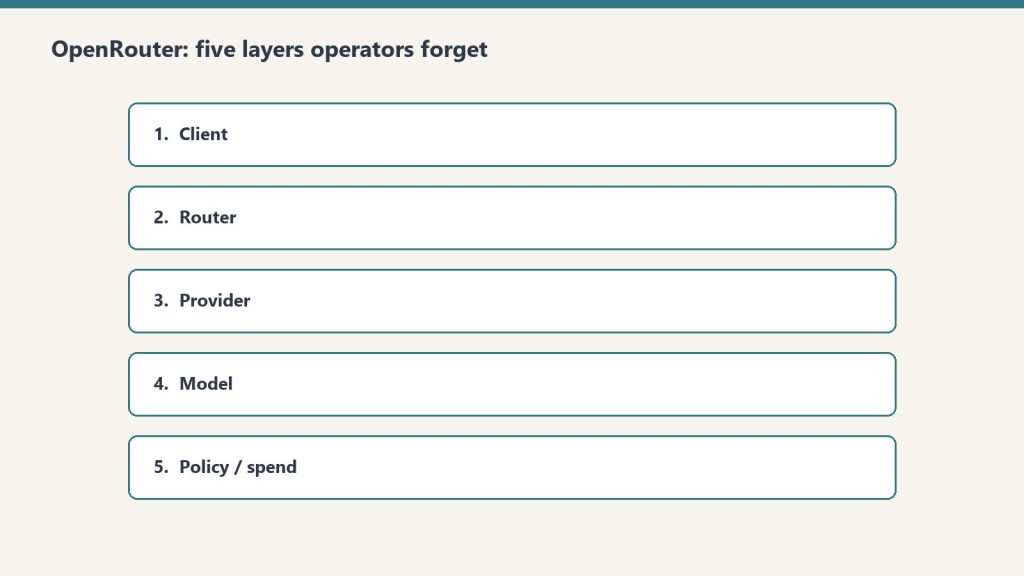
OpenRouter is a single API endpoint that gives you access to Claude, GPT-6 Astra, Gemini, Llama, Qwen, Mistral, and dozens of other models — including nearly twenty free ones — through one standardized interface. For anyone building Claude workflows on a budget, OpenRouter is not optional infrastructure. It is the orchestration layer that makes intelligent model routing practical without building your own multi-provider integration.
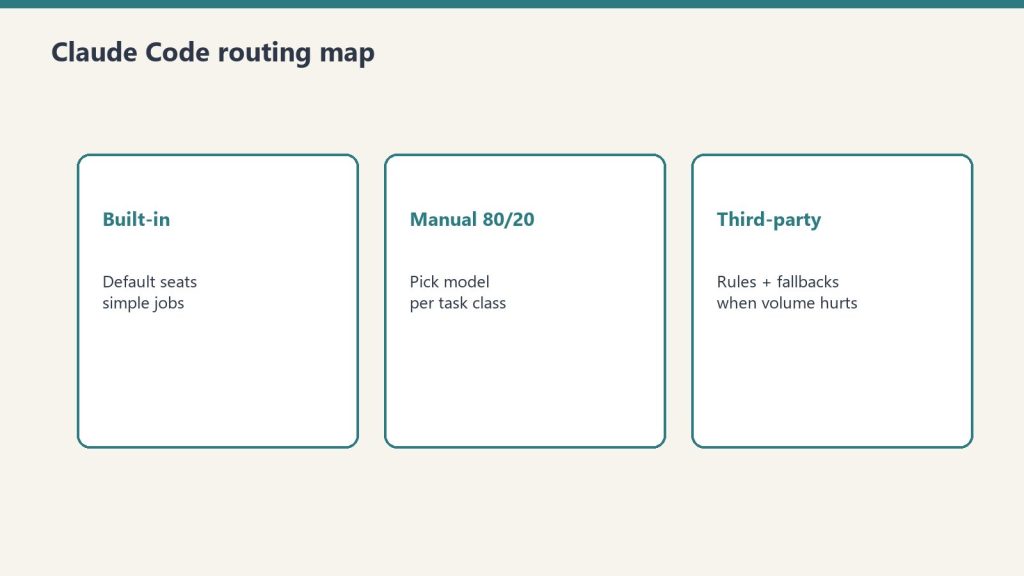
The core strategy: use free or cheap models for the work that doesn’t need Claude, and route only the remainder to Claude. In a well-designed pipeline, you pay Opus prices for 20% of the work and get Opus-quality output on the parts that genuinely require it. → Claude on a Budget pillar
Switch the model string to change providers. No new SDKs, no new authentication flows, no restructuring your application. The same call routes to Claude, Gemini, or a free Llama instance.
The Multi-Model Pipeline Pattern
Multi-model pipeline pattern.
The Tygart Media multi-model roundtable methodology — documented in the Knowledge Lab — uses this architecture:
First pass (free or cheap model): Send the full input set to a current free-tier model (Nemotron 3 Super, Gemma 4 31B, or similar) via openrouter/free. Task: filter, classify, score, or sort. Return only the items that meet the threshold — the top 20%, the flagged items, the ones that need deeper processing.
Second pass (Claude Sonnet 5.5 or Opus 5.5): Send only the filtered output to Claude. Task: reason, synthesize, write, decide. Claude sees pre-filtered, pre-organized input — no token waste on low-value items.
Synthesis (Claude): Claude consolidates findings from both passes into a final output. It operates on structured inputs, not raw noise.
In practice: if you’re processing 100 pieces of content to find the 20 worth writing about, the free model reads all 100 and returns 20. Claude reads 20 and writes 5. You paid free-tier prices for the reading work and Claude prices only for the synthesis work that Claude is actually better at.
Free and Near-Free Models Worth Knowing
Model
Cost
Best for
nvidia/nemotron-3-super:free
Free
Agentic workflows, multi-modal triage
google/gemma-4-31b-it:free
Free
Strong open-weight reasoning at zero cost
qwen/qwen3.8-27b:free
Free
Coding with image and video input, 262K context
cohere/north-mini-code:free
Free
Terminal and agent-harness coding tasks
anthropic/claude-haiku-4-5
$1.00/$5.00 per 1M
High-quality triage requiring Claude behavior
When to Still Use Claude Directly
When to still use Claude directly.
OpenRouter’s free models are not Claude. They have different safety behaviors, different instruction-following reliability, and different output quality on nuanced tasks. Use free models for tasks where the output is a structured signal (score, category, yes/no, ranked list) that Claude will then act on — not for tasks where the free model’s output goes directly to a human or into production.
The routing rule: if the output of the cheap/free model is an input to Claude, it can be imperfect — Claude will catch errors in its synthesis pass. If the output goes directly to a user or a system, it needs Claude-quality reliability. Do not route customer-facing outputs through free models.
OpenRouter for the Multi-Model Roundtable
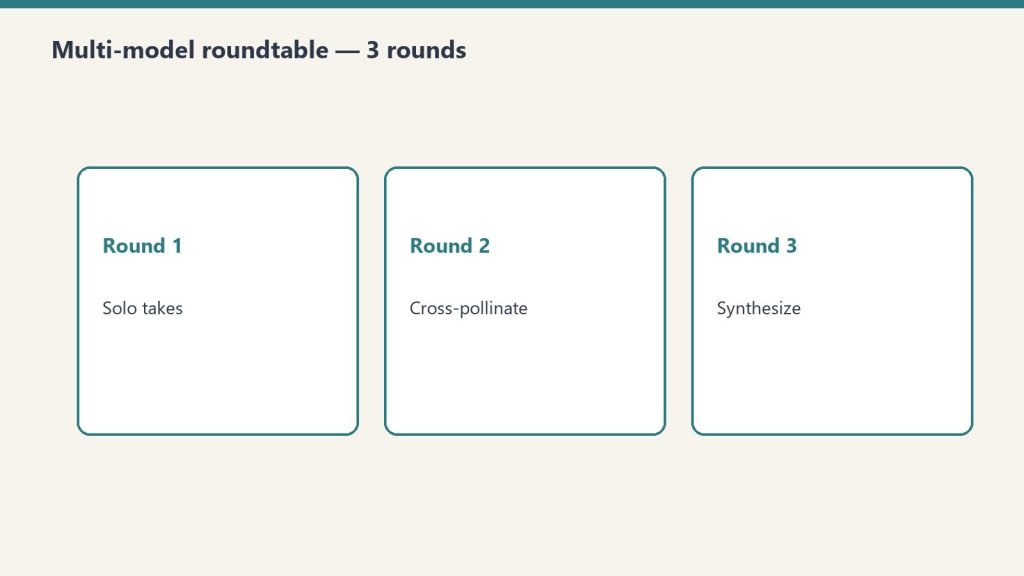
Beyond pipeline routing, OpenRouter enables the multi-model roundtable methodology: send the same complex question to Claude, GPT-6 Astra, and Gemini simultaneously. Each model responds independently. Claude synthesizes the responses into a final recommendation with consensus points and disagreement flags. You get multi-model confidence for 3× the cost of a single Claude call — but often 10× the confidence in the output, particularly for strategic decisions where single-model bias is a real risk.
The roundtable approach is documented in the Tygart Media Knowledge Lab and has been used for technology stack decisions, content strategy, and architecture choices where getting it wrong is expensive. The pattern: a current free-tier model for broad initial perspectives (free), Claude for synthesis (most reliable reasoning), GPT-6 Astra for the contrarian check.
Sign up for OpenRouter at openrouter.ai. API key creation is instant; credits load immediately. The free models require no payment method on file.
Every Claude session has a cold start cost. Before Claude can do useful work, it needs to know who you are, what you’re building, what decisions you’ve already made, what your brand voice sounds like, and what context is relevant to the task at hand. If that context doesn’t exist in the session, you spend tokens building it — through back-and-forth clarification, through pasting in background, through re-explaining things Claude knew perfectly well last Tuesday.
For a power user running multiple Claude sessions daily, cold start costs are not trivial. A 2,000-token orientation exchange at the start of each session, five sessions a day, 20 working days a month = 200,000 tokens of pure overhead. At Opus prices, that’s $5/month in tokens that produced zero output. At scale, with teams, it compounds fast.
Claude Code and Claude’s desktop tools support a CLAUDE.md file in your working directory. This file loads automatically at the start of every session — no input required, no tokens spent on orientation. It is your persistent instruction set: who you are, how you work, what conventions to follow, what tools are available, what Notion databases contain what, how to route decisions.
A well-built CLAUDE.md replaces 500–2,000 tokens of orientation with zero tokens — the file is read, not typed. The cost of writing it once is recovered in the first week of use. Every instruction you find yourself repeating across sessions belongs in CLAUDE.md.
What to put in CLAUDE.md: your name and operating context; your active projects and their current status; your tool stack (which MCP servers are running, which Notion databases hold what); your output preferences (format, length, tone); your recurring workflows and the skills or commands that drive them; any decisions already made that Claude should not re-litigate.
Layer 2: Notion as Second Brain — The Knowledge That Doesn’t Repeat
A Notion second brain functions as Claude’s long-term memory between sessions. When Claude finishes a task, it logs the outcome, the decisions made, and the context that future sessions will need. When Claude starts a new session, it fetches that context rather than reconstructing it from scratch.
The Tygart Media implementation uses a Second Brain database in Notion with structured entries per project, per client, and per system. The notion-deep-extractor skill runs every 8 hours, crawling recently edited Notion pages and injecting new knowledge into the Second Brain database automatically. Claude never starts a session unaware of what happened in the last session — that context is fetched on demand through the Notion MCP.
The token math: fetching a 500-token Notion page costs 500 input tokens. Re-explaining the same context through conversation costs 500+ tokens of input plus 200+ tokens of Claude’s clarifying questions plus your typing time. The fetch is always cheaper, and it is more accurate — your Notion page says exactly what you intended, not a conversational approximation of it.
For recurring project work, a project knowledge file is a curated document that contains everything Claude needs to be immediately productive on that project: the brief, the audience, the tone guidelines, the existing content structure, the decisions already made, the open questions. Loaded at the start of a project session, it replaces 10–15 minutes of orientation with 30 seconds of file loading.
The project-knowledge-builder skill generates these files automatically for WordPress sites — pulling existing posts, categories, brand voice, SEO context, and site history into a structured document. The same pattern applies to any recurring project: client accounts, content series, product builds, research projects.
The Concentrated Output Connection
The concentrated output connection.
Cold start elimination and output compression work together. When Claude starts a session already knowing the context, it can skip the exploratory phase and go straight to the task. When you’ve defined in CLAUDE.md that you want structured outputs — briefings, scored lists, run logs — Claude produces them without the verbose preamble that precedes them in orientation-heavy sessions.
The Tygart Media daily briefing is the clearest example: the desk spec in Notion defines the output format, the sources, the beat structure, and the run log format. Claude fetches the spec, executes, and produces a structured briefing page. No orientation. No format negotiation. No verbose preamble. Every token is productive output.
Implementation Steps
Implementation steps.
Audit your last 10 Claude sessions. For each one, identify the first message where Claude produced genuinely useful output. Everything before that is cold start cost. Measure it.
Write your CLAUDE.md. Start with the context you typed most often in those 10 sessions. One hour of writing recovers itself within days.
Create one project knowledge file for your highest-frequency project. Use it for one week and compare session start times and output quality against the prior week.
Set up Notion logging. At the end of each session, have Claude write a 3–5 sentence log entry: what was done, what decisions were made, what the next session needs to know. Store in a Notion database. Fetch at the start of the next session.
The cold start problem is the most invisible Claude cost because it feels like normal conversation. Once you measure it, it becomes obvious. Once you eliminate it, you cannot go back.
On February 2, 2026, Anthropic announced research partnerships with two of the most rigorous scientific institutions in the world: the Allen Institute (founded by Paul Allen, focused on neuroscience, cell science, and AI) and the Howard Hughes Medical Institute (HHMI, which funds more than 300 of the world’s leading biomedical researchers). Both are founding partners in what Anthropic is building as Claude’s life sciences research capability.
This is the most underreported significant Anthropic story of 2026. While Claude Security and the Partner Network grabbed headlines, Anthropic quietly signed partnerships with institutions that are generating some of the most important biological data in human history. Here is what is actually being built.
The Problem Claude Is Solving in Elite Labs
The problem Claude is solving in elite labs.
Modern biological research generates data at unprecedented scale. Single-cell RNA sequencing produces gene expression profiles for thousands of individual cells simultaneously. Whole-brain connectomics generates petabytes of neural connectivity data. Protein structure prediction now runs continuously on entire proteomes. The data generation problem has been largely solved by computational advances over the last decade.
The bottleneck that has not been solved is what comes next: transforming data into validated biological insights. Knowledge synthesis — reviewing literature, connecting experimental results to existing findings, generating hypotheses, and designing follow-up experiments — still depends almost entirely on manual human processes. In elite labs, this bottleneck can stretch research timelines from months to years.
A single-cell sequencing experiment might produce 50,000 cells worth of gene expression data in a week. Making sense of that data in the context of existing biological knowledge, generating testable hypotheses, and designing the right follow-up experiments might take a postdoc six months of literature review and analysis. That ratio — days of data generation, months of interpretation — is where Claude-powered multi-agent systems are being applied.
What the Allen Institute Is Building
What the Allen Institute is building.
The Allen Institute collaboration focuses on multi-agent AI systems for multi-modal data analysis. “Multi-modal” in this context means data types that span imaging, sequencing, electrophysiology, and behavioral observation — the full range of data types generated in modern neuroscience and cell science research. Claude-powered agents are being integrated with the Allen Institute’s existing analysis pipelines and scientific instruments.
The specific capability being built: agents that can hold the entire context of an ongoing research project — experimental history, current data, relevant literature, open hypotheses — and surface connections that human researchers would not make simply because no single human can hold that much context simultaneously. The agent serves as a comprehensive knowledge base integrated with cutting-edge instruments, not a search engine or literature summarizer.
The HHMI Partnership
Howard Hughes Medical Institute funds 300+ Investigators — researchers selected through a rigorous competitive process as among the most promising scientists in their fields. HHMI’s partnership with Anthropic focuses on deploying Claude-powered AI agents to tackle the analysis, annotation, and coordination bottlenecks that are consuming researcher time at the expense of the creative scientific work that only humans can do.
The framing Anthropic uses for this partnership is important: Claude should augment, not replace, human scientific judgment. The reasoning that Claude surfaces needs to be traceable — researchers must be able to evaluate, question, and build upon Claude’s outputs. This is a different design requirement than a consumer AI assistant. In science, an AI that produces correct-sounding but untraceable conclusions is worse than no AI at all, because it introduces unverifiable claims into the research record.
Why This Matters Beyond Biology
Why this matters beyond biology.
The Allen Institute and HHMI partnerships are significant beyond their direct scientific impact for two reasons:
They establish Claude’s capability floor in high-stakes reasoning environments. These institutions have no tolerance for AI that produces plausible-sounding incorrect answers. If Claude is being used in production at the Allen Institute and HHMI, it has cleared a rigor bar that most AI products have not. That is a capability signal.
They create a template for other scientific domains. The multi-agent architecture being built for neuroscience and cell biology is applicable to drug discovery, climate science, materials science, and astrophysics. The bottleneck pattern — fast data generation, slow knowledge synthesis — exists across all of science. The Allen Institute and HHMI implementations are the proof-of-concept Anthropic can show to the next set of research institutions.
Anthropic’s scientific AI partnerships sit at the intersection of its commercial strategy and its stated mission. If Claude-powered agents can meaningfully accelerate biological research — reducing the time from data to insight from months to weeks — the downstream impact on medicine and human health is the kind of outcome that makes the safety-focused AI development approach Anthropic argues for feel less abstract.
Current flagship: Claude Opus 4.7 (claude-opus-4-7). Current models: Opus 4.7 · Sonnet 4.6 · Haiku 4.5. Claude Opus 4.7 referenced in this article has been superseded. See current model tracker →
On December 3, 2025, Snowflake and Anthropic announced a multi-year, $200 million partnership making Claude models available to Snowflake’s 12,600+ global enterprise customers across AWS, Azure, and Google Cloud. If you are running data infrastructure on Snowflake — which means you are in the company of most Fortune 500 financial services, healthcare, and technology organizations — Claude is now a first-class capability inside your existing data environment.
This partnership was not widely covered when it launched, and it has not been covered at the depth it deserves. Here is the complete picture of what was built and why it matters.
Snowflake Intelligence: What It Is
Snowflake Intelligence — what it is.
Snowflake Intelligence is an enterprise intelligence agent powered by Claude Sonnet 4.6 (the model at launch; check Snowflake’s current docs for the latest). It answers natural language questions about your organization’s data by: determining what data is needed, querying across your entire Snowflake environment, joining data from multiple sources, and delivering answers with greater than 90% accuracy on complex text-to-SQL tasks in Snowflake’s internal benchmarks.
The “greater than 90% accuracy on complex text-to-SQL” claim is the number that matters. Text-to-SQL accuracy has historically been the failure mode for natural language data querying — ambiguous column names, complex join logic, and domain-specific terminology conspire to make AI-generated SQL unreliable without significant prompt engineering and validation. Snowflake’s 90%+ benchmark on complex queries (not simple ones) represents a meaningful improvement over prior-generation approaches.
Snowflake Cortex AI Functions
Beyond the intelligence agent, Snowflake Cortex AI Functions expose Claude Opus 4.5 and newer models directly within Snowflake’s SQL environment. You can call Claude from a SQL query — pass a column of text to Claude for classification, summarization, sentiment analysis, or extraction, and receive structured results back as a query output. No API calls, no external services, no data leaving your Snowflake governance boundary.
This is a fundamental shift in how AI is applied to enterprise data. Instead of extracting data from Snowflake, sending it to an external AI service, and loading results back, AI reasoning happens inside the governance boundary where the data lives. For regulated industries — financial services under SOX, healthcare under HIPAA, government under FedRAMP — this is the architectural difference between a compliant AI workflow and one that requires a data transfer agreement.
Why Regulated Industries Move to Production Faster
Why regulated industries move to production faster.
The specific value proposition Snowflake and Anthropic built this partnership around is the regulated industry path from pilot to production. The two primary blockers for enterprise AI in regulated industries have historically been:
Data governance. Sensitive data cannot leave governed environments. Solutions that require sending data to external APIs fail compliance reviews. Cortex AI Functions solve this by keeping Claude within the Snowflake perimeter.
Accuracy and auditability. A financial services firm cannot deploy a customer-facing AI tool that is wrong 20% of the time and cannot explain its reasoning. Claude’s documented reasoning capability and Snowflake’s query audit trail together create an auditable AI chain that compliance teams can review.
The 12,600 Snowflake customers who now have access to Claude through this partnership include organizations in financial services, healthcare, life sciences, manufacturing, and technology — precisely the sectors where AI adoption has been slowest due to compliance barriers. The Snowflake perimeter solves barrier #1. Claude’s accuracy and reasoning capability addresses barrier #2.
Practical Steps for Snowflake Customers
Practical steps for Snowflake customers.
If you are a Snowflake customer and have not activated Cortex AI Functions:
Check your Snowflake account tier — Cortex AI Functions require Business Critical or Enterprise edition.
Enable Cortex in your account settings. No additional Anthropic API key is required — the Claude models are accessed through Snowflake’s compute layer.
Start with a bounded use case: classify a column of customer feedback into categories, extract structured fields from unstructured text, or generate summaries of long documents stored as Snowflake objects.
Use Snowflake Intelligence for stakeholder-facing natural language querying once your Cortex implementation is validated.
Two new Claude Code capabilities shipped in the April sprint that have received almost no coverage despite being significant workflow expansions: Ultraplan, a cloud-hosted agentic planning workflow, and Ultrareview, a deep multi-pass code review command. Together they represent Claude Code’s first serious steps toward being an agentic planning tool, not just an interactive coding assistant.
Ultraplan: Cloud-Hosted Agentic Planning
Ultraplan — cloud-hosted agentic planning.
Ultraplan is currently in early preview. The workflow is three steps:
Draft in the CLI — from your terminal, describe the task or project you want Claude Code to plan. Ultraplan generates a structured execution plan: steps, dependencies, tool calls, expected outputs, error-handling branches.
Review in the browser — the plan is pushed to a cloud-hosted web editor where you can read it in a structured interface, add comments, modify steps, flag concerns, and approve or reject sections. This is the human-in-the-loop gate that makes agentic execution trustworthy.
Run remotely or pull back local — once approved, the plan can execute in Anthropic’s cloud infrastructure (no local machine required, runs while your laptop is off) or be pulled back to execute locally with full observability in your terminal.
The remote execution capability is the most significant aspect. This is Claude Code’s first “runs while your laptop is closed” feature — distinct from Cowork Routines (which are consumer-facing) and designed specifically for developer workflows. A migration plan, a batch refactoring job, a test suite generation task, or a dependency upgrade across a large codebase can be approved, handed to cloud execution, and completed overnight without a machine staying on.
When to Use Ultraplan
When to use Ultraplan.
Ultraplan is designed for tasks where you want to review the approach before committing to execution — not for quick, single-step tasks. The review step adds 5–15 minutes to the workflow. That is worth it when:
The task spans multiple files, services, or systems where a wrong step has cascading effects
You are working in a production codebase where mistakes have real consequences
The task will take more than 30 minutes to execute and you want human review before investing that time
You are using remote execution and cannot monitor progress in real time
You are delegating the task to a junior developer or teammate who will execute the plan
For quick tasks — generate a function, fix a specific bug, explain this code — use standard Claude Code. Ultraplan’s value scales with task complexity and execution risk.
Ultrareview: Deep Multi-Pass Code Review
Ultrareview — deep multi-pass code review.
The claude ultrareview subcommand applies multiple sequential review passes to code, each with a different evaluation focus:
Maintainability review — naming clarity, function size and cohesion, documentation gaps, test coverage, coupling and cohesion
Each pass generates findings, and Ultrareview synthesizes them into a prioritized report with severity ratings and specific remediation recommendations. The output is designed to go directly into a pull request review comment or a team review document.
Ultrareview vs. Standard Review
Standard claude review applies a single review pass optimized for breadth — it catches obvious issues quickly across all dimensions. Ultrareview applies specialized depth in each dimension sequentially. The trade-off is token cost and time: Ultrareview consumes 3–5× more tokens than standard review and takes proportionally longer.
The recommended workflow: use standard review on every pull request as part of your CI pipeline. Reserve Ultrareview for high-stakes merges — releases, security-sensitive features, architecture changes, any code that will touch production payment or authentication flows.
Both features are available now to Claude Code users on Pro and above. Ultraplan is in early preview — activate it via claude ultraplan --enable-preview. Ultrareview is generally available — run claude ultrareview [file or directory] from any Claude Code session.
Claude Code shipped v2.1.126 today, May 1, 2026. This is the 9th release in April’s sprint and continues what has been a 2–3 releases per week cadence throughout the month. Here is the complete picture of what shipped this week across v2.1.120 through v2.1.126, with operational context for each feature that actually matters.
v2.1.126 — Today’s Release
v2.1.126 — today’s release.
Gateway Model Picker
The gateway model picker allows you to route different tasks within a single Claude Code session to different models. This is the first step toward Claude Code as a multi-model orchestration layer rather than a single-model coding assistant. Practical use: run Haiku 4.5 on file reading, search, and summarization tasks where speed matters; route Opus 4.7 at complex reasoning, architecture decisions, and code generation where quality is the priority. The cost reduction on high-volume workflows can be material — Haiku is roughly 30× cheaper per token than Opus.
PowerShell as Primary Shell on Windows — Git Bash No Longer Required
This is the most significant quality-of-life change in this release for enterprise Windows shops. Claude Code previously required Git Bash as its terminal environment on Windows, which meant every Windows developer needed a non-standard shell installation, created friction in corporate IT environments with software approval processes, and produced a different developer experience than Mac/Linux teammates.
Starting with v2.1.126, PowerShell is the primary shell on Windows. Git Bash is no longer required. For enterprise teams where half the developer fleet runs Windows and software installation requires IT approval, this removes a significant deployment barrier. Claude Code is now a standard Windows application from an IT management perspective.
OAuth Code Terminal Input for WSL2, SSH, and Containers
Authentication in headless environments — WSL2 sessions, SSH remote development, Docker containers — previously required workarounds. v2.1.126 adds OAuth code terminal input: Claude Code displays the authorization code directly in the terminal, you paste it into your browser, and authentication completes without requiring a browser redirect to the headless environment. Eliminates the most common authentication friction point for remote and containerized development workflows.
claude project purge
New command that cleans up stale project data accumulated across sessions. For teams running Claude Code in CI/CD pipelines or long-running agent workflows, project data can accumulate and affect performance. claude project purge gives you explicit control over that cleanup rather than relying on automatic garbage collection.
v2.1.120–122 — April 28 Stack
v2.1.120–122 — April 28 stack.
alwaysLoad MCP Option
MCP servers can now be configured to always load regardless of context window state. Previously, Claude Code would make decisions about which MCP servers to initialize based on available context. alwaysLoad: true in your MCP server config guarantees that server is always available — critical for production deployments where MCP tools need to be reliably present, not conditionally loaded.
claude ultrareview Subcommand
claude ultrareview triggers a deep, multi-pass code review that goes beyond standard review. It applies multiple review personas in sequence — security researcher, performance engineer, maintainability analyst — and synthesizes findings into a prioritized report. For code that needs to meet high standards before production merge, ultrareview is the command. It consumes more tokens than standard review, so use it on pull requests that matter, not every commit.
claude plugin prune
Removes unused plugins from your Claude Code installation. As the plugin ecosystem has grown and plugin auto-update behavior has been refined in recent releases, teams accumulate plugins that are no longer active in their workflow. claude plugin prune audits your installed plugins against recent usage and removes those that have not been invoked within a configurable time window.
Type-to-Filter Skills Search
The skills picker now supports live type-to-filter — start typing a skill name and the list filters in real time. For teams with large skill libraries or plugin collections, this eliminates the scroll-and-hunt workflow that slowed skill invocation. Small UX change, large daily time savings at scale.
New environment variable that allows Claude Code running on Amazon Bedrock to specify service tier at the environment level rather than per-request. For teams using Claude Code through Bedrock as their primary deployment path — common in regulated industries that require AWS-native infrastructure — this simplifies configuration management across multiple environments and removes per-request overhead.
OpenTelemetry Improvements
Extended OpenTelemetry trace data now includes more granular span information for Claude Code operations. For enterprise teams with existing observability infrastructure (Datadog, Grafana, Honeycomb), Claude Code activity is now more fully integrated into your trace timeline — you can see exactly where Claude Code operations land within the context of your broader application traces.
v2.1.123 — April 29
Fixed OAuth 401 retry loop triggered when CLAUDE_CODE_DISABLE_EXPERIMENTAL_BETAS was set. If you were seeing repeated authentication failures in environments with that flag set, update to v2.1.123 or later immediately.
Update Now
Update now.
Update via npm install -g @anthropic-ai/claude-code@latest or through your package manager. v2.1.126 is the current stable release. For teams running Claude Code in CI/CD, update your Docker base images or pipeline steps to pin to 2.1.126.
This article was not written by a scheduled task. It was not part of a batch pipeline. There was no cron job, no Cloud Run trigger, no automation queue. I asked Claude in chat, we picked an angle, I generated the images myself, and Claude hand-crafted what you are reading now. Custom, batch-of-one, at the desk. I’m leading with that because it is the entire point of the piece.
On April 22, Google Cloud Next ’26 turned Vertex AI into something else. The keynote rebranded it as the Gemini Enterprise Agent Platform. The new pieces are an Agent Designer, an Agent Inbox, long-running agents that can work autonomously for days inside cloud sandboxes, and Agent Observability, Agent Simulation, Agent Identity, Agent Registry. Google framed agents as managed enterprise workloads with identity, policy, observability, evaluation, and runtime controls, rather than one-off AI applications. They added Anthropic’s Claude Opus 4.7 to the Model Garden alongside Gemini 3.1. They committed $750 million to a partner program to push it through Accenture, Salesforce, SAP, and Deloitte.
That announcement is the most architecturally ambitious version of agentic infrastructure anyone has shipped. It is also enterprise-shaped, not operator-shaped. The customers in the keynote were Walmart, Citadel, Honeywell, Home Depot, Papa John’s. The framing was Agentic Enterprise. The unit of trust was a partner integrator. None of that is a criticism. It is just a different scale of problem than the one a sole operator running 20+ WordPress sites and a content automation stack actually has.
What Google announced is what we already built — at our scale
Underneath the marketing, Gemini Enterprise Agent Platform answers one specific question: how do you give an autonomous system enough leash to be useful, while keeping enough control to catch it when it fails? Google’s answer involves Agent Identity, runtime policy enforcement, observability dashboards, and evaluation harnesses. It is the right answer. It is also the answer we landed on — independently, six months earlier, at a much smaller scale — because the question is the same whether you are running a Fortune 50 supply chain or a one-person agency that publishes 200 articles a month.
Tier-gated autonomy: amber proposes and waits for approval, blue prepares but never publishes, green runs autonomously and reports anomalies.
Our version is called The Bridge. It is a top-level page in our Notion workspace, peer to the operations Command Center. Underneath it lives the Promotion Ledger, where every autonomous behavior in our stack is tracked by tier and status. Tiers are A, B, C, and Wings. Status is one of Running, Probation, Demoted, Candidate, Graduated, or Retired. The Pane of Glass is the live Cowork artifact view of the whole thing. It is the operator-scale equivalent of Google’s Agent Inbox, except it is not selling itself to me — it is reporting to me.
The three tiers, in plain language
Tier A — System proposes, operator approves. A behavior at this tier produces a recommendation, not an action. Claude flags an opportunity, drafts a structure, surfaces a candidate. I make the call. Approval happens through an elevated report, not an atomic checkbox queue. This is where everything new starts.
Tier B — Operator flies it, system prepares. The behavior is allowed to do all the preparatory work — research, drafting, formatting, staging — but the publish button stays under my hand. This is where most behaviors live for a while. Most of the trust gap is closed at Tier B because I can see exactly what the system would have done before it does it.
Tier C — System runs autonomously, reports anomalies. The behavior publishes, posts, files, schedules — without asking. It only surfaces in my inbox when something is off. The twice-daily software update monitoring pipeline that writes posts to The Machine Room category on this site is Tier C. So is the weekly digest that drafts the LinkedIn and Facebook posts off it. I do not see those running. I see them only when they fail to run.
Wings is a fourth tier — used for behaviors that are still on the candidate list, where the architecture exists but the trust does not yet.
The clock that makes it work
Promotions are not a feeling. They are a count. Seven clean days at a tier makes a behavior a candidate for promotion to the next. Any gate failure resets that clock to zero and drops the behavior down one tier. The failure is logged on the Promotion Ledger row with date and reason. Decisions to promote or demote happen on Sunday evenings — not in the middle of a panic on a Tuesday.
This is the part that most “AI agent governance” frameworks skip. They define the tiers but not the promotion mechanic. Without the clock, every promotion is a vibe call. With the clock, the question stops being do I trust this agent and becomes what does the ledger say. The answer is either there or it is not.
Trust as evidence. The Promotion Ledger reads clean — or it does not. Reassurance is not a substitute for a number on a row.
Why this article is hand-crafted, on purpose
Here is the meta-move that makes the framework legible. The system that publishes most of our content is Tier C Running — twice-daily monitoring writes posts directly to The Machine Room and Industry Signals categories without my approval, and the weekly digest drafts the social. That works because the behavior has earned its leash on the ledger.
This article is not that. This article is a one-off, custom request, hand-crafted in chat. I asked Claude what it thought of the Next ’26 announcements relative to our stack. We had a real exchange about it. I generated four sets of images on my own, picked the directions, and let Claude pick the strongest variants from each set. We agreed on the angle. Then I gave one explicit, in-conversation authorization to publish live to WordPress and LinkedIn — because publishing to LinkedIn live is not a Tier C Running behavior on the ledger right now, and the system correctly flagged that gap and asked.
That is the whole framework, working in real time. The twice-daily Tier C automation does not need to ask. The one-off LinkedIn live publish does need to ask. The system knows the difference because the difference is on a Notion page, not in a vibe.
What Google’s announcement actually changes for operators like us
Three things, all useful.
The vocabulary went mainstream. “Long-running agents,” “Agent Inbox,” “agent governance,” “agent observability” — these are now words you can say to a CFO without translating. The bar for trust-gap evidence just went up across the field, which means the operators who already have a ledger are ahead of the operators who have a vibe. Stay on the ledger.
Claude is in the Model Garden. If we ever want to run our Cowork-style behaviors inside Google’s agent runtime — using their identity, observability, and governance plumbing while keeping Claude as the model — that door is now open. We will not, because the platform overhead is more than we need. But the option being available is structurally significant.
The architectural pattern is validated. When the third-largest cloud spends a keynote arguing that agents need tier-style governance and an inbox-style observability layer, every operator running an autonomous stack should treat that as confirmation, not as a sales pitch. We are not the weird ones for running a Promotion Ledger. We were just early.
The unsexy part
The unsexy part of all of this is that none of it works without the boring discipline of writing things down. The tiers are useful because they are on a page. The promotion clock is useful because it is a number. The trust-gap protocol is useful because it points to evidence rather than to feelings. Google is building the same thing for the Fortune 500 because the discipline is the same at every scale. The only thing that changes is whether you call it a Promotion Ledger or an Agent Registry.
Build the ledger. Run the clock. Publish what is earned. Ask before you do what is not. The rest is just whose dashboard is prettier.
The conversation no one in restoration is having yet
The conversation no one in restoration is having yet.
The most consequential shift in restoration economics over the next thirty-six months is also the topic that almost no one in the industry is discussing in any operational depth. The shift is the cost structure that emerges when a meaningful share of a restoration company’s operational work is done by AI agents running on managed infrastructure rather than by human staff or by traditional software.
The shift is not coming. It is here. The early-adopter companies have been operating in this cost structure for the last twelve months, and the second wave is coming online now. By the end of 2026, a competitive baseline will exist for what an AI-augmented restoration company looks like financially, and companies operating outside that baseline will start to feel the difference in their bid competitiveness, their margin profile, and their ability to take on growth.
This article is about the economics of that shift. The math is not complicated. The implications are large.
What an agent-assisted operation actually costs
What an agent-assisted operation actually costs.
Start with the cost of running a meaningful AI agent capability inside a restoration company in 2026. The cost has three components.
The first is the model usage cost. This is what gets paid to the AI provider for the actual inference — the tokens consumed, the requests made, the work the model does on the company’s behalf. For most restoration use cases, model usage cost runs in the range of a few cents per significant operation. A handoff briefing generation. A scope review pass. A photo organization run. A communication draft. Each of these costs pennies.
The second is the runtime cost when agents are executing autonomously rather than producing single outputs on demand. An agent that runs a multi-step task — pulling a file, organizing the documentation, generating the briefing, packaging it for the rebuild team — incurs runtime cost for the duration of its session. For restoration use cases, even complex agent sessions tend to cost low single digits of dollars at most.
The third is the operational cost of the human owners and reviewers. The senior operator who owns the AI capability. The person who reviews the outputs and feeds back corrections. The person who maintains the prompts and configurations. This is the largest of the three components by a wide margin and is often the only one that owners explicitly account for, because it is the one that shows up on payroll rather than on a separate line item.
The total cost per operation, when honestly accounted for, is meaningful but small. The economic significance comes not from the per-operation cost but from the volume.
The volume changes everything
A traditional restoration operation has a defined operational throughput per senior operator. A senior project manager can credibly run a certain number of jobs per month. A senior estimator can scope a certain number of files per week. A senior dispatcher can coordinate a certain number of mitigation responses per day. These throughput numbers are determined by the human operator’s working capacity and have not meaningfully changed in decades.
An agent-assisted operation has fundamentally different throughput characteristics for the work the agents handle. A handoff briefing generation that takes a human operator twenty minutes can be produced by an agent in under a minute. A scope review pass that takes a human estimator forty-five minutes can be produced by an agent in three minutes. A photo organization that takes a human technician thirty minutes can be done by an agent in ninety seconds. The human is still in the loop — reviewing, validating, correcting — but the operator is reviewing the agent’s output rather than producing the original work.
The economic implication is that a senior operator’s throughput on documentation and review work expands by a multiple. Not by ten percent or twenty percent. By a multiple. A senior estimator who previously could handle thirty files per week can, with appropriate agent assistance and a working review workflow, handle eighty or a hundred files per week, with comparable or improved quality, depending on the file mix and the maturity of the agent capability.
The cost of the agent capability supporting that estimator runs in the range of a few hundred dollars per month. The value of the additional throughput is in the tens of thousands of dollars per month at typical estimator productivity rates. The ratio is severe enough that the economics dominate the conversation about whether to invest, regardless of how the implementation cost is amortized.
What this does to bid competitiveness
The cost structure shift has direct implications for what restoration companies can afford to bid on competitive work.
A company running on traditional throughput economics has a certain unavoidable cost per job that includes the senior operator time required to produce the documentation, scope, communication, and review work the job requires. That cost sets a floor on the bid. Below that floor, the company loses money.
A company running on agent-assisted throughput economics has a meaningfully lower floor on the senior operator time required per job. The same senior team can be spread across more jobs without quality degradation, because the routine work has been compressed by orders of magnitude. The floor on what the company can profitably bid drops.
For the company doing the bidding, this looks like the ability to win more work at price points that previously would have been unprofitable. For the company being out-bid, this looks like an inexplicable competitive pressure where peers are taking work at numbers that should not pencil. The traditional company looks at the same numbers and assumes the competitor is buying market share unprofitably or providing inferior service. In the early days of the shift, that assumption is sometimes true. Within twelve to eighteen months it stops being true. The competitor is not buying market share. Their cost structure has shifted.
Companies that have not made the shift cannot match the bid without unacceptable margin compression. They start losing work at the margins of their territory, and the lost work is the most price-sensitive work, which means the work they are still winning is increasingly the high-touch, complex, strategically important work — which sounds fine until they realize they have lost the volume layer that used to fund their fixed overhead.
What this does to growth capacity
The same shift changes what growth looks like for a restoration company.
In a traditional operation, growth is gated by the company’s ability to add senior operational capacity. New service lines, new geographies, new account relationships, new program placements all require senior operators with the bandwidth and judgment to execute. Senior operational hiring is slow, expensive, and constrained by labor market availability. The company’s growth rate is essentially capped by its hiring capacity at the senior layer.
In an agent-assisted operation, growth is gated by a different constraint. The company’s existing senior operators can absorb significantly more operational throughput because the routine documentation and review work has been compressed. The constraint shifts from senior labor capacity to the speed at which the company can extend its captured operational standards into new contexts and the speed at which the senior team can review and validate the expanded throughput.
This does not mean growth becomes unconstrained. It means the constraint moves to a layer that the company has more direct control over than the labor market. A company that can extend its prep standard to a new geography can extend its operations to that geography faster than a company that has to hire and train senior operators in the new location. A company that can apply its captured judgment to a new service line can launch that service line faster than a company that has to recruit operators with the requisite experience.
The companies that have begun operating in this mode are growing in ways that competitors cannot easily explain. The growth is not coming from a marketing breakthrough or a particularly successful acquisition. It is coming from a structural change in how senior operational capacity scales.
What this does to margin profile
What this does to margin profile.
The clearest economic effect of the shift, at the company level, is the change in the long-run margin profile.
A traditional restoration company has a margin structure dominated by labor cost in the production of operational work. Senior operator time is the largest input on most jobs and the least compressible cost line. Margin improvements at the company level are primarily achieved through volume increases, pricing power, or supply chain optimization. The margin ceiling is structurally constrained.
An agent-assisted restoration company has a margin structure where senior operator time has been redirected from routine production to higher-value work. The senior team is doing more strategic activity per hour worked. The routine work that used to consume their time is being done at a fractional cost. The margin per job improves not because the company is cutting corners but because the per-job cost of producing the operational substrate has dropped.
Over a twenty-four to thirty-six month period, the margin profile of an agent-assisted operation pulls visibly ahead of the margin profile of a traditional operation in the same market. The pull-ahead is gradual but durable. By the time it becomes obvious in the financials, the gap is large enough that catching up requires more than a single-year investment program.
The honest risk picture
The economic shift is not without risk. The companies operating well in this new mode are managing several specific risks that owners considering the transition need to understand.
The first risk is over-reliance on the AI capability. A company that lets the agent handle a function entirely without continued human oversight will eventually experience a quality failure that costs more than all the throughput gains combined. The senior operator review workflow is not optional. The economics work because the human is still in the loop. Companies that try to push the human out of the loop in pursuit of further cost savings learn the lesson the expensive way.
The second risk is the brittleness of the captured judgment. The agent is only as good as the standard it is operating against. As conditions change — new construction styles, new carrier dynamics, new regulatory environments — the standard has to evolve, and the evolution requires continued investment. Companies that build the agent capability and then stop investing in the underlying standard see the agent quality drift over time.
The third risk is vendor concentration. Companies that build their entire operational substrate against a single AI provider’s specific platform are exposed to vendor pricing changes, capability changes, and continuity risk. The companies operating well in this mode tend to keep their captured standards in vendor-neutral form, so that the underlying judgment can be moved to a different runtime if the original vendor relationship deteriorates.
The fourth risk is the team’s relationship with the technology. A senior operator who has been told the AI is going to make their job easier will be disappointed if it makes their job different rather than easier. The framing of the transition with the team has to be honest about what is changing and what is not. Companies that mishandle this framing experience attrition at the senior layer that can wipe out the operational gains entirely, as discussed in the source code piece.
What owners should be doing about this in 2026
If you run a restoration company and you have not yet begun the transition to agent-assisted operations, the practical implication of the economic shift is that the cost of starting now is significantly lower than the cost of starting in eighteen months and the value of starting now is significantly higher.
The cost is lower because the infrastructure is mature, the patterns are documented, and the early-adopter mistakes have been made by other people. A company starting in 2026 can move faster and avoid more pitfalls than a company that started in 2024.
The value is higher because the bid competitiveness, growth capacity, and margin implications of the shift are now beginning to manifest in real markets. A company that begins building the capability now will start producing measurable economic effect within twelve to eighteen months. A company that waits will be entering the work at the same time competitors are starting to convert the capability into market position.
The starting point is the documentation acceleration work described in the previous article. The economic implications described here flow from the operational substrate that documentation work creates. Without the substrate, none of the economics materialize. With the substrate, all of them do.
The owners who recognize this and act on it now will be running a different kind of business in 2028. The owners who do not will be looking at their numbers in 2028 and trying to figure out what changed in the market. What changed will not be the market. What changed will be the cost structure of the companies they are competing against.
Next in this cluster: how to evaluate AI tools without getting fooled — the practical buyer’s framework for cutting through vendor noise and making decisions that hold up over time.
By Will Tygart • Long-form Position • Practitioner-grade
The extraction protocol works. The pivot signal lexicon is learnable. The four-layer descent can be taught. The question is whether it can be deployed without a trained human interviewer in the room — and if so, how much of the value survives the translation.
This is the duplication problem at the center of the Human Distillery business model. Will can run an extraction session. An app cannot run the same session. But an app can run a version of the session — and for a large subset of extraction use cases, the version is sufficient.
Understanding what transfers and what doesn’t is the whole architectural question.
What Transfers to an App
The four-layer question structure is codifiable. A stateful conversational agent — not a chatbot, a system that maintains a running knowledge map of what’s been surfaced and what’s still needed — can execute the question sequences in order, navigate the domain-specific question libraries for a given vertical, and detect the linguistic markers of pivot signals in real time.
“It’s hard to explain” is detectable by NLP. Hedging patterns are detectable. Energy shifts in voice are detectable by acoustic analysis. Deflection to process — “the policy says…” — is detectable. The app can recognize these signals and adjust its question path, slowing down at tacit knowledge boundaries and applying the correct follow-up from the signal response library.
The processing pipeline from transcript to structured concentrate is fully automatable: chunking by topic boundary, entity extraction, claim isolation, confidence scoring, contradiction flagging across multiple sessions, multi-model distillation rounds. This is where AI earns its keep. A human doing this manually would take days per session. The pipeline does it in minutes.
Domain-specific question libraries can be built from prior extractions and expanded with each new session. The more sessions the app runs in a given vertical, the richer its question library becomes. This is the compounding effect that makes the app more valuable over time.
What Doesn’t Transfer
Three things resist automation in ways that won’t be resolved by better models:
Micro-hesitation reading. The half-second pause before an answer that signals the subject knows more than they’re about to say. The slight change in phrasing when someone moves from what they’re comfortable saying to what they actually think. These are real-time, embodied, relational signals. A text-based app misses them entirely. A voice app gets closer but still lacks the visual channel that carries a significant portion of this information.
Protocol abandonment. The decision to stop following the four-layer sequence because the subject just said something unprompted that is more important than anything in the protocol. Expert interviewers make this call constantly. They recognize the thread that, if followed, goes somewhere the protocol would never reach. An app will follow the signal response library. It won’t recognize when the library should be put down.
Trust calibration. Whether the subject is performing for the recording or actually sharing. This is not detectable from content analysis. It requires the social intelligence to know when to lower the formality, when to match the subject’s energy, when to say something self-deprecating to signal that this is a peer conversation and not an evaluation. Subjects share differently with someone they trust. The app cannot build that trust.
The Honest Architecture
The tiered model that emerges from this analysis:
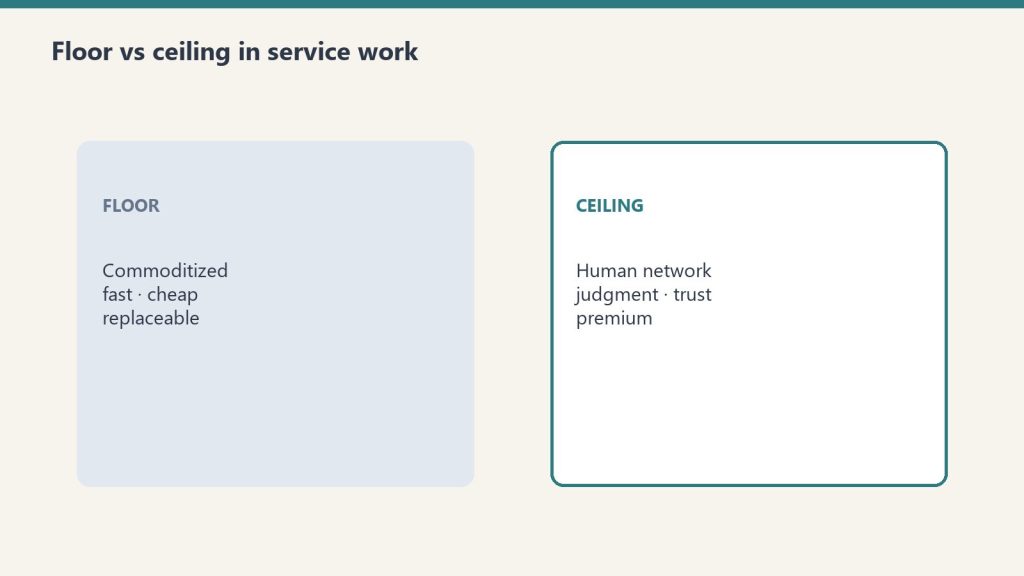
Tier 1 — App-led extraction. Well-mapped domains with accessible knowledge. The subject is cooperative. The question library is deep. The knowledge being sought is in Layers 1 and 2. The app handles the session. Will reviews the concentrate before delivery.
Tier 2 — Human-led extraction with app processing. High-stakes sessions. Guarded subjects. Knowledge at the outer edge of verbalization (Layer 3 and 4). Will conducts the session. The app runs the processing pipeline. Will reviews and approves the concentrate.
Tier 3 — Full human extraction and distillation. Strategic engagements. Subjects who will only speak candidly to a person they know. Knowledge so embedded that it requires real-time relational judgment to surface at all. Will does everything.
The business model implication: Tier 1 is volume. Tier 3 is premium. The ratio shifts over time as the app’s question libraries deepen and its signal detection improves. What begins as mostly Tier 2 and 3 eventually becomes mostly Tier 1, with Will’s direct involvement reserved for the sessions where only a human can get the door open.
The app is not a replacement for the protocol. It’s a multiplier for the protocol — allowing it to run at a scale that a single human operator never could, while preserving the human layer for the cases that actually require it.