Quick Answer: The U.S. Navy’s FY2027 budget request sets the first official FF(X) frigate timeline: launch in the first quarter of FY2029 (late calendar 2028), delivery by Q3 FY2030 (spring 2030). The program is funded at $1.429 billion for the lead hull plus $212 million for R&D. For Naval Station Everett — which has been in the homeport conversation since the Constellation-class cancellation in November 2025 — these dates turn a vague “someday” into a four-year countdown.
Why This Budget Document Changes Everything
Before last week, the FF(X) program had a general “2028 target” — the kind of language that appears in investor calls and press releases. HII mentioned it in their Q1 2026 earnings call. But investor call language is an acknowledgment. A federal budget document is a funding commitment.
The Navy’s FY2027 budget request, submitted to Congress this spring, puts two specific milestones in official U.S. government planning documents for the first time: launch of the lead FF(X) in the first quarter of Fiscal Year 2029 — October through December 2028 in calendar terms — and delivery to the fleet by the end of the third quarter of FY2030, meaning April through June 2030. Those aren’t marketing projections. They’re budget-backed program targets that Congress will scrutinize, fund, and hold the Navy accountable to.
What the FY27 Budget Actually Funds
The FY2027 request allocates $1.429 billion to procure the lead FF(X) hull. Alongside that, $212 million is designated for research and development — covering the ongoing design work, systems integration, and military-specific modifications being layered onto the National Security Cutter baseline. The total program objective calls for 22 ships, with the procurement schedule spreading across multiple budget years: one ship in FY2027, one in FY2029, and two per year in FY2031 and beyond.
This is not a paper program. The $282.9 million lead yard contract was awarded to HII’s Ingalls Shipbuilding in Pascagoula, Mississippi in April 2026, covering the pre-construction design work needed to support that 2028 launch timeline. Steel is moving.
The NSC Shortcut: Why Late 2028 Is Achievable
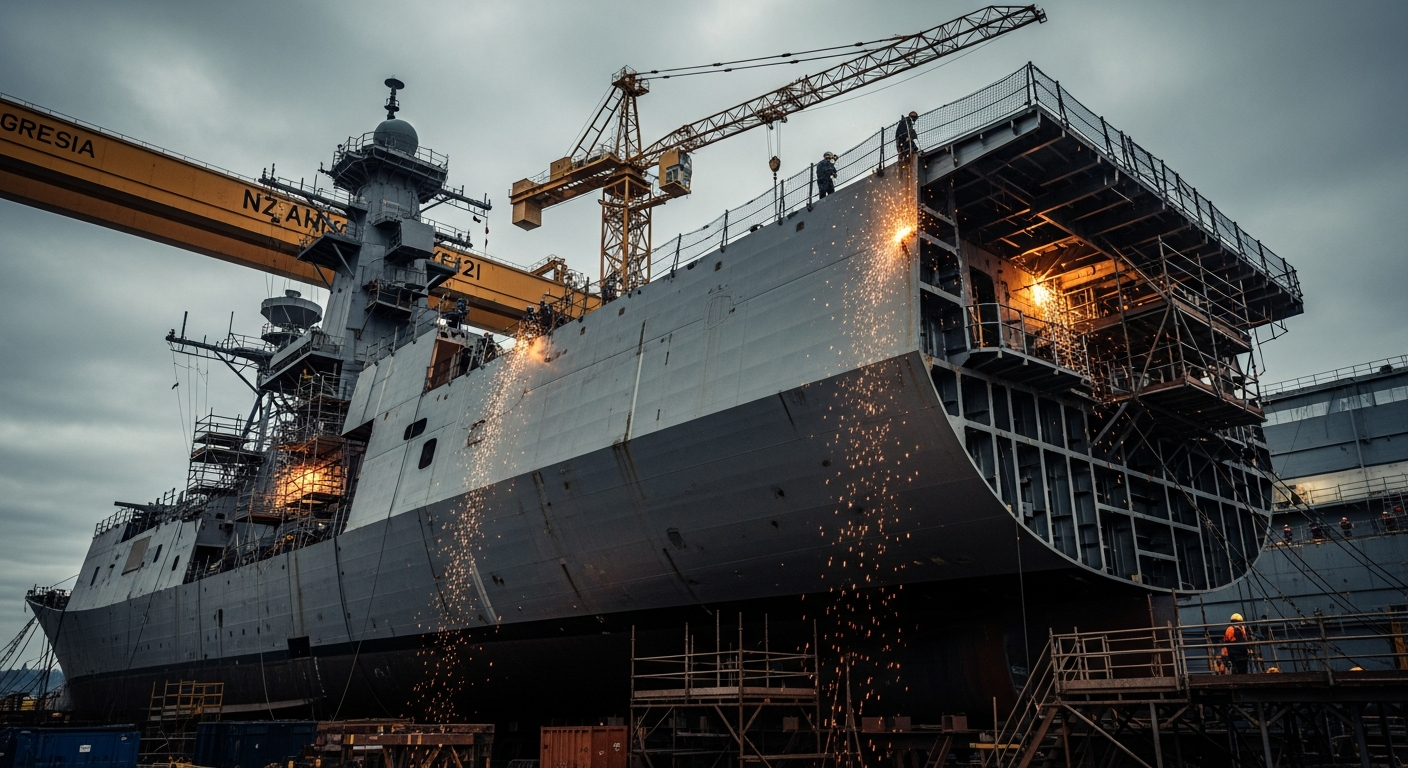
Building a new class of warship from scratch in three years would be aggressive to the point of fantasy. The FF(X) program isn’t doing that. According to Naval News, Ingalls will use steel and components from the cancelled 11th ship in the Legend-class National Security Cutter program — the same NSC baseline the FF(X) design derives from. That cancelled cutter was already partway through the production pipeline before the Coast Guard cancelled it, meaning Ingalls doesn’t have to order long-lead materials from the beginning.
The first FF(X) hulls will carry three primary military additions over the NSC baseline: a Rolling Airframe Missile (RAM) launcher for close-in air defense, an SPS-77 variant air search radar, and a repurposed stern boat ramp converted to carry containerized payload modules. The containerized payload capability is designed for modularity — swappable mission packages that can shift the ship’s function without rebuilding the hull.
What This Means for Naval Station Everett
NAVSTA Everett has been living in a state of strategic uncertainty since November 2025, when the Navy cancelled the Constellation-class frigate program. The station had been designated as the homeport for 12 Constellation-class ships. That designation vanished with the program cancellation, leaving Everett’s naval mission — and the economic activity it generates — without a clear successor.
The FF(X) budget timeline doesn’t resolve that homeport question. No official FF(X) homeport designation has been made. But it does transform the conversation in a meaningful way: Everett is no longer waiting on a program whose timeline is “someday.” The program now has a funded lead hull, a $282.9M contract at Ingalls, a launch date in late 2028, and a delivery date in spring 2030. The Navy will need to make homeport decisions as that delivery date approaches.
Naval Station Everett’s infrastructure advantages — a deep-water port, existing repair and logistics facilities, the proximity to Puget Sound Navy Yard at Bremerton for major maintenance, and established force protection arrangements — remain intact. The station has hosted Arleigh Burke-class destroyers and is capable of supporting smaller frigate-class hulls. Whether those advantages translate into an FF(X) homeport designation is a decision that will likely surface in FY2028 or FY2029 planning documents.
The Economic Stakes for Snohomish County
NAVSTA Everett generates approximately $340 million in annual economic activity for Snohomish County, according to Economic Alliance Snohomish County figures cited in prior coverage. That figure reflects current ship assignments — USS Gridley and supporting vessels — not a frigate fleet. A 12-ship frigate assignment, if it materialized, would represent a step-change in the station’s economic footprint: additional personnel, family housing demand, support services contracts, and commissary spending across Everett’s south side.
The FF(X)’s smaller crew requirements compared to Burke-class destroyers mean the per-ship economic multiplier would be lower. But 12 ships with a combined crew of roughly 2,400 sailors and their families would represent a substantial permanent addition to Everett’s population and tax base.
What Happens Next
Congress must authorize and appropriate the FY2027 funding — a process that typically completes by fall 2026. The $282.9M Ingalls contract is already in place, so pre-construction work is proceeding. The next major public milestone will likely be steel-cutting at Ingalls, which would confirm the 2028 launch trajectory is on track.
For Everett, the practical watch items are the FY2028 and FY2029 Navy budget requests — those documents will be where homeport planning language, if any, first appears. Rep. Rick Larsen’s office has been active on NAVSTA Everett advocacy; the Snohomish County Economic Alliance has been making the $340M case directly to Navy leadership. Both of those efforts gain credibility now that there’s a ship on a real timeline to fight for.
Frequently Asked Questions
When will the first FF(X) frigate launch?
The Navy’s FY2027 budget targets launch in the first quarter of Fiscal Year 2029 — October through December 2028 in calendar terms.
When will the FF(X) be delivered to the fleet?
Delivery is planned by the end of Q3 FY2030, meaning approximately April–June 2030.
Who is building the FF(X)?
HII’s Ingalls Shipbuilding in Pascagoula, Mississippi, which holds the $282.9 million lead yard contract awarded April 2026.
Will NAVSTA Everett homeport the FF(X)?
No official designation has been made. NAVSTA Everett is in the homeport conversation and held the designation for the cancelled Constellation-class, but FF(X) homeporting has not been announced.
What is the FF(X) based on?
The Legend-class National Security Cutter baseline, with three military additions: a RAM launcher, SPS-77 radar, and containerized payload modules.
How much does the FF(X) program cost?
$1.429 billion for the lead hull plus $212 million in R&D in the FY2027 request. Total program cost across 22 ships will be significantly higher.
Related Exploring Everett coverage: The FF(X) Contract Is Real: What the $282.9M Ingalls Award Means for NAVSTA Everett | HII Q1 2026: First Investor Confirmation FF(X) Is on Track | What the FF(X) Contract Means for Snohomish County’s Economy
Get The Signal
What we actually ran, what it measured, and what it means for a restoration shop — every week, including the flops.
Leave a Reply