
I have been running a working second brain for long enough to have stopped thinking of it as a second brain.
I have come to think of it as an actual brain. Not metaphorically. Architecturally. The pattern that emerged in my workspace over the last year — without me intending it, without me planning it, without me reading a single neuroscience paper about it — is structurally isomorphic to how the human brain manages memory. When I finally noticed the pattern, I stopped fighting it and started naming the parts correctly, and the system got dramatically more coherent.
This article names the parts. It is the architecture I actually run, reported honestly, with the neuroscience analogy that made it click and the specific choices that make it work. It is not the version most operators build. Most operators build archives. This is closer to a living system.
The pattern has three components: a cortex, a hippocampus, and a consolidation loop that moves signal between them. Name them that way and the design decisions start falling into place almost automatically. Fight the analogy and you will spend years tuning a system that never quite feels right because you are solving the wrong problem.
I am going to describe each part in operator detail, explain why the analogy is load-bearing rather than decorative, and then give you the honest version of what it takes to run this for real — including the parts that do not work and the parts that took me months to get right.
Why most second brains feel broken

Before the architecture, the diagnosis.
Get The Signal
What we actually ran, what it measured, and what it means for a restoration shop — every week, including the flops.
Most operators who have built a second brain in the personal-knowledge-management tradition report, eventually, that it does not feel right. They can not put words to exactly what is wrong. The system holds their notes. The search mostly works. The tagging is reasonable. But the system does not feel alive. It feels like a filing cabinet they are pretending is a collaborator.
The reason is that the architecture they built is missing one of the three parts. Usually two.
A classical second brain — the library-shaped archive built around capture, organize, distill, express — is a cortex without a hippocampus and without a consolidation loop. It is a place where information lives. It is not a system that moves information through stages of processing until it becomes durable knowledge. The absence of the other two parts is exactly why the system feels inert. Nothing is happening in there when you are not actively working in it. That is the feeling.
An archive optimized for retrieval is not a brain. It is a library. Libraries are excellent. You can use a library to do good work. But a library is not the thing you want to be trying to replicate when you are trying to build an AI-native operating layer for a real business, because the operating layer needs to process information, not just hold it, and archives do not process.
This diagnosis was the move that let me stop tuning my system and start re-architecting it. The system was not bad. The system was incomplete. It had one of the three parts built beautifully. It had the other two parts either missing or misfiled.
Part one: the cortex
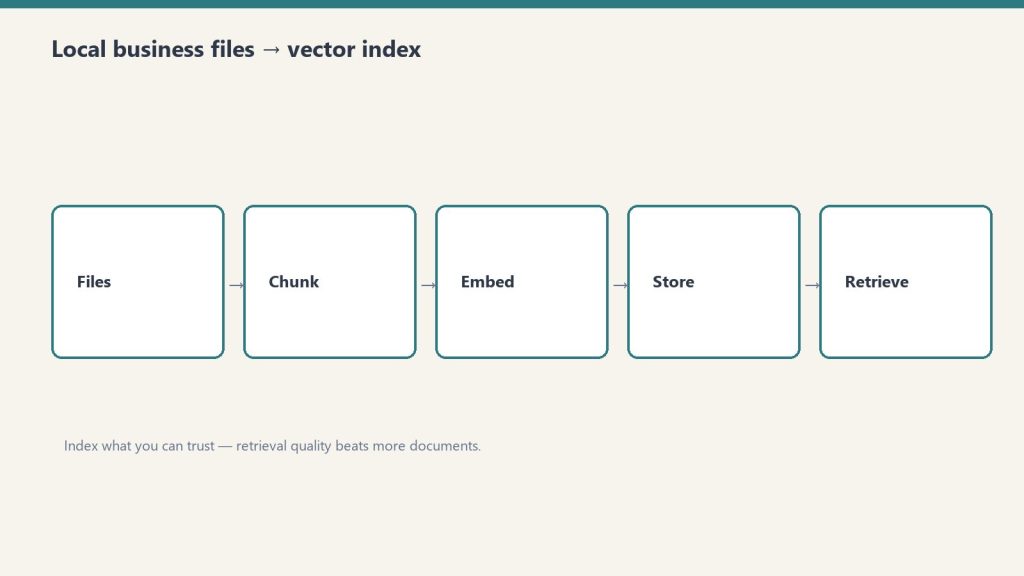
In neuroscience, the cerebral cortex is the outer layer of the brain responsible for structured, conscious, working memory. It is where you hold what you are actively thinking about. It is not where everything you have ever known lives — that is deeper, and most of it is not available to conscious access at any given moment. The cortex is the working surface.
In an AI-native workspace, your knowledge workspace is the cortex. For me, that is Notion. For other operators, it might be Obsidian, Roam, Coda, or something else. The specific tool is less important than the role: this is where structured, human-readable, conscious memory lives. It is where you open your laptop and see the state of the business. It is where you write down what you have decided. It is where active projects live and active clients are tracked and active thoughts get captured in a form you and an AI teammate can both read.
The cortex has specific design properties that differ from the other two parts.
It is human-readable first. Everything in the cortex is structured for you to look at. Pages have titles that make sense. Databases have columns that answer real questions. The architecture rewards a human walking through it. Optimize for legibility.
It is relatively small. Not everything you have ever encountered lives in the cortex. It is the active working surface. In a human brain, the cortex holds at most a few thousand things at conscious access. In an AI-native workspace, your cortex probably wants to hold a few hundred to a few thousand pages — the active projects, the recent decisions, the current state. If it grows to tens of thousands of pages with everything you have ever saved, it is trying to do the hippocampus’s job badly.
It is organized around operational objects, not knowledge topics. Projects, clients, decisions, deliverables, open loops. These are the real entities of running a business. The cortex is organized around them because that is what the conscious, working layer of your business is actually about.
It is updated constantly. The cortex is where changes happen. A new decision. A status flip. A note from a call. The consolidation loop will pull things out of the cortex later and deposit them into the hippocampus, but the cortex itself is a churning working surface.
If you have been building a second brain the classical way, this is probably the part you built best. You have a knowledge workspace. You have pages. You have databases. You have some organizing logic. Good. That is the cortex. Keep it. Do not confuse it for the whole brain.
Part two: the hippocampus
In neuroscience, the hippocampus is the structure that converts short-term working memory into long-term durable memory. It is the consolidation organ. When you remember something from last year, the path that memory took from your first experience of it into your long-term storage went through the hippocampus. Sleep plays a large role in this. Dreams may play a role. The mechanism is not entirely understood, but the function is: short-term becomes long-term through hippocampal processing.
In an AI-native workspace, your durable knowledge layer is the hippocampus. For me, that is a cloud storage and database tier — a bucket of durable files, a data warehouse holding structured knowledge chunks with embeddings, and the services that write into it. For other operators it might be a different stack: a structured database, an embeddings store, a document warehouse. The specific tool is less important than the role: this is where information lives when it has been consolidated out of the cortex and into a durable form that can be queried at scale without loading the cortex.
The hippocampus has different design properties than the cortex.
It is machine-readable first. Everything in the hippocampus is structured for programmatic access. Embeddings. Structured records. Queryable fields. Schemas that enable AI and other services to reason across the whole corpus. Humans can access it too, but the primary consumer is a machine.
It is large and growing. Unlike the cortex, the hippocampus is allowed to get big. Years of knowledge. Thousands or tens of thousands of structured records. The archive layer that the classical second brain wanted to be — but done correctly, as a queryable substrate rather than a navigable library.
It is organized around semantic content, not operational state. Chunks of knowledge tagged with source, date, embedding, confidence, provenance. The operational state lives in the cortex; the semantic content lives in the hippocampus. This is the distinction most operators get wrong when they try to make their cortex also be their hippocampus.
It is updated deliberately. The hippocampus does not change every minute. It changes on the cadence of the consolidation loop — which might be hourly, nightly, or weekly depending on your rhythm. This is a feature. The hippocampus is meant to be stable. Things in it have earned their place by surviving the consolidation process.
Most operators do not have a hippocampus. They have a cortex that they keep stuffing with old information in the hope that the cortex can play both roles. It cannot. The cortex is not shaped for long-term queryable semantic storage; the hippocampus is not shaped for active operational state. Merging them is the architectural choice that makes systems feel broken.
Part three: the consolidation loop
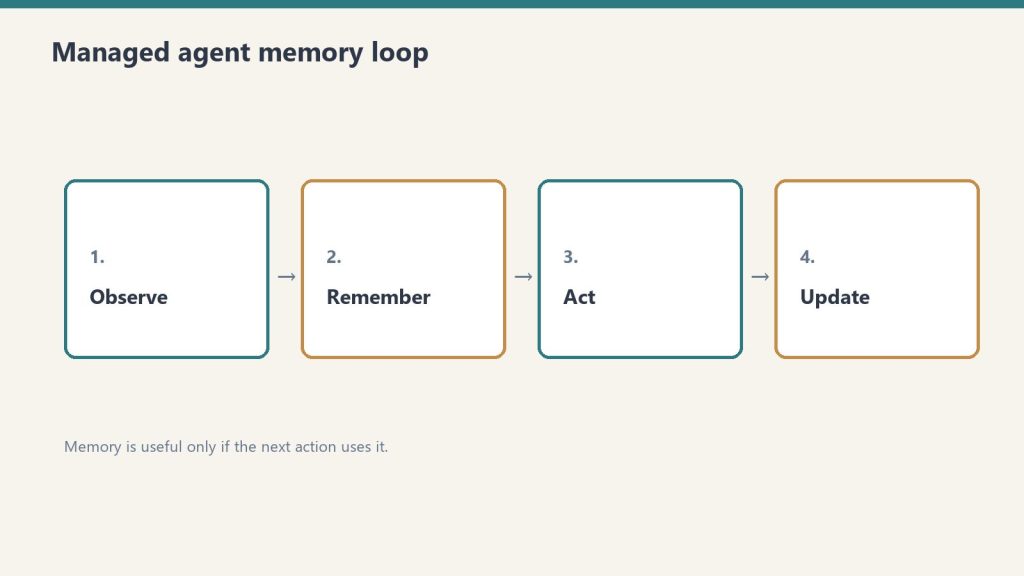
In neuroscience, the process by which information moves from short-term working memory through the hippocampus into long-term storage is called memory consolidation. It happens constantly. It happens especially during sleep. It is not a single event; it is an ongoing loop that strengthens some memories, prunes others, and deposits the survivors into durable form.
In an AI-native workspace, the consolidation loop is the set of pipelines, scheduled jobs, and agents that move signal from the cortex through processing into the hippocampus. This is the part most operators miss entirely, because the classical second brain paradigm does not include it. Capture, organize, distill, express — none of those stages are consolidation. They are all cortex-layer activities. The consolidation loop is what happens after that, to move the durable outputs into durable storage.
The consolidation loop has its own design properties.
It runs on a schedule, not on demand. This is the most important design choice. The consolidation loop should not be triggered by you manually pushing a button. It should run on a cadence — nightly, weekly, or whatever fits your rhythm — and do its work whether you are paying attention or not. Consolidation is background work. If it requires attention, it will not happen.
It processes rather than moves. Consolidation is not a file-copy operation. It extracts, structures, summarizes, deduplicates, tags, embeds, and stores. The raw cortex content is not what ends up in the hippocampus; the processed, structured, queryable version is. This is the part that requires actual engineering work and is why most operators do not build it.
It runs in both directions. Consolidation pushes signal from cortex to hippocampus. But once information is in the hippocampus, the consolidation loop also pulls it back into the cortex when it is relevant to current work. A canonical topic gets routed back to a Focus Room. A similar decision from six months ago gets surfaced on the daily brief. A pattern across past projects gets summarized into a new playbook. The loop is bidirectional because the brain is bidirectional.
It has honest failure modes and health signals. A consolidation loop that is not working is worse than no loop at all, because it produces false confidence that information is getting consolidated when actually it is rotting somewhere between stages. You need visible health signals — how many items were consolidated in the last cycle, how many failed, what is stale, what is duplicated, what needs human attention. Without these, you do not know whether the loop is running or pretending to run.
When I got the consolidation loop working, the cortex and hippocampus started feeling like a single system for the first time. Before that, they were two disconnected tools. The loop is what turns them into a brain.
The topology, in one diagram
If I were drawing the architecture for an operator who is considering building this, it would look roughly like this — and it does not matter which specific tools you use; the shape is what matters.
Input streams flow in from the things that generate signal in your working life. Claude conversations where decisions got made. Meeting transcripts and voice notes. Client work and site operations. Reading and research. Personal incidents and insights that emerged mid-day.
Those streams enter the consolidation loop first, not the cortex directly. The loop is a set of services that extract structured signal from raw input — a claude session extractor that reads a conversation and writes structured notes, a deep extractor that processes workspace pages, a session log pipeline that consolidates operational events. These run on schedule, produce structured JSON outputs, and route the outputs to the right destinations.
From the consolidation loop, consolidated content lands in the cortex. New pages get created for active projects. Existing pages get updated with relevant new information. Canonical topics get routed to their right pages. This is how your working surface stays fresh without you having to manually copy things into it.
The cortex and hippocampus exchange signal bidirectionally. The cortex sends completed operational state — finished projects, finalized decisions, archived work — down to the hippocampus for durable storage. The hippocampus sends back canonical topics, cross-references, and AI-accessible content when the cortex needs them. This bidirectional exchange is the part that most closely mirrors how neuroscience describes memory consolidation.
Finally, output flows from the cortex to the places your work actually lands — published articles, client deliverables, social content, SOPs, operational rhythms. The cortex is also the execution layer I have written about before. That is not a contradiction with the cortex-as-conscious-memory framing; in a human brain, the cortex is both the working memory and the source of deliberate action. The analogy holds.
The four-model convergence
I want to pause and tell you something I did not know until I ran an experiment.
A few weeks ago I gave four external AI models read access to my workspace and asked each one to tell me what was unique about it. I used four models from different vendors, deliberately, to catch blind spots from any single system.
All four models converged on the same primary diagnosis. They did not agree on much else — their unique observations diverged significantly — but on the core architecture, they converged. The diagnosis, in their words translated into mine, was:
The workspace is an execution layer, not an archive. The entries are system artifacts — decisions, protocols, cockpit patterns, quality gates, batch runs — that convert messy work into reusable machinery. The purpose is not to preserve thought. The purpose is to operate thought.
This was the validation of the thesis I have been developing across this body of work, from an unexpected source. Four models, evaluated independently, landed on the same architectural observation. That was the moment I knew the cortex / hippocampus / consolidation-loop framing was not just mine — it was visible from the outside, to cold readers, as the defining feature of the system.
I bring this up not to show off but to tell you that if you build this pattern correctly, external observers — human or AI — will be able to see it. The architecture is not a private aesthetic. It is a thing a well-designed system visibly is.
Provenance: the fourth idea that makes the whole thing work
There is a fourth component that I want to name even though it does not have a neuroscience analog as cleanly as the other three. It is the concept of provenance.
Most second brain systems — and most RAG systems, and most retrieval-augmented AI setups — treat all knowledge chunks as equally weighted. A hand-written personal insight and a scraped web article are the same to the retrieval layer. A single-source claim and a multi-source verified fact carry the same weight. This is an enormous problem that almost nobody talks about.
Provenance is the dimension that fixes it. Every chunk of knowledge in your hippocampus should carry not just what it means (the embedding) and where it sits semantically, but where it came from, how many sources converged on it, who wrote it, when it was verified, and how confident the system is in it. With provenance, a hand-written insight from an expert outweighs a scraped article from a low-quality source. With provenance, a multi-source claim outweighs a single-source one. With provenance, a fresh verified fact outweighs a stale unverified one.
Without provenance, your second brain will eventually feed your AI teammate garbage from the hippocampus and your AI will confidently regurgitate it in responses. With provenance, your AI teammate knows what it can trust and what it cannot.
Provenance is the architectural choice that separates a second brain that makes you smarter from one that quietly makes you stupider over time. Add it to your hippocampus schema. Weight every chunk. Let the retrieval layer respect the weights.
The health layer: how you know the brain is working
A brain that is working produces signals you can read. A brain that is broken produces silence, or worse, false confidence.
I build in explicit health signals for each of the three components. The cortex is healthy when it is fresh, when pages are recently updated, when active projects have recent activity, and when stale pages are archived rather than accumulating. The hippocampus is healthy when the consolidation loop is running on schedule, when the corpus is growing without duplication, and when retrieval returns relevant results. The consolidation loop is healthy when its scheduled runs succeed, when its outputs are being produced, and when the error rate is low.
I also track staleness — pages that have not been updated in too long, relative to how load-bearing they are. A canonical document more than thirty days stale is treated as a risk signal, because the reality it documents has almost certainly drifted from what the page describes. Staleness is not the same as unused; some pages are quietly load-bearing and need regular refreshes. A staleness heatmap across the workspace tells you which pages are most at risk of drifting out of reality.
The health layer is the thing that lets you trust the system without having to re-check it constantly. A brain you cannot see the health of is a brain you will eventually stop trusting. A brain whose health is visible is one you can keep leaning on.
What this costs to build
I want to be honest about what actually getting this working takes. Not because it is prohibitive, but because the classical second-brain literature underestimates it and operators get blindsided.
The cortex is the easy part. Any capable workspace tool, a few weeks of deliberate organization, and a commitment to keeping it small and operational. Cost: low. Most operators have some version of this already.
The hippocampus is harder. You need durable storage. You need an embeddings layer. You need schemas that capture provenance and not just content. For a solo operator without technical capability, this is a real build project — probably a few weeks to months of focused work or a partnership with someone technical. It is also the part that, once built, becomes genuinely durable infrastructure.
The consolidation loop is hardest. Because the loop is a set of services that extract, process, structure, and route, it is the most engineering-intensive part. This is where most operators stall. The solve is either to use tools that ship consolidation-like capabilities natively (Notion’s AI features are approximately this), or to build a small set of extractors and pipelines yourself with Claude Code or equivalent. For me, the loop took months of iteration to run reliably. It is now the highest-leverage part of the whole system.
Total cost for an operator with moderate technical capability: a few months of evenings and weekends, some cloud infrastructure spend, and an ongoing maintenance commitment of maybe eight to ten percent of working hours. In exchange, you get an operating system that compounds with use rather than decaying.
For operators who do not want to build the hippocampus and loop themselves, the vendor-shaped version of this architecture is starting to become available in 2026 — Notion’s Custom Agents edge toward a consolidation loop, Notion’s AI offers hippocampus-like capability at small scale, and various startups are working on the layers. None are complete yet. Most operators serious about this will need to build some of it.
What goes wrong (the honest failure modes)
Three failure modes are worth naming, because I have hit all three and the pattern recovered only because I caught them.
The cortex that tries to be the hippocampus. Operators who get serious about a second brain often try to put everything in the cortex — every article they have ever read, every transcript of every meeting, every bit of research. The cortex then gets too big to be legible, starts running slowly, and the search stops returning useful results. The fix is to build the hippocampus separately and move the bulk of the corpus there. The cortex should be small.
The hippocampus that gets polluted. Without provenance weighting and without deduplication, the hippocampus accumulates low-quality content that then gets retrieved and surfaced in AI responses. The fix is provenance, deduplication, and periodic hippocampal pruning. The archive is not sacred; some things earn their place and some things do not.
The consolidation loop that nobody maintains. The loop is background infrastructure. Background infrastructure rots if nobody owns it. A consolidation loop that was working six months ago might be quietly broken today, and you only notice because your cortex is drifting out of sync with your operational reality. The fix is health signals, monitoring, and a weekly ritual of checking that the loop is running.
None of these are dealbreakers. All of them are things the pattern has to work around.
The one sentence I want you to walk away with
If you take nothing else from this piece:
A second brain is not a library. It is a brain. Build it with the three parts — cortex, hippocampus, consolidation loop — and it will behave like one.
Most operators have built the cortex and called it a second brain. They have a library with the sign out front updated. The system feels broken because it is not a brain yet. Build the other two parts and the system stops feeling broken.
If you can only add one part this month, add the consolidation loop, because the loop is the thing that makes everything else work together. A cortex without a loop is still a library. A cortex with a loop but no hippocampus is a library whose books walk into the back room and disappear. A cortex with a loop and a hippocampus is a brain.
FAQ
Is this just a metaphor, or does the neuroscience actually apply?
It is a metaphor at the level of mechanism — the way neurons consolidate memories is not identical to the way a scheduled pipeline does. But the functional role of each component maps cleanly enough that the analogy is load-bearing rather than decorative. Where the architecture borrows from neuroscience, it inherits genuine design principles that compound the system’s coherence.
Do I need all three parts to benefit?
No. A well-built cortex alone is better than no system. A cortex plus a consolidation loop is significantly more powerful. Add the hippocampus when you have enough volume to justify it — usually once your cortex starts straining under its own weight, somewhere in the low thousands of pages.
Which tool should I use for the cortex?
The tool is less important than how you organize it. Notion is what I use and what I recommend for most operators because its database-and-template orientation maps cleanly to object-oriented operational state. Obsidian and Roam are better for pure knowledge work but weaker for operational state. Coda is similar to Notion. Pick the one whose grain matches how your brain already organizes work.
Which tool should I use for the hippocampus?
Any durable storage that supports embeddings. Cloud object storage plus a vector database. A cloud data warehouse like BigQuery or Snowflake if you want structured queries alongside semantic search. Managed services like Pinecone or Weaviate for pure vector workloads. The decision depends on what else you are running in your cloud environment and how technical you are.
How do I actually build the consolidation loop?
For operators with technical capability, a combination of Claude Code, scheduled cloud functions, and a few targeted extractors will get you there. For operators without technical capability, Notion’s built-in AI features approximate parts of the loop. For true coverage, you will eventually either need technical help or to wait for the vendor-shaped version to mature.
Does this mean I need to rebuild my whole system?
Not necessarily. If your existing workspace is serving as a cortex, keep it. Add a hippocampus as a separate layer underneath it. Build the consolidation loop between them. The cortex does not have to be rebuilt for the pattern to work; it has to be complemented.
What if I just want a simpler version?
A simpler version is fine. A cortex plus a lightweight consolidation loop that runs once a week is already far better than what most operators have. Do not let the fully-built pattern be the enemy of the partially-built version that still earns its place.
Closing note
The thing I want to convey in this piece more than anything else is that the architecture revealed itself to me over time. I did not sit down and design it. I built pieces, noticed they were not enough, built more pieces, noticed something was still missing, and eventually the neuroscience analogy clicked and the three-part structure became obvious.
If you are building a second brain and it does not feel right, you are probably missing one or two of the three parts. Find them. Name them. Build them. The system starts feeling like a brain when it actually has the parts of a brain, and not before.
This is the longest-running architectural idea in my workspace. I have been iterating on it for over a year. The version in this article is the one I would give a serious operator who was willing to do the work. It is not a quick start. It is an operating system.
Run it if the shape fits you. Adapt it if some of the parts translate better to a different context. Reject it if you honestly think your current pattern works better. But if you are in the large middle ground where your system kind of works and kind of does not, the missing part is usually the hippocampus, the consolidation loop, or both.
Go find them. Name them. Build them. Let your second brain actually be a brain.
Sources and further reading
Related pieces from this body of work:
- Archive vs Execution Layer — the precursor framing that reframed the second brain’s purpose
- The Notion Operating Company — the cortex layer in operational detail
- How to Wire Claude Into Your Notion Workspace — the connection layer that lets AI reason across both cortex and hippocampus
- The Agency Stack in 2026 — the broader stack this architecture fits inside
- The Exit Protocol — the hygiene discipline that keeps the hippocampus from becoming a liability
On the external validation: the cross-model convergent analysis referenced in this article was conducted using multiple frontier models evaluating workspace structure independently. The finding that the workspace behaves as an execution layer rather than an archive was independently surfaced by all evaluated models, which I took as meaningful corroboration of the internal architectural thesis.
The neuroscience analogy is drawn from standard memory-consolidation literature, particularly work on hippocampal consolidation during sleep and the role of the cortex in conscious working memory. This article does not attempt to make rigorous claims about neuroscience; it borrows the functional analogy where the analogy is useful and drops it where it is not.
Visual summary
About this image. This image is part of the AI & Technology Concepts collection in the Tygart Media visual library. Every image produced by Tygart Media is AI-generated using Google Vertex AI (Imagen), converted to WebP format, and injected with full IPTC/XMP metadata before publication.
- Format: WEBP
- Collection: AI & Technology Concepts
- Pipeline: Vertex AI Imagen → WebP → IPTC/XMP → WordPress
Get The Signal
What we actually ran, what it measured, and what it means for a restoration shop — every week, including the flops.
Leave a Reply