Updated October 2026: The 2025 edition (released April 2025) is the latest RIA TPA Scorecard — no 2026 edition has been published. Since the survey, Alacrity’s managed repair division became an independent company, Altimeter Solutions Group (January 2026, backed by BV Investment Partners), and Worley acquired Alacrity Renovation Services from Lowe’s. Scores below reflect the 2025 survey as published.
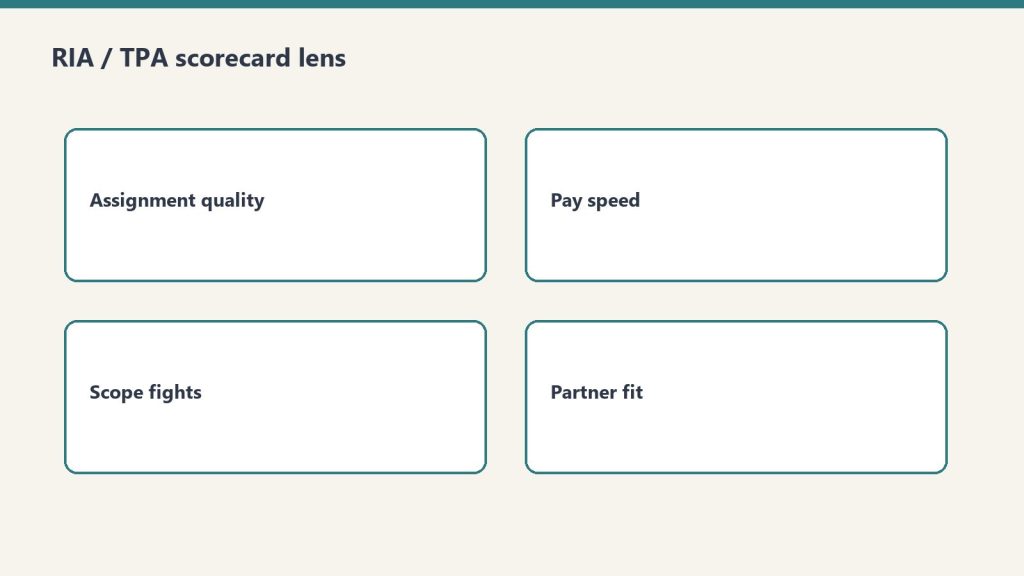
If you work insurance program work, this is the one report you should actually read. Every year, the Restoration Industry Association’s Advocacy and Governmental Affairs committee surveys contractors who have worked with TPAs in the past 12 months. No vendor marketing. No TPA spin. Just anonymous contractor ratings across 8 categories that actually matter: value, claims process, contractor support, scoring clarity, guidelines, credentialing, claim volume, and geographic coverage.
The 2025 results are in. 379 contractors rated 13 TPAs. The industry average sits at 2.7 out of 5 — a 54% satisfaction rate. That’s not a ringing endorsement of the TPA model, but it tells you something more useful: the spread between programs is significant, and knowing who’s at the top and who’s at the bottom changes your program strategy.
Here’s the breakdown, with the data that matters.
The Leaderboard: Who Contractors Actually Trust
ONCORE Claims Network: 3.1 stars — #1 for the third consecutive year. This is the benchmark. ONCORE (formerly CORE) outperforms everyone across nearly every category: 3.4 on credentialing (the highest of any TPA), 3.3 on guidelines, 3.2 on value, and 3.0 on contractor support — the only TPA to crack 3.0 in that category. Claim volume is their soft spot at 2.7, which contractors consistently flag: the program is good, but there aren’t enough jobs to go around. If you can get in and get volume, this is the cleanest program to run.
Lionsbridge: 3.0 stars. Tied with Sedgwick for second and rising. Lionsbridge improved 3% since 2022 and scores well on guidelines (3.1) and claims process (3.1). It operates as a CCA Global Partners cooperative — meaning members get access to significant group buying power on equipment, credit card processing, and supplies in addition to leads. The program is selective and built for established contractors. Their claim volume score of 2.4 is the weak link, but the jobs they do send tend to be cleaner to close.
Sedgwick: 3.0 stars. The highest geographic coverage of any TPA at 3.2, tied with Alacrity and Contractor Connection. Sedgwick is a large TPA that manages claims for major commercial carriers. Their value score improved from 2022 and holds at 3.2. Contractor support fell slightly to 2.8, which is still above average. Sedgwick’s biggest contractor complaint: they want better advocacy with carriers when scope disputes arise (34% of contractors flagged this as their top improvement priority).
The Middle of the Pack
Westhill Global: 2.9 stars (+27% from 2022). The biggest mover in the 2025 report. Westhill climbed from 2.3 to 2.9, the largest percentage gain of any TPA. They earned the highest credentialing score in that category at 3.2, and their value rating jumped from 2.0 to 3.0. What drove it? Contractors report that Westhill made meaningful process improvements and the program became easier to actually manage. Watch this one — if the trajectory continues, they’ll be in the top tier in 2027.
Preferred Repair Network (PRN) / Hancock Group: 2.9 stars (down from 3.5 in 2022). The biggest drop in the report. PRN was the top-rated TPA in 2022. Two years later they’ve fallen 17% across all categories — contractor support cratered from 3.5 to 2.7. The program score fell sharply (from 3.5 to 3.0), guidelines dropped, and claim volume expectations are down 23%. Contractors aren’t abandoning the program — the claim volume and geographic scores are still reasonable — but something changed in how the program is managed. If you’re heavily weighted in PRN, the trend line warrants attention.
Direct Claims Management Group (DCMG): 2.8 stars (+12% from 2022). DCMG improved across the board and earned the highest scoring clarity rating (3.1) and tied for the top value rating. Their communication scores are better than average, and they’re rated best-in-class for not requiring contractors to take estimate-only projects. Smaller program footprint, but if you’re in their coverage area, worth evaluating.
Alacrity Solutions/Alacrity Nexxus: 2.7 stars (down 4%). The largest program by claim volume alongside Contractor Connection — and that volume score (2.7) is their strongest asset. Contractors use Alacrity for the jobs, not the relationship. The program scored 2.3 on contractor support, the second lowest of any TPA. Key contractor complaints: 38% want better advocacy with carriers, 34% want overhead and profit addressed, 33% want more flexibility in guidelines. Alacrity knows this and has invested in contractor relations improvements (rebranding from the original Altimeter structure), but the needle hasn’t moved enough to show in the scores yet.
The Programs That Are Losing Contractor Confidence
Brightserv: 2.6 stars (flat). No change from 2022. Contractors score timely payment as a weak point (29% flag it), and contractor support (2.3) needs work. The program hasn’t gotten worse, but in a field where others are improving, flat is a problem.
HOMEE: 2.6 stars (new to 2025 survey). Debuted slightly below average with a concerning claim volume score of 1.8 — the lowest of any TPA. Contractor support is at 2.6, and 46% of contractors rate “improve partnership with TPA” as their top request. As a tech-forward TPA operating in the gig-economy model, HOMEE is a different kind of program — useful for certain contractors but not a primary revenue source for established restoration companies.
Contractor Connection (Crawford): 2.6 stars. The most widely used TPA in the restoration industry — 289 contractor responses, the largest sample in the survey. Geographic coverage ties for highest (3.2), claim volume ties for highest (2.7), and they’re among the best for timely payment (only 8% of contractors flag slow payment, one of the lowest rates). The problem is everything else. Contractor support sits at 2.2 — second lowest. Contractor advocacy with carriers is the top complaint at 42%. Guidelines flexibility is flagged by 39% of contractors. They send the most work. They’re also the most frustrating to work with. The calculation you have to make: is the volume worth the margin compression and administrative friction?
Accuserve (formerly CodeBlue): 2.1 stars — last place. The lowest-rated TPA in the 2025 report, and it’s not close. Accuserve scores below 2.0 on value (1.9), scoring clarity (1.9), claims process (1.9), and contractor support (1.9). The only category where they score above 2.5 is credentialing (2.6). Fifty percent of contractors working with Accuserve say providing pricing consistent with market value is their top requested improvement — double the industry average. This program has structural problems that go beyond management tweaks.
What the Numbers Actually Tell You
The overall industry average of 2.7 out of 5 means most contractors are running TPA work that’s tolerated, not preferred. The five most important things contractors want from TPAs — in order of importance they rated themselves: claims process efficiency (4.4/5 importance), contractor support/advocacy (4.2), claim volume (4.2), value/ROI (4.2), and guidelines flexibility (4.1). On every single one of those, TPAs are delivering somewhere between 2.3 and 2.9. There’s a consistent gap between what contractors need and what they’re getting.
The other number worth noting: 53% of restoration firms now report zero TPA revenue, up from 45% the prior year. That’s not a blip — it’s a structural shift. Contractors who built their own lead channels through Google LSA, direct plumber and agent referrals, and organic SEO are generating work at better margins without the administrative overhead. The TPA model still works, but fewer operators are treating it as their primary revenue strategy.
How to Build Your TPA Program Intelligently
The operators who do TPA work profitably aren’t in every program — they’re in two or three that fit their capacity, their geographic footprint, and their operational model. Here’s the framework:
Use the RIA scorecard as a filter, not a verdict. A 3.1 from ONCORE doesn’t mean the program works in your market — claim volume (2.7) is the constraint. A 2.6 from Contractor Connection doesn’t mean you walk away from the largest volume source in the country. But it does mean you know where the friction is going to come from before you budget for it.
Cap TPA revenue at 40-50% of total revenue. The moment more than half your revenue runs through a program, the TPA controls your business. They can change pricing, add administrative requirements, or reduce your zip code coverage — and you have no leverage. Keep direct work as your floor, TPA work as your upside.
Track margin per TPA, not aggregate TPA margin. The programs that send the most work aren’t always the ones generating the most gross profit. A company doing $800K in Contractor Connection work at 28% gross margin is generating less than a company doing $300K in ONCORE work at 44% gross margin. Build a simple spreadsheet that tracks average gross margin per job by program. You’ll know within 90 days which programs deserve more of your capacity.
Document your TPA scorecard complaints. The RIA survey directly affects how TPA programs are managed — TPA executives receive this data and respond to it. If you’re running program work and experiencing consistent friction with a specific TPA, log it and participate in the next RIA survey. That’s not altruism. That’s how contractors collectively move the needle on program terms.
TPA Readiness Checklist
TPAs don’t just score your work — they audit your back office before you ever get a job. Check every box that’s true for your company. Be honest; the TPA’s credentialing team will be.
Check the boxes to see where you stand.
Self-assessment, not a guarantee — every TPA publishes its own credentialing requirements. Use this to find your gaps before their auditor does.
The Bottom Line
If you’re choosing between TPA programs in 2025, the data is clear: ONCORE leads, Lionsbridge and Sedgwick are solid programs for contractors who qualify, and Westhill Global is the most improved. Contractor Connection sends the most work but has the worst contractor support score. Accuserve has structural problems that pricing alone won’t fix.
Don’t build your business on programs. Build your business on direct marketing, strong referral relationships, and operational capability — then let TPA work be the fill you take when capacity allows. The contractors who get that order right keep their margins. The ones who get it backwards spend their careers negotiating scope with adjusters they’ll never win against.
Source: RIA 2025 TPA Scorecard Report, Restoration Industry Association Advocacy and Government Affairs Committee. Survey conducted anonymously among 379 restoration contractors.
THE RESIDENTIAL-TO-COMMERCIAL BRIDGE · PART 2 OF 3
Compliance: prove your back office can handle program work
Certifications get you in the door; TPA-grade documentation keeps you there. Xactimate fluency, S500/S520-standard documentation, and audit-ready admin are the price of commercial program revenue. Final step: aim your marketing where commercial clients actually are.
← Part 1: Training — the certification roadmap
Part 3: Marketing — from residential clicks to commercial networking →
Related on Tygart Media: RCP guide · contractor ESG clauses · FM ESG frameworks.