
Last refreshed: September 26, 2026
Direct Answer (September 2026): Deploying Claude at scale means managing three limits: context windows (1M tokens on Fable 5.1, Opus 5.5, and Sonnet 5; 200K on Haiku 4.5 — 500K in web chat on paid plans), file upload caps in chat interfaces, and tiered API rate limits. Prompt caching cuts repeated-context costs by up to 90%, and the Batch API halves token prices for async work.

Once you stop asking “what is Claude” and start asking “how do I use Claude at scale,” you run into a different category of question. How big is the context window, actually, in this specific situation? What’s the file upload limit? What happens when one teammate burns through the Team plan? Where does the 1M context window apply and where doesn’t it? When does extra usage kick in and what does it cost?
The answers exist — they’re just spread across a dozen Anthropic Help Center articles, and the wrong combination of guesses can make you think you’ve hit a hard limit when you’ve actually just hit the wrong setting. This article is the consolidated map. Triple-sourced against Anthropic’s official documentation, verified September 26, 2026.
Claude Usage Limits by Plan (September 2026)

Lineup currency (Sept 2026): Current API list (Sept 2026, verified): Sonnet 5 $2/$10, Opus 5.5 $4/$20, Haiku 4.5 $1/$5, Fable 5.1 $10/$50. Legacy (still listed on Anthropic’s card): Opus 5 / 4.8 $5/$25, Sonnet 4.6 $3/$15. Rows below that still name Sonnet 4.6 or Opus 5 / 4.8 are legacy-or-prior availability figures — confirm live Anthropic limits before quoting TPM/RPM/context.
| Plan | Messages/Day | Context Window | File Upload | Projects |
|---|---|---|---|---|
| Free | Limited (varies) | 200K tokens | Up to 10MB per file | No |
| Pro ($20/mo) | ~2,000 (Sonnet) | 1M tokens (Fable 5.1 / Opus 5.5 / Sonnet 5) | Up to 30MB per file | Yes |
| Max 5x ($100/mo) | ~10,000 (Sonnet) | 1M tokens | Up to 30MB per file | Yes |
| Max 20x ($200/mo) | ~40,000 (Sonnet) | 1M tokens | Up to 30MB per file | Yes |
| Team ($25/seat/mo) | ~2,000/seat | 1M tokens | Up to 30MB per file | Yes |
| API (pay-per-token) | Rate-limited by tier | 1M tokens (Fable 5.1 / Opus 5.5 / Sonnet 5) | Per API limits | Via system prompt |
Message limits are approximate and vary by model. Anthropic adjusts limits based on system load. Verified September 26, 2026.
The four limits that matter most
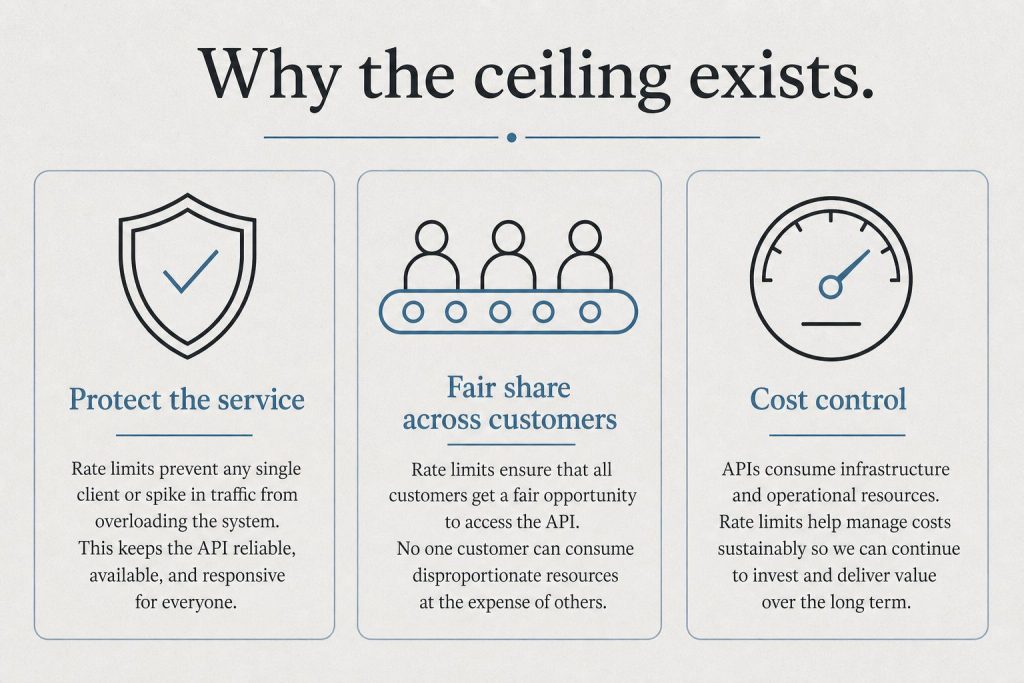
If you’re running Claude in any sustained capacity, four limits will define your experience. Get these right and you have headroom. Get them wrong and you’ll think Claude is broken when it’s actually working as designed.
1. Context window — how much Claude can read in a single conversation. Varies by model and surface. The 1M window is real but only available in specific places.
2. File upload size — how big a single file can be. 30 MB cap per file across the board, with workarounds for larger files.
3. Usage limits — how much Claude work you can do per session/week. Per-user, not pooled. Different limits for chat vs Claude Code vs Agent SDK.
4. Extra usage / overage — what happens when you hit the cap. Either you’ve enabled it and you keep going at API rates, or you’re stopped until the limit resets.
Context window: where 1M tokens actually applies
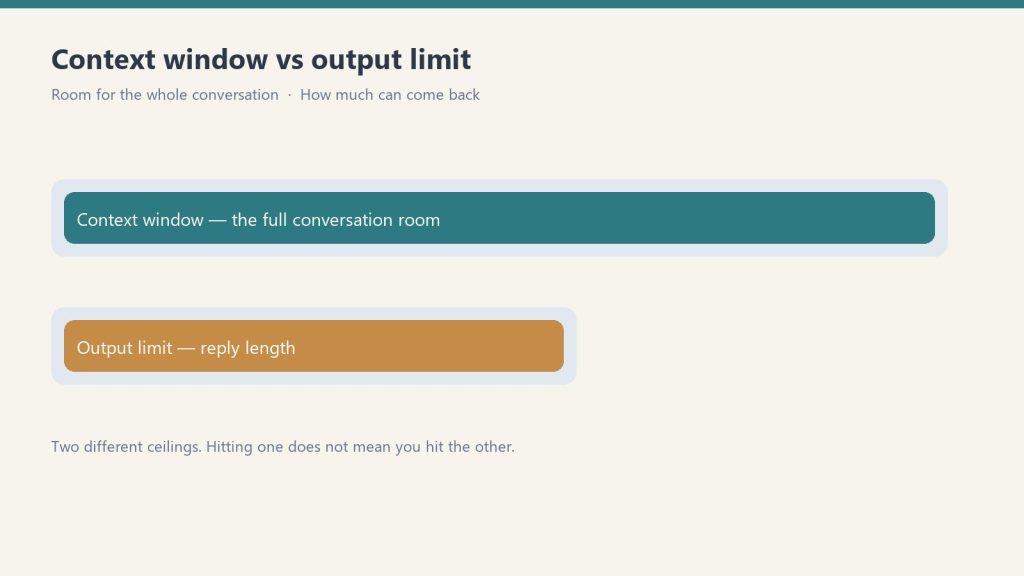
Per Anthropic’s Help Center documentation (verified September 26, 2026), context window size depends on the model AND on the surface you’re using Claude through. This is the single most-misunderstood limit because the same model can have a different context window in chat than it does in Claude Code or the API.
Web and desktop chat (claude.ai):
- Opus 5.5, Opus 5, Sonnet 5 — 500K tokens on all paid plans
- All other models — 200K tokens on paid plans
Claude Code:
- Opus 5.5 — 1M tokens on Pro, Max, Team, and Enterprise
- Sonnet 5 — 1M tokens on all paid plans, but extra usage must be enabled to access it (except on usage-based Enterprise plans)
Claude API:
- Opus 5.5, Opus 5, Sonnet 5 — 1M tokens at standard pricing (no long-context premium)
- All other models — 200K tokens
The practical translation: if you need the full 1M token window, use Claude Code or the API with one of the supported models. The web chat tops out at 500K even on the most capable models. That difference matters when you’re trying to feed Claude an entire codebase, a long video transcript, or a multi-document research bundle.
File upload size: 30 MB per file, with workarounds
Per Anthropic’s Help Center, the maximum file size for both uploads and downloads is 30 MB per file. This applies whether you’re uploading a PDF, a CSV, an image, or any other supported file type.
For PDFs larger than 30 MB, Anthropic’s documentation notes that Claude can process them through its computing environment without loading them into the context window. That’s a real workaround for big PDFs but it doesn’t help you for other large file types.
If you regularly hit the 30 MB cap, the practical patterns are:
- Split before upload — break the file into chunks under 30 MB, upload each, work with them as separate sources
- Convert format — a 35 MB Word doc with embedded images may compress to under 30 MB as a PDF; CSVs can often be reduced by removing unused columns
- Upload to GCS or S3 and let Claude read via tools — for the Agent SDK / API path, you can put the file in cloud storage and have Claude read it via web fetch or a custom tool, bypassing the upload cap entirely
Usage limits: per-user, not pooled
This is the limit that confuses teams the most. Per Anthropic’s Help Center documentation on the Team plan (verified September 26, 2026): each team member has their own set of usage limits. They are not shared across the team.
If one teammate burns through their session limit, the rest of the team is unaffected. There is no pooled team allowance that one user can drain on behalf of others. The math is per-seat, always.
The usage limits themselves vary by seat type:
- Standard Team seats — 1.25x more usage per session than Pro plan. One weekly usage limit applies across all models. Resets seven days after the session starts.
- Premium Team seats — 6.25x more usage per session than Pro plan. Two weekly limits: one across all models, plus a separate one for Sonnet models specifically. Both reset seven days after session start.
For the actual numeric token-per-session limits, Anthropic does not publish exact numbers — they describe relative multipliers vs Pro. This is intentional; the underlying math is calibrated against typical workloads rather than a hard token ceiling.
Extra usage: what happens when you hit the cap
When a user hits their weekly limit, two things can happen depending on whether the organization has enabled extra usage:
If extra usage is enabled: additional Claude requests continue to flow at standard API rates (the same per-token pricing published on Anthropic’s pricing docs — $10/$50 MTok for Fable 5.1, $5/$25 MTok for Opus 5 / 4.8 (legacy — still listed), $2/$10 for Sonnet 5, $1/$5 for Haiku 4.5). Extra usage is billed separately from the subscription. Team and Enterprise admins can enable, cap, and monitor extra usage at the organization level.
If extra usage is not enabled: the user’s Claude requests stop until their limit resets at the start of the next session window (seven days from when the current session started, not a fixed weekly day).
The right setting depends on your team’s tolerance for surprise bills versus interrupted workflows. Most production teams enable extra usage with a hard organizational cap so individual users have continuity but the org has predictable spend ceiling.
Claude Code limits: a separate model
Claude Code has its own usage limit accounting that exists alongside chat usage limits. Per Anthropic’s Help Center on Claude Code models, usage, and limits (verified September 26, 2026):
- Interactive Claude Code (typing in terminal/IDE) draws from your subscription’s usage limits, the same pool as web chat
- Non-interactive
claude -pmode currently also draws from subscription usage limits — until June 15, 2026 - Starting June 15, 2026, non-interactive mode and Agent SDK usage move to a separate per-user monthly Agent SDK credit pool
The June 15 change is important enough that it gets its own breakdown in our Agent SDK Dual-Bucket Billing article. The short version: if you’re running unattended Claude Code work in cron jobs or CI, your billing model is changing. Plan capacity against the new credit pool.
The limits that aren’t really limits
Three things that get reported as limits but are actually configuration choices:
“My context window keeps filling up.” This is usually caused by long-running conversations accumulating history rather than the model’s actual context window being too small. Starting a new conversation (or running /clear in Claude Code) resets the working context. Long sessions are not a hard limit; they are a working-memory pressure that compounds over turns.
“Claude won’t read my whole repository.” Repository size is rarely the actual limit; the limit is how much you can load into the context window at once. Tools like Claude Code’s file reading and search work around this by loading files on demand rather than upfront. The 1M context window helps but is not a substitute for selective loading.
“My team keeps hitting limits even though we’re on Team.” Almost always one of two things: (a) people are mistakenly assuming the seat allowance is shared, when it’s strictly per-user; (b) someone is running heavy automation through a subscription seat instead of a Claude Developer Platform API key (which is the recommended path for sustained team-wide automation, especially after June 15).
Decision matrix: which limits affect which use case
Map your use case to the limits that actually apply:
- Solo chat user on Pro — 500K context on Fable 5.1/Opus 5.5/Sonnet 5 in chat, weekly session limit, 30 MB upload cap. Hit your limit and you wait or pay extra usage.
- Solo developer using Claude Code — 1M context on Opus 5.5 (1M on Sonnet 5 with extra usage on). Same weekly session limit. June 15 billing change applies if you use
claude -p. - Small team on Team Standard — Per-seat limits at 1.25x Pro session capacity, not pooled. 30 MB upload cap. June 15 billing change applies per-seat.
- Team running Claude Code in CI — All of the above plus separate Agent SDK credit pool starting June 15. Strongly consider a Developer Platform API key for the CI workload to get true pay-as-you-go billing.
- Enterprise running large-scale automation — Subscription limits are the wrong tool. Move to a Developer Platform API key, monitor usage at the org level, set spend caps in the Console.
What to actually do this week
- Identify which surface you’re using Claude through (web, Claude Code, API). Different surfaces have different context windows even for the same model.
- If you’re hitting “limit” errors, check whether extra usage is enabled at the organization level before assuming it’s a hard cap.
- If you’re a Team admin and your team is reporting hitting limits, audit per-seat usage rather than assuming you need to upgrade the plan — the issue is often one heavy user, not the plan tier.
- If anyone on your team is running unattended Claude work, read the Agent SDK billing change before June 15.
- If you need the full 1M context window, switch to Claude Code or the API. Web chat tops out at 500K.
- For uploads larger than 30 MB, split, compress, or move the file to cloud storage and have Claude read it via tools.
Related on Tygart Media: how to use Claude · Anthropic API key.
Frequently Asked Questions
Is the Claude Team plan usage limit shared across team members?
No. Per Anthropic’s Help Center documentation, each team member has their own set of usage limits. If one team member reaches their seat’s included limit, other team members are unaffected and can keep working.
What is Claude’s file upload size limit?
30 MB per file for both uploads and downloads, per Anthropic’s official documentation. For PDFs larger than 30 MB, Claude can process them through its computing environment without loading them into the context window.
Where does the 1M token context window actually apply?
1M context is available on Claude Code with Opus 5.5 (Pro/Max/Team/Enterprise) and on the API with Fable 5.1, Opus 5.5, and Sonnet 5. Web chat tops out at 500K tokens even on the most capable models. Sonnet 5 in Claude Code requires extra usage to be enabled to access the 1M window (except on usage-based Enterprise plans).
What’s the difference between Standard and Premium Team seats?
Standard seats offer 1.25x Pro plan usage per session with one weekly limit across all models. Premium seats offer 6.25x Pro session usage with two weekly limits (one across all models, one Sonnet-specific). Both reset seven days after the session starts.
What happens when I hit my Claude usage limit?
If extra usage is enabled at your organization, you continue at standard API rates billed separately. If extra usage is not enabled, your requests stop until your limit resets at the next session window (seven days from session start, not a fixed weekly day).
Should I use a Team plan or the API for production automation?
For sustained shared automation (CI pipelines, cron jobs, background services), Anthropic recommends the Claude Developer Platform with an API key over subscription seats. Subscription seats are sized for individual interactive use; API keys give you predictable pay-as-you-go billing, no per-seat caps, and don’t compete with team members’ interactive usage.
Related Reading
- Claude Agent SDK Dual-Bucket Billing: What Changes June 15, 2026
- How to Install and Deploy Claude Code in Production
- Claude MCP Token Cost Reality
- Claude Models Roadmap May 2026
- Claude AI Pricing — with interactive calculator
How we sourced this
Sources reviewed September 26, 2026:
- Anthropic Help Center: Understanding usage and length limits, What is the Team plan?, How is my Team plan bill calculated?, Manage extra usage for Team and seat-based Enterprise plans, Models, usage, and limits in Claude Code, How large is the context window on paid Claude plans?, How large is the Claude API’s context window?, Upload files to Claude (primary sources for all limit specifics)
- Anthropic platform documentation: Context windows at docs.claude.com (primary source for API context window behavior)
- Anthropic Help Center: Use the Claude Agent SDK with your Claude plan (primary source for the June 15, 2026 billing change)
All limit numbers and policies are accurate as of September 26, 2026. Anthropic adjusts subscription mechanics regularly; if you’re making procurement decisions on this article more than 60 days from the date stamp, re-verify the per-seat multipliers and context window availability against the current Help Center.
Frequently Asked Questions
What is Claude’s message limit per day?
Message limits vary by plan. Free: limited daily messages (Anthropic adjusts based on load). Pro ($20/month): approximately 2,000 Sonnet-equivalent messages per day. Max 5x ($100/month): approximately 10,000. Max 20x ($200/month): approximately 40,000. API users are rate-limited by tier with no hard daily message cap, instead governed by tokens-per-minute limits.
What is Claude’s maximum context window in 2026?
Claude Fable 5.1, Claude Opus 5.5, and Claude Sonnet 5 all support a 1 million token context window. Claude Haiku 4.5 supports 200,000 tokens. Anthropic eliminated long-context surcharges in March 2026, so large-context requests are billed at standard per-token rates. The Free plan is limited to 200K context even on Sonnet.
What is the maximum file size I can upload to Claude?
On Pro, Max, and Team plans: up to 30MB per file, up to 5 files per conversation. Supported formats include PDF, text, CSV, code files, and images. The Free tier supports up to 10MB per file. For API users, file uploads are handled via the Files API with a 32MB per file limit.
How do I scale Claude beyond subscription message limits?
For high-volume workloads, switch to the Claude API (pay-per-token, no daily message cap beyond rate limits). Enterprise plans offer higher rate limits and custom agreements. The Batch API processes large jobs at 50% off standard prices for non-real-time workloads. Claude Max 20x ($200/month) is the highest subscription tier for interactive use.
What are Claude’s API rate limits?
API rate limits depend on your usage tier. New API accounts start at Tier 1 with lower limits. Spending history and account age automatically promote accounts to higher tiers with increased requests-per-minute and tokens-per-minute. Current tier limits are published at console.anthropic.com/settings/limits. Enterprise customers can negotiate custom rate limits.
Does Claude have a token limit per message?
There is no enforced per-message token limit separate from the overall context window. A single message can use up to the full context window (1M tokens for Fable 5.1 / Opus 5.5 / Sonnet 5, 200K for Haiku 4.5). However, very long single messages may be slower to process. The practical limit is the context window of whichever model you are using.
💼 Deploying Claude or AI Infrastructure in Your Business?
At Tygart Media, we engineer custom Model Context Protocol (MCP) servers, multi-model content pipelines, and AI operational systems. Explore our Claude AI Team Implementation Services or check out our complete Restoration Operations & AI Kit.
Leave a Reply