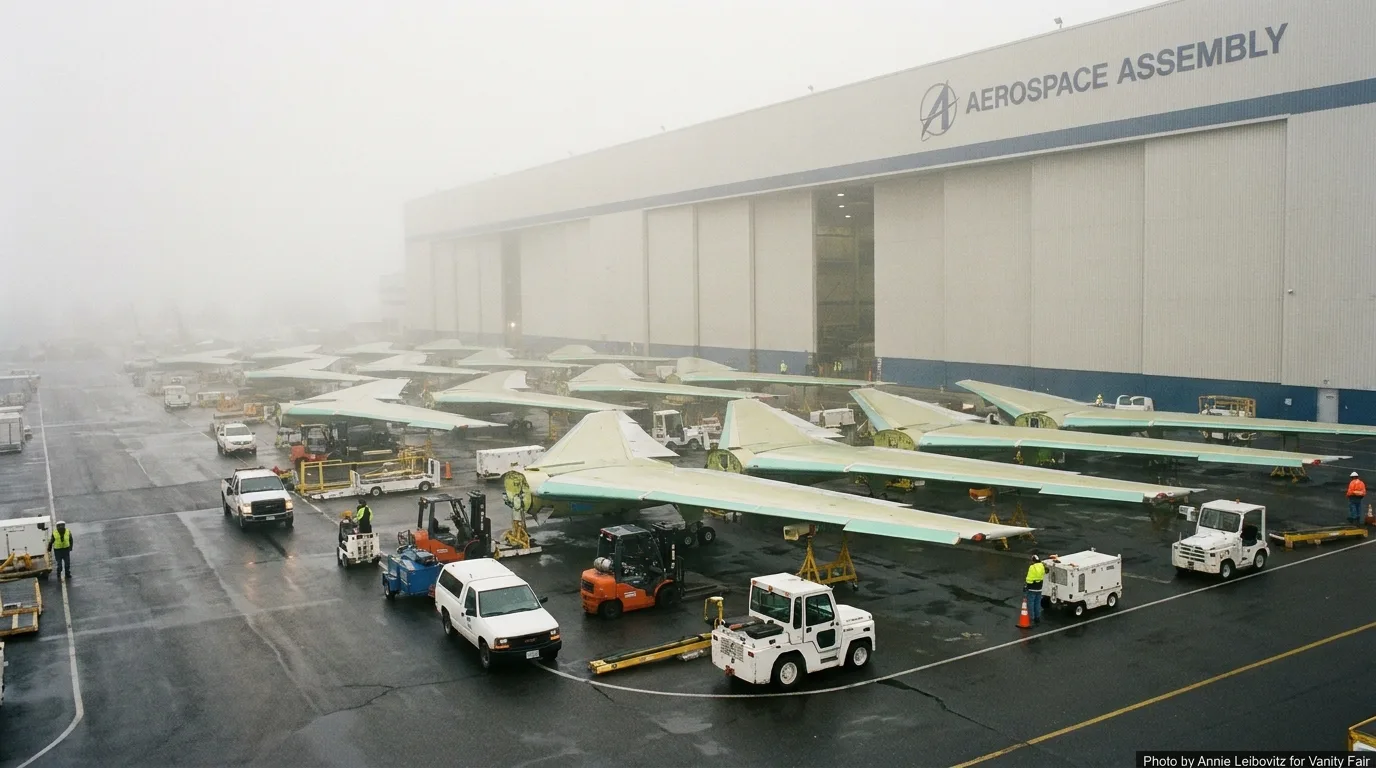
Q: What airplanes is Boeing building at the Everett factory right now?
A: As of mid-2026, Everett assembles the KC-46 tanker, 767 commercial freighter (final orders), 777 and 777-8F freighter, and 777-9. The 737 North Line — Boeing’s first narrowbody assembly in Everett — activates midsummer 2026.
Inside the World’s Largest Building: What Boeing Is Actually Building at Paine Field in 2026
You can see it from the 526 interchange. You can see it on final approach into Sea-Tac. You can see it — dimly, from miles away — on a clear day from downtown Everett. The Boeing factory at Paine Field is so large that it has its own weather system, its own postal address, its own internal transportation network, and a visitor attraction that hosts 800,000 people a year just to stare at its ceiling.
It is the largest building on Earth by volume: 472 million cubic feet, 98.3 acres under one roof, built in 1967 and expanded three times since. It covers approximately the same footprint as 75 football fields. The workers inside joke that rainclouds form before they do outside.
But what people rarely know — even Everett residents who have lived next to it for years — is what exactly is happening inside that building right now, in 2026, and why what happens there over the next 18 months will shape the region’s economy for a decade.
How the Building Grew
Boeing chose Everett for a specific reason in the mid-1960s: the 747. The aircraft was so large that no existing Boeing facility could accommodate it. The company needed to build not just a new airplane but a new factory from scratch, and the flat land near Paine Field offered space at a scale that made sense.
The original main assembly building opened in 1967, covering 43 acres — designed around one airplane, with every dimension calibrated to the 747’s enormous fuselage sections and wing stubs. In 1979, Boeing expanded the factory by 45 percent to launch the 767 program. In 1990, it expanded again by 50 percent for the 777. By the early 2000s, the factory was handling three major programs simultaneously: the 747, 767, and 777.
The 777X required yet another expansion — but a different kind. Rather than extending the main building again, Boeing built a separate 1.2-million-square-foot composite wing manufacturing facility adjacent to the main structure. Inside, industrial robots lay up carbon fiber to form the 777X’s folding wingtips, which span 235 feet unfolded — longer than the wingspan of any commercial aircraft in service today.
Today, the entire Everett campus covers approximately 1,000 acres with up to 200 separate buildings and facilities. The main assembly building is the centerpiece. Surrounding it are engine test stands, paint facilities, seal buildings, composite fabrication shops, a training center, and the Future of Flight Aviation Center where visitors rotate through what Boeing calls the world’s largest building tour.
The 767 and KC-46 Tanker Lines
The 767 commercial freighter program is in its final chapter. Boeing has fewer than 40 commercial 767 orders remaining — primarily for FedEx and UPS — and the commercial line will close when those are delivered, likely by 2027. For Everett workers on the 767 line, this is a known transition, not a surprise.
What keeps the line alive is the KC-46 Pegasus tanker. The KC-46 is the Air Force’s next-generation aerial refueling aircraft, derived from the 767 platform but built to military specifications. Boeing is on Lot 12 of a long-term contract, with the Air Force targeting a fleet of 179 aircraft against a full recapitalization requirement of 475. In 2026, Boeing is pacing toward approximately 19 KC-46 deliveries for the year — making the tanker program the most stable production line in the building. Unlike commercial programs, defense contracts are not subject to airline order cancellations or passenger demand swings.
The 777 Family: Two Programs, Two Futures
The 777 has been Boeing’s widebody flagship for three decades. In 2026, commercial 777 deliveries from Everett are winding down as the market transitions to the 777X generation. What makes the 777 line relevant this year is what just rolled out of the building.
On April 23, 2026, Boeing rolled out the first 777-8F freighter from the Everett factory — the physical debut of a program that carries Boeing’s commercial freight ambitions into the 2030s. The jet, which burns approximately 30 percent less fuel per tonne than the 747-8F it replaces, is currently in pre-flight ground testing. First delivery — to Cargolux, the launch customer — is targeted for 2027.
The 777-9 passenger variant tells a more complicated story. Boeing CEO Kelly Ortberg disclosed in April that the roughly 30 stored 777-9 jets at Paine Field require multi-year change incorporation work before they can be delivered. Some of those aircraft have been sitting in near-final configuration since 2020, waiting for certification milestones that kept getting pushed. Change incorporation — the engineering-intensive process of updating already-assembled jets to reflect certification-driven design changes — means Everett’s widebody workforce will be occupied with 777X work well into the late 2020s. Lufthansa, the launch customer, has confirmed it expects its first 777-9 in Q1 2027.
The 737 North Line: Something That Has Never Been Here Before
The newest addition to the building’s mission is something that has never existed here before: a 737 assembly line.
For the entire history of 737 production — since 1967, the same year the Everett factory opened — every single 737 has been assembled at Boeing’s Renton facility, 20 miles to the south. Renton was the narrowbody campus. Everett was widebody. That division was considered permanent.
Midsummer 2026 changes it. The North Line — Boeing’s fourth 737 MAX assembly line — is being activated in the Everett factory in space that has been reconfigured from widebody use. It will initially build the 737-8, 737-9, and 737-10 at a Low Rate Initial Production (LRIP) pace, assembling conformity aircraft that demonstrate to the FAA that processes in Everett match those in Renton. Once the FAA validates conformity under production certificate PC700, the line transitions to full production flow.
The business case is straightforward. Boeing’s current three Renton 737 lines are approaching their practical capacity ceiling. Getting from the current rate of 42 jets per month to the target rate of 52 or more requires additional line capacity. The North Line provides that headroom — and specifically gives the 737 MAX 10, with more than 1,200 outstanding orders, a dedicated production home in Everett where it will be built exclusively.
Boeing has been hiring 100 to 140 new Everett workers per week to prepare. The workforce is a mix of newly hired employees coming through the IAM 751 Machinists Institute training program at 8729 Airport Road and experienced teammates transferring from Renton and Moses Lake to seed the new line with institutional knowledge.
The Scale of What’s Inside
Standing on the factory floor provides a scale reference that no photograph delivers accurately. The 26 overhead cranes that move fuselage sections and wing assemblies operate along 39 miles of elevated track. The widest 777X fuselage section, when positioned for assembly, looks from the wrong angle like a commercial building. The building’s internal road system carries workers between production zones that are physically too far apart to walk in a reasonable time.
On any given production day in 2026, four distinct programs are in active assembly simultaneously — the KC-46, the 777 family, the 777X, and (by late summer) the first North Line 737s. Each program has its own workforce, its own production rhythm, its own relationship with the FAA. Coordinating them under one roof requires a logistics complexity that rarely gets attention in coverage of Boeing’s delivery numbers.
The Paine Field Community Day on June 6 will bring the public to the edge of that operation — a chance to see the flight line where these aircraft emerge, the military jets that operate alongside them, and the campus that defines Everett’s economic identity. The Future of Flight center runs daily tours of the main building year-round. It is, by any measure, worth the drive.
The 747 that gave this building its reason for existing made its final delivery in January 2023. The building it left behind is, in 2026, more active than it has been in years.
Frequently Asked Questions
Why is the Boeing Everett factory the largest building in the world?
The factory covers 98.3 acres of floor space and 472 million cubic feet of volume, making it the largest building by volume on Earth. It was built in 1967 for the 747 and expanded three times since to accommodate the 767, 777, and 777X programs.
What airplanes are built at Boeing’s Everett factory right now?
As of mid-2026, Everett assembles the 767 commercial freighter, the KC-46 Pegasus tanker, the 777 classic (final commercial orders), the 777-8F freighter (in pre-flight ground testing), and the 777-9 (in change incorporation ahead of 2027 deliveries). The 737 North Line begins LRIP production midsummer 2026.
What happened to the 747 line in Everett?
Boeing delivered the final 747 — a freighter for Atlas Air — in January 2023, ending a program that ran for more than 55 years and produced over 1,500 aircraft. The Everett space formerly used for 747 production has been repurposed for 777X and North Line programs.
Can the public visit the Boeing Everett factory?
Yes. The Future of Flight Aviation Center at 8415 Paine Field Blvd offers daily tours of the main assembly building and is open seven days a week. It is one of the Pacific Northwest’s most popular aviation destinations, welcoming approximately 800,000 visitors per year.
How does the 737 North Line differ from Renton?
The Renton facility has been Boeing’s sole 737 assembly site since the program began in 1967. The Everett North Line will be the first 737 final assembly line outside of Renton. It will initially produce the 737-8, 737-9, and 737-10 — with the MAX 10 slated for exclusive Everett production long-term — and will provide the capacity Boeing needs to reach production rates above 47 jets per month.
Leave a Reply