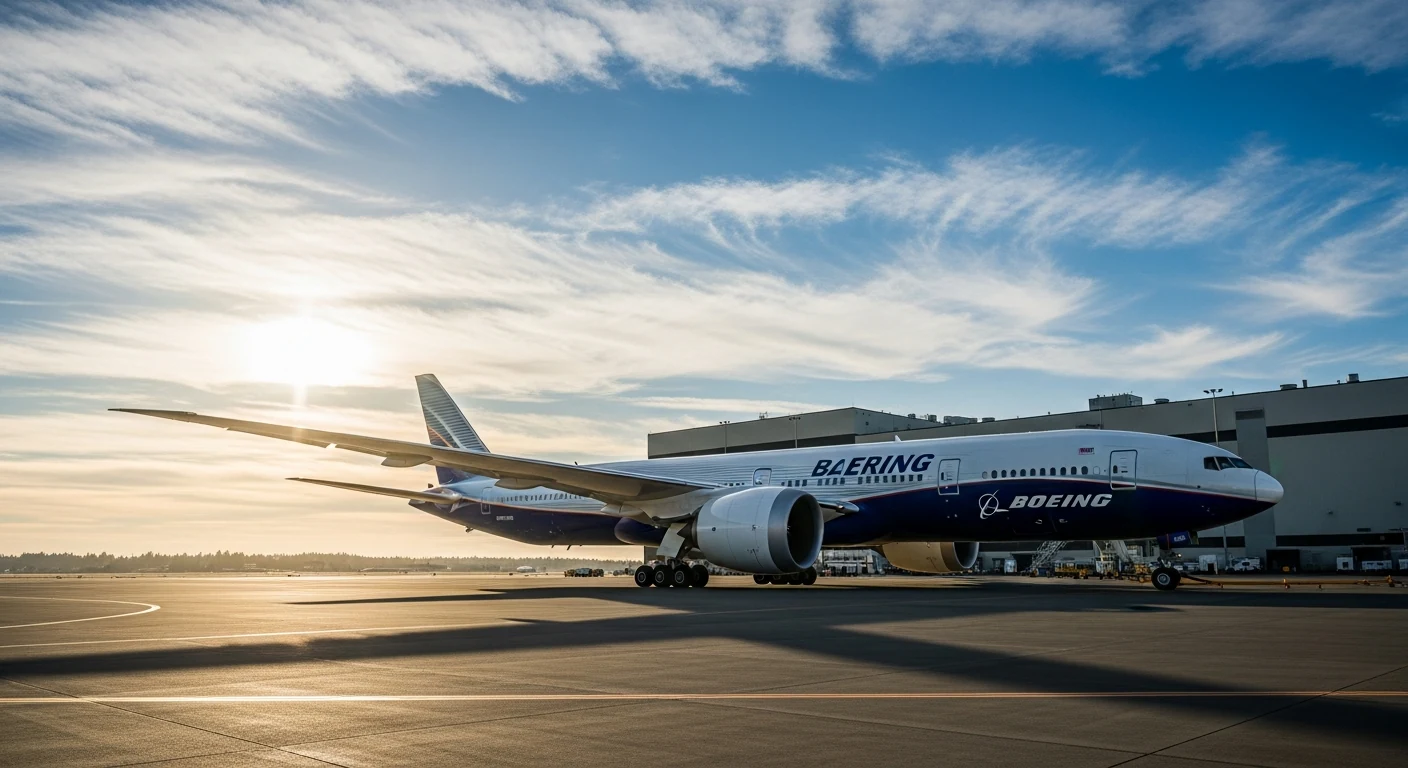
Q: What does the Boeing 777-9 simulator qualification mean for Everett?
A: On February 19, 2026, the FAA and EASA certified the first full-flight simulators for the Boeing 777-9. This milestone allows airlines including Lufthansa to begin pilot training programs, a prerequisite for 777X deliveries from the Paine Field line in Everett. Lufthansa's Frankfurt simulator is completing installation in late May 2026, with deliveries targeted for early 2027.
In the long story of the Boeing 777X program — a saga measured in years of delays, billions in cost overruns, and a certification path that has been anything but linear — a milestone cleared on February 19, 2026, deserves more attention than it got: the FAA and EASA jointly certified the first full-flight training simulators for the Boeing 777-9.
That might sound like a bureaucratic checkbox. It is not. For Everett, where every one of those jets will be assembled in the world's largest building, it means the airline industry is now formally preparing to operate the widebody jet that this factory has spent years building up to deliver. Airlines cannot hire and train 777X crews without FAA-qualified simulators. The simulator certification is the moment when "getting ready" becomes "getting pilots ready." The Paine Field production line just got a very real signal that its customers are moving from theory to execution.
What the Qualification Actually Covers
The February 19 announcement from Boeing's mediaroom came jointly with simulator manufacturer CAE. The devices qualified include a full-flight simulator (FFS) and a flight training device (FTD), both located at the Boeing Training Campus in Gatwick, United Kingdom. Both carry Level D qualification — the highest standard the FAA issues, requiring six-degrees-of-freedom motion, full visual system fidelity, and cueing that replicates the actual aircraft within tight tolerances.
The significance of Level D: it is the standard airlines need to conduct type rating training. Without it, pilots cannot legally qualify on a new aircraft type in revenue service. The FAA and EASA granting Level D to the 777-9 simulators simultaneously is a coordinated signal that both the primary regulators for U.S. and European carriers are aligned on the aircraft's systems representation — a meaningful statement for a program that has had to fight for every regulatory inch.
Crucially, this qualification predates delivery. That is intentional. The lead time to train a 777-9 crew is substantial. Airlines need months of instructor qualification, line training device hours, and route-specific procedures work before the first airplane lands in the hands of a paying passenger. By certifying simulators in February 2026 — roughly a year before the currently confirmed Lufthansa delivery window of early 2027 — Boeing and the regulators built in the runway carriers need to actually be ready.
Lufthansa Is First — And Already Installing Its Own Simulator
Lufthansa, the 777X launch customer with 34 aircraft on order, is not waiting. Lufthansa Aviation Training, the carrier's pilot training subsidiary, has received the first Boeing 777-9 full-flight simulator delivered to an airline. As of late April 2026, that device is being assembled and installed at LAT's Frankfurt training center, with operational readiness planned for late May 2026.
The Frankfurt simulator coming online in May matters for Everett's timeline. Lufthansa CEO Carsten Spohr confirmed in March 2026 that the carrier now expects its first 777-9 delivery in Q1 2027. That is a compressed window. For Lufthansa to take delivery and put the aircraft into revenue service, it needs trained captains and first officers before the keys are handed over. The simulator arriving in Frankfurt now, five-plus months before the delivery window, is the logistical machinery that makes a Q1 2027 entry-into-service possible rather than theoretical.
The Paine Field assembly line where that first Lufthansa jet is being built has approximately 30 stored 777X jets awaiting rework completion, a scale disclosed on Boeing's Q1 2026 earnings call. The rework timeline — combined with the production flight campaign Boeing targeted for April 2026 — means the Everett widebody team is running multiple parallel tracks simultaneously: complete the production flight, continue the FAA certification campaign, resolve the stored-jet rework sequence, and deliver to Lufthansa before Q1 2027 expires.
The simulator qualification removes one of the few variables that was entirely outside Boeing's control. Airlines can now train. That is one less bottleneck between this factory and the first revenue flight of a jet years in the making.
Asia-Pacific Carriers Are Also Preparing
Lufthansa is not the only operator in motion. CAE is installing Asia-Pacific's first Boeing 777X full-flight simulator at the Singapore-CAE Flight Training Centre, serving a cluster of early-order operators including Singapore Airlines (31 aircraft on order), Cathay Pacific (21 aircraft), ANA, and Air India. Each of those jets will roll out of the building at Paine Field.
Every simulator coming online in Frankfurt, Singapore, or wherever else airlines establish their 777X training footprints represents a future delivery from Everett's widebody line. The February qualification set the legal foundation for all of it.
For Boeing Everett's workforce, the broader pattern is worth understanding. The 777 program has been this factory's anchor for decades. The 777-300ER has been one of the most commercially successful widebodies in history. The 777-9, its successor, carries a combined backlog of several hundred orders. Getting it into service successfully — and on the current 2027 timeline rather than slipping again — is a defining question for whether the Everett widebody line sustains the workforce and economic weight it has carried in Snohomish County for a generation.
The GE9X Factor
One complication sitting alongside the simulator news: GE Aerospace, the exclusive supplier of the GE9X engine that powers the 777-9, disclosed in early 2026 that it is working on a fix for a mid-seal durability issue identified during a shop visit in January. Boeing and GE have both stated the resolution does not push 777-9 certification or delivery beyond the current 2027 timeline.
The GE9X is the engine that makes the 777-9's efficiency case: roughly 10 percent better fuel burn than the 777-300ER, with the largest commercial fan diameter in the industry at 134 inches. A mid-seal durability issue caught during a shop visit is exactly the kind of finding a rigorous certification campaign is designed to surface. Both companies have financial and reputational reasons to be precise about its scope. But it is a real variable on the program's critical path, and Everett workers and suppliers tracking the 2027 delivery window should know it exists and is being actively worked.
What to Watch From Here
The sequence ahead: Boeing targeted April 2026 for the first production-standard 777-9 flight from Paine Field. That flight triggers the FAA's grant of Type Inspection Authorization (TIA) for the production-configured aircraft, allowing FAA pilots to join the cockpit for final certification flights. TIA clearance in the second half of 2026 would set up a 2027 delivery consistent with what Spohr confirmed in March.
In the meantime, the Gatwick training campus is active, Frankfurt's simulator is being installed, and Singapore's device is being prepared. The certification machinery is in motion from multiple directions. For the 42,000-person aerospace workforce that defines Everett's economy, the trajectory matters more than any single checkpoint. The simulator qualification, unflashy as it is, is one of the clearest signals yet that Boeing and its customers are treating the 2027 timeline as real.
Related reading: Boeing 777X Rework: 30 Stored Jets at Paine Field | Boeing 777X Clears FAA Phase 4A | What the 777-8F and KC-46 Mean for Everett's Workforce
Frequently Asked Questions
What is a Level D flight simulator qualification?
Level D is the highest FAA certification for full-flight simulators. It requires six-degrees-of-freedom motion, high-fidelity visual systems, and precise replication of the aircraft's handling qualities. Airlines must use Level D simulators for type rating training — the qualification pilots need before flying a new aircraft type commercially.
Why does the 777-9 simulator qualification matter for Everett?
Every Boeing 777-9 is assembled at the Paine Field factory in Everett. Simulator certification allows airline customers to begin training pilots — a prerequisite for accepting deliveries. Without certified simulators, airlines cannot legally qualify crews, which would delay deliveries regardless of production progress.
When does Lufthansa expect its first Boeing 777-9?
Lufthansa CEO Carsten Spohr confirmed in March 2026 that the carrier expects delivery in Q1 2027. Lufthansa has 34 aircraft on order and is installing its own Level D 777-9 simulator at its Frankfurt training center, with completion expected in late May 2026.
What is the GE9X mid-seal issue?
GE Aerospace disclosed in early 2026 that it is developing a fix for a mid-seal durability issue found during a GE9X shop visit in January 2026. Both Boeing and GE have stated the fix does not affect the 777-9's 2027 first-delivery timeline.
Which airlines have 777-9 orders?
Major customers include Emirates (115 aircraft), Lufthansa (34), Singapore Airlines (31), Cathay Pacific (21), Qatar Airways, and ANA. All aircraft will be assembled at the Boeing Everett factory at Paine Field in Snohomish County.
Leave a Reply