Is Google Local Services Ads worth it for restoration companies? LSA earns its spot when the underlying review practice is strong — high review count, high star average, high review recency — because the LSA algorithm prioritizes those signals for placement. A restoration company with a disciplined review practice can dominate LSA in its service area for a reasonable cost per lead. A restoration company without the review foundation will bid against competitors and lose the cost-per-lead math. LSA is getting more competitive in most markets, and the companies that win it are the ones whose organic review asset makes them efficient.
Google Local Services Ads — LSA — sits in a distinct position in the restoration paid mix. It is the highest-intent placement available on Google for local services. It appears above the paid search results and above the map pack, with a “Google Screened” or “Google Guaranteed” badge, and most importantly with the company’s review count, star average, and photos visible directly in the unit.
When it works, it is one of the best lead sources a restoration company has. When it does not, it is one of the most expensive channels in the paid mix. The difference between the two outcomes is almost entirely about the underlying organic review asset the LSA is built on top of.
This article sits inside the broader organic-asset-paid-rent doctrine and focuses specifically on how LSA fits.
How LSA Works for Restoration
LSA is a pay-per-lead product (not pay-per-click). A homeowner searches for a restoration service — “water damage restoration near me” is a typical query — and Google surfaces a small set of LSA units at the top of the results. The homeowner sees a short list of companies with a badge, a star rating, a review count, a phone number, and a “contact” button.
When the homeowner calls or messages through the LSA unit, the advertiser pays for the lead. The cost per lead varies by service, geography, and competition, typically ranging from $30 to $150+ for restoration-related services, with emergency services on the higher end and specialty services on the lower end.
Get The Signal
What we actually ran, what it measured, and what it means for a restoration shop — every week, including the flops.
The ranking in the LSA unit is not primarily bid-based the way Google Ads is. It is heavily weighted toward:
- Review count — the total number of Google reviews on the linked GBP
- Review star average — the rating across those reviews
- Review recency — how fresh the most recent reviews are
- Response rate — how quickly the advertiser responds to LSA inquiries
- Proximity — the searcher’s distance from the business
- Service and category match — how closely the advertiser’s profile matches the query
- Hours — whether the business is currently open (especially important for emergency services)
- Budget — the daily cap the advertiser set (affects volume but not ranking directly)
The practical implication: a company with a strong review practice wins LSA placement efficiently. A company with a weak review practice cannot win at any budget level.
When LSA Earns Its Spot
LSA is a smart channel to run when:
The review asset is strong. 100+ reviews, 4.8+ star average, consistent review recency (fresh reviews every week), and a response pattern on every review. This is the pre-condition. Without it, budget burns without producing placement.
The response capacity is real. LSA leads require fast response. The inbound call or message needs to be picked up within minutes. Response time is a measured signal. Slow response reduces ranking and wastes the budget on leads that would otherwise convert.
The service area is well-defined and maintained. LSA uses the service area set in the advertiser’s LSA account, which should mirror the GBP service area. Inconsistency between the two channels confuses the delivery.
The service mix is covered correctly. LSA has distinct service categories (water damage, fire damage, mold, etc.). Each service the company offers should have its own LSA coverage configured.
The conversion economics work. Cost per lead × lead-to-job conversion rate × average job value × gross margin. If the math works at current CPL and current conversion rate, the channel is profitable. If it does not, the channel is not earning its spot regardless of how strong the placement is.
When all of those conditions are met, LSA is one of the highest-value placements in restoration paid. Many companies see LSA as their single largest source of residential emergency-service leads.
When LSA Does Not Earn Its Spot
LSA is a bad fit when:
The review asset is weak. Under 50 reviews, star average below 4.6, inconsistent recency. The company will show up in the LSA unit at a rate that makes the cost per lead math impossible to justify.
The response capacity is not there. If the company cannot pick up LSA leads within minutes, the ranking degrades and the channel gets starved.
The service area is not right-sized. Advertisers who over-extend service area on LSA end up paying for leads in geographies where they cannot respond fast or cannot complete the work profitably. Tighter is usually better.
The job mix is wrong. LSA is best for emergency services — the 2 AM water loss, the weekend fire. It is less efficient for services with longer decision cycles (reconstruction, mold inspection) where the homeowner will research and compare before calling. Those services are better served by a mix of organic, paid search, and referred flow.
Competition in the market is prohibitively intense. In some highly saturated metros, the CPL has risen to a level where the math no longer works for smaller operators. In those markets, LSA becomes a channel the biggest regional players dominate and everyone else competes around.
Operating LSA Well
For the companies where LSA fits, a few operating disciplines separate the efficient from the inefficient.
Feed the GBP religiously. Since LSA ranking is driven by the review signals on GBP, every improvement to the GBP playbook is also an improvement to LSA performance.
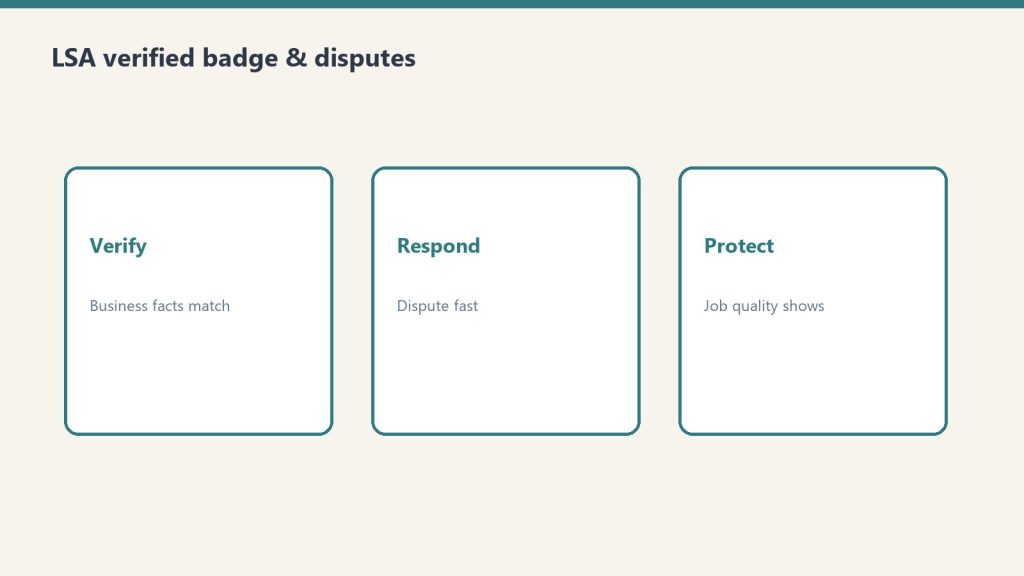
Review every LSA lead. Google allows advertisers to dispute leads that are not legitimate — wrong service, wrong area, spam, sales calls, wrong number. Disputing legitimately bad leads recovers budget. The process takes a few minutes per disputed lead. Make it a weekly habit.
Monitor response time. LSA dashboards show response rate and response time. Set a target (e.g., answer 95 percent of LSA calls within 60 seconds) and hold to it. A response problem kills channel performance regardless of anything else.
Set a daily budget that matches capacity. A budget too high relative to response capacity produces missed calls and degraded ranking. A budget too low relative to conversion opportunity leaves volume on the table. The right budget is the one that captures available leads your team can actually service.
Segment by service where possible. Running LSA across all services uniformly treats water and mold and reconstruction as the same opportunity. They are not. Use the service-specific settings to tune each.
Check the weekly report. Every week, look at spend, leads, qualified leads, disputed leads, response rate, booking rate. This is a managed channel, not an autopilot channel. Twenty minutes a week keeps it tuned.
The Trajectory of LSA Costs
LSA in restoration has been getting more competitive. Cost per lead has risen in most markets over the last few years as more restoration companies have entered the channel and Google has added features that let advertisers increase bids.
A company that was producing leads at $40 CPL two years ago might now be at $75. A company that was at $75 might be at $110. The direction is consistent.
This has implications for how the channel fits in the overall mix. It is no longer the case that LSA is unambiguously cheap. It is still highly efficient relative to Google Ads and most lead aggregators for matched services. But the margin is thinner than it was. Operators need to watch the numbers and adjust.
The companies that continue to win LSA economics as costs rise are the ones with the strongest organic review foundation — because their placement efficiency stays high even as the baseline CPL rises. The companies without that foundation get priced out.
This is another case where the organic is asset, paid is rent doctrine holds. LSA looks like a paid channel. It is really a channel whose performance is directly proportional to the organic review asset underneath it.
Integrating LSA With the Rest of the Paid Mix
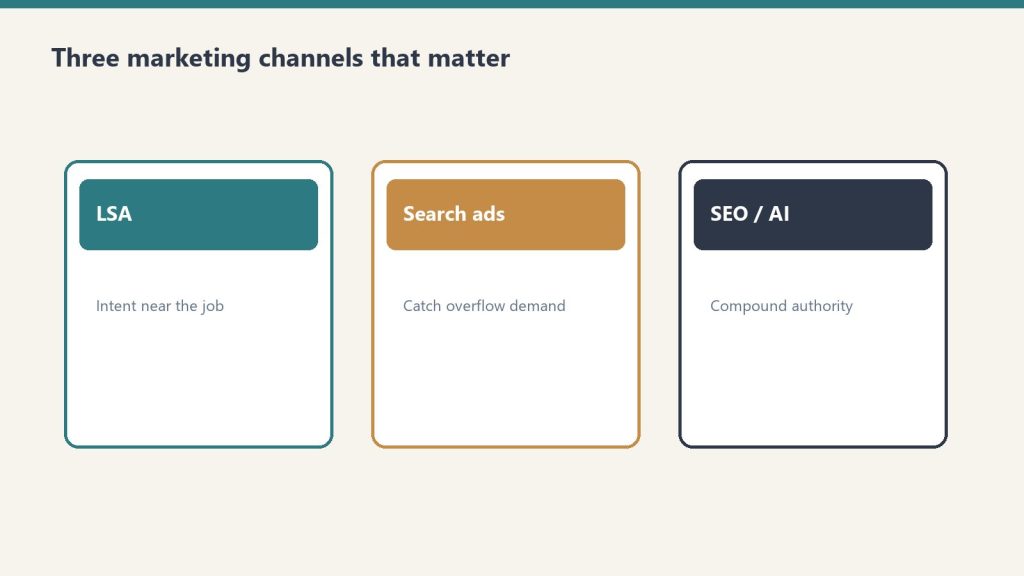
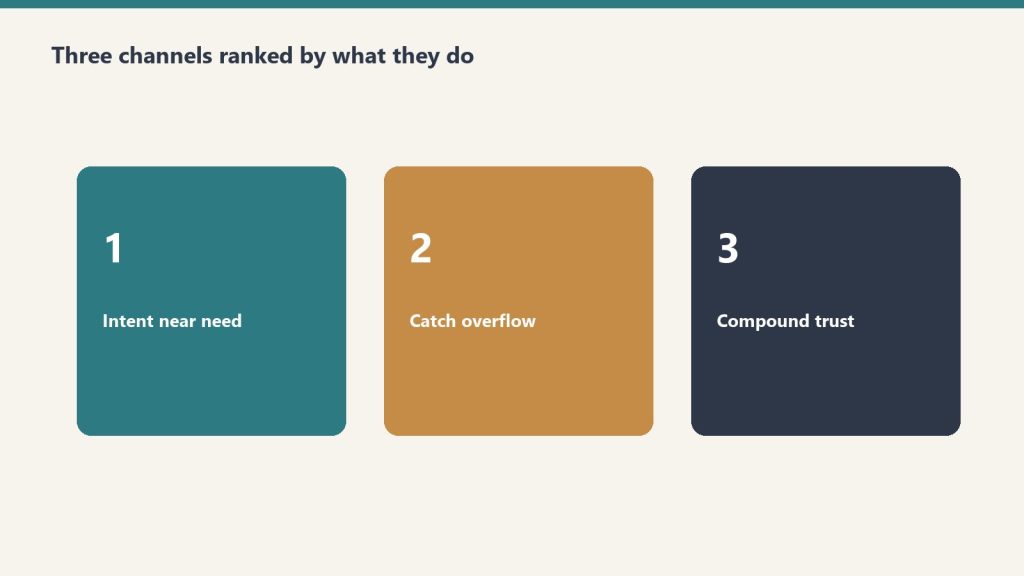
LSA is not the whole paid mix. It fills the highest-intent emergency service slot. The rest of the paid mix covers complementary slots.
Google Ads / Performance Max / AI Max covers branded search protection, non-emergency service queries, and upper-funnel reach that LSA does not serve.
Meta / Advantage+ covers broader awareness, community targeting, and services with longer decision cycles where social creative earns more attention than search.
YouTube covers specific targeted intent against video-searching audiences and residential homeowner demographics.
LSA sits at the bottom of the funnel — highest intent, highest cost per lead, highest conversion. The rest of the mix fills the middle and top. A well-run paid program has each layer and understands the role of each.
Common Mistakes
A few consistent LSA mistakes cost restoration companies budget.
Running LSA without the GBP foundation. Unprofitable almost immediately. Build the GBP first.
Setting service area too broad. Paying for leads in geographies where response time is poor.
Ignoring lead disputes. Leaving recoverable budget on the table, sometimes thousands of dollars a quarter.
Treating LSA as a set-and-forget. Drift in response time, review freshness, or service area produces slow degradation that is only caught on review.
Assuming LSA will grow indefinitely at constant CPL. Costs have risen. Plan for them to continue rising. Efficiency has to come from strengthening the organic foundation, not from hoping prices plateau.
How This Pairs With the Rest of the Stack
LSA sits at the intersection of the digital three-legged stool — because it depends on GBP and reviews — and the paid layer. It is where the review practice converts directly into lead flow. It is the clearest demonstration of why the review-as-comp-driver program pays for itself many times over.
Every new five-star review is more than a trust signal. It is a direct input to LSA ranking, and therefore a direct input to emergency-services lead cost.
Where to Start
Audit the current state. What is the review count, star average, recency pattern? What is the GBP completeness? What is the current response time for inbound emergency calls? Those numbers are the prerequisites for LSA performance.
If the review asset is not strong enough yet, LSA is the wrong first move. Build the review practice first (see the reviews-as-comp article) and come back to LSA when the foundation is in place.
If the review asset is strong, set up the LSA account. Configure service coverage correctly. Set a modest daily budget to start (something the team can actually service). Commit to the weekly review rhythm: disputes, response time, lead quality, conversion rate.
In ninety days, the channel either produces profitable lead flow or it does not. If it does, scale the budget to match capacity. If it does not, the likely cause is in the foundation — review velocity, GBP completeness, response time — and those are where the fix lives.
Frequently Asked Questions
Is Google Local Services Ads worth it for restoration companies? Yes, when the underlying review practice is strong. LSA ranking is heavily weighted toward review count, star average, review recency, and response time. A company with a disciplined review practice wins LSA efficiently. A company without the review foundation cannot win at any budget level.
How much does an LSA lead cost for restoration? Varies by service, geography, and competition. Restoration-related CPLs typically range from $30 to $150+, with emergency services on the higher end. Costs have been rising in most markets as competition intensifies. The operator’s review asset determines whether the CPL converts profitably or not.
What determines LSA ranking for restoration companies? Review count, review star average, review recency, response rate, response time, proximity, service and category match, hours (especially for emergency), and daily budget. Most ranking weight sits on the review signals and response discipline.
Should restoration companies run LSA if they have under 50 reviews? Usually no. The channel math rarely works with a weak review foundation because placement rates are too low and CPL becomes prohibitive. The better first move is to build the review practice — systematic ask, frictionless submission, staff comp tied to outcomes — and deploy LSA once the foundation supports it.
Can LSA leads be disputed? Yes. Google allows advertisers to dispute leads that are wrong service, wrong area, spam, sales calls, or wrong number. Legitimate disputes recover budget. Running the dispute process weekly is worth the time. Many restoration companies leave significant recoverable budget on the table by not disputing.
How does LSA fit with other paid channels? LSA covers the bottom of the funnel — highest-intent emergency service queries. Google Ads and Performance Max cover branded protection and upper-funnel intent. Meta covers broader awareness and longer decision cycles. YouTube covers targeted video intent. LSA is a slot in the paid mix, not the whole paid mix.
Tygart Media on restoration — an analyst-operator body of work on the systems that separate compounding restoration companies from busy ones. No client names. No brand placements. Just the operating standard.
Get The Signal
What we actually ran, what it measured, and what it means for a restoration shop — every week, including the flops.
Leave a Reply