The Short Answer
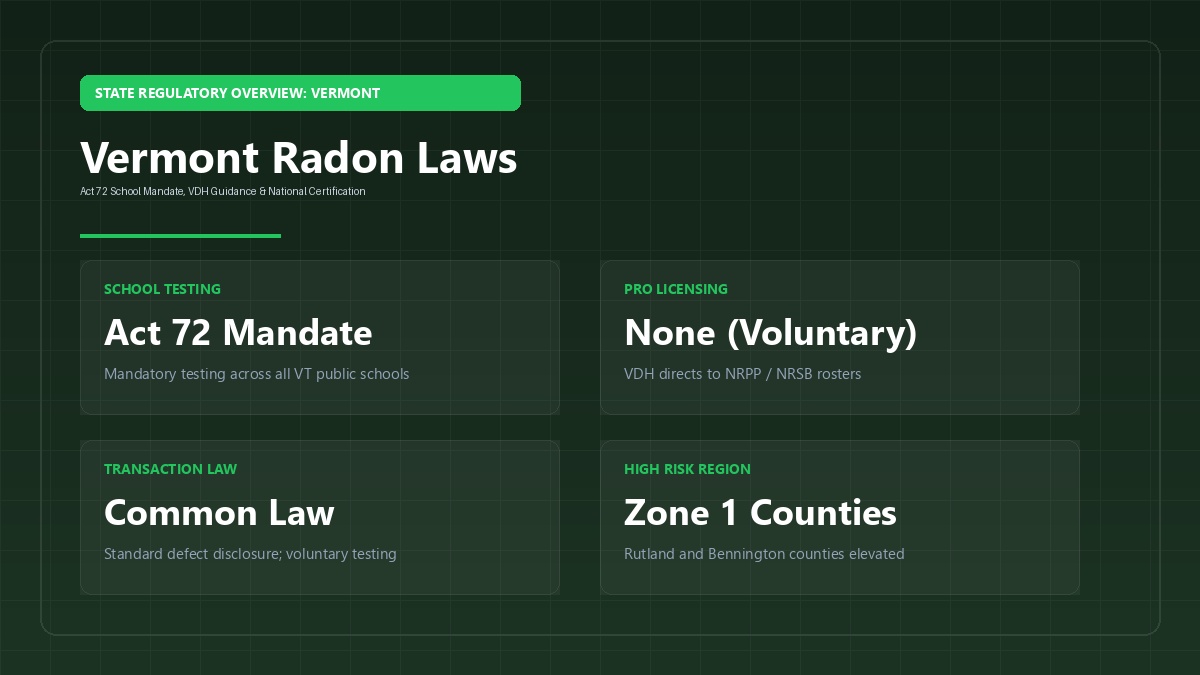
Vermont regulates radon primarily through targeted institutional testing mandates and comprehensive public health outreach, while maintaining a voluntary framework for residential transactions. Under Act 72 (passed in 2021), Vermont mandated radon testing across all public school buildings statewide. The state does not operate a direct licensing program for radon mitigators or testing contractors, relying instead on national credentialing through the NRPP and NRSB. In residential real estate, Vermont operates without a standalone statutory radon disclosure act, relying on common-law defect disclosure principles and contractual inspection contingencies.
Testing Requirements
Vermont enforces one of the most explicit public school testing statutes in New England. Under Section 12 of Vermont Act 72 (codified in Title 18), all public school supervisory unions and school districts were required to complete radon testing in all regularly occupied classrooms and educational spaces. Testing must be conducted in accordance with ANSI/AARST protocol for schools and large buildings, with elevated results requiring remediation planning. For private single-family homes and standard rental properties, radon testing remains voluntary under state law, although the Vermont Department of Health (VDH) urges all landlords and homeowners to test regularly, noting that approximately one in seven Vermont homes exceeds actionable levels.
Real-Estate Disclosure
Vermont does not have an explicit state statute mandating a standalone radon disclosure statement or forcing residential sellers to deliver pre-contract radon warning notices, per the Vermont Department of Health, verified November 2026. Real estate transactions in Vermont are guided by common-law principles governing the disclosure of known material latent defects and standard Vermont Association of Realtors (VAR) Seller’s Property Information Reports. If a seller or their real estate broker has actual knowledge of historical elevated radon test results or defective mitigation equipment, concealing that information can create common-law liability for fraudulent nondisclosure. Testing contingencies are routinely negotiated in purchase and sales agreements.
Mitigator & Tester Certification
Vermont has no state licensing requirement for radon mitigators or measurement contractors, per the Vermont Department of Health Radon Program, verified November 2026. The state maintains no state-administered licensing board or professional examination for radon contractors. Instead, the Vermont Department of Health officially advises consumers, school administrators, and property managers to hire contractors who hold active credentials from the National Radon Proficiency Program (NRPP) or the National Radon Safety Board (NRSB), and who comply with ANSI/AARST residential and large-building technical standards.
New Construction
Vermont does not enforce a statewide mandatory building code requiring passive Radon-Resistant New Construction (RRNC) in all new single-family residential dwellings. While the Vermont Residential Building Energy Standards (RBES) regulate air leakage, insulation, and ventilation efficiency, passive radon vent stacks and sub-slab membranes are not universally mandated for private single-family construction. However, the Vermont Department of Health and local environmental groups strongly advocate for voluntary passive pipe rough-ins during construction to prevent expensive retrofits later.
Radon Zones & the Action Level
According to the EPA Map of Radon Zones, Vermont presents varied geological potential across its counties. Rutland and Bennington counties in southwestern Vermont are designated as EPA Zone 1 (High Potential), where predicted average indoor screening levels exceed the national action level of 4.0 pCi/L. The remaining counties—including Chittenden (Burlington), Washington (Montpelier), and Windham—are designated as Zone 2 (Moderate Potential, 2.0 to 4.0 pCi/L) or Zone 3. VDH adopts the EPA action level of 4.0 pCi/L, while advising that homeowners consider mitigation between 2.0 and 4.0 pCi/L. For county-level geological details, visit our EPA Radon Zone Map guide.
The State’s Radon Program
The state’s official public health initiative is the Vermont Department of Health Radon Program, based within the Environmental Health Division. VDH provides technical assistance, educational toolkits for schools and child care centers, and distributes free radon test kits to Vermont residents through its online order system. Homeowners and facility operators can request a free test kit, submit samples to the Vermont Department of Health Public Health Laboratory, and obtain certified contractor guidance via the official Vermont Health Radon Program portal or by emailing radon@vermont.gov.
Sources & Limits
This regulatory guide is provided for educational and informational purposes only and does not constitute formal legal, building code, or engineering counsel. State statutes and school testing mandates are subject to legislative amendment. Property buyers, sellers, landlords, and contractors should verify current rules directly with the Vermont Department of Health or a licensed Vermont attorney.
Official Sources: Vermont Act 72 (2021) § 12; Vermont Department of Health (Environmental Health Division); U.S. Environmental Protection Agency.
To examine how Vermont’s regulatory approach compares to other states, consult our comprehensive guide to radon regulations across the United States or inspect the EPA Radon Zone Map.
Get The Signal
What we actually ran, what it measured, and what it means for a restoration shop — every week, including the flops.
Leave a Reply