The Short Answer
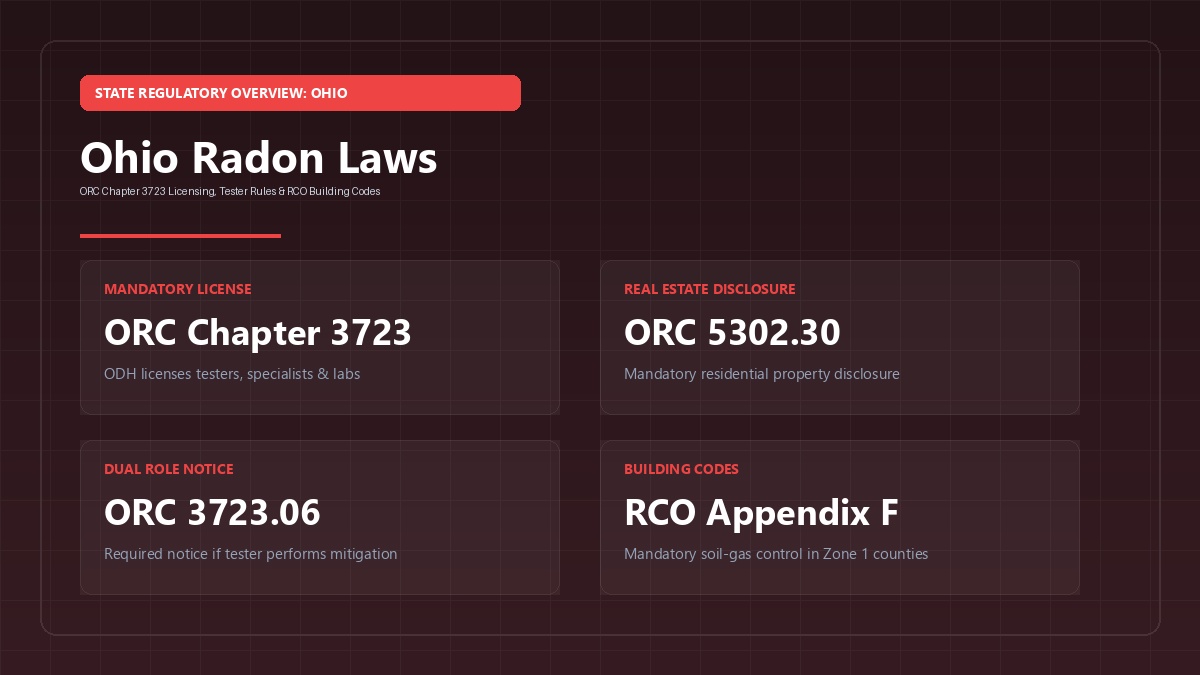
Ohio enforces a rigorous statutory framework governing radon, featuring mandatory state licensing for all commercial radon professionals and codified residential real estate disclosure. Under Ohio Revised Code (ORC) Chapter 3723, any individual or company performing radon testing, mitigation, or laboratory analysis for compensation must hold an active state license issued by the Ohio Department of Health (ODH). Residential property sellers must disclose known radon hazards under ORC § 5302.30, and contractors who conduct testing and subsequent mitigation on the same building are bound by strict dual-involvement consumer protection disclosures. Furthermore, Ohio’s residential building code mandates passive radon-resistant construction in designated high-risk counties.
Testing Requirements
Radon testing is voluntary for private single-family homeowners and residential landlords under Ohio law; the state does not compel property owners to test existing private dwellings. Similarly, Ohio statutes do not impose a universal mandatory testing requirement on public or private K-12 schools, although the Ohio Department of Health actively encourages local school districts to conduct voluntary testing using certified professionals. When testing is performed in commercial transactions or institutional facilities, it must be conducted by an ODH-licensed radon tester or specialist adhering to Ohio Administrative Code (OAC) Chapter 3701-69.
Real-Estate Disclosure
Real estate disclosure is governed under Ohio Revised Code § 5302.30 and the Ohio Department of Commerce Residential Property Disclosure Form. Sellers of residential real property (1 to 4 dwelling units) must complete and deliver the disclosure form to prospective purchasers prior to signing a binding purchase contract. Section E of the statutory form specifically requires the seller to disclose actual knowledge of environmental hazards, including radon gas, past testing reports, and the presence of any active or passive radon mitigation systems. In addition, under ORC § 3723.06, if a licensed professional provides testing or advice and subsequently contracts to perform mitigation on the same property, the mitigation agreement must include a conspicuous written disclosure warning the consumer of this dual role and highlighting the benefits of second opinions and long-term confirmation tests.
Mitigator & Tester Certification
Commercial licensing is strictly mandatory in Ohio under ORC Chapter 3723 and OAC Chapter 3701-69. It is unlawful for any person to perform radon testing, offer mitigation services, or operate a radon laboratory for compensation without an active license from the Ohio Department of Health. ODH establishes four distinct license categories: Radon Tester, Radon Mitigation Specialist, Radon Mitigation Contractor, and Radon Laboratory. Applicants must complete approved training courses, pass a national certification examination administered by the NRPP or NRSB, submit comprehensive quality assurance plans, and maintain required commercial liability insurance. Unlicensed practice constitutes a criminal misdemeanor under ORC § 3723.99.
New Construction
Radon-resistant new construction is regulated under the Residential Code of Ohio (RCO), administered by the Ohio Board of Building Standards. RCO Appendix F (Radon Control Methods) mandates passive radon control systems—including sub-slab aggregate, 6-mil polyethylene soil-gas retarders, and routed vertical PVC vent pipes—in all new residential dwellings constructed in designated EPA Zone 1 counties. Builders in Zone 1 jurisdictions must install these passive measures during initial framing, providing homeowners with a ready pathway for fan activation if post-occupancy testing reveals elevated concentrations.
Radon Zones & the Action Level
The EPA Map of Radon Zones designates Ohio with extensive EPA Zone 1 (High Potential) coverage across central, southwestern, and northeastern counties—including Franklin (Columbus), Hamilton (Cincinnati), Montgomery (Dayton), and Stark counties—where predicted average screening levels exceed 4.0 pCi/L. Remaining northwestern and southeastern counties fall within Zone 2 (Moderate Potential, 2.0 to 4.0 pCi/L). ODH adopts the national EPA action level of 4.0 pCi/L, advising immediate active mitigation for readings at or above 4.0 pCi/L and recommending mitigation consideration between 2.0 and 4.0 pCi/L. For detailed regional analysis, review our EPA Radon Zone Map guide.
The State’s Radon Program
The state regulatory and educational body is the Ohio Department of Health Radon Education and Licensing Program, operating within the Bureau of Environmental Health and Radiation Protection. The program administers professional licensing, conducts field enforcement audits, manages the public registry of licensed contractors, and coordinates public education. Ohio homeowners can order discounted test kits and verify contractor credentials through the official ODH Radon Program website or by calling the licensing bureau at 614-644-2727.
Sources & Limits
This regulatory guide is provided for educational and informational purposes only and does not constitute formal legal, architectural, or professional engineering advice. Statutory licensing requirements, real estate disclosure mandates, and building codes vary by jurisdiction and are subject to regulatory updates. Real estate buyers, sellers, landlords, and contractors should verify current rules directly with the Ohio Department of Health or legal counsel.
Official Sources: Ohio Revised Code Chapter 3723, § 5302.30; Ohio Administrative Code Chapter 3701-69; Residential Code of Ohio Appendix F; Ohio Department of Health; U.S. Environmental Protection Agency.
To evaluate how Ohio compares with other state regulatory models, consult our nationwide guide to radon regulations across the United States or review the EPA Radon Zone Map.
Get The Signal
What we actually ran, what it measured, and what it means for a restoration shop — every week, including the flops.
Leave a Reply