The Short Answer
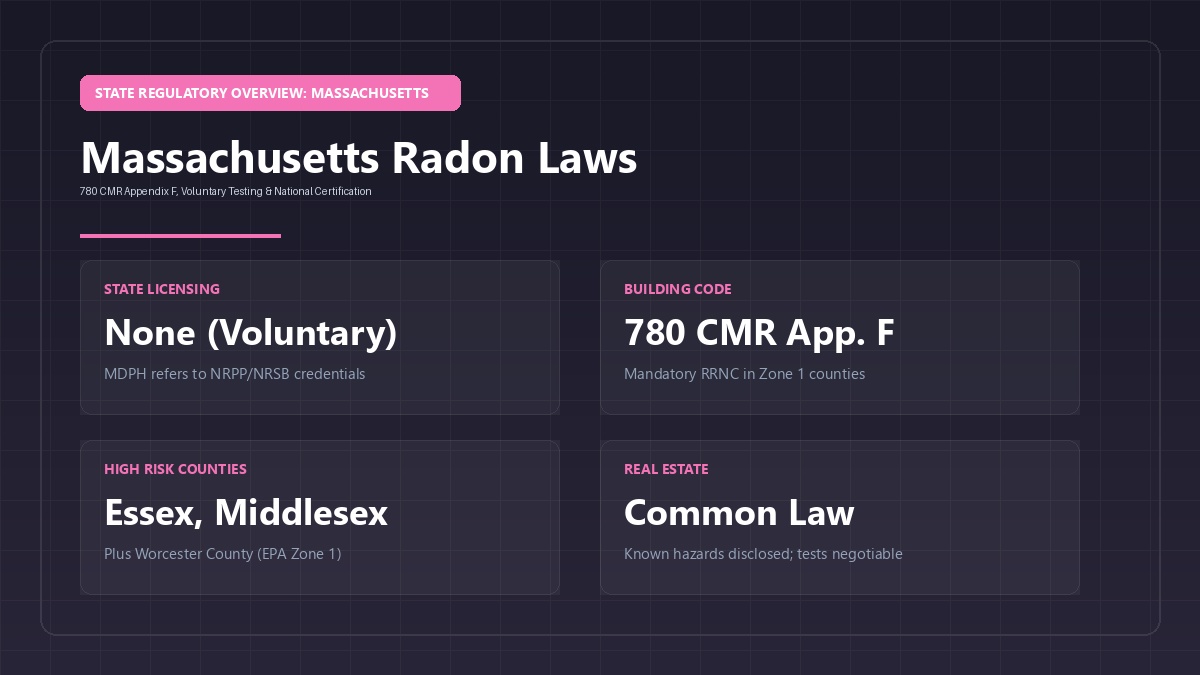
Massachusetts regulates radon primarily through targeted building code mandates in high-risk counties, while maintaining a voluntary framework for contractor licensing and private home testing. Under the Massachusetts State Building Code (780 CMR), new residential construction must incorporate passive radon-resistant features strictly in three designated EPA Zone 1 counties: Essex, Middlesex, and Worcester. Massachusetts does not maintain an independent state radon licensing board, officially pointing consumers to national NRPP and NRSB certification registries. In real estate transactions, the commonwealth relies on standard property disclosure statements and contractual home inspection contingencies rather than a standalone Radon Awareness Act.
Testing Requirements
Radon testing in Massachusetts is entirely voluntary for private homeowners, landlords, and commercial property owners. The Commonwealth of Massachusetts does not mandate routine radon testing in private residential rental properties, nor does it impose a statutory requirement for regular radon screening in public or private K-12 schools, daycare facilities, or municipal government buildings. The Massachusetts Department of Public Health (MDPH) strongly urges property owners and school administrators to test indoor spaces voluntarily, particularly during the winter heating months when soil gases accumulate indoors.
Real-Estate Disclosure
Massachusetts is historically a caveat emptor (“buyer beware”) state, modified by common law and consumer protection statutes (M.G.L. c. 93A). The commonwealth does not have a standalone radon disclosure statute. However, real estate licensees and sellers cannot engage in deceptive practices or knowingly conceal known material latent defects. Standard Massachusetts Association of Realtors (MAR) property condition disclosure statements include specific questions inquiring whether the seller has performed a radon test, possesses test reports, or has installed an operational mitigation system. Buyers routinely negotiate radon testing as part of standard home purchase inspection contingencies.
Mitigator & Tester Certification
Massachusetts has no state licensing or credentialing program for radon measurement or mitigation contractors; the commonwealth does not issue state radon licenses. Instead, the MDPH Radon Assessment Program officially recognizes and points residents to the two national credentialing bodies: the National Radon Proficiency Program (NRPP) and the National Radon Safety Board (NRSB). The state health department advises homeowners to hire only contractors who maintain active certification with one of these national organizations and hold standard Massachusetts Home Improvement Contractor (HIC) registration if performing structural modifications.
New Construction
New construction requirements are governed by the Massachusetts State Building Code (780 CMR, adopting International Residential Code Appendix F). Under 780 CMR, passive radon-resistant new construction (RRNC) techniques are mandatory strictly in Massachusetts’ three EPA Zone 1 counties: Essex, Middlesex, and Worcester. In newly built one- and two-family dwellings within these counties, builders must install sub-slab gas-permeable aggregate, a sealed vapor retarder, sealed foundation perimeters, and a dedicated 3- or 4-inch vertical vent pipe extending from beneath the slab through the roof. In Massachusetts’ remaining eleven counties, RRNC remains optional unless adopted by local municipal ordinance.
Radon Zones & the Action Level
Massachusetts encompasses all three EPA Radon Zones across its fourteen counties:
- Zone 1 (High Potential, predicted average indoor levels > 4.0 pCi/L): Essex, Middlesex, and Worcester counties.
- Zone 2 (Moderate Potential, predicted average 2.0 to 4.0 pCi/L): Berkshire, Franklin, Hampden, Hampshire, and Norfolk counties.
- Zone 3 (Low Potential, predicted average < 2.0 pCi/L): Barnstable (Cape Cod), Bristol, Dukes (Martha’s Vineyard), Nantucket, Plymouth, and Suffolk counties.
MDPH adheres to the EPA action level of 4.0 pCi/L, advising that mitigation systems be installed when test results meet or exceed 4.0 pCi/L and encouraging mitigation consideration for levels between 2.0 and 4.0 pCi/L. Explore the complete geological context on our EPA Radon Zone Map guide.
The State’s Radon Program
The state’s official program is the Massachusetts Department of Public Health (MDPH) Bureau of Climate and Environmental Health — Radon Assessment Program (mass.gov/radon-assessment-program). Massachusetts residents can contact the MDPH Radon Hotline at (800) 723-6681 to obtain technical guidance, purchase low-cost test kits through state-contracted laboratories, and verify certified national contractor rosters.
Sources & Limits
This regulatory guide is provided for educational and informational purposes only and does not constitute formal legal, architectural, or public health advice. Regulatory requirements are subject to revision by the Massachusetts Board of Building Regulations and Standards and the Department of Public Health. Always confirm current rules with local building officials and official state sources.
Primary Official Sources: Massachusetts Department of Public Health (MDPH) Radon Assessment Program; Massachusetts State Building Code (780 CMR Appendix F); U.S. Environmental Protection Agency (Map of Radon Zones for Massachusetts).
Return to our national guide on Radon Regulations in the United States or inspect national county risk rankings on the EPA Radon Zone Map.
Get The Signal
What we actually ran, what it measured, and what it means for a restoration shop — every week, including the flops.
Leave a Reply