Owner Dependency Audit
$99
Delivered by email after checkout.
Secure checkout via Square — all major cards accepted
You can copy this method and do it yourself. Rate nine areas. Map who decides what. Write what breaks if you vanish for 30 days. Buy Now is the packaged Notion page you duplicate each quarter, so you are not rebuilding the audit from a blank doc.
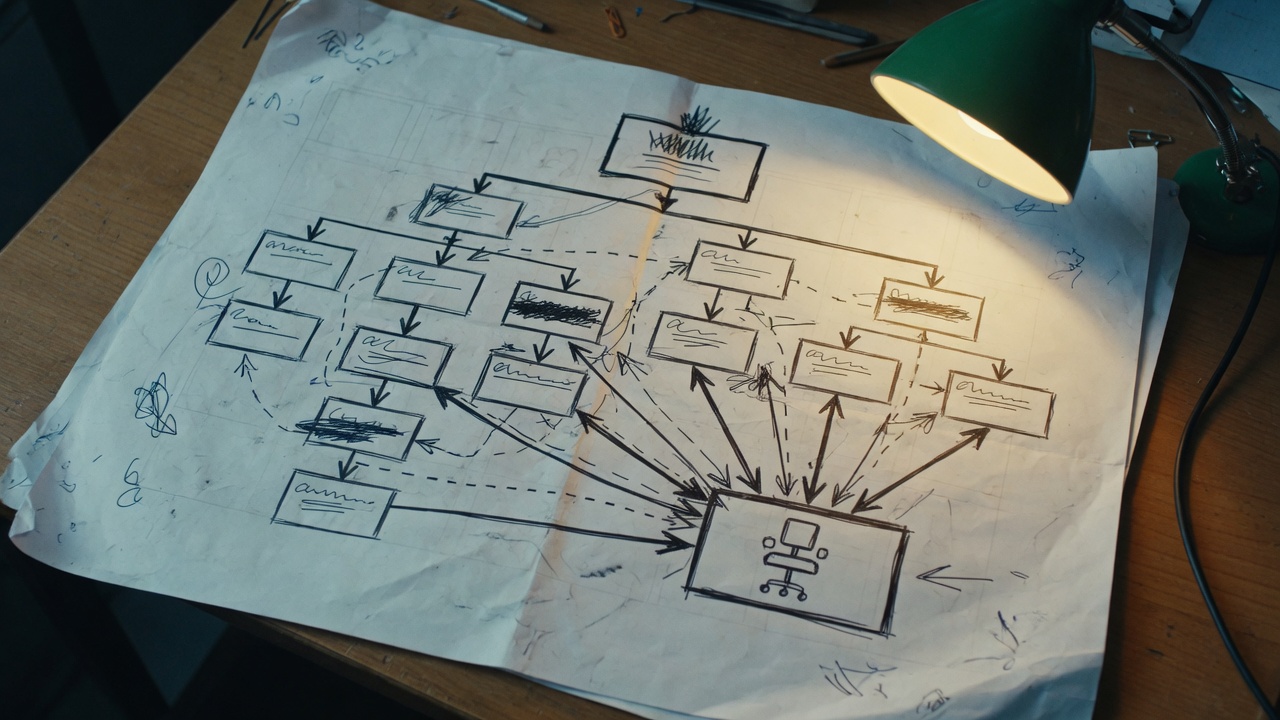
Tool #7 of the Restoration Leadership Toolkit. A deeper diagnostic of where you, the owner, are still embedded. The whole thing answers one question: if you disappeared for 30 days, what breaks first?
How to run it
- Work top to bottom. For each of the nine areas, pick a dependency level, write the honest answer to “what happens if I’m gone 30 days?”, and name the backup.
- Fill the Decision-Rights Map. Who decides today vs who should.
- Total your score. Write your first move.
- Re-run it quarterly. The goal is High → Med → Low over time.
Scoring key. Low = 1 (runs without you; a real backup exists and has done it). Med = 2 (limps along; backup needs you on call). High = 3 (stops cold, or only you can do it). Lower total = more freedom. Range is 9-27.
The nine areas
For each one, write four lines: dependency level (Low / Med / High); what happens if you are unavailable for 30 days; who is the backup today; what would have to be true for this to be Low.
1. Sales
Bidding, closing, key referral and adjuster relationships, the “yes” on big jobs.
2. Production
Crews, scheduling, job execution, quality on site, getting work out the door.
3. Finance
Cash flow, payroll, AR/AP, banking, payment approvals, signing checks.
4. Customer-issue resolution
The escalation call, the unhappy homeowner, the complaint only you can calm.
5. Hiring
Recruiting, interviewing, the final hire/fire call, who joins the crew.
6. Vendor relationships
Suppliers, subs, equipment rental, the accounts and the goodwill in your name.
7. Estimating / Project management
Scoping, writing estimates, Xactimate, change orders, running the job file.
8. Emergency response
After-hours calls, the 2 a.m. water loss, first-on-scene, the dispatch decision.
9. Decision rights
Who is actually allowed to decide and spend without calling you first.
Decision-Rights Map
The heart of the audit. List the decisions that actually move money, risk, or people. Be honest about who decides them today, then who should, so the gap becomes the delegation plan. Starter rows:
- Approve a job estimate over $25k
- Authorize overtime / call-in crew
- Issue a refund or credit to a customer
- Hire or fire a crew member
- Approve a vendor / sub payment
- Take on an out-of-area or unusual job
- Sign a contract or insurance scope
- Pull a crew off one job for another
- Spend on new equipment
- Set or discount a price
Add your own. For each: who decides today, who should decide.
Overall Dependency Score
Score each of the nine (Low = 1, Med = 2, High = 3) and total them.
- 9-13 Leader. The business runs without you. Use the freedom to grow it or build the next person. Protect this. Do not drift back into the work.
- 14-19 Coachable bottleneck. A few areas still need you. Pick your two highest-scoring areas and build a real backup this quarter.
- 20-27 You are the business. If you disappeared, it stops. Fragile and unsellable. Start with the single area that breaks first and delegate one decision this week.
The 30-Day Disappear Test

Write these five lines:
- What breaks first (the #1 single point of failure)
- Why it breaks (what only you do here)
- The one person who would have to step up
- The first thing I will delegate or document this week
- Date I will re-run this audit
The number does not matter as much as the trend. An owner who moves from 24 to 16 over two quarters has built a real company. One who stays at 24 has bought themselves a demanding job. Work the highest-scoring area first. Give one decision away at a time. Make sure every backup has actually done the task, not just been named.
What to do with the result
- Circle the two or three highest scores. Those are this quarter’s targets.
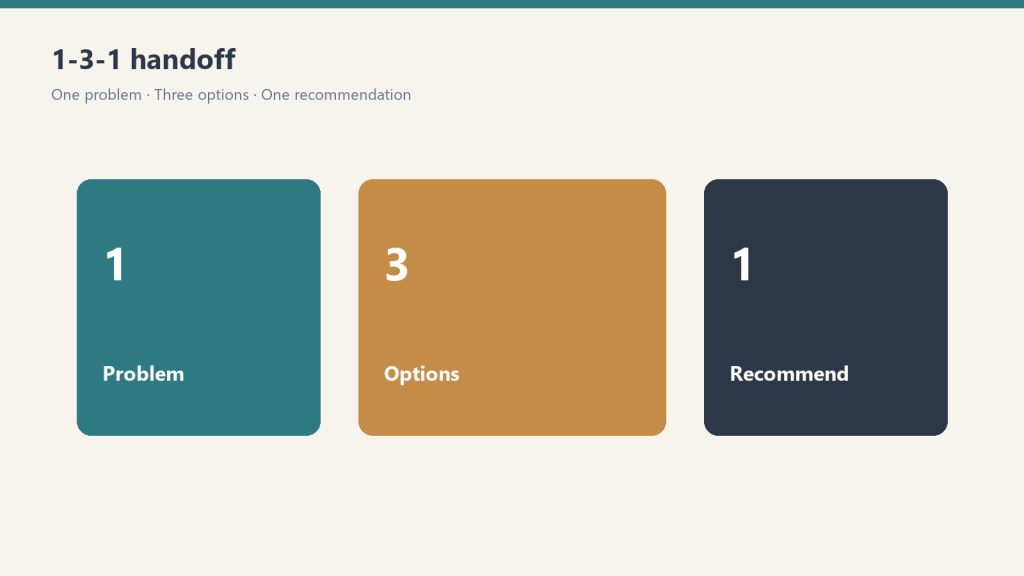
- For each, write the 1-3-1 handoff: one outcome you want, three rules or boundaries, one check-in cadence. Then hand it off.
- Put the named backups on a bench list: role, current owner, candidate, skill gaps, one 90-day development action they can be observed doing, and a weekly or biweekly 1-on-1.
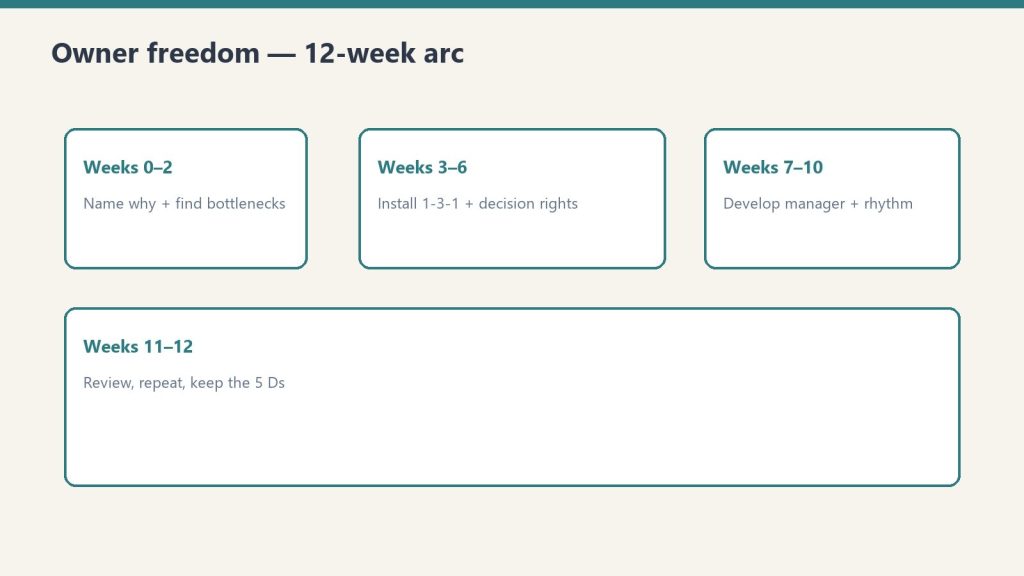
- If you want the full step-back, run a 12-week doer-to-leader plan on those same three bottlenecks. This audit is Weeks 1-2 of that plan.
A prompt you can give your own Claude if you want it walked: “Walk me through an owner-dependency audit. Ask me what only I can do across sales, scheduling, quality, money, relationships. Then rank each by risk, and give the delegation or documentation move for the top 3, including what I must accept will be done 80% as well.”
If you want the packaged audit
You can run the nine areas on a legal pad. Buy Now is the Notion page delivered by email after checkout. Duplicate it (··· → Duplicate) so the original stays clean for next quarter. The nine sections, the Decision-Rights Map, the score table, and the 30-day test are already laid out. Same Square button at the top of this page.
Pairs with the Restoration Leadership Bench Builder to develop the backups you just named, and the 90-Day Doer-to-Leader Transition Plan to step back on a schedule. Coaching and operational tool only. Not legal or HR advice.
Related on Tygart Media: owner freedom kit · leadership readiness kit · profit leak scorecard.
Leave a Reply