An Argument With No Winner
Open any marketing subreddit, LinkedIn thread, or industry conference agenda right now and you’ll find the same debate: SEO vs GEO vs AEO. Search Engine Optimization vs Generative Engine Optimization vs Answer Engine Optimization. Which framework should guide your content strategy? Which one is “the future”?
I’ve been watching this debate for months while sitting on a dataset that makes the entire argument irrelevant. The data comes from Bing Webmaster Tools AI Performance tab — 98,800 Microsoft Copilot citations across 576 grounding queries from a single domain. And what it shows is that the SEO/GEO/AEO framework is the wrong level of abstraction.
The right question isn’t “which optimization approach wins.” It’s “which AI platform are you optimizing for, and what does its specific user base need?”
Why the Old Categories Are Collapsing
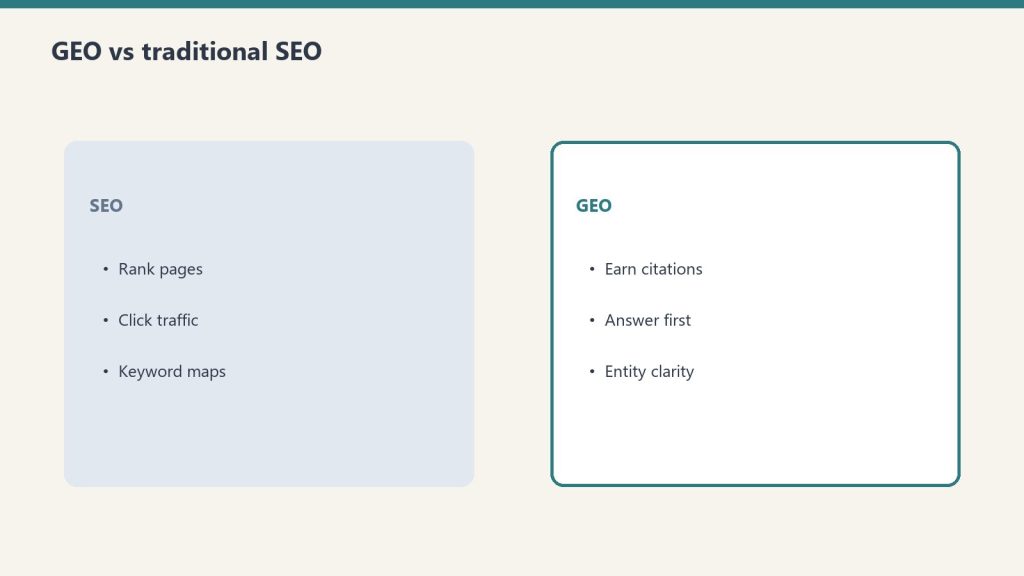
SEO was built for Google. It assumes a user types keywords, receives a ranked list of links, and clicks through to a website. The metrics are rankings, clicks, and conversions. This model still works for Google — but Google is no longer the only discovery engine that matters.
GEO emerged to address generative AI — the idea that your content needs to be optimized so that AI engines cite and reference it. But GEO treats “AI” as a single category. It assumes what works for ChatGPT also works for Copilot, Perplexity, Gemini, and Claude. My data says that’s wrong.
AEO focuses on structuring content for direct answers — featured snippets, People Also Ask boxes, voice search. It’s a useful tactical framework, but it was designed for Google’s answer features, not for AI platforms that consume and reprocess content in fundamentally different ways.
Each of these frameworks captures part of the picture. None captures the whole thing. And the gap between them is where the actual opportunity lives.
The Data That Breaks the Framework
Here’s what 98,800 Copilot citations taught me about why the SEO/GEO/AEO categories don’t hold:
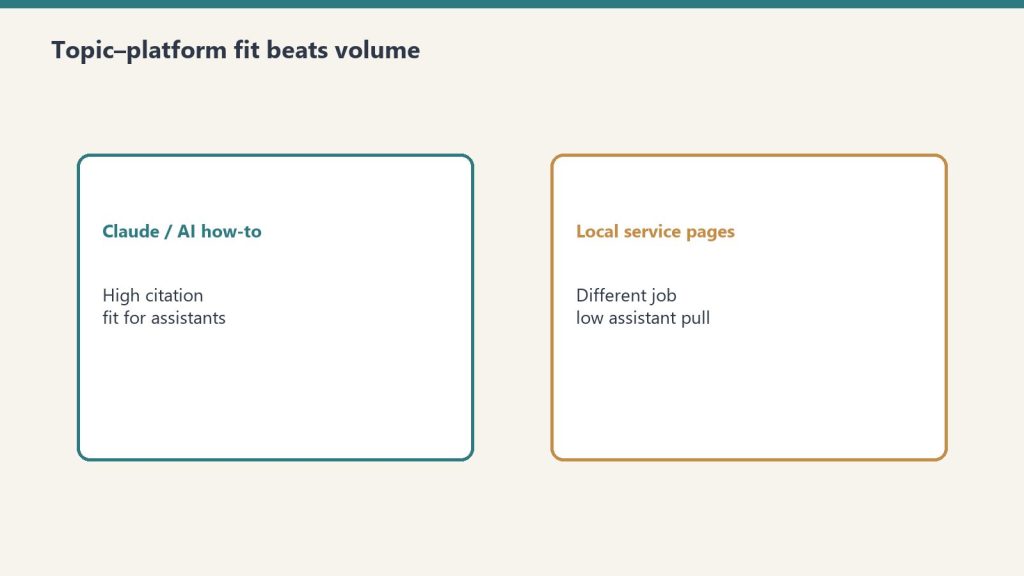
Topic-platform mismatch is real. My AI tool content generates thousands of daily Copilot citations. My local business content — which has strong Google SEO performance — generates zero Copilot citations. GEO theory says optimized content should perform across AI engines. Reality says the topic has to match the platform’s user base.
Content format preferences differ by platform. Copilot rewards structured reference content — pricing tables, comparison matrices, specific data points. ChatGPT rewards depth and original analysis. Perplexity rewards definitive, primary-source authority. AEO’s “structure for direct answers” advice is too generic to capture these distinctions.
User intent varies by context. A Copilot user asking about Claude AI pricing is in the middle of a work task — they need a number, now. A ChatGPT user asking the same question might be evaluating whether to adopt Claude at all — they want context, comparisons, and strategic thinking. Same query, different intent, different optimal content. SEO’s keyword-intent model doesn’t account for the platform delivering the answer.
The citation flywheel is platform-specific. My daily Copilot citations grew from 672 to 5,500 over 90 days. That growth happened because Copilot developed trust in my domain for specific topic clusters. This trust-building behavior is different from how Google ranks pages, how ChatGPT selects sources, or how Perplexity curates citations. Each platform has its own authority model.
Introducing Platform-Specific AI Optimization
I’m going to name the thing that comes after the SEO/GEO/AEO debate because someone has to, and I have the data to back it up.
Platform-Specific AI Optimization (PSAO) is the practice of creating content tailored to the specific user base, intent patterns, content format preferences, and authority models of individual AI platforms.
PSAO doesn’t replace SEO, GEO, or AEO. It subsumes them. SEO becomes your Google-specific strategy. GEO becomes a shared foundation of AI-friendly content practices. AEO becomes a tactical layer that applies differently depending on which platform you’re targeting. And PSAO is the strategic framework that coordinates all of them.
Here’s how PSAO maps the landscape:
Google (SEO focus): Keyword optimization, link building, technical SEO, Core Web Vitals. Audience: searchers with transactional or informational intent. Metric: rankings, clicks, conversions.
Microsoft Copilot (PSAO-Copilot): Structured reference content, pricing tables, comparison matrices, technical documentation. Audience: enterprise workers mid-task in Microsoft 365. Metric: AI citations in Bing Webmaster Tools.
ChatGPT (PSAO-ChatGPT): Long-form thought leadership, original research, unique data, comprehensive analysis. Audience: explorers and evaluators in conversation mode. Metric: ChatGPT Search referral traffic, citation mentions.
Perplexity (PSAO-Perplexity): Definitive primary-source content, original data, authoritative positioning. Audience: users seeking curated, multi-source answers. Metric: Perplexity citation frequency.
Google AI Overviews (PSAO-AIO): Featured-snippet-ready content, concise definitions, structured FAQs. Audience: searchers receiving AI-generated summaries. Metric: AI Overview inclusion rate.
Why Nobody Else Is Talking About This
The reason PSAO doesn’t exist as a category yet is simple: nobody has the data. The tools are fragmented, the measurement is early, and the marketing industry is still in the “arguing about which single framework wins” phase.
Bing Webmaster Tools AI Performance is in beta. Most marketers don’t know it exists. Google hasn’t released comparable citation-level data for AI Overviews. ChatGPT’s citation behavior isn’t exposed through any analytics dashboard. Perplexity doesn’t offer a webmaster console at all.
The data infrastructure is nascent. But the underlying behavior — AI platforms consuming and citing web content at massive scale with platform-specific patterns — is already happening. The 98,800 citations on my domain aren’t theoretical. They’re measured, daily, query-by-query.
The marketers who wait for a polished SaaS dashboard to tell them about platform-specific AI optimization will be years behind the ones who start measuring now with the crude tools available.
What PSAO Strategy Looks Like in Practice
On my own sites, PSAO looks like this:
Morning content (Copilot hours): I publish detailed AI tool guides, pricing comparisons, and integration documentation. This content is structured for extraction — clean tables, specific numbers, version-stamped details. It serves enterprise Copilot users who are working in Office and need reference data.
Evergreen content (Google hours): I publish local business guides, community resources, and civic information. This content is optimized for traditional SEO — keywords, headings, FAQ schema, internal links. It serves Google searchers looking for local information.
Weekend content (ChatGPT depth): I publish thought leadership, original analysis, and data-driven arguments like this article. This content is optimized for depth and originality — the kind of content ChatGPT’s grounding algorithm favors when users are exploring a topic.
Same domain. Three different content strategies. Three different audiences. Three different measurement frameworks. That’s PSAO.
The Category Is Open
Right now, there’s no Google Trends data for “Platform-Specific AI Optimization.” No conference tracks. No SaaS tools. No Gartner quadrant. The category is open because the phenomenon it describes has only become measurable in the last few months.
I’m staking my position: the SEO vs GEO vs AEO debate is a transitional phase. Within 18 months, the marketers who matter will be talking about platform-specific optimization because the data will force them to. Different platforms, different audiences, different content, different metrics. That’s the future.
And I’m publishing the playbook as I build it.
Related on Tygart Media: GEO tactics · Google vs Copilot audiences · citation monitoring.
Frequently Asked Questions
Does PSAO replace SEO?
No. PSAO subsumes SEO by treating it as your Google-specific optimization strategy. SEO remains essential for organic search traffic. PSAO adds parallel strategies for Copilot, ChatGPT, Perplexity, and other AI platforms — each tailored to the platform’s specific audience and behavior.
How is PSAO different from GEO?
GEO treats all AI engines as a single audience and applies general optimization principles — entity enrichment, structured data, authoritative sourcing. PSAO recognizes that each AI platform has a different user base, different intent patterns, and different content preferences. GEO is a foundation. PSAO is the targeting layer built on top of it.
Where can I measure AI citations right now?
Bing Webmaster Tools AI Performance tab shows Copilot citation data, including total citations, grounding queries, and daily trends. ChatGPT citations can be partially tracked through referral traffic analytics. Perplexity and Claude currently lack webmaster-facing citation analytics, requiring manual testing.
What topics perform best on Copilot vs Google?
Copilot users are enterprise workers mid-task, so technology tools, pricing comparisons, integration guides, and business strategy content earn the most citations. Google serves a broader audience including local searches, shopping intent, and general information queries. The overlap exists, but the highest-performing content for each platform is distinct.
When will the industry adopt PSAO?
The adoption curve depends on measurement tools. As Bing Webmaster Tools, Google Search Console, and potential new platforms expose AI citation data, marketers will be forced to segment their optimization by platform. Based on current data trends, platform-specific optimization will likely become standard practice within 12-18 months for advanced content operations.
Leave a Reply