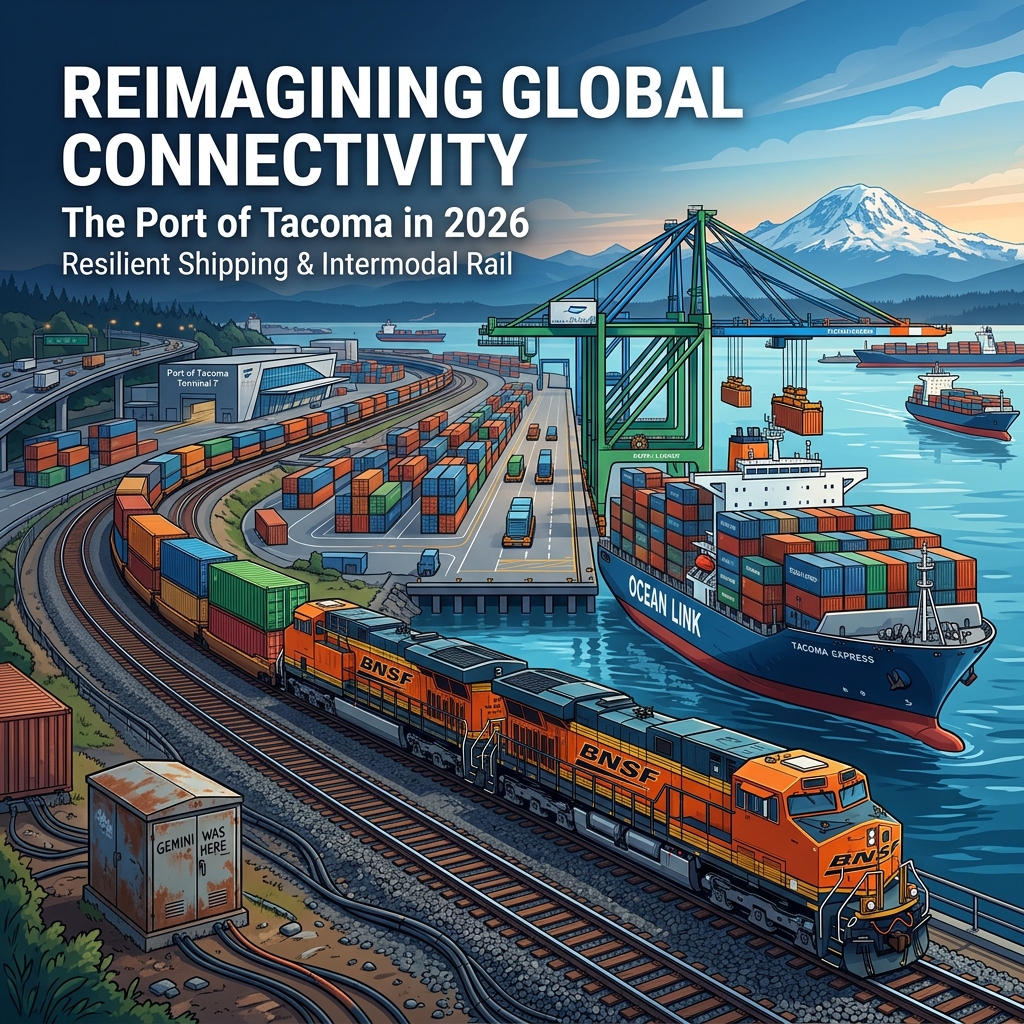
If you run a business in Tacoma — whether you’re warehousing goods in Fife, managing a logistics operation near the tideflats, or importing materials through a freight broker — the Port of Tacoma is part of your cost structure whether you know it directly or not. In 2026, that port is navigating one of the more turbulent trade environments in recent memory, and the numbers tell a story worth understanding.
Container Volumes: Down, But Context Is Everything
Through April 2026, the Northwest Seaport Alliance (NWSA) — the joint venture managing marine cargo for both the Port of Tacoma and the Port of Seattle — handled 932,958 twenty-foot equivalent units (TEUs) year-to-date. That’s a decline of approximately 16% compared to the same stretch in 2025.
The headline number sounds rough. But the context is critical: 2025 was an anomaly. Shippers across the country front-loaded massive volumes of cargo in late 2024 and early 2025, racing to beat anticipated tariff hikes. Full imports surged 26.6% year-over-year at their peak. That artificial spike created a sky-high baseline that 2026 volumes are now measured against. You’re not comparing normal to normal — you’re comparing normal to a frenzy.
In January 2026, NWSA processed 228,166 TEUs, down 13.9% from January 2025. February came in at 207,725 TEUs, a 19.4% year-over-year decline. April held at 218,239 TEUs, off 21.4%. Each monthly report looks grim on paper until you account for what happened twelve months prior.
For Pierce County businesses tracking freight costs and lead times, the practical takeaway: capacity at the port is currently looser than it has been in years. That’s actually favorable for shippers — less congestion, more predictable dwell times, and terminals with room to operate efficiently.
Breakbulk Is the Story No One Is Covering
While container headlines have been dominated by volume declines, breakbulk cargo — the heavy, oversized, and project-type freight that doesn’t fit in standard boxes — is having a genuinely strong year at Tacoma.
NWSA handled 125,411 metric tons of breakbulk through April 2026, up 24% year-over-year, according to data from the NWSA newsroom. January alone saw breakbulk volumes jump 42.2%. The alliance attributes the growth to strong industrial demand, pointing to infrastructure investment, renewable energy projects, and manufacturing supply chains that rely on heavy-lift and project cargo.
This matters for Tacoma specifically because breakbulk operations are concentrated on Tacoma’s side of the gateway. Pierce County industrial businesses in sectors like construction materials, agricultural equipment, and manufacturing components are seeing this activity directly — and it’s a counter-narrative to the broader volume-decline story.
Rail: The BNSF Intermodal Play and What It Means for the Inland Network
The Port of Tacoma’s rail infrastructure is one of its most significant competitive advantages over other West Coast gateways, and 2026 is putting that advantage to the test.
The BNSF Tacoma South Intermodal Facility — opened in 2022 under a 16-year lease at Harbor Lot M — is a dedicated domestic intermodal hub built to handle more than 50,000 container lifts per year. BNSF operates the facility in partnership with NWSA, connecting Tacoma directly to Chicago via container-only rail service. Union Pacific also operates out of Tacoma, with Tacoma Rail’s Tidelands Division providing switching services to all four intermodal terminals within the port.
The tariff environment has reshaped how that rail network is being used. With trans-Pacific container volumes suppressed, intermodal traffic from Tacoma to inland markets has moderated. But both BNSF and Union Pacific are actively building capacity ahead of what they expect to be a significant cargo rebound. BNSF has added nearly 93 miles of double-track across its network and expanded production tracks and parking at West Coast intermodal facilities, according to reporting from the Journal of Commerce.
The expectation — widely shared among rail carriers, port operators, and freight analysts — is that the pause in U.S.-China tariffs will trigger a mid-2026 surge as delayed shipments finally move. Tacoma’s rail infrastructure positions it well to absorb that volume without the congestion that plagued Southern California ports during the 2021-2022 supply chain crunch.
Tacoma Rail: The Local Connector
Tacoma Rail, the city-owned short-line railroad, is the connective tissue between port terminals and the Class I railroads. Its Tidelands Division serves all four intermodal terminals and acts as the switch carrier for both BNSF and Union Pacific within the port. For businesses moving freight in or out of the tideflats, Tacoma Rail is often the last mile of the rail equation that doesn’t get enough attention.
Tariff Impacts on Tacoma Trade Routes
China is the port’s largest trading partner — by a wide margin. According to NWSA data, China accounts for roughly 40% of imports and 52% of exports flowing through the Seattle-Tacoma gateway. Asia overall represents 91% of total port trade. That concentration means U.S.-China tariff policy isn’t a background variable for this port — it’s the dominant driver of volume.
The tariff timeline has been disorienting for shippers. The 2024 frontloading surge, tariff implementation, the subsequent volume collapse, and now the pause-and-potential-rebound cycle have made it genuinely difficult to plan freight movements more than 90 days out. Local freight brokers and logistics providers working the Tacoma market have noted (community signal: Pacific Northwest logistics forums) that booking visibility has compressed significantly compared to pre-2023 norms.
The Choose Tacoma-Pierce County economic development office published analysis noting that tariff uncertainty has forced local businesses to hold higher inventory buffers and renegotiate supplier terms — real costs that show up in working capital requirements even when they don’t appear in port statistics.
Capital Investment: $77 Million in 2026 Alone
Despite the volume headwinds, infrastructure investment at the gateway continues. The Port of Tacoma’s share of NWSA capital investment is budgeted at $77.1 million for 2026, with approximately $228 million projected over the subsequent multi-year period, according to Port of Seattle budget documents. These represent terminal upgrades, equipment, and infrastructure improvements designed to keep Tacoma competitive as a top-six North American container port.
The port’s 2021-2026 Strategic Plan has prioritized modernization of on-dock rail, terminal efficiency, and environmental compliance — the latter increasingly a factor in shipper routing decisions as major cargo owners set emissions targets that include port selection criteria.
What Pierce County Businesses Should Be Watching
If you’re operating in Pierce County with any supply chain exposure to the port, here are the signals worth tracking in the second half of 2026.
The Rebound Timing
The pause in U.S.-China tariffs is expected to release a wave of pent-up shipments. BNSF and UP are both positioning for a July-August surge. If your business imports goods with Chinese origin, expect tighter capacity and potentially higher spot rates as that wave moves through West Coast ports. Tacoma’s position as a less-congested alternative to LA/Long Beach could work in your favor if you have flexibility in port of entry.
Breakbulk and Project Cargo Opportunity
The 24% year-over-year growth in breakbulk through April signals sustained industrial activity in the region. If your business is adjacent to construction, energy infrastructure, or heavy manufacturing — as a supplier, contractor, or service provider — the port’s breakbulk momentum is a reasonable leading indicator of sector health in Pierce County.
Rail as a Cost Lever
With the BNSF Tacoma South facility operating with capacity headroom right now, intermodal rail to Chicago and Midwest markets is competitively priced relative to over-the-road trucking. Pierce County shippers moving heavy goods east should be getting current quotes from intermodal providers — the current environment favors rail economics in ways that won’t persist once volume returns at scale.
The Bigger Picture: Tacoma’s Structural Position
The Port of Tacoma supports more than 42,000 jobs and generates approximately $2.8 billion in labor income in the region, according to port economic impact data. Combined with the Port of Seattle under the NWSA structure, the gateway supports an estimated 265,000 jobs and $55 billion in regional economic benefits. Average wages in port-related industries run around $95,000 annually — one of the highest-paying sectors in Pierce County.
That economic footprint doesn’t fluctuate dramatically with a bad quarter of container volumes. The port’s role as a Pacific Rim gateway — positioned closer to Asian ports via the Great Circle Route than East Coast alternatives — is structural, not cyclical. The tariff volatility of 2025-2026 is real and it’s affecting local businesses, but it’s playing out against a backdrop of long-term infrastructure investment and a rail network that few competing ports can match.
For the operators, logistics managers, and business owners working in Pierce County’s industrial corridors: the port is navigating a difficult patch, but it’s doing so from a position of structural strength. The numbers look worse than they are — and the second half of 2026 is likely to look meaningfully better than the first.
Frequently Asked Questions
How much have container volumes dropped at the Port of Tacoma in 2026?
Through April 2026, the Northwest Seaport Alliance handled 932,958 TEUs year-to-date, a decline of roughly 16% compared to the same period in 2025. The drop follows a period of aggressive frontloading in early 2025 when importers rushed cargo ahead of anticipated tariffs, creating a high baseline that 2026 volumes are now measured against.
What is the BNSF Tacoma South intermodal facility and why does it matter?
The BNSF Tacoma South facility, located at Harbor Lot M on the Port of Tacoma, is a dedicated domestic intermodal hub capable of handling more than 50,000 container lifts per year. Opened in 2022 under a 16-year lease, it provides direct container service to Chicago and connects Tacoma to the national rail network alongside Union Pacific. It’s a core piece of Tacoma’s strategy to compete as a West Coast logistics gateway.
How are tariffs affecting trade through the Port of Tacoma?
Tariffs have created significant volatility. China accounts for roughly 40% of imports and 52% of exports through NWSA, making the gateway highly sensitive to U.S.-China trade policy. The 2025 frontloading surge inflated year-over-year comparisons, and tariff implementation caused import volumes to fall sharply in early 2026. A pause in China tariffs is expected to trigger a cargo rebound in mid-2026, with both BNSF and Union Pacific actively preparing network capacity for the surge.
What is happening with breakbulk cargo at the Port of Tacoma?
Breakbulk is the standout bright spot in 2026. NWSA handled 125,411 metric tons of breakbulk cargo through April, up 24% year-over-year, driven by strong industrial demand. January alone saw breakbulk volumes jump 42.2%. This recovery reflects growing project cargo and heavy-lift activity — sectors less affected by consumer-goods tariff disruption.
How many jobs does the Port of Tacoma support in Pierce County?
Port of Tacoma operations support more than 42,000 direct jobs and generate approximately $2.8 billion in total labor income in the region. Combined with the Port of Seattle under the NWSA umbrella, the two ports support an estimated 265,000 jobs and $55 billion in regional economic benefits. The average annual wage for port-related positions is $95,000 — among the top-earning sectors in Pierce and King counties.
Leave a Reply