Tag: Paine Field

  • Inside the World’s Largest Building: What Boeing Is Actually Building at Paine Field in 2026

    Inside the World’s Largest Building: What Boeing Is Actually Building at Paine Field in 2026

    Q: What airplanes is Boeing building at the Everett factory right now?
    A: As of mid-2026, Everett assembles the KC-46 tanker, 767 commercial freighter (final orders), 777 and 777-8F freighter, and 777-9. The 737 North Line — Boeing’s first narrowbody assembly in Everett — activates midsummer 2026.

    Inside the World’s Largest Building: What Boeing Is Actually Building at Paine Field in 2026

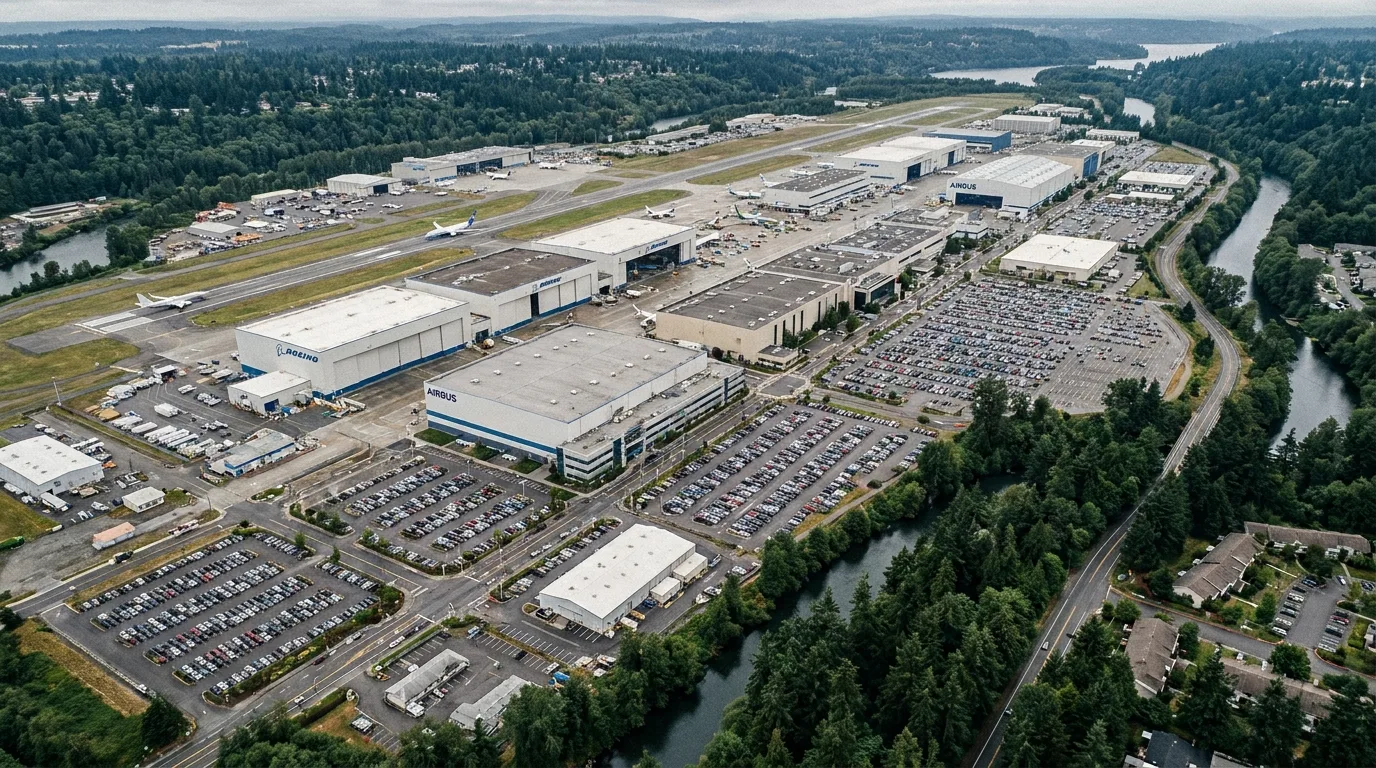
    You can see it from the 526 interchange. You can see it on final approach into Sea-Tac. You can see it — dimly, from miles away — on a clear day from downtown Everett. The Boeing factory at Paine Field is so large that it has its own weather system, its own postal address, its own internal transportation network, and a visitor attraction that hosts 800,000 people a year just to stare at its ceiling.

    It is the largest building on Earth by volume: 472 million cubic feet, 98.3 acres under one roof, built in 1967 and expanded three times since. It covers approximately the same footprint as 75 football fields. The workers inside joke that rainclouds form before they do outside.

    But what people rarely know — even Everett residents who have lived next to it for years — is what exactly is happening inside that building right now, in 2026, and why what happens there over the next 18 months will shape the region’s economy for a decade.

    How the Building Grew

    Boeing chose Everett for a specific reason in the mid-1960s: the 747. The aircraft was so large that no existing Boeing facility could accommodate it. The company needed to build not just a new airplane but a new factory from scratch, and the flat land near Paine Field offered space at a scale that made sense.

    The original main assembly building opened in 1967, covering 43 acres — designed around one airplane, with every dimension calibrated to the 747’s enormous fuselage sections and wing stubs. In 1979, Boeing expanded the factory by 45 percent to launch the 767 program. In 1990, it expanded again by 50 percent for the 777. By the early 2000s, the factory was handling three major programs simultaneously: the 747, 767, and 777.

    The 777X required yet another expansion — but a different kind. Rather than extending the main building again, Boeing built a separate 1.2-million-square-foot composite wing manufacturing facility adjacent to the main structure. Inside, industrial robots lay up carbon fiber to form the 777X’s folding wingtips, which span 235 feet unfolded — longer than the wingspan of any commercial aircraft in service today.

    Today, the entire Everett campus covers approximately 1,000 acres with up to 200 separate buildings and facilities. The main assembly building is the centerpiece. Surrounding it are engine test stands, paint facilities, seal buildings, composite fabrication shops, a training center, and the Future of Flight Aviation Center where visitors rotate through what Boeing calls the world’s largest building tour.

    The 767 and KC-46 Tanker Lines

    The 767 commercial freighter program is in its final chapter. Boeing has fewer than 40 commercial 767 orders remaining — primarily for FedEx and UPS — and the commercial line will close when those are delivered, likely by 2027. For Everett workers on the 767 line, this is a known transition, not a surprise.

    What keeps the line alive is the KC-46 Pegasus tanker. The KC-46 is the Air Force’s next-generation aerial refueling aircraft, derived from the 767 platform but built to military specifications. Boeing is on Lot 12 of a long-term contract, with the Air Force targeting a fleet of 179 aircraft against a full recapitalization requirement of 475. In 2026, Boeing is pacing toward approximately 19 KC-46 deliveries for the year — making the tanker program the most stable production line in the building. Unlike commercial programs, defense contracts are not subject to airline order cancellations or passenger demand swings.

    The 777 Family: Two Programs, Two Futures

    The 777 has been Boeing’s widebody flagship for three decades. In 2026, commercial 777 deliveries from Everett are winding down as the market transitions to the 777X generation. What makes the 777 line relevant this year is what just rolled out of the building.

    On April 23, 2026, Boeing rolled out the first 777-8F freighter from the Everett factory — the physical debut of a program that carries Boeing’s commercial freight ambitions into the 2030s. The jet, which burns approximately 30 percent less fuel per tonne than the 747-8F it replaces, is currently in pre-flight ground testing. First delivery — to Cargolux, the launch customer — is targeted for 2027.

    The 777-9 passenger variant tells a more complicated story. Boeing CEO Kelly Ortberg disclosed in April that the roughly 30 stored 777-9 jets at Paine Field require multi-year change incorporation work before they can be delivered. Some of those aircraft have been sitting in near-final configuration since 2020, waiting for certification milestones that kept getting pushed. Change incorporation — the engineering-intensive process of updating already-assembled jets to reflect certification-driven design changes — means Everett’s widebody workforce will be occupied with 777X work well into the late 2020s. Lufthansa, the launch customer, has confirmed it expects its first 777-9 in Q1 2027.

    The 737 North Line: Something That Has Never Been Here Before

    The newest addition to the building’s mission is something that has never existed here before: a 737 assembly line.

    For the entire history of 737 production — since 1967, the same year the Everett factory opened — every single 737 has been assembled at Boeing’s Renton facility, 20 miles to the south. Renton was the narrowbody campus. Everett was widebody. That division was considered permanent.

    Midsummer 2026 changes it. The North Line — Boeing’s fourth 737 MAX assembly line — is being activated in the Everett factory in space that has been reconfigured from widebody use. It will initially build the 737-8, 737-9, and 737-10 at a Low Rate Initial Production (LRIP) pace, assembling conformity aircraft that demonstrate to the FAA that processes in Everett match those in Renton. Once the FAA validates conformity under production certificate PC700, the line transitions to full production flow.

    The business case is straightforward. Boeing’s current three Renton 737 lines are approaching their practical capacity ceiling. Getting from the current rate of 42 jets per month to the target rate of 52 or more requires additional line capacity. The North Line provides that headroom — and specifically gives the 737 MAX 10, with more than 1,200 outstanding orders, a dedicated production home in Everett where it will be built exclusively.

    Boeing has been hiring 100 to 140 new Everett workers per week to prepare. The workforce is a mix of newly hired employees coming through the IAM 751 Machinists Institute training program at 8729 Airport Road and experienced teammates transferring from Renton and Moses Lake to seed the new line with institutional knowledge.

    The Scale of What’s Inside

    Standing on the factory floor provides a scale reference that no photograph delivers accurately. The 26 overhead cranes that move fuselage sections and wing assemblies operate along 39 miles of elevated track. The widest 777X fuselage section, when positioned for assembly, looks from the wrong angle like a commercial building. The building’s internal road system carries workers between production zones that are physically too far apart to walk in a reasonable time.

    On any given production day in 2026, four distinct programs are in active assembly simultaneously — the KC-46, the 777 family, the 777X, and (by late summer) the first North Line 737s. Each program has its own workforce, its own production rhythm, its own relationship with the FAA. Coordinating them under one roof requires a logistics complexity that rarely gets attention in coverage of Boeing’s delivery numbers.

    The Paine Field Community Day on June 6 will bring the public to the edge of that operation — a chance to see the flight line where these aircraft emerge, the military jets that operate alongside them, and the campus that defines Everett’s economic identity. The Future of Flight center runs daily tours of the main building year-round. It is, by any measure, worth the drive.

    The 747 that gave this building its reason for existing made its final delivery in January 2023. The building it left behind is, in 2026, more active than it has been in years.

    Frequently Asked Questions

    Why is the Boeing Everett factory the largest building in the world?

    The factory covers 98.3 acres of floor space and 472 million cubic feet of volume, making it the largest building by volume on Earth. It was built in 1967 for the 747 and expanded three times since to accommodate the 767, 777, and 777X programs.

    What airplanes are built at Boeing’s Everett factory right now?

    As of mid-2026, Everett assembles the 767 commercial freighter, the KC-46 Pegasus tanker, the 777 classic (final commercial orders), the 777-8F freighter (in pre-flight ground testing), and the 777-9 (in change incorporation ahead of 2027 deliveries). The 737 North Line begins LRIP production midsummer 2026.

    What happened to the 747 line in Everett?

    Boeing delivered the final 747 — a freighter for Atlas Air — in January 2023, ending a program that ran for more than 55 years and produced over 1,500 aircraft. The Everett space formerly used for 747 production has been repurposed for 777X and North Line programs.

    Can the public visit the Boeing Everett factory?

    Yes. The Future of Flight Aviation Center at 8415 Paine Field Blvd offers daily tours of the main assembly building and is open seven days a week. It is one of the Pacific Northwest’s most popular aviation destinations, welcoming approximately 800,000 visitors per year.

    How does the 737 North Line differ from Renton?

    The Renton facility has been Boeing’s sole 737 assembly site since the program began in 1967. The Everett North Line will be the first 737 final assembly line outside of Renton. It will initially produce the 737-8, 737-9, and 737-10 — with the MAX 10 slated for exclusive Everett production long-term — and will provide the capacity Boeing needs to reach production rates above 47 jets per month.

  • Boeing Delivered 47 Aircraft in April 2026 — Here Is What the Everett Widebody Count Actually Means

    Boeing Delivered 47 Aircraft in April 2026 — Here Is What the Everett Widebody Count Actually Means

    Boeing delivered 47 commercial aircraft in April 2026 — a number that looks modest on a spreadsheet but carries real economic weight for Everett. Every widebody that leaves Paine Field represents final assembly work completed on the factory floor, engine runs completed on the flight line, and delivery paperwork processed by the teams that handle Boeing’s customer relationships. April’s numbers confirm the Everett widebody lines are running, and they set the table for the production acceleration Boeing has staked its financial recovery on.

    According to Forecast International’s May 2026 commercial aircraft production report, Boeing’s April deliveries included 36 narrowbody 737 MAX jets plus 11 widebody aircraft — comprising six 787 Dreamliners from the South Carolina facility, three 777-series jets, and two 767s. The five Everett-built widebodies in that count — three 777s and two 767 freighters — each reflect production at the factory campus where Boeing is simultaneously standing up the fourth 737 assembly line for this summer’s North Line launch.

    What April’s Numbers Mean for Everett

    The widebody lines at Everett are the steady heartbeat underneath the louder story of 737 production ramp. While the industry’s attention tracks Boeing’s narrowbody rate — currently around 38-42 per month with a target of 47 this summer — the 777 and 767 programs at Everett have been delivering with relative consistency through 2026, providing both revenue and workforce continuity for the factory campus.

    Each 777 delivery represents one of the most complex commercial aircraft in production: a twin-aisle widebody with a list price north of $375 million, built by a workforce that includes IAM 751 machinists, SPEEA engineers, and the supply chain of Snohomish County suppliers that feed the line. Three 777s shipped in April means three aircraft worth approximately $1 billion in list-price value cleared the Everett flight line and headed to airline customers.

    The two 767 freighters represent something different: near-end-of-program deliveries for a line that has served Everett for 45 years. Boeing has confirmed the commercial 767 freighter line winds down in 2027 as FedEx and UPS work through the remaining orders. But in April 2026, those jets are still shipping — and the KC-46 tanker variant of the same airframe continues as the most stable defense production program at Paine Field, with 19 tanker deliveries targeted for full-year 2026.

    The Rate-47 Context

    April’s 36 MAX deliveries reflect a production rate in the low 40s — consistent with Boeing’s stated ramp path toward rate 47 this summer. Boeing CEO Kelly Ortberg confirmed on the April 22 Q1 2026 earnings call that the company remains on track for rate 47, with the North Line in Everett serving as the capacity bridge to rates above that threshold. The path to 53 and eventually 63 aircraft per month — a long-range production target that has emerged in industry analysis — runs directly through the Everett campus.

    Boeing’s full-year 2026 delivery target is approximately 500 737 MAX aircraft, up from 447 in 2025. At April’s pace of 36 per month, the math requires acceleration in the second half of the year — exactly the period when the North Line is expected to begin producing its first commercial-standard 737s following Low Rate Initial Production and FAA conformity sign-off.

    Boeing’s Q1 2026 free cash flow guidance of $1-3 billion for the full year depends heavily on this delivery ramp materializing. Each incremental 737 delivered in the back half of 2026 contributes to the cash inflection Ortberg has been signaling to investors since the April 22 earnings call. From Everett’s perspective, the North Line is not an abstract production-planning concept — it is the specific facility that makes the math work.

    Boeing vs. Airbus in April

    Boeing’s Q1 2026 delivery comeback — 143 jets vs. Airbus’s 114 in the same quarter, Boeing’s first quarterly win since before the MAX crisis — set an optimistic tone that April’s numbers are now tasked with sustaining. Airbus typically accelerates deliveries toward year-end, so the margin that looks comfortable in Q1 tends to narrow by Q4. Boeing needs the North Line to be contributing real volume by fall to hold the position.

    For Everett specifically, the competitive dynamic with Airbus is somewhat secondary — Everett builds widebodies and will build 737s, but it does not operate in exactly the same production-rate pressure cooker as Renton. The Everett campus’s value proposition is diversification: the widebody lines (777, 767/KC-46, 777X in development) provide a revenue base that is less dependent on the rate ramp than the narrowbody story. When analysts discuss Boeing’s production recovery, they tend to focus on the Renton rate numbers — but the Everett contribution to the delivery count, five widebodies in April alone, is what keeps the enterprise cash-flow math coherent month to month.

    The 777X Variable

    April’s delivery count does not include any 777X aircraft — because the program has not yet received FAA type certification. The certification process advanced to Phase 4A of the Type Inspection Authorization in March 2026, and GE Aerospace confirmed in April that it has identified the root cause of the GE9X mid-seal durability issue discovered in January and is ramping supplier production for the redesigned component. Both Boeing and GE maintain that the engine fix will not delay 777-9 delivery beyond the current 2027 target.

    When the 777X does enter service — with Lufthansa as the launch customer, targeting Q1 2027 — Everett’s widebody delivery count will gain its highest-value line item since the original 777 entered service in 1995. A 777-9 carries a list price north of $440 million. With approximately 520 orders on the books and an Everett-exclusive production assignment, the 777X represents the clearest long-range view of what the Paine Field campus is worth to Boeing’s enterprise.

    The Spirit AeroSystems Integration Effect

    One production-quality variable that does not show up in April’s delivery numbers but underpins them is the ongoing integration of Spirit AeroSystems, which Boeing acquired in December 2025 for approximately $4.7 billion. Spirit’s primary contribution to Boeing’s Everett lines was fuselage-adjacent work; the December acquisition brought those operations back under Boeing’s direct quality management. Since Boeing began stricter Spirit-component inspections in 2024, the defect rate for Spirit-supplied components has declined by approximately 60 percent — a quality improvement that flows directly into the smoother production cadence that April’s numbers reflect.

    Nose-to-tail quality control — Boeing’s own phrase for what direct Spirit ownership enables — is not glamorous production news. But for the Everett workforce that catches and corrects defects before an aircraft leaves the factory, fewer incoming defects means fewer rework hours, higher throughput per shift, and a better safety record on the production floor.

    What to Watch in May and June

    Boeing typically reports May delivery numbers in mid-June. The figures to track for Everett’s economic health:

    • 777 deliveries — sustained at two or more per month signals healthy widebody production ahead of the 777X transition
    • 767 deliveries — remaining commercial freighter orders for FedEx and UPS are finite; each delivery is one closer to the commercial line’s 2027 closure
    • North Line activation timing — Boeing has publicly committed to midsummer 2026 for the first commercial-standard 737 off the Everett line. If LRIP and conformity aircraft complete on schedule, the first commercial deliveries from the North Line could appear in Boeing’s Q3 2026 delivery report
    • 777X certification milestones — Phase 4A natural icing testing and Phase 5 completion are the remaining gates before type certification; any FAA communication on timing will move the Everett economic calendar

    Boeing has forecast 500 737 deliveries for full-year 2026 — a number that requires the second half to deliver more than the first. The North Line teammates currently in training are the production variable that closes the gap between April’s pace and December’s target. For Everett, that is not a Wall Street story — it is a jobs story, a family-income story, and a community-stability story rolled into one production-rate number.

    Frequently Asked Questions

    How many aircraft did Boeing deliver in April 2026?

    Boeing delivered 47 commercial aircraft in April 2026, including 36 737 MAX narrowbodies and 11 widebodies — six 787s from South Carolina, three 777s from Everett, and two 767 freighters from Everett.

    How does Boeing’s April 2026 delivery count compare to Airbus?

    Boeing had outperformed Airbus in Q1 2026 (143 vs. 114 deliveries), its first quarterly win since the MAX crisis. April’s pace of 47 is consistent with the production rate Boeing needs to sustain through the second half of 2026 as the North Line ramps up.

    When will Boeing reach rate 47 on the 737?

    Boeing has targeted summer 2026 for rate 47, with the Everett North Line providing the incremental capacity above that rate toward 53 per month. CEO Kelly Ortberg confirmed the rate-47 target on the April 22, 2026 Q1 earnings call.

    What widebody jets does Boeing build in Everett?

    Boeing’s Everett factory produces the 767 (commercial freighter and KC-46 tanker), 777 (freighter and passenger variants), and the 777X (in final development, targeting 2027 service entry). The 787 Dreamliner is built in South Carolina.

    When will Boeing deliver its first 777X?

    Boeing and launch customer Lufthansa are targeting Q1 2027 for the first 777-9 delivery. The program is in FAA Type Inspection Authorization Phase 4A, and GE Aerospace is working a fix for a GE9X engine seal durability issue discovered in January 2026. Both companies say the fix will not push the delivery target past 2027.

    What happens to Everett when the 767 commercial line ends?

    The commercial 767 freighter line is expected to close in 2027 after completing orders for FedEx and UPS. The KC-46 tanker variant of the 767 airframe continues as a defense program with a strong backlog. The Everett campus is expected to transition that production capacity to 777X and, eventually, higher 737 rates through the North Line.

  • Paine Field Community Day Returns June 6 — Free Aviation Event Brings Navy Jets, ZeroAvia Hydrogen Tech, and Young Eagles Flights to Everett

    Paine Field Community Day Returns June 6 — Free Aviation Event Brings Navy Jets, ZeroAvia Hydrogen Tech, and Young Eagles Flights to Everett

    Every year, Paine Field throws open its gates to families, aviation buffs, and curious Everett neighbors who want to get closer to the aircraft that define this community — and on Saturday, June 6, 2026, the third annual Paine Field Community Day does exactly that. From 9 AM to 5 PM, the Snohomish County airport hosts a free, youth-focused aviation day featuring military jets, hydrogen-electric technology, Young Eagles flights for kids, and the kind of tarmac access most airports charge a premium for.

    For a community whose economy is inextricably linked to Boeing, Paine Field, and the 42,000 aerospace workers who call Snohomish County home, Community Day is more than an air show. It is an annual reminder of what is actually being built in the industrial corridors north of Everett — and a rare chance to bring kids, neighbors, and newcomers into direct contact with the machines and the people who make them.

    What to Expect on June 6

    Paine Field Community Day 2026 runs 9 AM to 5 PM at Paine Field Airport, 3220 100th Street SW, Everett. Admission is free. There is no on-site parking — free parking is available at 9902 24th Place West, Everett, WA 98204, with continuous shuttle service to the event throughout the day.

    The event draws attendees from across Snohomish County and beyond, offering a program that blends aerospace education, aircraft displays, and community connection in a setting most people never otherwise get to access — the working ramp of one of the most aviation-dense airports in the United States.

    Featured Aircraft: A Navy Growler, a Hydrogen HyperTruck, and Historic Warbirds

    The 2026 event lineup includes some of the most technically interesting aircraft on the Pacific Northwest aviation circuit:

    • U.S. Navy EA-18G Growler from Naval Air Station Whidbey Island — the electronic warfare version of the F/A-18 Super Hornet that defines Puget Sound skies. Getting up close to a Growler on the ramp, without the roar of an airshow flyby, is a different experience entirely.
    • ZeroAvia HyperTruck — a mobile ground testing platform used to develop systems for ZeroAvia’s 40-80 seat hydrogen-electric powertrains. ZeroAvia operates a 136,000-square-foot Propulsion Center of Excellence at Paine Field, marking its two-year anniversary at the site in April 2026. The HyperTruck is one of the clearest windows into what Paine Field’s aviation future might look like beyond the Boeing era.
    • Flying Heritage and Combat Armor Museum aircraft — the Paul Allen-founded collection in Everett brings meticulously restored World War II aircraft to Community Day each year, offering a counterweight to the cutting-edge technology on display elsewhere on the ramp.
    • Flight school and training aircraft — Paine Field hosts multiple fixed-base operators and flight schools, and Community Day gives prospective pilots a chance to sit in cockpits and talk to instructors without an enrollment pitch attached.

    Young Eagles: Free Flights for Kids Aged 8-17

    The single most popular element of Paine Field Community Day is the Young Eagles program, run by the Experimental Aircraft Association (EAA). On June 6, approximately 30 volunteer pilots and planes will fly an estimated 300 youth — ages 8 to 17 — on free introductory flights from Paine Field.

    Young Eagles registrations are expected to open soon through the Paine Field website at painefield.com. Slots fill quickly. If you have a child in the target age range and even a passing interest in aviation, register as soon as registration opens — the Young Eagles program has a documented record of sparking aerospace careers, and Snohomish County needs the next generation of that pipeline to show up.

    That workforce context matters. The Aerospace Futures Alliance has documented a projected shortage of more than 5,200 aerospace workers in Snohomish County through the end of 2026, concentrated in CNC operators, composites technicians, and quality inspectors. A free flight over Paine Field at age eleven is not a hiring solution — but it is where aerospace careers begin.

    The Paine Field Setting: Why This Airport Is Worth Understanding

    Paine Field is not a typical general-aviation airport. It is the home of the Boeing Everett Factory — the largest building by volume in the world — and the primary assembly site for the 767, 777, and 777X widebody jets. The North Line, Boeing’s new fourth 737 MAX assembly facility, is scheduled to open this summer at the same Everett campus, adding capacity for production rates above 47 aircraft per month. Alaska Airlines’ new nonstop to Portland launches from the commercial terminal on June 10 — four days after Community Day — as part of a network that now spans nine destinations.

    The Boeing Future of Flight Aviation Center, located at the Paine Field entrance, now operates seven days a week with updated exhibits including Wisk autonomous air taxi displays and a space exploration wing. Community Day visitors who want to extend the experience can book a factory tour before or after the event through the Future of Flight website.

    Aviation Technical Services (ATS), Everett’s second-largest aerospace employer with roughly 800 workers operating a 500,000-square-foot maintenance facility at the south end of Paine Field, operates quietly behind the headlines Boeing dominates. ATS is the largest MRO facility on the U.S. West Coast and serves the same airframes Boeing builds — widebodies cycling through maintenance checks between deliveries. Community Day is one of the few times the full breadth of what happens at Paine Field becomes visible in one place.

    Who Should Go

    Paine Field Community Day draws a wide crowd, but a few groups in particular should mark June 6 on the calendar:

    • Families with kids aged 8-17 — Young Eagles flights are the flagship offering and registration fills fast. Get in line when it opens.
    • Boeing and aerospace workers — Community Day shows the broader ecosystem at Paine Field. Most line workers at the factory have never stood next to a Navy Growler or a ZeroAvia HyperTruck. The event is a reminder that this airport is more than one factory, even a factory the size of 98 football fields.
    • New Everett residents — if you moved to Snohomish County recently and want to understand what the regional economy is actually built on, there is no better two-hour introduction than walking the Paine Field ramp on Community Day.
    • Prospective aerospace students — local colleges including Everett Community College and Edmonds College have aviation programs, and training pipeline representatives will be on the ground. The event functions as an informal open house for Snohomish County’s aerospace education ecosystem.

    How to Get There

    Plan ahead on transportation: no on-site parking is available. Free parking with continuous shuttle service operates from 9902 24th Place West, Everett, WA 98204. Build in extra time for shuttle waits at opening (9 AM) and closing (5 PM). The shuttle drops off at the Paine Field main entrance. Bring water and sunscreen — June in Snohomish County is mild but the ramp is open and exposed.

    For the most current event details including Young Eagles registration, confirmed aircraft, and any schedule updates, check painefield.com/198/Paine-Field-Community-Day directly. The event page is updated regularly in the weeks leading up to June 6.

    The Bigger Picture

    Paine Field Community Day exists because an airport at the center of a regional economy has an obligation to be more than a fence line people drive past on their way to work. The Snohomish County aerospace ecosystem — Boeing, ATS, ZeroAvia, the flight schools, the repair stations, the FBOs — generates tens of thousands of jobs, billions in annual economic output, and a supply chain that stretches across the Pacific Northwest. Community Day is the one afternoon a year when all of that comes down to earth, literally, and invites the neighborhood to walk up and touch it.

    The event is free. The flights are free. The parking and shuttle are free. The Alaska Airlines Portland nonstop launch four days later means this first week of June is shaping up as a genuinely significant moment for Paine Field’s community profile. Two events in four days that together tell a story about what kind of airport Paine Field is becoming: not just a Boeing factory annex, but a real regional aviation hub with a community identity of its own.

    Bring the kids. Register for Young Eagles early. And take a moment on the ramp to look up — because on June 6, the aircraft that build Everett’s economy will be close enough to touch.

    Frequently Asked Questions

    When is Paine Field Community Day 2026?

    Saturday, June 6, 2026, from 9 AM to 5 PM at Paine Field Airport, 3220 100th Street SW, Everett, Washington.

    How much does Paine Field Community Day cost?

    The event is completely free, including parking and shuttle service from the off-site lot at 9902 24th Place West, Everett.

    Can my child get a free flight at Community Day?

    Yes — the EAA Young Eagles program offers free introductory flights to youth aged 8 to 17. Registration is required and opens in advance at painefield.com. Approximately 300 flights are offered with around 30 volunteer pilot planes. Slots fill quickly.

    What aircraft will be on display at the 2026 event?

    The confirmed 2026 lineup includes a U.S. Navy EA-18G Growler from Naval Air Station Whidbey Island, the ZeroAvia HyperTruck hydrogen-electric ground test platform, and aircraft from the Flying Heritage and Combat Armor Museum, among others.

    Is there parking at Paine Field Community Day?

    There is no on-site parking. Free parking is available at 9902 24th Place West, Everett, WA 98204, with a continuous free shuttle to the event throughout the day.

    What is ZeroAvia and why is it at Paine Field?

    ZeroAvia is a hydrogen-electric aviation company that opened a 136,000-square-foot Propulsion Center of Excellence at Paine Field in April 2024. The company is developing zero-emission powertrains for 40-80 seat regional aircraft targeting a 300-mile range by end of 2026. Its HyperTruck mobile ground test platform will be on display at Community Day 2026.

    Can I tour the Boeing factory on Community Day?

    Community Day does not include a Boeing factory tour, but the Boeing Future of Flight Aviation Center operates standard tours seven days a week. You can book a factory tour separately before or after the Community Day event. The Future of Flight is at the main Paine Field entrance.

  • 39 Days to Paine Field’s Portland Nonstop: What Alaska Airlines’ June 10 Launch Means for Everett

    39 Days to Paine Field’s Portland Nonstop: What Alaska Airlines’ June 10 Launch Means for Everett

    Q: When does Alaska Airlines’ Paine Field–Portland nonstop start, and what does it mean for the Everett travel market?
    A: Alaska Airlines resumes daily nonstop service between Paine Field (PAE) and Portland International (PDX) on June 10, 2026 — exactly 39 days from today. The route is operated by Horizon Air on Embraer E175 regional jets and gives Snohomish County travelers a Sea-Tac bypass to Oregon. The launch brings Alaska’s Paine Field network to nine destinations and 13 daily departures, the most commercial activity Paine Field has seen since the terminal opened in 2019.

    The countdown is real: 39 days to Portland nonstop

    Alaska Airlines first announced the resumption of Paine Field–Portland service in late 2025. As of tonight there are 39 days until the first revenue flight on June 10, 2026, and seats have been on sale at alaskaair.com for months.

    For Everett residents and Snohomish County aerospace workers, that countdown is more than a route announcement. It is the closest thing Paine Field has had to a normal commercial-airport summer schedule since Frontier exited the market on January 5, 2026, leaving Alaska as the sole carrier serving the passenger terminal.

    Here is what’s actually happening on June 10 and why it matters for the way Everett moves.

    The route, in detail

    • Departure airport: Paine Field (PAE), Snohomish County’s commercial passenger terminal operated by Propeller Airports under a 30-year lease since 2019.
    • Arrival airport: Portland International (PDX).
    • Frequency: Daily, year-round.
    • Aircraft: Embraer E175 regional jets operated by Horizon Air under the AlaskaHorizon brand.
    • Cabin: 12 First Class seats, 16 Premium Class seats, 36 Economy seats — 64 total.
    • Booking: Available now at alaskaair.com.

    That last detail — daily, year-round — is the one most worth pausing on. The previous Alaska Paine Field–Portland service was seasonal and ultimately suspended. June 10 marks a return to a steady-state operation that Paine Field travelers can build commute and business-trip patterns around.

    Where Paine Field sits with Portland service starting

    With the Portland route active, Alaska’s Paine Field network grows to nine year-round and seasonal destinations:

    • Honolulu (HNL)
    • Las Vegas (LAS)
    • Los Angeles (LAX)
    • Orange County / John Wayne (SNA)
    • Palm Springs (PSP)
    • Phoenix (PHX)
    • Portland (PDX) — starting June 10
    • San Diego (SAN)
    • San Francisco (SFO)
    • Tucson (TUS) — starting November 19, 2026 (seasonal)

    That brings the daily departure count to 13 across the network. All flights are operated on the E175, the regional workhorse Alaska uses across its short-haul Pacific Northwest network.

    Why Portland matters more than the seat count suggests

    Sixty-four seats on a single daily turn is a small number on its own. The strategic value sits in what connects on the other end at PDX.

    Portland is one of Alaska Airlines’ larger Pacific Northwest hubs and offers single-stop access from Everett to a meaningful set of secondary markets that PAE itself does not serve nonstop. Among them: Houston, Nashville, Orlando, Dallas, Bozeman, Spokane, and Austin. For an aerospace supplier in Snohomish County trying to reach a customer in central Texas without driving to Sea-Tac, the difference between “30 minutes to PAE plus a single connection” and “the full I-5-to-Sea-Tac slog” is the difference between a same-day round trip and an overnight.

    That’s the same business-traveler logic that built Paine Field’s case for commercial service in the first place. The terminal sits roughly 25 miles north of Sea-Tac. For travelers north of the I-90/I-5 split, Sea-Tac is structurally inconvenient. PAE, by contrast, is a two-gate, 300-seat lobby with a single TSA checkpoint, parking next to the door, and a coffee shop, bar, and Beecher’s Handmade Cheese stand operated under the Propeller terminal management.

    The Frontier lesson and the Alaska bet

    Paine Field’s commercial story in early 2026 was not all up and to the right. Frontier Airlines launched at PAE in June 2025 with thrice-weekly service to Denver, Las Vegas, and Phoenix. By December the schedule had been cut to once a week. By January 5, 2026, Frontier had exited the market entirely.

    The Frontier exit and the Alaska Portland resumption are not unrelated. Alaska’s commitment to Paine Field has consistently been the floor under the terminal’s commercial viability — the carrier’s E175 network is the operational substrate the terminal depends on, and the Portland resumption signals Alaska is doubling down on PAE as a Sea-Tac-relief market rather than treating it as marginal.

    For aerospace workers, Boeing salaried staff, Naval Station Everett families, and Snohomish County residents in general, that signal is what counts. A daily PDX nonstop that Alaska treats as core network rather than experiment is what makes the terminal sustainable through the next downturn.

    Practical notes for the first weeks of service

    • TSA at PAE typically requires arriving 60–75 minutes before departure for a domestic flight. The single checkpoint is fast but not infinite.
    • Parking at the Propeller terminal is on-site and substantially cheaper per day than off-airport Sea-Tac options. Reserve in advance during the launch weeks.
    • The control tower at Paine Field is open 7 a.m. to 9 p.m. The Alaska schedule fits inside those hours, but late inbound flights from PDX can occasionally end up in the after-hours window if weather backs up the system.
    • Alaska MVP and MVP Gold elite benefits apply on Horizon-operated PAE flights. The lounge is at SEA — there is no Alaska Lounge at PAE — but the boarding-priority and bag benefits transfer.
    • Bookings beyond PDX through to the connecting markets above route as a single Alaska itinerary, with bag-through service.

    The economic frame for Snohomish County

    Paine Field’s commercial terminal is a relatively small operation by passenger count — well under a million enplanements annually in its current configuration. But its economic role in Snohomish County is disproportionate.

    For Boeing salaried employees commuting to programs at Renton and Auburn, for Naval Station Everett family travel, for the roughly 600 aerospace suppliers in the county whose engineers and account managers fly out for customer meetings, the existence of nonstop service to Pacific Northwest hubs is the difference between Paine Field functioning as an everyday business-travel airport and not. Alaska’s June 10 PDX restoration is the single largest schedule add of 2026 by destination importance — Portland is the connection that opens the rest of the country efficiently.

    Tucson on November 19 is a quieter add — a seasonal leisure route — but adds further critical mass to the schedule. Both are Alaska continuing to lean into PAE rather than pull back from it.

    Frequently Asked Questions

    When does Alaska Airlines’ Paine Field–Portland nonstop start?

    June 10, 2026. The service operates daily and year-round on Embraer E175 regional jets under the AlaskaHorizon brand.

    How many destinations will Alaska serve from Paine Field as of summer 2026?

    Nine destinations once Portland goes live on June 10, growing to ten when seasonal Tucson service starts November 19, 2026. Total daily departures across the network: 13.

    What aircraft operates the Paine Field–Portland route?

    The Embraer E175, with 12 First Class seats, 16 Premium Class seats, and 36 Economy seats — 64 total. All Alaska/Horizon flights from PAE use the E175.

    Can I connect through Portland to other cities on a single Alaska itinerary from Paine Field?

    Yes. Alaska’s network at PDX includes connections to markets including Houston, Nashville, Orlando, Dallas, Bozeman, Spokane, and Austin. Bookings through to those destinations route as a single itinerary with bag-through service.

    Why did Frontier leave Paine Field?

    Frontier launched PAE service in June 2025 and exited on January 5, 2026, after stepping the schedule down from thrice-weekly to once-weekly in December 2025. The carrier did not publicly disclose specific traffic figures behind the exit.

    Is Paine Field a good alternative to Sea-Tac for Snohomish County travelers?

    For travelers based in Everett, Mukilteo, Marysville, Mill Creek, Lynnwood, and points north, Paine Field is roughly 25 miles closer than Sea-Tac and offers a faster TSA checkpoint and less-congested parking. The Alaska-only commercial operation limits destination choice but covers the major Pacific Northwest, California, and Hawaii markets.

    Are there any new Paine Field routes coming after Portland?

    The next confirmed addition is seasonal Tucson service starting November 19, 2026. No additional routes have been publicly announced beyond Tucson.

    Deeper coverage in the Paine Field PDX Cluster:

  • Boeing’s Path to $3 Billion in Free Cash Flow Runs Straight Through Everett

    Boeing’s Path to $3 Billion in Free Cash Flow Runs Straight Through Everett

    Q: What is Boeing’s free cash flow guidance for 2026, and what does Everett have to do with it?
    A: On its April 22, 2026 first-quarter earnings call, Boeing reaffirmed full-year free cash flow guidance of $1 billion to $3 billion. CEO Kelly Ortberg told CNBC the company is on track for the upper end of that range. The math depends almost entirely on commercial airplane deliveries — and roughly half of those deliveries either originate from or pass through the Everett factory, including the 767, 777, KC-46 tanker, and (later this year) the 737 MAX from the new North Line.

    The “burn era” is ending — and Everett is where the math starts working

    Boeing’s first-quarter 2026 earnings call on April 22 didn’t deliver fireworks on the surface. Revenue rose 14% to $22.22 billion. The net loss narrowed to $7 million from $31 million a year earlier. Operating cash flow was a small negative $0.2 billion. By the standards of any other Fortune 50 company those would be unremarkable numbers.

    For Boeing they were the closest thing to a turning point investors have seen in years. CEO Kelly Ortberg told CNBC immediately after the report that he sees a path to as much as $3 billion in free cash flow this year — the upper end of Boeing’s $1 billion to $3 billion guidance — and that the company’s long “burn era,” the multi-year stretch where it consumed cash faster than it generated it, is finally nearing its end.

    If you live in Everett, that sentence isn’t an abstraction on a financial wire. It is a sentence about your neighbors.

    Why Everett is the cash-flow engine

    Free cash flow at a commercial airplane manufacturer is, more than anything else, a function of one number: deliveries. An airplane on the factory floor is working capital tied up. An airplane handed to a customer is cash in the door. Boeing delivered 143 commercial airplanes in the first quarter of 2026 — its best Q1 since 2019, and the first quarter since 2019 in which it out-delivered Airbus.

    The Everett factory, the 472-million-cubic-foot building south of Paine Field, is a meaningful share of that delivery line.

    • 767 Freighter: Built in Everett. Roughly 29 unfilled orders remain split between FedEx and UPS, on a line scheduled to wind down in 2027 as the program transitions to KC-46-only. Each delivery is high-value cargo cash.
    • KC-46 Pegasus: Also built in Everett. Boeing has guided to roughly 19 deliveries in 2026, anchored to the Pentagon’s Lot 12 and the broader 75-tanker recapitalization plan.
    • 777 family: Including ongoing 777F freighter deliveries and the upcoming 777-8F that rolled out April 23. The 777-9 is still working through certification — Lufthansa now expects its first delivery in Q1 2027 — but every 777 currently leaving Paine Field is a delivery on the books.
    • 737 MAX (coming this summer): The new North Line in Everett is scheduled to begin commercial 737 production this summer. It is the capacity bridge Boeing needs to push the 737 program from rate 42 today to rate 47 by mid-year and rate 52 next year.

    Rate 42 → 47 → 52: the production-rate ladder Everett unlocks

    On the earnings call, Ortberg confirmed that the 737 program is currently producing at 42 jets per month and will move to 47 per month by summer 2026. The further step to 52 per month — which is what gets Boeing to the upper end of free-cash-flow guidance — explicitly depends on the new Everett North Line being online and producing.

    The Renton plant in King County does not have the floor space to push 737 rates above the high 40s while also handling new-build inventory and rework. Everett does. The North Line was designed for that role: a fourth surge line capable of building all three current MAX models (737-8, 737-9, 737-10), with deeper bay capacity and a workforce trained inside Renton, then rotated north.

    This is why the North Line ramp is a financial story, not just a workforce story. Every additional 737 delivered per month is roughly $50 million of revenue and a meaningfully higher contribution to free cash flow once the program clears its accounting reach-forward losses on the MAX 7 and MAX 10 (still in certification).

    The Spirit AeroSystems integration drag

    The $1 billion to $3 billion 2026 guidance includes an explicit roughly $1 billion unfavorable free-cash-flow impact from absorbing Spirit AeroSystems. Boeing closed the Spirit acquisition in December 2025, bringing the structures supplier — and a meaningful share of 737, 767, and 777 fuselage and wing work — back in-house after a 20-year detour.

    For Everett, the Spirit integration is mostly upside in the medium term: the 767 and 777 fuselage work that comes through Spirit’s Wichita facility now gets done under Boeing’s direct production system rather than across an arms-length supplier contract. In the short term it is cash drag — Spirit was burning cash when Boeing bought it, and Boeing is now absorbing that burn while it stabilizes the operation.

    Underlying free cash flow potential, adjusted for these temporary integration items, would be in the high single billions according to management commentary on the call. That number is the real signal of where Boeing thinks the business sits today.

    What “$3 billion” means in Snohomish County

    Boeing’s free cash flow does not show up directly in Everett paychecks. But the second-order effects are what every aerospace community in the country watches for after a decade of cuts:

    • Hiring continues. Boeing has been hiring at 100 to 140 employees per week factory-wide. That pace requires positive cash flow trajectory to defend internally during budget cycles.
    • Capex stays on schedule. The North Line buildout in Everett, the 777X tooling investment, and the ZeroAvia hydrogen-electric powertrain partnership down at Paine Field’s south end all depend on Boeing not having to pull back on Washington state capital spending.
    • Supplier ecosystem stabilizes. Roughly 600 aerospace suppliers in Snohomish County depend on Boeing demand. Visibility into a $1 billion to $3 billion free cash flow year — versus another year of burn — changes those suppliers’ own hiring and capacity decisions.
    • Apprenticeship and training pipelines hold. The IAM 751 Machinists Institute, Edmonds College’s aerospace programs, the Everett Community College / Washington Aerospace Training and Research Center, and the IAM/Boeing Joint Apprenticeship Program — all of these run on the assumption that Boeing will be hiring on the other side of training.

    The risks Ortberg flagged

    The path to $3 billion is not assumed. Ortberg told analysts that hitting the upper end of guidance requires the 737 rate-47 ramp to land cleanly in the summer, the 737 MAX 7 and MAX 10 to certify on the current 2026 timeline (with deliveries starting in 2027), and the Everett North Line to come online without the kind of stumbles that have plagued Boeing program ramps for the last six years.

    Any one of those three slipping shifts the year toward the $1 billion floor instead. Two of them slipping pushes Boeing back toward break-even free cash flow and another year of conserving cash rather than reinvesting it.

    That is the framing every Snohomish County aerospace worker should be reading the quarterly results through. Not “did Boeing beat estimates?” — they did, modestly. The question is whether the production system in Everett, Renton, and now Wichita can hold the rate ramps and certification milestones that turn the 2026 plan into 2027 momentum.

    Frequently Asked Questions

    What was Boeing’s Q1 2026 free cash flow?

    Boeing reported operating cash flow of approximately negative $0.2 billion and free cash flow that was modestly negative for the quarter, in line with management expectations for a back-half-loaded year.

    What is Boeing’s full-year 2026 free cash flow guidance?

    $1 billion to $3 billion, including roughly $1 billion of unfavorable impact from the Spirit AeroSystems integration. CEO Kelly Ortberg said on April 22 the company is on track to land in the upper portion of that range.

    How does Everett affect Boeing’s free cash flow?

    The Everett factory builds the 767 Freighter, KC-46 Pegasus, 777 family, and (starting this summer) the 737 MAX on the new North Line. Each delivery converts inventory to cash, and the planned 737 production rate increase from 42 to 47 to 52 per month is dependent on the Everett North Line coming online.

    When does the new 737 North Line in Everett start producing?

    This summer. Boeing has been training teammates in Renton on 12-week rotations and rotating them to Everett. Hiring is currently running at 100 to 140 new factory hires per week company-wide, with a meaningful share routing to Everett.

    What is the 737 production rate today and where is it headed?

    Currently 42 jets per month. Boeing is targeting 47 by summer 2026 and 52 in 2027 — a step that requires the new Everett North Line to be producing at scale.

    Is Boeing still losing money?

    Boeing reported a Q1 2026 net loss of $7 million, narrowed substantially from the year-prior loss. Free cash flow guidance for the full year is positive $1 billion to $3 billion, which would mark Boeing’s first meaningfully positive cash year since the 737 MAX grounding in 2019.

    What happens if the 737 rate ramp slips?

    Free cash flow guidance moves toward the $1 billion floor instead of the $3 billion upper end. The rate-47 ramp landing cleanly this summer, plus the MAX 7 and MAX 10 certifying on schedule, are the two largest single variables in the year’s outcome.

    Deeper coverage in the Boeing FCF Cluster:

  • Meet ATS: Everett’s Second-Largest Aerospace Employer Operates the Largest MRO on the West Coast — Right Next to Boeing

    Meet ATS: Everett’s Second-Largest Aerospace Employer Operates the Largest MRO on the West Coast — Right Next to Boeing

    Quick answer: Aviation Technical Services (ATS) is Everett’s second-largest aerospace employer after Boeing, with roughly 800 people working out of a 500,000-square-foot hangar at the south end of Paine Field. The company is the largest aircraft maintenance, repair, and overhaul (MRO) operator on the U.S. West Coast — and most Everett residents drive past its hangars without realizing they hold up to 14 commercial airliners at any given time.

    Drive south on Airport Road and the building most people picture as Boeing’s territory thins out. Past the Future of Flight, past the rows of stored 777-9s, past the Paine Field commercial terminal, the south end of the airport opens onto a cluster of hangars that don’t have Boeing logos on them.

    That cluster is Aviation Technical Services — ATS — and it employs about 800 people in Everett. Inside Snohomish County’s aerospace economy, ATS is the company that everyone in the industry knows about and most outside of it doesn’t. The shorthand: ATS is the second-largest aerospace employer in Everett, behind only Boeing, and it operates the largest MRO operation on the West Coast of the United States.

    For an aerospace ecosystem that is preparing to absorb a 737 MAX 10 North Line activation in mid-summer, a 777-9 delivery ramp into 2027, and a steady KC-46 cadence underneath all of it, ATS sits in a useful place in the supplier map. It is the company that touches the airplanes after they leave the factory and need to come back for service.

    The 500,000-square-foot building most Everett residents have never been inside

    The ATS Everett airframe MRO facility runs out of a 500,000-square-foot hangar at Paine Field with bay space for up to 14 commercial airliners simultaneously. The building has the kind of scale that doesn’t read from the road — until you realize a 737 NG is roughly 130 feet long, and the building is fitting more than a dozen of them under one roof at a time.

    The hangar isn’t new. It was originally built and operated by Tramco, then sold to Goodrich, then sold to ATS in the fall of 2007. The footprint has been an MRO operation in Everett for decades, which means the institutional knowledge — the techs who have seen the same airframe come back for its third C-check, the engineers who know how the supply of certain parts behaves — runs deep.

    Adjacent to the airframe hangar, ATS also runs a 50,000-square-foot component repair facility. That’s the building where structural, hydraulic, and electrical components come off the airplanes and get repaired by technicians trained on the specific systems. The two facilities together — airframe and component — give ATS what the trade press calls a “full-service” MRO posture: an airline can ship the whole airplane to Everett and ship the parts that come off it to the same campus.

    Why MRO matters in an aerospace town

    It is easy to think about Everett’s aerospace economy as a Boeing factory and the suppliers who feed it. The factory model is the most visible part — 737 MAX 10s rolling off the North Line, 777-9s flying production tests over Puget Sound, KC-46s painted in Air Force gray, 767 freighters wearing FedEx and UPS livery.

    But MRO is the other half of the airplane lifecycle, and it generates a different kind of work for the same workforce.

    A factory builds a finished jet. An MRO operation tears one down to its frames, inspects every primary structure, replaces what’s worn, upgrades what’s been superseded, and puts the airplane back together to a standard the FAA and the airline both have to sign off on. The work is more diagnostic than assembly. The skills overlap with Boeing’s mechanic and inspector workforce, but the day-to-day rhythm is different: shorter project cycles, more airplane variety, deeper component-level work.

    For Snohomish County, that means an aerospace mechanic who trained at the Machinists Institute on Airport Road or the WATR Center has two career destinations within a half-mile of each other — Boeing on the north end of Paine Field, ATS on the south end. The same skill set ports across the airport perimeter.

    Where ATS sits in the supplier-shortage math

    The 5,200-worker aerospace shortage that the Aerospace Futures Alliance has projected through the end of 2026 isn’t just a Boeing problem. It is a Snohomish County problem, and ATS is one of the companies on the demand side of that shortage. The Everett operation has historically grown its own talent — running internal mechanic training programs because the regional pipeline cannot keep up with attrition and ramp.

    That training-from-within approach matters for the broader workforce conversation. When the Machinists Institute, Edmonds College, and WATR Center put aerospace mechanics into the labor market, those graduates have multiple landing spots in Everett: Boeing’s main bay floors, Boeing’s KC-46 line, ATS’s airframe hangar, ATS’s component repair facility, and the smaller aerospace suppliers scattered across the county.

    For workers, optionality is leverage. For the regional economy, optionality is resilience.

    The piece of the cycle Boeing doesn’t do

    Boeing builds the airplane. The airline flies it. ATS — and a small number of MRO operators like it — handles the heavy maintenance checks (C-checks, D-checks) that the airline can’t perform on its own ramp.

    That separation matters in a downturn. When a launch customer like Lufthansa pushes its first 777-9 delivery from late 2026 to first quarter 2027, that affects Boeing’s delivery cadence in Everett. It does not, on its own, materially affect ATS, because the MRO demand pipeline is fed by every airline operating an aging fleet anywhere in the world. Delta, Alaska, United, Hawaiian, Southwest, and dozens of cargo and charter operators send airplanes to Paine Field for the kind of structural and systems work that ATS specializes in.

    That means ATS sits in a different cyclical position than Boeing. When new-jet deliveries slow, MRO demand often rises — airlines run their existing fleets longer and the heavy-maintenance interval comes due. When new-jet deliveries accelerate, the older airplanes still need their inspections. The MRO floor in Everett doesn’t oscillate the way the new-build factory does.

    The Paine Field economic picture, with ATS on it

    Adding ATS to the standard Paine Field map produces a different economic story than the Boeing-only version. The picture, roughly:

    • Boeing’s commercial Everett operations — 737 North Line, 767, 777, 777X, KC-46 — drive the bulk of the aerospace payroll in the county.
    • ATS sits at the south end of Paine Field as the second-largest aerospace employer, with 800 people on a hangar floor that handles up to 14 airplanes at a time.
    • ZeroAvia’s Propulsion Center of Excellence at the south end builds the next-generation hydrogen-electric powertrains.
    • The Future of Flight Aviation Center on Paine Field Boulevard is the public-facing tourism asset.
    • The 600-plus aerospace suppliers across Snohomish County feed all of the above.

    Each piece reinforces the others. ATS draws from the same training pipeline that feeds Boeing. ZeroAvia draws from the same engineering talent base that supports SPEEA at Boeing. The Future of Flight tour walks visitors past the active production lines that make the rest of the ecosystem possible.

    The point: Paine Field is not an airport that happens to have aerospace tenants. It is an aerospace cluster that happens to have a runway running through it.

    What this means for residents

    For Everett residents, the practical takeaway is that the local aerospace economy is more diversified than the headline numbers suggest. A Boeing labor disruption does not pause the south end of the airport. A delay in a new program does not collapse the maintenance work. The school district’s projections of family-wage employment, the housing market’s tracking of dual-income aerospace households, and the city’s tax base all benefit from having multiple anchor employers operating side-by-side rather than one dominant one.

    It also means that when local aerospace coverage talks about “the Boeing economy,” that frame is incomplete. The accurate version: the aerospace economy in Snohomish County is a Boeing-led cluster that includes a major MRO operator, a hydrogen-electric propulsion company, and 600 suppliers. Each one of those plays a role in keeping the workforce and the wage profile stable.

    Frequently Asked Questions

    Who is the second-largest aerospace employer in Everett?

    Aviation Technical Services (ATS) is the second-largest aerospace employer in Everett after Boeing, with about 800 employees at its Paine Field operation.

    What does ATS do?

    ATS provides maintenance, repair, and overhaul (MRO) services for commercial airliners. The company performs heavy maintenance checks, structural repairs, component repairs, and engineering services for airlines and cargo operators across the U.S. and internationally.

    How big is the ATS Everett facility?

    The main airframe MRO hangar is 500,000 square feet with bay space for up to 14 commercial airliners. ATS also operates a 50,000-square-foot component repair facility adjacent to the main hangar.

    Where is ATS located in Everett?

    ATS operates at the south end of Paine Field, adjacent to the Boeing Everett production facility but on the opposite end of the airport from the Future of Flight Aviation Center.

    How long has ATS been at Paine Field?

    The Everett MRO facility has operated continuously since the Tramco era. Goodrich operated the building before selling it to ATS in the fall of 2007, so ATS itself has been in the building for nearly two decades.

    Is ATS the largest MRO on the West Coast?

    Yes. ATS is the largest aircraft maintenance, repair, and overhaul operator on the U.S. West Coast.

    Does ATS hire from local training programs?

    Yes. ATS has historically grown its own mechanic talent through internal training programs and hires from regional aerospace training programs including the Machinists Institute, Edmonds College, and the WATR Center.

    How does MRO demand differ from new-aircraft demand?

    MRO demand is fed by aging fleets at every airline operating worldwide and tends to be more stable cyclically than new-aircraft demand. When new deliveries slow, airlines run older fleets longer and MRO demand often rises.

  • Lufthansa Confirms 777X Delivery Slips to Q1 2027 — But Everett’s April Production Flight Is Still On

    Lufthansa Confirms 777X Delivery Slips to Q1 2027 — But Everett’s April Production Flight Is Still On

    Quick answer: Lufthansa CEO Carsten Spohr told the airline’s annual press conference that the first Boeing 777-9 will now arrive in the first quarter of 2027 — not late 2026 as previously targeted. The April 2026 production-flight milestone at Paine Field in Everett remains on track, and that flight is the keystone of the FAA certification package the program needs to clear before any 777-9 leaves the Everett ramp wearing a customer’s livery.

    The Boeing 777X timeline moved again, and this time the source isn’t Boeing — it’s the airline at the front of the line.

    At Lufthansa’s annual press conference in Frankfurt in March, CEO Carsten Spohr confirmed that the German flag carrier now expects its first 777-9 delivery in the first quarter of 2027, slipping from a previously revised late-2026 target. Boeing’s own April 22 first-quarter 2026 earnings call landed on the same destination from a different angle: the company “anticipates first delivery in 2027” and said the program “continued to make progress” on certification.

    For Everett, the Q1 2027 number isn’t a setback — it’s clarification. The factory has been building, testing, and reworking 777-9s on a runway in front of more than two hundred Boeing engineers for a long time. Now there’s a date the broader supply chain, the IAM 751 floor, and Snohomish County’s economic planners can write down with a pen instead of a pencil.

    What Spohr actually said

    Lufthansa’s annual press conference is one of the few moments in the year when a launch customer speaks publicly about a delayed program in any specificity. Spohr’s remarks confirmed three things that had been swirling in the trade press for months:

    1. Lufthansa now expects its first 777-9 in the first quarter of 2027.
    2. The April 2026 first flight of the production-conforming 777-9 — the very airframe Lufthansa will eventually take — remains on schedule.
    3. Lufthansa is comfortable with the new timing.

    That last point matters. Launch customers can put real pressure on a delayed program by speaking to the press, demanding compensation, or quietly shifting orders to alternative airframes. Spohr’s tone was the opposite — patient, fact-based, and oriented around getting the airplane right. For an Everett factory floor that has lived through three certification regimes (the original timeline, the revised 2025 target, and the 2026 path), a calm launch customer is its own form of stability.

    Why the April 2026 flight is the real news for Everett

    The headline says “delivery slip.” The factory-floor story is “first production flight, on time.”

    The 777-9 that takes off from Paine Field in April 2026 is not a flight-test airframe pulled from a hangar. It’s the airplane Lufthansa will fly. The four flight-test 777-9s that have been running the certification campaign are pre-production aircraft built before the design freeze. The airplane that flies in April is the first one built to the production standard — the same configuration every customer airframe will follow.

    That is why Boeing has put the date in writing in front of the FAA. Flight hours logged on a production-conforming 777-9 carry direct certification credit. Every test flight from April onward contributes data to the type certification package Boeing has been assembling since the program received its Phase 4A Type Inspection Authorization on March 17, 2026. The TIA cleared the FAA to begin riding along on certification flights and counting those hours toward the final approval.

    Put another way: April’s flight is the moment the program shifts from “are we going to make it” to “how fast can we accumulate the flight hours we still need.” That is a more comfortable problem than the one Boeing was solving in 2024.

    The Everett factory math through 2027

    Roughly 30 completed 777-9s sit on the Paine Field ramp today, built before the latest engineering changes were folded into the production line. Boeing CEO Kelly Ortberg called the rework on those airplanes “pretty massive activity” on the April 22 earnings call. The newer airframes — built to the current standard — will deliver first; the parked-ramp jets will be reworked over multiple years.

    That sequencing has direct workforce implications for Everett. The factory has to do two things at once for the next eighteen months:

    • Build new 777-9s and 777-8Fs to the production standard at the cadence the order book demands.
    • Cycle the stored airframes through change incorporation work that requires rework cells, parts kits, and qualified aerospace mechanics.

    Both jobs are work for IAM 751 members and SPEEA engineers in Everett. Both jobs draw on the same supplier base in Snohomish County. Both jobs feed paychecks that move through Casino Road, Hewitt Avenue, and the school district’s enrollment numbers.

    A Q1 2027 first delivery means the rework backlog isn’t a deadline pressure event the way late 2026 would have been. It becomes part of the steady-state Everett widebody operation through the end of the decade.

    Why Lufthansa specifically matters

    Lufthansa is not the only 777-9 launch customer — Emirates holds the largest order book at 35 firm 777-9s and 5 freighters — but Lufthansa is the lead-off airline because of how it has staged its widebody fleet. The German flag carrier ordered 20 777-9s in 2013, has been holding crew training slots open, has its long-haul network planned around the airplane, and has allocated ramp space at Frankfurt and Munich for the type. When Lufthansa says Q1 2027, it is moving slot allocations, simulator schedules, and crew training rotations.

    The airline’s confidence on the April 2026 production flight also matters because Lufthansa has the technical staff to evaluate the program independently. The airline’s flight operations and engineering teams have visited Everett repeatedly. If Lufthansa believed the April flight was at risk, the messaging from Frankfurt would look very different.

    What Snohomish County’s aerospace ecosystem reads from this

    For the 600-plus aerospace suppliers in Snohomish County, the Q1 2027 confirmation lands as good news. A vague “sometime in 2027” forecast doesn’t let a supplier plan capacity. A first-quarter delivery date does — it sets a firm-up window in late 2026 for the components that go on the first delivery airframe and the next handful behind it.

    The same is true for the Future of Flight Aviation Center, Mukilteo’s lodging operators, and the trade-show economy that ramps every time a new widebody enters service. A Q1 2027 first delivery means commemorative tour traffic — the European press, Lufthansa’s branded delivery ceremony, the analyst flights — concentrates in early 2027, not the end of 2026 holiday window.

    For the Edmonds College aerospace track and the Machinists Institute on Airport Road, the date confirms the workforce demand profile the schools have been planning around. The 777-9 ramp won’t compete head-to-head with the 737 North Line activation in mid-summer 2026. Instead, the two production curves stack: North Line standing up through late 2026, 777-9 deliveries beginning in early 2027, KC-46 deliveries running steady through both, and the 777-8F ramping behind the -9.

    The certification work between here and Q1 2027

    Three certification milestones still sit between Paine Field and the first Lufthansa delivery:

    • Type certification — the FAA’s formal sign-off that the 777-9 design meets all applicable airworthiness requirements. Boeing is targeting type certification before year-end 2026.
    • Production certificate amendment — the FAA’s approval of Boeing’s manufacturing system to build production 777-9s at the Everett factory. The April first flight begins building the data package the FAA needs to close this out.
    • Customer-specific delivery readiness — Lufthansa-specific configuration, livery, interior, and entry-into-service documentation. This is the step that actually transfers the airplane.

    Q1 2027 is when step three finishes. Steps one and two have to clear before that. The April production flight is the start of the data-collection sprint that makes the back end of that calendar workable.

    The bigger Everett picture

    The 777-9 program lives on the same factory floor as the 767 freighter, the KC-46 tanker, and — starting this summer — the 737 MAX 10 North Line. Each of those programs has its own cadence. The 767 commercial line sundowns in 2027. The KC-46 line is the most stable production program at Paine Field. The North Line ramps from zero to a steady cadence over twelve to eighteen months. The 777-9 transitions from build-and-store to build-and-deliver.

    For the first time in several years, all four programs have legible timelines pointing in the same direction — toward production-and-delivery cadence, not certification limbo. The Lufthansa announcement is one piece of that picture, but it’s an important one because it confirms the 777-9 is no longer the program that drags the rest down.

    Frequently Asked Questions

    When will Lufthansa receive its first 777-9?

    Lufthansa CEO Carsten Spohr confirmed in March 2026 that the airline expects its first Boeing 777-9 delivery in the first quarter of 2027. Boeing said on its April 22 earnings call that it “anticipates first delivery in 2027.”

    Is the April 2026 production flight still on schedule?

    Yes. Both Lufthansa and Boeing have confirmed the production-standard 777-9 will fly in April 2026 from Paine Field. The aircraft is the specific airframe destined for Lufthansa.

    How does this affect Everett jobs?

    The Q1 2027 timeline locks in steady widebody work in Everett through 2027. Roughly 30 stored 777-9s on the Paine Field ramp also need multi-year rework, which adds a second stream of work for IAM 751 mechanics and SPEEA engineers.

    How many 777-9s does Lufthansa have on order?

    Lufthansa ordered 20 777-9s in 2013 and has been the launch customer ever since.

    Who has the largest 777X order?

    Emirates holds the largest 777-9 order book at 35 firm aircraft, plus 5 777-8Fs.

    What is a Type Inspection Authorization?

    A Type Inspection Authorization (TIA) is the FAA milestone that allows agency pilots and engineers to ride along on certification flights and count those flight hours toward type certification. Boeing received Phase 4A TIA for the 777-9 on March 17, 2026.

    Will the 777-9 ramp affect the 737 MAX 10 North Line?

    No. The two programs run on different bays inside the Everett factory and have offset production curves. The North Line ramps through late 2026; the 777-9 begins customer deliveries in early 2027.

    What does this mean for Snohomish County’s 600 aerospace suppliers?

    A confirmed first-delivery date lets suppliers firm up component schedules for the first delivery airframe and the airframes immediately behind it, replacing a soft “sometime in 2027” forecast with a planning-grade target.

  • The Boeing 737 MAX 10 Will Be Built Exclusively in Everett — And More Than 1,200 Airline Orders Are Riding on It

    The Boeing 737 MAX 10 Will Be Built Exclusively in Everett — And More Than 1,200 Airline Orders Are Riding on It

    The Boeing 737 MAX 10 Will Be Built Exclusively in Everett — And More Than 1,200 Airline Orders Are Riding on It

    When Boeing's North Line opens at the Everett factory this summer, it will not just be another production line. It will be the only place on earth where the Boeing 737 MAX 10 gets built.

    That distinction matters more than it might seem at first. The MAX 10 is Boeing's longest and highest-capacity 737 variant. It seats up to 230 passengers in a high-density configuration, making it the narrowbody option for airlines trying to squeeze maximum economics out of a single-aisle jet. And as of the start of 2026, it has accumulated more than 1,200 firm orders — placing it among the most heavily ordered undelivered commercial aircraft in aviation history. Every single one of those aircraft will be built at Paine Field, Everett, Snohomish County.

    The certification that unlocks all of those deliveries is still pending FAA approval, expected to complete in 2026. But the production infrastructure — the line that will build the first of those 1,200-plus jets — is taking shape now. The workforce is training. The tooling is installed. The North Line is scheduled to open at low-rate initial production (LRIP) this summer.

    Why the MAX 10 Goes to Everett and Not Renton

    Boeing's existing 737 production is entirely at Renton, Washington — three parallel assembly lines producing the MAX 8, MAX 9, and other variants at the facility that has built 737s since 1967. Adding the MAX 10 at Renton would require either displacing an existing line or building additional capacity in an already constrained campus.

    Everett offered something Renton could not: space. The Boeing Everett Factory at Paine Field is the largest building in the world by volume, originally constructed for the 747 program. As widebody programs have evolved and the 747 ended production, floor space became available for new purposes. The North Line occupies that freed-up real estate.

    The MAX 10's physical size also factors in. At 143.8 feet long — 66 inches longer than the MAX 9 and requiring modified landing gear with a new semi-levered bogie to maintain ground clearance — the MAX 10 is the most dimensionally complex 737 variant to build. Routing it to a new, purpose-configured line in Everett, rather than trying to integrate it into Renton's existing flow, gives Boeing tighter control over tooling and process standardization for what is still a new configuration.

    The practical result: Everett becomes the home of the MAX 10 for the foreseeable future of the program.

    The Order Book: 1,200-Plus and What It Represents

    More than 1,200 firm orders for the MAX 10 is not an abstract number. It is the work order for Everett's North Line, measured in individual aircraft that will each require assembly, quality checks, systems installation, and delivery to an airline customer somewhere in the world.

    The customer list reads like a roll call of global aviation's largest operators. United Airlines holds 167 MAX 10s — the U.S. carrier with the largest single MAX 10 order. Ryanair, Europe's largest low-cost carrier, has 150 on order. American Airlines has committed to 115. Delta Air Lines, historically a Boeing skeptic that spent years flying Airbus A321s, placed an order for 100 MAX 10s, a significant statement of confidence in the variant and in Boeing's recovery.

    Other operators round out the book: Southwest Airlines, IndiGo, Lion Air Group, and others have positions in the queue. Each will eventually take delivery from the Paine Field line. Combined, they represent years of production — and years of economic activity in Snohomish County.

    For context: Boeing's current approved production rate for all 737 variants is 42 per month at Renton. The North Line will add capacity incrementally as it stabilizes. Boeing's next target rate — 47 jets per month across all lines — is now confirmed for 2027, not 2026, as the FAA requires demonstrated quality performance before approving any rate increase. The long-run goal remains 63 per month. The North Line is the essential bridge to those higher numbers.

    Certification First — Without It, None of This Happens

    There is an important sequence dependency here that every observer of the Everett story should understand: the MAX 10 cannot be delivered to any of those 1,200-plus customers until the FAA certifies it. That certification is expected in 2026, but it has not yet been granted.

    The MAX 10 has been in certification limbo since a 2022 Congressional deadline was not met, requiring Boeing to re-engage with the FAA on the certification pathway. The path forward involves the PC700 amendment — an agreement on what additional compliance work the MAX 10 must complete — and flight testing with conformity aircraft. Boeing has been publicly confident that 2026 certification is achievable, and the April 2026 North Line opening at LRIP is predicated on that timeline.

    The North Line opening at low-rate initial production before certification is not unusual. LRIP aircraft serve as conformity airplanes for the FAA certification process — each one built to production-standard specs and inspected to verify that the manufacturing process matches the certified design. Building those aircraft in Everett is itself part of the certification workflow, not a bypass of it.

    Once the FAA signs off on the MAX 10, deliveries can begin. The aircraft that United, Ryanair, American, and Delta have been waiting for will start flowing from Paine Field. That transition — from conformity aircraft to delivery aircraft on the same line — is the moment Everett's North Line earns its place in Boeing's permanent production footprint.

    What This Means for Everett's Economy

    The aerospace workforce in Snohomish County numbers approximately 42,000 direct employees at Boeing and its supply chain. The 5,200-worker shortage projected through end of 2026 — driven by retirement velocity, time-to-productivity at scale, and housing economics — has been one of the defining labor stories of the North Line ramp-up.

    The MAX 10's exclusive assignment to Everett locks that workforce relationship in for the program's foreseeable life. As long as Boeing is building MAX 10s — and with 1,200-plus orders representing potentially a decade-plus of production at current rates — the Paine Field facility needs the assemblers, technicians, inspectors, and engineers to build them. The IAM 751 Machinists Institute at 8729 Airport Road, the WATR Center, Everett Community College, and Edmonds College are all building training pipelines toward this specific demand.

    The supply chain picture is similarly significant. Boeing's integration of Spirit AeroSystems, completed in late 2025, brought the fuselage supplier's Wichita and other operations under Boeing's banner. Snohomish County's 600-plus aerospace supplier companies — from precision machining shops to composites fabricators — will see MAX 10 work flow into their order books as the line scales.

    The widebody story at Paine Field — the 777-9 certification path, the 777-8F freighter program, the KC-46 tanker backlog — gets most of the public attention because those programs are larger and more visually dramatic. The MAX 10 story is quieter, but in terms of sheer unit volume and long-run economic contribution to Everett, it may end up being the most consequential production decision Boeing has made about this factory in years.

    More than 1,200 airplanes. All of them built right here.

    Related reading: Boeing Rate 47 and Everett's North Line | MAX 7 and MAX 10 Certification on Track for 2026 | What Is LRIP? The FAA Conformity Process Explained

    Frequently Asked Questions

    Why will the Boeing 737 MAX 10 only be built in Everett?

    Boeing assigned the MAX 10 exclusively to the new North Line at the Everett factory at Paine Field. Everett has the available floor space freed up from the 747 program's end, and the MAX 10's longer fuselage and specialized landing gear made a dedicated production line more efficient than integrating it into Renton's existing flow.

    How many Boeing 737 MAX 10 orders are there?

    Boeing has received more than 1,200 firm orders for the 737 MAX 10. Major customers include United Airlines (167), Ryanair (150), American Airlines (115), and Delta Air Lines (100), plus Southwest, IndiGo, Lion Air Group, and others.

    When will the Boeing 737 MAX 10 be certified?

    Boeing expects FAA certification of the 737 MAX 10 in 2026. The program is proceeding through conformity aircraft and flight testing under the PC700 amendment framework. Certification must be complete before any MAX 10 can be delivered to airline customers.

    When does the Boeing North Line in Everett open?

    Boeing plans to open the North Line at midsummer 2026 at low-rate initial production (LRIP). The line will initially build conformity aircraft for the MAX 10 FAA certification process, then transition to commercial deliveries once certification is complete.

    How does the MAX 10 differ from the MAX 9?

    The 737 MAX 10 is 66 inches longer than the MAX 9, reaching 143.8 feet total length. It seats up to 230 passengers and features a semi-levered landing gear bogie design to maintain ground clearance despite the longer fuselage. It is Boeing's direct competitor to the Airbus A321neo.

  • Boeing 777-9 Simulators Just Cleared the FAA and EASA — And That Is a Bigger Deal for Everett Than It Sounds

    Boeing 777-9 Simulators Just Cleared the FAA and EASA — And That Is a Bigger Deal for Everett Than It Sounds

    Boeing 777-9 Simulators Just Cleared the FAA and EASA — And That Is a Bigger Deal for Everett Than It Sounds

    In the long story of the Boeing 777X program — a saga measured in years of delays, billions in cost overruns, and a certification path that has been anything but linear — a milestone cleared on February 19, 2026, deserves more attention than it got: the FAA and EASA jointly certified the first full-flight training simulators for the Boeing 777-9.

    That might sound like a bureaucratic checkbox. It is not. For Everett, where every one of those jets will be assembled in the world's largest building, it means the airline industry is now formally preparing to operate the widebody jet that this factory has spent years building up to deliver. Airlines cannot hire and train 777X crews without FAA-qualified simulators. The simulator certification is the moment when "getting ready" becomes "getting pilots ready." The Paine Field production line just got a very real signal that its customers are moving from theory to execution.

    What the Qualification Actually Covers

    The February 19 announcement from Boeing's mediaroom came jointly with simulator manufacturer CAE. The devices qualified include a full-flight simulator (FFS) and a flight training device (FTD), both located at the Boeing Training Campus in Gatwick, United Kingdom. Both carry Level D qualification — the highest standard the FAA issues, requiring six-degrees-of-freedom motion, full visual system fidelity, and cueing that replicates the actual aircraft within tight tolerances.

    The significance of Level D: it is the standard airlines need to conduct type rating training. Without it, pilots cannot legally qualify on a new aircraft type in revenue service. The FAA and EASA granting Level D to the 777-9 simulators simultaneously is a coordinated signal that both the primary regulators for U.S. and European carriers are aligned on the aircraft's systems representation — a meaningful statement for a program that has had to fight for every regulatory inch.

    Crucially, this qualification predates delivery. That is intentional. The lead time to train a 777-9 crew is substantial. Airlines need months of instructor qualification, line training device hours, and route-specific procedures work before the first airplane lands in the hands of a paying passenger. By certifying simulators in February 2026 — roughly a year before the currently confirmed Lufthansa delivery window of early 2027 — Boeing and the regulators built in the runway carriers need to actually be ready.

    Lufthansa Is First — And Already Installing Its Own Simulator

    Lufthansa, the 777X launch customer with 34 aircraft on order, is not waiting. Lufthansa Aviation Training, the carrier's pilot training subsidiary, has received the first Boeing 777-9 full-flight simulator delivered to an airline. As of late April 2026, that device is being assembled and installed at LAT's Frankfurt training center, with operational readiness planned for late May 2026.

    The Frankfurt simulator coming online in May matters for Everett's timeline. Lufthansa CEO Carsten Spohr confirmed in March 2026 that the carrier now expects its first 777-9 delivery in Q1 2027. That is a compressed window. For Lufthansa to take delivery and put the aircraft into revenue service, it needs trained captains and first officers before the keys are handed over. The simulator arriving in Frankfurt now, five-plus months before the delivery window, is the logistical machinery that makes a Q1 2027 entry-into-service possible rather than theoretical.

    The Paine Field assembly line where that first Lufthansa jet is being built has approximately 30 stored 777X jets awaiting rework completion, a scale disclosed on Boeing's Q1 2026 earnings call. The rework timeline — combined with the production flight campaign Boeing targeted for April 2026 — means the Everett widebody team is running multiple parallel tracks simultaneously: complete the production flight, continue the FAA certification campaign, resolve the stored-jet rework sequence, and deliver to Lufthansa before Q1 2027 expires.

    The simulator qualification removes one of the few variables that was entirely outside Boeing's control. Airlines can now train. That is one less bottleneck between this factory and the first revenue flight of a jet years in the making.

    Asia-Pacific Carriers Are Also Preparing

    Lufthansa is not the only operator in motion. CAE is installing Asia-Pacific's first Boeing 777X full-flight simulator at the Singapore-CAE Flight Training Centre, serving a cluster of early-order operators including Singapore Airlines (31 aircraft on order), Cathay Pacific (21 aircraft), ANA, and Air India. Each of those jets will roll out of the building at Paine Field.

    Every simulator coming online in Frankfurt, Singapore, or wherever else airlines establish their 777X training footprints represents a future delivery from Everett's widebody line. The February qualification set the legal foundation for all of it.

    For Boeing Everett's workforce, the broader pattern is worth understanding. The 777 program has been this factory's anchor for decades. The 777-300ER has been one of the most commercially successful widebodies in history. The 777-9, its successor, carries a combined backlog of several hundred orders. Getting it into service successfully — and on the current 2027 timeline rather than slipping again — is a defining question for whether the Everett widebody line sustains the workforce and economic weight it has carried in Snohomish County for a generation.

    The GE9X Factor

    One complication sitting alongside the simulator news: GE Aerospace, the exclusive supplier of the GE9X engine that powers the 777-9, disclosed in early 2026 that it is working on a fix for a mid-seal durability issue identified during a shop visit in January. Boeing and GE have both stated the resolution does not push 777-9 certification or delivery beyond the current 2027 timeline.

    The GE9X is the engine that makes the 777-9's efficiency case: roughly 10 percent better fuel burn than the 777-300ER, with the largest commercial fan diameter in the industry at 134 inches. A mid-seal durability issue caught during a shop visit is exactly the kind of finding a rigorous certification campaign is designed to surface. Both companies have financial and reputational reasons to be precise about its scope. But it is a real variable on the program's critical path, and Everett workers and suppliers tracking the 2027 delivery window should know it exists and is being actively worked.

    What to Watch From Here

    The sequence ahead: Boeing targeted April 2026 for the first production-standard 777-9 flight from Paine Field. That flight triggers the FAA's grant of Type Inspection Authorization (TIA) for the production-configured aircraft, allowing FAA pilots to join the cockpit for final certification flights. TIA clearance in the second half of 2026 would set up a 2027 delivery consistent with what Spohr confirmed in March.

    In the meantime, the Gatwick training campus is active, Frankfurt's simulator is being installed, and Singapore's device is being prepared. The certification machinery is in motion from multiple directions. For the 42,000-person aerospace workforce that defines Everett's economy, the trajectory matters more than any single checkpoint. The simulator qualification, unflashy as it is, is one of the clearest signals yet that Boeing and its customers are treating the 2027 timeline as real.

    Related reading: Boeing 777X Rework: 30 Stored Jets at Paine Field | Boeing 777X Clears FAA Phase 4A | What the 777-8F and KC-46 Mean for Everett's Workforce

    Frequently Asked Questions

    What is a Level D flight simulator qualification?

    Level D is the highest FAA certification for full-flight simulators. It requires six-degrees-of-freedom motion, high-fidelity visual systems, and precise replication of the aircraft's handling qualities. Airlines must use Level D simulators for type rating training — the qualification pilots need before flying a new aircraft type commercially.

    Why does the 777-9 simulator qualification matter for Everett?

    Every Boeing 777-9 is assembled at the Paine Field factory in Everett. Simulator certification allows airline customers to begin training pilots — a prerequisite for accepting deliveries. Without certified simulators, airlines cannot legally qualify crews, which would delay deliveries regardless of production progress.

    When does Lufthansa expect its first Boeing 777-9?

    Lufthansa CEO Carsten Spohr confirmed in March 2026 that the carrier expects delivery in Q1 2027. Lufthansa has 34 aircraft on order and is installing its own Level D 777-9 simulator at its Frankfurt training center, with completion expected in late May 2026.

    What is the GE9X mid-seal issue?

    GE Aerospace disclosed in early 2026 that it is developing a fix for a mid-seal durability issue found during a GE9X shop visit in January 2026. Both Boeing and GE have stated the fix does not affect the 777-9's 2027 first-delivery timeline.

    Which airlines have 777-9 orders?

    Major customers include Emirates (115 aircraft), Lufthansa (34), Singapore Airlines (31), Cathay Pacific (21), Qatar Airways, and ANA. All aircraft will be assembled at the Boeing Everett factory at Paine Field in Snohomish County.

  • What Is LRIP? The FAA Conformity Process Boeing Must Complete Before Everett’s North Line Builds Its First Commercial 737

    What Is LRIP? The FAA Conformity Process Boeing Must Complete Before Everett’s North Line Builds Its First Commercial 737

    What you need to know: Before Boeing’s North Line can build its first commercial 737 for delivery, it must complete a process called Low Rate Initial Production — a deliberately slowed startup phase where conformity airplanes are built for FAA review. Here’s what that process is, why it exists, and what it means for Everett’s aerospace economy this summer.

    Everyone in Everett knows the North Line is coming. Boeing announced it. The Herald covered it. The hiring signs went up on Airport Road. The stories about new assemblers learning their jobs in Renton have circulated through the shops and the union halls for months.

    But there’s a step between “the North Line opens” and “the North Line ships jets to airlines” that hasn’t been explained in plain terms: Low Rate Initial Production, or LRIP.

    LRIP is the phase Boeing must complete before its new Everett factory can build commercial aircraft for delivery. It’s not a delay. It’s not a setback. It’s a required feature of the FAA certification system — and understanding it helps explain why Boeing is being so deliberate about the timeline for the most significant factory expansion in Snohomish County’s aerospace history.

    What LRIP Actually Is

    Low Rate Initial Production is exactly what it sounds like: production at a reduced rate, on purpose, during the early phase of a new manufacturing line’s operation.

    When the North Line begins building 737 MAX jets this summer, it won’t immediately be producing at full speed. The line will first build what are called conformity airplanes — jets assembled specifically for FAA inspection to demonstrate that the Everett production process meets Boeing’s type certificate requirements. These are not demonstration aircraft. They’re real 737 MAXs built to production standards, but the FAA reviews them closely before approving the line to operate under Boeing’s production certificate.

    “Once the North Line begins operation, the program will complete a process known as low rate initial production,” Boeing stated in its April 2026 North Line feature. “During LRIP, the build process is intentionally slowed to provide additional checks and make any adjustments to the production system to support standard flow times in the future.”

    Jennifer Boland-Masterson, the production leader for the Everett line, offered a vivid way of thinking about it.

    “It’s like running,” she said. “We know how to do it, and we’ve done it before, but we need to warm up our muscles. You don’t start with a marathon. You start with shorter distances and build up from there.”

    The Role of PC700

    Every Boeing production facility that builds commercial jets operates under a production certificate issued by the FAA. For Boeing’s 737 program, that certificate is known as PC700. Before the North Line can legally deliver commercial aircraft to airline customers, it must be operating under PC700 — meaning the FAA has reviewed the production system and confirmed it meets the quality and safety standards required to build certificated aircraft.

    The LRIP conformity airplanes are the evidence package. They demonstrate to the FAA that the Everett line can replicate the same build process as Renton — same tooling standards, same inspection rigor, same assembly sequence, same quality outcomes. Once conformity is demonstrated to the FAA’s satisfaction, the North Line gets added to PC700 and can begin producing jets for delivery.

    “Boeing will use the first set of airplanes built on the LRIP line to demonstrate conformity to the U.S. Federal Aviation Administration,” Boeing confirmed, “allowing the North Line to operate under Boeing’s production certificate, PC700.”

    Only after PC700 coverage is established can the North Line be integrated into Boeing’s overall 737 MAX flow — adding production capacity for rates above 47 airplanes per month, the threshold beyond which Renton’s three lines are fully committed and every additional jet requires Everett’s output.

    The Wing Transport Tool: Everett’s Unique Supply Chain Link

    There’s one key difference between how Boeing builds 737s in Renton and how it will build them in Everett: the wings.

    Boeing’s 737 wing fabrication happens in Renton. Rather than build duplicate wing tooling in Everett — an enormously expensive and time-consuming investment — Boeing engineered a solution: the 737 Wing Transport Tool. This specialized fixture carries partially completed wings approximately 30 miles north from Renton to Everett, where final assembly is completed on the North Line.

    The Wing Transport Tool is a purpose-built piece of logistics infrastructure that doesn’t exist anywhere else in Boeing’s manufacturing system. It’s one of the more tangible indicators of how the North Line was engineered as a genuine extension of the Renton production system rather than a standalone factory.

    The People Making It Happen

    The North Line workforce is being built from three sources: newly hired employees, existing Renton teammates who transfer to Everett, and experienced Everett workers from the widebody programs (777, 767) who cross-train on narrowbody work.

    All of them go through Renton first.

    John V., a nearly 40-year Boeing veteran who spent most of his career on the 747, 767, and 777 programs in Everett, now serves as an FAA and customer coordinator for the North Line. It’s his first time on the 737 program — and even he is doing structured on-the-job training in Renton before his Everett assignment begins.

    “This will be my first time working on the 737 program,” John V. told Boeing’s communications team. “But we are doing the training right. Even folks like me who have been around for a long time are in Renton now getting familiar with the program and the product before the North Line starts.”

    Among the newest members of the team are Jaden M. and Alondra P., who joined Boeing in late 2025 as two of the first teammates hired specifically for the North Line. Jaden’s job on the floor is installing the dorsal fin in Flow Day 1 — the first station in the Everett assembly sequence.

    “Opening a new production line is something special,” Jaden said. “So, we have to do it right. Training went smooth and I’m excited and ready to get home to our shop in Everett.”

    The broader Boeing hiring wave — running at 100 to 140 new employees per week across the Everett campus in 2026 — is creating the workforce that will eventually staff the North Line at full rate. The IAM 751 Machinists Institute on Airport Road is one of the primary training pipelines feeding that workforce, offering accelerated instruction in the mechanics skills Boeing needs most.

    What Happens After LRIP

    Once LRIP is complete and the FAA has reviewed the conformity airplanes, the North Line transitions from a startup operation to a fully integrated production facility. That’s when the economics of the Everett investment start to show up in delivery numbers.

    Boeing’s strategy is to use the North Line to build all 737 MAX variants, initially focusing on the 737-8, 737-9, and 737-10. CEO Kelly Ortberg has said the MAX 10 — the largest and most complex member of the family — will be built predominantly in Everett. With FAA certification of the MAX 7 and MAX 10 expected later in 2026, the North Line’s MAX 10 mission is on a timeline to become real in 2027.

    That progression — from LRIP to conformity to full rate — is what turns the North Line from a construction project in a parking lot into the newest, most productive narrowbody factory on the West Coast.

    For Everett, that’s a transition worth understanding. The city has been a widebody town for 60 years — 747s, 767s, 777s, 777Xs, KC-46 tankers. The North Line adds something new: a factory where narrowbody jets, the workhorses of global aviation, get built for the first time on Snohomish County soil.

    LRIP is the warm-up lap. The marathon starts when the conformity airplanes clear the FAA, PC700 covers the line, and the first delivery jet destined for an airline’s fleet rolls out of what was, until recently, just an empty corner of the world’s biggest building.

    Boeing’s North Line has been coming to Everett all spring. Now it’s almost here — and the process that makes it official is well underway.

    Frequently Asked Questions

    What is LRIP in Boeing’s production process?

    LRIP stands for Low Rate Initial Production. It’s a deliberately slowed startup phase for a new manufacturing line where Boeing builds conformity airplanes for FAA review. LRIP lets Boeing identify and fix any issues in the production system before operating at full rate.

    What is a conformity airplane?

    A conformity airplane is a production aircraft built specifically so the FAA can inspect and verify that a new production line meets Boeing’s type certificate standards. These jets are built to full commercial production specs. Once the FAA confirms conformity, the line can operate under Boeing’s production certificate and deliver aircraft to customers.

    What is Boeing production certificate PC700?

    PC700 is the FAA production certificate that covers Boeing’s 737 program manufacturing. Any facility building 737s commercially must operate under PC700. The North Line must be added to PC700 — through the LRIP conformity process — before it can ship delivery jets to airlines.

    How do wings get from Renton to the North Line in Everett?

    Boeing engineered a specialized fixture called the 737 Wing Transport Tool to carry partially completed wings approximately 30 miles from Renton’s wing fabrication facility to Everett for final assembly on the North Line. This avoids the cost of building duplicate wing tooling in Everett.

    When will the North Line start building jets?

    Boeing has said the North Line will open “this summer” (2026) and will initially operate in LRIP mode, building conformity airplanes for FAA review. Full integration into Boeing’s 737 MAX production flow — adding capacity above 47 jets per month — comes after LRIP and conformity demonstration are complete.

    Will Everett workers be building 737s for the first time?

    Yes. The North Line is the first time Boeing has assembled 737 aircraft outside its Renton facility. Many of the workers — including long-tenured Everett widebody mechanics — are cross-training on the 737 program in Renton before transitioning to the Everett line.