Your website used to be the front door. A homeowner with a problem found you, walked in, looked around.
Now the front door is an answer. And the answer lives somewhere else.
What changed
Picture the homeowner with water on the kitchen floor. Five years ago she Googled “water damage restoration Tacoma,” opened six tabs, and compared websites. Your homepage mattered. Your design mattered. Your “welcome to our family-owned business” paragraph mattered.
Today she asks her phone who to call. She gets one name — maybe two — spoken back with confidence, plus a number. She calls. She never sees your homepage. She never sees anyone’s homepage.
The website didn’t die. It got demoted. It’s not the destination anymore; it’s the reference library the answer reads before it speaks.
The library, not the lobby
That’s not bad news. Libraries get cited. Lobbies get walked through.
But it changes what the building is for. A lobby is designed to impress visitors. A library is designed to be read by something that isn’t you — quickly, accurately, and with enough trust to repeat what it found.
Every page on your site is now a candidate for exactly one job: being the page an AI pulls when somebody asks the question that page answers. If a page can’t do that job, it’s not underperforming — it’s unemployed.
What the answer reads
The pages that get cited aren’t the prettiest. They’re the most answerable. After watching this for a year, the pattern is consistent:
One question, one answer. The page that wins “who do I call for a flooded kitchen in Tacoma” is the page that answers exactly that — not the page that also covers mold, fire, and the company’s founding story.
Proof you can’t fake. Real job photos. Real street names. Real before-and-afters from real houses in the towns you serve. An AI cross-checks everything against the rest of the web; verifiable detail is the whole game.
The same story everywhere. Business name, service area, phone number — identical on your site, your Google profile, and every directory that matters. Trust is a pattern. Patterns need repetition.
Notice the theme: nothing here is about design. The answer doesn’t care what your homepage looks like. It cares whether it can trust your emergency page at 2 AM when a pipe bursts.
Your Monday-morning playbook
Five moves. No agency required for the first four.
Own your Google Business Profile like it’s your storefront — because it is. Correct hours, correct service area, real photos of real work, reviews answered. The answer checks here first.
One money page per service, per city. Not one “services” page with a dropdown. “Kitchen flood cleanup in Tacoma” gets its own page. “Mold remediation in Puyallup” gets its own page. Each one answers one question completely.
Put the phone question on the page. Write the question your customer actually asks — “who do I call when my water heater floods the garage” — and answer it in the first paragraph. Plain words. Their words, not industry words.
Real proof on every page. A photo from a job in that city. The street, the outcome, what it took. Stock photos are invisible to trust.
Say the same thing everywhere. Pick one business name, one service-area list, one phone number. Put them identically on every surface you control. Boring. Essential.
Do those five and you’ve done more for your AI visibility than a redesign, a blog schedule, and a keyword report combined.
What not to do
Don’t chase traffic. Traffic was the metric of the lobby era — how many people walked in. The library era has a different metric: how often you’re cited as the answer. A page with forty visitors a month that gets cited weekly is worth more than a page with four thousand visitors nobody quotes.
Don’t blog for Google. The weekly “5 Tips for Preventing Water Damage” post was written for an algorithm that ranked pages. The new reader doesn’t rank — it answers. One true answer beats fifty tips.
Don’t redesign for visitors who aren’t coming. If your homepage gets a tenth of the eyeballs it used to, that’s not a design problem. That’s the era. Spend the redesign money on proof: more job photos, more real answers, more pages that each do one job.
The judgment call you can’t outsource
Here’s the part no tool does for you: deciding which questions are yours to win.
“Water damage restoration” is everyone’s question. “Who do I call when the crawlspace floods in Fircrest” might be yours — if you’re the company with three Fircrest crawlspace jobs photographed, documented, and answered in plain English. The riches are in the specific. The specific is a decision, not a tactic.
Ask yourself: what are the ten questions your best customers asked right before they hired you? Those are your ten pages. Everything else is optional.
The close
The homepage isn’t dead. It’s just not the front door anymore.
The front door is the moment somebody asks — out loud, to a machine, water on the floor — and your name comes out of its mouth. Every page you publish, every photo you post, every review you answer is either earning you that moment or it isn’t.
A working concept from Will Tygart. The image generator took the $300 gig. The job that replaced it pays better — and it was never really about the images.
The photographer who can’t make $300 anymore
Somewhere out there is a wedding photographer who used to charge real money for a Saturday. Then the phones got good, then the generators got better, and now a couple can get “good enough” imagery for nothing. The $300 gig evaporated. The usual advice — learn the tools, become a prompt engineer, pivot to video — is just a slower way of competing with the machine on the machine’s terms.
Here’s a different offer: stop making images. Start making meaning.
Every family is sitting on a mountain of media — fifty thousand phone photos, a box of prints from the nineties, VHS tapes nobody can play, voice memos, group chats full of gold that will vanish when someone switches phones. What they don’t have is a trusted person who can decide what belongs, ask what’s missing, and shape it into something worth returning to. Not a wealth manager. A wisdom manager.
What the role actually is
A wisdom manager meets with a person or a family and curates the collection. That means:
Inventory with judgment. Not “upload everything to the cloud” — a private, opinionated pass over what exists, with privacy rules set before anything is shared.
Finding the gaps. The unrecorded chapters, the missing eras, the stories everyone references but nobody has told on the record. Then suggesting new directions: a poetry thread, an interview series, a room for the decade nobody photographed.
Conducting the sessions. Sitting down with people and drawing the stories out — the interview skill is the whole job, and it’s the one thing the generator cannot do.
Building the rooms. Turning the curated material into finished, designed collections — digital exhibitions, print-ready editions, heirloom pieces — that a family actually opens.
It’s a recurring relationship, not a one-night gig. The photographer used to show up once. The wisdom manager keeps showing up.
Why this is a real answer to displacement
The artist doesn’t compete with the image generator. The artist becomes the one who makes the collection mean something. Curation is the scarce thing now that generation is free. Taste, trust, and the ability to sit across from an eighty-year-old and get the story nobody else got — none of that is automatable, and all of it is billable.
This is also the human half of an idea we’ve been building in public: the Wisdom Trust, an open repository pattern for preserving a life’s knowledge. The Trust is the box. The wisdom manager is who opens it with a family.
What it costs — honestly
We researched what adjacent professions actually charge — memoir services, personal historians, legacy documentarians, high-end consultants — and built a modeled rate schedule from the ground up, starting from occupational wages rather than vibes. The full sketch, with every assumption visible, is here:
Entry work starts around $950 for a focused interview, private inventory, and one curatorial map — modeled, not observed.
Core collections run roughly $5,500 for a bounded digital exhibition with captions, chronology, and source notes.
Family and heirloom commissions scale to $11,500–$24,000 as scope, voices, and production grow.
Ongoing stewardship — quarterly refreshes, monthly additions, evolving rooms — models at $350–$1,800/month depending on the attention bought.
Two caveats, stated plainly because they matter. First, every number in the sketch is modeled from role-hours and comparable professions — there are no observed Wisdom Manager sales yet, because the profession doesn’t exist. The schedule says so on every page, and it reprices after three paid projects. Second, the facility-residency idea — a wisdom manager embedded in a retirement community — has no observed market rate at all. Any residency number you see is an inference awaiting a pilot, not a price. Don’t quote it as established.
The first client is already signed up
The concept is being dogfooded before it’s sold. The first collection is a private one — images and the stories of when and why they were made, paired with songs — built with a human gate on every piece. (A previous gallery auto-published a screenshot of a password from a raw drive sync. Curation is mandatory; automation only organizes and suggests.)
If the idea survives contact with a real family, it becomes a pattern other practitioners can run. The ceiling just became the floor. The humans are so back.
AI citations don’t come from pages alone. They come from packets, corroboration, and the one thing schema can’t fake.
William Tygart · Tygart Media
The morning I thought we’d been delisted
I thought we’d been delisted.
Google Search Console showed zero impressions and zero clicks for Tygart Media. A flatline. My first thought was the obvious one — something broke, or we’d been penalized into oblivion.
We hadn’t. Bing showed real traffic the whole time. Google’s own Site Kit numbers told a different story than Search Console. The site was fine. The dashboard was measuring the old world.
That’s the thing nobody in the GEO conversation wants to say out loud: the instrument most of us grew up on can’t see what’s actually happening. AI citations don’t show up in Search Console. The traffic is real; the attribution is invisible. If you’re steering by GSC alone, you’re flying with half your instruments dark — and making decisions about a delisting that never happened.
The packet theory
Here’s what I keep coming back to: classic search already has the answers. Every question worth asking has been answered somewhere, usually well. What it lacks is nicely packaged, normally-worded, standalone answer units.
So package it up, and they lift it.
An AI answer doesn’t want your page. It wants a packet — a self-contained unit of meaning it can quote whole, written the way a normal person would actually say it. Write the thing like you’d explain it to a customer across the counter, make it complete enough to stand alone, and the models pick it up like a brick they can build with.
“The page is not the product. The packet is.”
This is where most GEO practice misses. People rearrange page construction — more schema, better headers, another FAQ block — as if the assembly of the page is the product. It isn’t. GEO is more than how pages are constructed. The pages are just where the work becomes visible.
Off-page weights
I was replying to Ira Bodnar about this recently. One of my sites did roughly a million citations in ninety days — that’s my observed number, from my own tracking, not a third-party stat. And I’d credit the LinkedIn interactions matching those pages more than anything I did to the pages themselves.
Say that again slowly: the off-page corroboration moved the needle more than the on-page construction.
Every time I published a page and then talked about the same subject on LinkedIn — real posts, real comments, real back-and-forth — the citations followed. The models aren’t just reading your HTML. They’re weighing whether the world around the page agrees with it. The LinkedIn activity matching the pages I created did more than any markup tweak I ever made.
“Off-page weights move AI citations. Full stop.”
Different humans altogether
Here’s another one: Claude desktop users and ChatGPT mobile users behave like different humans altogether.
We keep talking about “GPT” or “Claude” like each one is a single portal. It isn’t. Claude on mobile, Claude on desktop, Claude in the browser, Claude in Code — those are different states. The model knows the person and the surface. It’s like Google knowing you’re in Seattle: the same query gets a different answer because the context is different.
There is no one portal called GPT. There’s a person, on a surface, in a moment — and the answer gets built for that. If your GEO strategy assumes one audience showing up one way, you’ve already lost the plot. Segment by surface or don’t bother.
What the server logs show
Nobody in the GEO conversation looks at raw server logs. That’s the edge, and it’s sitting right there.
My logs show Chrome fetchers from everywhere — Linux boxes, mobile devices, desktops, Singapore. Manus, Perplexity, You.com, OpenAI, Grok. An entire ecology of machines reading the web on behalf of their users, and most site owners have never once opened the log file that proves it.
Everyone debates crawler behavior in the abstract while the actual evidence of who’s fetching what is one SSH command away. Look at your logs. The bots will tell you exactly what they care about, if you bother to ask. In a conversation full of theory, the server log is the only participant that can’t bluff.
You still have to connect to the person
Here’s the close, and it’s the whole game: you still have to connect to the person.
Schema doesn’t make anyone feel heard. Markup doesn’t make anyone feel heard. A million citations don’t make anyone feel heard.
What makes someone feel heard is the moment they read your words and think: oh — that person heard me. That feeling is the product. Everything else is packaging.
“That feeling is the product. Everything else is packaging.”
And here’s my dare, the one I mean: go ahead and try to copy what I do. Seriously. Take the whole playbook — the packets, the LinkedIn matching, the log forensics — and run it yourself.
You won’t be able to. Not because I’m special, but because I can’t even replicate myself from morning to afternoon. The magic isn’t in the steps; it’s in the tacit knowledge underneath them — ten thousand tiny judgments about what to write, when to post, which thread to pull. You can’t replicate magic.
Tacit knowledge is the moat.
GEO is more than throwing pages together. It always was.
Inspired by Revved Digital. Original article: SEO for Contractors: The Complete 2026 Playbook. This is a new Tygart article for restoration contractors. We kept the mechanism, added first-party field knowledge, and did not reprint the piece.
The playbook says contractors write about services and homeowners search problems. “Water heater making a banging noise.” Not “residential plumbing services.” Restoration does the same thing when the homepage only offers “full-service mitigation.”
They type: ceiling dripping at 1 a.m. How long before mold after a flood. Will insurance cover a sewage backup. Can I stay in the house during dry-out. Those queries are already on the CSR log. Each one is a post with a local sentence, a real photo, and a link into the water, sewage, or mold page you want to rank.
One good post a week beats a burst of picnic content. Compress the phone photos before they land on the page — unoptimized job shots are how contractor sites die on mobile. HTTPS, a sitemap in Search Console, LocalBusiness schema on the home page and Service schema on each loss type. None of that is fancy. All of it is how Google decides the shop is real.
Review the same file monthly: GBP calls, top twenty service-plus-city queries in Search Console, which pages send organic traffic, which of those become tagged jobs. A page that sits for three months with no movement needs depth and internal links, not another agency reset.
The original list was plumber and roofer questions: water-heater cost in Boca, how long a roof lasts in South Florida, fence permits in Palm Beach County. Those are searches. Company picnic posts are not.
Sit with the night board for one week and you already have the restoration calendar.
How long before mold after a flood?
What is Category 3 water?
Will insurance cover a sewage backup?
Do I call the carrier before I call you?
How fast can a crew be in this zip at 11 p.m.?
Can I stay in the house during dry-out?
What do you do with wet furniture?
Who pays if the hidden leak started last month?
Each of those is a page with a direct answer, a local photo, IICRC language where it belongs, and a tap-to-call line. That is content that can rank for the question the homeowner is typing while the carpet is wet.
Rule: if the CSR has not been asked it this month, it is not a post. If they have been asked it three times, it is a service-page FAQ or a standalone article this week.
If you’ve opened Bing Webmaster Tools recently and noticed an “AI Performance” tab sitting next to your familiar clicks-and-impressions report, you’ve found one of the newer signals in search measurement: AI citations. It’s a genuinely useful number. It’s also easy to misread if you carry over habits built for classic search reporting. Here’s how to read it correctly.
What a Bing AI Citation Actually Is
What a Bing AI citation actually is.
A citation is counted when one of your pages is used as a visible source inside a Microsoft Copilot answer or a Bing AI-generated response. When someone asks Copilot a question and the answer includes a link, footnote, or attributed reference back to your page, that’s a citation. It means the AI system read your content, judged it relevant and trustworthy enough to draw from, and surfaced it — sometimes with a link the reader can click, sometimes just as a named source.
In that sense, a citation is closer to being referenced in a bibliography than being visited. Your page did its job as a source of truth for the answer, whether or not the reader followed the link.
What a Citation Is Not
What a citation is not — not traffic.
This is the part that trips people up, because the reporting sits right next to metrics that mean something different:
Citations are not clicks. A citation records that your content was used to generate an answer. It says nothing about whether a human then visited your site.
Citations are not sessions. Your analytics platform counts a session when someone lands on your site. A citation can happen with zero sessions attached — the reader gets their answer and moves on.
Citations are not rankings. Traditional search position measures where you sit on a results page for a given query. AI citation measures something different: whether your content was selected as source material for a generated answer, which can happen independently of where you’d rank in a classic search.
Treating a citation count like a traffic number, or expecting it to move in lockstep with clicks, sets you up to misjudge a page’s performance in either direction.
Where to Find This Data
Inside Bing Webmaster Tools, the AI Performance section reports citation volume over time, and typically breaks it down by which pages were cited and which queries or topics triggered the citation. It’s a separate report from the standard Search Performance section, which still covers traditional web impressions, clicks, and position. Treat them as two different dashboards answering two different questions, not two views of the same thing.
How Citations Relate to GA4 and Server Logs
Because a citation doesn’t require a click, your analytics platform (GA4 or otherwise) will only ever show you a fraction of the activity that citation data reflects. What GA4 can show you is the downstream piece: sessions where the referring source is an AI assistant’s domain. Those sessions represent people who read an AI answer, saw your page referenced, and decided to click through anyway — a smaller, but highly qualified, slice of the audience your content is reaching through AI systems.
Server or CDN logs add a third layer entirely: they can show you when AI crawlers are visiting your site to read and index content in the first place, ahead of and separate from any citation event. Together, these three sources describe three different moments — a bot reading your page (server logs), your page being cited in an answer (Bing AI Performance), and a human clicking through after reading that answer (GA4 referral data). None of them substitutes for the others.
Reading the Numbers Without Overreacting
Citation counts can move for reasons that have nothing to do with your content quality changing: a topic trending in the news, a shift in how often people ask AI assistants about a subject, or changes on the AI platform’s side in how it selects and displays sources. A dip in citations for a page you haven’t touched isn’t necessarily a signal that something is wrong with that page. Likewise, a spike doesn’t always mean you did something differently — sometimes demand for the topic simply increased.
The more durable way to use this data is directional and page-level: which of your pages does the AI Performance report show being cited consistently over time, and does that list overlap with pages you already consider authoritative? That overlap is a reasonable confirmation signal. A single week’s swing usually isn’t.
Practical Takeaways
Practical takeaways for reading the numbers.
Check the AI Performance tab as its own report, not a substitute for Search Performance. Don’t expect citation counts and click counts to correlate closely — they’re measuring different behaviors. Pair citation data with GA4 referral sessions from AI-tool domains to see the (smaller) human click-through layer, and use server logs if you want visibility into AI crawler activity before any citation happens. Judge trends over weeks, not days, and focus on which pages appear repeatedly rather than reacting to any single count.
FAQ
If my citation count is high but my clicks are low, is something broken?
No. That pattern is expected. Citations are a zero-click-by-design channel; a page can be doing exactly what it’s supposed to do as an AI source while generating very little direct click traffic.
Does Google offer the same kind of citation reporting?
Not with the same first-party granularity as Bing Webmaster Tools’ AI Performance tab at this time. Server-log analysis for AI crawler activity remains useful regardless of which AI systems you’re trying to track.
Should I optimize content specifically to increase citations?
Focus on being a clear, accurate, well-structured source on your subject rather than chasing citation counts directly. Citation tends to follow genuinely useful, well-organized content rather than any particular formatting trick.
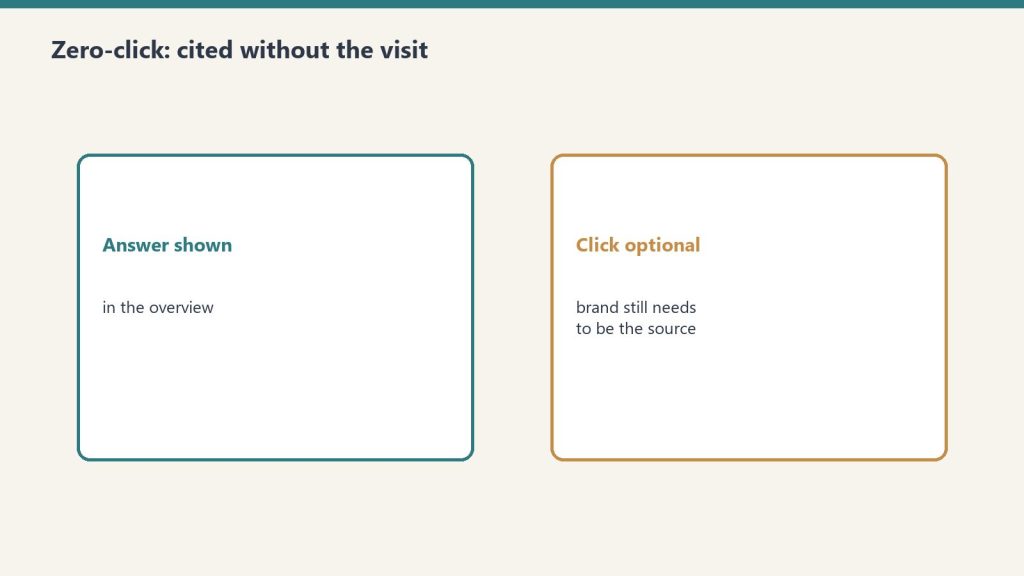
68% of U.S. Google searches end without a click in 2026. When AI Overviews appear, that rate hits 83%. The question for content-driven businesses is no longer how to rank — it’s how to be cited inside the answer that replaced the click.
This is a practical guide to structuring content, managing brand entity signals, and measuring visibility in a world where users get their answer before they ever reach your site.
What Zero-Click Actually Means for Content Businesses
What zero-click actually means for content businesses.
Zero-click doesn’t mean zero value. Brands cited inside AI Overviews earn 35% more organic clicks than uncited brands on the same query. The traffic goes to the cited brand — not to the site that ranks #1 but isn’t cited.
The data that reframes zero-click as a competition problem, not a traffic problem:
68% of U.S. Google searches are zero-click in 2026 (SparkToro, June 2026, based on Similarweb panel data)
When AI Overviews appear, zero-click rate hits 83%
Brands cited in AI Overviews earn 35% more organic clicks and 91% more paid clicks versus uncited brands
AI-referred visitors convert at 4.4x the rate of traditional organic visitors (Semrush)
The overlap between top-10 rankings and AI Overview citations: 17–38% in early 2026, down from 75% in mid-2025
The conclusion: ranking is no longer sufficient for visibility. A site can rank #1 and not be cited in the AI Overview that answers the query. The two need to be optimized separately.
How AI Overviews Decide What to Cite
How AI overviews decide what to cite.
Google’s AI Overview system retrieves web pages in real time, synthesizes a 3–5 sentence answer, and cites 3–6 source pages. The selection criteria weight answer extractability, entity authority, freshness, and structured data — not just ranking position.
The signals that influence AI Overview citation:
Answer extractability: The answer to the query must appear in the first 200 words of the page, stated directly. Pages that build toward the answer, providing extensive context before the conclusion, are retrieved for topic relevance but can’t be cited because the extractable answer isn’t there.
Entity authority: Consistent, factually accurate information about the brand entity across the web — site, LinkedIn, social profiles, third-party mentions — signals that the source is authoritative on the topic. AI systems treat entities with strong external corroboration as more trustworthy.
Freshness: For fast-changing topics (Claude pricing, AI model capabilities, regulatory changes), recency is a significant weight. A page last updated in 2024 competes poorly against one updated in August 2026 on a query about current Claude pricing.
Structured data: FAQPage, HowTo, and Article schema markup signals to Google that content is formatted for extraction. Pages with properly implemented schema see measurably higher AI Overview inclusion.
E-E-A-T signals: Experience, expertise, authoritativeness, trustworthiness. An article written by a named author with a consistent byline and external presence outperforms anonymous content on contested or technical topics.
Strategy 1: Structure Every Page for Extraction
Structure every page for extraction.
Answer-first structure is the single highest-leverage change for AI citation rates. The first paragraph of every article should directly and completely answer the likely query.
The structure AI systems can extract from:
H1: [Specific, query-answering title]

[Bold one-sentence direct answer to the query implied by the title]

[Supporting detail — the why, the how, the context]

H2: [First subtopic as a question]
[Bold answer sentence to the H2 question]
[Elaboration]
What this means in practice for tygartmedia.com content:
Every article about Claude pricing, model capabilities, or Anthropic history should open with the factual answer — not a framing sentence, not background, not “in this article we’ll cover.” The answer, stated directly, in the first two sentences.
The reason this matters beyond GEO: it’s also better for users. Answer-first structure is a discipline that makes content more useful and more likely to be cited. The SEO and GEO benefits are secondary to the writing quality improvement.
Strategy 2: Build and Maintain the Brand Entity
AI systems treat brands as entities — named things with verifiable, consistent information across multiple authoritative sources. Building entity authority means making sure that information is consistent, correct, and present everywhere crawlers look.
Entity checklist for tygartmedia.com:
On-site signals:
Organization schema on every page (name, URL, description, logo, founder, sameAs links)
Consistent author byline (“Will Tygart”) on every article
Author bio that establishes expertise consistently across all articles
Contact and about page with complete, factual business information
Off-site signals:
LinkedIn Company Page with consistent description matching the website
Google Business Profile (if applicable) with consistent NAP (name, address, phone)
Third-party mentions and citations on authoritative sites in the AI/tech space
Social profiles with consistent handles and descriptions
The consistency requirement: AI systems cross-reference. If the description on LinkedIn says “AI infrastructure for operators” and the website says something different, that inconsistency weakens the entity signal. Everything should say the same thing about the same thing.
Strategy 3: Implement Structured Data
FAQPage, Article, and Organization schema markup signals to AI Overviews that content is formatted for extraction. This is not optional in 2026 for sites that depend on search visibility.
Minimum structured data implementation:
FAQPage schema on every article with a FAQ section:
{
  "@context": "https://schema.org",
  "@type": "FAQPage",
  "mainEntity": [{
    "@type": "Question",
    "name": "What is Metricool pricing?",
    "acceptedAnswer": {
      "@type": "Answer",
      "text": "Metricool has a free plan and paid plans starting at the Starter tier. API access requires the Advanced plan or above. Pricing is per brand, not per connected social account."
    }
  }]
}
Article schema on all editorial content (author, published date, modified date, headline).
In Rank Math (the plugin on tygartmedia.com): FAQ blocks in the WordPress editor generate FAQPage schema automatically. Use the Rank Math FAQ block for all FAQ sections rather than plain text. Article schema is enabled site-wide in Rank Math settings.
Strategy 4: Keep Content Current
AI retrieval systems weight freshness heavily for fast-changing topics. For any site publishing Claude pricing, model capabilities, or AI tool features, stale content is not just less useful — it actively loses citation ground to fresher sources.
Freshness implementation:
“Last refreshed” date at the top of every article — visible to users and read by crawlers as a freshness signal
“What’s new” section in evergreen articles covering frequently updated topics (Claude pricing, model capabilities, Metricool features)
Update the modified date in Article schema whenever content is refreshed — not just the publication date
Monitor Search Console for queries where the site appears in AI Overviews — freshness issues show up as drops in citation before they show up as ranking drops
Trigger list for mandatory refreshes on tygartmedia.com:
Any Anthropic pricing change
Any new Claude model release or deprecation
Any Metricool feature update
Any change to Anthropic’s Enterprise product structure
Strategy 5: Earn Third-Party Citations
AI systems give extra weight to content cited by other authoritative sources. Being linked to or mentioned by other sites publishing on Claude, Anthropic, and AI infrastructure strengthens the entity signals for all related queries.
Practical approaches:
Original data and research: Content with specific numbers, benchmarks, and original findings gets cited by others. The Claude pricing breakdowns, benchmark comparisons, and API cost calculations on tygartmedia.com are exactly the type of content other AI publications cite.
First-mover coverage: Publishing accurate, detailed coverage of Anthropic announcements before or alongside other publications builds a citation pattern over time.
Expertise-signal content: Content that can only be written from operational experience — running 24 brands in Metricool, building vector DB systems for business documents — earns citations because it’s not replicable from Anthropic’s documentation alone.
Measuring Zero-Click Performance
Standard click and session metrics are insufficient for measuring zero-click visibility. The right metrics are AI citation rate, branded search volume trend, and AI-referred conversion rate.
Measurement framework:
Metric
Tool
What It Measures
AI Overview appearances
Google Search Console (AIO report)
Queries where site is cited
CTR on AIO queries
GSC, filter by AI Overview queries
Whether citations drive clicks
AI-referred traffic
GA4 source filter (ChatGPT, Perplexity)
Direct traffic from AI citations
Branded search volume
GSC, filter by brand terms
Awareness from zero-click exposure
Conversion rate from AI sources
GA4 segmented by source
Value of AI citation traffic
Manual testing protocol: Monthly, ask ChatGPT, Perplexity, and Claude the questions your audience asks — “what is Claude Enterprise pricing,” “how does Metricool API work,” “what is the history of Anthropic” — and record whether tygartmedia.com is cited. This is the most direct feedback loop available and costs nothing.
If branded search volume is growing while organic clicks are flat or declining, the site is appearing in AI summaries and building awareness without receiving credit in standard traffic metrics. That’s the zero-click pattern working in favor of the brand — and the signal that citation strategy is working.
Frequently Asked Questions
What is zero-click search?
Zero-click search is a search that ends on the results page itself — the user gets their answer from an AI Overview, featured snippet, or knowledge panel and doesn’t click through to any website. In 2026, 68% of U.S. Google searches are zero-click.
Does zero-click hurt all websites equally?
No. Sites cited inside AI Overviews and featured snippets earn 35% more organic clicks than uncited sites on the same query. Zero-click hurts uncited sites and benefits cited ones. The competition shifts from ranking to citation.
What is the difference between GEO and zero-click optimization?
GEO (Generative Engine Optimization) is the discipline of getting cited inside AI-generated answers from ChatGPT, Perplexity, Gemini, and Claude. Zero-click optimization is specifically about Google search — being cited in AI Overviews and featured snippets. They use the same underlying tactics (answer-first structure, entity signals, structured data, freshness) applied to different surfaces.
How long does it take to see results from zero-click optimization?
Plan for 3–6 months of consistent effort before citation rates change meaningfully. AI systems update their citation patterns as they re-index updated content. The fastest wins come from freshness updates on existing high-traffic pages and FAQ schema implementation on pages that already rank.
Do clicks from AI citations convert differently?
Yes — significantly. AI search visitors convert at approximately 4.4x the rate of traditional organic visitors (Semrush). The mechanism is intent: users who get a specific answer from an AI Overview and then click through to the cited source are further along in their decision process than typical organic visitors.
Secure checkout via Square — all major cards accepted
You can copy this method and run a month of WordPress work yourself. Buy Now is Will doing that month on your site: ten existing-post optimizations and four new articles, already connected.
SiteBoost Monthly Retainer is a service. Square lists it per month at $997. The /siteboost/ hub defines the month as 10 posts + 4 articles. That is the scope. Not “unlimited blog support.” Not ads. Not a redesign.
This SKU assumes the site is already connected and you have a baseline. If it is not, run Site Connection and Audit first (or the Pilot, which includes the connection). Self-hosted WordPress only. Posts, not Pages, unless you put a Page in writing.
What a month includes
From the public hub, two work types:
10 existing-post optimizations. Same method as the $47 SKU, ten times. SEO, AEO, GEO, schema, interlink, IndexNow. Highest-opportunity published posts, agreed before the month starts if you can, or pulled from the last audit if you already have a queue.
4 new articles. Same method as the $97 SKU, four times. Brief, write, three layers, taxonomy, internal links, publish, IndexNow.
That is 14 URLs touched in a month if you finish the scope. The pilot is ten existing posts and a 60-day wait. The retainer is the ongoing version: keep refreshing the library and keep adding posts, on a calendar.
The weekly rhythm
The operator guide on tygartmedia.com is the calendar. Scope changes. Process does not.
Monday. Audit and pick. Re-pull the inventory or last month’s leftover queue. Score content health. Pick this week’s existing posts and the next new-article brief. Do not start writing until the week’s list is written down.
Tuesday to Thursday. Execute. Existing-post passes and new-article drafts. Every action gets all three layers by default. Schema on every URL you touch. Interlink into the cluster you are building, not random related-posts widgets.
Friday. Verify. Re-read what you published or refreshed. Rich Results Test on the new or changed URLs. IndexNow pings. Log what shipped: URL, what changed, word count, schema types, which brief it came from.
The 23-site stack article adds the monthly maintenance layer on top of that week: taxonomy health, orphan detection, meta-pollution scan (wp-clean-meta), and a look at rankings / competitor movement if you have Search Console and a research tool. Do that once a month, not every Monday, or you will spend the retainer on reports.
How to pick the ten and the four
Existing ten, same rules as the pilot:
Impressions but empty meta / no FAQ / no schema.
Over 500 words, real query, missing AEO and GEO.
Across pillars, not ten from one tag.
Skip stubs, test posts, and anything you are about to redirect.
Four new articles, same rules as New Article Publishing:
Start from a brief: keyword, intent, PAA list, sources you can name, internal-link targets that already exist.
Prefer spokes that point back to a hub you already optimized, or a hub you will optimize this month. The SiteBoost cluster process is hub and spoke with bidirectional links. A new post that does not link to anything, and is linked from nothing, is a wasted slot.
content-quality-gate before publish: no unsourced claims, no fabricated stats.
A month on a legal pad
Write these lines on day 1, then fill them as you go:
Site URL. Connection still works? (users/me 200)
This month’s ten existing URLs (before title / after title).
This month’s four briefs (keyword, intent, target publish date).
Monday notes: what the audit still says is on fire.
Friday logs, four of them.
Month-end: Search Console on the 14 URLs versus last month. What you would pick next month. What you would stop.
If you cannot name the 14 URLs at month-end, you did not run a retainer. You blogged.
What a month does not include
Page redesigns, theme work, or plugin installs.
Google Ads, GBP posts, or social, unless you hired those separately.
Editing attorney bios, service pages, or the homepage without a written ask.
A promised ranking. The public SiteBoost copy measures at 60 days and treats traditional SEO as 60 to 90 days on competitive terms. A single month is a shipping month, not a miracle month.
How this sits next to the other doors
Connection and Audit is the one-time setup. Pilot is connection + ten existing posts + a 60-day report, once. Retainer is the monthly machine after that. Existing Post Optimization and New Article Publishing are the à la carte versions of the same two work types if you do not want a month.
If you want the skill files so your own Claude can run the week, that is the WordPress SEO Skill Pack. Pro has the full refresh stack and the content pipeline. Agency adds new-site setup and thin-content expansion, which is what you need if you are the one retaining other people’s sites.
If you want Will to run the month
You can keep the Monday / midweek / Friday rhythm on your own staff. Buy Now is Will doing the month: ten existing-post passes, four new articles, shipped through the REST API, with a log of what changed. Same Square button at the top. $997 per month.
Email the site URL after checkout. If the site is not connected yet, the first month still needs the Application Password and the baseline. Do not send the login password. Application Password only.
Frequently Asked Questions
How does the retainer work?
Billed monthly starting at checkout. Work begins within 5 business days. Month-to-month — no contract.
Is there a refund policy?
Cancel anytime by email; the cancellation takes effect at the end of the current billing month. The current month is not refunded.
Azure Neural TTS vs Google Cloud Text-to-Speech: Audio Versions of Every Article
Adding an audio version of every article is one of those low-effort, high-leverage moves: it makes your content accessible to people who’d rather listen, it gives you a “play this article” widget that lifts time-on-page, and the audio file itself becomes another thing search and assistants can surface. The work is entirely automated — text goes in, an MP3 comes out — so the only real decisions are which voice sounds least like a robot and which free tier covers your back catalog.
We auto-generate audio versions of the same articles on both Azure Neural TTS and Google Cloud Text-to-Speech, on the free tiers, and listen. Short answer: this one’s an honest toss-up. Both produce genuinely natural neural voices, both give you SSML control, and both run our audio pipeline for $0/month. Azure’s free tier is 500,000 characters/month (~60–80 article audio versions of neural voices); Google’s is 1,000,000 characters/month of Standard voices and 1,000,000 characters/month of WaveNet/Neural2 premium voices. Pick by ecosystem and by which voice you’d rather hear.
This is the breakdown from the running lab on tygart.media — voice naturalness, SSML control, voice variety, free ceilings, and the accessibility/SEO payoff.
The free-tier ceilings
Free-tier ceilings for Neural TTS vs Cloud TTS.
How we do it
Azure
Google Cloud
Verdict
Free neural/premium chars/month
500,000 (Neural)
1,000,000 (WaveNet/Neural2)
Google — 2× headroom
Free standard chars/month
n/a (neural is the tier)
1,000,000 (Standard)
Google on raw volume
Roughly how many article audios
~60–80 neural/mo
~140 premium/mo
Google
Always-free
Yes
Yes
Tie
Our actual bill
$0
$0
Tie where it counts
A 1,200-word article runs around 6,500–7,000 characters, so Azure’s 500K neural budget covers roughly 60–80 full article audio versions a month, and Google’s 1M premium budget covers roughly twice that. For a publisher shipping a handful of articles a week, both stay free with room to spare — the 2× gap only bites if you’re voicing a large back catalog in one go.
Voice quality and SSML control
Voice quality and SSML control.
This is where you actually choose, and it’s genuinely close.
How we do it
Azure
Google Cloud
Verdict
Voice naturalness
Excellent, very expressive
Excellent, very natural
Tie — both clear the “robot” bar
Voice variety
Huge neural catalog, many styles
Large WaveNet/Neural2 catalog
Slight edge Azure on styles
Speaking styles / emotion
Yes (cheerful, newscast, etc.)
More limited emotional styles
Azure
SSML control
Full SSML + style/prosody tags
Full SSML
Azure, slightly
Custom voice
Yes (custom neural voice)
Yes (custom voice)
Tie
Languages / locales
140+ locales
50+ languages, many voices
Azure on locale breadth
Both clear the bar that matters: neither sounds like a 2010-era text-to-speech engine, and a casual listener wouldn’t immediately clock either as synthetic. Azure edges ahead on expressiveness — its neural voices support named speaking styles (newscast, cheerful, empathetic) that are perfect for an article read-aloud, and its SSML supports fine prosody control. Google’s Neural2 voices are beautifully natural and, to some ears, a touch warmer; the emotional-style controls are just a little thinner.
The accessibility and SEO payoff
Accessibility and SEO payoff of audio articles.
The audio isn’t only a nice-to-have. It does real work.
How we do it
Azure
Google Cloud
Verdict
Accessibility win
Listen instead of read
Listen instead of read
Tie
Output format
MP3 / WAV / streaming
MP3 / LINEAR16 / OGG
Tie
Pipeline integration
REST + SDKs
REST + SDKs
Tie
Time-on-page lift
Audio widget keeps people on page
Same
Tie
An audio version gives screen-reader users and “I’d rather listen” users a first-class way to consume the piece, and the on-page player tends to lift dwell time — a signal that doesn’t hurt. The mechanics are identical on both clouds: feed text, get an MP3, embed it.
What surprised us
Both are genuinely good now. We expected one to clearly win on naturalness and neither did — the synthetic-voice era is over on both clouds.
Azure’s speaking styles are the sleeper feature. Being able to render an article in a “newscast” or “cheerful” style without writing prosody by hand made the read-alouds noticeably more engaging.
Google’s free character budget is the bigger one. 1M premium characters is real headroom; if you’re voicing a back catalog, that matters more than a half-point of naturalness.
The MP3s are interchangeable. Once embedded, listeners couldn’t reliably tell which cloud voiced which article in a blind test we ran on ourselves.
The takeaway
Pick Azure Neural TTS if you want maximum expressiveness — named speaking styles, fine prosody control, and the broadest locale catalog — and your Microsoft ecosystem is already where the rest of your stack lives. The 500K free characters cover a normal publishing cadence comfortably.
Pick Google Cloud Text-to-Speech if you want the larger free character budget (1M premium) for voicing a big back catalog, or you simply prefer the warmth of the Neural2 voices, and your stack is GCP-centric.
For us this is the rare comparison with no loser. We run the pipeline on whichever cloud the rest of that article’s workflow already lives on — and the listener can’t tell the difference either way.
This is part of our “Two Clouds, One Site” series — we run the same media property on both Azure and Google Cloud on the free tiers, generating audio versions of the same articles on each to hear where the voices differ. The lab lives on tygart.media; the findings publish here.
How many free characters do Azure and Google text-to-speech give you per month?
Azure Neural TTS gives 500,000 free neural characters per month, which is roughly 60–80 article audio versions. Google Cloud Text-to-Speech gives 1,000,000 free Standard characters and 1,000,000 free WaveNet/Neural2 premium characters per month, roughly double Azure’s premium headroom. Both stay free for a normal publishing cadence.
Which text-to-speech sounds more natural, Azure or Google?
Both produce genuinely natural neural voices, and in blind listening neither clearly wins. Azure edges ahead on expressiveness with named speaking styles like newscast and cheerful, while Google’s Neural2 voices are very natural and, to some ears, slightly warmer. The synthetic-robot problem is solved on both.
Can I auto-generate an audio version of every blog post for free?
Yes. Both clouds expose a simple REST API that turns article text into an MP3, and their free character budgets cover a typical few-articles-a-week cadence at $0. Google’s larger free budget is better if you want to voice a big back catalog in one pass.
Does Azure Neural TTS support SSML and speaking styles?
Yes. Azure supports full SSML plus named speaking styles (newscast, cheerful, empathetic and more) and fine prosody control, which makes article read-alouds noticeably more engaging. Google also supports full SSML, but its emotional-style controls are thinner.
Does adding an audio version of articles help accessibility and SEO?
Yes. An audio version gives screen-reader and listen-first users a first-class way to consume the content, improving accessibility, and the on-page audio player tends to lift time-on-page, which is a positive engagement signal. The benefit is identical whether you generate the audio on Azure or Google.
Here’s the number that reorganized how we think about search: ~84% of our organic traffic comes from Bing. Not Google. Bing — and the Copilot and ChatGPT surfaces that draw on Bing’s index. Yet for a long time, like nearly everyone, we watched only Google Search Console and treated Bing as an afterthought.
That’s the blind spot this article is about. Short answer: use both consoles, but if Bing drives your traffic, stop treating Bing Webmaster Tools as optional — it has data, indexing controls, and an AI-insights surface that Google Search Console doesn’t, and it’s reporting on the search engine that’s actually sending you readers.
This is the side-by-side from running both consoles on the same media property: what each one tells you, where Bing is quietly ahead, and how we wired the Bing Webmaster Tools API into our editorial calendar.
The core reporting — query, position, CTR
Core reporting: query, position, CTR.
At the surface, the two consoles look like twins. Both give you queries, impressions, clicks, average position, and CTR. The differences are in coverage and freshness.
How we do it
Job
Bing Webmaster Tools
Google Search Console
Verdict
Query / position / CTR
Yes, per query and page
Yes, per query and page
Tie on the basics
Data freshness
Often faster to update
~2-3 day lag
Bing edges ahead
Historical window
Generous
16 months
Toss-up
API access
Full API: position + CTR per query/page
Search Analytics API
Bing — the API is the underrated weapon
AI / Copilot insights
Dedicated AI-traffic insights
No equivalent surface yet
Bing, clearly
Market it reports on
Bing + Copilot + ChatGPT-via-Bing
Google only
Depends on your traffic mix
The honest read: for the basic dashboard, they’re close enough that you’d never switch for the UI. The reasons to take Bing seriously are whose traffic it reports on and what it lets you do about it — the AI insights tab and the API.
Indexing: IndexNow vs crawl-when-it-feels-like-it
Indexing: IndexNow vs crawl-when-it-feels-like-it.
This is the most concrete operational difference, and it’s lopsided.
How we do it
Job
Bing Webmaster Tools
Google Search Console
Verdict
Tell it about a new URL
IndexNow — push, indexed near-instantly
URL Inspection → “Request indexing” (queued)
Bing — push beats poll
Bulk submission
IndexNow ping + sitemap
Sitemap, then wait
Bing
Control over crawl
Crawl control, block/allow
Limited crawl controls
Bing — more knobs
Re-crawl on edit
Re-ping IndexNow
Hope, or re-request
Bing
IndexNow is the standout. Instead of submitting a sitemap and waiting for a crawler to wander by, you push a URL the moment it changes and it’s picked up almost immediately — and because IndexNow is a shared protocol, one ping notifies participating engines. Google’s model is still largely “request indexing and wait.” For a content site that publishes and edits constantly, push beats poll every time. We ping IndexNow on publish and on every meaningful edit.
The AI / Copilot insights tab
The AI insights tab is the differentiator.
Google Search Console has no real equivalent here yet. Bing Webmaster Tools surfaces AI-traffic insights — visibility into how your content shows up across Bing’s AI-powered and Copilot surfaces. Given that those surfaces (and ChatGPT’s web results, which draw on Bing) are an increasing share of how people find answers, this is the single console feature most aligned with where discovery is heading. If you care about GEO at all, it’s the dashboard that tells you whether the AI assistants are actually pulling you in.
Wiring the BWT API into the editorial calendar
The Bing Webmaster Tools API is the part most sites never touch, and it’s the most actionable. It returns position and CTR per query and per page — which is a ready-made content-optimization loop:
Pull query/position/CTR from the BWT API on a schedule.
Find pages ranking on page one with weak CTR (good position, bad headline/meta) — fast wins.
Find queries where we rank position 5-15 with real impressions — the “one good edit from page one” list.
Feed both lists straight into the editorial calendar as prioritized rewrites.
Because Bing drives most of our traffic, this loop is pointed at the engine that actually moves our numbers. Running the same loop off Google Search Console’s API would optimize for the 16% of traffic, not the 84%.
What surprised us
Bing’s data is often fresher than Google’s. We frequently see new queries in Bing Webmaster Tools before they show up in Search Console.
IndexNow is faster than anything Google offers — and it’s free and standard. The gap between “push and it’s indexed” and “request and wait” is real and daily.
The AI insights tab has no GSC counterpart. For a site doing GEO, that’s the most forward-looking surface either console offers.
Almost nobody verifies their site in Bing Webmaster Tools. You can import directly from Google Search Console in a couple of clicks, so the only reason most sites skip it is that they’ve never looked at where their traffic comes from.
The takeaway
This was never a “pick one” — it’s “stop ignoring one.” Google Search Console is still essential; Google isn’t going anywhere. But running only GSC is a bet that Google’s view of your site is the only one that matters, and our traffic data says that bet is wrong by a factor of five.
Use both. Watch Google Search Console for the Google slice. But if a large share of your organic traffic comes from Bing — and a surprising number of content sites are in exactly that position without checking — then Bing Webmaster Tools is your primary console: fresher data, IndexNow for instant indexing, the AI/Copilot insights surface, and an API you can wire straight into your editorial calendar.
The 84% lesson is simple: measure where your readers actually come from, then watch the console that reports on it. For us, that meant promoting Bing from afterthought to the dashboard we open first.
This is part of our “Two Clouds, One Site” series — we run the same media property on Azure and Google Cloud, on the free tiers, and report what watching both ecosystems actually teaches us. The lab lives on tygart.media; the findings publish here.
Should I use Bing Webmaster Tools if I already use Google Search Console?
Yes — they report on different search engines, so using only Google Search Console hides all of your Bing performance. If any meaningful share of your traffic comes from Bing, Copilot, or ChatGPT’s Bing-powered results, Bing Webmaster Tools shows data and offers indexing controls that Search Console doesn’t. You can import your site from Search Console in a couple of clicks.
What is IndexNow and is it faster than Google indexing?
IndexNow is a protocol that lets you push a URL to search engines the moment it’s published or changed, instead of waiting for a crawler. It’s typically much faster than Google’s “request indexing and wait” model, and because it’s a shared standard, one ping notifies participating engines. For sites that publish or edit frequently, it’s a meaningful indexing-speed advantage.
Does Bing Webmaster Tools have an API?
Yes. The Bing Webmaster Tools API exposes per-query and per-page data including position and CTR, plus URL submission. That makes it practical to pull your search performance on a schedule and feed it into a content-optimization loop — for example, flagging page-one results with weak CTR or near-miss rankings to prioritize for rewrites.
What does the Bing Webmaster Tools AI insights tab show?
It surfaces how your content appears across Bing’s AI-powered and Copilot surfaces, giving visibility into AI-driven discovery that Google Search Console has no direct equivalent for yet. For sites focused on Generative Engine Optimization, it’s the most forward-looking view either console offers into whether AI assistants are pulling in your content.
Why would a site get most of its traffic from Bing instead of Google?
It’s more common than people assume, especially for niche or B2B content, sites strong in Bing-heavy regions or browsers, and content that surfaces well in Copilot and ChatGPT’s Bing-powered results. The lesson is to measure your actual referral mix rather than assume Google dominates — many sites only discover their Bing share once they verify in Bing Webmaster Tools.