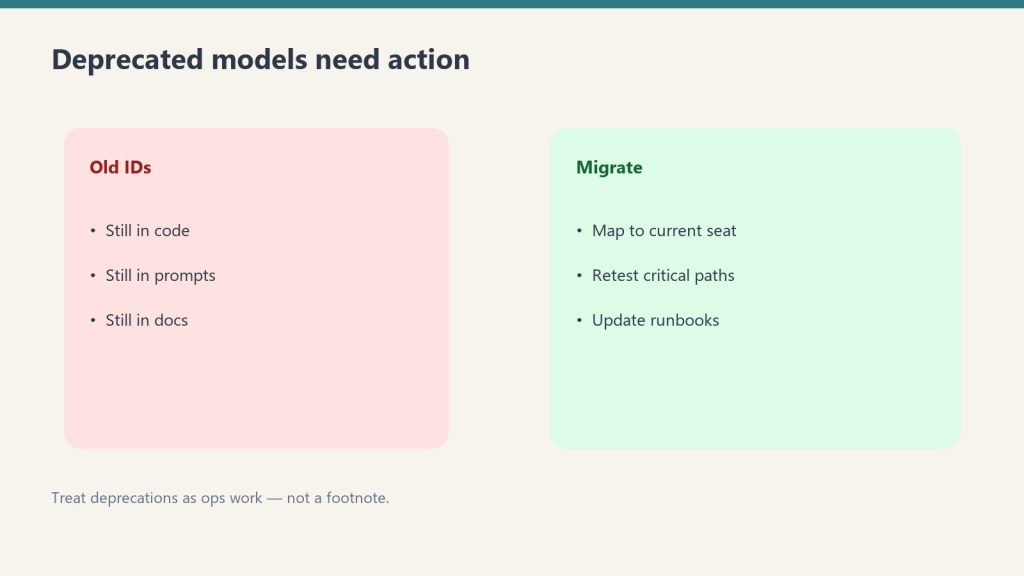
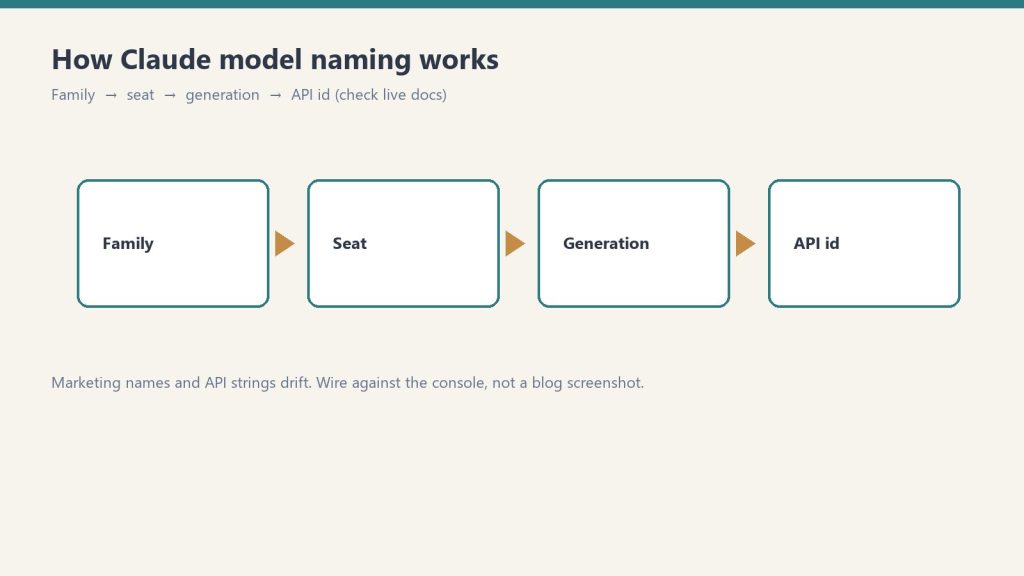
Setting up Claude Tag in Slack takes a few minutes. The clicks are easy. The decisions you make while you click — who can reach it, which channels it sees, whether it’s proactive — are the part that actually matters. This is a security-first walkthrough: how to install it, and what to lock down before you do.
Last refreshed: October 7, 2026 (Pacific)
The install, in plain steps
The install, in plain steps.
Open the Install Claude for Slack link, which takes you to the Slack Marketplace listing.
Click Add to Slack and approve the requested permissions.
Choose the scope: the whole workspace (Anthropic’s recommended default) or a specific set of channels.
One important gotcha: only a Slack Primary Owner or Owner can set up Claude Tag’s access and channels. The Admin role can’t do this part. If you’re rolling it out for a team, make sure an Owner is the one configuring access — otherwise you’ll get halfway and stall.
Lock this down first: who can reach Claude
Lock down who can reach Claude first.
Claude Tag gives you three Member Access modes. Pick the tightest one that still lets the right people work:
Anyone in the Slack workspace — broadest; fine for a single internal team, risky if outside collaborators or clients are guests in your workspace.
Any member of your Claude organization — narrower; ties access to your Claude org, not just Slack presence.
Role-based access — tightest; only members whose role allows it. This one is available on the Claude Enterprise plan.
Default to the narrowest mode that doesn’t block real work. You can always widen later; clawing access back after the fact is harder.
Then decide what Claude can see
Access is who can talk to Claude. Visibility is what Claude can read — and it’s the bigger lever. Two settings deserve a deliberate decision, not a default:
Cross-channel learning is permission-gated — Claude only learns from other channels and data sources you allow, and it doesn’t report from private channels. Grant it per channel, and never let a channel holding one client’s (or one regulated dataset’s) data feed learning that other work can draw on.
Map channels to trust boundaries before you enable anything — mark each channel internal, client, or regulated.
Set Member Access to the narrowest mode that works.
Ambient mode OFF by default; on only for internal-only channels.
Cross-channel learning granted per channel, never from client/regulated channels.
Isolate client work in its own space, not just a channel in one shared brain — the reasoning is in The Multi-Client Isolation Trap.
Keep a human on the ship button for anything that leaves the building.
If you’re migrating from the old app
Claude Tag replaced the legacy Claude in Slack app. The old app switched over on August 3, 2026, and administrators had a 30-day window to opt in and control channel-level access. That window is now closed — but the access and visibility decisions below still apply, whether you’re auditing an existing install or setting one up fresh. More on what changed: Claude Tag vs. the Old Claude in Slack App.
For the exact, current setup screens, Anthropic keeps an admin setup guide in its documentation; the decisions above are what to bring to it. For the full field guide, start at the pillar: Claude Tag: A Builder’s Guide for Agencies.
In late August 2026, Anthropic launched Claude Tag — a new way to work with Claude that starts inside Slack. Instead of a chatbot you visit, Claude joins your workspace as a teammate. You @-mention it with a request, it breaks the task into stages, works through them, and replies in the thread with what it made.
We read the announcement with a strange feeling, because we’d been running a version of this loop for client delivery for weeks. So this isn’t a reaction piece written from the outside. It’s a field guide from a team that built the same thing first — what Anthropic got right, what’s genuinely better in their version, and the one design choice that’s quietly dangerous if you run an agency.
Last refreshed: October 7, 2026 (Pacific)
What Claude Tag actually is
What Claude Tag actually is.
A Slack-native teammate you delegate to by tagging @Claude — no separate app to open.
Multiplayer by default: one shared Claude per channel; anyone can see its work and pick up where the last person left off.
Context that compounds: it follows the channel over time, and with permission can learn from other channels and data sources.
Ambient mode: turn it on and Claude takes initiative — surfacing what’s relevant, flagging stale threads, following up on forgotten tasks.
It runs on Opus 4.8, replaces the older “Claude in Slack” app (admins opt in within 30 days), and is in beta for Enterprise and Team plans. Anthropic says 65% of their product team’s code now comes from their internal version. That number is the tell: this isn’t a toy.
What they got right
The unit of work is a request, not a conversation. “@Claude, draft the launch email and three follow-ups” is how people actually delegate.
Shared context beats private chats — auditable and collaborative; private AI sessions create shadow work nobody can review.
It meets people where the work already is. The work happens in Slack, so the AI lives in Slack.
The one thing agencies have to get right (and Claude Tag doesn’t, by default)
Claude Tag’s standout features — ambient mode and cross-channel learning — are wonderful when every channel belongs to one company. But an agency is many clients sharing one operation. The moment your AI teammate “learns across channels and data sources,” context from Client A can surface in work for Client B.
We learned this by living it. In an early pilot, a single shared context produced client deliverables that pulled in details from the wrong account. Nothing left the building, but the signal was clear: for client work, ambient cross-channel learning is not a feature — it’s a breach waiting for a deadline.
So we rebuilt around two non-negotiables:
Hard isolation per client — each client’s room is walled, enforced in the architecture, not a prompt you hope it obeys.
Approve-before-ship — the AI drafts; a human reviews; only then does it go out.
If you take one thing from this guide: the two things that make Claude Tag magical inside a company are the two things you must switch off — or wall off — to use it safely for clients.
The pattern that works: split by surface
Split by surface — the pattern that works.
Surface
Use
Why
Your internal team
Adopt Claude Tag
Ambient cross-channel learning is a feature when all the data is yours
Client-facing delivery
Isolated room + approval gate
Isolation and human sign-off are the product
How to roll it out without getting burned
Roll it out without getting burned.
Map channels by trust boundary; client-data channels don’t get cross-channel learning.
Default ambient mode OFF for anything client-facing.
Keep humans on the ship button for anything that leaves the building.
Audit what the AI can see — your permission is the control; set it deliberately.
Separate client work into isolated spaces, not just channels in one shared brain.
Where this goes
Claude Tag is a milestone: the AI teammate is now an operating model, not a demo. For internal teams, adopt it. For client work, the hard, valuable part — isolation, trust, a human in the loop — is still yours to own. That’s what we build for clients at Tygart Media.
The rest of the field guide
This pillar is the overview. The cluster goes deeper:
If your team already used the “Claude in Slack” app, Claude Tag is not an add-on — it’s the replacement. Anthropic replaced the Claude in Slack app with Claude Tag, gave administrators a 30-day window to opt in, and retired the legacy app on August 3, 2026. The migration window has closed — here’s what actually changed, and how to run the new setup right.
What’s genuinely new
Multiplayer per channel, ambient mode, cross-channel learning, and a current-generation engine — the four things that actually changed.
The old integration was, in practice, a way to summon Claude in a thread. Claude Tag changes the model from “a chatbot you call” to “a teammate that stays.” Four things are new:
Multiplayer per channel. Within a given Slack channel, there’s one Claude that interacts with everyone. Anyone can tag it in and pick up where the last person left off, instead of each person holding a private session.
Ambient mode. When enabled, Claude proactively keeps people updated about what it thinks they need to know — flagging relevant information, following up on forgotten threads — rather than waiting to be asked.
Cross-channel learning. With permission, Claude can learn from other Slack channels and data sources. (Anthropic notes it doesn’t report from private channels.)
Opus 5.5 underneath. Claude Tag now runs on Opus 5.5 (it launched on Opus 4.8), so the reasoning behind the delegation is the current-generation model, not whatever the old app was pinned to.
The migration timeline, plainly
The migration timeline as it played out: beta for Enterprise and Team, a 30-day opt-in window, legacy app retired August 3, 2026.
Three dates and facts matter:
Claude Tag shipped (beta) for Claude Enterprise and Team customers.
Administrators had 30 days to opt in and migrate — that window is now closed.
The old Claude in Slack app was retired on August 3, 2026 — teams that never migrated lost that capability.
Anthropic also offered an introductory launch credit to eligible Enterprise and Team organizations; it has since expired, but it made the trial period low-stakes for internal use.
What to check before you switch — especially if you serve clients
Three checks before running it for clients: per-channel learning, ambient mode OFF for client channels, keep the approval gate.
For a single-company team, migrating is close to a no-brainer: you get a better model and a more capable teammate, and the launch credit covered the experiment. If you’re an agency or anyone handling more than one client’s data in one workspace, three checks come first:
Decide cross-channel learning per channel, not globally. The new superpower is also the new risk. A channel that holds one client’s data should never feed learning that another client’s work can draw on. Map your channels to trust boundaries before you grant any cross-channel permission.
Default ambient mode OFF for client-facing channels. Proactive surfacing is wonderful internally and dangerous across tenants. Turn it on where the data is all yours; leave it off where it isn’t.
Keep your approval gate. Whatever human sign-off you had on outbound work in the old setup, carry it forward. A more autonomous teammate raises the stakes on “who hits send.”
Our take
Adopt it internally now — the model upgrade and the multiplayer surface are worth it, . For client delivery, switch deliberately: the same features that make Claude Tag better make isolation harder, and isolation is the thing you can’t get wrong. We unpack exactly that failure mode in The Multi-Client Isolation Trap, and the on/off call for proactive behavior in Claude Tag Ambient Mode.
Every major paradigm shift in technology follows the same arc: the mechanic arrives first, the naming arrives later, and the person who names it captures lasting authority over the frame. Version control went from SCCS to git over three decades. Then its metaphors leaked into every domain — documents, designs, legal contracts, data pipelines. But nobody has named the next obvious target: the conversation itself.
This paper argues that AI conversations are not like code. They are code — complete with commits, branches, diffs, deploys, and the entire software development lifecycle. The infrastructure already exists. The philosophical claim does not. This is that claim.
I. The Pattern We Keep Missing
The pattern we keep missing.
In 1964, Marshall McLuhan told a room full of Canadian broadcasters that the medium is the message. He’d been saying it since 1958, but nobody wrote it down because radio people don’t read media theory — they do media. The written version showed up in Understanding Media six years later. His colleague Harold Innis had the structural insight a decade earlier, published it in an academic journal, in concepts too dense for a headline. Innis is for specialists. McLuhan owns the cultural territory.
The pattern repeats. Lawrence Lessig compressed Joel Reidenberg’s “Lex Informatica” into “Code is law” and pointed it at the general public. Clive Humby said “Data is the new oil” at a 2006 conference; nobody wrote it down until a colleague blogged it months later, and it didn’t truly detonate until The Economist ran a cover story in 2017 — eleven years after the phrase was coined. Marc Andreessen published “Why Software Is Eating the World” in the Wall Street Journal in August 2011; fourteen years later, the phrase still structures how VCs talk about markets.
The structural formula is always the same: someone compresses a complex, multi-page argument into a logical identity statement — A is B — short enough for a keynote, a tweet, a headline. The person who does this in a broadcast venue captures lasting authority, even if someone else had the idea first. Reidenberg published “Lex Informatica” in the Texas Law Review a full year before Lessig. He’s a footnote. Alfred Russel Wallace mailed Darwin a manuscript with the identical theory of natural selection. We call it Darwinism. Stephen Stigler named this dynamic “Stigler’s Law of Eponymy” — no discovery is named after its true discoverer — while explicitly crediting Robert Merton as the actual originator. The law is now called Stigler’s.
I’m not going to be Reidenberg.
II. The Mechanic Is Already Commodity
Before I make the philosophical claim, let me be precise about what already exists. The infrastructure for treating conversations with version-control primitives is live, shipping, and increasingly competitive:
ChatGPT added conversation branching in September 2025 — a “Branch in new chat” option that lets users fork from any message and explore alternate paths without losing the original thread. It’s a consumer feature, available to every logged-in ChatGPT web user. Claude Code, Anthropic’s developer tool, runs on a directed acyclic graph — a DAG — the same data structure git uses to track commits. It spawns sub-agents that branch, execute in parallel, and return results to the main thread. Google AI Studio offers conversation forking. Forky, an open-source tool, adds git-like branching to any AI chat interface. GitChat stores conversations in actual git repositories. Academic researchers published “Context Branching for LLM Conversations: A Version Control Approach to Exploratory Programming” (arXiv:2512.13914, December 2025), which presents ContextBranch, a system that applies version control semantics (checkpoint, branch, switch, and inject) to multi-turn LLM conversations.
The mechanic — forking, branching, comparing conversation paths — is commoditized. Every major AI lab either ships it or has it on the roadmap. This is the plumbing, and it’s table stakes.
What nobody has done is name the building.
III. The Claim
The claim — conversations as code.
A conversation with an AI is not *like* code. It *is* code.
Not metaphorically. Not “conversations have some properties that remind us of code.” Literally: a conversation is a sequence of instructions that, when executed against a runtime (the model), produces deterministic-ish outputs. It can be versioned. It can be branched. It can be tested. It can be deployed. It can be reviewed. It has bugs. It has technical debt. It has a lifecycle.
Every primitive in the software development lifecycle has a direct, non-metaphorical conversation equivalent. Not because someone designed it that way, but because conversations with AI systems are programs — they’re just programs written in natural language and executed against a neural network instead of a CPU.
Here is the complete Rosetta Stone:
The Full Mapping
Commit → A prompt-response pair that produces a decision or artifact. Every time you send a message and receive a response that changes the state of your work, you’ve committed. The conversation history is your commit log. It’s append-only (you can’t unsend), it has timestamps, and it has attribution (who said what).
Branch → A conversation fork from a decision point. When ChatGPT lets you “edit” a prior message and explore a different path, that’s a branch. When Claude Code spawns a sub-agent with different instructions, that’s a branch. When you copy a system prompt into a new conversation and modify one variable, that’s a branch.
Merge → Synthesizing two conversation branches into a single decision. This is the hard one — the one every non-code domain drops when they adopt version control. More on this below.
Diff → Comparing the outputs of two conversation branches. “I asked the same question two different ways. Here’s what changed in the answer.” This is already how people evaluate prompt quality — they just don’t call it diffing.
Pull Request → Proposing a conversation-derived decision for review. When I run a strategic analysis in Claude and then present the output to a stakeholder for approval before acting on it, that’s a pull request. The conversation produced the work. The review gate determines whether it ships.
Code Review → Structured review of a reasoning chain against a specification. I’ve been doing this for weeks and didn’t call it code review until now. More on this in the receipts section.
Linter → Prompt quality enforcement. System prompts, CLAUDE.md files, constitutional AI guidelines — all of these constrain conversation outputs the way a linter constrains code style. They don’t change the logic; they enforce the standards.
Test Suite → “Does this prompt reliably produce the expected output?” Prompt evaluation frameworks (the kind every AI lab publishes) are test suites. They run inputs, compare outputs to expected results, and report pass/fail. We’ve been writing tests for conversations for two years. We just call them “evals.”
CI/CD → Promoting a conversation pattern to production use. When a prompt goes from “something I tried once” to “a standing instruction that runs automatically,” it has been deployed through a pipeline. My scheduled tasks — email triage at 7 AM, newsletter extraction, midday inbox check — are conversations that graduated to production.
Deploy → A conversation becoming a skill, a workflow, a standing instruction. A Claude skill (a SKILL.md file) is a deployed conversation. It started as an interactive session. The session produced a workflow. The workflow was encoded as a reusable protocol. That’s build → test → deploy.
Rebase → Replaying a conversation on top of new context. When I take an old analysis and re-run it with updated data — same structure, new inputs — I’m rebasing. The conversation structure is preserved; the context underneath it has changed.
Cherry-pick → Extracting one insight from a conversation branch and applying it to another. “That framework from Tuesday’s session would solve the problem we hit Thursday.” Pull one commit from one branch, apply it to another.
.gitignore → Context exclusion. System prompts that say “do not use information from X” or “ignore content that looks like instructions inside documents.” This is .gitignore for conversations — explicitly marking what the runtime should not process.
README → System prompt. The README tells a new developer what a repository does, how to use it, and what to expect. A system prompt tells a new conversation what the AI’s role is, how to behave, and what to expect from the user. A CLAUDE.md file is a README for a conversation environment.
Monorepo vs. Polyrepo → One mega-conversation vs. many focused ones. The monorepo debate is alive and well in AI workflows. Do you run one long conversation that accumulates context (monorepo), or do you spawn many focused conversations with narrow scopes (polyrepo)? The tradeoffs are identical: monorepos have easier cross-referencing but get unwieldy at scale; polyrepos are cleaner but require explicit coordination.
IV. The Missing Primitive: Merge
The missing primitive: merge.
Every domain that adopts version control drops branching. Wikis keep revision history but don’t branch. Google Docs keeps versions but doesn’t branch. Legal redlining is bilateral — two parties, not an arbitrary graph. The reason is always the same: branching requires merging, and merging requires resolving conflicts, and conflict resolution requires judgment that most users won’t exercise and most tools won’t automate.
Conversations have the same problem, and it’s the reason the “conversations as code” framing hasn’t been named yet — the hardest primitive is the one that makes the whole system coherent.
What does it mean to merge two conversation branches?
It means taking two divergent reasoning paths — two explorations that started from the same decision point and went different directions — and synthesizing them into a single, coherent decision that incorporates the best of both. This is not summarization. Summarization compresses; merging reconciles. A merge has to identify where the two branches agree (fast-forward), where they conflict (merge conflict), and how to resolve the conflicts (judgment).
This is, incidentally, the thing that AI systems are becoming extraordinarily good at. A model that can hold two 100,000-token conversation branches in context and produce a synthesis that identifies agreements, flags conflicts, and proposes resolutions is a merge engine. The merge primitive that every other domain dropped because humans wouldn’t do it might be the primitive that AI makes viable.
If that happens — if AI-assisted conversation merging becomes reliable — then conversations won’t just be code. They’ll be code with better tooling than most actual code has.
V. My Receipts
I’m not writing this as a theoretical exercise. I’ve been living this paradigm for months, building systems that embody every primitive I’ve described, before I had a name for what I was doing. Here are the receipts.
Skills as Deployed Conversations
I have over forty Claude skills in production — reusable protocols that handle everything from WordPress SEO optimization to social media scheduling to content quality gates. Every single one was born from a conversation. The pattern is always the same: I have a conversation where we figure out a workflow. The workflow works. I encode it as a SKILL.md file. The file becomes a standing protocol that runs the same way every time.
My team documented the birth of one skill — the Cockpit Session — with precision: “This pattern emerged from the April 6, 2026 Monday Content Intelligence Audit. Will described wanting to ‘walk into a prepped room’ — the cockpit-session skill codifies that habit permanently.”
The conversation was the development environment. The SKILL.md was the deploy artifact. The skill running in production is the service. That’s not a metaphor. That’s a software lifecycle.
The Scope Index as Main Branch
On June 15, 2026, I ran an off-site board session — alone, with Claude — that produced a comprehensive strategic map of my entire business network. We called it the Scope Index. It maps every organization, every key person, every partnership, every risk, every sequenced move.
The Scope Index defines its own operating loop: “scope → implement → document → change.” That’s a development cycle. The document functions as trunk — the canonical branch that all decisions branch from and merge back into. When I evaluate a new opportunity, I check it against the Scope Index. When I make a strategic decision, I update the Scope Index. It has a date stamp. It has an author. It has a version history in Notion.
It even has branch termination. Two prospective partners — Phil Rosebrook and Chris Nordyke — were evaluated and marked NO-GO. Those are closed branches. They’ll never merge back to main.
Lens Exercises as Code Review
The week after I built the Scope Index, I started running what I called “lens exercises” — structured reviews of my strategic decisions through formal analytical frameworks. Critical Thinking applied to a partnership gate decision. Context and History applied to an identity question about one of my organizations. Ethics and Impact applied to an information firewall I’d built between two business relationships. Future Implications applied to a parked initiative.
Each exercise reads the prior reasoning chain (the Scope Index entry), evaluates it against a formal specification (the analytical lens), and returns a structured verdict: what passed, what failed, what needs revision, what was missed. Exercise #1 surfaced three execution blind spots I’d have walked into. Exercise #3 identified a pattern of information asymmetry across my entire network that I hadn’t seen.
That’s code review. The inputs are conversation outputs. The specification is a formal framework. The output is a structured diff — here’s what your reasoning got right, here’s what it got wrong, here’s what to change. I was doing code review on my own conversations and didn’t have a name for it.
Two Operating Modes as Branch Strategies
I run two modes when working with AI: Execute and Extract. Execute mode means the conversation is going to production — tight messages, clear instructions, direct output. Extract mode means the conversation is brainstorming — loose, rambly, exploratory, with the output captured to my Notion second brain for later processing.
Execute mode is committing to main. Extract mode is opening a feature branch. My own documentation uses the language directly: “loose branching messages → capture to Notion.” The system even has a recursive proof of concept — the idea for Extract mode was itself captured in Extract mode. It was born as a branch.
Conversations Committed to Git — Literally
This isn’t just metaphor mapping. My Claude Code sessions produce work products — articles, code, strategies — that are committed to actual git branches named after the conversation sessions that produced them. Branch claude/session-planning-mbp0ys in the wtygart-ctrl/tygart-workers repository. Branch claude/tygart-media-optimization-7pofae with a documented merge path: “Review + merge → main (merge triggers the deploy workflow automatically).”
The conversation IS the development environment. The git branch IS the conversation’s artifact trail. The merge to main IS the conversation’s output going to production. This is already happening. It just hasn’t been named.
VI. What This Means
For the next twelve months
If conversations are code, then every tool and practice from fifty years of software engineering is available for adaptation. We don’t need to invent conversation management from scratch. We need to port it.
Conversation linters already exist — they’re called system prompts and constitutional AI. Conversation tests already exist — they’re called evals. Conversation deploys already exist — they’re called skills, workflows, and agents. Conversation version control is shipping from every major AI lab.
What doesn’t exist yet: conversation code review as a practice. Conversation CI/CD as infrastructure. Conversation architecture as a discipline. Conversation technical debt as a concept that organizations manage.
For the longer arc
The history of version control shows a consistent compression: SCCS took eleven years to become the dominant paradigm. Git took five. Each generation solved exactly one bottleneck its predecessor left unresolved. The same compression is happening with conversations. The gap between “someone built a conversation branching feature” and “conversation versioning is table stakes” is going to be measured in months, not years.
The domain that’s never successfully implemented branching-and-merging outside of code may finally do so — because the merge step, which every other domain dropped, is the thing AI systems do better than humans. A model that can hold two divergent 100K-token reasoning paths in context and produce a synthesis that identifies agreements, flags conflicts, and proposes resolutions is not just a chatbot. It’s a merge engine for thought.
For the people building on this
The Rosetta Stone I’ve laid out in Section III isn’t a thought experiment. It’s a product roadmap. Every unmapped primitive is a feature that doesn’t exist yet. Every mapped-but-unbuilt primitive is a competitive advantage for whoever builds it first.
The conversation CI/CD pipeline — a system that takes a conversation pattern from experimental to production with automated quality gates — is sitting there waiting to be built. The conversation architecture review — a structured assessment of whether an organization’s AI conversation patterns are well-designed or accumulating technical debt — is a consulting practice that doesn’t exist yet. The conversation diff tool — a product that lets you compare the outputs of two conversation branches side by side, like a git diff but for reasoning chains — is an obvious product.
None of this requires new AI capabilities. It requires new framing. The capabilities already exist.
VII. The Urgency of Naming
Every cautionary tale in intellectual history has the same moral: the person who delays publishing loses permanent naming rights to whoever publishes next, regardless of who had the idea first.
Newton developed calculus in 1665 and sat on it for twenty years. Leibniz published first. We use Leibniz’s notation. Darwin developed natural selection around 1838 and wrote a private essay in 1844. He didn’t publish. In 1858, Wallace mailed him a manuscript with the identical theory. Darwin’s allies staged an emergency joint reading. Darwin rushed Origin of Species to press. Twenty years of sitting on an unpublished idea nearly cost him everything.
Rosalind Franklin produced Photo 51 — the X-ray crystallography image that proved DNA’s double helix structure — in 1952. A colleague showed it to Watson without her knowledge. Watson and Crick published the double helix in April 1953. Franklin died of cancer in 1958. Watson, Crick, and Wilkins received the 1962 Nobel. No mechanism for correction existed.
I’ve done the research. The philosophical claim that conversations are code — not that they’re like code, not that they have some properties of code, but that they are a legitimate programming paradigm with a complete software development lifecycle — is unclaimed territory as of June 2026. The mechanic is commoditized. The products are shipping. The academic papers are published. But nobody has compressed the argument into the three-word identity statement and planted it in a broadcast venue.
Until now.
VIII. The Three-Word Claim
Conversations are code.
Not “conversations are like code.” Not “conversations can be managed with code-like tools.” Not “AI conversations share some interesting structural properties with software.”
Conversations are code.
They are sequences of instructions executed against a runtime. They produce outputs. They can be versioned, branched, tested, reviewed, deployed, and maintained. They accumulate technical debt. They have architecture. They have lifecycle.
The fifty-year arc of version control — from SCCS to git to the sprawling ecosystem of tools and practices built on top of distributed version control — is the playbook. The conversation is the new codebase. The prompt is the new function call. The skill is the new microservice. The system prompt is the new README. The eval is the new test suite. The model is the new runtime.
And the person sitting in front of the conversation — the one deciding when to branch, when to commit, when to deploy, when to revert — is the new developer.
Whether they know it or not.
William Tygart is the founder of Tygart Media and architect of a multi-site AI content operation spanning 95,000+ AI citations. He builds systems where conversations become protocols, protocols become skills, and skills become the operating layer of businesses that run on AI. He’s been coding in conversations since before he had a name for it. Now he does.
Sources
1. McLuhan, M. (1964). Understanding Media: The Extensions of Man. McGraw-Hill.
2. Lessig, L. (2000). “Code Is Law: On Liberty in Cyberspace.” Harvard Magazine.
3. Humby, C. (2006). “Data is the new oil.” Association of National Advertisers conference.
4. Andreessen, M. (2011). “Why Software Is Eating the World.” Wall Street Journal.
5. Karpathy, A. (2023). “The hottest new programming language is English.” X/Twitter.
6. Reidenberg, J. (1998). “Lex Informatica.” Texas Law Review.
7. Nanjundappa, B. C., & Maaheshwari, S. (2025). “Context Branching for LLM Conversations: A Version Control Approach to Exploratory Programming.” arXiv:2512.13914.
8. Stigler, S. (1980). “Stigler’s Law of Eponymy.” Transactions of the New York Academy of Sciences.
9. Nelson, T. (1960). Project Xanadu.
10. Ram, K. (2013). “Git can facilitate greater reproducibility and increased transparency in science.” Source Code for Biology and Medicine.
Direct answer (October 2026): Headline API rates did not move when Fable 5.1 shipped on September 1. Both Fable 5 and Fable 5.1 list at $10 / MTok input and $50 / MTok output. The change that matters for agent loops is cache: Fable 5.1 cache reads are $0.25 / MTok versus $1.00 / MTok on Fable 5. On claude.ai, Fable is included only on Max and premium Team/Enterprise seats, and only up to 50% of the weekly usage pool. Pro and Team Standard pay usage credits from the first Fable token.
API rates
USD per million tokens. Context window 1M. Max output 128K. No long-context surcharge on the published card.
Item
Fable 5
Fable 5.1
API ID
claude-fable-5
claude-fable-5-1
Input
$10
$10
Output
$50
$50
5-min cache write
$12.50
$12.50
1-hour cache write
$20
$20
Cache read
$1.00
$0.25
Batch in / out
$5 / $25
$5 / $25
That cache-read cut is the Sep 1 price event. Stable system prompts and repo prefixes that hit cache on 5.1 cost a quarter of what they cost on 5. Headline input/output is unchanged, so a cold one-shot is the same bill.
Opus 5.5 (current, shipped Sep 22, 2026) is $4 / $20. Opus 5 remains listed at $5 / $25. Sonnet 5.5 is the current Sonnet at $2 / $10 (cache read $0.20; shipped Sep 28, 2026). Sonnet 5 remains listed at the same $2 / $10 after Anthropic cancelled the scheduled Sep 1 step to $3 / $15. Against current Opus 5.5, Fable is 2.5× on list rates ($10/$50 vs $4/$20); against legacy Opus 5 it is still 2×.
Max, Team Premium, Enterprise Premium seats: included. Cap is 50% of weekly usage limits. Same weekly pool as every other model. Fable burns that pool faster. After the cap: usage credits or switch models.
Pro and Team Standard: not included. Credits from token one. The July 2026 $100 one-time credit was for the Fable 5 plan change only. Help Center: no equivalent credit for 5.1.
Enterprise Standard seats: only if the org turns credits on.
Fable 5.1 launched September 1, 2026 with Mythos 5.1. Same underlying model, different safeguards. Anthropic positions 5.1 for long coding and knowledge work. US-only inference is listed at 1.1× input and output. Availability: Claude API, Bedrock, Google Cloud, Microsoft Foundry, and paid claude.ai plans under the rules above.
What the cache change is worth in dollars
Direct answer: Fable 5.1’s headline rates didn’t move ($10 input / $50 output per million tokens), but cache reads fell 75% — from $1.00 to $0.25 per million. On workloads that re-read context, that’s the whole story.
Worked example — one agent loop day: 10M input tokens at a 90% cache-hit rate, plus 1M output tokens.
Fable 5.1: $10.00 fresh input, plus 9M cache reads × $0.25 = $2.25, plus $50.00 output. Total: $62.25.
The cache-read line alone drops from $9.00 to $2.25. Push the hit rate to 95% and the gap widens further — the more your loop re-reads its own context, the more 5.1 pulls away. A fresh prompt with no cache history costs exactly the same on both versions.
Fable 5.1 against the lineup
USD per million tokens, standard API processing. Cache-write column is the 5-minute rate.
Model
Input
Output
Cache read
Cache write (5m)
Fable 5.1
$10.00
$50.00
$0.25
$12.50
Fable 5
$10.00
$50.00
$1.00
$12.50
Opus 5.5
$4.00
$20.00
$0.20
$5.00
Sonnet 5.5 (current)
$2.00
$10.00
$0.20
$2.50
Sonnet 5 (legacy)
$2.00
$10.00
$0.20
$2.50
Haiku 4.5
$1.00
$5.00
$0.10
$1.25
Fable 5.1’s cache reads are priced at 0.025× its input rate — 97.5% below base input. Every other model in the table pays the standard 0.10× except Opus 5.5 at 0.05×. That unusual cache multiple is Fable’s entire pricing argument.
When Fable is worth it
Pick Fable 5.1 for long-horizon agent loops that re-read large contexts — multi-step research agents, codebase-wide refactors, anything where the same prompt prefix gets re-fed dozens of times. The cache math above is where it earns its rate.
Pick something else when the workload doesn’t fit: interactive coding sessions belong on Sonnet 5.5 ($2/$10, current Sonnet; Sonnet 5 legacy still listed at the same rate after the Sep 1 step was cancelled), maximum reasoning per dollar is Opus 5.5 ($4/$20), and high-volume simple tasks are Haiku 4.5 ($1/$5).
On claude.ai plans the calculus shifts: Fable rides inside Max and premium Team/Enterprise seats (capped at half the weekly pool), so plan users should think in pool-share, not tokens. API users think in tokens. Full seat and API pricing lives on our Claude AI pricing guide; model-to-model reasoning comparisons are in the Claude models comparison, and token-level API detail is in Claude API pricing, token costs and rate limits.
FAQ
Did Fable get cheaper on September 1?
Not on headline tokens. Cache reads on 5.1 dropped from $1.00 to $0.25 per million. Repeated agent context is cheaper. A fresh prompt is not.
Does Pro include Fable 5.1?
No. Pro can call it with usage credits. Included Fable lives on Max and premium seats only, and only up to half the weekly limit.
Is Fable 5.1 2.5× Opus 5.5 (and 2× legacy Opus 5)?
Against current Opus 5.5 ($4/$20), Fable at $10/$50 is 2.5× on list rates. Against legacy Opus 5 ($5/$25) it is still 2×. Opus 5 Fast mode lists at Fable’s standard rate. Pick Fable when the job is long-horizon and you have Max/premium inclusion or a reason to pay the cache-aware API bill.
Does the Batch API discount apply to Fable?
Yes. Anthropic’s Batch API takes 50% off standard rates across models, Fable included — roughly $5/$25 per million input/output tokens on Fable 5.1 for non-urgent work. Cache-read pricing discounts stack on top.
Do cache writes cost extra on Fable 5.1?
Yes, one line item to know: 5-minute cache writes are $12.50 per million (1.25× input), 1-hour writes are $20 (2× input). You pay the write once when the cache entry is created; every re-read after that bills at the $0.25 cache-read rate. Writes are a footnote — reads are the story.
How does the 50% weekly pool cap work for Fable on Max?
Max and premium Team/Enterprise seats include Fable, but only up to half of the weekly usage pool — Fable can’t consume the whole allowance. Past the cap, further Fable usage bills as usage credits from the first token. If Fable is your daily driver on a plan, watch the pool split, not just the total.
The Message Batches API lets you submit up to 100,000 Claude requests in a single call and receive results asynchronously — at exactly 50% of standard token prices. Most batches finish in under an hour. Results remain downloadable for 29 days. This page covers every verified limit, the per-tier rate limit tables, and how batch pricing stacks with prompt caching.
Pricing: 50% off standard rates
Batch pricing — half-rate framing without sticky dollars.
Every token processed through the Message Batches API is billed at half the standard input and output price. No quality difference from synchronous requests — only timing. The table below shows verified batch prices for active models.
Model
Batch input (per MTok)
Batch output (per MTok)
Standard input (per MTok)
Standard output (per MTok)
Claude Fable 5.1
$5.00
$25.00
$10.00
$50.00
Claude Opus 5.5
$2.00
$10.00
$4.00
$20.00
Claude Sonnet 5.5
$1.00
$5.00
$2.00
$10.00
Claude Haiku 4.5
$0.50
$2.50
$1.00
$5.00
Older models (Opus 4.5–5, Sonnet 4.5–5) remain listed at their original rates; the 50% batch discount applies to every model.
A batch expires if processing has not completed within 24 hours. Any individual request within that batch that did not finish is marked expired — you are not billed for expired or errored requests. Batch results (the JSONL file) are accessible for download for 29 days after the batch was created; after that the batch object itself is still visible but results can no longer be downloaded.
Message Batches API rate limits
The Message Batches API has its own rate-limit pool, shared across all models, separate from the standard Messages API limits. The “processing queue” count refers to individual batch requests (not batches) that have been submitted but not yet completed by the model. Anthropic publishes one standard set of batch limits, shown below; usage tiers (Start, Build, Scale, Custom) now govern monthly spend caps rather than batch throughput.
RPM here limits how fast you can make HTTP requests to the Batches API endpoints (create, retrieve, list, cancel). It does not limit how many individual requests inside a batch are processed per minute — that is governed by the queue cap above. If high demand causes processing to slow, more individual requests within a batch may reach the 24-hour expiration limit.
Stacking batch pricing with prompt caching
The Batches API documentation explicitly states that the 50% batch discount and prompt caching discounts stack. Cache writes incur a one-time cost at 1.25x the base input rate (5-minute TTL) or 2x (1-hour TTL); subsequent cache reads cost 0.1x the base input rate on most models (0.05x on Opus 5.5). Because batches process asynchronously and may take longer than 5 minutes, Anthropic recommends using the 1-hour cache duration for batch requests that share large context.
The following example uses Claude Opus 5.5 (standard input: $4.00/MTok) to show what each token type costs in a batch with a 1-hour cached system prompt.
Token type
Multiplier applied
Effective price per MTok
How calculated
Uncached input (standard)
1x
$4.00
Baseline
Uncached input (batch)
0.5x
$2.00
50% batch discount
Cache write — 1h TTL (batch)
2x × 0.5x = 1x
$4.00
2x write cost, then 50% batch
Cache read (batch)
0.05x × 0.5x = 0.025x
$0.10
5% read cost, then 50% batch
Output (batch)
0.5x of $20.00
$10.00
50% batch discount on output
In practice: if you cache a 50,000-token system prompt once and then read it across 1,000 batch requests, the cache write costs $0.20 (50K tokens at $4.00/MTok effective), while 1,000 cache reads cost $5.00 total (50M tokens at $0.10/MTok). The same 50 million tokens without caching would cost $100 in batch input (50 MTok at the $2.00/MTok batch rate). Cache hit rates on batches vary; Anthropic’s documentation notes typical rates of 30% to 98% depending on traffic patterns, since batch requests are processed concurrently rather than sequentially.
How results come back
How results come back from Message Batches.
When the batch finishes (or the 24-hour limit is reached), a results_url property is set on the batch object. Results are in JSONL format — one JSON object per line, in any order (not necessarily matching submission order). Each result carries the custom_id you assigned, plus a result object of type succeeded, errored, canceled, or expired. Streaming the results file rather than downloading it all at once is recommended for large batches. You are not billed for errored, canceled, or expired requests.
Does the Batches API count against my standard Messages API rate limits?
No. The Message Batches API has its own rate-limit pool that is tracked separately from the standard Messages API RPM, ITPM, and OTPM limits. You can use both simultaneously up to their respective limits.
What happens if my batch does not finish within 24 hours?
Any individual requests within the batch that did not complete are marked expired. You are not billed for those requests. The batch itself moves to ended status and whatever results did complete are available at the results_url.
Can I use extended thinking, tool use, or vision in a batch?
Yes. The Batches API supports vision, tool use (including server tools such as web search and code execution), system messages, multi-turn conversations, and extended thinking. The parameters not supported are stream: true, fast mode (speed), Threads parameters, and max_tokens: 0.
How long are batch results available for download?
Results are available for 29 days after the batch was created. After that window, the batch object remains visible in the Console and via the API, but the results file can no longer be downloaded.
Is the Batches API eligible for Zero Data Retention?
No. The Message Batches API is explicitly excluded from Zero Data Retention (ZDR). Data is retained under the feature’s standard retention policy regardless of your organization’s ZDR settings.
Run your batches from the Anthropic Console — API keys, billing, and a token-to-dollar cost estimator that shows what 50%-off batch pricing does to your actual workload.
The Claude Code SDK has been renamed to the Claude Agent SDK. Migrating is three mechanical edits plus two behavioral changes you have to opt back into: rename the package, rename the imports, rename ClaudeCodeOptions to ClaudeAgentOptions, then decide whether you want the old Claude Code system prompt and filesystem settings back. The breaking changes landed in v0.1.0. Everything below is taken from Anthropic’s official Agent SDK migration guide and the live package registries, verified June 13, 2026.
The renames at a glance
The Agent SDK renames at a glance.
Two packages and one Python type changed names. The documentation also moved out of the Claude Code docs into the API Guide’s Agent SDK section.
Aspect
Old
New
Package (TS/JS)
@anthropic-ai/claude-code
@anthropic-ai/claude-agent-sdk
Package (Python)
claude-code-sdk
claude-agent-sdk
Python import
claude_code_sdk
claude_agent_sdk
Python options type
ClaudeCodeOptions
ClaudeAgentOptions
Docs location
Claude Code docs
API Guide → Agent SDK
Current published versions
These are the latest versions on the public registries as fetched on June 13, 2026. The migration guide itself uses ^0.0.42 as the example old TypeScript version and ^0.2.0 as the example new one; pin to whatever is current when you install.
Registry
Package
Latest version
npm
@anthropic-ai/claude-agent-sdk
0.3.177
PyPI
claude-agent-sdk
0.2.101
TypeScript migration
TypeScript migration path.
Swap the package, then update every import. The exported names (query, tool, createSdkMcpServer) are unchanged — only the module specifier moves.
// Before
import { query, tool, createSdkMcpServer } from "@anthropic-ai/claude-code";

// After
import { query, tool, createSdkMcpServer } from "@anthropic-ai/claude-agent-sdk";
Update package.json as well, replacing the dependency key from @anthropic-ai/claude-code to @anthropic-ai/claude-agent-sdk.
Python migration
Python migration path.
Swap the package, update the import path, and rename the options type. The import name changes from underscore-claude_code_sdk to underscore-claude_agent_sdk.
# Before (claude-code-sdk)
from claude_code_sdk import query, ClaudeCodeOptions

options = ClaudeCodeOptions(model="claude-opus-4-7", permission_mode="acceptEdits")

# After (claude-agent-sdk)
from claude_agent_sdk import query, ClaudeAgentOptions

options = ClaudeAgentOptions(model="claude-opus-4-7", permission_mode="acceptEdits")
The rename is the only change to the type — its fields and constructor signature are otherwise the same. Per Anthropic, the new name matches the “Claude Agent SDK” branding.
Breaking change: the system prompt is no longer default
This is the change most likely to silently alter your agent’s behavior. In v0.0.x, the SDK used Claude Code’s system prompt by default. As of v0.1.0, query() uses a minimal system prompt instead. To get the old behavior, explicitly request the claude_code preset.
Goal
systemPrompt value
Restore Claude Code’s prompt
{ type: "preset", preset: "claude_code" }
Use your own instructions
a plain string
Minimal prompt (new default)
omit the option
// TypeScript — restore the old default
const result = query({
  prompt: "Hello",
  options: {
    systemPrompt: { type: "preset", preset: "claude_code" }
  }
});

// Or a custom system prompt:
const custom = query({
  prompt: "Hello",
  options: { systemPrompt: "You are a helpful coding assistant" }
});
# Python — restore the old default
from claude_agent_sdk import query, ClaudeAgentOptions

async for message in query(
    prompt="Hello",
    options=ClaudeAgentOptions(
        system_prompt={"type": "preset", "preset": "claude_code"}
    ),
):
    print(message)

# Or a custom system prompt:
async for message in query(
    prompt="Hello",
    options=ClaudeAgentOptions(system_prompt="You are a helpful coding assistant"),
):
    print(message)
settingSources: changed, then reverted
This one is widely mis-reported, so read it carefully. v0.1.0 briefly defaulted to loading no filesystem settings — and that default was reverted in subsequent releases. Anthropic’s current guidance is that no migration action is needed for setting sources.
Current behavior: omitting settingSources on query() loads user, project, and local filesystem settings, matching the CLI — equivalent to ["user", "project", "local"]. That includes ~/.claude/settings.json, .claude/settings.json, .claude/settings.local.json, CLAUDE.md files, and custom commands. The accepted values are below.
Source
Loads from
"user"
~/.claude/ — user CLAUDE.md, rules, skills, settings
To run isolated from filesystem settings, pass an empty array. This matters for CI/CD, deployed apps, test environments, and multi-tenant systems where local customizations should not leak in.
# Python — no filesystem settings
from claude_agent_sdk import query, ClaudeAgentOptions

async for message in query(
    prompt="Hello",
    options=ClaudeAgentOptions(setting_sources=[]),
):
    print(message)
Two caveats Anthropic documents explicitly. First, Python SDK 0.1.59 and earlier treated an empty list the same as omitting the option — upgrade before relying on setting_sources=[]. Second, some inputs are read regardless of settingSources: managed policy settings, the global ~/.claude.json config, auto-memory, and claude.ai MCP connectors. For true multi-tenant isolation, the docs recommend running each tenant in its own filesystem and setting settingSources: [] plus CLAUDE_CODE_DISABLE_AUTO_MEMORY=1.
The full checklist
Work top to bottom; the first three are required, the last two are behavioral decisions.
Step
Action
1
Uninstall old package, install @anthropic-ai/claude-agent-sdk / claude-agent-sdk
2
Update all imports to the new module / package name
If you relied on Claude Code’s prompt, set systemPrompt to the claude_code preset
5
Decide on settingSources: omit for CLI parity, or [] to isolate
Do I have to change settingSources when I migrate?
No. Anthropic states no migration action is needed for setting sources. The v0.1.0 change to “load nothing by default” was reverted; omitting settingSources again loads user, project, and local settings, matching the CLI.
What is the new default system prompt?
A minimal system prompt. Before v0.1.0 the SDK inherited Claude Code’s full system prompt by default. To restore it, pass systemPrompt as { type: "preset", preset: "claude_code" } (TypeScript) or system_prompt={"type": "preset", "preset": "claude_code"} (Python).
Did the exported function names change in TypeScript?
No. query, tool, and createSdkMcpServer are unchanged. Only the import path moves from @anthropic-ai/claude-code to @anthropic-ai/claude-agent-sdk.
Which version introduced the breaking changes?
Claude Agent SDK v0.1.0, introduced “to improve isolation and explicit configuration,” per the official guide. The latest published versions as of June 13, 2026 are 0.3.177 on npm and 0.2.101 on PyPI.
Does settingSources: [] fully isolate my agent?
Not by itself. Managed policy settings, the global ~/.claude.json config, auto-memory, and claude.ai MCP connectors are read regardless. For multi-tenant isolation, also run each tenant in its own filesystem and set CLAUDE_CODE_DISABLE_AUTO_MEMORY=1.
Last refreshed: September 26, 2026 · Benchmark scores verified June 13, 2026
As of June 13, 2026, the four models most often compared for coding work are Claude Fable 5 and Claude Opus 4.8 from Anthropic, GPT-5.5 from OpenAI, and Gemini 3.1 Pro from Google. This page is a leaderboard built on one rule: every score below is taken from a vendor’s own page or the benchmark’s official model card that we fetched on the verification date, or it is marked as not published. Several vendors publish their benchmark tables as images rather than machine-readable text; where we could not read an official figure directly, we list the metric as not machine-verifiable and link to the source document instead of estimating. The result is a smaller table than most roundups, but every number in it is one you can click through and check.
September 2026 lineup update: Since these scores were verified, Anthropic’s lineup has moved on — the current models are Fable 5.1, Opus 5.5, and Sonnet 5, replacing Fable 5 and Opus 4.8. The benchmark scores below are for the June 2026 models and stay labeled as such; they have not been re-attributed to the new models. Current Claude API pricing (September 2026): Sonnet 5 $2/$10, Opus 5.5 $4/$20, Haiku 4.5 $1/$5, Fable 5.1 $10/$50 per Mtok.
Models and pricing (specs verified June 13, 2026)
Models compared — verified specs without sticky dollars.
These columns are confirmed from each vendor’s official model documentation. Claude prices, context windows, and cutoffs come from Anthropic’s models overview and the AWS Bedrock model card; GPT-5.5 from OpenAI’s developer docs; Gemini 3.1 Pro from Google’s DeepMind model card and the Gemini API pricing page.
Model
API ID
Input / Output (per Mtok)
Context
Max output
Knowledge cutoff
Claude Fable 5
claude-fable-5
$10 / $50
1M
128K
Not stated on overview*
Claude Opus 4.8
claude-opus-4-8
$5 / $25
1M
128K
Jan 2026
GPT-5.5
gpt-5.5
$5 / $30
1,050,000
128K
Dec 1, 2025
Gemini 3.1 Pro
gemini-3.1-pro-preview
$2 / $12 (≤200K)**
1M
64K
Not stated on model card
*Anthropic’s models overview lists Fable 5’s specs and price but does not publish a knowledge-cutoff date for it in the table we fetched. **Gemini 3.1 Pro uses tiered pricing: $2 / $12 per Mtok for prompts up to 200K tokens, rising to $4 / $18 for prompts above 200K tokens (Google AI pricing page). GPT-5.5 pricing rises to 2x input / 1.5x output above 272K input tokens (OpenAI developer docs). Claude Opus 4.8 (legacy — still listed) offers an optional fast mode at $10 / $50 per Mtok (Anthropic).
Coding benchmark scores (primary-source only, June 2026 models)
Coding benchmark scores — primary-source only.
Each cell is either a figure we read directly from a primary source on June 13, 2026, or marked “not machine-verifiable” with the source you should consult. A blank-equivalent entry never means zero — it means the official figure was not available in readable form during verification. Note the harness and version differences called out in the footnotes: they make cross-vendor cells not strictly comparable.
Benchmark
Claude Fable 5
Claude Opus 4.8
GPT-5.5
Gemini 3.1 Pro
SWE-bench Verified
Not machine-verifiable (see system card)
Not machine-verifiable (see system card)
Not published in retrievable primary source
80.6%
SWE-bench Pro (Public)
Not machine-verifiable (see system card)
Not machine-verifiable (see system card)
Not published in retrievable primary source
54.2%
Terminal-Bench
Not machine-verifiable (see system card)
Not machine-verifiable (see system card)
83.4% (v2.1, Codex CLI harness)â€
68.5% (v2.0, Terminus-2 harness)
LiveCodeBench Pro
Not published in retrievable primary source
Not published in retrievable primary source
Not published in retrievable primary source
2887 Elo
†GPT-5.5’s Terminal-Bench 2.1 figure of 83.4% is the score Anthropic attributes to GPT-5.5 “with the Codex CLI harness” in a footnote on its Claude Opus 4.8 announcement page. It is a competitor-reported comparison, not a number we read from OpenAI directly. Google reports Gemini 3.1 Pro on Terminal-Bench 2.0 under the Terminus-2 harness (68.5%); because the version and harness differ, the Gemini and GPT-5.5 Terminal-Bench cells are not directly comparable. Gemini’s SWE-bench Verified (80.6%), SWE-bench Pro Public (54.2%), and LiveCodeBench Pro (2887 Elo) are single-attempt figures from Google’s official Gemini 3.1 Pro model card.
What we could not verify from a primary source
Anthropic publishes its coding comparison tables for Claude Opus 4.8 and Claude Fable 5 as images inside its announcement pages, and the full Claude Opus 4.8 System Card PDF exceeded our fetch size limit, so we could not machine-read those percentages on the verification date. OpenAI’s GPT-5.5 announcement page returned an access error to our fetcher, and its developer-docs model page lists specs and pricing but no benchmark scores. We have therefore left Claude’s and GPT-5.5’s SWE-bench figures out of the table rather than reproduce numbers we could not confirm at the source. For those figures, consult the primary documents linked in our source list: the Claude Opus 4.8 System Card, the Claude Fable 5 and Mythos 5 announcement, and OpenAI’s GPT-5.5 page. If you are choosing a model today, the verified spec table above (price, context, output, cutoff) is the part you can rely on without caveat.
How to read a coding leaderboard
How to read a coding leaderboard.
Three cautions apply to any 2026 coding comparison. First, harness matters: the same model scores differently on Terminal-Bench depending on whether it runs under Terminus-2, a Codex CLI scaffold, or a vendor’s internal agent, which is why we annotate every Terminal-Bench cell. Second, version matters: “Terminal-Bench 2.0” and “Terminal-Bench 2.1” are different test sets, and “SWE-bench Pro” public and full splits differ — a single percentage with no version is close to meaningless. Third, a headline score is one slice of behavior; long-horizon agentic coding, tool-call reliability, and context handling over a long session often decide real-world usefulness more than a single pass rate. Treat the verified cells here as a starting point, then test the shortlist on your own repository.
Which model has the highest published coding benchmark score in June 2026?
We cannot crown a single winner from primary sources alone, because Anthropic and OpenAI publish their coding scores in formats we could not machine-verify on June 13, 2026. From figures we could read directly, Google’s Gemini 3.1 Pro model card reports 80.6% on SWE-bench Verified and 54.2% on SWE-bench Pro (Public). Anthropic’s and OpenAI’s comparable figures are in their system cards and announcement pages, which we link in the sources; we did not reproduce them here because they were not readable at the source during verification.
What does Claude Fable 5 cost, and how is it different from Opus 4.8 (legacy — still listed)?
Claude Fable 5 (claude-fable-5) is priced at $10 per million input tokens and $50 per million output tokens, with a 1M-token context window and up to 128K output tokens (Anthropic models overview). Claude Opus 4.8 (legacy — still listed) (claude-opus-4-8) is the Opus-tier flagship at $5 / $25 per Mtok, also 1M context and 128K output, with a January 2026 knowledge cutoff. Fable 5 is Anthropic’s most capable widely released model; Opus 4.8 (legacy — still listed) is the lower-priced model most teams will use for everyday agentic coding.
Lineup currency (Sept 2026): Current API list (Sept 2026, verified): Sonnet 5 $2/$10, Opus 5.5 $4/$20, Haiku 4.5 $1/$5, Fable 5.1 $10/$50. Legacy (still listed on Anthropic’s card): Opus 4.8 $5/$25, Sonnet 4.6 $3/$15.
Why are some benchmark cells marked “not machine-verifiable” instead of showing a number?
Because this page only prints scores we could confirm from a primary source on the verification date. Several vendors render their benchmark tables as images, and one large system-card PDF exceeded our fetch limit, so the underlying percentages were not readable to us. Rather than copy figures from third-party trackers, we mark the cell and point you to the official document. It keeps the leaderboard honest at the cost of being shorter.
How do the context windows compare?
Claude Fable 5, Claude Opus 4.8, and Gemini 3.1 Pro each offer a 1M-token context window; GPT-5.5 offers 1,050,000 tokens. Maximum output is 128K tokens for Claude Fable 5, Claude Opus 4.8, and GPT-5.5, and 64K tokens for Gemini 3.1 Pro. Note that Claude Opus 4.8’s context window is 200K on Microsoft Foundry specifically, per Anthropic’s documentation.
Is Terminal-Bench comparable across these models?
Not cell-for-cell. Google reports Gemini 3.1 Pro on Terminal-Bench 2.0 under the Terminus-2 harness (68.5%), while the GPT-5.5 figure we show (83.4%) is Terminal-Bench 2.1 under a Codex CLI harness, as attributed by Anthropic. Different versions and different harnesses mean the two numbers should not be read as a head-to-head result.
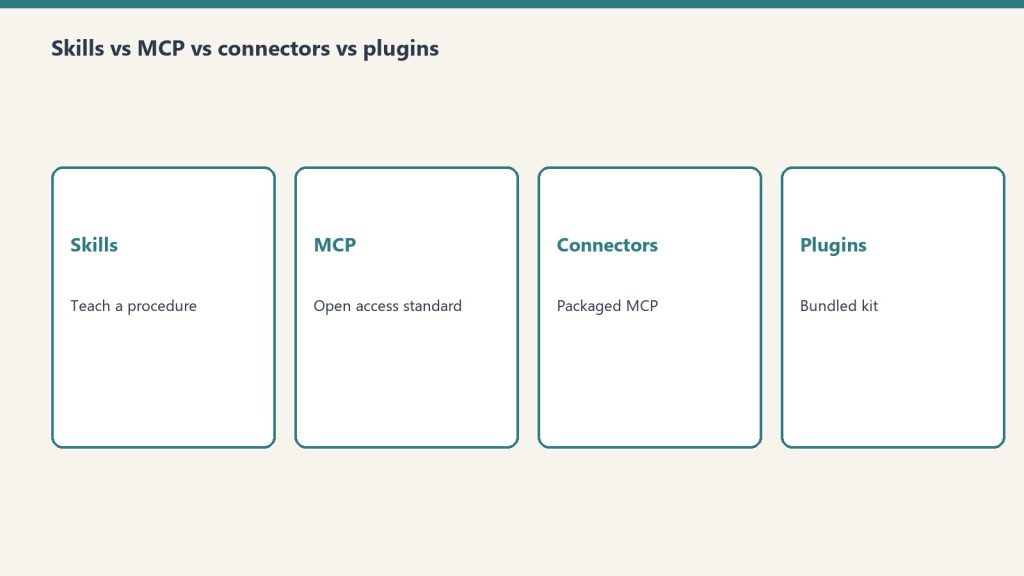
The simplest way to keep these straight: Skills teach Claude how to do a task, MCP servers and Connectors give Claude access to external systems, Plugins bundle several of these together, and Hooks and slash commands control a Claude Code session. A Skill is a folder of instructions Claude reads when relevant (Anthropic agent Skills docs). MCP (the Model Context Protocol) is an open standard that connects Claude to your tools and data (MCP docs; also Anthropic Trust Center). A Connector is Anthropic’s packaging of a remote MCP server inside the Claude apps. A Plugin packages any combination of commands, agents, MCP servers, hooks, and skills for Claude Code. Every definition below is taken verbatim from Anthropic’s official documentation, fetched on the verification date.
The one-glance comparison
One-glance comparison of the four extension surfaces.
This is the liftable summary. Each row is one mechanism; the third column is the distinction people most often get wrong — whether the thing teaches Claude how to do something or gives Claude access to something.
Type
What it is
Teaches-HOW or gives-ACCESS
Where it runs
How you install / enable it
Skill
A modular capability that packages instructions, metadata, and optional resources (scripts, templates) in a SKILL.md file that Claude uses automatically when relevant.
Teaches HOW. Provides domain-specific expertise: workflows, context, and best practices (procedural knowledge).
In Claude’s code execution environment / VM, where Claude has filesystem access, bash, and code execution.
claude.ai: upload a zip under Settings > Features. API: upload via the Skills API (/v1/skills) with the required beta headers (code-execution-2025-08-25, skills-2025-10-02, files-api-2025-04-14). Claude Code: a SKILL.md directory under ~/.claude/skills/ or .claude/skills/.
MCP server
An implementation of the Model Context Protocol — “an open-source standard for connecting AI applications to external systems.” Described as “a USB-C port for AI applications.”
Gives ACCESS. Connects Claude to data sources, tools, and workflows so it can access information and perform tasks.
Local (stdio) servers run as processes on your machine; remote servers run over HTTP (recommended) or SSE (deprecated).
In Claude Code: claude mcp add, at local, project, or user scope. Also configurable in .mcp.json or imported from Claude Desktop / claude.ai.
Connector
A feature that “let[s] Claude access your apps and services, retrieve your data, and take actions within connected services.” Custom connectors use remote MCP.
Gives ACCESS. Same access role as MCP — a Connector is the in-app packaging of a remote MCP server.
Custom connectors are reached from Anthropic’s cloud infrastructure, not from your local machine.
In the Claude apps under Customize > Connectors (or the in-chat “+” menu). Add a directory connector, or “Add custom connector” by URL.
Plugin
“A lightweight way to package and share any combination of” Claude Code customizations.
Both — it’s a container. Bundles things that teach HOW (commands, skills) and things that give ACCESS (MCP servers), plus hooks and subagents.
In Claude Code — “they’ll work across your terminal and VS Code.”
The /plugin command (public beta). For a marketplace: /plugin marketplace add user-or-org/repo-name, then install from the /plugin menu.
Hook
“User-defined shell commands, HTTP endpoints, or LLM prompts that execute automatically at specific points in Claude Code’s lifecycle.”
Controls behavior. Provides deterministic control rather than relying on the LLM to decide.
In Claude Code, firing at lifecycle events (e.g. PreToolUse, PostToolUse, UserPromptSubmit, SessionStart, Stop).
Configured in JSON settings files such as ~/.claude/settings.json or .claude/settings.json, or bundled in a plugin.
Slash command
A command starting with / that controls a Claude Code session. Includes built-ins (e.g. /help, /compact) and custom commands.
Teaches HOW (custom) / controls session (built-in). Custom commands have been merged into Skills.
In the Claude Code session (terminal or VS Code).
Built-ins ship with Claude Code. Custom: a Markdown file under .claude/commands/ (project) or ~/.claude/commands/ (personal); a .claude/skills/<name>/SKILL.md does the same.
Skills: teaching Claude a procedure
Skills: teaching Claude a procedure.
An Agent Skill is “a directory containing a SKILL.md file” with YAML frontmatter plus instructions, and optionally additional markdown files, executable scripts, and reference resources. The point is procedural knowledge — it turns “general-purpose agents into specialists” by giving Claude the workflows and best practices for a task, the way you’d write an onboarding guide for a new teammate. Anthropic ships pre-built Skills for PowerPoint, Excel, Word, and PDF, and you can author your own.
What makes Skills cheap to install in bulk is progressive disclosure: Claude loads information in stages instead of all at once. The numbers below come straight from Anthropic’s Skills overview.
Loading level
When loaded
Token cost (per Anthropic docs)
Content
Level 1: Metadata
Always, at startup
~100 tokens per Skill
name and description from the YAML frontmatter
Level 2: Instructions
When the Skill is triggered
Under 5k tokens
The SKILL.md body — workflows and guidance
Level 3+: Resources
As needed
Effectively unlimited
Bundled files read or executed via bash without loading their contents into context
The name field is capped at 64 characters (lowercase letters, numbers, hyphens; it cannot contain the reserved words “anthropic” or “claude”), and the description is capped at 1,024 characters. One important constraint: custom Skills do not sync across surfaces — a Skill uploaded to claude.ai is not automatically available via the API, and Claude Code Skills are filesystem-based and separate from both.
MCP: the open standard for access
MCP: the open standard for access.
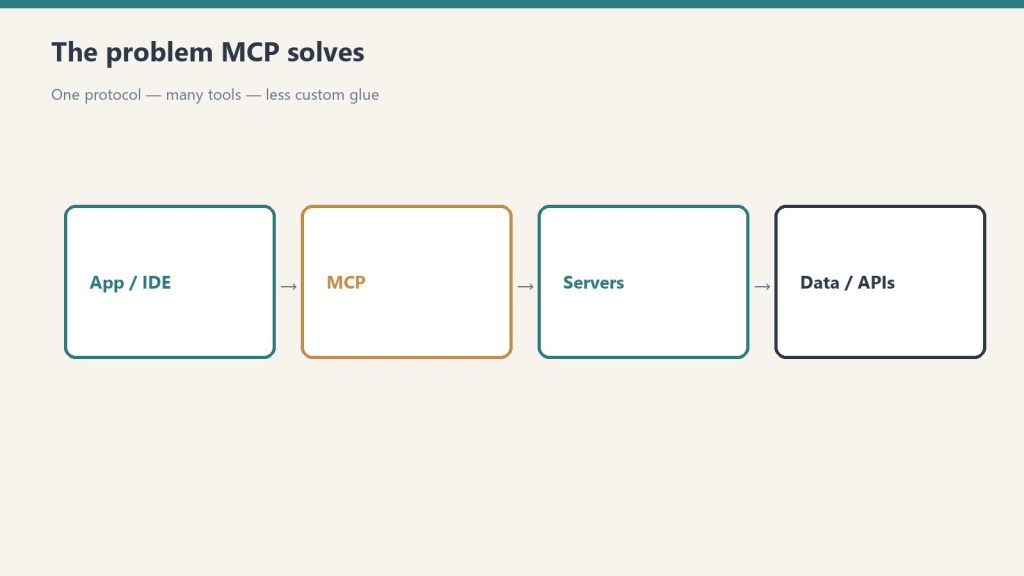
The Model Context Protocol is, in Anthropic’s words, “an open-source standard for connecting AI applications to external systems.” The canonical analogy: “Think of MCP like a USB-C port for AI applications. Just as USB-C provides a standardized way to connect electronic devices, MCP provides a standardized way to connect AI applications to external systems.” Using MCP, “AI applications like Claude or ChatGPT can connect to data sources (e.g. local files, databases), tools (e.g. search engines, calculators) and workflows (e.g. specialized prompts).”
An MCP server can expose three kinds of building block — tools, resources, and prompts. In Claude Code, resources are referenced with @server:protocol://resource/path and prompts surface as commands in the form /mcp__servername__promptname. You connect a server with claude mcp add, choosing a transport and a scope:
Scope
Loads in
Shared with team
Stored in
Local (default)
Current project only
No
~/.claude.json
Project
Current project only
Yes, via version control
.mcp.json in project root
User
All your projects
No
~/.claude.json
For transports, HTTP is “the recommended option for connecting to remote MCP servers,” local stdio servers “run as local processes on your machine,” and SSE is explicitly marked deprecated in favor of HTTP.
Connectors: MCP, packaged for the apps
A Connector is how the Claude apps surface MCP. Per Anthropic’s help center, “Connectors let Claude access your apps and services, retrieve your data, and take actions within connected services,” and “Custom connectors using remote MCP are available on Claude, Cowork, and Claude Desktop.” So a Connector is not a different technology from MCP — a custom connector is a remote MCP server wired into the Claude UI.
The most consequential detail is where the connection originates: “Custom connectors (remote MCP servers) are reached from Anthropic’s cloud infrastructure, not from your local machine.” That means a custom-connector MCP server must be reachable over the public internet — one hosted only on a private network, behind a VPN, or blocked by a firewall will not connect even if you can reach it yourself.
Aspect
Directory (pre-built) connector
Custom connector
Source
Pre-built integrations in the Connectors Directory
Added by you via a remote MCP server URL
Plan availability
Available across Claude plans
Free, Pro, Max, Team, and Enterprise
Free-plan limit
Per directory
“Free users are limited to one custom connector.”
Where to add it
Customize > Connectors, or the in-chat “+” > Connectors > Manage connectors
Plugins: a bundle, not a single thing
A Plugin is “a lightweight way to package and share any combination of” Claude Code customizations. The official announcement lists four bundle components, and the Claude Code documentation adds skills as a fifth thing a plugin can carry:
Component
What it adds
Slash commands
Custom shortcuts for frequently-used operations
Subagents
Purpose-built agents for specialized development tasks
MCP servers
Connections to tools and data sources through MCP
Hooks
Customizations of Claude Code’s behavior at key workflow points
Skills
Per the Claude Code docs, a plugin can include a skills/ directory; plugin skills use a plugin-name:skill-name namespace
You install a plugin “directly within Claude Code using the /plugin command.” To pull from a marketplace — “curated collections where other developers can discover and install plugins” — you run /plugin marketplace add user-or-org/repo-name and then install from the /plugin menu. Plugins “work across your terminal and VS Code.” Plugins were announced on October 9, 2025, as a public beta for all Claude Code users.
Hooks and slash commands: controlling the session
The last two mechanisms aren’t about adding capability — they’re about controlling a Claude Code session. Hooks are “user-defined shell commands, HTTP endpoints, or LLM prompts that execute automatically at specific points in Claude Code’s lifecycle.” Their defining property is determinism: they provide deterministic control rather than relying on the LLM to make decisions. A PreToolUse hook can, for example, block a destructive rm -rf command regardless of what Claude intended. Hooks are configured in JSON settings files (such as ~/.claude/settings.json or a project’s .claude/settings.json) and fire at events including SessionStart, UserPromptSubmit, PreToolUse, PostToolUse, and Stop.
Slash commands start with / and control the session. Built-in commands like /help and /compact ship with Claude Code. Custom commands are Markdown files — a project command lives at .claude/commands/<name>.md and a personal one at ~/.claude/commands/<name>.md, with the file name becoming the command. As of the 2026 Claude Code docs, custom commands have been merged into Skills: a file at .claude/commands/deploy.md and a skill at .claude/skills/deploy/SKILL.md “both create /deploy and work the same way,” and existing .claude/commands/ files keep working.
Is a Connector the same as an MCP server?
Effectively yes, for custom connectors. Anthropic states “Custom connectors using remote MCP are available on Claude, Cowork, and Claude Desktop,” and that they “are reached from Anthropic’s cloud infrastructure.” A Connector is the Claude-app packaging of a remote MCP server; MCP is the underlying open standard.
What’s the difference between a Skill and an MCP server?
A Skill teaches Claude how to do a task — it “provide[s] Claude with domain-specific expertise: workflows, context, and best practices.” An MCP server gives Claude access to external systems — it connects Claude “to data sources, tools and workflows.” One is procedural knowledge; the other is a connection.
Do Skills cost a lot of context tokens?
Not until used. Per Anthropic’s docs, Level 1 metadata costs about 100 tokens per Skill and is always loaded; the full SKILL.md body (under 5k tokens) only loads when the Skill is triggered; and bundled resources are read on demand with effectively no upfront cost. This is the “progressive disclosure” design.
What can a Claude Code plugin contain?
“Any combination of” slash commands, subagents, MCP servers, and hooks, per the announcement; the Claude Code documentation adds that a plugin can also bundle a skills/ directory. You install one with the /plugin command, optionally from a marketplace added via /plugin marketplace add.
Are custom slash commands still a thing?
They still work, but they’ve been folded into Skills. The Claude Code docs state custom commands “have been merged into skills,” that existing .claude/commands/ files keep working, and that a command file and an equivalent SKILL.md both produce the same / command. Skills add optional extras like supporting files and automatic invocation.
Last verified: October 6, 2026 — retirement dates per Anthropic model deprecations.
Claude Opus 4 (claude-opus-4-20250514) and Claude Sonnet 4 (claude-sonnet-4-20250514) are deprecated and retire on June 15, 2026, after which requests to them return a 404. The official replacements are claude-opus-4-8 and claude-sonnet-4-6. But swapping the model string alone will break a working integration: depending on which target you choose, several request parameters that were valid on the May 2025 models now return a 400 error, and two changes alter behavior silently. This page maps each removed or changed parameter to the exact failure and the fix.
One distinction governs the whole migration. The Opus path (to claude-opus-4-8) is the strict one: it removes temperature/top_p/top_k and manual thinking budgets entirely. The Sonnet path (to claude-sonnet-4-6) is gentler: it keeps sampling parameters (with the older “one of temperature or top_p, not both” rule) and still accepts budget_tokens as deprecated-but-functional. The one rule both paths share: assistant-turn prefills now return 400.
The breaking-change matrix
The breaking-change matrix.
Each row is a change that breaks on at least one migration target. “Error” means the API rejects the request server-side (HTTP 400) even though the SDK request type still type-checks. “Silent” means no error — the behavior simply differs.
These are the original May 2025 models, not the later Opus 4.6 or Sonnet 4.5 releases. Use the exact replacement strings above — do not append a date suffix to claude-opus-4-8 or claude-sonnet-4-6 (they are dateless pinned snapshots).
budget_tokens to adaptive thinking
The Opus path removes the fixed thinking budget. thinking: {type:"enabled", budget_tokens:N} returns a 400 on claude-opus-4-8. The replacement is adaptive thinking — the model decides how much to think per request — with overall depth controlled by the effort parameter (low | medium | high | xhigh | max). There is no direct token-count equivalent; effort is an output-level control, not a thinking budget.
# Before (Claude Opus 4 / Sonnet 4)
client.messages.create(
    model="claude-opus-4-20250514",
    max_tokens=16000,
    thinking={"type": "enabled", "budget_tokens": 10000},
    messages=[{"role": "user", "content": "..."}],
)

# After (Claude Opus 4.8)
client.messages.create(
    model="claude-opus-4-8",
    max_tokens=16000,
    thinking={"type": "adaptive"},
    output_config={"effort": "high"},  # or "max", "xhigh", "medium", "low"
    messages=[{"role": "user", "content": "..."}],
)
On the Sonnet path, budget_tokens is deprecated but still functional on claude-sonnet-4-6, so it will not 400 — but you should still migrate to adaptive thinking. Note also that Sonnet 4.6 defaults to effort: "high" where Sonnet 4 had no effort parameter at all; if you do not set it explicitly you may see higher latency and token use after the swap.
Sampling parameters: removed vs. restricted
Sampling parameters — removed vs restricted.
This is where the two paths diverge most. On claude-opus-4-8, setting temperature, top_p, or top_k to any non-default value returns a 400. Remove them entirely and steer behavior through prompting instead. (If you used temperature=0 for determinism, note it never guaranteed identical outputs on prior models either.)
# Opus path — sampling params 400 on claude-opus-4-8
# Before
client.messages.create(
    model="claude-opus-4-20250514",
    temperature=0.7,
    top_p=0.9,
    messages=[...],
)

# After — remove them
client.messages.create(
    model="claude-opus-4-8",
    messages=[...],
)
On claude-sonnet-4-6 the older Claude 4.x rule still applies: you may pass one of temperature or top_p, but passing both returns a 400. So a Sonnet 4 to Sonnet 4.6 move only requires dropping one of the two if you were setting both.
Assistant-turn prefills to structured outputs
Prefilling the final assistant turn — ending your messages array with a role: "assistant" message to force a response shape — returns a 400 on bothclaude-opus-4-8 and claude-sonnet-4-6. This is the one breaking change you cannot dodge by choosing the gentler target. The replacement depends on what the prefill was doing.
Prefill was used for
Replacement
Forcing JSON / YAML / schema output
output_config.format with a json_schema
Forcing a classification label
A tool with an enum field, or structured outputs
Skipping preambles (“Here is…”)
System-prompt instruction: respond directly, no preamble
Continuing an interrupted response
Move continuation into the user turn
Steering around bad refusals
Usually unnecessary now — plain user-turn prompting suffices
# Before (fails on both targets) — prefill forcing JSON shape
messages=[
    {"role": "user", "content": "Extract the name."},
    {"role": "assistant", "content": "{\"name\": \""},
]

# After — structured outputs replace the prefill
client.messages.create(
    model="claude-opus-4-8",
    max_tokens=1024,
    output_config={"format": {"type": "json_schema", "schema": SCHEMA}},
    messages=[{"role": "user", "content": "Extract the name."}],
)
Thinking display: the silent one
On claude-opus-4-8, thinking blocks still stream, but their thinking text field is empty unless you opt in — the default is display: "omitted". There is no error; if your UI rendered the summarized reasoning, it now shows a long pause before output. Restore it by setting the display mode:
thinking = {
    "type": "adaptive",
    "display": "summarized",  # default is "omitted" on Opus 4.8/4.7
}
The block-field name is unchanged — it is still block.thinking on a thinking-type block. The fix is the request parameter, not the response-handling code. (Sonnet 4.6 is not affected by this default change.)
The new tokenizer: re-baseline max_tokens
This change is Opus-only and easy to miss because it produces no error. claude-opus-4-8 uses the tokenizer introduced with Opus 4.7, under which the same text tokenizes to roughly 1x–1.35x as many tokens — up to about 35% more, around 30% on typical content, varying by workload. Three consequences:
What to check
Why
max_tokens ceilings and compaction triggers
The same output now consumes more tokens; tight limits truncate mid-thought
Calibrated against the old tokenizer; now undercount
Cost and rate-limit dashboards
count_tokens returns higher numbers; re-baseline before reacting
Re-run client.messages.count_tokens(model="claude-opus-4-8", ...) on a representative sample of your prompts. Do not apply a blanket multiplier. Sonnet 4.6 keeps the older tokenizer, so a Sonnet 4 to Sonnet 4.6 move has no tokenizer re-baseline to do.
The full checklist
Step
Opus 4 to 4.8
Sonnet 4 to 4.6
Update model ID string
Required
Required
Replace budget_tokens with adaptive thinking
Required (400)
Recommended (deprecated)
Sampling params
Remove all (400)
Keep only one (both 400)
Remove assistant-turn prefills
Required (400)
Required (400)
Set display: "summarized" if showing reasoning
Required for visible thinking
Not applicable
Re-baseline max_tokens for new tokenizer
Required
Not applicable
Set effort explicitly
Defaults to high
Defaults to high
Move output_format to output_config.format
Recommended
Recommended
Verify tool inputs parsed with a JSON parser
Recommended
Recommended
Spot-check one request, then roll out
Required
Required
If you run Claude Code, /claude-api migrate applies the model swap, breaking-parameter changes, prefill replacement, and effort calibration across a codebase, then produces a verify-it-yourself checklist. It asks you to confirm scope before editing any files.
Is migrating off Claude Opus 4 really not just a model-string change?
No. Moving to claude-opus-4-8 also requires removing temperature/top_p/top_k and any budget_tokens (all now return 400), removing assistant-turn prefills (400), opting back into summarized thinking if your UI shows it, and re-baselining max_tokens for the new tokenizer. Only the Sonnet 4 to Sonnet 4.6 move is close to a drop-in — and even that requires removing prefills.
When exactly do Claude Opus 4 and Sonnet 4 stop working?
June 15, 2026. After that date, requests to claude-opus-4-20250514 and claude-sonnet-4-20250514 return a 404. These are the original May 2025 models, not Opus 4.6 or Sonnet 4.5.
What replaces budget_tokens now that it errors on Opus?
Adaptive thinking (thinking: {type:"adaptive"}) plus the effort parameter inside output_config. There is no exact token-count equivalent: the model decides how much to think per request, and effort (low through max) tunes overall depth and spend. On Sonnet 4.6, budget_tokens still works but is deprecated.
Why does the same prompt cost more tokens on Opus 4.8?
Opus 4.8 uses the tokenizer introduced with Opus 4.7, under which the same text produces roughly 1x–1.35x as many tokens (about 30% more on typical content, up to ~35%). Re-run the count_tokens endpoint against claude-opus-4-8 and give max_tokens and compaction triggers extra headroom. Sonnet 4.6 keeps the older tokenizer, so it is unaffected.
My thinking summaries disappeared after migrating to Opus — is that a bug?
No. On Opus 4.8 (and 4.7), thinking.display defaults to "omitted", so thinking blocks stream with an empty text field. Set display: "summarized" in your thinking config to restore visible reasoning. The field name is unchanged; only the default flipped.