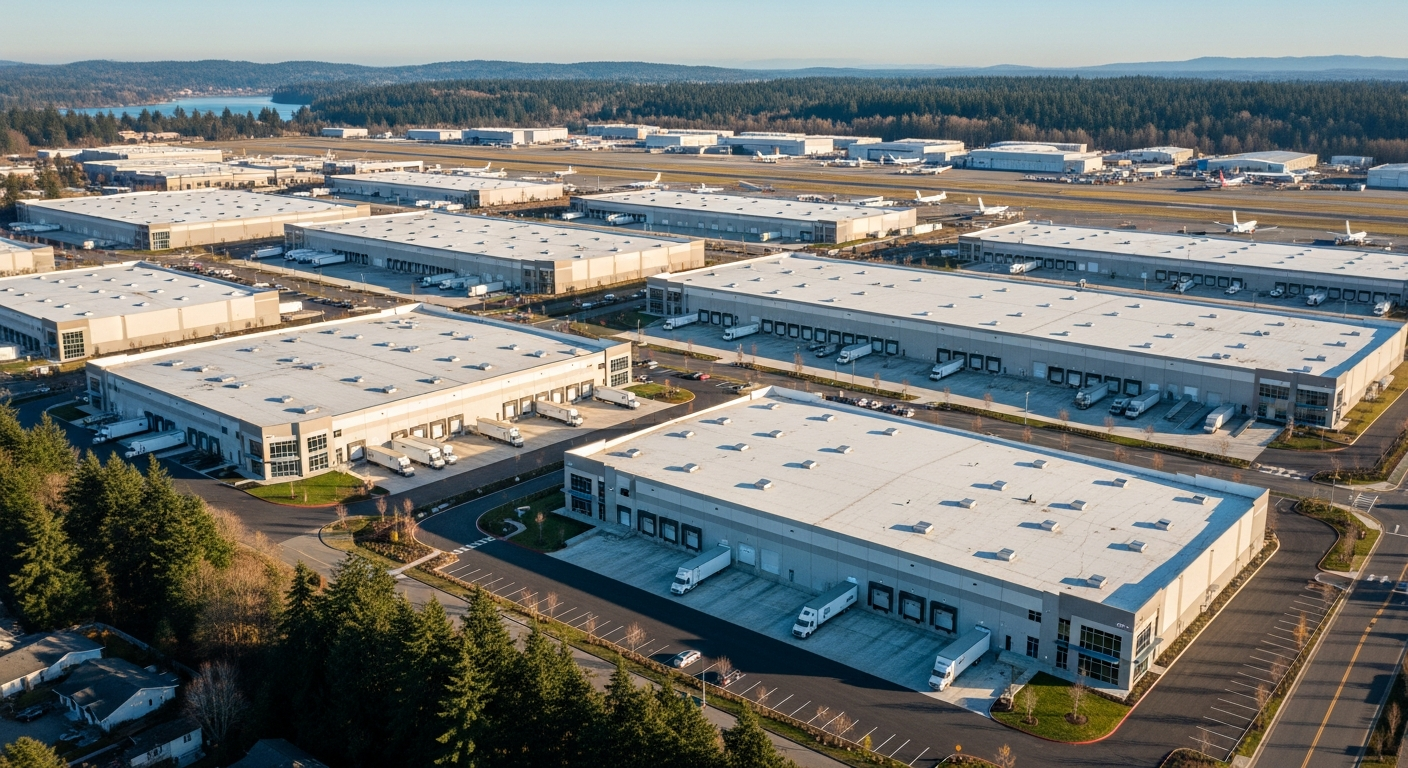
Q: How much does warehouse space cost in Snohomish County in 2026?
A: Snohomish County warehouse rents in 2026 are running approximately $0.70 to $1.00 per square foot monthly on a triple-net basis — the most affordable warehouse market in the Puget Sound region. The broader Seattle metro ranges from $0.70 to $1.60/SF monthly, making Snohomish County the value end of the market by a significant margin.
The Number That Matters: $0.70 to $1.00 per Square Foot
If you’re an Everett-area business looking for industrial or warehouse space in 2026, the market conditions haven’t been this favorable in over a decade. Snohomish County’s warehouse and industrial rents are running $0.70 to $1.00 per square foot monthly (NNN), making it the most affordable industrial submarket in the entire Puget Sound region, according to WareCRE’s 2026 Seattle Warehouse Market Report. That’s below Southend markets like Kent and Renton, below Pierce County, and well below the Seattle in-city markets at the top of the range.
To put that in annual terms: $0.70 to $1.00/SF monthly is $8.40 to $12.00/SF annually on a triple-net lease. For a 20,000-square-foot distribution or manufacturing facility, that’s $168,000 to $240,000 per year in base rent — before operating expenses that you’re responsible for as a tenant under NNN terms, but still well below what comparable space costs in King County.
And those asking rents are the ceiling right now, not the floor. Kidder Mathews’ Q1 2026 Seattle Industrial Market Report shows vacancy at 10.39 percent across the Seattle metro industrial market, up from 9.74 percent at year-end 2025. At that vacancy level, with net absorption running negative (-130,751 square feet absorbed in Q1 2026) and only two speculative projects totaling 478,740 square feet under construction across the entire market, landlords are dealing. Effective rents — after concessions like free rent periods and tenant improvement allowances — are running below the published asking rates across the region.
The Market Context: Why It’s the Best Tenant Window in a Decade
The Puget Sound industrial market is correcting from a 2021-2022 boom cycle that pushed vacancy to historic lows. Speculative development that was planned during that peak is now delivering into a softened demand environment. The result is the most tenant-friendly industrial market the region has seen in more than ten years.
Cushman & Wakefield’s April 2026 Industrial MarketBeat report describes the national picture this way: “Peak industrial vacancy likely in rearview mirror as demand holds and supply slows.” The national vacancy rate ended Q1 2026 at 7.0 percent — flat with year-end 2025, and 10 basis points below the Q3 2025 peak. The West region runs hotter than the national average at 7.9 percent, and Seattle specifically came in at 9.7 percent for Q1 2026.
That 9.7 percent Seattle metro figure blends markets with very different profiles — Southend logistics hubs, South Seattle last-mile space, and Eastside flex. Snohomish County’s position within that range reflects its role as the region’s industrial value market: strong fundamentals, affordable rents, and proximity to the Port and to Paine Field’s aerospace manufacturing cluster without the price premium of South King County.
Tariffs have added a wrinkle to the demand picture. Container volume growth at the Northwest Seaport Alliance reversed from 16 percent year-over-year to 0.2 percent, according to WareCRE’s 2026 report — a direct effect of tariff uncertainty on import volumes. For Everett specifically, which handles breakbulk and project cargo rather than containerized imports, this tariff impact is less acute than it is for the container-focused markets south of Seattle. But it’s part of the broader softening that has tilted conditions toward tenants.
What This Means for Everett Businesses Specifically
For businesses in the Everett corridor — manufacturing, distribution, aerospace supply chain, construction materials — Q1 2026 is the moment to renegotiate or explore. A few specific scenarios:
If you’re renewing a lease: Don’t auto-renew. Take this market to your landlord and negotiate. Vacancy is up, absorption is negative, and landlords are offering concessions that weren’t available 18 months ago. Free rent periods, tenant improvement allowances, and rate reductions are all on the table in a 10-percent-vacancy market.
If you’re looking for your first industrial space: Snohomish County’s $0.70 to $1.00/SF range gives you significant square footage for your budget. The Port of Everett’s bonded warehouse space, Norton Terminal cargo yard, and on-dock rail connection make this a particularly attractive location for businesses with freight-intensive operations.
If you’re an aerospace or defense supplier: The Port of Everett Seaport — which just landed an $11.25 million federal grant to rebuild Pier 3 — is actively expanding its cargo-handling capacity. Industrial space near the Port and near Paine Field puts you in the middle of that ecosystem at the market’s most affordable price point.
The Port’s Industrial Footprint: What’s Already There
The Port of Everett is not just a transshipment point — it’s an industrial anchor. The Seaport campus includes Norton Terminal (40 acres, paved, lit, and secured), bonded warehouse space, a 15-acre secondary cargo yard, 40-foot MLLW deep-water access, and on-dock rail. That infrastructure supports freight-intensive tenants at a scale that most Puget Sound industrial parks can’t replicate.
The Port’s broader economic footprint — $21 billion in U.S. exports annually, 40,000-plus jobs supported, $433 million in state and local tax revenues — makes Snohomish County’s industrial corridor one of the most economically active in the Pacific Northwest, despite not getting the same press as South King County’s distribution hubs.
The Snohomish County office market also showed improvement in Q1 2026, with vacancy ticking down to 10.7 percent and posting a third consecutive quarter of positive net absorption. The industrial and office markets are telling a consistent story: Snohomish County is a market with more space available than King County, at lower prices, and with occupiers slowly returning.
What Comes Next
With only two industrial construction projects totaling 478,740 square feet active across the Seattle metro, new supply isn’t going to flood the Snohomish County market in the next 12 to 18 months. Cushman & Wakefield’s assessment — that peak vacancy may be behind us — suggests the window of maximum tenant leverage may be closing at the national level, even if local conditions lag that trend by a quarter or two.
For Everett: the Pier 3 rebuild will take multiple years from planning through construction, but when it’s done, the Port will have a pier capable of handling more diverse and heavier freight. That means more industrial activity flowing through the waterfront corridor, more demand for warehouse and staging space near the Seaport, and a strengthened case for industrial site selection decisions that prioritize proximity to the Port.
Right now, $0.70 to $1.00/SF is the entry price. That’s the Snohomish County advantage — and in this market, it’s also the moment to use it.
Frequently Asked Questions
What is the average warehouse rent in Snohomish County in 2026?
Snohomish County warehouse rents are approximately $0.70 to $1.00 per square foot monthly (NNN) in 2026, making it the most affordable industrial submarket in the Puget Sound region. The broader Seattle metro ranges from $0.70 to $1.60/SF monthly.
Is the Seattle industrial real estate market a buyer’s or tenant’s market right now?
As of Q1 2026, it is the most tenant-friendly industrial market in over a decade. Vacancy is at 10.39 percent across the Seattle metro, net absorption was negative in Q1 2026, and landlords are offering concessions including free rent and TI allowances.
How does tariff uncertainty affect the Snohomish County industrial market?
Tariffs reversed container volume growth at the Northwest Seaport Alliance from 16 percent year-over-year to 0.2 percent, softening demand in logistics-heavy submarkets. Snohomish County and the Port of Everett, which focus on breakbulk and project cargo rather than containerized imports, are somewhat insulated from this trend.
Where is industrial space available near the Port of Everett?
The Port of Everett Seaport campus includes Norton Terminal (40 acres), bonded warehouse space, a 15-acre secondary cargo yard, and on-dock rail. Additional industrial space in the Everett corridor is available through commercial brokers; the Port’s business development team can also connect businesses with Port-adjacent space options.
Is now a good time to lease industrial space in Everett?
Q1 2026 represents favorable conditions for tenants: vacancy is elevated, new supply is limited, and landlords are offering concessions. Cushman & Wakefield’s April 2026 report suggests peak industrial vacancy may be in the rearview nationally, which means the current window of maximum tenant leverage may be narrowing.
Leave a Reply