Related on Tygart Media: GEO tactics · AI search funnel · SEO vs GEO vs AEO.
Category: AEO — Answer Engine Optimization
-

The Citation Block Pattern: Format AEO Answers for AI
Answer engine optimization in 2026 has narrowed to a single tactical question: when an AI system synthesizes a response, which sentence does it lift, and which source does it cite? The answer is no longer theoretical. Google AI Overviews now appear on 50–60% of U.S. searches, ChatGPT and Perplexity surface inline citations on most factual queries, and the content that gets pulled shares a structural fingerprint. That fingerprint is the citation block — a 40-to-60 word standalone answer placed immediately under a question-shaped heading. This article shows you the exact pattern, the heading-to-answer mapping that wins extraction, and a before-and-after rewrite you can apply to any existing post today.
Why the 40–60 word window exists
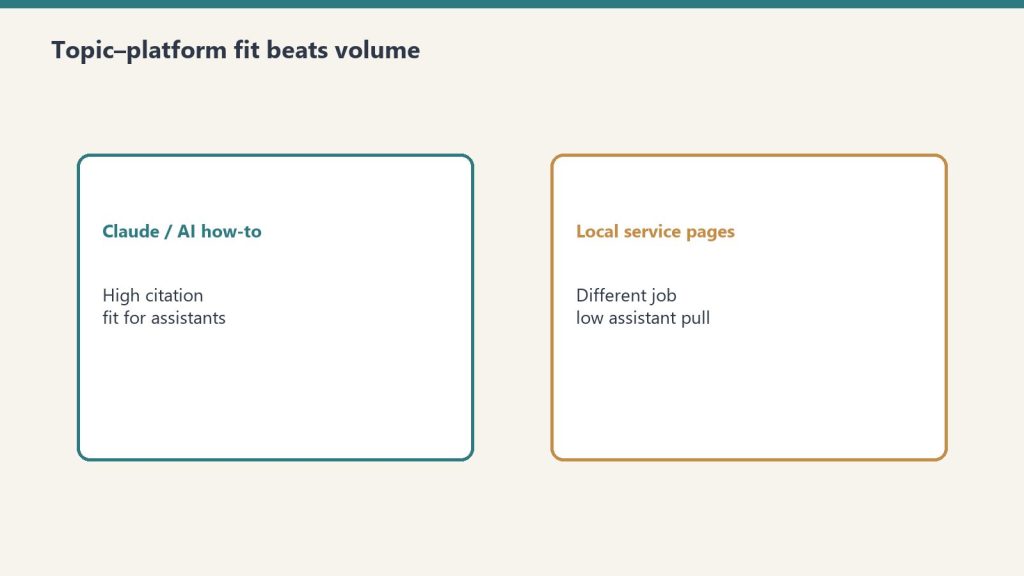
Why the 40–60 word window exists. A citation block is the first 40 to 60 words of prose that sits directly beneath a question-shaped H2 or H3 and answers that question in full without requiring any surrounding sentences for context. It must be self-contained, factually specific, and parseable as a single semantic chunk.
Large language models retrieve passages, not paragraphs. When ChatGPT, Claude, Gemini, or Perplexity assembles a response, the retrieval step pulls discrete text spans that the synthesis step then weaves into the final answer. Shorter spans get attributed more cleanly because they fit inside a single citation token without truncation. The 40–60 word window is the practical sweet spot: long enough to be a complete answer, short enough that the model does not need to summarize or compress it before citing.
Featured snippets reinforce the same pattern. Google’s paragraph snippets average roughly 40–50 words and are extracted, not generated, which means a well-formed citation block can win both the traditional snippet slot and the AI Overview citation in the same crawl.
The structural rule: one question, one heading, one block
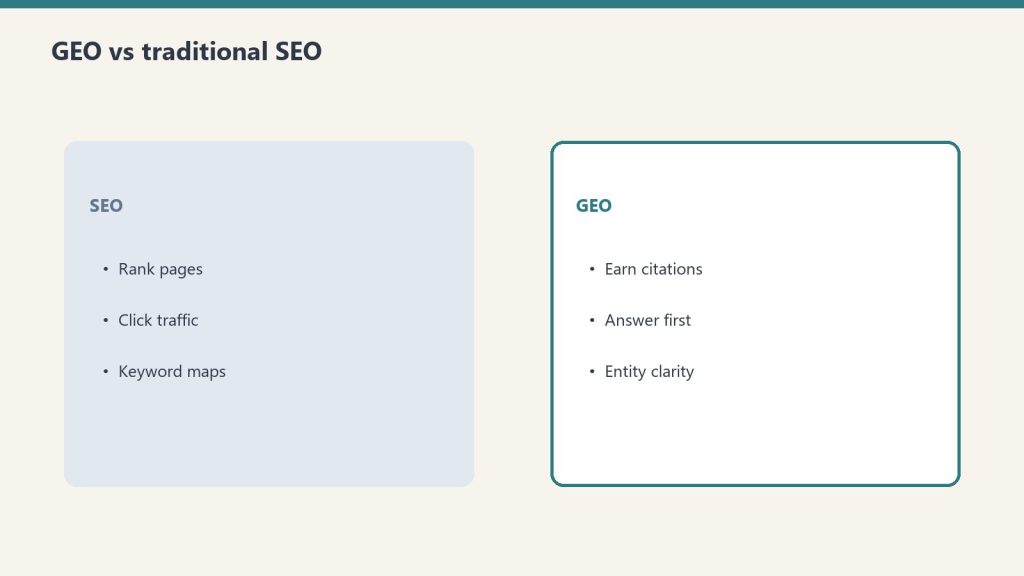
One question, one heading, one block. The pattern is mechanical. Take the exact question wording a user would type — or that already appears in a People Also Ask box — and use it verbatim or near-verbatim as the heading. Directly under that heading, write a 40–60 word answer that opens with the subject of the question, contains the specific claim, and closes the loop without trailing off into a transition.
This is the wrong way to structure an FAQ-style section:
<h3>Schema Markup</h3>
<p>There are many forms of structured data you can use. Some people prefer JSON-LD, while others use microdata. We'll discuss the pros and cons of each in the next section, but first let's talk about why schema matters at all in the modern search landscape...</p>
This is the right way:
<h3>What schema markup should you use for AEO?</h3>
<p>Use JSON-LD format with FAQPage schema for question-answer sections, Article schema on the post itself, and BreadcrumbList for navigation context. JSON-LD is Google's recommended format, sits in the page head without affecting visible content, and is the schema type AI crawlers parse most reliably. Add HowTo or QAPage schema only when content genuinely matches those structures.</p>
The second version puts the question verbatim in the heading, opens the answer with the recommendation, names the specific schema types, and closes inside the 40–60 word window. Anywhere this pattern repeats across a page, you stack extraction surface area.
FAQPage schema: the multiplier
FAQPage JSON-LD pre-formats your citation blocks for machine consumption. Once a section is wrapped in FAQPage schema, Google, Bing, and most LLM crawlers can ingest the question-answer pairing without needing to infer it from HTML structure. Pages with properly implemented FAQPage schema are reported to earn AI citations at materially higher rates than pages relying on heading hierarchy alone.
Here is the minimum viable FAQPage block for a single question:
<script type="application/ld+json">
{
  "@context": "https://schema.org",
  "@type": "FAQPage",
  "mainEntity": [{
    "@type": "Question",
    "name": "What schema markup should you use for AEO?",
    "acceptedAnswer": {
      "@type": "Answer",
      "text": "Use JSON-LD format with FAQPage schema for question-answer sections, Article schema on the post itself, and BreadcrumbList for navigation context. JSON-LD is Google's recommended format, sits in the page head without affecting visible content, and is the schema type AI crawlers parse most reliably."
    }
  }]
}
</script>
The “text” value should be identical or near-identical to the visible citation block beneath the heading. Identical text reduces the parsing burden on AI crawlers and removes any ambiguity about which sentence is the canonical answer.
Before-and-after: rewriting a thin section
Here is a real pattern you will recognize from your own archive. The before is a thin sub-section that buries the answer; the after is the same content restructured for extraction.
Before:
<h3>Voice Search</h3>
<p>Voice search has been growing for years, and many SEOs still don't take it seriously. With smart speakers in millions of homes, the way people search is changing fast. You have to think about how someone would actually ask a question out loud versus typing it. This affects everything from keyword research to content structure...</p>
After:
<h3>How do you optimize content for voice search in 2026?</h3>
<p>Optimize for voice search by writing direct answers to natural-language questions in 40–60 word blocks, using conversational question phrasing in your H2s and H3s, and adding Speakable schema to mark which sentences a voice assistant should read aloud. Target long-tail conversational queries — phrasing like "how do you," "what is the best way to," and "where can I find" — rather than truncated typed-search keywords.</p>
The rewrite swaps a topic-shaped heading for a question, leads with the specific implementation, names the schema type, and ends inside the extraction window. That single restructure turns a passive paragraph into a citation candidate.
How to audit an existing page in 15 minutes

Audit an existing page in 15 minutes. Open any of your highest-traffic posts and run this checklist. For each H2 and H3, ask whether the heading is phrased as a question a user would actually type. If not, rewrite it. For each section under those headings, read the first 60 words and ask whether they stand alone as a complete answer. If not, restructure the opening paragraph so the direct answer comes first and the elaboration comes after. Then add FAQPage schema covering the question-answer pairings, with the “text” value matching the visible answer.
The pages that win AI citations in 2026 are not the longest, the most authoritative, or the best-linked. They are the ones whose structure makes the answer impossible to miss. The citation block pattern is how you build that structure on purpose.
Related on Tygart Media: chunk-first GEO · GEO tactics · how AI engines cite.
Frequently Asked Questions
What is a citation block in answer engine optimization?
A citation block is a 40-to-60 word standalone answer placed directly beneath a question-shaped heading. It must answer the question completely without depending on surrounding sentences for context. Citation blocks are the text spans that AI systems like ChatGPT, Perplexity, and Google AI Overviews extract and attribute when synthesizing responses.
How long should an AEO answer be?
Lead each section with a 40-to-60 word direct answer block, then follow with supporting context, examples, or elaboration. The 40–60 word window is long enough to be a complete answer and short enough to fit inside a single AI citation without truncation or summarization, which improves attribution reliability.
Does FAQPage schema still help in 2026?
Yes. FAQPage JSON-LD pre-formats question-answer pairings for machine consumption, which AI crawlers parse more reliably than answers inferred from heading hierarchy alone. The schema’s “text” value should match the visible citation block beneath the heading to remove parsing ambiguity for crawlers.
How is AEO different from traditional SEO?
Traditional SEO optimizes pages to rank in a list of blue links; AEO optimizes specific text spans inside the page so AI systems extract and cite them as direct answers. AEO assumes the user may never click — the goal is the citation itself, with the brand attribution as the conversion event.
-

5 GEO and AEO Case Studies: What Actually Worked in 2026
Most GEO and AEO case studies you can find online are vendor-published and short on implementation detail. So instead of stacking another “look at this 300% lift” headline, this piece walks through five publicly documented results from 2026 — and pulls out the structural change that actually drove the win in each one. If you want to copy what works, copy the structure, not the percentage.
1) HubSpot: 3x lead conversion from AEO traffic
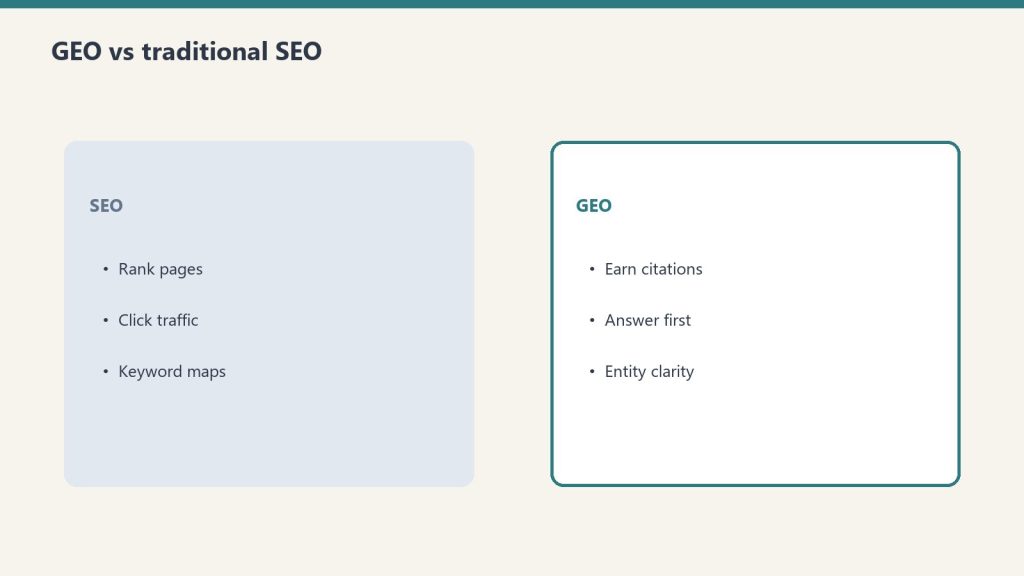
Case patterns: what actually worked in GEO/AEO. HubSpot’s own 2026 State of Marketing reporting found 58% of marketers saying AI-referred visitors convert at higher rates than traditional organic, with HubSpot itself reporting roughly 3x better lead conversion from AEO sources versus other channels. The implementation pattern across HubSpot’s blog: question-led H2s, a 40–60 word direct answer in the first paragraph below the heading, then expanded context, then a structured FAQ block with FAQPage schema.
The before/after isn’t “more content.” It’s “the same content, restructured so the answer arrives in the first 60 words.” That single edit is what featured snippets and AI Overviews both reward.
2) Hashmeta e-commerce client: +50% zero-click visibility
Zero-click visibility lifts without chasing vanity traffic. Hashmeta documented a 50% increase in zero-click visibility for an e-commerce client after a targeted AEO sprint. The lever: rebuilding product and category pages around explicit question intent (“what is the difference between X and Y,” “is X worth it for Z use case”) and adding HowTo and FAQPage schema. The page didn’t get more traffic from the same query — it started winning the answer position on related queries it wasn’t competing for before.
The takeaway for practitioners: zero-click visibility is its own funnel. Track it separately from sessions, because the value shows up in branded search lift two to four weeks later, not in same-day clicks.
3) SaaS brand: 20+ free-trial signups per month from ChatGPT citations

ChatGPT citations can create free-trial demand. One SaaS case study circulating in the GEO community in early 2026 reported 20+ free-trial signups per month attributed directly to ChatGPT citations, identified via a unique UTM and a referral-source filter in their analytics. The structural pattern: a single canonical comparison page per top competitor, written as a third-person reference rather than first-person marketing, with a clear definition block, a structured comparison table, and a “when to choose X” section.
This is the format ChatGPT cites because it’s the format ChatGPT was trained to produce. Match the output shape and you become the source.
4) Generic brand study: 140% lift in AI-driven search traffic
A widely cited 2026 GEO case study reported a 140% increase in LLM and AI-driven search traffic alongside a 62% rise in AI mentions after a strategy that prioritized entity saturation, internal-link clustering, and structured data over keyword density. The implementation detail worth copying: a single hub page per entity with at least 15 distinct factual data points, then 8–12 supporting articles linking back to it with descriptive anchor text.
The 15-data-point threshold matches what GEO researchers have flagged repeatedly: articles with 15+ verifiable data points receive substantially more AI citations than articles with fewer than five.
5) Mangools: featured-snippet capture from a single edit
Mangools published a walkthrough showing how rewriting one blog post to lead with a 50-word direct answer captured a featured snippet for a head-term query, with the resulting traffic and brand exposure outpacing the rest of the content cluster. No new backlinks, no new content — just a structural rewrite of the first 100 words.
The pattern across all five
Every win has the same shape: question-led H2, 40–60 word direct answer, structured supporting content, schema markup. Here is the minimum viable AEO block, drop-in ready:
<h2>What is generative engine optimization?</h2>
<p><strong>Generative engine optimization (GEO) is the practice of structuring web content so AI systems like ChatGPT, Claude, Gemini, and Perplexity cite it as a source.</strong> Unlike SEO, which optimizes for ranking in a list of links, GEO optimizes for being included in a generated answer. The core levers are entity clarity, factual density, structured data, and crawlability via LLMs.txt and robots.txt.</p>

<script type="application/ld+json">
{
  "@context": "https://schema.org",
  "@type": "FAQPage",
  "mainEntity": [{
    "@type": "Question",
    "name": "What is generative engine optimization?",
    "acceptedAnswer": {
      "@type": "Answer",
      "text": "Generative engine optimization (GEO) is the practice of structuring web content so AI systems cite it as a source in generated answers."
    }
  }]
}
</script>
The measurement layer
None of these case studies mean anything without isolation. The minimum tracking stack: a referrer filter for chatgpt.com, perplexity.ai, claude.ai, gemini.google.com, and copilot.microsoft.com in GA4; a separate event for zero-click impressions from Google Search Console; and a manual citation log — query a representative model with your top 25 prompts weekly and record whether your domain is cited. The third one is what most teams skip, and it’s the only one that tells you whether GEO is working before traffic shows up.
What to copy this week
Pick your top five highest-intent pages. For each one, rewrite the first 100 words as a direct-answer block, add a single FAQPage schema with three questions, and add the page to your LLMs.txt manifest. That is the entire implementation. Every case study above is a variation on those three moves.
Related on Tygart Media: GEO case study teardown · GEO tactics · SEO vs GEO vs AEO.