Tacoma - Tygart Media

Category: Tacoma

Tacoma Business Journal coverage

  • Tacoma Public Schools: Enrollment, Rates & Programs

    Tacoma Public Schools: Enrollment, Rates & Programs

    The District at a Glance

    Tacoma Public Schools is Pierce County’s largest school district, serving approximately 28,000-30,000 students across 60+ schools (elementary, middle, and high school levels). It’s the third-largest district in Washington State behind Seattle and Spokane. The district operates within Tacoma city limits and serves a student population that reflects the city’s demographic diversity — approximately 35% white, 20% Hispanic/Latino, 15% Black, 12% Asian/Pacific Islander, 10% multiracial, and 8% other backgrounds.

    For families considering Tacoma, the school district is often the first research topic. This article covers what the data actually shows — not the marketing version and not the complaint-thread version, but the measurable performance and structural realities.

    Enrollment Trends

    Like most urban districts in Washington State, Tacoma Public Schools experienced enrollment decline during and immediately after the pandemic. The district lost approximately 2,000-3,000 students between 2019 and 2022, with partial recovery since. Current enrollment hovers around 28,000-29,000 depending on the school year and count date.

    The enrollment loss was not evenly distributed. Elementary schools in higher-income neighborhoods (North End, Stadium District) maintained enrollment better than schools in south and east Tacoma. Some of the lost students went to private schools, some to neighboring districts (University Place, Puyallup), and some represent families who left Pierce County entirely during the post-pandemic housing churn.

    The district’s response has included school consolidation discussions (controversial and ongoing), increased marketing of magnet and choice programs, and investment in the programs that do attract and retain families.

    Graduation Rates

    Per Washington State OSPI data, Tacoma Public Schools’ four-year graduation rate has improved steadily over the past decade. Recent rates hover in the 82-86% range — above the state average for large urban districts but below some surrounding suburban districts (Puyallup, University Place).

    The graduation rate varies significantly by high school. Schools like Stadium High School and Wilson High School typically report rates in the high 80s to low 90s. Schools serving higher-poverty populations have lower rates but have shown improvement trends.

    The district has invested heavily in dropout prevention and credit recovery programs. The Tacoma Whole Child initiative — a framework addressing student mental health, basic needs, and family support alongside academics — is credited with some of the graduation rate improvement.

    Bond Measures and Facilities

    Tacoma Public Schools has passed several significant bond measures in recent years to address aging facilities. The district’s building stock ranges from 1900s-era structures (some still in use) to modern buildings completed within the last decade.

    Recent bond investments have funded: new or renovated elementary schools, seismic upgrades to older buildings (Tacoma sits in earthquake country), technology infrastructure, and athletic facility improvements. The capital program runs in the hundreds of millions across multi-year bond cycles.

    The political reality: bond measures require 60% voter approval in Washington State (for school construction bonds). Tacoma voters have generally supported these measures, reflecting community willingness to invest in school facilities even when other aspects of district performance generate criticism.

    Standout Programs

    Science and Math Institute (SAMI) at Stadium High School — A competitive-admission STEM magnet program housed within Stadium High School. Students complete a rigorous science/math curriculum with research opportunities. SAMI students consistently represent at regional and state science competitions.

    School of the Arts (SOTA) at Wilson High School — An arts-focused program within Wilson High School offering concentrated study in visual arts, performing arts, and media arts alongside standard academics. Audition-based admission.

    International Baccalaureate (IB) Programme — Lincoln High School hosts a full IB Diploma Programme, offering an internationally recognized curriculum for students seeking college preparation beyond standard AP courses.

    Career and Technical Education (CTE) — The district has expanded CTE pathways significantly, including partnerships with Tacoma Community College for dual-credit offerings. Programs include healthcare, construction trades, IT/cybersecurity, and manufacturing — directly tied to Pierce County’s employment sectors.

    Early College High School / Running Start — Multiple high schools facilitate Running Start enrollment at Tacoma Community College, allowing juniors and seniors to earn college credit (free tuition for state-funded credits) while completing high school requirements.

    What Families Should Know

    Tacoma Public Schools is a large urban district with all the variation that implies. The experience at a high-performing North End elementary school is substantively different from the experience at an under-resourced south Tacoma school — same district, different realities. Families choosing based on district-level statistics will miss this variation.

    The choice/open enrollment system allows families to apply to schools outside their attendance area, though transportation is not provided for choice transfers. This means families with cars and schedule flexibility have more options than those without — an equity issue the district acknowledges but hasn’t fully resolved.

    For families moving to Tacoma: research individual schools, not just the district. Use the OSPI Report Card for school-level data. Visit during school hours if possible. Talk to current parent communities. The quality variation within the district is larger than the variation between districts in Pierce County.

    Frequently Asked Questions

    How many students attend Tacoma Public Schools?

    Approximately 28,000-30,000 students across 60+ schools, making it Pierce County’s largest district and the third-largest in Washington State. The student population is demographically diverse, reflecting Tacoma’s overall population.

    What is the graduation rate for Tacoma Public Schools?

    The district’s four-year graduation rate is in the 82-86% range based on recent OSPI data — above average for large urban districts in Washington but below some surrounding suburban districts. Rates vary significantly by individual high school.

    Does Tacoma have magnet or specialized high school programs?

    Yes. SAMI (Science and Math Institute) at Stadium High School is a competitive-admission STEM program. SOTA (School of the Arts) at Wilson is an audition-based arts program. Lincoln High School offers the International Baccalaureate Diploma Programme. Multiple schools offer CTE career pathways.

    Can you choose which school your child attends in Tacoma?

    Yes. Tacoma Public Schools has an open enrollment / school choice system allowing families to apply to schools outside their attendance area. Admission to choice schools depends on available space. Transportation is not provided for choice transfers — families must arrange their own transport.

    Are Tacoma Public Schools better or worse than Puyallup or University Place schools?

    Tacoma has more variation within the district than the difference between district averages suggests. Top-performing Tacoma schools compare favorably to suburban districts. Lower-performing schools lag behind. District-level comparisons mask this internal range. Individual school research is more informative than district-vs-district comparison.


  • Tacoma Public Transit Guide: Routes, Rail & JBLM Commute

    Tacoma Public Transit Guide: Routes, Rail & JBLM Commute

    Tacoma’s Two-System Transit Reality

    Tacoma is served by two distinct public transit agencies with overlapping but different missions. Pierce Transit handles local bus routes within Pierce County — the daily commute within Tacoma, connections to Lakewood, University Place, and neighborhood service. Sound Transit handles regional connections — the Sounder commuter rail to Seattle, the Tacoma Link light rail, and ST Express buses to King County.

    Understanding how they fit together is essential for anyone living or working in Tacoma without relying entirely on a car. And understanding their limitations is equally essential for anyone coming from a city with better transit coverage.

    Pierce Transit: Local Bus Network

    Pierce Transit operates approximately 35 fixed bus routes across Pierce County. The system is hub-and-spoke, centered on the Tacoma Dome Station (the main transfer point where Pierce Transit, Sound Transit, and Greyhound all connect) and the downtown Commerce Street corridor.

    High-frequency routes (15-minute headways during peak hours) include Route 1 (6th Avenue corridor), Route 2 (South Tacoma Way), Route 3 (Pacific Avenue), and Route 4 (Point Defiance). These form the backbone of the system and provide reasonable service for car-free living along those specific corridors.

    The honest assessment: outside the high-frequency routes, Pierce Transit operates on 30-60 minute headways that make transit impractical as a primary mode for most trips. Evening and weekend service is reduced further. If your origin and destination aren’t both on a frequent route, you’re likely looking at transfer times that double or triple the equivalent drive time.

    Pierce Transit ridership has recovered to approximately 75-80% of pre-pandemic levels as of recent reporting. The agency passed a significant sales tax measure in recent years to fund service improvements, with planned increases in frequency on key routes and new connections to developing areas.

    Sound Transit: Regional Rail and Light Rail

    Sounder S Line (Commuter Rail)

    The Sounder S Line runs from Lakewood through Tacoma Dome to Seattle’s King Street Station, with peak-direction service (northbound morning, southbound evening). Trip time from Tacoma Dome to King Street: approximately 60 minutes. Service frequency: trains depart every 20-30 minutes during peak commute windows.

    This is the commuter rail line that enables Tacoma residents to hold Seattle jobs — and it’s the transit service most responsible for Tacoma’s residential price appreciation. The monthly pass (included in ORCA regional passes) makes the cost roughly equivalent to gas and parking for driving, but with productivity time on the train.

    Limitations: Sounder runs peak-direction only during commute hours. There is no midday, evening, or weekend Sounder service. If you need to get to Seattle outside of 6-9 AM or 3-7 PM, you’re using ST Express bus (slower) or driving.

    Tacoma Link T Line (Light Rail)

    The Tacoma Link T Line is a streetcar-style light rail running from the Theater District through downtown to the Hilltop neighborhood (extended 2023) and south to the Tacoma Dome Station. The entire T Line is fare-free — you don’t pay to ride it.

    The T Line serves primarily as a downtown circulator connecting the main transit hub (Tacoma Dome), the government/business district (Union Station area), the entertainment district (Theater District), and Hilltop. It’s useful for moving within central Tacoma but doesn’t extend to residential neighborhoods beyond Hilltop.

    The JBLM Commute Reality

    Joint Base Lewis-McChord sits approximately 12 miles south of downtown Tacoma via I-5. It’s the largest military installation on the West Coast by personnel (over 40,000 military members plus civilians and contractors). The commute between Tacoma and JBLM is one of Pierce County’s defining traffic patterns.

    The I-5 corridor between Tacoma and JBLM (exits 116-127) experiences significant congestion during morning and evening commute hours. Southbound morning rush (7:00-8:30 AM) and northbound evening rush (4:00-6:00 PM) can add 20-40 minutes to what would otherwise be a 15-minute drive.

    Transit options for the JBLM commute: Sound Transit Route 592 connects Lakewood (adjacent to JBLM) to downtown Tacoma and Seattle. Pierce Transit Route 206 serves the Lakewood/JBLM area with connections to Tacoma Dome Station. However, transit is impractical for most JBLM-bound commuters because the base itself is enormous and not well-served by internal transit — you need a car once on base.

    Park-and-ride capacity is a constraint. The Lakewood Station and South Tacoma Station park-and-rides fill early on weekday mornings. Sound Transit is expanding capacity at several locations, but demand consistently outpaces supply.

    What’s Coming: ST3 and Pierce Transit Improvements

    Sound Transit’s ST3 expansion plan includes extending the Tacoma Link light rail further south (potentially to Tacoma Community College) and improving Sounder service frequency. These projects are in various stages of planning and construction — timelines have been pushed back from original estimates, which is the norm for major transit capital projects in the Puget Sound region.

    Pierce Transit’s service improvement plan focuses on increasing frequency on existing routes rather than adding new routes. The goal is 15-minute service on 8-10 key corridors — making transit usable for more trip types than just peak-commute office workers.

    Frequently Asked Questions

    Is the Tacoma Link light rail free?

    Yes. The Tacoma Link T Line is completely fare-free. You can board at any station without paying or tapping a card. This applies to the entire T Line from Tacoma Dome Station through downtown to the Hilltop extension.

    How long does the Sounder train take from Tacoma to Seattle?

    Approximately 60 minutes from Tacoma Dome Station to King Street Station in downtown Seattle. Trains run peak-direction only during commute hours — northbound morning (roughly 5:30-8:30 AM departures) and southbound evening (3:30-6:30 PM departures). No midday, evening, or weekend service.

    Does Pierce Transit go to JBLM?

    Pierce Transit Route 206 serves the Lakewood area adjacent to JBLM with connections to Tacoma Dome Station. However, transit access to JBLM itself is limited — the base is large and not well-served by internal transit, so most commuters need a car once on base. Sound Transit Route 592 also connects Lakewood to Tacoma and Seattle.

    What are the park-and-ride options in Tacoma?

    Major park-and-rides include Tacoma Dome Station (largest, served by Sounder, ST Express, and Pierce Transit), South Tacoma Station, and Lakewood Station. All fill early on weekday mornings. Overflow parking is a persistent issue — arrive before 7:30 AM for guaranteed spots at Tacoma Dome.

    Is public transit in Tacoma good enough to live without a car?

    Possible but limiting. If you live and work on a high-frequency Pierce Transit route (Routes 1, 2, 3, or 4) and commute during peak hours, car-free living is feasible. For most other situations — evening trips, weekend errands, destinations off main corridors — you’ll find 30-60 minute headways frustrating. The system works for some lifestyles, not all.


  • South Tacoma Development & Eastside Real Estate Trends

    South Tacoma Development & Eastside Real Estate Trends

    The Working Side of Tacoma

    South Tacoma and the Eastside don’t make the tourism brochures. These neighborhoods — stretching from South 38th Street to South 72nd Street and east toward I-5 — were built to house workers and support industry. The character is utilitarian: auto shops, welding operations, building supply yards, and modest single-family homes on small lots. But this is where some of Tacoma’s most significant development pressure is building, precisely because the land was historically undervalued.

    Industrial Heritage

    South Tacoma’s commercial identity was forged by two anchors: the South Tacoma Way commercial/industrial corridor and the BNSF rail yard that bisects the area. For decades, South Tacoma Way was Tacoma’s auto row — dealerships, repair shops, parts stores, and related businesses lined the arterial from Pacific Avenue south to the city limits.

    The rail infrastructure remains active. BNSF’s Tacoma Yard handles intermodal freight serving the Port of Tacoma, and the rail corridor creates a physical divide between South Tacoma residential areas and the tideflat industrial zone to the east. This is working railroad — unit trains, switching operations, and the associated noise are part of daily life for nearby residents.

    The Eastside — roughly the area east of Pacific Avenue between I-5 and the Puyallup River valley — has its own industrial character tied to the Nalley Valley (named after the Nalley’s food company that operated there for decades) and the manufacturing operations that clustered near rail access.

    What’s Changing: New Residential Development

    The development pressure on South Tacoma and Eastside is driven by a simple math problem: these neighborhoods have large lots, lower land costs than the North End or Stadium District, and they’re inside Tacoma city limits with full urban services. For developers building workforce housing and market-rate apartments, the numbers work here when they don’t work elsewhere.

    The City of Tacoma’s Planning Department has designated portions of South Tacoma Way and Pacific Avenue as mixed-use growth corridors. This means increased height allowances, reduced parking requirements for new construction, and density bonuses for projects that include affordable units.

    What’s actually getting built: mid-rise apartment buildings (4-6 stories) on former commercial lots along major arterials. The typical project replaces a single-story auto shop or vacant commercial lot with 60-120 residential units above ground-floor retail. Several of these are completed or under construction along South Tacoma Way between 48th and 56th Streets.

    The Neighborhood Tension

    Long-term South Tacoma residents have mixed feelings about the development wave. On one hand, new investment brings improved streetscapes, reduced vacancy, and neighborhood commercial options (coffee shops, restaurants) that didn’t exist before. On the other, the character change is substantial — a neighborhood built around auto shops and industrial supply doesn’t feel the same when apartment buildings replace those businesses.

    The practical concerns are real: increased traffic on streets designed for lower density, parking competition as new buildings are constructed with minimal garages, and the displacement of industrial businesses that provided blue-collar employment. Not every auto body shop that closes to make way for apartments represents progress — those were jobs.

    What’s Coming

    The City of Tacoma’s comprehensive plan update and the South Tacoma Groundwater Protection District rules will shape development patterns over the next decade. The groundwater protection district (which covers much of South Tacoma) restricts certain land uses to protect the city’s water supply — this limits some types of development while encouraging others.

    The extension of frequent transit service along South Tacoma Way and Pacific Avenue (Pierce Transit has identified both as priority corridors for service improvements) will further incentivize dense residential construction. The pattern is clear: South Tacoma is transitioning from industrial/commercial to mixed-use residential, and the transition will accelerate.

    For buyers: South Tacoma currently offers Tacoma’s most affordable single-family homes within city limits. Modest 2-3 bedroom houses on the Eastside trade in the $350,000-$425,000 range — substantially below North End pricing. Whether these represent value (buying before the neighborhood improves further) or risk (industrial adjacency, noise, traffic) depends on individual tolerance and timeline.

    Frequently Asked Questions

    Is South Tacoma a good area to buy a house?

    South Tacoma offers Tacoma’s most affordable single-family homes within city limits — typically $350,000-$425,000 for modest 2-3 bedroom houses. The area is in transition from industrial to mixed-use residential. Good value for buyers with tolerance for ongoing construction, traffic growth, and industrial character. Less suitable if you want quiet, walkable, established neighborhood feel immediately.

    What is South Tacoma Way known for?

    Historically, South Tacoma Way was Tacoma’s auto row — car dealerships, repair shops, and parts stores. It’s now in transition as some commercial lots are replaced by residential development. The corridor still has auto-related businesses mixed with new apartments, restaurants, and retail.

    Are there apartments being built in South Tacoma?

    Yes — significant new apartment construction is underway along South Tacoma Way and Pacific Avenue. Typical projects are 4-6 story mid-rise buildings with 60-120 units above ground-floor commercial. The city has designated these corridors as mixed-use growth areas with increased height allowances.

    What’s the Eastside of Tacoma like?

    The Eastside (east of Pacific Avenue, between I-5 and the Puyallup River valley) is a working-class residential area with industrial heritage from the Nalley Valley manufacturing era. It’s more affordable than west-side Tacoma neighborhoods, with smaller lots and proximity to rail and highway infrastructure.

    How far is South Tacoma from downtown?

    South Tacoma (centered around South 56th Street) is approximately 4 miles from downtown Tacoma — about 10-12 minutes by car via I-5 or Pacific Avenue. Pierce Transit serves the corridor with regular bus service. It’s within Tacoma city limits with full urban services.


  • 6th Avenue Tacoma: Nightlife & Proctor District Guide

    6th Avenue Tacoma: Nightlife & Proctor District Guide

    Two Neighborhoods, One Corridor, Completely Different Energy

    Tacoma’s 6th Avenue runs east-west through the city’s central residential core, but two distinct commercial districts sit along it — and they could hardly be more different. The 6th Avenue business district (roughly between Sprague and Alder) is Tacoma’s nightlife strip: dive bars, music venues, late-night food, tattoo shops, vintage stores. The Proctor District (centered on North 26th and Proctor Street, about a mile north) is family-friendly: bookstores, bakeries, a farmer’s market, yoga studios. Together they represent the full spectrum of Tacoma’s independent business culture.

    6th Avenue: The Independent Strip

    6th Avenue between Sprague Avenue and Alder Street is Tacoma’s densest concentration of independent, non-chain businesses. The commercial district stretches about 15 blocks and is characterized by small storefronts, minimal corporate presence, and a character that feels more like a neighborhood in Portland than anything in the Seattle metro.

    The strip’s identity is built on several categories:

    Bars and nightlife: The Red Hot, Doyle’s Public House, The Spar, Bob’s Java Jive (the iconic coffee-pot-shaped building), Jazzbones — these establishments form Tacoma’s primary going-out corridor. On weekend nights, the 6th Ave bar scene draws from across Pierce County. The vibe is decidedly unpretentious — this is not Capitol Hill pricing or attitude.

    Music venues: Several bars along 6th Ave host live music regularly, making this corridor Tacoma’s de facto music scene hub for local and touring indie/punk/rock acts. The venues are small (100-300 capacity) which means intimate shows and low cover charges.

    Independent retail: Vintage clothing stores, record shops, used bookstores, comic shops, and local art galleries. The rent structure on 6th Ave has historically been low enough to support businesses that would be priced out of Seattle’s commercial corridors.

    Food: The restaurant mix on 6th Ave ranges from late-night pizza and teriyaki to legitimate sit-down options. It’s not a fine-dining destination — it’s a neighborhood food corridor with emphasis on affordable, unpretentious, and open late. Several food spots specifically target the post-bar crowd.

    The Proctor District: Family-Friendly Independent

    About a mile north of 6th Avenue’s bar district, the Proctor District occupies the intersection of North 26th Street and Proctor Street. The character here is 180 degrees from 6th Ave: daytime-oriented, family-friendly, and anchored by retail that serves the residential neighborhoods surrounding it.

    Key anchors of the Proctor District:

    Blue Mouse Theatre — A single-screen independent cinema that has operated since 1932, showing second-run films at discount prices. It’s a genuine community institution and one of the oldest continuously operating theaters in Washington State.

    Proctor Farmer’s Market — Operates Saturdays during growing season (typically April through October) in the parking area near the district center. Farm-direct produce, prepared foods, flowers, and local crafts. Smaller than the larger Tacoma Farmers Market but more neighborhood-scale and walkable for North End residents.

    Independent bookstore, bakeries, coffee shops — The district supports businesses that explicitly serve a residential neighborhood: places where you walk from your house, get a coffee, browse books, pick up bread, and walk home. This is buy-local culture at its most functional.

    Why They Work: The Rent Advantage

    Both 6th Avenue and Proctor maintain their independent character for a structural reason: commercial rents are substantially lower than equivalent locations in Seattle. A storefront that might cost $35-50/sq ft in Seattle’s neighborhoods leases for $18-28/sq ft on 6th Avenue or in Proctor. This gap allows businesses with thinner margins — bookstores, record shops, single-owner restaurants — to survive in a way they increasingly cannot in King County.

    The City of Tacoma has designated both corridors as priority areas for small business support, including facade improvement grants and streamlined permitting for independent operators. Whether this preferential treatment will survive as property values rise (particularly near the light rail extension zones) is a live question.

    Getting There and Parking

    Both districts are served by Pierce Transit bus routes. 6th Avenue is served by Route 1 (one of Pierce Transit’s highest-frequency routes). The Proctor District is accessible via Routes 2 and 13.

    Street parking is free in both districts — no meters, no time limits outside of a few rush-hour restrictions on 6th Avenue itself. This is another advantage over Seattle’s commercial districts and a deliberate policy choice by the city. Small parking lots exist behind some businesses in both districts.

    What Locals Debate

    The ongoing conversation on r/Tacoma and in community forums: can 6th Avenue maintain its dive-bar independent character as Tacoma’s overall cost of living rises? New development along the corridor (apartments replacing single-story commercial) threatens to change the rent structure that enables marginal businesses. Proctor faces the same pressure from a different angle — rising residential values around it push commercial rents upward.

    For now, both districts remain intact and independently-operated in character. But anyone who’s watched similar corridors in Portland or Seattle knows the pattern. The next five years will determine whether Tacoma’s growth manages to sustain these commercial ecologies or compress them.

    Frequently Asked Questions

    What’s the difference between 6th Avenue and the Proctor District?

    6th Avenue is Tacoma’s nightlife and independent retail strip — bars, music venues, vintage shops, late-night food. The Proctor District is family-oriented — bookstores, bakeries, a farmer’s market, and the Blue Mouse Theatre. Same city, completely different energy and hours of operation.

    Is 6th Avenue in Tacoma safe at night?

    The commercial strip is generally safe during business hours and bar hours due to consistent foot traffic. Like any nightlife district, basic urban awareness applies late at night. The area is well-lit along the main corridor and populated until bar close (2 AM). Side streets are residential and quiet.

    Does Tacoma have good nightlife?

    Yes, centered on 6th Avenue. The strip offers dive bars, craft cocktail spots, live music venues, and late-night food within a 15-block walkable corridor. It’s unpretentious, affordable compared to Seattle, and locally-owned throughout. Not a club scene — more of a pub/music venue culture.

    What is the Blue Mouse Theatre in Tacoma?

    The Blue Mouse Theatre is a single-screen independent cinema in the Proctor District that has operated continuously since 1932. It shows second-run films at discount prices and is one of the oldest operating movie theaters in Washington State. It’s a neighborhood institution.

    Is there free parking on 6th Avenue in Tacoma?

    Yes. Street parking along 6th Avenue and in the Proctor District is free — no meters and no time limits outside of a few rush-hour restrictions. This is a deliberate city policy that helps support the independent business character of both districts.


  • Stadium District Tacoma: Historic Homes & Real Estate

    Stadium District Tacoma: Historic Homes & Real Estate

    The Premium Address in Tacoma

    If Tacoma has a prestige neighborhood, it’s the North End — specifically the Stadium District and the residential streets radiating north from it. This is where Tacoma’s original wealth built homes in the 1890s through 1920s, where walkability scores break 80, where restaurant density per block rivals Capitol Hill in Seattle, and where median home prices sit 40-60% above the citywide average.

    The neighborhood takes its name from Stadium High School — the castle-like structure at North 1st and E Street that was originally built as a luxury hotel in 1891 before being converted to a high school in 1906. That building sets the architectural tone for the entire district: ambitious, slightly theatrical, built to impress.

    Historic Architecture: What You’re Looking At

    The North End contains one of the densest concentrations of intact Victorian, Edwardian, and Craftsman homes in the Pacific Northwest. Walking North 4th Street, North Yakima Avenue, or North J Street is essentially a survey course in turn-of-the-century American residential architecture.

    Key architectural styles represented:

    Queen Anne Victorian — Towers, wraparound porches, ornate woodwork. The largest concentration sits within a few blocks of Stadium High School. Some of these homes exceed 5,000 square feet and sell in the $800K-$1.2M range when they hit market.

    Craftsman/Arts & Crafts — Deep porches, exposed rafters, natural wood. The dominant style north of Division Avenue. These are the $500K-$700K homes that young professional families compete for.

    Tudor Revival — Steeply pitched roofs, half-timbering, brick accents. Scattered throughout, especially along North 30th and North 21st Streets. Well-maintained examples are among the most photographed houses in Tacoma.

    The City of Tacoma Historic Preservation Office maintains the Stadium-Seminary Historic District on the National Register of Historic Places, which provides some protection against incompatible alterations but does not prevent demolition in all cases.

    Walkability: The Numbers and the Reality

    The Stadium District proper scores in the low-to-mid 80s on Walk Score, meaning “Very Walkable — Most errands can be accomplished on foot.” This is unusual for Tacoma, which averages in the 50s citywide. The North End more broadly (north to Proctor) scores 65-75 depending on exact location.

    What makes it walkable: the commercial nodes are spaced at pedestrian-friendly intervals. You have the Stadium District restaurant cluster (North 1st to North 3rd along Tacoma Avenue), the Proctor District (North 26th and Proctor), and 6th Avenue (though that’s technically a separate neighborhood). Between these nodes, the residential streets have sidewalks, mature street trees, and gentle grades — Tacoma’s famous hills are less punishing here than in other neighborhoods.

    The waterfront trail along Ruston Way connects the Stadium District to Point Defiance via a flat 2-mile paved path. Residents use this as a commuter route (bike to downtown in 10 minutes from the Stadium District) and recreational path.

    Restaurant Density

    The Stadium District / North Slope area contains the highest concentration of restaurants per block in Tacoma. Within a 4-block radius of Stadium Way and North 1st Street, you’ll find approximately 25-30 restaurants, bars, and cafes — a density that supports walking between dinner, drinks, and dessert without moving your car.

    The mix skews upscale-casual compared to 6th Avenue’s more dive-bar character: craft cocktail bars, farm-to-table restaurants, specialty coffee, wine bars, and several established fine-dining options. Pacific Grill, The Table, En Rama, and numerous others have chosen this location specifically for the foot traffic and demographic.

    Housing Market Reality

    The North End is Tacoma’s most expensive residential neighborhood by median sale price. Current market conditions (check Pierce County assessor data for exact figures) show:

    Median home price in the North End / Stadium District area runs approximately $550,000-$650,000, compared to a Tacoma citywide median in the $400,000-$450,000 range. Larger historic homes in prime locations (Stadium-Seminary Historic District, waterfront-adjacent) regularly trade above $800,000.

    Inventory is chronically low. These neighborhoods have very low turnover — people who buy here tend to stay. When homes do list, well-maintained Craftsman and Victorian properties often receive multiple offers within the first week. The competition is primarily from tech workers commuting to Seattle via Sounder train (the Tacoma Dome station is accessible from the North End) and local professionals (MultiCare, Tacoma Public Schools, city/county government).

    The Sounder Train Factor

    A significant portion of North End residents commute to Seattle via Sound Transit Sounder S Line. The train from Tacoma Dome to King Street Station takes approximately 60 minutes. This enables the lifestyle calculation that defines modern North End demographics: buy a 3,000 sq ft Craftsman in Tacoma for $600K (vs. a 1,200 sq ft condo in Seattle for the same price), accept a train commute, and live in a walkable historic neighborhood with actual yards.

    This commute arbitrage has been a primary driver of North End price appreciation over the past decade. As long as the Puget Sound housing price differential holds and Sounder service remains reliable, this dynamic will continue.

    Frequently Asked Questions

    What is the Stadium District in Tacoma?

    The Stadium District is a historic neighborhood in Tacoma’s North End, named after Stadium High School — a castle-like building originally constructed as a hotel in 1891. The area is known for its dense concentration of historic homes, walkable restaurants, and proximity to the Ruston Way waterfront.

    Why is the North End the most expensive neighborhood in Tacoma?

    The combination of historic architecture, walkability, restaurant density, waterfront access, and Sounder train commute viability to Seattle makes the North End uniquely desirable. Low inventory from minimal turnover keeps prices elevated relative to other Tacoma neighborhoods.

    Can you walk to restaurants from homes in the Stadium District?

    Yes — this is the neighborhood’s defining feature. Walk Score rates it in the low-to-mid 80s (Very Walkable). Within a 4-block radius of the Stadium District core, there are 25-30 restaurants, bars, and cafes accessible on foot from most residences.

    How much do homes cost in Tacoma’s North End?

    Median home prices in the North End / Stadium District area run approximately $550,000-$650,000 as of current market conditions. Larger historic homes in prime locations regularly trade above $800,000. This compares to a Tacoma citywide median of roughly $400,000-$450,000.

    Is Stadium High School really a castle?

    Stadium High School is built in a French chateau style and does resemble a castle. It was originally constructed in 1891 as a luxury hotel (The Tacoma Hotel) by the Northern Pacific Railroad, but a fire damaged it before completion and it was eventually converted to a high school in 1906. It’s listed on the National Register of Historic Places.


  • Hilltop Tacoma’s Transformation 3 Years After Light Rail

    Hilltop Tacoma’s Transformation 3 Years After Light Rail

    The Neighborhood That’s Changing Fastest

    Hilltop — the neighborhood centered around Martin Luther King Jr. Way and South 11th Street — has undergone more visible change in the past three years than any other part of Tacoma. The catalyst was the Tacoma Link Light Rail Hilltop Extension, which opened in 2023, connecting the neighborhood to downtown’s Theater District and the regional transit network for the first time.

    I’ve watched Hilltop for years now. The change isn’t subtle — new mixed-use buildings, restaurants that didn’t exist 36 months ago, and foot traffic patterns that simply weren’t there before the streetcar arrived. But Hilltop’s story is more complex than a simple gentrification narrative. The community has been intentional about what it wants to preserve.

    The Light Rail Impact

    Sound Transit’s Hilltop Tacoma Link extension added six new stations connecting MLK Jr. Way to the existing T Line that runs from the Theater District to the Tacoma Dome. The line runs at-grade (street level) along MLK Jr. Way, with stations at approximately every two blocks between Stadium Way and the St. Joseph Medical Center area.

    The extension cost approximately $275 million and was the most significant public infrastructure investment in Hilltop’s modern history. Per Sound Transit ridership data, the Hilltop stations have shown steady ridership growth since opening, though exact numbers fluctuate seasonally.

    What the light rail actually did to the neighborhood: it eliminated the perception of isolation. Hilltop is only about a mile from downtown Tacoma, but the steep grade and lack of convenient transit made it feel disconnected. Now you can step on at the Theater District station and be on MLK Jr. Way in 8 minutes, no car needed. That accessibility shift changed the calculus for businesses deciding where to open.

    New Businesses Along MLK Jr. Way

    The commercial corridor along Martin Luther King Jr. Way has seen notable openings in the past three years. New restaurants, coffee shops, and retail have filled spaces that were vacant for years in some cases. The mix is intentionally diverse — Black-owned businesses have been prioritized in several of the new mixed-use developments through community benefit agreements negotiated during the planning process.

    The City of Tacoma implemented a Hilltop Subarea Plan that includes anti-displacement measures: commercial rent stabilization incentives, facade improvement grants for existing businesses, and priority permitting for BIPOC-owned enterprises. Whether these measures are working at scale is debated on r/Tacoma regularly — the general sentiment is “better than nothing, not enough to prevent all displacement.”

    Cultural Investment and Community Anchors

    The cultural infrastructure investments in Hilltop have been significant. People’s Community Center, operated by Metro Parks Tacoma, underwent renovation and remains the neighborhood’s recreational anchor — gym, pool, meeting spaces, youth programming.

    The Hilltop Artists program, connected to the Tacoma glass arts tradition, continues operating its hot shop where youth learn glassblowing — one of the only free youth glass programs in the country. The Hilltop Action Coalition remains the primary community organizing body, maintaining neighborhood voice in development decisions.

    Public art installations along the light rail corridor were commissioned from local artists with deep Hilltop ties. The art reflects the neighborhood’s African American, Pacific Islander, and Latino history — stories that were at risk of being overwritten by new development without this intentional investment.

    Housing: What’s Built and What’s Coming

    Multiple mixed-use developments (residential above, commercial at ground level) have been completed or are under construction along the light rail corridor. Many used the City of Tacoma’s Multifamily Tax Exemption (MFTE) program which requires affordable units in exchange for property tax breaks.

    Typical unit mix in new Hilltop buildings: studios and one-bedrooms at market rate of $1,400-$1,800/month, with 20% of units income-restricted at 60-80% AMI levels. This is lower than comparable new construction in Seattle but still substantially above what long-term Hilltop residents were paying pre-development.

    The displacement tension is real and ongoing. Homeowners in the neighborhood have seen property values appreciate significantly — positive for them. Renters in older housing stock face pressure as landlords sell to developers. The community has pushed back successfully on some projects, less successfully on others.

    What’s Changed in Three Years: Honest Assessment

    Improved: Street safety perception (more foot traffic, better lighting along MLK), restaurant/retail options, transit access, building condition (fewer boarded-up storefronts), public art quality.

    Concerning: Rising rents displacing some long-term residents, construction disruption that lasted longer than promised, some locally-owned businesses replaced by newer operators without neighborhood history.

    Unchanged: Community pride and organizing capacity (strong before, strong now), economic diversity of residents (still more mixed-income than many changing neighborhoods), the essential character of Hilltop as a neighborhood with identity and voice.

    The next 2-3 years will determine whether Hilltop’s transformation results in a neighborhood that retains its character while gaining amenities, or whether it follows the common American pattern of cultural erasure through development. The structural protections in place are stronger than most cities attempt. Whether they’re strong enough is the open question.

    Frequently Asked Questions

    How do you get to Hilltop on the light rail?

    The Tacoma Link T Line connects downtown’s Theater District station to Hilltop via MLK Jr. Way. Board at any T Line station (Tacoma Dome, Union Station, Theater District) and ride to the Hilltop stations. The ride from Theater District to MLK/11th Street takes approximately 8 minutes. Service is fare-free on the entire T Line.

    Is Hilltop safe to visit?

    Hilltop has seen measurable improvement in crime statistics since the light rail brought increased foot traffic and business activity. Like any urban neighborhood, situational awareness applies — but the daytime commercial corridor along MLK Jr. Way is active, well-trafficked, and safe for visitors. The neighborhood is significantly different from its reputation of 15-20 years ago.

    What’s the history of Hilltop in Tacoma?

    Hilltop has been Tacoma’s primary African American neighborhood since the mid-20th century, shaped by the same redlining and restrictive covenants that created segregated neighborhoods across American cities. It’s also home to significant Pacific Islander and Latino communities. The neighborhood’s cultural identity is rooted in this history.

    Are there restaurants in Hilltop worth visiting?

    Yes — the dining options have expanded substantially since 2023. The MLK Jr. Way corridor now has restaurants ranging from soul food to Vietnamese to coffee/bakery concepts. The neighborhood is still developing its restaurant identity but already offers options you won’t find elsewhere in Tacoma.

    How has Hilltop changed since the light rail opened?

    Since the 2023 T Line extension opening: new mixed-use buildings completed, multiple new restaurants and retail opened, foot traffic increased significantly, property values appreciated 15-25%, and several vacant storefronts reactivated. The neighborhood is visibly different from three years ago while retaining its cultural anchors.


  • Tacoma to Mount Rainier: Drive Times & Entry Points

    Tacoma to Mount Rainier: Drive Times & Entry Points

    The 60-Mile Advantage

    Tacoma is the closest major city to Mount Rainier National Park. The Nisqually Entrance — the park’s most-used year-round entry point — sits approximately 60 miles from downtown Tacoma via Highway 7 and Highway 706. That’s roughly 90 minutes of driving in normal conditions, compared to 2+ hours from Seattle, 3 hours from Portland, and 4+ hours from Spokane.

    This proximity isn’t just a geographic fact — it shapes Tacoma’s identity. Residents here live with Rainier as a daily visual companion (weather permitting), and the mountain’s recreational opportunities function as an extension of Tacoma’s outdoor infrastructure. When Seattle residents plan a Rainier trip as a weekend commitment, Tacoma residents can realistically do a day hike and be home for dinner.

    Entry Points From Tacoma

    Nisqually Entrance (Year-Round)

    The primary access point for visitors coming from Tacoma. Take I-5 South to Highway 7 (exit 133 in Tacoma), follow Highway 7 through Spanaway, Graham, Elbe, and connect to Highway 706 at Ashford. The road ends at the Nisqually Entrance. Drive time: approximately 85-95 minutes from downtown Tacoma, depending on traffic through Spanaway.

    The Nisqually Entrance provides access to Longmire (historic district, museum, ranger station), Paradise (the park’s most visited destination at 5,400 feet elevation, wildflower meadows, visitor center, trailheads for Skyline Trail), and the road between them. This entrance and the road to Paradise are open year-round, though the road above Longmire may require chains November through April.

    Carbon River Entrance (Seasonal, Limited)

    The closest entrance by straight-line distance — about 50 miles from Tacoma via Highway 167 and Highway 165 through Buckley and Carbonado. However, the Carbon River Road has been repeatedly damaged by flooding and is currently open only to pedestrians and cyclists past the ranger station. You can still access the Carbon River Rainforest trail and Ipsut Falls, but it requires a 5-mile walk on the old road to reach the former campground area.

    This entrance accesses the park’s northwest corner — the most remote and least-visited section of Rainier. The Carbon Glacier here is the lowest-elevation glacier in the contiguous United States.

    Mowich Lake (Summer Only)

    Access via Highway 165 through Buckley and Carbonado, then the unpaved Mowich Lake Road (typically opens late June or July depending on snowpack). About 65 miles from Tacoma, 2+ hours due to the gravel road. Mowich Lake is the largest and deepest lake in the park and serves as the trailhead for Spray Park (wildflower meadows rivaling Paradise) and Tolmie Peak Lookout.

    White River / Sunrise (Summer Only)

    Longer drive from Tacoma — about 2 hours via Highway 167 to Highway 410 through Enumclaw and into the park’s northeast corner. Sunrise is the highest point accessible by car in the park (6,400 feet) and offers the most dramatic close-up views of Rainier’s summit and Emmons Glacier. The road typically opens late June through mid-October.

    Seasonal Access Reality

    Mount Rainier’s access is dictated by snowfall. The park receives an average of 640 inches (53 feet) of snow annually at Paradise, making it one of the snowiest places on Earth measured at an inhabited location. Per NPS current conditions:

    Year-round access: Nisqually Entrance to Paradise (chains may be required November-April above Longmire).

    Summer only (typically July-October): Sunrise/White River, Mowich Lake, Stevens Canyon Road (connecting Nisqually side to Ohanapecosh/east side).

    Limited/closed: Carbon River Road (pedestrian only), West Side Road (closed to vehicles past Dry Creek).

    Tacoma residents learn to check the NPS road status page before any trip between October and June. Roads can close with minimal notice due to weather, avalanche risk, or fallen trees.

    What Tacoma-Based Visitors Should Know

    The Timed Entry question: Mount Rainier has experimented with timed entry reservations for Paradise during peak summer weekends. Check the NPS website for current season requirements — this policy has changed year to year. If reservations are required, book early; July-August weekends sell out.

    Fuel and services: The last reliable fuel stop heading to the Nisqually Entrance is Ashford or Elbe. There is no gas inside the park. Fill up before the Highway 706 corridor.

    Cell service: Essentially nonexistent inside the park. Download maps and communicate plans before entering. Emergency-only satellite communication exists at ranger stations.

    National Park Pass: Entrance fee is $30 per vehicle or $55 for an annual America the Beautiful pass (covers all national parks and federal recreation lands). The pass is worth it if you’ll visit twice in a year.

    Day hike sweet spots from Tacoma: Leave by 7 AM, arrive at Paradise by 8:30 AM, hike the Skyline Trail loop (5.5 miles, 1,700 feet elevation gain, 3-4 hours), return to Tacoma by early afternoon. This is the most popular Tacoma day-trip formula for Rainier.

    The Gateway City Economy

    Mount Rainier National Park drew over 2 million visitors in recent years according to NPS statistics. A significant portion of those visitors either stage from Tacoma (hotels, restaurants, gear shops) or pass through the city en route. The Highway 7 corridor through south Pierce County serves as the primary arterial for park-bound traffic.

    Tacoma’s outdoor retail presence — REI’s flagship-sized store, numerous independent gear shops, and outfitter operations — exists in part because of this gateway function. The mountain brings tourism dollars through Pierce County regardless of whether visitors know they’re in Tacoma’s orbit.

    Frequently Asked Questions

    How long does it take to drive from Tacoma to Mount Rainier?

    Approximately 85-95 minutes from downtown Tacoma to the Nisqually Entrance via Highway 7 and Highway 706. Add 30-40 minutes to reach Paradise from the entrance. Total drive time to Paradise is roughly 2 hours from Tacoma in normal conditions.

    Which entrance to Mount Rainier is closest to Tacoma?

    The Carbon River Entrance is the closest by distance (about 50 miles) but the road is currently limited to pedestrian access. The Nisqually Entrance is the closest fully functional year-round entrance at about 60 miles from downtown Tacoma.

    Can you visit Mount Rainier as a day trip from Tacoma?

    Yes — this is one of Tacoma’s key advantages. Leave by 7 AM, reach Paradise by 8:30-9:00 AM, complete a substantial hike (Skyline Trail, Myrtle Falls, Bench and Snow Lakes), and return to Tacoma by mid-afternoon. It’s a realistic weekday or weekend day trip.

    Do you need reservations to enter Mount Rainier National Park?

    This varies by year and season. The NPS has implemented timed entry reservations for Paradise during peak summer weekends in recent years. Check the official NPS website for current-year requirements before planning summer weekend visits. Weekday visits typically do not require reservations.

    Is Mount Rainier open in winter?

    The Nisqually Entrance and road to Paradise remain open year-round, though chains may be required above Longmire from November through April. Paradise is a popular snowshoeing and cross-country skiing destination in winter. All other entrances (Sunrise, Mowich Lake, Carbon River) are closed by snow typically from November through June.


  • Tacoma Museum District Guide: 7 World-Class Museums

    Tacoma Museum District Guide: 7 World-Class Museums

    Tacoma Built a Museum District That Rivals Cities Ten Times Its Size

    Between Pacific Avenue and the waterfront, Tacoma has concentrated seven distinct museums and cultural institutions within a radius you can cover on foot in twenty minutes. This isn’t an accident — it’s the result of decades of intentional civic investment that turned a struggling industrial city into one of the Pacific Northwest’s most compelling cultural destinations. I’ve walked this district more times than I can count, and I’m still finding reasons to go back.

    Here’s every institution worth your time, what makes each one special, and the practical details you need to plan your visit.

    Museum of Glass

    The Museum of Glass is Tacoma’s signature cultural institution, and for good reason. The building itself — designed by Canadian architect Arthur Erickson with its iconic 90-foot stainless steel cone — is a landmark visible from I-705. But what sets this museum apart from every other glass art institution in the world is the Hot Shop, a working glass studio where visiting artists create pieces in real time while you watch from stadium-style seating.

    The Chihuly Connection

    Dale Chihuly, arguably the world’s most famous glass artist, was born in Tacoma in 1941. His influence is woven into the city’s identity. The Chihuly Bridge of Glass — a 500-foot pedestrian overpass connecting the museum to downtown — features three major Chihuly installations including the Seaform Pavilion and the Crystal Towers. You can walk the bridge for free, anytime, day or night.

    2026 Capital Renovation

    In April 2026, the Museum of Glass began a capital renovation project to modernize and expand its gallery spaces. Traditional galleries are closed during construction and will remain closed until early fall 2026. However, the museum remains open — the Hot Shop, Education Studio, Store, and Café are all operating normally. The Grand Hall is hosting smaller exhibitions during construction. The renovation includes a new immersive Lino Tagliapietra Legacy Gallery, scheduled to open fall 2026.

    Visit Details

    Hours: Wednesday–Sunday, 10 AM–5 PM (closed Monday–Tuesday). Last ticket sold at 4:30 PM. Free admission every Third Thursday from 5–8 PM. Address: 1801 Dock Street, Tacoma, WA 98402. Insider tip: Go on a Third Thursday evening — you get free entry, the Hot Shop demonstrations are running, and the Bridge of Glass is stunning at sunset.

    Tacoma Art Museum

    The Tacoma Art Museum (TAM) sits at 1701 Pacific Avenue, one block from the Museum of Glass. TAM’s permanent collection focuses on the art and artists of the Western United States and Pacific Northwest, with particular strength in studio glass, Japanese woodblock prints, and Western American art from the Haub Family Collection — one of the finest collections of Western art outside of a dedicated Western museum.

    The building itself was designed by Antoine Predock and opened in 2003, with a major expansion in 2014 that added the Benaroya Wing. TAM regularly rotates exhibitions and has become increasingly adventurous with contemporary and emerging artist shows.

    Visit Details

    Hours: Wednesday–Sunday, 10 AM–5 PM. Thursday open until 8 PM. Closed Monday–Tuesday. Free admission every Thursday 5–8 PM. Address: 1701 Pacific Avenue, Tacoma, WA 98402. Insider tip: The TAM Store has one of the best curated gift shops in the region — worth browsing even if you’re short on time for the galleries.

    Washington State History Museum

    The Washington State History Museum is the one institution in this district that consistently surprises people who think they’re “not museum people.” Operated by the Washington State Historical Society, this museum occupies a massive facility at 1911 Pacific Avenue and covers the full sweep of Washington history — from indigenous peoples through fur trading, statehood, industrialization, and the tech boom.

    What Makes It Special

    The Great Hall features permanent exhibitions that are genuinely immersive, not just panels on walls. A long-term gallery explores the incarceration of Japanese Americans during World War II under Executive Order 9066 — one of the most thoughtful treatments of this history you’ll find anywhere. Another permanent exhibit examines migration and immigration through individual stories of people who came to Washington. And the top floor features the state’s largest permanent model train layout — 1,700 square feet recreating scenes from Tacoma’s Union Station and regional railroads. Kids lose their minds over it. Adults do too.

    Visit Details

    Hours: Tuesday–Sunday, 10 AM–5 PM. Closed Monday. Free admission every Third Thursday 3–8 PM (courtesy of Columbia Bank). Address: 1911 Pacific Avenue, Tacoma, WA 98402. Insider tip: Start here if you’re doing a museum crawl — the history context makes every other museum in the district more interesting.

    LeMay — America’s Car Museum

    LeMay — America’s Car Museum (ACM) is the largest automotive museum in North America, and it’s not close. Located at 2702 E D Street on the edge of the Tacoma Dome district, the museum houses rotating exhibits drawn from the Harold LeMay collection — which at its peak was the world’s largest privately owned automobile collection, exceeding 3,500 vehicles.

    Current Exhibits

    The headline exhibit in 2026 is “The Birth of the American Supercar,” guest curated by automotive innovator Steve Saleen. It features some of the most significant American-made performance vehicles ever built. Also on display: “The British Invasion” covering British cars and culture from the end of WWII through the 1960s, and “Powering the Future,” an interactive lab exploring next-generation transportation technology.

    Visit Details

    Hours: Thursday–Monday, 10 AM–5 PM. Closed Tuesday–Wednesday. Admission: Adults $20.57, Seniors (65+) $18.89, Military/Veterans $18.89, Youth (5–17) $14.70. Address: 2702 E D Street, Tacoma, WA 98421. Insider tip: Even if you’re not a car person, the architecture of the building itself is worth seeing — the 165,000-square-foot facility was purpose-built and the design is striking from the I-5 overpass.

    Fort Nisqually Living History Museum

    Fort Nisqually Living History Museum is tucked inside Point Defiance Park, and it’s the kind of place that’s easy to overlook if you don’t know about it. This is a reconstructed 1850s Hudson’s Bay Company fur trading post — one of the first European settlements on Puget Sound. Two of the buildings are original 1850s structures, making them the oldest surviving buildings in the state of Washington.

    Costumed interpreters demonstrate period trades — blacksmithing, carpentry, domestic skills, and fur trading operations. It’s hands-on, it’s educational, and it’s genuinely interesting for both kids and adults who want to understand what this region looked like before everything else arrived.

    Visit Details

    Hours: May 1–September 30: daily, 11 AM–5 PM. October 1–April 30: Wednesday–Sunday, 11 AM–4 PM. Admission: Adults $9, Ages 3 and under free. Family pass (max 2 adults, 5 youth) $40. Address: 5519 Five Mile Drive, Tacoma, WA 98407. Insider tip: Combine this with the zoo — they’re both in Point Defiance Park, and you can walk between them in about ten minutes on the park trails.

    Point Defiance Zoo & Aquarium

    Point Defiance Zoo & Aquarium (PDZA) is the only combined zoo and aquarium in the Pacific Northwest, and it sits on one of the most beautiful pieces of real estate in Pierce County — inside the 760-acre Point Defiance Park, surrounded by old-growth forest with views across Puget Sound to the Olympic Mountains.

    PDZA is AZA-accredited and focuses on Pacific Rim species, with particular strengths in its shark and ray exhibits, red wolves, clouded leopards, and Indo-Pacific coral reef displays. The zoo has invested heavily in habitat-style exhibits that prioritize animal welfare over spectacle — the result is a facility that feels more intimate and less industrial than most urban zoos.

    Visit Details

    Hours: Daily, 9 AM–4 PM (Monday–Friday), 9 AM–5 PM (Saturday–Sunday). Address: 5400 N Pearl Street, Tacoma, WA 98407. Insider tip: Go early. The animals are most active in the morning, parking fills up by noon on weekends, and the aquarium sections are less crowded before 11 AM. After the zoo, drive Five Mile Drive through Point Defiance Park — it’s one of the most scenic loops in the South Sound.

    Children’s Museum of Tacoma

    The Children’s Museum of Tacoma operates on a model that’s increasingly rare: pay-as-you-will admission. There is no set ticket price — families donate what they can afford. This was a deliberate decision by the museum (operated by Greentrike) to ensure every family in Pierce County can access play-based learning regardless of income.

    Located at 1501 Pacific Avenue, right in the Museum District corridor, this is designed for children ages birth through 8. The exhibits rotate and are built around sensory exploration, creativity, and problem-solving. It’s not a daycare drop-off — this is a place designed for parents and children to explore together.

    Visit Details

    Hours: Monday, Wednesday–Sunday, 10 AM–5 PM. Closed Tuesday. Admission: Pay as you will (donation-based). Address: 1501 Pacific Avenue, Tacoma, WA 98402. Insider tip: Visit mid-week if you can. Weekend mornings get crowded, especially during school breaks. The location makes it an easy add-on to a Museum of Glass or TAM visit.

    Planning Your Museum District Visit

    The most efficient way to experience the Museum District is on a Third Thursday, when Museum of Glass, Tacoma Art Museum, and Washington State History Museum all offer free admission in the evening. Start at the History Museum at 3 PM, walk to TAM, cross the Chihuly Bridge of Glass to Museum of Glass, and finish with dinner on Pacific Avenue. You’ll hit three world-class institutions in four hours without spending a dollar on admission.

    For families with kids, pair the Children’s Museum (morning) with Fort Nisqually and Point Defiance Zoo (afternoon) for a full day. LeMay is slightly outside the walkable core — it’s a five-minute drive from the Museum District and works best as a standalone half-day visit.

    Tacoma’s Metro Parks system, which manages Fort Nisqually and PDZA, also maintains the parks and trails that connect these institutions. The waterfront Ruston Way trail connects Point Defiance Park to the Museum District — it’s a flat, scenic 4.5-mile walk or bike ride along Commencement Bay.

    FAQ

    Can you walk between all seven museums in Tacoma’s Museum District?

    Five of the seven — Museum of Glass, Tacoma Art Museum, Washington State History Museum, Children’s Museum, and the Chihuly Bridge of Glass — are within a few blocks of each other on Pacific Avenue. Fort Nisqually and Point Defiance Zoo are in Point Defiance Park, about a 10-minute drive north. LeMay is near the Tacoma Dome, a 5-minute drive east.

    When is free admission at Tacoma’s museums?

    Every Third Thursday of the month, Museum of Glass offers free admission from 5–8 PM, Tacoma Art Museum is free from 5–8 PM, and Washington State History Museum offers free admission from 3–8 PM. The Children’s Museum of Tacoma is always pay-as-you-will (donation-based).

    Is the Museum of Glass open during the 2026 renovation?

    Yes. While the traditional gallery spaces are closed for a capital renovation until early fall 2026, the Museum of Glass remains open. The Hot Shop (live glass demonstrations), Education Studio, Store, Café, and Grand Hall exhibitions continue to operate normally during construction.

    What is the best museum in Tacoma for kids?

    The Children’s Museum of Tacoma is purpose-built for children birth through age 8, with hands-on sensory exhibits and pay-as-you-will admission. Point Defiance Zoo & Aquarium is excellent for all ages. The Washington State History Museum’s model train layout on the top floor is also a hit with kids.

    How many cars are at LeMay — America’s Car Museum?

    LeMay — America’s Car Museum rotates exhibits from the Harold LeMay collection, which at its peak included over 3,500 vehicles — the world’s largest privately owned automobile collection. The museum’s 165,000-square-foot facility displays a rotating selection at any given time, with current exhibits including “The Birth of the American Supercar” and “The British Invasion.”

  • Tacoma Events Summer 2026: Dome, Pantages & EQC Guide

    Tacoma Events Summer 2026: Dome, Pantages & EQC Guide

    Tacoma’s Live Entertainment Scene Is in Transition — and That’s Not a Bad Thing

    Tacoma has always punched above its weight when it comes to live entertainment. Between the Tacoma Dome, the historic Pantages Theater, the Temple Theatre, and the Emerald Queen Casino Event Center, this city offers more venue diversity per capita than most metros twice its size. Summer 2026 brings a packed calendar — and a significant organizational shift that’s worth understanding if you’re planning nights out in Pierce County.

    The Tacoma Dome: Washington’s Largest Indoor Venue

    The Tacoma Dome remains the anchor of the region’s concert and event calendar. Opened in 1983 at a cost of $44 million, this 530-foot-diameter, 152-foot-tall wood-domed arena accommodates anywhere from 1,000 to 21,000 depending on configuration — making it the largest indoor venue in Washington state. The roof alone used 1.6 million board feet of lumber, much of it salvaged from trees felled by the 1980 Mount St. Helens eruption.

    A $30 million capital improvement in 2018 modernized the guest experience, and the Dome continues to attract major touring acts. David Bowie played the first concert here in August 1983, and the venue hasn’t slowed down since.

    Summer 2026 at the Dome

    The confirmed summer lineup includes the Tacoma Washington Super Show on June 27, Forrest Frank: The Jesus Generation Tour on July 10, and ENHYPEN World Tour ‘Blood Saga’ on July 26. Tickets for all shows are available through Ticketmaster and the Dome box office. Pro tip: parking fills fast for Saturday shows — the Freighthouse Square lot across the street is your best overflow option, and Sounder trains run event service from Seattle on select dates.

    The Broadway Center Complex: Pantages, Rialto, and Theatre on the Square

    The Broadway Center for the Performing Arts is the largest theater complex between Seattle and Portland, comprising three distinct venues on or near Broadway in downtown Tacoma:

    • Pantages Theater (1,169 seats) — Built in 1918 and restored in 1983, this is the flagship. The Pantages hosts Broadway touring productions, symphony performances, and headline comedy acts. The ornate interior is worth the visit alone.
    • Rialto Theater (739 seats) — Also built in 1918 and restored in 1991, the Rialto handles mid-size concerts, community theater, and film screenings. Its acoustics are outstanding for its size.
    • Theatre on the Square (302 seats) — The intimate black-box venue built in 1993. This is where you’ll find experimental theater, spoken word, and smaller musical acts.

    The Tacoma Arts Live Transition

    Here’s the development every Tacoma arts patron needs to understand: Tacoma Arts Live, the nonprofit that programmed these theaters for 47 years (formerly known as the Broadway Center for the Performing Arts), is closing its doors on June 30, 2026. Their presenting season, community events, and rentals will end.

    But here’s what most people miss: the theaters themselves aren’t going anywhere. The Pantages, Rialto, and Theatre on the Square are city-owned venues managed by Tacoma Venues & Events — the same entity that operates the Tacoma Dome and Convention Center. Tacoma Arts Live was a programming tenant, not the building owner. The venues will continue hosting events under new programming arrangements. If anything, this transition may open the theaters to a wider variety of promoters and productions.

    Temple Theatre: 1,600 Seats of Egyptian Revival History

    The Temple Theatre on Broadway is one of Tacoma’s most architecturally striking venues. Originally opened in 1927 as the Heilig Theatre, this Egyptian revival–inspired space sits inside a ten-story Masonic building constructed for $550,000 in 1926. With a capacity of roughly 1,620, it fills the gap between the intimate theater houses and the Dome.

    The Temple has shifted from its cinema origins to live performance — concerts, wrestling events, comedy shows, and private functions. The ornamental details are genuinely remarkable: hieroglyphic-inspired columns, scarab motifs, and a lobby that makes you feel like you’ve walked into a 1920s archaeological expedition. If you haven’t been inside, find an excuse to go.

    Emerald Queen Casino Event Center: The Wild Card Venue

    The Emerald Queen Casino Event Center (EQC) has become Tacoma’s most consistent booking engine for touring comedians, country acts, and legacy rock bands. Because casino entertainment budgets operate differently than nonprofit arts organizations, EQC can book acts that other Tacoma venues can’t justify financially.

    Summer 2026 EQC Lineup

    The confirmed summer schedule is stacked: Blackberry Smoke (June 12), Jim Jefferies (June 18), War (July 17), Jeff Dunham: Artificial Intelligence (July 24), Brantley Gilbert (August 22), Pete Davidson (August 28), and Bobby Lee (September 4). Note: all EQC shows are 21+ with valid ID required, and no children are permitted regardless of the act.

    Greater Tacoma Convention Center: The Conference and Community Hub

    The Greater Tacoma Convention Center isn’t a traditional entertainment venue, but it hosts community events that draw thousands — and it’s increasingly booking entertainment-adjacent programming. Summer 2026 events include the Northwest Pinball & Arcade Show, the Seattle/Tacoma Front Row Card Show, and multiple dance competitions. The facility also hosts the region’s largest trade shows, professional conferences, and cultural celebrations throughout the year.

    How to Navigate Tacoma’s Venue Ecosystem

    The practical reality of attending events in Tacoma comes down to a few things most guides don’t tell you. Tacoma Venues & Events manages the Dome, Convention Center, Pantages, Rialto, and Theatre on the Square — so if you’re checking calendars, their centralized site is your first stop. EQC and Temple Theatre operate independently and book their own shows.

    Parking downtown is straightforward and cheap compared to Seattle. The Pacific Avenue garage serves the Broadway Center theaters, and street parking is free after 6 PM and on weekends. The Tacoma Dome has its own lots, but arriving 45 minutes early for major shows is non-negotiable. For EQC, the casino provides free parking, and the new facility on Portland Avenue is significantly easier to access than the old I-5 location.

    Dinner before a show? The stretch of Pacific Avenue between the Convention Center and the Pantages has more restaurant density than any other corridor in Tacoma. r/Tacoma regulars consistently recommend arriving early enough to walk the Museum District and grab food — the combination of world-class museums and live entertainment in a six-block radius is something Tacoma doesn’t market aggressively enough.

    FAQ

    What is the largest entertainment venue in Tacoma?

    The Tacoma Dome is the largest indoor venue in Washington state, with a maximum capacity of 21,000. It hosts major concerts, sporting events, and conventions. The wood-domed arena opened in 1983 and received a $30 million renovation in 2018.

    Are the Pantages and Rialto theaters closing in 2026?

    No. Tacoma Arts Live, the nonprofit that programmed the theaters, is closing on June 30, 2026. But the Pantages Theater, Rialto Theater, and Theatre on the Square are city-owned venues managed by Tacoma Venues & Events and will continue operating under new programming arrangements.

    What summer 2026 concerts are scheduled at the Tacoma Dome?

    Confirmed summer 2026 shows include the Tacoma Washington Super Show (June 27), Forrest Frank: The Jesus Generation Tour (July 10), and ENHYPEN World Tour ‘Blood Saga’ (July 26). Check tacomadome.org/events for the latest additions.

    Do you have to be 21 to attend shows at Emerald Queen Casino?

    Yes. All events at the Emerald Queen Casino Event Center require attendees to be 21 years or older with valid identification. No children are permitted, regardless of the performer or event type.

    Where should I park for events at the Pantages or Rialto in downtown Tacoma?

    The Pacific Avenue parking garage is the closest option to the Broadway Center theaters. Street parking in downtown Tacoma is free after 6 PM and on weekends. For Tacoma Dome events, arrive at least 45 minutes early as dedicated lots fill quickly — the Freighthouse Square overflow lot is the best backup.

  • Tacoma Water Access Guide: Kayaking, Fishing & Crabbing

    Tacoma Water Access Guide: Kayaking, Fishing & Crabbing

    Tacoma’s Waterfront Advantage

    Tacoma sits on Commencement Bay, a deep-water harbor where the Puyallup River meets Puget Sound. Unlike Seattle — where waterfront access often means walking past condos to a seawall — Tacoma has maintained substantial public shoreline access points scattered from Point Defiance in the north to the tideflats in the south. For kayakers, shore anglers, crabbers, and shellfish harvesters, Pierce County offers access that King County largely paved over decades ago.

    This guide covers the practical access points: where you can physically get to the water, what you can legally do there, and what permits or seasons apply. All locations verified against Washington Department of Fish and Wildlife (WDFW) and Metro Parks Tacoma current information.

    Kayak and Paddleboard Launch Points

    Owen Beach, Point Defiance Park — The most popular hand-carry launch in Tacoma. Sandy beach with gradual entry, protected from heavy current by the Point Defiance peninsula. Parking lot within 100 yards of the water. Best for: beginners, stand-up paddleboarding, calm-water paddling toward the Narrows. Note: Afternoon westerly winds can pick up — plan morning paddles if you’re inexperienced.

    Titlow Beach, 8425 6th Avenue — A Metro Parks Tacoma facility with direct Narrows access. Rocky entry (bring water shoes) but excellent access to open Sound. Popular with experienced kayakers heading toward Day Island or under the Narrows Bridge. The marine preserve here means you’ll paddle over abundant sea life. Parking, restrooms, picnic areas all available.

    Ruston Way Waterfront, multiple access points — The 2-mile Ruston Way corridor has several beach access points between restaurants. The Jack Hyde Park section offers the easiest entry. These are urban launches — you’re paddling in Commencement Bay with commercial vessel traffic. Stay aware of shipping lanes and tug movements.

    Chambers Bay (University Place) — Technically just south of Tacoma city limits in UP, the Chambers Bay beach area provides protected launch access into southern Puget Sound. Lower traffic than Commencement Bay. Good for intermediate paddlers wanting a longer open-water route.

    Shore Fishing Locations

    All shore fishing in Washington requires a valid WDFW fishing license. Puget Sound is classified as Marine Area 11 (Tacoma/Commencement Bay) and Marine Area 13 (southern Sound near Steilacoom).

    Les Davis Pier, Point Defiance — Tacoma’s dedicated public fishing pier, maintained by Metro Parks. No boat needed. Species: rockfish, lingcod (seasonal), perch, flounder, and occasional salmon depending on opener dates. The pier extends far enough into the Sound to reach depth. Open 5 AM to 10 PM.

    Ruston Way seawall — Shore casting along the Commencement Bay waterfront. Target species: sea-run cutthroat trout (catch and release), flounder, perch. Best in early morning before jogger traffic picks up. Legal access from any public section of the waterfront trail.

    Titlow Beach area — Rocky structure holds fish. Lingcod, greenling, and perch from shore. The old Titlow Pool ruins provide structure. This is a marine preserve — check current WDFW regulations for any harvest restrictions specific to this area.

    Chambers Creek estuary — Where Chambers Creek meets the Sound near Steilacoom. Sea-run cutthroat, chum salmon (fall), occasional steelhead in the creek itself. Creek fishing requires awareness of wild steelhead release rules — check WDFW emergency rules before targeting salmonids.

    Crabbing in Pierce County

    Recreational Dungeness crab harvest in Puget Sound operates on WDFW-set seasons that vary by year and area. Marine Area 11 (Commencement Bay) and Marine Area 13 (southern Sound) typically open for summer crabbing between July and September, but exact dates are set annually based on tribal treaty allocations and stock assessments.

    Shore-based crabbing — Legal from public piers and docks using crab pots or ring nets. Les Davis Pier and the Point Defiance Boathouse dock area are the most accessible shore crabbing spots. You need: valid shellfish license, crab gauge (minimum 6.25 inches for Dungeness), and awareness of daily limits (typically 5 per person per day for Dungeness).

    Boat-based crabbing — Launch from Point Defiance Boathouse Marina or the Foss Waterway public launch. Deploy pots in 40-120 feet of water in Commencement Bay or off the Point Defiance shelf. The area between Point Defiance and Vashon Island is historically productive.

    Shellfish Harvesting

    Clam digging and oyster harvest in Pierce County is governed by WDFW and subject to beach-specific openings that depend on biotoxin testing. The WDFW shellfish page publishes beach status updates.

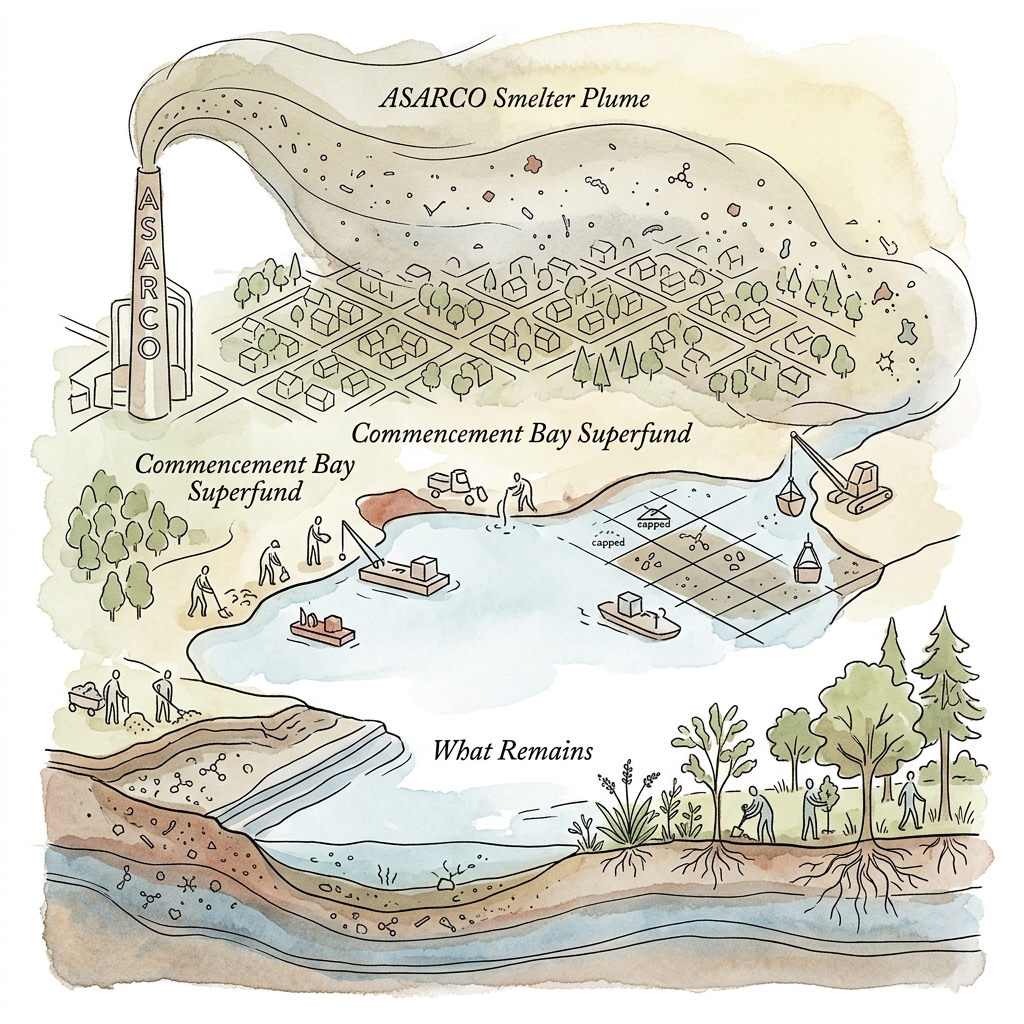
    Important health note: Commencement Bay beaches within the Superfund site boundary are NOT recommended for shellfish harvest due to historical contamination. Stick to beaches outside the contamination zone — generally north of Point Defiance or south of the Puyallup River delta.

    Public beaches open for harvest when WDFW declares them open include areas near Kopachuck State Park (Gig Harbor side) and other Pierce County shorelines. Always check the WDFW hotline or website within 24 hours of planned harvest — biotoxin closures happen with short notice.

    Boat Launch Ramps

    Point Defiance Boathouse Marina — Public launch ramp, fee required. Access to the entire southern Puget Sound. Ramp can queue on summer weekends; arrive before 6 AM for salmon openers.

    Chinook Landing, Foss WaterwayPierce County operated public boat launch in the industrial waterway area. Less scenic but functional and rarely crowded. Good access to Commencement Bay.

    Seasons and Regulations Summary

    Washington’s marine seasons are complex and change annually. The non-negotiable rules:

    A valid Washington fishing license is required for all finfish. A separate shellfish/seaweed license is required for crab, clams, oysters, and shrimp. Both are available through the WDFW licensing system online.

    Salmon seasons in Marine Area 11 open and close on specific dates set by WDFW emergency regulation — these change with short notice. Do not assume last year’s dates apply. Check the WDFW emergency rules page within 48 hours of any planned salmon fishing trip.

    Crab seasons operate similarly — summer windows are announced annually. The daily limit, size minimums, and male-only harvest rules are consistent year to year, but open/close dates are not.

    Frequently Asked Questions

    Do I need a license to kayak in Puget Sound from Tacoma?

    No license is needed for kayaking or paddleboarding itself. However, all watercraft including kayaks must comply with USCG requirements: a PFD (life jacket) for each person aboard, a whistle or sound-producing device, and a light if paddling after dark. Washington does not require kayak registration for human-powered craft.

    What fish can I catch from shore in Tacoma year-round?

    Perch, flounder, and greenling are available year-round from shore in Marine Area 11 with a valid fishing license. Sea-run cutthroat trout are catch-and-release only. Lingcod and rockfish have specific seasons — check WDFW for current dates. Salmon requires checking emergency rules for open periods.

    Is it safe to eat shellfish from Tacoma beaches?

    Not from all beaches. Commencement Bay beaches within the historical Superfund contamination zone should be avoided for shellfish consumption. Beaches north of Point Defiance and south of the contamination zone are tested by WDFW for biotoxins. Only harvest from officially opened beaches listed on the WDFW website.

    Where is the closest place to rent a kayak in Tacoma?

    The Point Defiance Boathouse Marina area has seasonal kayak rentals. Several outfitters operate from Ruston Way during summer months. Availability is seasonal (typically May through September) — call ahead to confirm. Tacoma Narrows Kayak and other local operators also offer guided tours.

    Can I crab from shore in Tacoma without a boat?

    Yes. Shore-based crabbing with ring nets or pots is legal from public piers and structures during open WDFW crab seasons. Les Davis Pier at Point Defiance is the most productive shore crabbing spot. You need a valid shellfish license, and all Dungeness crabs must meet the 6.25-inch minimum carapace width and be male.