Six Tracts, One Program, and the Question That Matters: Is Capital Actually Flowing?
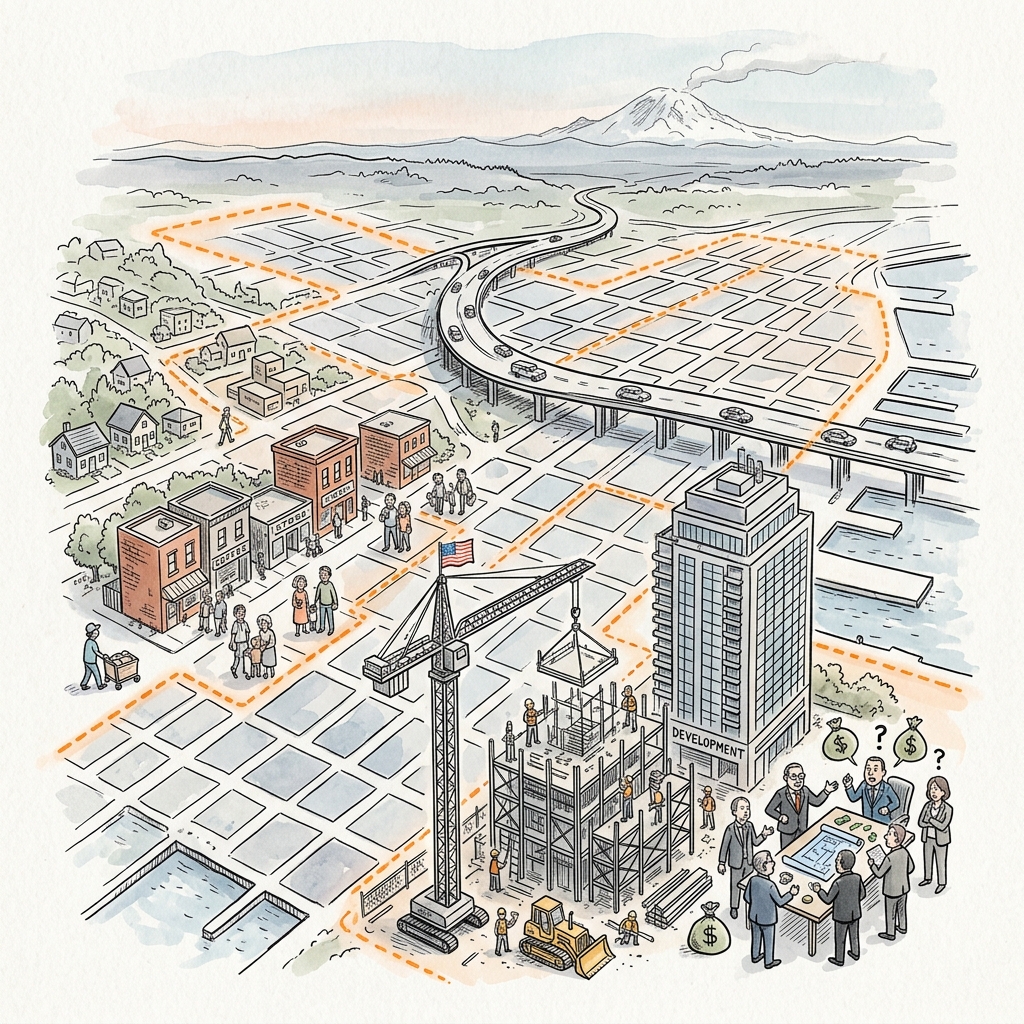
Tacoma has six census tracts designated as Qualified Opportunity Zones — approximately 10.71% of the city’s 56 total census tracts. These zones were created under the 2017 Tax Cuts and Jobs Act to incentivize long-term investment in economically distressed communities through preferential tax treatment of capital gains. The program, previously set to expire in 2026, was extended through 2028 and made permanent by the One Big Beautiful Bill Act (OBBA, P.L. 119-21).
But designation doesn’t guarantee investment. The real question is: what’s actually happening on the ground in these tracts? Here’s a zone-by-zone assessment based on public records, city data, and observable development activity.
Source: City of Tacoma Economic Development — Opportunity Zone Investment.
The Six Designated Zones
All six of Tacoma’s Opportunity Zone census tracts qualify as low-income communities, meaning their poverty rates exceed 20% or median household incomes fall below 80% of the state or metropolitan area median. The designated areas are:
- Hilltop & Martin Luther King Jr. Street (Census Tract 0614.00)
- Lincoln District (Census Tract 0624.00)
- Old City Hall & Central Business District
- Puyallup Tribal Land / Portland Avenue & I-5 Interchange
- Tacoma Mall & Nalley Valley
- UW Tacoma & Brewery District
Interactive map available via Tacoma Open Data — Opportunity Zones (HUD) and the HUD Opportunity Zones Map.
Zone 1: Hilltop & MLK — The Most Active Zone
Investment Activity
Hilltop is Tacoma’s most active Opportunity Zone by every measure. The combination of OZ tax incentives, Tacoma Link light rail extension, and Tacoma Housing Authority investment has created a development environment unmatched anywhere else in the city.
Confirmed OZ-eligible projects:
- Housing Hilltop (THA): $120 million mixed-use development with 137 affordable units and 23,000 SF of commercial/community space. Located at S. 11th and L Streets, directly within the OZ tract. While this is a public-sector project, the commercial spaces are designed to attract private OZ-fund investment for tenant buildouts.
- Hilltop Lofts: 57 permanent supportive housing units. Demonstrates that OZ capital can serve social objectives, not just market-rate development.
- Transit-Oriented Development parcels: Multiple privately-held parcels within 1/4 mile of the Hilltop Link station are in various stages of entitlement and development. These are the primary targets for Qualified Opportunity Fund (QOF) capital seeking ground-up construction plays with 10-year hold periods.
Source: Activate Hilltop — Neighborhood Development.
Assessment
Source depth: HIGH. Multiple verifiable projects with public funding sources, permit records, and community documentation. This zone has the clearest evidence of actual capital deployment aligned with OZ objectives.
Zone 2: UW Tacoma & Brewery District — Institutional Anchor
Investment Activity
The UW Tacoma campus and adjacent Brewery District benefit from institutional stability that most OZ tracts lack. The University of Washington’s continued investment in campus facilities provides a demand anchor for surrounding commercial development.
Observable activity:
- UW Tacoma campus expansion: Ongoing academic building and student housing development creates construction jobs and long-term demand for surrounding services.
- Brewery District adaptive reuse: The historic brewery buildings along Fawcett Avenue have attracted creative office tenants, restaurants, and retail — though much of this predates OZ designation. The question is whether OZ-specific capital has accelerated the pace.
- Pacific Avenue corridor redevelopment: Ground-floor retail in mixed-use buildings along Pacific Avenue between 17th and 21st Streets shows increased tenant activity, though attribution to OZ capital specifically is difficult to confirm from public records.
Assessment
Source depth: MODERATE. Clear development activity exists, but distinguishing OZ-funded investment from general market activity around a university campus is challenging. The institutional anchor (UW) would attract investment regardless of OZ designation.
Zone 3: Old City Hall & Central Business District — Premium Positioning
Investment Activity
The CBD zone includes some of Tacoma’s most valuable commercial real estate and the highest-profile redevelopment project in the downtown core: Old City Hall’s conversion to residential with ground-floor commercial.
Observable activity:
- Old City Hall renovation: Historic building converted to 100+ residential units with premium retail suites (761-1,447 SF) available late 2026. Building amenities include parking, fitness, rooftop event space. This project’s scale and quality suggest institutional capital — potentially OZ-structured.
- Downtown office-to-residential conversions: Several Pacific Avenue office buildings are pursuing or have completed residential conversion, a nationwide trend accelerated in Tacoma by the combination of remote-work-driven office vacancies and housing demand.
- Theater District improvements: The relocated Theater District Link station and surrounding streetscape investments have improved the public realm, supporting private investment in adjacent parcels.
Assessment
Source depth: MODERATE. Development activity is clear, but this zone would likely attract investment regardless of OZ status given its CBD location and transit access. OZ designation may be accelerating timelines rather than creating entirely new investment that wouldn’t otherwise occur.
Zone 4: Tacoma Mall & Nalley Valley — Retail Evolution
Investment Activity
The Tacoma Mall area OZ tract encompasses one of the region’s largest retail power centers and the surrounding Nalley Valley industrial/commercial corridor. Activity here is harder to attribute directly to OZ incentives versus general retail evolution.
Observable activity:
- Tacoma Mall area pad redevelopment: Former big-box pad sites are being repositioned for mixed-use (retail + medical office + services), reflecting the shift from pure retail to diversified commercial uses.
- Nalley Valley industrial repositioning: Older industrial buildings are attracting cannabis production, craft manufacturing, and logistics tenants at rents below the citywide average, providing affordable space for businesses priced out of Seattle’s industrial districts.
Assessment
Source depth: LOW-MODERATE. Activity exists but is diffuse and difficult to tie specifically to OZ investment. The Tacoma Mall’s evolution would likely proceed regardless of zone designation. Nalley Valley’s industrial repositioning may be benefiting from OZ capital for building improvements, but documentation is limited in public records.
Zones 5 & 6: Lincoln District and Portland Avenue/Puyallup Tribal Land
Investment Activity
These two zones show the least observable development activity directly attributable to OZ investment. The Lincoln District has experienced some residential infill development, but at a pace consistent with general market activity rather than OZ-accelerated investment. The Portland Avenue/I-5 interchange tract involves Puyallup Tribal land, which adds jurisdictional complexity for private investors considering OZ fund structures.
Assessment
Source depth: LOW. Limited public documentation of OZ-specific capital deployment in these tracts. This doesn’t mean no investment is occurring — OZ fund reporting is not required to be publicly disclosed at the project level — but verifiable evidence is thin.
The OBBA Extension: What Changes in 2026
The One Big Beautiful Bill Act made three significant changes to the Opportunity Zone program that affect Tacoma:
1. Program made permanent. The previous 2026 sunset is eliminated. Investors can now structure 10+ year holds without concern about legislative expiration — removing the single largest source of uncertainty for OZ fund managers.
2. New OZ 2.0 designation process. Governors must submit new designations to Treasury by July 1, 2026, with Washington State narrowing from 139 to 99 designated zones statewide. The Washington State Department of Commerce is leading recommendations for Governor Ferguson by June 30, 2026. Some current Tacoma zones may lose designation while others could be added.
3. Census tract updates. The program will use 2020 Census tract boundaries rather than 2010 boundaries, which may shift zone boundaries in ways that include or exclude specific parcels. Per CLA’s analysis of census tract changes, investors with existing holdings should verify their properties remain within qualifying tracts.
Source: IRS — Treasury guidance on OZ nominations under OBBA.
The Bottom Line: Where OZ Capital Is Actually Working in Tacoma
Of Tacoma’s six Opportunity Zones, one (Hilltop/MLK) shows clear evidence of significant, verifiable investment aligned with OZ program objectives. Two others (UW/Brewery District and CBD/Old City Hall) show strong development activity that may be partially OZ-funded but would likely occur regardless. The remaining three zones show limited or undocumentable OZ-specific investment from public sources.
This mirrors national patterns. GAO reporting has consistently found that OZ investment concentrates in tracts that were already on upward trajectories — areas like Hilltop (with transit investment) and downtown (with institutional anchors) — rather than creating new investment in the most distressed communities. The program works best as an accelerant for areas with existing momentum, not as a catalyst for areas without it.
For investors considering Tacoma OZ plays in 2026: Hilltop remains the strongest opportunity given the transit infrastructure, public co-investment, and long-term gentrification trajectory. But the OZ 2.0 redesignation process (deadline: July 1, 2026) introduces near-term uncertainty that requires diligence on whether specific tracts will retain their qualifying status under the new program.
Source: U.S. GAO — Opportunity Zones: Census Tract Designations, Investment Activities, and IRS Challenges.
Frequently Asked Questions
How many Opportunity Zones does Tacoma have?
Tacoma has six designated Opportunity Zone census tracts: Hilltop/MLK, Lincoln District, Old City Hall/CBD, Portland Avenue/Puyallup Tribal Land, Tacoma Mall/Nalley Valley, and UW Tacoma/Brewery District. These represent approximately 10.71% of the city’s 56 total census tracts.
Are Tacoma’s Opportunity Zones expiring in 2026?
No. The One Big Beautiful Bill Act (OBBA) extended and made permanent the Opportunity Zone program. However, a new OZ 2.0 designation process requires governors to submit updated zone nominations by July 1, 2026. Washington State will narrow from 139 to 99 zones, meaning some current Tacoma zones may lose designation.
Which Tacoma Opportunity Zone has the most investment?
Hilltop/MLK (Census Tract 0614.00) shows the most verifiable investment activity, anchored by the $120M Housing Hilltop project, Hilltop Lofts, and multiple transit-oriented development parcels near the Link light rail station.
What tax benefits do Tacoma Opportunity Zones offer investors?
Qualified Opportunity Fund investors can defer capital gains taxes on investments held in OZ properties. For investments held 10+ years, any appreciation on the OZ investment itself is tax-free. The OBBA made these incentives permanent, removing previous sunset concerns.
Where can I find a map of Tacoma’s Opportunity Zones?
Interactive maps are available through the HUD Opportunity Zones Map (opportunityzones.hud.gov/resources/map) and Tacoma Open Data (data.tacoma.gov). These show exact census tract boundaries, demographic data, and qualifying criteria for each zone.