The trucks leave. The record doesn’t.
The magazine piece tells the facility manager why the gap exists. This is the shop version. Same week. Different door.
A water job ends when the last air mover comes off the truck, not when the invoice hits QuickBooks. After that, the only carbon record most shops have is a line item and a memory. The facility manager who hired you will get asked for numbers tied to greenhouse gas reporting—specifically Scope 3 under the GHG Protocol. Two buckets show up again and again in those conversations.
Category 1 (purchased goods and services) covers what the organization bought and had performed on its behalf: labor, equipment run on site, materials installed, subcontractor work. Your job is part of that spend chain. Category 5 (waste generated in operations) covers waste the organization’s activities create when it operates the building—demolition debris, wet carpet, contents sent to landfill, hauls off the loading dock. Restoration generates both in a compressed window.
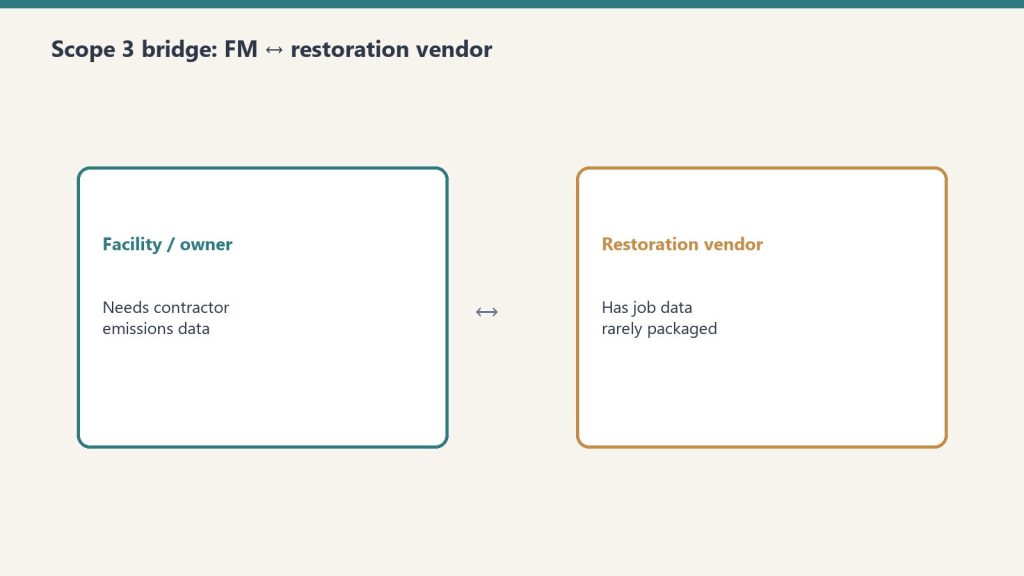
When the owner or corporate sustainability team asks the FM for Category 1 and Category 5 numbers, the FM does not have a meter on your dehu. They call you. If you cannot produce a job-level record with a timestamp from the week of the loss, you are not the vendor who gets the next call. Not because anyone hates paper. Because “we’ll get back to you” reads as “we don’t know what we did on your floor.”
What has to change is not your craft. It is what leaves with the crew.
The dozen fields: what to write while the floor is still wet
Not a sustainability essay. A dozen fields, filled before the truck rolls. If a tech cannot complete it in five minutes, the form is wrong. If it waits for the office on Monday, it will be invented.
The Restoration Carbon Protocol knowledge base is the open mapping if you do not want to invent the buckets. Use it, rename it, or steal the twelve fields. The standard is not the point. The timestamp is.
| Field | Why it matters (carbon math) | Capture in under a minute |
|---|---|---|
| 1. Equipment runtime (hours) — dehus, air movers, scrubbers, etc.; mark primary or estimated | Electric or fuel burned on site drives emissions attributed to purchased services (Category 1). | Photo hour meters or write run hours from the panel; note if rounded from crew shift length. |
| 2. Generator runtime (hours) + fuel type — diesel, gasoline, propane, or grid tie-in; primary or estimated | Generator fuel is a direct combustion source; grid power still needs kWh or hours for conversion factors. | Generator hour meter or fuel fill log; one line for fuel type; photo of meter. |
| 3. Crew trips — count and approximate miles (shop to site and return, or per day); primary or estimated | Vehicle miles stack into purchased services when your crew travels to perform the work. | Crew lead odometer at departure and return, or map estimate; one number per trip day. |
| 4. Haul trips — count, approximate miles, truck type if mixed; primary or estimated | Hauling moves mass; miles and trips feed transport emissions tied to the job. | Dump run tally on the clipboard; odometer photo or dispatcher mileage note. |
| 5. Debris — wet drywall (volume) — bags, yards, or tons as your shop measures; primary or estimated | Material mass and disposal path drive Category 5 waste reporting. | Count bags or roll-off fraction; photo of loaded trailer or ticket weight if scaled. |
| 6. Debris — carpet / pad (volume); primary or estimated | Same stream: landfill vs recycle changes the waste factor. | Square feet removed × layers, or roll-off estimate; note wet vs dry. |
| 7. Debris — contents (volume or weight); primary or estimated | Contents off-site as waste or salvage still count in what left the building. | Box count, pod fraction, or invoice from pack-out vendor. |
| 8. Debris — mixed C&D (volume); primary or estimated | Mixed loads need a declared split or honest “mixed” with disposal site. | Roll-off size × fill level, or scale ticket photo. |
| 9. Disposal method + receiving facility / transfer station — landfill, recycle, waste-to-energy, donation, etc. | Category 5 is not “garbage” in the abstract; method and location determine factors. | Photograph dump ticket; copy facility name and address from ticket. |
| 10. Materials removed (summary) — what came out; primary or estimated | Mass balance: what left the building anchors waste and demo attribution. | One line from demo scope: “~800 sf carpet, 200 lf baseboard, 12 sheets drywall.” |
| 11. Materials installed (summary) — what went back in; primary or estimated | Installed goods are purchased goods/services (Category 1) the owner will allocate. | Pull from pick ticket or invoice stub; photo of delivery slip. |
| 12. Job class + duration — water / fire / mold / mechanical (or your codes); start and close dates; primary or estimated | Duration scales equipment and trip totals; class tells the FM which protocol line to use. | Dates from work auth; class from loss type already on the folder. |
Every number gets a flag: primary (measured — meter, ticket, scale, invoice) or estimated (judgment — “~half a 20-yard,” “assume 40-mile round trip”). Never fake precision. An honest estimate with a date beats a fabricated decimal from accounting six months later.
Building the capture habit
Nobody fills a questionnaire after the trucks have gone. They fill what stands between them and getting paid.
Tie it to the invoice trigger
Put one clause in the work authorization or master agreement: the per-job record is a condition of final invoice. Same shape as a moisture log. Same habit as photos. Final invoice does not go out until the record is attached to the job file—PDF photo of the clipboard, form in your CRM, whatever your shop already uses for documentation that must exist to get paid.
That single gate does more than a training deck. The crew lead knows the rule: no record, no release. Office staff stop chasing “sustainability forms” and start enforcing the same checklist they enforce for signed auth and dry standard.
Who owns it, and when
Owner: crew lead on site—not the office on Monday. The lead has the hour meters, the dump runs, and the conversation with the FM at the door.
When: before the truck rolls, while the floor is still wet and the debris stream is visible. Last hour on site, not first hour back at the shop.
What it looks like: one page. Checkbox for job class. Table for the twelve fields. Two columns for primary vs estimated initials. Signature and date. Lives on the clipboard that already holds the moisture log.
The discipline matches what you already run on the first day of a water loss: document early, while evidence is in front of you. The first-24-hours water loss operators checklist is the same muscle—capture before memory replaces the floor.
Pushback you will hear
“We don’t have time.” Five minutes. Hour-meter photos and a dump ticket fit in the same walk-through where you pick up the last cord.
“We’ll do it Monday.” Monday produces fiction. Miles blend across jobs. Fuel type becomes “diesel probably.” The FM’s deadline will not wait for fiction.
“The office can estimate.” The office was not on the roll-off. Estimates are fine when labeled estimated—not when invented without a witness.
Estimates vs primary data: Mark every field. Primary data comes from meters, tickets, invoices, or counted units on site. Estimates are allowed when measurement was impossible—note the reason in one word (“no scale,” “combined load”). Reporting downstream can treat estimates differently; lying about precision cannot be untangled later.
Feeding Scope 3 reporting from the job file
Facility managers and owners are not asking you to file their corporate inventory. They need defensible inputs they can map into Scope 3 workbooks.
Your twelve fields supply the bridge. Category 1: equipment and generator runtime (especially fuel type and grid vs diesel), materials installed, crew and subcontractor effort represented by trips and job duration, and the job class that tells them this was restoration services—not janitorial, not capital project. Category 5: debris by stream, volumes, disposal method, and receiving facility name—so their waste factor matches what actually left the dock, not a generic “construction waste” line.
When you hand the FM a completed record dated the week of closeout, you give them primary or honestly labeled estimated data with a chain of custody: ticket photos, meter photos, material slips. Their sustainability consultant can plug factors without calling you twelve times. When you hand them silence, they spread one invoice total across a quarter and hope nobody audits.
The Restoration Carbon Protocol (RCP) documents how restoration-specific activity maps to those reporting needs—field names, streams, and guidance so shops and FMs speak one language. You do not have to adopt every label. You do have to leave a record that can be mapped.
Who this is for
Commercial water, fire, mold, and the one-off mechanical swap. The FM inside the building is the only person who can demand the data at the door. You are the only person who can produce it on the job.
The sentence that pays: “We capture the job record before we leave. You can hand it to whoever asks.” Only say it if the clipboard is on the truck.
Frequently asked questions
What if the job is already done and we captured nothing?
Document what you can reconstruct from tickets, invoices, and photos—with every number marked estimated and the reconstruction date noted. Send it anyway. Partial honest data beats silence. Change the process for the next job; do not rewrite history as primary.
Who owns the record — the crew or the office?
The crew lead captures it on site before departure. The office verifies it is attached before final invoice release. Capture is field work; gatekeeping is office work.
How precise do the numbers need to be?
Precise enough to be honest. Primary when you have meters and tickets; estimated when you do not—never unlabeled guesses. Facility reporting uses ranges and factors; they cannot use numbers you pretended were weighed when they were guessed.
Does this replace our moisture log or invoice documentation?
No. It sits beside them. Same invoice gate, same job file. Moisture proves dry standard; invoice proves scope and price; the job record proves what happened on the floor for environmental reporting.
What does the FM actually do with these numbers?
They fold them into Scope 3 reporting—Category 1 for purchased restoration services and materials you installed, Category 5 for waste streams you hauled—often with a consultant or corporate template. Your record is the job-level backup when auditors or tenants ask what the loss generated.
Do we have to use the Restoration Carbon Protocol name?
No. Use the twelve fields, your own form, or RCP’s mapping. The FM needs consistent fields and a date from closeout week, not a brand.