The facility manager’s source of truth for Scope 3 ESG reporting — from regulatory deadlines to contractor data standards including the Restoration Carbon Protocol.
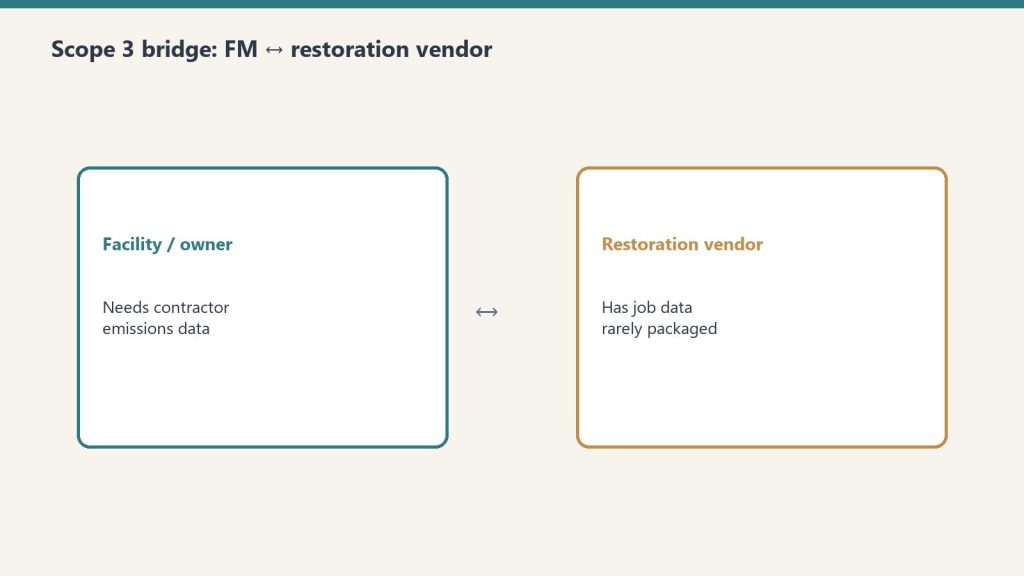
The magazine piece tells the facility manager why the gap exists. This is the shop version. Same week. Different door.
A water job ends when the last air mover comes off the truck, not when the invoice hits QuickBooks. After that, the only carbon record most shops have is a line item and a memory. The FM who hired you will get asked for Category 1 and Category 5 numbers. They will call you. You will not have them.
What actually has to leave with the crew
Not a sustainability essay. A dozen fields, written while the floor is still wet:
If a tech cannot fill it in five minutes, the form is wrong. If it waits for the office on Monday, it will be invented.
Put it on the invoice trigger
Nobody fills a questionnaire after the trucks have gone. They fill what stands between them and getting paid.
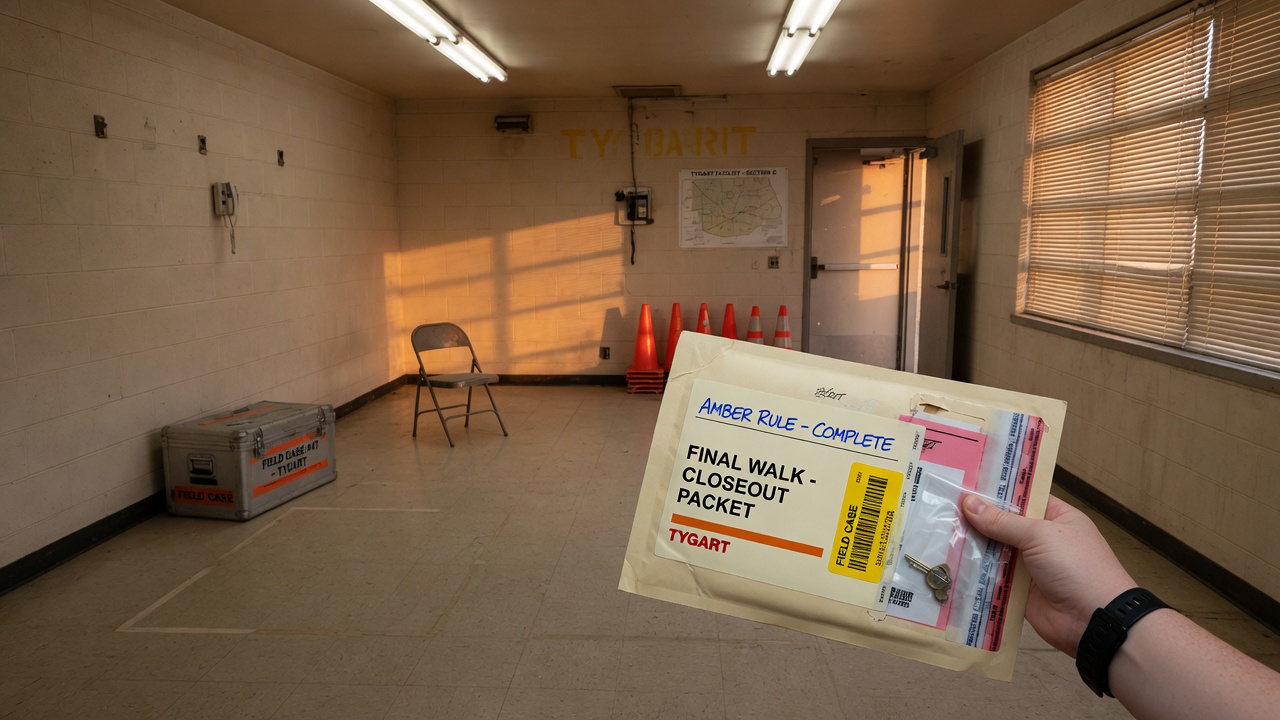
One clause in the work auth or the master: the per-job record is a condition of final invoice. Same shape as a moisture log. Same habit as photos. The Restoration Carbon Protocol is the open mapping if you do not want to invent the buckets. Use it, rename it, or steal the twelve fields. The standard is not the point. The timestamp is.
Who this is for
Commercial water, fire, mold, and the one-off mechanical swap. The FM inside the building is the only person who can demand the data at the door. You are the only person who can produce it at the job.
IFMA just ran the occupier-side argument. Closing the Scope 3 Data Gap is theirs. This is the field note that makes that article usable when the next pipe opens.
The sentence that pays
“We capture the job record before we leave. You can hand it to whoever asks.”
Scope 3 is leaving the voluntary pile. California SB 253 and the EU CSRD pull Category 1 onto a deadline. Facility managers cannot close that inventory without data from the vendors who actually do the work — water, fire, mold, emergency mechanical. Those crews are high-intensity and almost never on a reporting stack, because they were procured as an emergency, not as a supplier program.
Spend-based estimates are a stopgap. Updated GHG Protocol guidance wants primary data.
Vendor pledges and AI principles are not a control. A policy the vendor can rewrite alone does not survive an auditor.
The occupier’s FM team holds the leverage: RFPs, MSAs, and the closeout packet.
A real control is standardized, job-level emissions data demanded in the contract — fuel, miles, waste, equipment hours — against a named methodology.
Who this is for
Facility managers and sustainability leads who will be asked for Category 1 numbers and do not currently get them from restoration or specialty trades. Restoration operators who want to be the vendor that can produce the packet instead of the vendor that gets swapped at renewal. Same gap. Opposite desks.
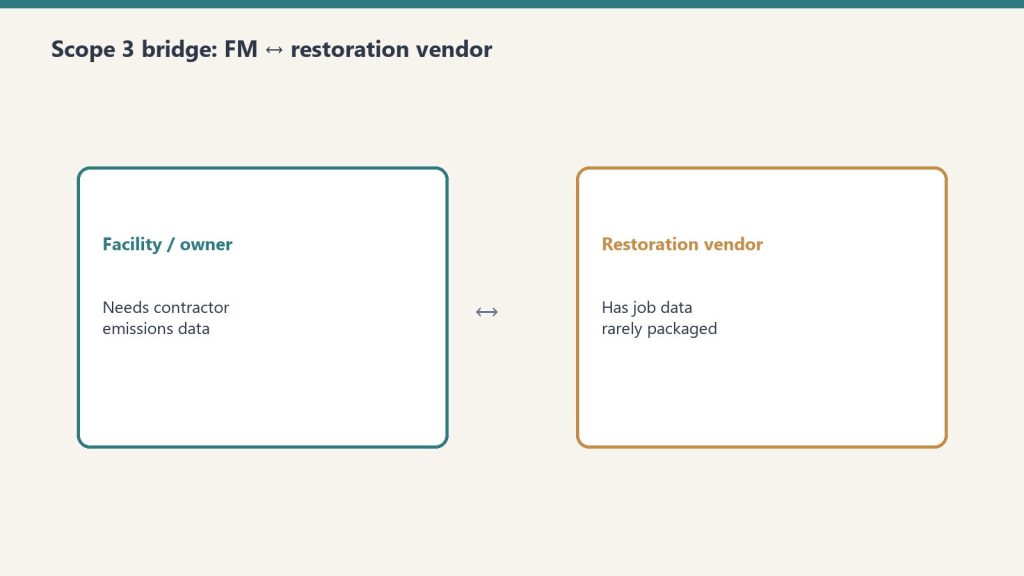
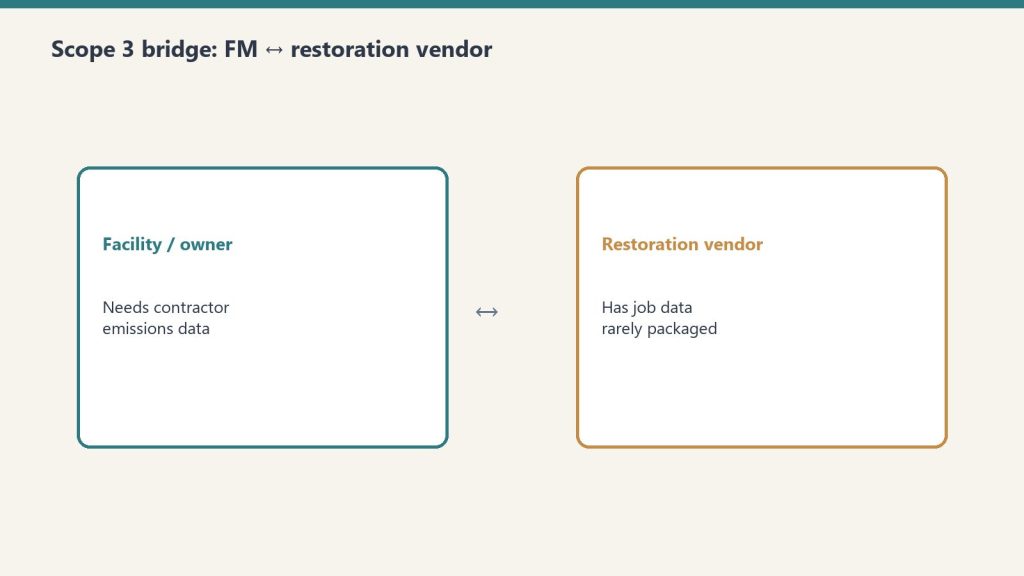
The missing control is the bridge: the FM needs the number; the vendor already has the job file.
What you do next
Do not wait for a software RFP. The sequence is short:
Read the FMJ piece — the case to the profession, on IFMA’s site.
Run the workbook — five phases, live scoring, a paste-ready contract clause, and an exportable program summary. Work email unlocks the clause.
If you are a facility manager trying to understand your Scope 3 ESG obligations, you have almost certainly encountered three acronyms that sound similar but operate very differently: GRESB, CDP, and SB 253. Each one creates real obligations for FM operations — but they apply to different organizations, require different data, and serve different audiences. This article maps the landscape so you can determine which frameworks govern your program and what each one specifically requires from your contractor data collection.
GRESB: The Asset-Level Framework
GRESB — the asset-level framework.
GRESB (the Global Real Estate Sustainability Benchmark) is an investor-driven ESG assessment framework for real estate portfolios. It is primarily used by property owners, REITs, and real estate investment managers who need to demonstrate sustainability performance to institutional investors.
Who it primarily affects: BOMA-type property owners and real estate investors. If you are an FM at a corporate occupier — a company that uses its buildings for operations, not as investment assets — GRESB is typically your asset manager’s problem, not yours.
What it asks about contractors: GRESB’s Real Estate Assessment includes questions about green building certifications, energy performance, and sustainability policies for construction and renovation projects. It does not currently have a Scope 3 contractor data requirement comparable to GHG Protocol Category 1. However, GRESB is evolving its framework to incorporate more supply chain data as investor pressure increases.
IFMA relevance: Low to medium, unless your corporate occupier organization owns its real estate portfolio and participates in GRESB as both occupier and investor. In that case, GRESB and GHG Protocol obligations overlap.
CDP: The Voluntary Disclosure Framework
CDP (formerly the Carbon Disclosure Project) operates a global disclosure system that allows companies to report their environmental data to investors, purchasers, and the public. CDP’s Supply Chain program specifically requests Scope 3 data from suppliers — which means your organization may receive CDP questionnaires from your own customers asking about the emissions associated with the services you provide to them.
Who it primarily affects: Companies that participate voluntarily in CDP disclosure, and companies whose corporate customers require supplier CDP responses. CDP is used by many large corporate occupiers as a sustainability disclosure mechanism.
What it asks about contractors: CDP’s corporate questionnaire includes Scope 3 Category 1 disclosure. If your organization reports to CDP, you are expected to include Category 1 emissions from your contractors — including restoration vendors — in your response. CDP accepts activity-based and spend-based estimates; it also tracks year-over-year improvement in data quality.
IFMA relevance: High for FM teams at organizations that participate in CDP or whose parent companies have signed CDP commitments. CDP is often the first Scope 3 reporting pressure FM teams experience, because it is voluntary but publicly visible — investors and customers can see whether your organization reports and how complete your data is.
SB 253: The Mandatory Disclosure Framework
California SB 253 — the Climate Corporate Data Accountability Act — is mandatory, not voluntary. It requires companies with over $1 billion in annual revenue doing business in California to disclose Scope 1, 2, and 3 emissions on a phased schedule: Scope 1/2 starting in 2026 (for fiscal year 2025 data), Scope 3 starting in 2027 (for fiscal year 2026 data). Reports must be independently verified by a CARB-registered third-party auditor.
Who it primarily affects: Any company doing business in California with over $1 billion in annual revenue. This is a wide net — it captures many large corporate occupiers regardless of headquarter location.
What it asks about contractors: SB 253 uses GHG Protocol methodology, which requires reporting all material Scope 3 categories. Category 1 (contractors and suppliers) is a mandatory category under the GHG Protocol for most organizations. Restoration contractors are a Category 1 source. SB 253’s independent verification requirement means your auditor will scrutinize the quality of your Category 1 data — spend-based estimates will be accepted but flagged as lower quality than activity-based data.
IFMA relevance: High for FM teams at large corporate occupiers doing business in California. This is the framework with the hardest deadline and the most compliance consequence.
EU CSRD: The European Mandatory Framework
For completeness: the EU Corporate Sustainability Reporting Directive (CSRD) applies to large EU companies and, in some cases, non-EU companies with significant EU operations or revenue. CSRD requires disclosure under the European Sustainability Reporting Standards (ESRS), which include Scope 3 under ESRS E1. Like SB 253, it requires third-party verification and covers supply chain emissions.
IFMA relevance: High for FM teams at multinational corporate occupiers with European operations. CSRD and SB 253 overlap in their Scope 3 requirements, meaning data infrastructure built for one framework largely serves both.
The Framework Decision Matrix
The framework decision matrix.
Framework
Voluntary or Mandatory
Who It Applies To
Contractor Scope 3 Required?
IFMA FM Priority
GRESB
Voluntary (investor-driven)
Real estate owners and investors
Not directly — asset-level focus
Low (unless dual occupier/investor)
CDP
Voluntary
Companies disclosing to investors
Yes — Category 1 in corporate questionnaire
Medium-High (if your org participates)
SB 253
Mandatory
>$1B revenue, does business in CA
Yes — GHG Protocol Category 1
High (if threshold met)
EU CSRD
Mandatory
Large EU companies + some non-EU
Yes — ESRS E1 Scope 3
High (if European operations)
What This Means for Contractor Data Collection
What this means for contractor data collection.
If your organization is subject to SB 253, or participates in CDP, or both — you need Category 1 contractor data. The specific data points required are the same across all three frameworks because they all use GHG Protocol methodology as their basis. Building a contractor data collection process that satisfies GHG Protocol Category 1 requirements will satisfy SB 253, CDP, and CSRD simultaneously.
The Restoration Carbon Protocol is designed to produce exactly that data. Its output — the per-job RCP Carbon Report — maps to Category 1 inputs for all three frameworks. FM teams that implement RCP-compliant vendor requirements do not need to build separate data collection processes for each framework.
If my company participates in GRESB, do I still need to collect contractor Scope 3 data?
GRESB’s current framework focuses on asset-level energy and water performance rather than supply chain Scope 3 data. However, if your organization also participates in CDP or is subject to SB 253 or CSRD, those frameworks require contractor Category 1 data regardless of GRESB participation. Check which frameworks your sustainability team is reporting to.
Can I use one dataset to satisfy multiple frameworks?
Yes. Because GRESB, CDP, SB 253, and CSRD all use GHG Protocol methodology as their technical basis, data collected to satisfy one framework’s Scope 3 Category 1 requirements is compatible with the others. Build the data collection process once; use it across all frameworks your organization reports to.
Scope 3 compliance for facility managers is fundamentally a vendor management problem. You cannot calculate your Category 1 emissions without data from your contractors, and you cannot get data from contractors without a systematic process for requesting, receiving, and storing it. This article provides a practical checklist for building that process — one that works for FM teams of any size and scales as your contractor pool grows.
Free Interactive Workbook
Use the live Scope 3 contractor compliance workbook
Map contractor categories, tier vendors, generate the contract clause, and export a program summary. Five phases. Live scoring. Work email unlocks the clause.
Before you can build a Scope 3 data collection process, you need to know which contractors generate material emissions on your behalf. Not all vendors are equal Scope 3 risks — prioritize based on emission intensity and spend.
Step 1: Map your contractor categories
List every category of contractor your FM program engages. For most corporate FM teams, the highest emission-intensity contractor categories are:
Construction and tenant improvements — embodied carbon in materials, significant waste
HVAC maintenance and retrofits — refrigerant handling, combustion equipment
Grounds and landscaping — fuel-burning equipment, fertilizer (N₂O emissions)
Janitorial and facility services — lower intensity but high volume
Step 2: Score by emission intensity × annual spend
Multiply each category’s estimated emission intensity (high/medium/low) by your annual spend in that category. The highest-scoring categories are your priority Scope 3 data gaps. Emergency restoration typically scores high on intensity even when annual spend is variable, because a single large water damage event can generate a meaningful emissions figure.
Phase 2: Vendor Qualification Updates
Step 3: Add Scope 3 capability questions to RFP and vendor qualification forms
For new vendor solicitations, add the following questions to your qualification criteria:
Does your organization track greenhouse gas emissions associated with individual project work?
Are you familiar with GHG Protocol Scope 3 Category 1 methodology?
Have you adopted the Restoration Carbon Protocol (for restoration vendors)?
Can you provide a per-project emissions summary upon project completion?
What job management system do you use, and does it support emissions data export?
Step 4: Tier your existing vendors
Survey your existing contractor pool with the same questions. Categorize vendors into three tiers: Tier 1 (already tracking emissions data), Tier 2 (willing to adopt a framework with support), and Tier 3 (unable or unwilling to provide data). Tier 3 vendors become a procurement risk factor — flag for transition to Tier 1 or 2 alternatives at contract renewal.
Phase 3: Contract Language
Phase 3 — contract language for Scope 3.
Step 5: Add Scope 3 data provisions to new contracts
For restoration contractors specifically, reference the Restoration Carbon Protocol as the accepted methodology standard. For other contractor categories, reference GHG Protocol Scope 3 Category 1 methodology and specify the data fields required. Include:
Obligation to provide a per-project emissions summary within 30 days of completion
Minimum data fields required (fuel, vehicle miles, waste type and weight, equipment hours)
Accepted methodology standard (RCP for restoration; GHG Protocol Category 1 for others)
Data format and delivery method (PDF report, CSV, or API-compatible format)
Right to audit contractor data collection processes during the contract term
Phase 4: Data Collection and Storage
Step 6: Establish a receiving process for contractor emissions reports
Decide where contractor emissions data will live in your FM systems. Options include: a dedicated folder in your CMMS work order system attached to each job record, a shared ESG data repository managed by your sustainability team, or a direct integration with your ESG reporting platform. The key is that every restoration job has an associated emissions record — not a separate tracking system you have to reconcile at year-end.
Step 7: Build a gap-filling protocol for missing data
Some contractors will not provide data even after you request it. Build a proxy calculation protocol for data gaps using spend-based or activity-based estimation. The RCP provides proxy tables for restoration jobs. For other categories, the GHG Protocol’s Scope 3 Calculation Guidance provides spend-based emission factors you can apply to invoice data.
Phase 5: ESG Inventory Integration
Phase 5 — ESG inventory integration.
Step 8: Integrate contractor data into your annual Scope 3 Category 1 calculation
At the end of each fiscal year, compile all contractor emissions reports and proxy estimates into your Scope 3 Category 1 input. Document your methodology, note which vendors provided primary data and which required proxy estimation, and flag any material gaps for disclosure in your ESG report. Most third-party ESG auditors will accept a documented methodology with known limitations more readily than an unexplained data gap.
The Checklist Summary
☐ Map contractor categories by emission intensity and annual spend
☐ Score and prioritize: emergency restoration at the top
☐ Add Scope 3 capability questions to vendor qualification forms
If you manage facilities for a corporate occupier and you have been trying to figure out how to get Scope 3 emissions data from your restoration contractors, the Restoration Carbon Protocol (RCP) exists to answer that question. This article explains what the RCP is, how it works, and what IFMA members specifically need to know about using it as a procurement and compliance tool.
What the Restoration Carbon Protocol Is
What the Restoration Carbon Protocol is.
The RCP is an industry self-standard published by Tygart Media that defines how restoration contractors should calculate, document, and report the greenhouse gas emissions associated with each project they complete. It is built on the GHG Protocol’s Corporate Value Chain (Scope 3) Standard — the same framework used by most corporate ESG reporting programs and required by SB 253 and CSRD.
The RCP fills a specific void: no restoration industry body — not IICRC, not RIA, not any trade association — had previously published a Scope 3 reporting methodology for restoration work. Commercial property managers and corporate FM teams asking their restoration vendors for emissions data were getting blank stares. The RCP gives contractors the methodology and gives FM procurement teams the standard to reference.
The Five Core Restoration Job Types and Their Scope 3 Mapping
Five core job types and their Scope 3 mapping.
The RCP maps each of the five primary restoration job types to the relevant GHG Protocol Scope 3 categories:
Water damage restoration: Category 1 (services purchased), Category 5 (waste from extracted water and contaminated materials)
Fire and smoke restoration: Category 1 (services), Category 5 (soot, char, and demolition debris waste streams)
In all five cases, the primary Scope 3 category for the FM client is Category 1 — Purchased Goods and Services. The emissions are generated by the contractor performing work on your behalf at your facility.
The 12 Data Points: What to Ask Your Contractor to Track
Twelve data points to ask your contractor to track.
The RCP defines 12 data points that a restoration contractor should capture on each job to enable a complete Scope 3 calculation. As an FM procurement professional, these are the data fields you should be requiring in your vendor agreements:
Total diesel consumed by drying and dehumidification equipment (gallons)
Total propane or natural gas consumed by heat drying equipment (cubic feet or gallons)
Total vehicle miles traveled to and from the site by all crew vehicles
Number of crew vehicle trips and vehicle types (van, pickup, box truck)
Total equipment operating hours (by equipment category)
Weight of water extracted and removed from the site (gallons or pounds)
Weight and type of contaminated materials removed (drywall, insulation, flooring, etc.)
Disposal method for each waste stream (landfill, recycling, hazardous waste facility)
Refrigerants used, recovered, or vented (for HVAC-adjacent work)
Materials installed by type and weight (for reconstruction phases)
Cleaning agents and chemical products used by product category
Total project duration in days
Not every data point is relevant to every job type. The RCP provides job-type-specific templates that pre-populate the relevant fields for water, fire, mold, hazmat, and biohazard jobs respectively.
How FM Teams Can Use the RCP Framework
There are three practical ways IFMA members can incorporate the RCP into their FM operations:
1. Vendor Qualification
Add RCP awareness to your restoration vendor qualification checklist. Ask prospective vendors whether they have adopted the RCP framework. Vendors who can demonstrate RCP familiarity are already capturing the data you need; vendors who cannot are a data gap risk for every job they complete.
2. Contract Language
Include a Scope 3 data provision clause in restoration vendor agreements referencing the RCP as the accepted methodology standard. This gives vendors a concrete deliverable (the RCP Job Carbon Report) rather than an open-ended “emissions data” request they have no idea how to fulfill.
3. Scope 3 Inventory Integration
Route the per-job RCP carbon reports from your restoration vendors into your Scope 3 Category 1 data collection system. Most ESG reporting platforms (Watershed, Persefoni, Salesforce Net Zero Cloud, etc.) accept Category 1 supplier data in standardized formats. The RCP report is designed to map directly to these platforms’ input requirements.
The RCP Is Free to Use
The Restoration Carbon Protocol is published as an open industry standard. There is no licensing fee, no certification requirement, and no vendor lock-in. FM teams can share the RCP framework directly with their restoration vendors at no cost. Contractors can adopt the RCP’s data capture templates and calculation methodology without purchasing anything.
The goal is adoption — the more restoration contractors who begin tracking RCP-compliant data, the more complete FM Scope 3 inventories become across the industry.
Frequently Asked Questions
Is the RCP recognized by IICRC or RIA?
The RCP is an independent industry self-standard published by Tygart Media. It is not currently endorsed by IICRC or RIA, as neither body has published a competing ESG standard. The RCP fills the void those bodies have not addressed. FM teams and restoration contractors can adopt it independently without waiting for official industry body endorsement.
How does a restoration contractor become RCP-certified?
The RCP v1.0 includes a self-certification checklist. Contractors complete the checklist to demonstrate they have implemented the required data capture processes and calculation methodology. Third-party verification is available for organizations that require audited certification. Details are published at tygartmedia.com/category/esg-restoration/.
California’s Climate Corporate Data Accountability Act — SB 253 — is the most consequential piece of corporate climate disclosure legislation in the United States. For facility managers at large corporate occupiers, its Scope 3 provision creates a specific and urgent vendor management problem that most FM teams have not yet fully reckoned with.
What SB 253 Actually Requires
SB 253 requires companies with annual revenues exceeding $1 billion that do business in California to publicly disclose their greenhouse gas emissions. The disclosure schedule is phased:
Scope 1 and Scope 2: First reports due in 2026 (covering fiscal year 2025 data)
Scope 3: First reports due in 2027 (covering fiscal year 2026 data)
The California Air Resources Board (CARB) is the administering body. Reports must be independently verified by a third-party auditor. The law applies to any company doing business in California — not just California-headquartered companies — which means the net is significantly wider than the state’s own corporate population.
This is not a voluntary framework. SB 253 carries penalties for non-compliance. The Scope 3 provision is the one that creates a direct operational problem for FM teams, because Scope 3 data lives outside your organization — in your contractors’ job management systems.
The Contractor Data Chain
The contractor data chain under SB 253.
Under the GHG Protocol’s Scope 3 framework — which SB 253 uses as its methodological basis — your restoration contractors are a Category 1 (Purchased Goods and Services) supplier. Every time you hire a restoration company to respond to a water intrusion event, a fire damage claim, or a mold remediation project, that contractor’s emissions for that job are technically part of your Scope 3 inventory.
The calculation is not optional. The GHG Protocol requires organizations to make a reasonable effort to quantify all material Scope 3 categories. For a large corporate occupier with a substantial real estate portfolio, emergency restoration is a recurring and quantifiable Category 1 exposure. Your ESG auditor will ask about it. Your SB 253 filing will need to account for it.
Why Most Restoration Contractors Cannot Provide This Data Today
Most restoration contractors cannot provide this data today.
The restoration industry has no Scope 3 standard. IICRC — the primary certification body for restoration professionals — has no ESG reporting guidance. RIA has no Scope 3 framework. Most restoration contractors manage their operations through job management software that tracks labor hours, materials, and job costs — not emissions.
This is not negligence; it is a gap that simply has not been filled until now. The Restoration Carbon Protocol (RCP) is the first industry self-standard that defines how restoration contractors should calculate and report their Scope 3 emissions data. It gives contractors the methodology, the data capture template, and the calculation framework — and it gives FM procurement teams the standard they can reference in vendor contracts.
What to Put in Your Vendor Agreements Now
Put requirements in vendor agreements now.
The most practical SB 253 preparation step for FM procurement teams is to update restoration vendor agreements to include a Scope 3 data provision clause. Here is the language framework:
“Vendor agrees to provide a per-project greenhouse gas emissions summary for each project completed at Client facilities, using a documented calculation methodology consistent with GHG Protocol Scope 3 Category 1 guidelines. The summary shall include: total fuel consumption by equipment type, vehicle miles traveled, waste materials removed by type and weight, and total equipment operating hours. Submissions shall be provided within 30 days of project completion.”
This clause does not require contractors to be ESG experts. It requires them to track and report the underlying data points from which a Scope 3 calculation can be made. Contractors who have adopted the RCP framework already capture this data as part of their standard job documentation.
The Retroactive Data Problem
SB 253 requires disclosure for fiscal year 2026 data, meaning the clock is already running. If your organization does business in California and exceeds the revenue threshold, your restoration vendors should be tracking Scope 3 data for jobs completed throughout 2026. Waiting until late 2026 to request this data will result in gaps that your ESG auditor will flag.
For restoration jobs already completed in 2025 and early 2026, proxy-based estimation is acceptable under GHG Protocol methodology when primary data is unavailable. The RCP provides proxy calculation tables for each restoration job type, allowing FM teams to estimate historical emissions from basic job records (square footage treated, job duration, equipment type). This is not ideal, but it is methodologically defensible and far better than a data gap.
The SB 253 Compliance Checklist for FM Teams
Confirm whether your organization meets the SB 253 threshold (>$1B revenue, does business in California)
Identify all restoration and specialty trade contractors in your vendor pool as Category 1 Scope 3 sources
Update vendor agreements with a Scope 3 data provision clause (language above)
Share the RCP framework with active vendors so they understand what data to capture
Establish a process for collecting and storing per-job emissions summaries in your FM system
Engage your ESG consultant to integrate contractor data into your Scope 3 Category 1 calculation methodology
Plan for third-party verification of your Scope 3 data — auditors will scrutinize Category 1 more than any other category
Does SB 253 apply if my company is not headquartered in California?
Yes. SB 253 applies to any company that “does business in California” and meets the revenue threshold. This is broadly interpreted to include companies with California employees, customers, or operations — even if they are incorporated and headquartered elsewhere.
What is the penalty for non-compliance with SB 253 Scope 3 provisions?
CARB has authority to assess administrative penalties for non-compliance. The specific penalty structure is being finalized through rulemaking. Consult your legal counsel for the current enforcement guidance applicable to your organization.
Can I use a spend-based methodology for restoration contractor Scope 3 data?
Spend-based estimation (using economic input-output data) is permitted under GHG Protocol methodology as a fallback when primary or activity-based data is unavailable. However, third-party auditors generally flag spend-based estimates as lower quality than activity-based calculations. For a recurring Category 1 source like restoration contractors, building toward activity-based data is the appropriate goal.
If you manage facilities for a large corporate occupier, you have almost certainly heard the phrase “Scope 3 emissions” from your sustainability team, your CFO, or your ESG consultant. What you may not have heard is a clear explanation of what that means for your day-to-day vendor management — and why the contractors who respond to your water damage and mold remediation calls are sitting in the middle of your most difficult compliance gap.
The Three Scopes: A Plain-Language Primer
Three scopes primer — contractors sit in Scope 3.
The GHG Protocol’s Corporate Standard divides greenhouse gas emissions into three categories based on where they originate relative to your organization’s operations:
Scope 1 — Direct emissions from sources your organization owns or controls. The combustion in your building’s boilers, the fuel in your company-owned fleet vehicles, the refrigerants in your HVAC systems.
Scope 2 — Indirect emissions from purchased electricity, heat, or steam. The power your facilities consume from the grid.
Scope 3 — All other indirect emissions across your value chain. Everything that happens upstream (your supply chain) and downstream (how your products or services are used) that generates emissions on your behalf.
Scope 1 and Scope 2 are manageable. You own the sources or the meters. You have the data. Scope 3 is where it gets hard — because Scope 3 data lives in other organizations’ systems, not yours.
The 15 Categories of Scope 3
The GHG Protocol breaks Scope 3 into 15 categories across upstream and downstream activities. For a corporate FM managing occupied facilities, the most relevant upstream categories are:
Category 1 — Purchased Goods and Services: The emissions associated with producing and delivering everything your organization buys from third parties. For FMs, this includes every contractor, vendor, and service provider who performs work at your facilities — including your restoration contractors.
Category 2 — Capital Goods: Emissions from the production of capital equipment and major building systems your organization purchases.
Category 4 — Upstream Transportation and Distribution: Relevant when contractors transport materials and equipment to your site.
Category 5 — Waste Generated in Operations: Emissions from waste your organization generates — relevant when restoration work produces debris, contaminated materials, or demolition waste disposed of on your behalf.
Why Contractors Are Your Hardest Data Category
Why contractors are your hardest data category.
Among all the inputs to a corporate FM’s Scope 3 inventory, contractor-generated emissions are consistently the most difficult to quantify. Here is why:
Contractors do not routinely track their own emissions. Most restoration, janitorial, maintenance, and specialty trade contractors have no internal system for calculating the greenhouse gas footprint of individual jobs. They track labor hours, materials costs, and square footage — not carbon.
Restoration work is episodic. Unlike your regular janitorial or HVAC maintenance contractor, your restoration vendors are called in during emergencies. There is no standing purchase order to attach emissions data to. Each job is a separate event, often managed by a different project manager.
No industry standard exists for restoration Scope 3 data. IICRC — the restoration industry’s primary certification body — has no ESG reporting standard. RIA has no Scope 3 guidance. There is no form, no template, no industry norm for what a restoration contractor should provide.
The emissions profile of restoration work is complex. A single water damage job involves diesel-powered drying equipment running 24/7 for days, hazardous material disposal, multiple material categories, and vehicle trips from multiple crew members. Calculating the emissions accurately requires a methodology most contractors have never seen.
The 2027 Problem
California SB 253 — the Climate Corporate Data Accountability Act — requires companies with over $1 billion in annual revenue doing business in California to disclose their Scope 3 emissions starting with the 2027 reporting year. The EU’s CSRD is already in effect and expanding. CDP and GRESB already request Scope 3 data from the organizations they track.
For FMs at large corporate occupiers, this creates a specific operational problem: your sustainability team needs contractor emissions data for the 2027 filing, your contractors do not have a system for providing it, and there is no industry standard to point them to. The gap between the regulatory requirement and the contractor’s current capability is the problem this publication addresses.
What Good Contractor Scope 3 Data Looks Like
What good contractor Scope 3 data looks like.
The Restoration Carbon Protocol (RCP) defines 12 data points that every restoration job ticket should capture to enable Scope 3 calculation. At a minimum, FM procurement teams should be asking their restoration vendors for:
Total fuel consumed by diesel-powered drying and dehumidification equipment (gallons)
Total vehicle miles traveled by contractor crews to and from the site
Weight and type of waste materials removed and method of disposal
Refrigerants used or recovered (for HVAC-adjacent restoration work)
Materials installed by type and weight (for reconstruction phases)
Total job duration and equipment operating hours
With these inputs, a standardized calculation using EPA emission factors can produce a per-job carbon estimate that satisfies Scope 3 Category 1 methodology. The RCP provides exactly that calculation framework — free for any contractor or FM team to use.
What to Do Now
If the 2027 Scope 3 deadline is on your radar, the most practical steps you can take today are:
Audit your vendor pool for contractors who perform Category 1 services. Restoration, abatement, specialty trades, and maintenance contractors are your highest-priority Scope 3 data gaps.
Include a Scope 3 data provision clause in new vendor agreements. Require contractors to provide a per-job emissions summary using a standardized methodology.
Share the RCP framework with your restoration vendors. It gives them the methodology, the data capture form, and the calculation tools — everything they need to start providing compliant data on the next job.
Start tracking now, even if imperfectly. A reasonable estimate based on available data is better than a data gap. Your ESG auditor would rather see a documented methodology with known limitations than a blank line item.
Frequently Asked Questions
Does every facility manager need to report Scope 3?
Mandatory Scope 3 reporting under SB 253 applies to companies with over $1 billion in annual revenue doing business in California. CSRD applies to large EU entities. Many FMs at smaller organizations will face voluntary disclosure pressure through CDP participation, GRESB assessments, or investor requirements. Regardless of regulatory mandate, proactively building Scope 3 data capability now reduces compliance cost later.
Are restoration contractors required to provide Scope 3 data?
Not yet — but their FM clients increasingly will be required to report it. The most practical approach is to contractually require Scope 3 data from restoration vendors as part of vendor onboarding, rather than trying to collect it retroactively after a job is complete.
Part of the IFMA Scope 3 series on tygartmedia.com.
When sustainability consultants talk about ESG in commercial real estate, they often treat IFMA and BOMA as interchangeable acronyms for “building people.” They are not. The distinction between these two associations is not a branding detail — it is a fundamental difference in who you work for, what buildings you manage, and which Scope 3 obligations land on your desk. Getting this wrong means applying the wrong compliance framework to the wrong problem.
The Core Difference: Occupier vs. Owner
Occupier vs owner — where each association lives.
IFMA — the International Facility Management Association — primarily serves facility managers who work for corporate occupiers. These are the FMs at a hospital system, a university, a Fortune 500 headquarters, or a government agency. They manage buildings that their organization uses to do its business. They do not own those buildings as an investment. They are the operational stewards of space their organization occupies.
BOMA — the Building Owners and Managers Association — primarily serves property owners and commercial property management firms. BOMA members typically work for organizations whose business model is real estate: they own or manage buildings as assets, lease space to tenants, and generate revenue from that occupancy. The building is the product, not the platform.
This single distinction — occupier vs. owner — changes everything about how Scope 3 ESG obligations flow.
Contractor supply chain data gaps (Category 1); purchased services
Tenant energy use; embodied carbon in renovation; asset-level GRESB
Restoration relevance
Every emergency restoration job generates Scope 3 data the FM must capture
Tenant improvement work; asset restoration after casualty
Reporting framework
GHG Protocol Corporate Standard; California SB 253; EU CSRD
GRESB Real Estate Assessment; ENERGY STAR; local building performance standards
Why This Matters for Scope 3 Specifically
Under the GHG Protocol’s Scope 3 framework, a corporate occupier’s emissions inventory must include the activities of every contractor who performs services at their facilities. Water damage restoration, fire and smoke remediation, mold abatement, asbestos removal — every one of these jobs generates greenhouse gas emissions that belong somewhere in the FM’s Scope 3 report. Specifically, restoration contractor activity typically falls under Category 1 (Purchased Goods and Services) or Category 14 (Franchises), depending on the contractual structure.
The BOMA member’s Scope 3 picture is different. A property manager’s primary Scope 3 exposure is Category 13 (Downstream Leased Assets) — the energy and emissions generated by the tenants who occupy their buildings. Restoration work on a BOMA member’s asset matters for GRESB and insurance, but it is not the core Scope 3 data gap they are trying to solve.
The IFMA member, by contrast, is the one whose sustainability team is currently trying to figure out how to get emissions data from their restoration vendor. They are the ones receiving questionnaires from CDP and GRESB asking about contractor emissions. They are the ones whose corporate ESG report will be incomplete without restoration job data. And right now, they have no standard way to get it.
The 2027 Deadline Is the IFMA Problem, Not the BOMA Problem
California’s SB 253 — the Climate Corporate Data Accountability Act — requires companies with over $1 billion in annual revenue doing business in California to disclose their Scope 3 emissions beginning in 2027. The EU’s Corporate Sustainability Reporting Directive (CSRD) is already in effect for large European companies, with phased expansion through 2026. Both frameworks require supply chain emissions data — which means contractor data.
For the corporate FM managing a large occupier’s portfolio, this deadline is operational. Their sustainability team is assembling the Scope 3 inventory now. They need contractor emissions data now. Every restoration company they have worked with in the past three years is a potential data gap in their 2027 filing.
BOMA members face a related but structurally different pressure: their tenants are the Scope 3 reporters. The property manager’s role is to provide energy use data to tenants, not necessarily to collect contractor emissions data for their own disclosure. This is a meaningful distinction. The compliance urgency for Scope 3 contractor data sits much more squarely with the IFMA member.
The Missing Bridge: Restoration Contractors and Scope 3 Data
The missing bridge: restoration contractors and Scope 3 data.
Here is the specific gap this publication exists to close: restoration contractors — the companies that respond to water damage, fire, mold, and environmental emergencies at commercial facilities — have no standardized way to provide Scope 3 emissions data to their FM clients. The International Institute of Cleaning and Restoration Certification (IICRC) has no ESG standard. The Restoration Industry Association (RIA) has no Scope 3 guidance. No industry body has built the framework that tells a restoration contractor what data to capture on each job ticket so their FM client can use it in a Scope 3 report.
This is the problem the Restoration Carbon Protocol (RCP) was built to solve. The RCP is a Tygart Media-published industry self-standard that maps restoration job types to the GHG Protocol’s 15 Scope 3 categories, defines the 12 data points every job ticket should capture, and provides the calculation methodology restoration contractors need to produce credible emissions data. It is the operational bridge between the FM’s Scope 3 disclosure obligation and the restoration contractor’s job management system.
What IFMA Members Should Be Asking Their Restoration Vendors Today
What IFMA members should ask restoration vendors today.
If you are a facility manager with Scope 3 reporting obligations, here are the five questions you should be putting to every restoration contractor in your vendor pool:
Can you provide a per-job emissions summary for each project you complete at our facilities? If the answer is no, that is a gap in your Scope 3 Category 1 data.
Do you track materials disposed of by type and weight? Waste stream data is a required input for Scope 3 calculation under GHG Protocol methodology.
Do you track vehicle and equipment fuel consumption for each project? Mobile combustion is a Category 1 input that most restoration contractors currently ignore.
Are you familiar with the Restoration Carbon Protocol? RCP-aware contractors are already capturing the data FMs need.
Would you be willing to complete a standardized carbon data form for each project? The RCP Job Carbon Report is a one-page form any contractor can complete without a sustainability consultant.
Why Tygart Media Covers This Beat
Tygart Media’s position in the restoration industry — through the Restoration Carbon Protocol, the Restoration Golf League network, and years of content production for restoration operators — gives us a direct view into the contractor side of this data gap. This IFMA Scope 3 category exists to build the FM side of the same bridge: to give facility managers the framework, vocabulary, and vendor guidance they need to close their Scope 3 contractor data gap before the 2027 deadline arrives.
This is not a BOMA story. It is not a property management story. It is a facility management story — about the corporate occupier’s FM team trying to satisfy a board-level ESG commitment with incomplete data from contractors who have never been asked for it before. We are building the source of truth for that problem.
What is the difference between IFMA and BOMA for ESG purposes?
IFMA serves facility managers who manage buildings for corporate occupiers — organizations that use the space for their own operations. BOMA serves property owners and managers who lease space to tenants as a business. For Scope 3 ESG, IFMA members must capture contractor emissions data as part of their corporate supply chain disclosure, while BOMA members primarily focus on tenant energy use and asset-level performance benchmarking.
Why do restoration contractors matter for IFMA Scope 3 reporting?
Restoration contractors perform services at IFMA members’ facilities. Under the GHG Protocol, the emissions from those services are part of the corporate occupier’s Scope 3 inventory — typically Category 1 (Purchased Goods and Services). Without standardized emissions data from restoration vendors, the FM’s Scope 3 report has a recurring gap every time an emergency occurs at a managed facility.
What is the Restoration Carbon Protocol?
The Restoration Carbon Protocol (RCP) is an industry self-standard published by Tygart Media that maps restoration job types to GHG Protocol Scope 3 categories and defines the data restoration contractors should capture to enable their FM clients’ Scope 3 reporting. It is the first framework of its kind in the restoration industry.
When does Scope 3 reporting become mandatory for large companies?
California SB 253 requires Scope 3 disclosure for companies with over $1 billion in annual revenue doing business in California beginning in 2027. The EU’s CSRD is already in force for large European entities, with phased expansion through 2026. Many voluntary frameworks (CDP, GRESB) already request Scope 3 data.
This article is part of Tygart Media’s IFMA Scope 3 category — the facility manager’s source of truth for Scope 3 ESG reporting and contractor data standards.