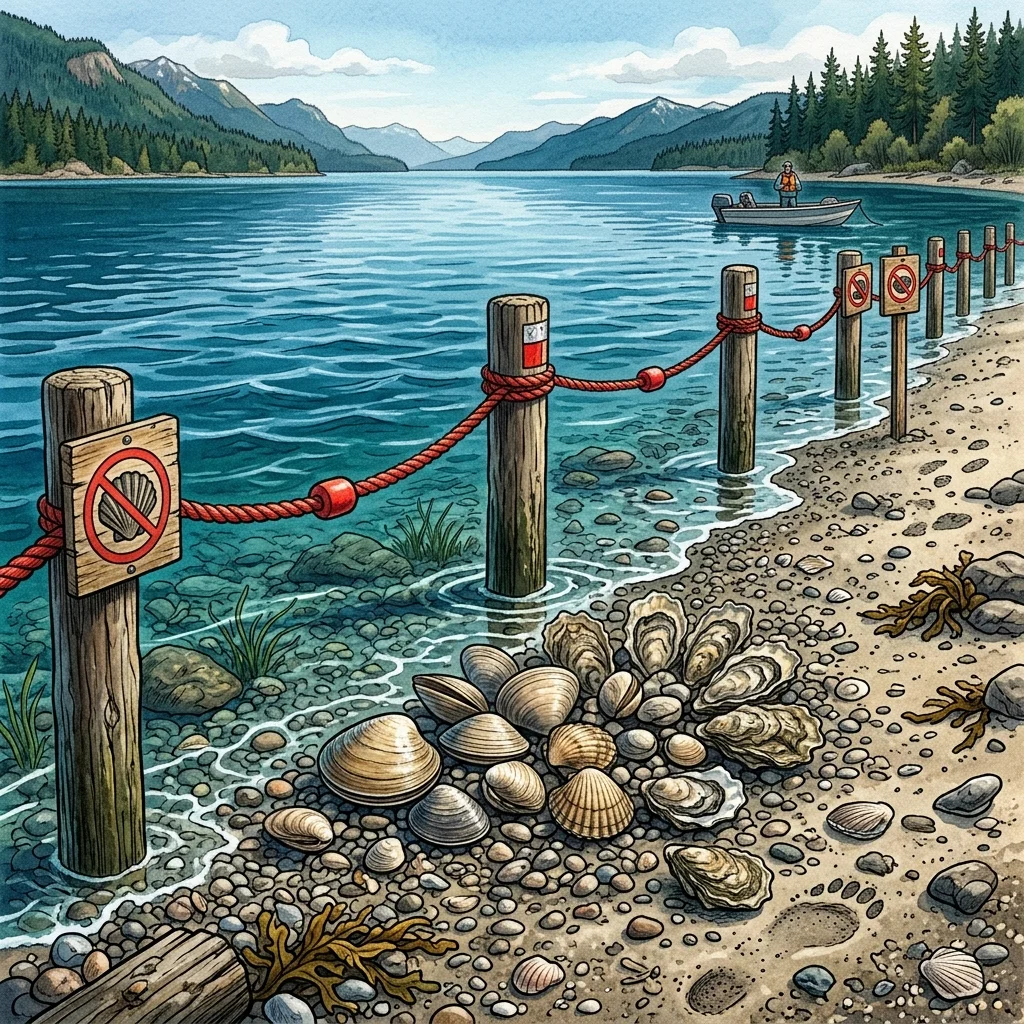
BELFAIR, Wash. — The Washington Department of Fish and Wildlife (WDFW) closed two of the most popular shellfish beaches on northern Hood Canal effective May 3, 2026, citing unsustainable harvest pressure and widespread rule-breaking — and the conservation action 50 miles north of the Great Bend has direct consequences for the Belfair-area beaches that North Mason families, Hood Canal property owners, and Mason County visitors use most.
The closure of Shine Tidelands State Park and Wolfe Property State Park, both in Jefferson County near the Hood Canal Bridge, ends the 2026 recreational clam, mussel, and oyster season at those sites earlier than scheduled. WDFW biologists and Fish and Wildlife Police said low tides this spring drew hundreds of harvesters at a time, many directed by social-media gathering groups, and compliance with limits, hole-filling, parking, and species-identification rules collapsed under that volume.
Last refreshed: October 20, 2026 (Pacific).
October 2026 update: The pressure story below played out against a much bigger closure: in June 2026, DOH testing found lethal paralytic shellfish poisoning (PSP) levels and all of Hood Canal closed to bivalve harvest. On October 14, 2026, WDFW issued an emergency rule reopening or extending several beaches as water quality improved — Belfair State Park is open to clam, mussel, and oyster harvest through October 31, 2026, to make up for the lost summer opportunity. Twanoh’s campsite reservations remain closed through spring 2027 for the shoreline restoration. Check the DOH Shellfish Safety Map the morning of any harvest — status can change again.
What WDFW closed — and why it matters in North Mason
The 2026 season at Shine Tidelands and Wolfe Property had already been reduced under a statewide rule package adopted in late 2025 that targeted ten Puget Sound beaches showing harvest stress. The May 3 action closed the season early on top of that reduction.
For North Mason, the news is not just about two parks an hour north. Hood Canal harvesters are mobile, and any closure on the canal’s north end displaces effort. The same 2026 statewide rule package also shifted the dates at Twanoh State Park — Mason County’s most heavily-used Hood Canal shellfish beach, sitting on SR-106 between Belfair and Union. When fewer beaches are open at the same time, the ones that remain open absorb the displaced demand.
Get The Signal
What we actually ran, what it measured, and what it means for a restoration shop — every week, including the flops.
The Twanoh squeeze: shifted season + summer shoreline closure
Twanoh State Park faced two compounding closures of its own in 2026. The first is the WDFW season shift — harvest windows have moved to different months than locals are used to, and harvesters who show up on the wrong tide will find the beach legally closed. The second is a Washington State Parks shoreline restoration project: campsite reservations at Twanoh closed from June 1, 2026 through spring 2027, and beach access was scheduled to close after the 2026 clam season for restoration construction.
Stacked together, those two closures meant Twanoh’s window of legal, accessible shellfish harvest in 2026 was narrower than it had been in years. Mason County harvesters who missed it looked for alternatives. Belfair State Park, Potlatch State Park, and Mason County’s private tidelands will see the spillover.
Why Belfair-area beaches are the next pressure point
The Mason County stretch of Hood Canal — from the head of the Great Bend at Belfair down through Tahuya, Union, Hoodsport, and Lilliwaup — holds some of the most productive recreational shellfish ground in Washington. Belfair State Park, at the very tip of the Great Bend, has seasonal openings tied to the Mary E. Theler Wetlands and the Union River estuary. Twanoh has historically been the workhorse beach for residents driving SR-3 and SR-106.
WDFW’s enforcement note on the May 3 closure was unusually pointed: gatherers exceeding daily limits, abandoning open digging holes, parking unsafely or illegally, and misidentifying clam species. None of those behaviors are unique to Shine Tidelands or Wolfe Property — the same patterns show up at North Mason beaches during peak low-tide weekends. For planning context, the Bugle’s Hood Canal Shellfish Season summer planner for Belfair and the 2026 shellfish and crab calendar for Hood Canal property owners remain the working baseline, both cross-checked against the WDFW Shellfish Safety Map before any harvest day.
How Hood Canal shellfish management works
Two state agencies share authority. WDFW sets seasons, daily limits, and species rules. The Washington State Department of Health (WA DOH) handles biotoxin and pollution closures through its Shellfish Safety Map and the Biotoxin Hotline at 1-800-562-5632. A beach can be open under WDFW and simultaneously closed under DOH for paralytic shellfish poison or vibrio risk — both have to be checked. Coverage of how shoreline land use affects water quality on the canal is in the Bugle’s water quality and shellfish reporting on the Tahuya River Preserve.
What this means going forward
WDFW signaled the May 3 action was a conservation tool the agency intends to keep using. If harvest pressure at any Hood Canal beach outruns sustainability, early closures should be expected rather than viewed as a surprise. The practical takeaway for Belfair, North Mason, and Hood Canal property-owner audiences: check the WDFW beach page and DOH Shellfish Safety Map the morning of harvest, not the night before. The Belfair Bugle will track the Twanoh State Park shoreline restoration timeline, the post-shift Twanoh harvest dates, and any further early closures on the Mason County side of the canal as they’re announced.
Frequently Asked Questions
Were Shine Tidelands and Wolfe Property the only Hood Canal beaches closed in May 2026?
Those are the two WDFW closed early on May 3, 2026 — the picture as of that spring. The map has moved since: a June 2026 biotoxin closure shut all of Hood Canal, and WDFW’s October 14, 2026 emergency rule reopened or extended several beaches as water quality improved, including Belfair State Park (open through October 31, 2026). Other Hood Canal beaches run on their own published 2026 seasons and may be open, closed, or under biotoxin advisory. Always check the WDFW shellfish-beach page for the specific beach plus the WA DOH Shellfish Safety Map before harvesting.
Is Belfair State Park open for recreational shellfish harvest right now?
As of October 20, 2026, Belfair State Park is open to clam, mussel, and oyster harvest through October 31, 2026 — WDFW’s October 14 emergency rule extended the season to make up for this summer’s biotoxin closure, which closed all of Hood Canal in June. After October 31, check the Belfair State Park beach page on wdfw.wa.gov and the DOH Shellfish Safety Map before planning a harvest trip.
Was Twanoh State Park open for camping in summer 2026?
No. Washington State Parks closed Twanoh State Park campsite reservations from June 1, 2026 through spring 2027 for a shoreline restoration project, so there was no summer 2026 camping season. Beach access was scheduled to close after the 2026 clam season ended.
What changed at Twanoh State Park for shellfish in 2026?
The 2026 statewide rule package WDFW adopted in late 2025 shifted Twanoh State Park’s recreational harvest dates to different months than the historical pattern. Harvesters who relied on prior-year calendars need to re-check the WDFW Twanoh page for the new 2026 windows.
What can North Mason residents do to keep their Hood Canal beaches open?
WDFW listed four behaviors that triggered the May 3 closure to the north: exceeding daily limits, leaving open digging holes, illegal or unsafe parking, and misidentifying clam species. Avoiding all four — and reporting violations to WDFW — is the single biggest thing local recreators can do to keep beaches like Belfair State Park and Potlatch State Park from following Shine Tidelands and Wolfe Property into early closure.
Where do I report a violation or get a current closure status?
For violations: WDFW Enforcement at 360-902-2936. For biotoxin closures: WA DOH Biotoxin Hotline at 1-800-562-5632 or the Shellfish Safety Map at doh.wa.gov/ShellfishSafety. The map updates as test results come in and is the authoritative source for whether a beach is safe on a given day.
Related Expansion Coverage
This story has been expanded into a full knowledge cluster for Mason County audiences:
- Twanoh’s Window Is Closing: What the WDFW Hood Canal Shellfish Enforcement Action Means for Mason County Harvesters (core guide)
- Mason County Shellfish Harvest 2026: Twanoh Is Open May 15–June 15 — Here’s How to Plan Your Season (household harvester guide)
- Hood Canal Tidelands Owner’s Alert: What the WDFW Enforcement Closures Mean for Your Beach (property owner guide)
- WDFW’s Early Closure Authority Is Now a Policy Tool — What It Means for Mason County Shellfish Management (civic overview)
Get The Signal
What we actually ran, what it measured, and what it means for a restoration shop — every week, including the flops.
Leave a Reply