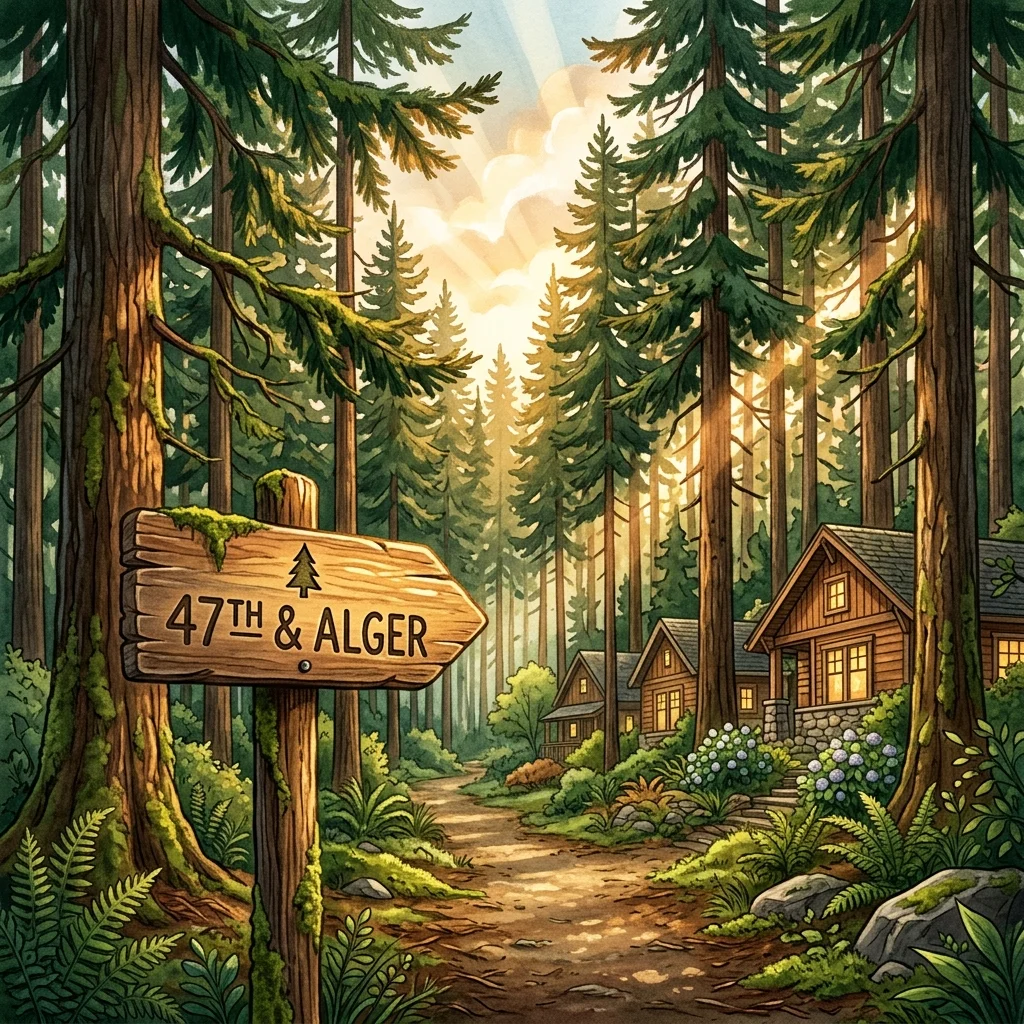
**What is South Forest Park in Everett?** South Forest Park is one of the City of Everett’s 19 official neighborhoods, located between Casino Road to the south and Glacier View to the east. It is one of Everett’s smallest neighborhoods by population — roughly 2,499 residents — and one of the most heavily forested, anchored by 197-acre Forest Park itself. Its neighborhood association meets the second Tuesday of most months at Zion Lutheran Church at 47th & Alger.
If you have driven Mukilteo Boulevard between downtown Everett and Boeing’s south end, you have already been to the edge of South Forest Park without knowing it. The neighborhood does not announce itself with a sign or a commercial strip. It does not have a “main drag.” What it has, instead, is canopy. South Forest Park is one of the most heavily wooded residential neighborhoods inside Everett city limits, and the people who live there tend to like it that way.
It is also, quietly, one of Everett’s most stable.
Where South Forest Park Actually Is
The neighborhood sits in south-central Everett, bordered roughly by Mukilteo Boulevard on the north, Casino Road on the south, the western edge of Forest Park on the west, and the rough alignment of Glacier View on the east. The City of Everett’s official neighborhood map shows the boundaries in detail; locals usually describe it more simply as “the streets between Forest Park and Casino Road that aren’t on Casino Road yet.”
The neighborhood is named for its most defining feature. Forest Park — Everett’s oldest and largest park at 197 acres — sits at the western edge of the neighborhood at 802 East Mukilteo Boulevard. South Forest Park is, literally, the neighborhood south of Forest Park.
It is also adjacent to two of the projects we have covered before. To the south, the Casino Road corridor is in the middle of a long-running anti-displacement and community investment cycle. To the west, the Pinehurst-Beverly Park neighborhood sits across Mukilteo Boulevard. Long-timers in South Forest Park tend to think of themselves as a buffer between the activity on Casino Road and the quieter, older residential streets to the north — and the geography backs them up.
The Numbers That Define the Neighborhood
South Forest Park is small. Population estimates from neighborhood data aggregators put the resident count at approximately 2,499 — making it one of the smaller of Everett’s 19 official neighborhoods. The household size averages about 2.6 people. Owner-occupancy runs at roughly 66 percent, which is high for an Everett neighborhood that mixes single-family homes with multifamily housing.
Real estate listings put the typical home price between roughly $450,000 for a smaller ranch and $800,000 for a larger or remodeled house. Median sale prices over the last twelve months have been clustered around $675,000. By comparison, Valley View-Sylvan Crest just east of here is reaching for higher numbers, and Casino Road just south of here is doing something different again. South Forest Park sits in the middle — established, wooded, mostly single-family.
If you want a quick mental model: this is one of the Everett neighborhoods where a 1970s-era ranch on a wooded lot is still the dominant housing type, where most blocks have a tree canopy that hides the rooflines from the street, and where the streets are quieter at 5 p.m. than they are at 8 a.m.
The Neighborhood Association — and Where It Meets
South Forest Park has an active neighborhood association recognized by the City of Everett. The association meets the second Tuesday of most months at 7 p.m. at Zion Lutheran Church, 47th & Alger. It is one of about a dozen Everett neighborhood associations that meet regularly enough to maintain a continuous voice in city processes — neighborhood plan updates, capital projects, parks programming, traffic comments.
The host venue is part of the story. Zion Lutheran was founded in 1901 in downtown Everett and moved to its current South Forest Park location in 1962. The church is part of the Evangelical Lutheran Church in America (ELCA) and has been a community service hub since its founding — food bank, AA meetings, community meals, and the kind of standing-room-only basement that every working neighborhood needs somewhere. The neighborhood association rents the room, but the relationship has lasted because the building has always been used for things bigger than worship.
The association also collaborates regularly with View Ridge-Madison just to the north, and supports a community garden — the kind of low-cost, high-trust civic infrastructure that does not show up in city budgets but does show up on a Saturday in May.
What’s Inside the Boundaries
A few features inside the neighborhood are worth knowing if you are new:
Forest Park (197 acres) at the northwest edge — Everett’s oldest park, with a Swim Center, picnic shelters, wooded trails, the Parks and Recreation Department’s administrative offices, and (as of a 2026 buildout) refreshed pickleball courts opening at the southeast corner of the park complex. The park alone is reason enough to live in this neighborhood.
Woodlawn Gardens — the older multifamily/garden apartments that anchor the eastern side of the neighborhood, built when the canopy was already mature.
Pigeon Creek — one of Everett’s named streams runs along the park edge and through the western side of the neighborhood. Pigeon Creek and its restoration history is part of why the city’s Critical Areas Update matters here.
Zion Lutheran Church (47th & Alger) — the de facto neighborhood center.
What Long-Timers Say
The thing long-time residents say most often is “we are the people who chose the trees.” South Forest Park is small enough that homes don’t turn over often, and the people who do move in tend to be people who explicitly wanted the canopy. The neighborhood’s modest housing stock and stable owner-occupancy rate reflect that.
The thing they say second most often is “we are not Casino Road, but we care about Casino Road.” The neighborhood has long taken a quiet but clear interest in what is happening to the south — most recently the 2026 Community Transit Goodwill site acquisition and the slower investments through Stations Unidos. South Forest Park residents commute through Casino Road, send kids to Mukilteo School District schools to the south, and read the neighborhood plan updates carefully.
Schools and Daily Life
South Forest Park sits at the edge of two school district boundaries — Everett Public Schools serves the northern portion, while Mukilteo School District serves much of the southern portion. Families in the neighborhood often say the boundary line runs through a backyard fence somewhere on their block — and they are not wrong. Anyone shopping for a house here should verify the specific school assignments for that exact address before they commit.
For groceries, residents drift to either the Casino Road corridor to the south or the West Casino Road QFC. For coffee and quick meals, the closest options are along Mukilteo Boulevard and Evergreen Way. There is no in-neighborhood retail strip, and that is by design.
A Quiet Verdict
South Forest Park is not the neighborhood that makes the Tygart Media headlines, and that is the highest compliment Everett can pay a neighborhood. It is small. It is forested. It owns its own homes. It meets at a 64-year-old Lutheran church basement and runs a community garden. It has a neighborhood association that shows up to plan updates and stays on topic.
If your version of “moving to Everett” includes a tree canopy, an established association, and a short walk to one of the largest urban parks in Snohomish County, South Forest Park is the neighborhood you should look at first.
Frequently Asked Questions
Where exactly is South Forest Park in Everett? South Forest Park is in south-central Everett, bordered by Mukilteo Boulevard to the north, Casino Road to the south, Forest Park to the west, and the western edge of Glacier View to the east. The official City of Everett neighborhood map confirms the boundaries.
How many people live in South Forest Park? Roughly 2,499 residents according to neighborhood-level data aggregators, making it one of Everett’s smaller neighborhoods.
What is the median home price in South Forest Park? Recent twelve-month median sale prices cluster around $675,000, with smaller homes starting near $450,000 and larger or remodeled homes reaching toward $800,000.
When does the South Forest Park neighborhood association meet? The association meets the second Tuesday of most months at 7 p.m. at Zion Lutheran Church, 47th & Alger.
What schools serve South Forest Park? The neighborhood spans the Everett Public Schools / Mukilteo School District boundary. School assignments are address-specific — verify with the appropriate district before purchasing.
Is Forest Park inside the South Forest Park neighborhood? The 197-acre Forest Park is at the northwest edge of the neighborhood at 802 East Mukilteo Boulevard. The neighborhood is named for its proximity to the park.
How is South Forest Park different from Pinehurst-Beverly Park? They are separate neighborhoods on the City of Everett’s official 19-neighborhood map. Pinehurst-Beverly Park sits to the west; South Forest Park sits to the east of Forest Park. They share some character but are governed by separate neighborhood associations.
Leave a Reply