Q: Is Everett Police getting augmented reality training technology?
A: Yes. The Everett City Council is scheduled to approve a $327,573 purchase of an InVeris FATS AR augmented reality training system for EPD on May 13, 2026 — fully funded by a federal DOJ COPS grant, with no general fund money involved.
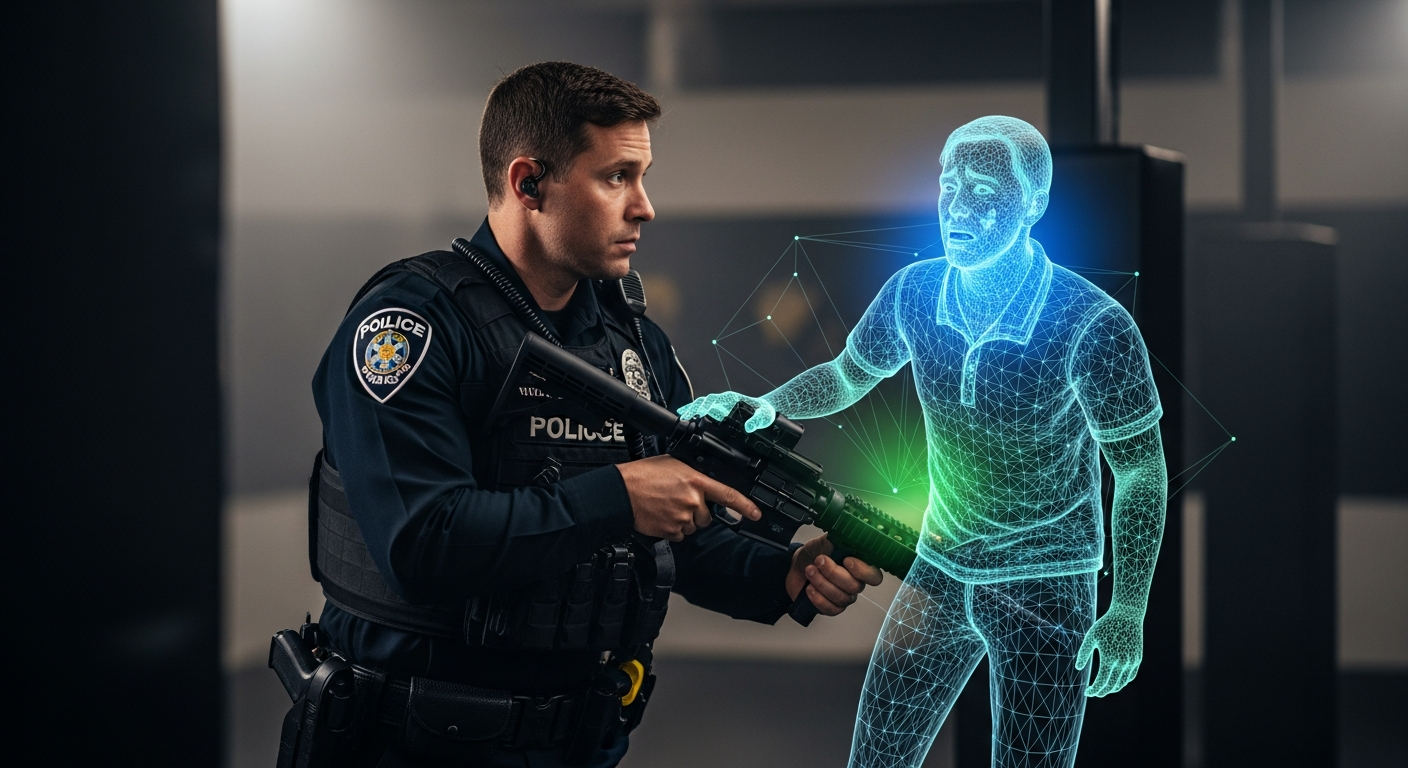
Everett Police Department is set to receive a major training upgrade: a mobile augmented reality platform that projects digital subjects and threats into real physical spaces, letting officers practice de-escalation and crisis response scenarios in actual buildings, hallways, and parking lots — not just a shooting range.
The Everett City Council is scheduled to approve a sole-source purchase of the InVeris FATS AR (Augmented Reality) Training System on May 13 as a consent agenda item. Total cost: $327,573.07 ($298,064.67 system cost plus $29,508.40 in tax). Funding source: a federal grant from the U.S. Department of Justice under the COPS FY25 Safer Outcomes program. No general fund money is involved.
What the System Does
The InVeris FATS AR system scans a real physical environment — a room, a corridor, a lobby — and overlays computer-generated characters into it. Officers see the actual space around them alongside digitally projected individuals they must interact with, de-escalate, or respond to in real time.
According to the resolution cover sheet signed by Police Chief Robert Goetz, the system supports:
- Multi-officer participation in the same scenario simultaneously
- Real-time instructor control over how scenarios evolve — the instructor can introduce new elements, escalate or de-escalate situations, and change variables mid-exercise
- Integrated after-action review with positional tracking, weapon orientation data, and performance analytics — so officers and instructors can review exactly what happened and why
- BlueFire® smart weapon integration — training weapons communicate with the system, tracking how and when officers raise or use them
The scenarios EPD is specifically targeting with the system: situations involving individuals experiencing mental health crises, behavioral health conditions, and other complex interactions “that require communication, decision-making, and peer intervention,” per the resolution.
This directly connects to the department’s direction under Chief Goetz’s community policing strategy, which has emphasized de-escalation skill-building alongside enforcement. The AR system delivers that philosophy in a high-fidelity, data-recordable training environment where officers can fail safely, reset, and learn from what the system captured.
Why It’s a Sole-Source Purchase
The resolution asks the council to waive standard public bidding requirements. Under normal circumstances, contracts of this size go through competitive bidding. The justification here, per state law (RCW 39.04.280) and federal grant rules (2 CFR 200.320(c)): there is only one vendor that makes this system.
The cover sheet states: “no other commercially available system meets the department’s operational requirements for multi-officer, real-world, augmented-reality training with integrated weapon functionality and instructor-controlled adaptability.”
InVeris holds patents on the core technology — including real-world environment scanning, the BlueFire® weapon integration, and AI-driven scenario control — that competitors cannot replicate. EPD’s market research confirmed no alternative system qualifies.
Sole-source purchases are reviewed and approved by the City Council case by case. Placing it on the consent agenda signals that city staff reviewed the sole-source documentation and found it meets the statutory threshold.
The Federal Grant Behind It
The COPS FY25 Safer Outcomes grant from the U.S. Department of Justice targets police departments investing in training and technology designed to reduce use-of-force incidents and improve officer-civilian outcomes.
EPD’s grant application tied the InVeris AR system to Safer Outcomes priorities: crisis response, de-escalation, and officer decision-making training — particularly for encounters involving individuals in mental health or behavioral health situations.
The grant covers the full system cost. Everett taxpayers are not paying for this purchase from the general fund.
The approach aligns with a national trend in law enforcement training: moving from static range-and-role-player exercises toward immersive, data-rich scenario environments. AR lets EPD run more training sessions faster, reset immediately between scenarios, and accumulate a performance record over time that supports individual officer coaching.
What Happens at the May 13 Meeting
The InVeris resolution is on the consent agenda for May 13 — meaning it’s expected to pass as part of a block vote alongside routine items like claims payables and contract extensions. Consent items move without individual debate unless a council member pulls one for separate discussion.
The May 13 meeting at City Hall begins at 6:30 p.m. The utility tax and rate ordinances are also on Wednesday’s agenda for their first readings. It is one of the more substantive midweek council sessions of the spring.
What To Do Next
- Watch the May 13 meeting: Live at YouTube.com/EverettCity, 6:30 p.m.
- Read the resolution and grant materials: Available in the May 13 agenda packet at everettwa.gov/AgendaCenter.
- Contact EPD: Police Chief Robert Goetz, RGoetz@everettwa.gov, 425-754-4540.
Frequently Asked Questions
Who is paying for this?
The federal government, through a COPS FY25 Safer Outcomes grant from the U.S. Department of Justice. The full $327,573.07 cost comes from the grant. Everett’s general fund is not used.
What is InVeris FATS AR?
FATS stands for Firearms Augmented Training System. The AR version projects digital characters into real physical environments, allowing officers to train in actual spaces — a building, a room, an outdoor area — rather than a dedicated simulation lab. The system is the only untethered AR training platform designed for law enforcement available in the current market.
Why isn’t this put out to competitive bid?
The City and EPD determined that InVeris is the only vendor with a commercially available AR training system meeting their requirements for multi-officer participation, real-world scanning, and integrated smart weapon functionality. Under state law and federal grant rules, a sole-source purchase is permitted when no alternative exists. The council reviews and approves the waiver.
What kinds of scenarios will officers train on?
Primarily de-escalation and crisis response, including encounters with individuals experiencing mental health crises or behavioral health episodes. The system records officer behavior for after-action review and coaching. The scenarios align with EPD’s COPS FY25 Safer Outcomes grant priorities.
Has EPD used AR training before?
The resolution does not reference prior AR training at EPD. This would be the department’s first InVeris FATS AR system.
When will EPD have the system?
The council is expected to approve the purchase on May 13, 2026. Delivery and installation timelines depend on InVeris’s production schedule following a purchase order.
Get The Signal
What we actually ran, what it measured, and what it means for a restoration shop — every week, including the flops.
Leave a Reply