
What is a neighborhood page for a restoration company? A page built from a completed job in a specific neighborhood, with real photos from the job site, real neighborhood references, real scope detail, and ideally a real client quote. Published within a week of job completion. Every neighborhood page is both a local SEO asset and a trust proof — it shows search engines and homeowners that the company actually works in that specific area. The compound effect of sustained neighborhood page publishing outcompetes every generic location-page strategy in restoration.
The difference between a restoration website that ranks in a neighborhood and one that does not is usually one thing: whether the site has a page specifically about work done in that neighborhood.
Not a generic “serving [neighborhood]” page with stock photos and city-council history copied from Wikipedia. A page about an actual job completed in that neighborhood — with the tech’s photos, the client’s story, the before-and-after, the specific street or landmark references that make it obvious the work really happened there.
This page pattern is the single highest-leverage piece of local-SEO content a restoration company can build. It is also almost never the one most companies prioritize, because it is harder than building generic location pages.
The discipline is worth it. Here is the full playbook.
Why Neighborhood Pages Beat Generic Location Pages

The generic location page pattern is familiar. The company maintains a page for every city in its service area. “Water Damage Restoration in Anytown.” The content is a rewrite of the main water damage page with the city name inserted in a dozen places. Stock photos. Generic copy. Maybe a driving directions widget. A map. A form.
Get The Signal
What we actually ran, what it measured, and what it means for a restoration shop — every week, including the flops.
Those pages used to work, mechanically, in an earlier era of local SEO. They do not work well now. Google’s algorithm has gotten better at detecting templated location pages and treats them as thin content. Homeowners have gotten more sophisticated at telling the difference between a company that actually works in their area and one that has a page claiming to.
The neighborhood page is the answer to both. It is specific. It is proof. It ranks because it is actually about the neighborhood. It converts because the homeowner reading it sees real evidence that the company was in their area doing exactly the kind of work they need.
The Anatomy of a Working Neighborhood Page
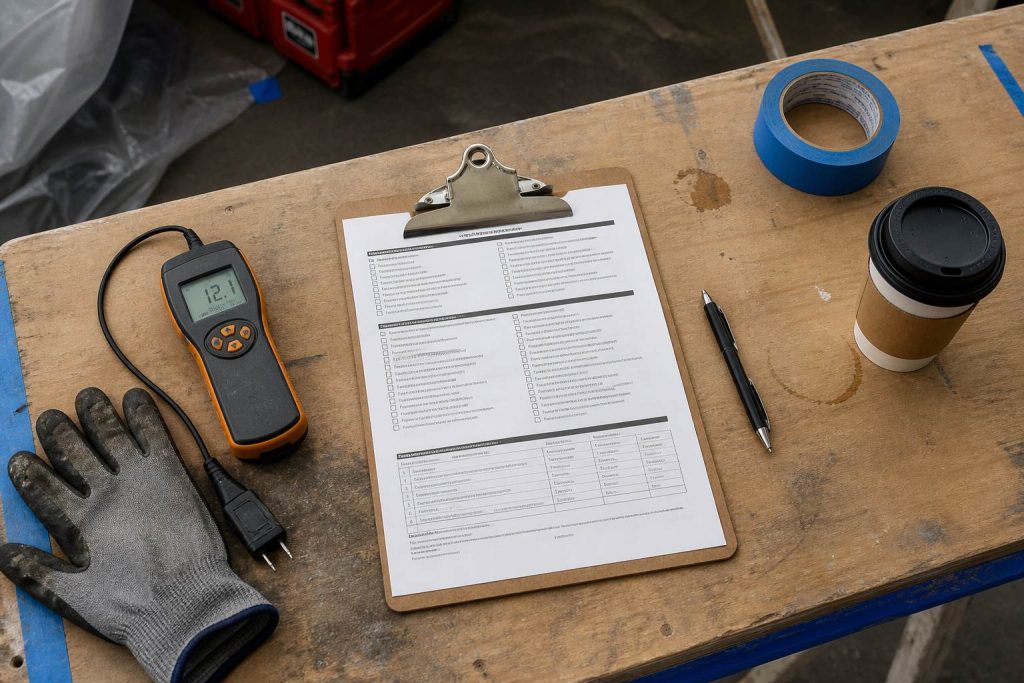
A neighborhood page that performs has a consistent structure.
Title. Service + neighborhood + date. “Water Mitigation in [Neighborhood Name] — [Month Year].” The structure is explicit — search engines index it, homeowners understand it.
Opening summary. One or two paragraphs about what happened. What the damage was. Who the client was (with permission — a first name, or “a homeowner near [landmark]” if they asked not to be named). What the company did. How long it took. How it went.
The job gallery. Real photos from the job, labeled. Water intrusion before. Equipment in place. Drying in progress. Moisture mapping. Before and after for the affected area. Equipment being removed. The finished space. The tech working if they agreed to be photographed.
Neighborhood references. Specific, visible. The street sign photographed in the background of one of the job photos. A reference to the coffee shop on the corner. The municipal park two blocks over. A note about the age of the homes in the area or the common construction style. These are the details that make the page obviously specific to this neighborhood, not copy-pasted from a template.
Scope detail. What was actually done. The specific water mitigation steps — extraction, structural drying, moisture mapping, dehumidification, sanitization, post-remediation verification. Written in a way the homeowner can follow. The detail proves expertise and answers the questions the next reader in that neighborhood will be asking.
Client quote. When possible. “The crew was at my house within 90 minutes of my call.” Even a single specific sentence from the client adds enormous trust weight. Permission captured in writing at job close-out.
A sidebar with company context. The company’s service area, the other services offered, the contact phone for emergencies. The page is optimized for the specific neighborhood search, but it is also where many homeowners will first encounter the company, so the context has to be there.
Schema markup. Article schema, local business schema, FAQ schema if an FAQ section is included, speakable schema for the direct-answer sections. The AI search engines and voice assistants reward well-structured pages with correct schema.
Published Within a Week
The timing matters. A neighborhood page published within a week of the job is worth considerably more than the same page published four months later.
Why: recency signals. Photos with a clear timestamp or seasonal context. Client memory is fresh, so quotes and permission are easier to capture. The job details are accurate because nobody has had to reconstruct them from memory. The tech and the PM are available to review the page.
A week is fast but realistic. The rough workflow:
- Day 0 to 3: Job completed. Tech photos in the file. Close-out conversation including content permission ask.
- Day 3 to 5: Content team drafts the page from the job file. Photos selected and edited. Scope detail written. Any client quote captured with written permission.
- Day 5 to 7: PM reviews for accuracy. Owner approves if needed. Page published. Added to relevant category/service index pages. Linked from adjacent neighborhood pages.
This is an operational rhythm, not a campaign. Once installed, it runs itself. The content team knows to expect a new page every few days. The techs know the photos are needed. The PMs know to schedule the review time.
How Many Neighborhood Pages Is Enough
The honest answer is: there is no enough. The neighborhood page library is a long-term compounding asset. The first thirty pages do not move much. The two hundredth page is when the site starts to dominate. The five hundredth page is when generic competitors can no longer compete.
Practically, a restoration company running a steady job flow should be publishing a new neighborhood page every one or two weeks. That is 25 to 50 per year. In three years, the site has 75 to 150 neighborhood pages. That is a structurally different site from a competitor with zero.
Not every job needs to become a page. The pages that perform best come from jobs that had something specific about them — a distinct service, an interesting scope challenge, a memorable client, a rare neighborhood for the company. The routine jobs can still be represented through briefer updates on existing location or service pages.
Handling the Permission Conversation
The client permission conversation is the bottleneck that kills most neighborhood-page programs. Companies get anxious about asking. So they do not. So the content library stays empty.
The script is short and respectful. At job close-out, a version of:
“Before we wrap up, I want to ask — if it’s okay with you, we’d love to use this job as an example of the kind of work we do. We’d post some photos of the before and after on our website. We can leave your name off, use just a first name, or include your full name if you’re comfortable with it. We’d never show anything identifying about the address specifically. Is that something you’d be okay with?”
Most clients say yes. Some say “yes, but no name.” A few say “no.” All three are fine. The answer goes in the job file. The content team only uses what was given permission for.
Clients who say yes and see the resulting page published usually become ambassadors. A page about their job is a page they share. That sharing behavior extends the reach of every neighborhood page beyond what SEO alone produces.
Handling the Photo Quality Problem
Tech photos are sometimes not suitable for publication without editing. Bad lighting. Motion blur. Inappropriate framing. Personal items visible in the background.
A few mitigations:
Train the tech. Five-minute training, once, on framing water mitigation shots, lighting considerations, what not to include in the frame. The improvement after basic training is substantial.
Provide a simple camera standard. A phone camera held horizontal, good light, steady, subject filling the frame. Not complicated.
Pair with occasional professional photos. For flagship jobs — a large commercial loss, a showcase residential project — bring a professional photographer for an hour at the end. Those photos elevate the whole library.
Edit with a light hand. Crop. Adjust exposure. Remove personal items visible in the frame when possible. Do not over-polish — over-edited photos read as stock and lose the authenticity that makes them effective.
Linking the Neighborhood Pages
Neighborhood pages do not exist in isolation. They participate in a link architecture that makes them findable and reinforcing.
From the service pages. “Recent water mitigation work: [neighborhood] — [neighborhood] — [neighborhood].” The service pages carry the topical authority. The neighborhood pages carry the local specificity. The links connect them.
From the city pages. If the site has a city-level page (separate from the neighborhood pages), the city page lists the recent neighborhood jobs in that city. This reinforces the city page with fresh evidence of local activity.
From each other. Adjacent neighborhood pages can link to each other. “In nearby [neighborhood name], we also handled [service].” This builds internal link density in a way search engines read as topical relevance.
From blog posts and social. Every neighborhood page gets mentioned in the weekly content cycle — a social post, a mention in an email, a citation in a related blog post. The cross-promotion extends reach.
The Pattern Compounds
What makes the neighborhood page strategy effective is that it compounds in a way generic SEO content does not.
Each page adds to the site’s topical authority in restoration. Each page adds to the site’s geographic authority in the specific area. Each page adds a trust signal that a real job was done at a real place. Each page provides content the algorithm can read, the AI engines can cite, and the homeowner can trust.
Over three years, the cumulative effect is a restoration site that functions as a living directory of the company’s actual work. The competitive moat is structural — not just “we have more pages,” but “we have more evidence.” A competitor starting fresh cannot catch up quickly. The moat keeps widening.
How This Pairs With the Rest of the Stack
Neighborhood pages are the deepest expression of the digital three-legged stool’s website leg. They depend on the content engine’s every-story-starts-with-a-job doctrine. They benefit from the GBP playbook — neighborhood pages are naturally featured in GBP posts and photos. They get amplified efficiently by the paid layer — a neighborhood page is a strong landing page for a geo-targeted paid campaign.
Every layer of the stack either contributes to or benefits from the neighborhood page practice.
Where to Start
Pick one job from the last thirty days that had good photos and a client who would likely be comfortable with a page. Write the page this week. Publish it. Link it from the service page.
Install the permission ask in the job close-out SOP. Train the PMs and techs to run it. Log permission answers in the job file.
Install the weekly publishing cadence. One page every one to two weeks minimum. Name the owner of the workflow. Put the cadence on a shared calendar.
In ninety days, the site has six to twelve neighborhood pages. In a year, 30 to 50. In three years, 100 to 150. Every one of them is a permanent compounding asset.
The restoration companies that commit to this practice end up owning the local search results in their service area in a way no advertising budget can replicate.
Frequently Asked Questions
What is a neighborhood page for a restoration website? A page built from a real completed job in a specific neighborhood, with real photos from the job, real client detail (with permission), real neighborhood references, and real scope information. Published within a week of job completion. Designed to rank for the neighborhood-specific search and to prove to homeowners that the company actually works in their area.
How is a neighborhood page different from a standard location page? A standard location page is a template (“Water Damage Restoration in [City]”) with stock photos and generic copy. A neighborhood page is about an actual job with actual photos and actual client and neighborhood specifics. The difference is generic versus proven — and both search engines and homeowners reward the latter.
How quickly should a neighborhood page be published after the job? Within a week. The photos are fresh, the details are accurate, the client permission is easy to capture, and the recency is a signal the algorithm rewards. Four-month-old pages are still valuable but lose a lot of what makes them effective.
How many neighborhood pages does a restoration website need? There is no upper limit. A sustainable cadence is one new page every one to two weeks, producing 25 to 50 per year. In three years, a site has 75 to 150 neighborhood pages. The library compounds — the two hundredth page is when the site starts to dominate local search in a structural way.
Do you need client permission to publish a neighborhood page? Yes, always. Ask at job close-out. Offer the client three levels — full name, first name only, or anonymous. Capture the answer in writing in the job file. Only publish within what was permitted.
Do neighborhood pages work for commercial restoration too? Yes. The same pattern applies — building type, location, service, scope, photos, with permission. Commercial clients often require more specific permission handling (NDAs, brand considerations) but many will agree to featured case studies with appropriate terms. Commercial neighborhood pages rank well for the specific commercial building type in the specific area.
Tygart Media on restoration — an analyst-operator body of work on the systems that separate compounding restoration companies from busy ones. No client names. No brand placements. Just the operating standard.
Get The Signal
What we actually ran, what it measured, and what it means for a restoration shop — every week, including the flops.
Leave a Reply