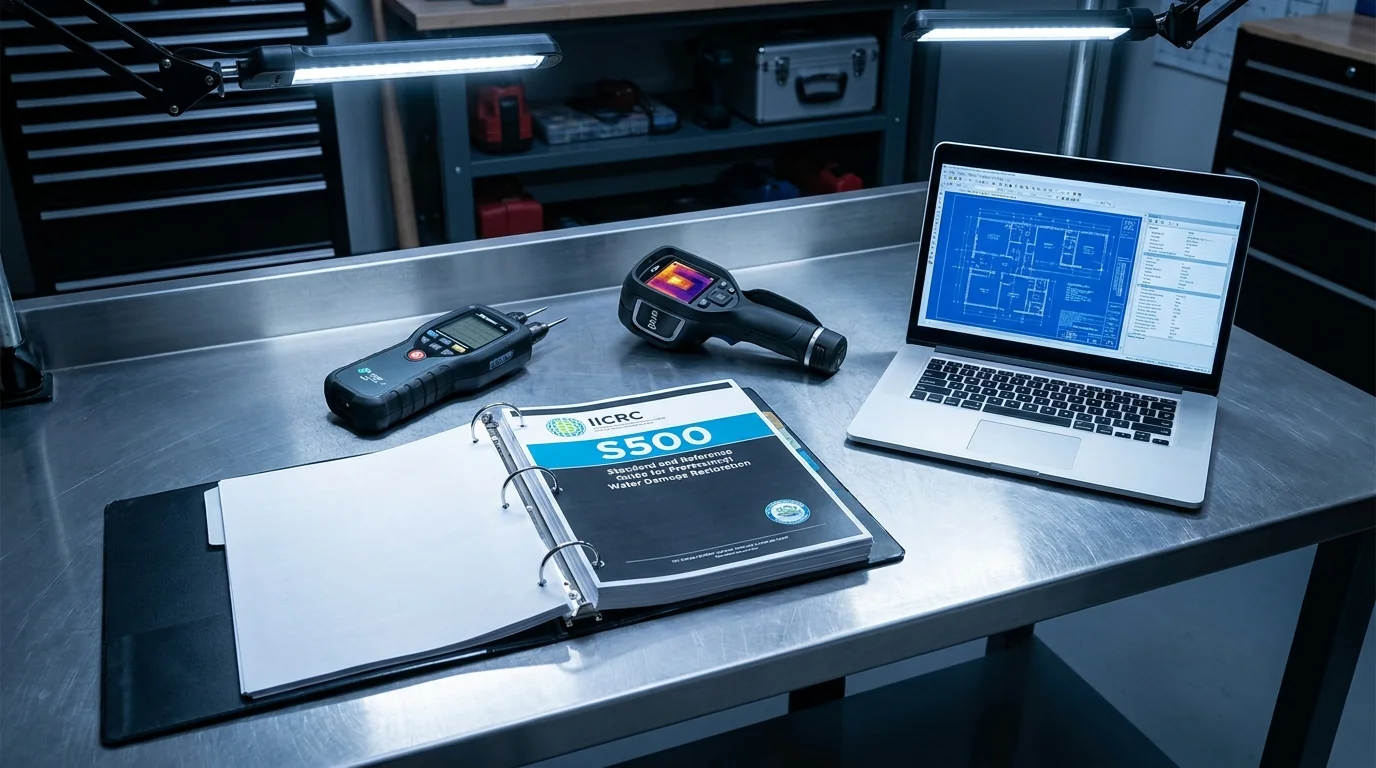
The 2026 revision of ANSI/IICRC S500 — the Standard for Professional Water Damage Restoration — is the most consequential update the standard has seen in nearly a decade. For restoration contractors, the practical impact lands in three places: documentation, scope-of-work language, and the science behind how losses are categorized and classed.
This guide focuses on what changes for the working restoration company, not the academic background. If you are billing insurance, defending scope in litigation, or training technicians to a current standard, here is what the 2026 update actually requires of you.
Why Standards Revisions Matter to Restoration Contractors
S500 is the reference document insurance carriers, TPAs, and litigation experts cite when evaluating whether a restoration job met the standard of care. When the standard moves, your documentation, your contracts, and your technician training all need to move with it. Continuing to operate against the prior version creates avoidable exposure on every loss you handle.
The 2026 revision was driven by a combination of new science around microbial contamination, accumulated industry experience with category 3 losses, and the documentation burden that has emerged from rising restoration litigation. Each driver shows up in the changes.
Documentation Is Now the Center of the Standard
The single largest practical change is that documentation expectations have been promoted from supporting language to a central requirement. The 2026 revision tightens the description of what must be recorded at each phase of a water mitigation project.
For a restoration contractor, this means a moisture map, atmospheric readings, and material moisture content readings are no longer optional supporting evidence. They are the evidence that the work met the standard. Operators who have been documenting on the technician’s phone with no centralized capture process need to formalize that workflow before their next loss.
Practical implication: if your shop is still relying on handwritten logs or on technicians remembering to upload photos at the end of the day, the 2026 revision has effectively closed that gap. A documented chain from FNOL through final reading, with timestamps and consistent measurement methodology, is now the standard.
Category and Class Definitions Have Been Sharpened
Category and Class definitions in the prior S500 had room for interpretation that frequently surfaced in scope disputes. The 2026 revision narrows that room. Specifically, the language around when a Category 2 loss escalates to Category 3, and the criteria for Class 4 losses involving low-permeance materials, has been written more tightly.
For contractors, the practical consequence is that the determination is now harder to wave away if challenged. A clearly documented Category 3 determination — with the specific contamination indicator that drove the call — protects the scope. A loosely documented determination is now easier to challenge in a coverage dispute.
Scope-of-Work Language Has to Match the Standard
If your work authorization, scope sheet, and final invoice use category and class language inconsistent with how the 2026 revision defines those terms, expect more pushback from carriers and TPAs. Many restoration shops are revising their template documents — work authorizations, scope sheets, certificates of completion — to align with the updated terminology.
This is a low-cost, high-value update to make once. A document review by your shop manager or a qualified consultant ahead of your next loss will save hours of dispute resolution downstream.
Microbial Considerations and the Mold Boundary
S500 has historically pointed to ANSI/IICRC S520 for mold remediation guidance, but the 2026 revision sharpens the boundary between the two standards. Specifically, the 2026 update clarifies the conditions under which a water mitigation project becomes a microbial remediation project, with corresponding implications for containment, PPE, and documentation.
The takeaway for contractors is that the gray area between “drying” and “remediation” has narrowed. A job that crosses the threshold needs to be re-scoped under S520, not extended under S500. Operators who run both work types should review their internal escalation triggers against the new language.
Drying Goals and Verification
The 2026 revision retains the drying-goal framework but tightens the verification language. Specifically, the standard now expects that the drying goal be documented at the project outset, that the verification methodology be specified, and that the final reading be tied back to the goal that was set.
For a working contractor, this means the moisture map and the dry-standard reference need to live in the same document trail, not in separate files that no one reconciles. Loss reviewers will increasingly look for that reconciliation as a marker of standard-of-care compliance.
Training Implications
Every WRT and ASD technician on your team is being trained to the prior version of the standard until your training materials are updated. IICRC course content typically lags a standard revision by several months, which means there will be a window in which technicians hold a credential issued under the prior standard but are working to a job that needs to meet the new one.
Mature shops are addressing this with a short internal training cycle: a one-page summary of the changes, a documentation template update, and a refresher on category and class language. The cost is low. The cost of skipping it is a documentation gap that surfaces during the next disputed claim.
What to Do This Quarter
If you are a restoration contractor reading this and have not yet acted on the 2026 revision, the prioritized list is short: review your work authorization and scope-sheet templates, formalize your documentation workflow if it is not already centralized, run a 30-minute internal training for production staff on category and class language, and review your S500-to-S520 escalation triggers. None of these are large projects. All of them reduce exposure on the next loss.
Frequently Asked Questions
When did the IICRC S500 2026 revision take effect?
The 2026 ANSI/IICRC S500 revision is the current published version of the standard. Restoration contractors are expected to operate against the most current published version of the standard as their reference for standard of care.
Does the 2026 S500 revision change how I bill water mitigation jobs?
The standard does not directly govern billing, but it governs the documentation and scope language that supports billing. Expect carriers and TPAs to align their review criteria with the updated terminology, which means scope sheets and final invoices need to use the current language.
What is the most important documentation change in the 2026 revision?
The promotion of documentation from supporting language to a central requirement. Moisture maps, atmospheric readings, and material moisture content readings must now form a continuous, timestamped record of the project from FNOL through completion.
Do I need to retrain my technicians on the 2026 S500 revision?
A formal IICRC retake is not required for technicians already holding WRT or ASD credentials. However, a short internal training on documentation workflow, updated category/class language, and the S500-to-S520 boundary is a recommended practice for any shop operating to current standard of care.
Where does the S500 2026 revision draw the line between drying and microbial remediation?
The 2026 revision sharpens the boundary by clarifying the conditions — including time elapsed, contamination indicators, and material affected — that move a project from S500 water mitigation into S520 microbial remediation. Shops that handle both types of work should review their internal escalation triggers against the updated language.
For more industry standards coverage and operator-focused analysis, see Industry Signals on Tygart Media.
Leave a Reply