
The Notion second brain content online is almost entirely written for individuals. Personal productivity. Getting things out of your head. PARA systems for your reading notes. That’s useful for a person. It’s not what a business owner running an operation actually needs.
A business second brain is different in kind, not just in scale. It’s not a place to capture your ideas — it’s the institutional memory of an organization. The difference matters for how you build it, what goes in it, and how you use it.
This is the business owner’s version: no productivity philosophy, no personal capture system, just the architecture that works when the stakes are operational rather than personal.
What a Business Second Brain Actually Stores
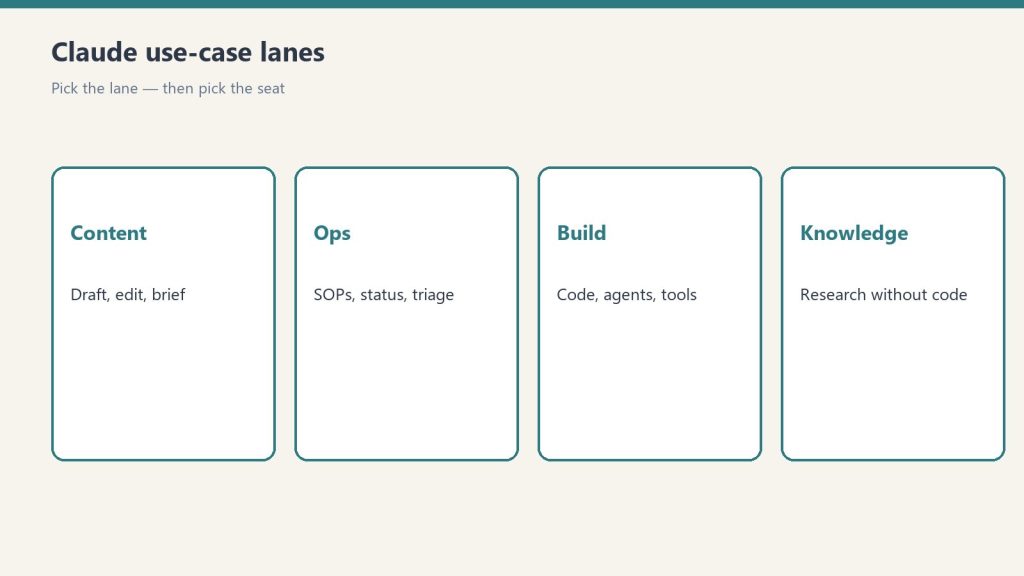
Personal second brains store ideas, highlights, book notes, and learning. Business second brains store different things — and getting clear on the distinction prevents building the wrong system.
A business second brain stores: how things get done (SOPs and procedures), what has been decided and why (architecture decisions and rationale), who the relevant people are and where relationships stand (CRM and contact history), what is currently in motion (project and content pipelines), and what was learned that should change how things get done next time (session logs and after-action notes).
It does not store every idea you had, every article you read, or every meeting note verbatim. Those belong in a personal system or in the trash. The business second brain is a curated operational record, not a capture-everything archive.
The Organizational Principle: Function Over Topic

Personal second brains are usually organized by topic — a page for marketing, a page for strategy, a page for each project. This makes sense for individual knowledge management. It breaks down for business operations because the same information belongs to multiple topics simultaneously.
Business second brains are organized by function: what kind of operational question does this answer? The six functional categories that cover most small business operations are tasks, content, revenue, relationships, knowledge, and the daily dashboard. Everything in the business belongs to one of those six. If it doesn’t fit any of them, it probably doesn’t need to be documented.
The Knowledge Layer Is the Differentiator
Most business Notion setups have tasks and maybe a content tracker. The part that separates a true second brain from a fancy to-do list is the knowledge layer — the documented institutional memory that makes the operation less dependent on any one person’s recall.
The knowledge layer contains three things. SOPs: how specific procedures get executed, written precisely enough that someone unfamiliar with the process could follow them correctly. Architecture decisions: why the operation is structured the way it is, including the alternatives that were considered and rejected. Client and project context: the accumulated understanding of each relationship and engagement that would otherwise live only in the account manager’s memory.
This layer is the hardest to build because it requires translating tacit knowledge — things people just know from experience — into explicit documentation. It’s also the most valuable, because it’s the layer that survives personnel changes, makes onboarding tractable, and allows an AI system to operate on your behalf with real institutional context.
Daily Use Is What Makes It a Brain
A second brain that you consult once a week is a reference library. A second brain that you interact with every working day is an operating system. The difference is in how the daily rhythm is designed.
The daily interaction with the business second brain should take ten to fifteen minutes in the morning: triage new items into the right databases, check what’s due or overdue, scan the content queue for anything publishing in the next 48 hours that needs attention. And five minutes at the end of the day: mark done tasks complete, push anything untouched, log any significant decisions made.
If those interactions feel like maintenance overhead, the system isn’t designed right. They should feel like reading the dashboard of a machine you trust — a quick orientation to current state before the day’s work begins.
What Makes It AI-Ready

The most significant thing a business second brain can do in 2026 that wasn’t possible five years ago is function as context infrastructure for an AI system. When Claude can read your SOPs, understand your active projects, and know what decisions have already been made, it operates as a genuine collaborator rather than a tool you have to re-brief every session.
Making a Notion workspace AI-ready requires one addition beyond good organization: a consistent metadata structure on key pages that makes them machine-readable. A brief structured summary at the top of each important page — the page type, what it covers, the key constraints, and a resume instruction for continuing work in progress — gives an AI system the orientation it needs without requiring it to read thousands of words of context every session.
This isn’t complicated to implement. It’s a JSON block at the top of each important page, written once and updated when the page changes. But it’s the difference between a Notion workspace that an AI can navigate and one that requires constant manual context transfer.
Starting Without Starting Over
Most business owners who want a Notion second brain already have some Notion — random pages, abandoned systems, half-built databases from previous attempts. The instinct is to start over from scratch. Usually the right move is not to.
Start by identifying what already exists that’s actually useful: any SOPs that are current, any databases that are being used, any pages that people actually refer to. Move those into the right place in the six-database architecture. Then identify the most important gaps — usually the knowledge layer, which is often entirely missing — and fill those first.
A usable business second brain built in two weeks by organizing what exists is worth more than a perfect system built from scratch over three months. The system’s value is in being used, not in being complete.
We build Notion second brain systems for business owners — the full architecture, configured for your operation, with the knowledge layer that most setups skip.
Tygart Media runs this system live across multiple business lines. We know what the build process looks like and what makes it stick.
Related on Tygart Media: Notion-deep, surface-simple · Command Center · second brain setup.
Frequently Asked Questions
Is a business second brain the same as a personal second brain?
No. A personal second brain is organized around individual knowledge management — capturing ideas, notes, and learning for personal recall and creativity. A business second brain is organized around operational function — tasks, pipelines, relationships, procedures, and institutional knowledge. The tools can overlap (both often use Notion) but the architecture and the content are fundamentally different.
How is a Notion business second brain different from a project management tool?
Project management tools handle tasks and timelines. A business second brain handles those plus the knowledge layer — why decisions were made, how procedures work, what the history of a client relationship looks like, what was learned from past projects. The knowledge layer is what transforms a task tracker into something that actually captures and preserves institutional memory.
Who should own the business second brain?
In a small agency or solo operation, the owner maintains it. In a slightly larger team, the person closest to operations — often the account lead or operations manager — maintains the shared elements while individuals maintain their own client-specific documentation. The critical rule: someone must own it. A second brain maintained by everyone equally is maintained by no one.
How long does it take to build a business second brain in Notion?
A functional minimum viable second brain — the six databases set up, the most critical SOPs documented, the daily rhythm established — takes twenty to thirty hours of focused work. A mature system with comprehensive knowledge documentation takes three to six months of consistent operation. The minimum viable version provides immediate value; the mature version is what makes the operation genuinely resilient and AI-ready.
Leave a Reply