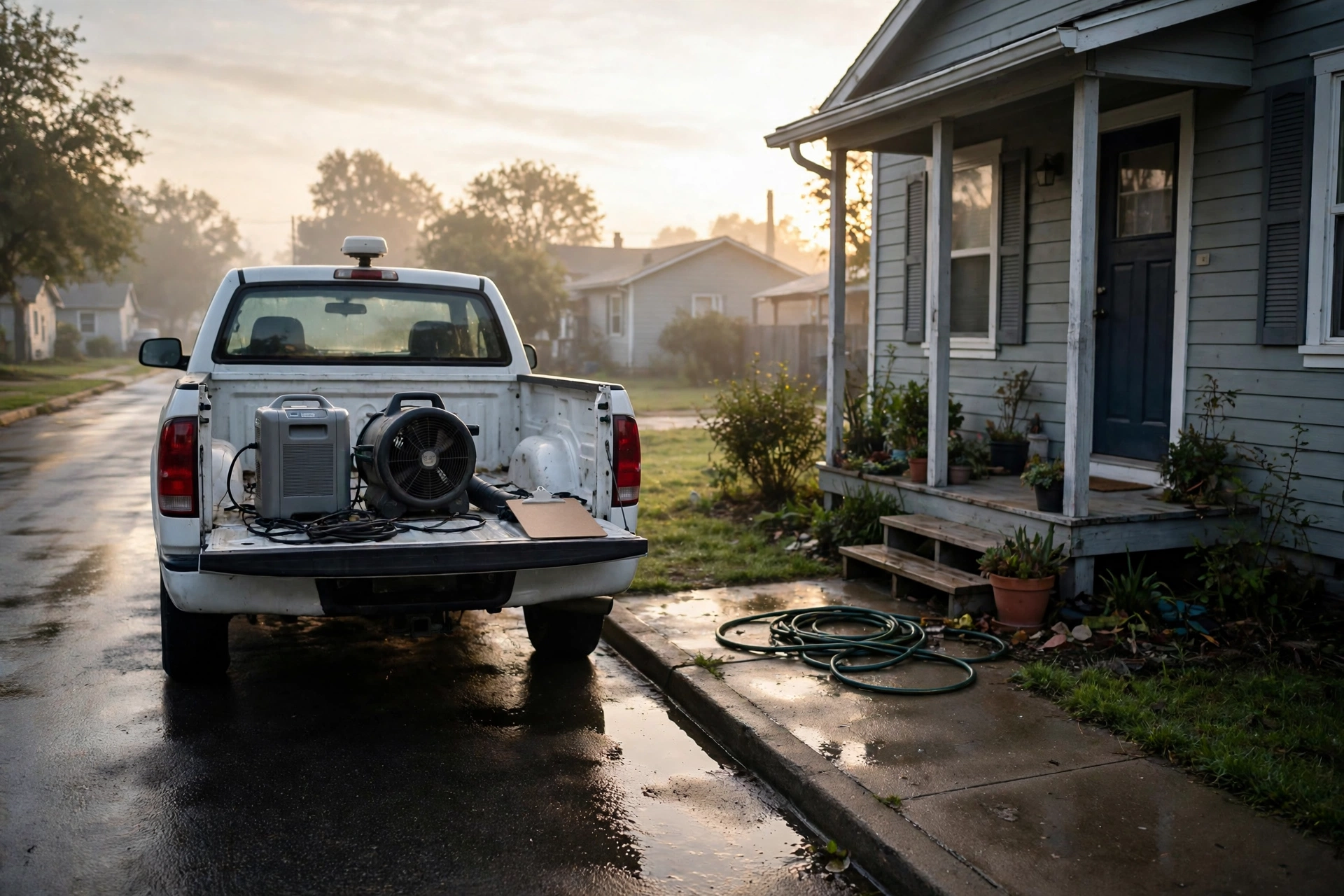
He doesn’t beat the big shops by out-buying them. He beats the comparison by changing what gets compared. He takes the trade he came from — eight years as a home inspector — breaks it down to the part that still matters, and builds it into the offer, so every water-loss job includes something the adjuster’s sheet has no column for: a written, dated inventory of the condition of the parts of the house the water didn’t touch.
If you started your business after a first career — and in the trades, a lot of founders did — that past life is not background. It’s inventory. It’s also the one thing the bigger competitor cannot claim, because he didn’t live it.
One truck, second year
The operator in this story is a familiar shape. Second year in business. One truck. A rented storage unit where the drying equipment lives between jobs. His spouse does the books at night after her own day is done.
He came into restoration from eight years as a home inspector. No brand anyone recognizes. No program agreements. No marketing budget worth the name. Work comes as a trickle — two realtors who remember him from inspection days, and a plumber who calls when he finds something wet he doesn’t want to own.
He is good at the work. That was never the problem.
The problem is the axis he’s being judged on.
Get The Signal
What we actually ran, what it measured, and what it means for a restoration shop — every week, including the flops.
Smaller on every column that counts
Put him next to the established shops on the measures everyone defaults to — response time, trucks, equipment ready to roll, certifications, headcount on a bad-weather weekend — and he loses every row. Not because he’s careless. Because he’s one person.
Homeowners like him. They say so. Then the quotes go into a process that doesn’t run on liking. An adjuster compares offers on a sheet with set columns, and his entries are thinner in almost every box. So he loses jobs he could have done well.
First-year revenue was survivable. It was not compounding. Survivable means the truck runs and the storage rent clears. It does not mean a second truck, a first hire, or a month where one slow week stops being a scare.
The obvious advice all cost money he didn’t have yet. Niche down — on what budget to reach the niche? Buy more equipment — to sit in the unit beside the equipment already there? Join a network — with fees due before the referrals are? Every suggestion was a way to become a slightly less small version of the same shop. None of it changed the comparison.

The snowmobile
John Boyd — the fighter pilot and thinker who wrote about how people orient themselves when things are changing — had an image for how something genuinely new gets made. He called the process destruction and creation.
Destruction, in his sense, is analysis: taking a thing from general to specific, breaking a familiar domain apart until you’re holding its separate parts. Creation is the reverse move: synthesis, specific to general, finding common qualities across those shattered pieces and building something that didn’t exist in any one of them.
His example was a snowmobile.
Look, he said in effect, at a skier, a motorboat, a bicyclist, and a toy tractor. Shatter each domain. From the skier, skis. From the motorboat, an outboard motor. From the bicyclist, handlebars. From the toy tractor, rubber treads. None of those parts, by itself, is a vehicle that crosses snow under power. Synthesize them around what they share, and you get one — a machine that belongs to none of the four domains it came from.
This is not brainstorming, and it’s not bolting features onto an existing product. A ski is useless for this purpose until “skier” has first been broken apart and the ski is just a ski, free to be used another way. The combining only works after the breaking.
Boyd put the stakes in one hard sentence, in sense if not in his exact cadence: faced with uncertainty and change, the loser cannot build snowmobiles, the winner can — and employs the ability appropriately, when the situation calls for it.
Our operator didn’t need a better version of a restoration truck. He needed a snowmobile.
What he stopped selling
He stopped selling “restoration, but smaller” — same promise, fewer people — and asked what his inspector years had actually left him holding, once that job was broken apart.
Not the license. Not the checklist as a whole. The useful constituent was narrower: the habit, and the trained eye, for walking an entire house and writing down its condition before anything went wrong in it — what was stained, what was worn, what was already old — with dates and photographs, in language a third party could rely on later.
Bolted onto a dry-out, that part changes the job.
So the offer became this: every water-loss job includes a written pre-loss condition inventory of the unaffected parts of the home. Not the damaged kitchen — the rest of the house. Floors, subfloors where visible, walls, finishes, the rooms the water never reached, documented at intake while he is already there setting equipment. Homeowner and adjuster each get a copy. It is the baseline document neither the big shops nor the carrier had bothered to create, because on a standard dry-out, nobody’s job says to make it.
He wasn’t adding a freebie. He was adding a column.
The kitchen leak that paid for the idea
It proved out on a routine job. A kitchen supply line, a wet cabinet floor, a small dry-out.
While he was there, he did the inventory as he now does it on every job. In the next room, he noted pre-existing subfloor staining — old, dry, unrelated to this leak — and photographed it with the date attached, without making a point of it. The homeowner signed the inventory with everything else.
Three weeks later, that staining tried to become an argument. Was it part of this loss or wasn’t it? That kind of question usually gets settled by whoever sounds most confident, because nobody wrote anything down when it could still be checked.
He had written it down. The argument ended quietly — the document was simply earlier and clearer than the dispute.
After that, the adjuster on the job had a name for him. Not the small shop. Not the new guy. “The one who documents the whole house.”
That name is worth more than a certification he hasn’t bought yet, because it describes a difference, not a size.
And a second channel opened that he hadn’t planned on. The realtors who already knew him started sending him pre-listing work — houses about to be sold, where a seller wants both things at once: someone who can dry what needs drying and read the rest of the house like an inspector. No other shop in his market was working that channel, because no other shop was built that way. It isn’t huge. For a one-truck operator, huge is not the test. Work that arrives because of who he specifically is, is.
What it costs, said straight
The inventory adds about 40 minutes to every job. Unbillable minutes, for now — no line on the standard sheet pays for documenting rooms that aren’t damaged. Forty minutes is nothing to a shop that can hand it to a second tech. To a solo operator, it is real money: the difference between two jobs in a day and a job and a half.
And the snowmobile has no moat.
If the idea proves out — and adjusters asking for him by that name suggests it is — a larger shop can copy it within a quarter, assign it to a tech with a tablet, design a cleaner form than his, and market it harder than he can afford to. Synthesis wins by being unorthodox first. It does not stay defensible forever just because it was yours first.
So the honest strategy is not “build this once and defend it.” It is to keep assembling. While the inventory is still his difference, use it and bank the referrals it earns. And watch what else is lying in the shattered pieces of the inspector years for the next combination, before the last one is copied into everybody else’s column.
That is less comfortable than a moat. It is also the actual position of a small operator.

The practice
- Break your past trade down to parts this week. Don’t write “experience.” List the specific things you can still produce — a document, a read, a check — that your current customers’ other vendors don’t produce at all.
- Add one column on Monday’s next job. Pick one constituent part and build it into the standard offer, delivered every time, not as a favour. If the comparison sheet has no box for it, you’re on the right track.
- Price the cost honestly before you commit. Count the unbillable minutes per job at your scale, and decide — in advance — how many jobs you’ll run it for before you judge whether the referrals and the name it earns pay for them.
- Plan the next combination while this one works. Assume a bigger shop copies a good idea in a quarter. Your edge is not defence. It’s being the person who assembles the next one first.
From the Boyd & Toyota series. The operator-side pieces run at Restoration Intel — start with The Cord Nobody Pulls and Salvage Is a Window, Not a Service. Want this thinking applied to your own shop? Book a call with Will Tygart — 30 minutes, and we start from your receipts, not a pitch deck.
Get The Signal
What we actually ran, what it measured, and what it means for a restoration shop — every week, including the flops.
Leave a Reply