The Short Answer
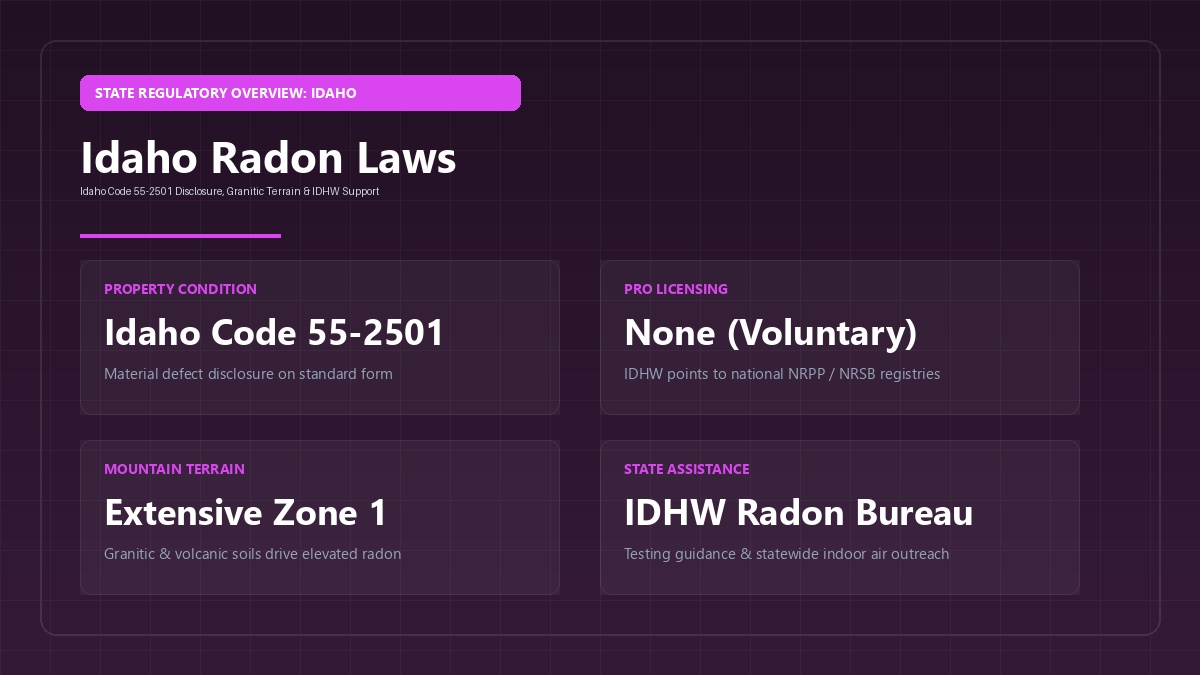
Idaho regulates radon primarily through statutory property condition disclosure requirements and public health awareness initiatives. Under the Idaho Property Condition Disclosure Act (Idaho Code § 55-2501 et seq.), residential home sellers must provide prospective buyers with a standardized disclosure statement disclosing known material defects, including environmental hazards and historical radon test results. Idaho does not operate a direct state licensing program for radon mitigators or testing specialists, pointing consumers to national NRPP and NRSB certification registries. Geologically, granitic batholiths and volcanic soils across southern and central Idaho create substantial radon potential.
Testing Requirements
Indoor radon testing is voluntary for private residential homeowners and landlords in Idaho; the state imposes no statutory mandate compelling property owners to test existing single-family dwellings or rental units prior to occupancy or sale. Similarly, Idaho law does not mandate routine radon testing in public or private K-12 school buildings or licensed commercial childcare facilities, though the Idaho Department of Health and Welfare (IDHW) strongly encourages school districts to conduct voluntary testing using EPA and ANSI/AARST protocols.
Real-Estate Disclosure
Real estate disclosure is codified under the Idaho Property Condition Disclosure Act, Idaho Code §§ 55-2501 to 55-2518. Under Idaho Code § 55-2504, sellers of residential real property (1 to 4 dwelling units) must complete and deliver a Seller’s Property Condition Disclosure Form to prospective purchasers prior to contract acceptance. The statutory disclosure form requires sellers to disclose actual knowledge of environmental hazards affecting the property, including hazardous substances and past testing reports. While the act obligates sellers to disclose known historical test records and installed mitigation equipment, it does not compel sellers to commission new testing, leaving testing contingencies to purchase negotiations.
Mitigator & Tester Certification
Idaho has no state licensing requirement for radon measurement technicians or mitigation contractors, per the Idaho Department of Health and Welfare, verified November 2026. The state maintains no state-administered radon licensing board or regulatory credential. Instead, IDHW officially directs homeowners, builders, and real estate professionals to hire contractors certified through the two national proficiency programs recognized by the EPA: the National Radon Proficiency Program (NRPP) and the National Radon Safety Board (NRSB). Contractors must comply with local municipal building and electrical trade permits when installing fans and running sub-slab piping.
New Construction
Idaho does not enforce a statewide mandatory building code requiring passive Radon-Resistant New Construction (RRNC) in all new residential buildings. While the Idaho Building Code Board incorporates the International Residential Code (IRC), Appendix F (Radon Control Methods) is not universally mandated for single-family residential construction across the state. However, individual local jurisdictions facing elevated geological risk (such as Blaine County, Ketchum, and Sun Valley) have adopted Appendix F locally, making passive soil-gas ventilation mandatory in new residential builds within their boundaries.
Radon Zones & the Action Level
According to the EPA Map of Radon Zones and IDHW geological surveys, Idaho possesses extensive radon potential. Multiple southern and central counties—including Ada (Boise), Blaine, Boise, Bonneville (Idaho Falls), Custer, Elmore, Fremont, and Lemhi—are designated as EPA Zone 1 (High Potential), where predicted average indoor screening levels exceed the national action level of 4.0 pCi/L. Remaining counties fall within Zone 2 (Moderate Potential, 2.0 to 4.0 pCi/L). IDHW adopts the federal action level benchmark of 4.0 pCi/L, noting that approximately two out of five homes tested in southern Idaho exhibit elevated concentrations. For regional county risk details, visit our EPA Radon Zone Map guide.
The State’s Radon Program
The state’s official public health initiative is the Idaho Department of Health and Welfare Indoor Radon Program, based within the Division of Public Health. IDHW provides educational guidance, tracks regional screening data, and partners with testing laboratories to distribute subsidized, low-cost short-term and long-term test kits to Idaho residents. Homeowners and contractors can order test kits, review county testing maps, and locate certified contractors through the official Idaho Health and Welfare Radon Program portal or by calling the program hotline at 800-445-8647.
Sources & Limits
This regulatory guide is provided for educational and informational purposes only and does not constitute formal legal, building code, or engineering counsel. Statutory disclosure requirements and local building codes are subject to legislative amendment. Property buyers, sellers, landlords, and contractors should verify current rules directly with the Idaho Department of Health and Welfare or a licensed Idaho attorney.
Official Sources: Idaho Code §§ 55-2501–55-2518; Idaho Department of Health and Welfare (Division of Public Health); U.S. Environmental Protection Agency (Map of Radon Zones).
To review how Idaho’s regulatory approach compares to other states across the nation, consult our master guide to radon regulations across the United States or inspect the EPA Radon Zone Map.
Get The Signal
What we actually ran, what it measured, and what it means for a restoration shop — every week, including the flops.
Leave a Reply