The Short Answer
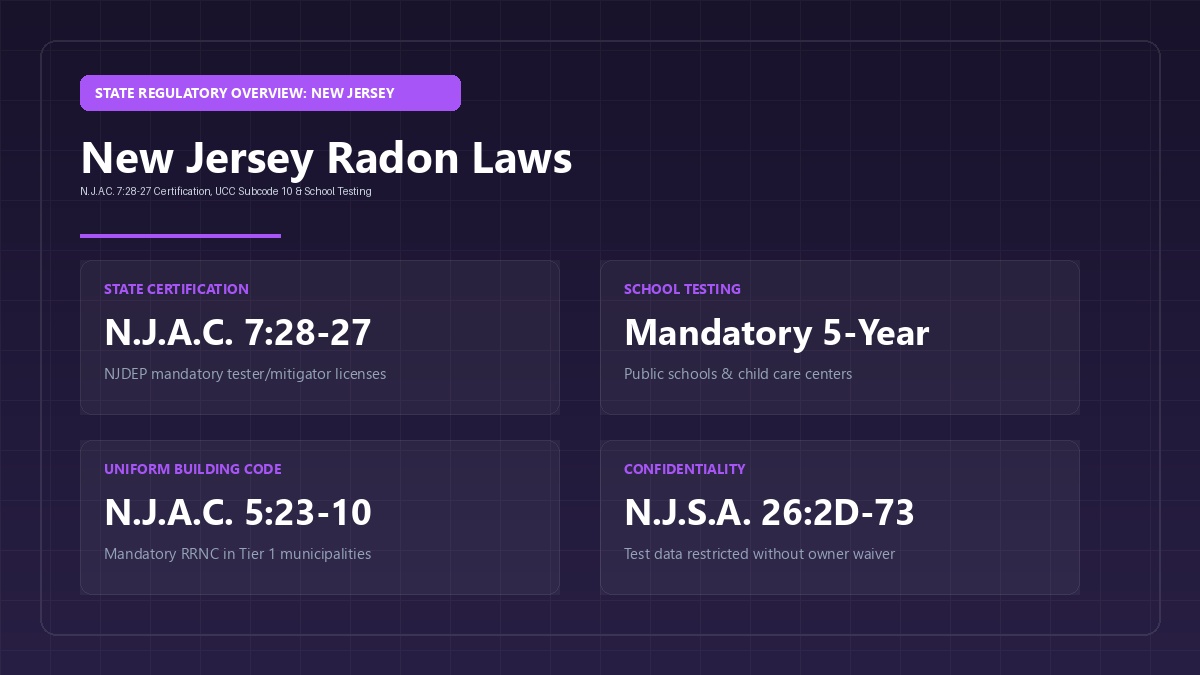
New Jersey operates one of the nation’s earliest and most rigorously enforced radon regulatory systems, overseen by the New Jersey Department of Environmental Protection (NJDEP). It is a criminal offense in New Jersey to test for, mitigate, or analyze radon for pay without NJDEP certification. Under the New Jersey Uniform Construction Code, passive radon-resistant new construction is mandatory in all designated Tier 1 (high hazard) municipalities. In addition, public school buildings and licensed child care centers must undergo mandatory radon testing every five years, and sellers must disclose all known radon test data once a contract of sale is executed.
Testing Requirements
Radon testing is mandatory in institutional educational settings across New Jersey. Under N.J.S.A. 18A:20-40, all public school districts must test every school building for radon at least once every five years. In addition, New Jersey Department of Children and Families (DCF) licensing rules mandate that all licensed child care centers test for radon every five years. For private single-family residences, private residential rentals, and general commercial buildings, testing is voluntary under state law, though heavily executed during real estate transactions.
Real-Estate Disclosure
Real estate disclosure in New Jersey is governed by N.J.S.A. 26:2D-73 and standard property disclosure law. Under § 26:2D-73, radon test data and mitigation records are protected by strict statutory confidentiality: certified businesses and the NJDEP are prohibited from disclosing test results to third parties without the owner’s written authorization. However, once a contract of sale is signed, the seller is legally obligated to provide the buyer with all available radon test results and mitigation documentation. Furthermore, the standard New Jersey Seller’s Property Condition Disclosure Statement requires sellers to disclose known radon levels, mitigation systems, and historical test certificates.
Mitigator & Tester Certification
Commercial radon activity in New Jersey is strictly governed by N.J.S.A. 26:2D-70 et seq. and New Jersey Administrative Code (N.J.A.C.) 7:28-27. Performing radon testing, mitigation, or laboratory analysis for a fee without NJDEP certification is classified as a crime of the fourth degree, carrying civil penalties and criminal sanctions. NJDEP issues certifications across four primary categories: Radon Measurement Specialist (RMS), Radon Measurement Technician (RMT), Radon Mitigation Specialist (RMS), and Radon Mitigation Business (RMB). Certified mitigators must follow strict NJDEP technical codes and report all measurement and mitigation project data monthly to the state.
New Construction
Radon-resistant construction is enforced under the New Jersey Uniform Construction Code (UCC) Radon Hazard Subcode (N.J.A.C. 5:23-10). The subcode categorizes all 564 New Jersey municipalities into Tier 1 (high hazard), Tier 2 (moderate hazard), and Tier 3 (low hazard). All newly constructed residential (Group R) and educational (Group E) buildings in Tier 1 municipalities must install passive radon-resistant features. This includes a 4-inch gas-permeable gravel base, 6-mil poly vapor barrier, sealed expansion joints and sump pits, and a vertical rough-in PVC vent pipe through the roof ready for fan connection if post-construction testing exceeds 4.0 pCi/L.
Radon Zones & the Action Level
New Jersey’s geological radon distribution follows distinct provincial formations:
- Zone 1 / Tier 1 (High Potential, predicted average indoor levels > 4.0 pCi/L): Northern and west-central counties, including Sussex, Warren, Morris, Hunterdon, Somerset, and Mercer.
- Zone 2 / Tier 2 (Moderate Potential, predicted average 2.0 to 4.0 pCi/L): Passaic, Bergen, Essex, Union, Middlesex, and Monmouth counties.
- Zone 3 / Tier 3 (Low Potential, predicted average < 2.0 pCi/L): Coastal Plain southern counties, including Burlington, Camden, Gloucester, Salem, Cumberland, Atlantic, and Cape May.
NJDEP enforces the EPA national action level of 4.0 pCi/L, strongly advising active mitigation for any living space testing at or above 4.0 pCi/L. Explore the full national picture on our EPA Radon Zone Map guide.
The State’s Radon Program
The state regulatory program is the New Jersey Department of Environmental Protection (NJDEP) — Bureau of Environmental Radiation, Radon Section (dep.nj.gov/radon/). Property owners can verify contractor certifications on the NJDEP online registry, review municipal hazard tier listings, or call the NJDEP Radon Information Line at (800) 648-0394 for test kit assistance.
Sources & Limits
This regulatory document is for informational purposes only and does not constitute formal legal, building code, or structural engineering advice. Municipal hazard tier classifications and UCC rules are subject to update by NJDEP and the Department of Community Affairs. Consult NJDEP or legal counsel for specific compliance questions.
Primary Official Sources: New Jersey Department of Environmental Protection (NJDEP) Radon Section; N.J.S.A. 26:2D-70 et seq., N.J.S.A. 18A:20-40; N.J.A.C. 7:28-27, N.J.A.C. 5:23-10; U.S. Environmental Protection Agency (Map of Radon Zones for New Jersey).
Return to our national guide on Radon Regulations in the United States or inspect national county risk rankings on the EPA Radon Zone Map.
Get The Signal
What we actually ran, what it measured, and what it means for a restoration shop — every week, including the flops.
Leave a Reply