If you manage facilities for a large corporate occupier, you have almost certainly heard the phrase “Scope 3 emissions” from your sustainability team, your CFO, or your ESG consultant. What you may not have heard is a clear explanation of what that means for your day-to-day vendor management — and why the contractors who respond to your water damage and mold remediation calls are sitting in the middle of your most difficult compliance gap.
The Three Scopes: A Plain-Language Primer
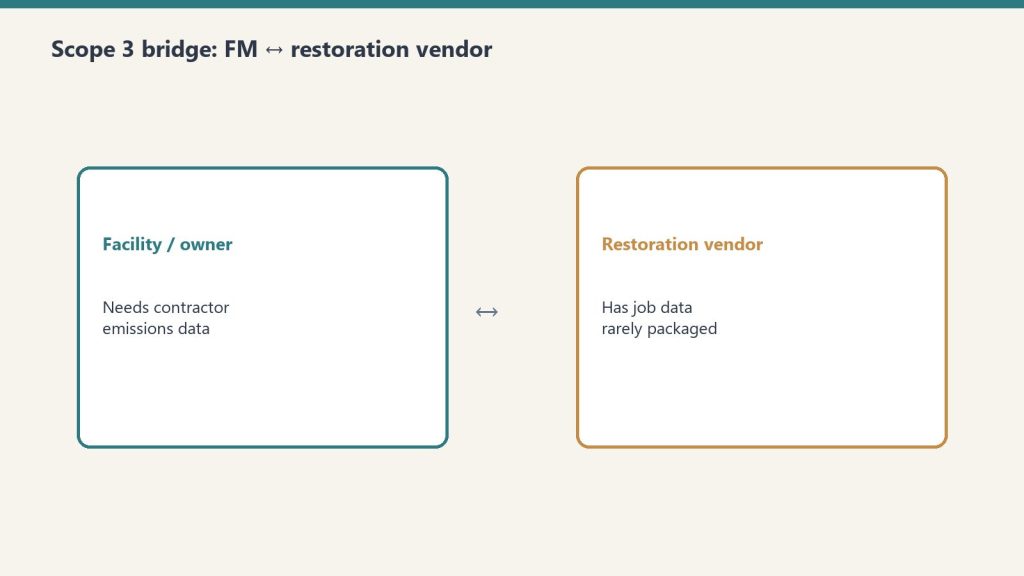
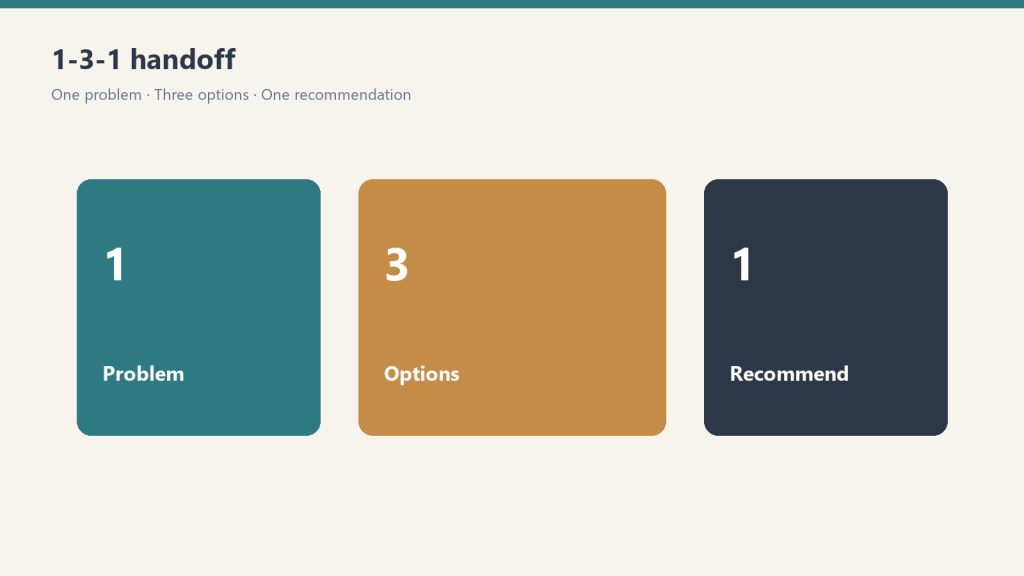
Three scopes primer — contractors sit in Scope 3.
The GHG Protocol’s Corporate Standard divides greenhouse gas emissions into three categories based on where they originate relative to your organization’s operations:
Scope 1 — Direct emissions from sources your organization owns or controls. The combustion in your building’s boilers, the fuel in your company-owned fleet vehicles, the refrigerants in your HVAC systems.
Scope 2 — Indirect emissions from purchased electricity, heat, or steam. The power your facilities consume from the grid.
Scope 3 — All other indirect emissions across your value chain. Everything that happens upstream (your supply chain) and downstream (how your products or services are used) that generates emissions on your behalf.
Scope 1 and Scope 2 are manageable. You own the sources or the meters. You have the data. Scope 3 is where it gets hard — because Scope 3 data lives in other organizations’ systems, not yours.
The 15 Categories of Scope 3
The GHG Protocol breaks Scope 3 into 15 categories across upstream and downstream activities. For a corporate FM managing occupied facilities, the most relevant upstream categories are:
Category 1 — Purchased Goods and Services: The emissions associated with producing and delivering everything your organization buys from third parties. For FMs, this includes every contractor, vendor, and service provider who performs work at your facilities — including your restoration contractors.
Category 2 — Capital Goods: Emissions from the production of capital equipment and major building systems your organization purchases.
Category 4 — Upstream Transportation and Distribution: Relevant when contractors transport materials and equipment to your site.
Category 5 — Waste Generated in Operations: Emissions from waste your organization generates — relevant when restoration work produces debris, contaminated materials, or demolition waste disposed of on your behalf.
Why Contractors Are Your Hardest Data Category
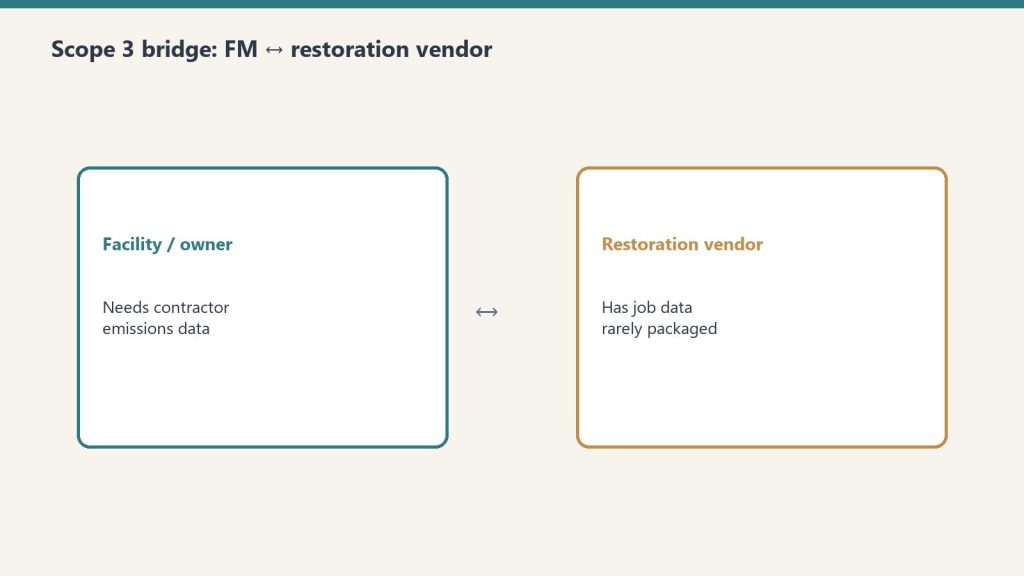
Why contractors are your hardest data category.
Among all the inputs to a corporate FM’s Scope 3 inventory, contractor-generated emissions are consistently the most difficult to quantify. Here is why:
Contractors do not routinely track their own emissions. Most restoration, janitorial, maintenance, and specialty trade contractors have no internal system for calculating the greenhouse gas footprint of individual jobs. They track labor hours, materials costs, and square footage — not carbon.
Restoration work is episodic. Unlike your regular janitorial or HVAC maintenance contractor, your restoration vendors are called in during emergencies. There is no standing purchase order to attach emissions data to. Each job is a separate event, often managed by a different project manager.
No industry standard exists for restoration Scope 3 data. IICRC — the restoration industry’s primary certification body — has no ESG reporting standard. RIA has no Scope 3 guidance. There is no form, no template, no industry norm for what a restoration contractor should provide.
The emissions profile of restoration work is complex. A single water damage job involves diesel-powered drying equipment running 24/7 for days, hazardous material disposal, multiple material categories, and vehicle trips from multiple crew members. Calculating the emissions accurately requires a methodology most contractors have never seen.
The 2027 Problem
California SB 253 — the Climate Corporate Data Accountability Act — requires companies with over $1 billion in annual revenue doing business in California to disclose their Scope 3 emissions starting with the 2027 reporting year. The EU’s CSRD is already in effect and expanding. CDP and GRESB already request Scope 3 data from the organizations they track.
For FMs at large corporate occupiers, this creates a specific operational problem: your sustainability team needs contractor emissions data for the 2027 filing, your contractors do not have a system for providing it, and there is no industry standard to point them to. The gap between the regulatory requirement and the contractor’s current capability is the problem this publication addresses.
What Good Contractor Scope 3 Data Looks Like
What good contractor Scope 3 data looks like.
The Restoration Carbon Protocol (RCP) defines 12 data points that every restoration job ticket should capture to enable Scope 3 calculation. At a minimum, FM procurement teams should be asking their restoration vendors for:
Total fuel consumed by diesel-powered drying and dehumidification equipment (gallons)
Total vehicle miles traveled by contractor crews to and from the site
Weight and type of waste materials removed and method of disposal
Refrigerants used or recovered (for HVAC-adjacent restoration work)
Materials installed by type and weight (for reconstruction phases)
Total job duration and equipment operating hours
With these inputs, a standardized calculation using EPA emission factors can produce a per-job carbon estimate that satisfies Scope 3 Category 1 methodology. The RCP provides exactly that calculation framework — free for any contractor or FM team to use.
What to Do Now
If the 2027 Scope 3 deadline is on your radar, the most practical steps you can take today are:
Audit your vendor pool for contractors who perform Category 1 services. Restoration, abatement, specialty trades, and maintenance contractors are your highest-priority Scope 3 data gaps.
Include a Scope 3 data provision clause in new vendor agreements. Require contractors to provide a per-job emissions summary using a standardized methodology.
Share the RCP framework with your restoration vendors. It gives them the methodology, the data capture form, and the calculation tools — everything they need to start providing compliant data on the next job.
Start tracking now, even if imperfectly. A reasonable estimate based on available data is better than a data gap. Your ESG auditor would rather see a documented methodology with known limitations than a blank line item.
Frequently Asked Questions
Does every facility manager need to report Scope 3?
Mandatory Scope 3 reporting under SB 253 applies to companies with over $1 billion in annual revenue doing business in California. CSRD applies to large EU entities. Many FMs at smaller organizations will face voluntary disclosure pressure through CDP participation, GRESB assessments, or investor requirements. Regardless of regulatory mandate, proactively building Scope 3 data capability now reduces compliance cost later.
Are restoration contractors required to provide Scope 3 data?
Not yet — but their FM clients increasingly will be required to report it. The most practical approach is to contractually require Scope 3 data from restoration vendors as part of vendor onboarding, rather than trying to collect it retroactively after a job is complete.
Part of the IFMA Scope 3 series on tygartmedia.com.
When sustainability consultants talk about ESG in commercial real estate, they often treat IFMA and BOMA as interchangeable acronyms for “building people.” They are not. The distinction between these two associations is not a branding detail — it is a fundamental difference in who you work for, what buildings you manage, and which Scope 3 obligations land on your desk. Getting this wrong means applying the wrong compliance framework to the wrong problem.
The Core Difference: Occupier vs. Owner
Occupier vs owner — where each association lives.
IFMA — the International Facility Management Association — primarily serves facility managers who work for corporate occupiers. These are the FMs at a hospital system, a university, a Fortune 500 headquarters, or a government agency. They manage buildings that their organization uses to do its business. They do not own those buildings as an investment. They are the operational stewards of space their organization occupies.
BOMA — the Building Owners and Managers Association — primarily serves property owners and commercial property management firms. BOMA members typically work for organizations whose business model is real estate: they own or manage buildings as assets, lease space to tenants, and generate revenue from that occupancy. The building is the product, not the platform.
This single distinction — occupier vs. owner — changes everything about how Scope 3 ESG obligations flow.
Contractor supply chain data gaps (Category 1); purchased services
Tenant energy use; embodied carbon in renovation; asset-level GRESB
Restoration relevance
Every emergency restoration job generates Scope 3 data the FM must capture
Tenant improvement work; asset restoration after casualty
Reporting framework
GHG Protocol Corporate Standard; California SB 253; EU CSRD
GRESB Real Estate Assessment; ENERGY STAR; local building performance standards
Why This Matters for Scope 3 Specifically
Under the GHG Protocol’s Scope 3 framework, a corporate occupier’s emissions inventory must include the activities of every contractor who performs services at their facilities. Water damage restoration, fire and smoke remediation, mold abatement, asbestos removal — every one of these jobs generates greenhouse gas emissions that belong somewhere in the FM’s Scope 3 report. Specifically, restoration contractor activity typically falls under Category 1 (Purchased Goods and Services) or Category 14 (Franchises), depending on the contractual structure.
The BOMA member’s Scope 3 picture is different. A property manager’s primary Scope 3 exposure is Category 13 (Downstream Leased Assets) — the energy and emissions generated by the tenants who occupy their buildings. Restoration work on a BOMA member’s asset matters for GRESB and insurance, but it is not the core Scope 3 data gap they are trying to solve.
The IFMA member, by contrast, is the one whose sustainability team is currently trying to figure out how to get emissions data from their restoration vendor. They are the ones receiving questionnaires from CDP and GRESB asking about contractor emissions. They are the ones whose corporate ESG report will be incomplete without restoration job data. And right now, they have no standard way to get it.
The 2027 Deadline Is the IFMA Problem, Not the BOMA Problem
California’s SB 253 — the Climate Corporate Data Accountability Act — requires companies with over $1 billion in annual revenue doing business in California to disclose their Scope 3 emissions beginning in 2027. The EU’s Corporate Sustainability Reporting Directive (CSRD) is already in effect for large European companies, with phased expansion through 2026. Both frameworks require supply chain emissions data — which means contractor data.
For the corporate FM managing a large occupier’s portfolio, this deadline is operational. Their sustainability team is assembling the Scope 3 inventory now. They need contractor emissions data now. Every restoration company they have worked with in the past three years is a potential data gap in their 2027 filing.
BOMA members face a related but structurally different pressure: their tenants are the Scope 3 reporters. The property manager’s role is to provide energy use data to tenants, not necessarily to collect contractor emissions data for their own disclosure. This is a meaningful distinction. The compliance urgency for Scope 3 contractor data sits much more squarely with the IFMA member.
The Missing Bridge: Restoration Contractors and Scope 3 Data
The missing bridge: restoration contractors and Scope 3 data.
Here is the specific gap this publication exists to close: restoration contractors — the companies that respond to water damage, fire, mold, and environmental emergencies at commercial facilities — have no standardized way to provide Scope 3 emissions data to their FM clients. The International Institute of Cleaning and Restoration Certification (IICRC) has no ESG standard. The Restoration Industry Association (RIA) has no Scope 3 guidance. No industry body has built the framework that tells a restoration contractor what data to capture on each job ticket so their FM client can use it in a Scope 3 report.
This is the problem the Restoration Carbon Protocol (RCP) was built to solve. The RCP is a Tygart Media-published industry self-standard that maps restoration job types to the GHG Protocol’s 15 Scope 3 categories, defines the 12 data points every job ticket should capture, and provides the calculation methodology restoration contractors need to produce credible emissions data. It is the operational bridge between the FM’s Scope 3 disclosure obligation and the restoration contractor’s job management system.
What IFMA Members Should Be Asking Their Restoration Vendors Today
What IFMA members should ask restoration vendors today.
If you are a facility manager with Scope 3 reporting obligations, here are the five questions you should be putting to every restoration contractor in your vendor pool:
Can you provide a per-job emissions summary for each project you complete at our facilities? If the answer is no, that is a gap in your Scope 3 Category 1 data.
Do you track materials disposed of by type and weight? Waste stream data is a required input for Scope 3 calculation under GHG Protocol methodology.
Do you track vehicle and equipment fuel consumption for each project? Mobile combustion is a Category 1 input that most restoration contractors currently ignore.
Are you familiar with the Restoration Carbon Protocol? RCP-aware contractors are already capturing the data FMs need.
Would you be willing to complete a standardized carbon data form for each project? The RCP Job Carbon Report is a one-page form any contractor can complete without a sustainability consultant.
Why Tygart Media Covers This Beat
Tygart Media’s position in the restoration industry — through the Restoration Carbon Protocol, the Restoration Golf League network, and years of content production for restoration operators — gives us a direct view into the contractor side of this data gap. This IFMA Scope 3 category exists to build the FM side of the same bridge: to give facility managers the framework, vocabulary, and vendor guidance they need to close their Scope 3 contractor data gap before the 2027 deadline arrives.
This is not a BOMA story. It is not a property management story. It is a facility management story — about the corporate occupier’s FM team trying to satisfy a board-level ESG commitment with incomplete data from contractors who have never been asked for it before. We are building the source of truth for that problem.
What is the difference between IFMA and BOMA for ESG purposes?
IFMA serves facility managers who manage buildings for corporate occupiers — organizations that use the space for their own operations. BOMA serves property owners and managers who lease space to tenants as a business. For Scope 3 ESG, IFMA members must capture contractor emissions data as part of their corporate supply chain disclosure, while BOMA members primarily focus on tenant energy use and asset-level performance benchmarking.
Why do restoration contractors matter for IFMA Scope 3 reporting?
Restoration contractors perform services at IFMA members’ facilities. Under the GHG Protocol, the emissions from those services are part of the corporate occupier’s Scope 3 inventory — typically Category 1 (Purchased Goods and Services). Without standardized emissions data from restoration vendors, the FM’s Scope 3 report has a recurring gap every time an emergency occurs at a managed facility.
What is the Restoration Carbon Protocol?
The Restoration Carbon Protocol (RCP) is an industry self-standard published by Tygart Media that maps restoration job types to GHG Protocol Scope 3 categories and defines the data restoration contractors should capture to enable their FM clients’ Scope 3 reporting. It is the first framework of its kind in the restoration industry.
When does Scope 3 reporting become mandatory for large companies?
California SB 253 requires Scope 3 disclosure for companies with over $1 billion in annual revenue doing business in California beginning in 2027. The EU’s CSRD is already in force for large European entities, with phased expansion through 2026. Many voluntary frameworks (CDP, GRESB) already request Scope 3 data.
This article is part of Tygart Media’s IFMA Scope 3 category — the facility manager’s source of truth for Scope 3 ESG reporting and contractor data standards.
Direct answer: A commercial emergency services agreement is a pre-loss contract that gives a restoration company the right of first response to a facility’s property emergencies and defines scope, pricing, response time, indemnification, insurance, and termination before a loss ever happens. It is not an assignment of benefits, it is not a work authorization, and it is not a scope contract — it is the operating framework those other documents plug into when a loss occurs. The structural content is consistent across the industry. The exact language varies by state, carrier requirements, and facility type, which is why every serious ESA should be drafted or reviewed by an attorney and vetted by the facility’s risk manager before signature.
Most restoration companies treat the emergency services agreement as a sales artifact — a one-page “priority response guarantee” that gets signed at a vendor fair and filed in a binder nobody opens. That version of the ESA is nearly worthless. It creates no rights, no duties, no pricing clarity, and no risk transfer. When the loss hits, the contractor still has to negotiate scope, rates, indemnity, and insurance on the night of the event, while water is running and a facility director is trying to get production back online.
A real ESA does the opposite. It pre-decides every negotiable variable so that when the phone rings at 2 a.m., the only remaining questions are operational: where is the water coming from, what equipment is at risk, who is on site, and when can we start. The rate sheet is settled. The indemnity is settled. The certificate of insurance is on file. The scope framework is defined. The facility’s legal and risk functions have already signed off. That pre-decision is what converts an ESA from a marketing document into a commercial wedge.
This article walks through the eight structural provisions that belong in every commercial ESA, what each one actually protects, and how the specialty-services posture from the rest of this cluster fits into the agreement. It does not contain sample clause language. It does not tell you what to write in your indemnity paragraph. That restraint is deliberate, and the next section explains why.
Why this article stays structural and sends you to counsel for the words
There are a few categories of content in the restoration industry where the specificity of the advice is inversely related to its usefulness. Contract drafting is the clearest example. A sample indemnity clause pulled from a template site will get you sued in some states and held unenforceable in others. A sample additional-insured endorsement that looks reasonable on its face may fail to match the carrier’s underlying policy form. A sample assignment paragraph that worked in one jurisdiction five years ago may be void under a statute that passed last session.
A few specific reasons the clause-level language belongs with a lawyer, not a generic template:
State law on restoration contracts is genuinely inconsistent. Florida’s §627.7152, for example, imposes tight procedural requirements on any instrument that assigns post-loss insurance benefits — including a fourteen-day cancellation window, a written itemized estimate, and specific cost limits on emergency assignments. Other states have no statutory framework at all. A clause that satisfies Florida may be overbuilt elsewhere. A clause that works in a state with no statute may violate a Florida consumer-protection provision the moment you cross the border. An ESA is not an AOB, but some of the same drafting traps apply to both, and only a lawyer who practices in the state where the work will occur can tell you which ones.
Commercial insurance requirements are carrier-specific and property-specific. The additional-insured language that satisfies the facility’s general liability carrier will not necessarily satisfy the carrier underwriting a pharmaceutical plant’s product-liability tower, a hospital’s professional-liability layer, or a data center’s cyber-liability program. The insurance provisions in the ESA need to be negotiated against the facility’s actual policy stack, not against a generic standard. Facility risk managers have strong opinions about this, and the ESA is the document that either satisfies them on day one or triggers a six-week redline cycle.
Indemnification law is jurisdictionally fractured. Anti-indemnity statutes in California, Texas, Oregon, and several other states limit how far a contractor can transfer liability for its own negligence. A hold-harmless clause that reads naturally may be partially or fully void under statute, which means the indemnity you think you negotiated does not exist. The only way to get this right is to have counsel in the relevant state write the language.
The Restoration Industry Association publishes a contract sample package for members that is widely used in the industry as a starting point, and it is appropriately marked as informational only. Even the RIA explicitly notes that the package does not warrant compliance with any given state or local jurisdiction. If the trade association that wrote the templates will not warrant the language, a restoration company should not rely on it without review.
So the rule this article follows is simple. Structure, intent, and risk logic are safe to write about because they are consistent across the industry. Exact clause language is not safe to write about because it is not consistent. When you are ready to execute an ESA, take this structural framework to a commercial attorney who has drafted facility contracts in your state, hand them the facility’s standard vendor requirements, hand them your certificate of insurance and policy forms, and let them write the words. Budget for the review. It is cheaper than a deficient contract.
With that preface, here are the eight provisions.
Provision 1: Scope of services and what the ESA is not
ESA scope: what commercial emergency response is — and is not.
The first provision defines what the agreement covers and, equally important, what it does not. This is the provision that most ESA templates get backwards — they either promise far too much (every possible restoration service the company offers) or far too little (a one-sentence “emergency response services” reference that creates no enforceable scope at all).
The structural answer is that the ESA covers emergency stabilization services: the water extraction, temporary dry-out, source containment, initial equipment protection, specialty stabilization subcontractor coordination, and site documentation that occur in the first hours to days after a loss event. It does not cover the reconstruction scope, the full contents restoration, or the permanent repair work. Those are separate agreements — typically a work authorization or a standard construction contract — that get executed after the emergency phase is stabilized and a full scope of loss has been developed.
Why separate them? Because emergency services have to move faster than any negotiated scope can support, and reconstruction services have to be priced against a known scope, which does not exist during the emergency. Mixing them in one agreement forces the contractor to either pre-commit to reconstruction pricing without a scope, or makes the facility pre-commit to a contractor for work that their insurance carrier may require them to competitively bid. Neither of those outcomes is good for either party.
For the specialty-services version of an ESA — the version this cluster has been building toward — the scope provision should explicitly name the specialty categories covered (documents, electronics, fine art, medical equipment, or whatever subset the contractor’s specialist bench supports) and should reference that specialty work will be performed by named or vetted subcontractors under the contractor’s coordination and supervision. The facility needs to understand from day one that the restoration company is the responsible party on coordination and the specialist is the responsible party on technical execution. Building that clarity into the scope provision prevents a dispute later when a specialist invoices directly and the facility wants to know why the restoration company’s name is on the ESA but not the bill.
Provision 2: Response time, staging, and on-call structure
Response time, staging, and on-call structure.
Every ESA should define response time in three ways, not one. Most templates define it once — “one hour on-site response” is the cliché — and then say nothing about what one hour means or what happens when the weather, traffic, or a regional catastrophe makes one hour impossible.
The three definitions that belong in a real ESA:
Initial acknowledgment. The time from the facility’s first call to a confirmed response from someone at the restoration company who has authority to deploy. This should be measured in minutes and should be twenty-four-seven. It is the most important response-time commitment in the agreement because it is the one the facility experiences first and the one that determines whether the contract feels like a real service.
Arrival on site. The time from call to boots-on-the-ground at the loss location. This varies by geography, by staging strategy, and by type of event. A contractor with a local crew and a truck that lives in the facility’s metro can honestly commit to one to two hours under normal conditions. A contractor serving a multi-state region may commit to four hours for a single-site event and acknowledge longer windows during CAT events when every truck is already deployed.
CAT-event modification. What happens when a hurricane, winter storm, wildfire, or regional flood creates simultaneous demand across every account the contractor serves. Honest ESAs acknowledge that pre-loss priority status gets harder to honor during a CAT event, define how priority is sequenced among covered accounts, and explain the staging approach — crew positioning, equipment staging, mutual-aid agreements with out-of-region affiliates — that makes priority response credible under stress. A facility with a real risk function will ask this question explicitly. A facility without a real risk function should still have it answered in the document.
The on-call structure provision also belongs here: the call tree, the escalation path, the backup contacts, and the requirement that the facility maintain current contact information on its side so the restoration company does not lose fifteen minutes finding someone authorized to allow access.
Provision 3: Pricing framework and rate schedule
Pricing framework and rate schedule — write it before the night hit.
This is the provision that separates serious ESAs from sales artifacts. The ESA should reference a rate schedule attached as an exhibit, and that rate schedule should be complete enough to price an actual emergency without further negotiation.
Structural components of a real rate schedule: labor rates by role (technician, lead technician, supervisor, project manager) and by shift (straight time, overtime, holiday, after-hours callout); equipment rental by category (air movers, dehumidifiers, HEPA filtration, desiccant systems, generators, extraction trucks) with clear daily or weekly rates and minimum-days commitments; consumables and materials at cost plus a defined markup; subcontractor handling fee or specialist coordination fee for specialty services; travel and mobilization charges and how they apply; and any CAT-event surcharge structure if the contractor uses one.
The rate schedule should also state how it reconciles with insurance industry pricing databases. Most commercial losses end up being scoped and priced in Xactimate, and the ESA rate sheet should either (a) commit to Xactimate pricing as the default with contractor rates as a fallback, (b) commit to contractor rates with Xactimate as a reconciliation benchmark, or (c) use a hybrid where emergency labor and equipment use contractor rates and scope work after the emergency phase uses Xactimate. All three are defensible. Silence is not.
The specialty-services layer adds one more requirement: the ESA should define how specialist pricing flows through. Some specialists bill direct to the carrier and the restoration company takes a coordination fee. Some specialists bill the restoration company and the restoration company bills the carrier with a markup. Some specialists are embedded in the restoration company’s rate schedule directly. All three models are fine. The ESA should name which one applies so the facility and the adjuster know what to expect when the invoice arrives.
Provision 4: Insurance requirements and certificates
The ESA should require, at minimum, four categories of insurance from the restoration company: general liability, workers compensation, commercial auto, and — for any specialty work that touches data, medical devices, or art — appropriate professional or specialty-services coverage.
For each, the ESA should specify minimum limits (per occurrence and aggregate), additional-insured status for the facility and for any parent entity or property manager the facility names, waiver of subrogation in favor of the facility, and a thirty-day notice of cancellation provision. The restoration company should be required to provide certificates of insurance on execution and on renewal, and the ESA should give the facility the right to request policy forms and endorsements on reasonable notice.
The specialty-services layer matters here. When a restoration company is coordinating a document-recovery specialist, an electronics restoration vendor, or an art conservator, the specialists carry their own insurance and the facility needs to know whether they are covered as subcontractors under the restoration company’s policy, whether they are required to name the facility as additional insured on their own policies, or both. The cleanest structure is usually both — the specialist names the facility and the restoration company as additional insureds on their own policy, and the restoration company’s policy extends to cover the specialist’s work as a subcontractor. Building that into the insurance provision up front avoids a fight after a claim.
For healthcare, pharmaceutical, biotech, data center, and fine-art accounts, the minimum limits should be higher than the commercial-general defaults. A small restoration company with a one-million-dollar general-liability limit is not adequately insured to work inside a hospital, a data center, or a facility holding seven-figure art. Those accounts will require higher limits as a condition of vendor approval, and the ESA should either specify the higher limits or explicitly commit to meeting whatever the facility’s risk manager requires at the time of approval.
Provision 5: Indemnification and hold harmless
This is the provision where state law matters most and where a generic template is most dangerous. The structural intent is straightforward: the restoration company agrees to indemnify, defend, and hold harmless the facility for claims, damages, and expenses arising from the contractor’s own negligence or breach, and the facility retains its own liability for its own pre-existing conditions and for claims arising from its own negligence. That is the defensible mutual structure that most commercial contracts land on when the parties have balanced bargaining power.
What makes this provision jurisdictionally fragile is that states regulate how far one party can indemnify another for the other party’s negligence. California Civil Code §2782 and similar anti-indemnity statutes in several other states restrict or void clauses that require a contractor to indemnify a property owner for the owner’s own negligence. The permissible scope ranges from “contractor’s negligence only” to “comparative indemnity for proportional fault” to “broad-form indemnity including the indemnitee’s own negligence” — and which of those is enforceable depends entirely on the state.
The operator’s takeaway is that mutual indemnity for each party’s own negligence is nearly always enforceable and is a reasonable floor. Broader indemnity may or may not be enforceable and should never be signed without state-specific counsel review. If a facility’s vendor form asks the contractor to broad-form indemnify the facility, the contractor should not sign it without a lawyer explaining whether the clause is enforceable in that state and whether it is covered by the contractor’s insurance. Some insurers exclude broad-form contractual indemnity from general liability coverage, which means a contractor who signs a broad-form clause may be uninsured for the liability they just assumed.
Provision 6: Term, renewal, and termination
The ESA should be a fixed-term agreement with automatic renewal unless either party provides notice. Three years is a common term. One-year terms with annual renewal work as well. The automatic renewal is the important feature — a contract that expires and has to be re-negotiated annually is a contract that lapses accidentally, and a lapsed ESA at the moment of a loss is worse than no ESA at all.
Termination provisions should allow either party to terminate for convenience with reasonable notice (thirty to ninety days is standard) and for cause without notice. Cause should be defined tightly: breach of the agreement, loss of required insurance, insolvency, loss of licensure, or failure to meet response time commitments on a defined number of events. A facility should not be able to terminate on a whim, because the contractor has been investing in relationship-specific knowledge of the facility; a contractor should not be able to hold the facility hostage, because the facility has emergency needs that require the flexibility to replace the contractor if performance degrades.
The ESA should also address what happens to work in progress at termination. If a loss is active and stabilization is mid-stream when termination notice is given, the termination does not apply to the active loss — the contractor continues to completion under the ESA terms and the termination takes effect afterward. Missing that clause can create a situation where one party tries to walk away from an active loss, which serves no one.
Provision 7: Data, confidentiality, and regulatory compliance
This provision is where commercial ESAs have evolved significantly over the last decade, and where most template documents are still underbuilt.
For any account where the work touches protected information — patient health information in healthcare, cardholder data in retail, student records in education, employee records generally, trade secrets in manufacturing — the ESA needs to specify how the restoration company handles that information. For healthcare specifically, the ESA needs to be accompanied by a business associate agreement under HIPAA, and the ESA should reference the BAA as a required condition of performance. For education, FERPA creates similar obligations. For financial services, GLBA. For retail handling cardholder data, PCI-DSS. The ESA does not need to recite every provision of every regulation, but it does need to commit the contractor to meeting the applicable standard and to making the workforce aware.
Confidentiality should be mutual — the contractor agrees to protect facility information, and the facility agrees not to disclose contractor pricing, methods, or proprietary approaches. Confidentiality survives termination. Disclosures to carriers, adjusters, and conservators for the purpose of executing a loss are permitted as operational necessity.
Chain-of-custody and data-handling obligations for specialty work belong in this provision or in the scope exhibit. Document restoration that involves moving records off-site must define how the records are tracked, transported, stored, and returned. Electronics restoration that involves systems carrying data must define whether data is preserved, destroyed, or extracted and returned. Medical equipment restoration must define how PHI-bearing equipment is handled during triage and transport. These are not abstract compliance questions — they are operational requirements that come up on every loss and need to be pre-decided in the contract.
Provision 8: Dispute resolution, governing law, and venue
The last provision is the one most people skip reading. It is also the one that determines what happens if things go sideways on a seven-figure loss with an insurance carrier in the middle.
Governing law should be specified explicitly — usually the state where the facility is located. Venue for any litigation should be specified — usually the county where the facility is located or a nearby federal district. Dispute resolution should include a mandatory meet-and-confer step before any formal action, an escalation path to executive-level representatives on both sides, and a commitment to mediation before litigation. Arbitration can be used, but should be specified clearly — including the rules that apply (AAA, JAMS, or another recognized body), the location, the number of arbitrators, and whether discovery is permitted.
Attorney’s fees and costs should follow the prevailing party — both as a deterrent against frivolous claims and as a protection for whichever party is forced to litigate a legitimate position. Limitation of liability caps are common in commercial contracts, and the ESA may or may not include one depending on negotiation. Consequential and punitive damage exclusions are also common and negotiated.
For specialty work, the dispute resolution provision should acknowledge that technical disputes over conservation methods, recertification requirements, or data-restoration outcomes may need subject-matter-expert arbitrators rather than generalists. A dispute over whether a painting was properly stabilized is not a dispute a commercial litigator is equipped to decide; it needs a conservator. The agreement can name the tribunal or defer to mutual selection, but should acknowledge the issue.
How the eight provisions fit together
The eight provisions are not a checklist — they are a system. The scope defines what the work is. The response time defines when the work happens. The pricing defines what the work costs. The insurance protects both parties financially. The indemnity transfers legal risk rationally. The term provides stability without captivity. The data and compliance obligations keep both parties regulatorily clean. The dispute resolution provides an exit path if the other seven provisions break down.
A well-drafted ESA with all eight provisions is a document that a facility’s legal team, risk manager, and operations leader can sign without holding their breath. An ESA that has four of the eight, or that has all eight written badly, is a document that either never gets signed or that gets signed but does not actually protect either party when a loss hits.
The specialty-services layer — the wedge this entire cluster has been building toward — fits naturally inside a well-drafted ESA. The specialty services are named in the scope. The specialist coordination model is named in the pricing. The specialist insurance structure is named in the insurance provision. The specialist data-handling obligations are named in the compliance provision. The facility signs one document, gets priority response for property losses, and inherits a specialist bench they did not have to vet themselves. That is the door-opener. The eight provisions are the hinges.
What to do before you sign anything
If you are a restoration company using this article to prepare for ESA conversations with commercial accounts, the honest sequence is:
Engage a commercial attorney in your state. Give them your existing contract templates, your insurance declarations, your standard rate schedule, and the categories of facilities you are targeting. Ask them to build a master ESA that addresses all eight provisions with state-appropriate language, and a set of modifications for regulated verticals (healthcare, data, education, fine art). Budget two to four thousand dollars for the initial work and a few hundred dollars annually for review and updates. That number is trivial compared to the cost of a deficient contract on a seven-figure loss.
Review the RIA contract sample package if you are a Restoration Industry Association member. It is a useful starting point and a useful cross-check against your attorney’s draft, but it is not a substitute for counsel-drafted documents. The RIA itself does not warrant the language.
Have your insurance agent review the indemnity, additional-insured, and limit-of-liability provisions before you circulate the draft to accounts. Your general liability carrier may exclude certain contractual assumptions of liability from coverage, and you need to know that before you sign something that strips you of your insurance protection.
Run the final document past a facility risk manager or two — a peer in the property management or corporate real estate space — and get their candid reaction. Risk managers see dozens of vendor contracts a year and can tell you within five minutes whether your document looks professional or amateur.
None of that is glamorous. All of it is what separates a restoration company that gets written into facility vendor files from a restoration company that shows up with a one-page “priority response guarantee” and gets treated like the last call the facility director makes instead of the first.
Is an ESA the same as an assignment of benefits?
No, and conflating them is a serious error. An assignment of benefits is a post-loss instrument in which the policyholder transfers some or all of their insurance claim rights to the contractor. An ESA is a pre-loss operating agreement that defines how emergency services will be performed if a loss occurs. An ESA may reference how assignments or direct-pay arrangements will be handled, but it is not itself an assignment. States like Florida have enacted strict rules on AOBs — §627.7152 — that do not apply to ESAs in the same way. Treat them as distinct documents and let your attorney advise on whether, when, and how you use AOBs inside your state.
How long should the ESA be?
A properly drafted commercial ESA with all eight provisions and a rate schedule exhibit usually runs fifteen to thirty pages. If it is shorter than that, something is missing. If it is substantially longer, something is probably over-engineered. The structural content can be expressed concisely; length comes from exhibits (rate schedule, insurance requirements, specialty subcontractor list, compliance addenda) that the main contract references.
Can a facility sign our ESA as-is, or will they always want to redline?
Most serious commercial accounts will redline. Expect it, plan for it, and do not treat it as a rejection. The facility’s legal and risk functions are doing their job. The redlines usually concentrate in insurance limits, indemnity scope, termination rights, and data compliance — the provisions where the facility’s exposure is real. A well-drafted starting document narrows the redlines to reasonable negotiation rather than a fundamental rewrite.
What if the facility has their own ESA template they want us to sign?
Read it carefully, have your attorney read it carefully, and push back where the document is unbalanced. Facility templates frequently contain one-sided indemnity provisions, insurance requirements that exceed what a mid-size restoration company can reasonably carry, and termination rights that give the facility everything and the contractor nothing. Most facilities will negotiate those points once you raise them — because most facilities would rather have a qualified contractor with reasonable protections than an unqualified contractor who signs whatever is in front of them.
How often should we update our ESAs once they are in place?
Annually at minimum. Insurance limits may need to rise. State law may have changed. Your own rate schedule almost certainly has. The compliance landscape around HIPAA, data protection, and specialty handling continues to evolve. An ESA from three years ago is probably not the ESA you want defending you today.
Do we need a separate ESA for each facility, or can we use a master agreement across a portfolio?
Both structures work. For multi-site accounts with a single corporate owner — a hospital system, a data center operator, a property manager — a master services agreement with facility-specific exhibits is cleaner. For single-site owners, a standalone ESA is simpler. What matters is that the scope and pricing exhibits are specific to each facility’s actual equipment, access requirements, and operational needs, rather than generic.
How does the ESA interact with the work authorization signed at the time of a loss?
The ESA is the operating framework. The work authorization is the post-loss trigger. When a loss occurs, the facility signs a short work authorization that references the ESA, identifies the specific loss, and confirms the scope of the emergency services being authorized. The ESA provisions (rates, indemnity, insurance, compliance) flow through automatically. This structure is why the ESA pre-decides everything — so the work authorization at 2 a.m. is a one-page document, not a contract negotiation.
What happens if a subcontractor specialist damages the facility during specialty work?
The answer depends on how the ESA is drafted. In the cleanest structure, the restoration company carries general liability that extends to the work of its subcontractors, the specialist carries their own liability that names the facility and the restoration company as additional insureds, and the indemnity provision allocates responsibility based on whose negligence caused the damage. A well-drafted ESA and subcontract between the restoration company and the specialist will define the flow so that a covered loss is paid by an insurer rather than argued over between the parties.
Is the ESA a confidential document, or can we reference it in marketing?
The ESA itself is usually confidential — both the pricing and the legal terms. The fact of the relationship is often not. Many facilities are comfortable being referenced as emergency-services accounts with pre-loss agreements in place, as long as the contents remain private. Ask before you reference anyone, get the answer in writing, and respect the answer.
How do we actually get a facility to sign one of these?
That is the subject of the next article in this cluster. The short answer is that you do not walk in and ask for a signature. You work the account through vendor qualification, risk-manager education, and a staged demonstration of capability that makes signing the ESA feel like the natural outcome of a longer conversation rather than the thing you asked for in the first meeting. The specialty-services wedge this entire cluster has been building makes that conversation easier because the door opens around specialty recovery, not around general restoration.
Direct answer: Electronics and data equipment restoration is the specialty category where the seventy-two-hour corrosion window turns the emergency services agreement into a genuine risk-management instrument rather than a convenience. Acidic soot residue begins measurably corroding circuit traces inside twenty-four hours and the recoverability curve drops sharply after seventy-two. The specialist response — ultrasonic cleaning at thirty-seven to forty-five kilohertz in deionized water with a pH-neutral detergent, followed by magnified inspection and bench testing — is work the restoration company subcontracts to BELFOR’s electronics division, Prism Specialties, CRDN, or a qualified regional lab. The stabilization — pH-neutralizing wipes on exposed boards, HEPA-filtered negative-air in the space, desiccant dehumidification to drive relative humidity below forty percent, and triage inventory of salvageable versus replace-in-kind — is work the restoration company performs on hour one. The accounts that value this capability most are data centers, colocation facilities, large enterprise IT operations, manufacturing plants with industrial controls, hospitals with imaging and clinical equipment, and broadcast or media facilities with specialty production gear.
The paper on a file cabinet has a forty-eight-hour mold clock, and that clock is fast. The traces on a circuit board have a twenty-four to seventy-two-hour corrosion clock, and that clock is faster. The difference matters for two operational reasons. First, the restoration company that arrives on an electronics loss at hour eight has fifty percent of the recoverable window already gone. Second, the cost of failure on electronics is not just replacement — it is replacement plus downtime plus data loss plus the cascading business-continuity impact of equipment that cannot be quickly replaced because it is custom-configured, vendor-dependent, or on a months-long lead time.
A data center that loses a cold aisle’s worth of servers to water ingress cannot simply order new servers on Tuesday. The servers are configured, cabled, certified, and in many cases loaded with production-validated firmware that took months to qualify. The same is true of medical imaging equipment, industrial control systems, broadcast gear, laboratory instruments, and high-end audio-video installations. The replacement cost is the visible number; the replacement timeline is the invisible number that makes the specialty response genuinely valuable.
This article is the operational guide for building the electronics specialty inside the restoration company. Not how to operate an ultrasonic tank — that is the specialist’s work. How to stabilize a contaminated space inside the first twelve hours, triage equipment by salvage category, manage the chain of custody on serialized high-value assets, coordinate with the client’s IT or operations leadership, and produce the documentation an adjuster will pay the specialty restoration claim against without friction.
The corrosion curve and why speed is the product
The corrosion curve — speed is the product.
The physical failure mode in electronics restoration is not the water itself on the day of the loss. Circuit boards that get briefly wet with clean water and are promptly dried can frequently survive without specialist intervention. The failure mode is the residue — the conductive, hygroscopic, acidic material that water and smoke deposit on and beneath components, and the corrosion that residue drives over the hours and days that follow.
Three contaminant categories matter. Smoke and soot residue is acidic (pH in the three-to-four range is typical) and conductive. When the residue sits on a board at even modest humidity, the acid attacks copper traces and solder joints, and the conductivity creates unintended current paths that either damage components immediately on power-up or cause intermittent failures that surface weeks later. Sprinkler water is not clean — it contains corrosion inhibitors, accumulated pipe sediment, and whatever contaminants the water picked up as it flowed across contaminated surfaces before reaching the equipment. Firefighting foam and dry chemical agents are aggressively corrosive and require specialist treatment regardless of the apparent severity of exposure.
The time constants are driven by the chemistry. Corrosion kinetics at room temperature and moderate humidity produce measurable copper oxidation on exposed board surfaces inside twenty-four hours of contamination, with solder-joint degradation following by forty-eight hours and widespread pitting by seventy-two. Lower humidity slows the reactions; higher humidity accelerates them. The practical implication is that every hour the contaminated equipment sits in the loss environment without stabilization reduces the yield of the eventual restoration.
The specialist process is ultrasonic cleaning, but the stabilization window exists because ultrasonic cleaning works on what has not yet corroded beyond recovery. An ultrasonic tank at thirty-seven to forty-five kilohertz with deionized water and a pH-neutral detergent will remove residues and contaminants from board surfaces and from under component bodies where hand-cleaning cannot reach. A board cleaned inside the seventy-two-hour window, inspected under magnification, dried in a controlled chamber, and bench-tested for function typically returns to service with high reliability. A board cleaned outside that window, where corrosion has already attacked traces or plated through-holes, may clean cosmetically but fail functionally because the underlying conductor has already been consumed.
The restoration company’s stabilization work is therefore engineered around slowing the chemistry until the specialist can start the cleaning cycle. Desiccant dehumidification to drive the space below forty percent relative humidity slows the hygroscopic contaminants. pH-neutralizing wipes applied promptly to exposed circuit board surfaces neutralize residual acid. Negative-air containment with HEPA filtration prevents cross-contamination to adjacent unaffected equipment. Power-down protocols prevent the cascading failure of energized equipment running with wet or contaminated boards. Each of these is a billable line item and each of them materially increases the salvage rate the specialist will deliver.
The first twelve hours on an electronics loss
First twelve hours on an electronics loss.
Electronics stabilization runs a different first-response protocol than documents, because the equipment is often energized, often serialized, and often sitting inside a customer-operated space that has its own access controls and operational dependencies.
Phase one: power down and access coordination (hour zero to one). The single most important action inside the first hour is a controlled power-down of affected and at-risk equipment. Energized wet electronics short-circuit progressively — damage continues as long as power is applied. The power-down has to be coordinated with the client’s IT or operations team because abrupt shutdown of production systems causes cascading failures elsewhere. The first-response conversation is with the IT director, facilities director, or data center operations manager. The restoration company’s team does not pull breakers without authorization and does not disconnect servers or industrial controls without the client’s engineer present. The photographic documentation begins at arrival and continues throughout.
Phase two: environmental stabilization (hour one to three). Negative-air with HEPA filtration is established around the affected area to contain airborne contaminants and prevent cross-contamination. Desiccant dehumidification is staged to drive relative humidity toward thirty to forty percent. Temperature is managed for human safety and equipment preservation — lower temperature slows corrosion chemistry but has to be balanced against condensation risk on still-cold equipment moved to a warmer area. Cross-contamination risk is real: dragging contaminated boards through a clean area or pulling contaminated air across unaffected equipment damages assets that did not need to be damaged.
Phase three: pH neutralization on exposed boards (hour two to four). For fire and smoke losses specifically, pH-neutralizing wipes applied to exposed board surfaces inside the first two to four hours neutralize the acidic residues and buy time before specialist cleaning. This is not a substitute for ultrasonic cleaning — it is a stabilization step that protects the metal underneath. For water-only losses without smoke, this step is usually unnecessary, but the restoration company should test the water with pH strips and apply neutralization if the water shows contamination from firefighting chemicals or soot transport.
Phase four: triage inventory and salvage categorization (hour three to six). Every affected piece of equipment is logged with manufacturer, model, serial number, current location, and an initial salvage category: (A) recoverable in-place with desiccant and cleaning, (B) removable for specialist cleaning and return to service, (C) probable total loss requiring replacement, (D) irreplaceable or mission-critical requiring priority handling regardless of cost. The triage is a judgment call made jointly with the client’s engineer, and it drives the rest of the engagement. Priority (D) items move first; priority (C) items are photographed, documented, and set aside for adjuster inspection without further handling.
Phase five: packout of removable equipment (hour four to eight). Equipment in category (B) is packed out for transport to the specialist. Packing requires anti-static protection, cushioning, and container specification appropriate to the equipment type. The chain-of-custody log captures each unit with serial number, packout time, and responsible party. The transport vehicle is climate-controlled to prevent temperature and humidity excursions. For data center and enterprise IT loads specifically, the packout often occurs over multiple shifts because the volume is substantial and the specialist bench needs time to ramp intake capacity.
Phase six: specialist handoff and scope documentation (hour eight to twelve). Transport delivers the inventory to the specialist with a signed manifest. The specialist signs receipt, and the chain of custody transfers. The restoration company produces a preliminary scope-of-loss within twenty-four hours: stabilization services performed, equipment inventory by salvage category, specialist handoff confirmation, estimated specialist turnaround, and preliminary cost estimate. The client’s IT director receives the document and confirms categories before any billing cycle begins.
Every phase is billable, every phase is documented, and every phase serves the downstream adjuster conversation. The restoration company’s product is not the ultrasonic cleaning — it is the twelve hours of coordinated stabilization, triage, packout, and documentation that makes the ultrasonic cleaning effective.
The specialist landscape in electronics
The electronics restoration specialist market is smaller than the documents specialist market and more technically demanding. A credible bench includes national firms with specialty electronics divisions and a limited number of regional or independent specialists who can handle overflow or regional response.
National specialists with electronics capability include BELFOR’s electronic restoration service line, Prism Specialties’ electronics and appliance division, CRDN (which started in textiles but has expanded into electronics in several regions), ATI Restoration’s electronic services, and Cotton GDS for larger industrial and commercial losses. Each operates ultrasonic cleaning facilities at multiple sites with the throughput to handle data center, industrial, and commercial losses.
Regional specialists exist in major metropolitan markets and are worth identifying for response-time advantages on medium-sized losses. Independent electronics cleaning labs that serve the industrial and biomedical markets sometimes accept restoration work as a supplementary line and can be excellent partners for specific equipment types.
The evaluation criteria for an electronics specialist are stricter than for documents. Chamber and tank capacity matter; the specialist needs to accept a data-center-scale load without rejecting the work or delaying start. Technical capabilities matter; the specialist should be competent on a range of equipment types from commodity servers and desktops to industrial controls, imaging equipment, and specialty instruments. Recertification and testing protocols matter; a cleaned board has to be bench-tested for function and documented to a standard that the client’s equipment vendor or insurer will accept. Insurance and bonding matter; the specialist holds serialized client equipment that is frequently irreplaceable and typically high-value, and the restoration company’s teaming agreement should specify minimum insurance limits and indemnification structure. Chain-of-custody protocols matter; the specialist’s process should mirror the restoration company’s protocols and produce documentation that feeds cleanly into the overall engagement package.
The teaming agreement with the electronics specialist should additionally cover equipment vendor coordination. Many categories of commercial equipment — enterprise servers, medical imaging, industrial controls — require manufacturer recertification before return to production service. The specialist’s role is cleaning and functional testing; the manufacturer’s role is recertification. The teaming agreement should specify which party coordinates with the manufacturer, what documentation flows between them, and how the recertification cost is billed.
Pricing the electronics scope
Electronics restoration pricing is materially different from documents pricing because the unit is the piece of equipment rather than cubic feet of paper. Four billing components apply.
Stabilization services. Billed at the restoration company’s published commercial rates on a time-and-materials basis. The line items are crew labor for power-down coordination and packout, negative-air containment with HEPA filtration, desiccant dehumidification, pH neutralization materials and labor, anti-static packout materials, climate-controlled transport, and specialized PPE. Stabilization on a substantial electronics loss — a mid-sized server room, a manufacturing cell, a broadcast control room — commonly runs ten to thirty thousand dollars before any specialist cleaning is invoiced.
Triage and scope documentation. The inventory, serial number capture, photographic documentation, and salvage-category triage is billable labor and should appear as a line item. Typical pricing is a per-unit inventory fee for serialized equipment (ten to twenty-five dollars per unit) plus an hourly rate for senior technician time on triage decisions.
Specialist cleaning pass-through. The specialist’s cleaning cost varies by equipment type. Commodity desktops, laptops, and small-form-factor electronics typically price in the fifty-to-two-hundred-dollars-per-unit range for cleaning, inspection, and functional test. Enterprise servers, rack equipment, and larger specialty gear price higher and often on a custom basis. Industrial controls and medical equipment can run into thousands per unit depending on complexity. The restoration company adds the disclosed management fee (ten to fifteen percent) and passes through.
Manufacturer recertification pass-through (when applicable). For equipment that requires manufacturer certification before return to service, the manufacturer’s recertification cost passes through with the same management fee structure. Clients and adjusters generally accept this as a legitimate cost; the restoration company should never mark up the specialist’s pass-through by more than the disclosed management fee.
For a substantial commercial electronics engagement, the total invoice (stabilization, triage, specialist cleaning, recertification) typically runs in the low six figures. The restoration company’s margin on the specialist and recertification passes is a fraction of total engagement value. The margin on stabilization and triage is the operational profit. The strategic value, as always, is the vendor-file position and the downstream business.
Account types where electronics is the dominant specialty
Six commercial account categories have concentrated electronics exposure and should be prioritized for the specialty pitch.
Data centers and colocation facilities. The obvious target. The infrastructure is dense, the replacement cost is enormous, and the downtime sensitivity is total. Approval sits with the facility operations director or the COO, often with risk management involvement. The specialty agreement is understood immediately because data center operators already think in terms of recovery time objective and recovery point objective, and the specialty response is a direct operational hedge. Expect technical due diligence from the client — the operations team will ask about ultrasonic protocols, drying chambers, specialist certifications, and response commitments. Prepare accordingly.
Large enterprise IT operations with on-premises server rooms. The second-tier target. Mid-to-large enterprises with significant on-premises infrastructure face the same risk as data centers at smaller scale. Approval sits with the IT director or CIO. The conversation is similar to data center but the buyer is more cost-sensitive and less technically specialized. The specialty agreement lands well because the IT director is acutely aware that their server room is a single-point-of-failure that the facilities vendor list does not cover.
Manufacturing plants with industrial controls. Programmable logic controllers, human-machine interfaces, distributed control systems, motor drives, and specialty automation equipment are all electronics losses in the context of a plant fire, sprinkler activation, or flood event. Downtime on a manufacturing line runs into tens of thousands of dollars per hour and recertification of safety-instrumented systems is a real regulatory obligation. Approval sits with the plant engineering manager or operations director. The specialty agreement works exceptionally well here because the plant has typically never had a specialty electronics vendor and the risk is well understood.
Hospitals with imaging and clinical equipment. CT scanners, MRI machines, X-ray systems, ultrasound, and clinical monitoring equipment all carry electronics exposure on top of their medical-equipment overlay. The dual-category nature (electronics plus medical) makes the specialty agreement especially valuable because the restoration company’s response coordinates across both specialties. Approval in healthcare runs through biomedical engineering, risk management, and facilities; the cycle is longer but the agreement value is high.
Broadcast, media production, and audiovisual facilities. Specialty production equipment — video servers, audio consoles, broadcast cameras, routing and switching gear, studio controls — is often custom, high-value, and on months-long lead times. A single sprinkler activation in a broadcast facility can disable a production operation for weeks. Approval sits with the chief engineer or director of broadcast operations. The specialty agreement is well-received because the chief engineer has often been through an incident before and knows how poorly the generalist restoration response performs on specialty equipment.
Laboratory and research facilities. Scientific instruments — mass spectrometers, chromatography equipment, environmental chambers, analytical instruments — are expensive, specialized, and slow to replace. Exposure events can disable a research program for months. Approval sits with facilities or research operations with input from the investigators whose work depends on the instruments. The specialty agreement requires a specialist bench with instrument-vendor experience.
Each of these accounts benefits from a specialty agreement that explicitly addresses electronics, and each of them is unlikely to have a credible specialty-electronics vendor in their existing file. The call lands because the gap is real and the product answers it.
The ninety-day build for the electronics specialty
Ninety-day build for the electronics specialty.
A restoration company adding electronics to an existing documents specialty program can stand up the capability inside a compressed ninety-day window.
Days one through fifteen: specialist bench. Evaluate and teaming-agreement one primary and one backup electronics specialist in each service region. Confirm chamber capacity, technical capabilities, insurance, and chain-of-custody protocols. Confirm manufacturer coordination capability for the equipment categories most common in the target accounts.
Days sixteen through thirty: internal capacity. Configure response vehicles with negative-air and HEPA filtration capability, desiccant dehumidification, pH neutralization materials, anti-static packout materials, and climate-controlled transport capacity. Standardize the electronics packout kit and stage it for immediate dispatch. Cross-train the documents response crew on electronics stabilization protocols or assign a dedicated electronics response team.
Days thirty-one through forty-five: documentation and system integration. Build or extend the chain-of-custody tool to handle serialized equipment inventory. Produce standard templates for electronics scope of loss, triage inventory, transport manifest, and specialist handoff documentation. Run a tabletop exercise covering a mid-sized server room response scenario.
Days forty-six through sixty: commercial collateral. Extend the specialty agreement summary and exhibit package to cover electronics explicitly. Build account-specific collateral for data center, enterprise IT, manufacturing, healthcare, broadcast, and laboratory targets. Brief the sales team on technical due diligence expectations.
Days sixty-one through seventy-five: pipeline activation. Identify first-wave electronics-heavy targets, prioritizing accounts where the restoration company has existing warm relationships. Book technical meetings with IT directors, data center operations, plant engineers, or chief engineers. The meeting includes a walkthrough of the stabilization protocol, the specialist bench, and the chain-of-custody package. The ask is the specialty agreement signed into the vendor file.
Days seventy-six through ninety: first signed agreements and readiness. Run facility-specific readiness drills on each signed account, including an equipment inventory baseline, power-down coordination protocol confirmation, and primary-specialist dispatch test. The electronics specialty is now operational alongside the documents specialty.
How much of a contaminated board can actually be recovered?
Inside the seventy-two-hour window, ultrasonic cleaning typically restores roughly eighty percent of soot-contaminated boards to functional service when performed correctly and followed by inspection and bench testing. The percentage drops as the time window extends. Boards with visible corrosion pitting, damaged plated through-holes, or degraded solder joints may clean cosmetically but fail functionally and should be documented as total losses.
Does ultrasonic cleaning damage components?
Properly performed ultrasonic cleaning at thirty-seven to forty-five kilohertz in deionized water with a pH-neutral detergent does not damage most electronic components. Specific components with internal cavities that can fill with liquid — certain MEMS devices, some mechanical relays, some specialty sensors — are excluded from ultrasonic cleaning and require alternate processes. The specialist’s technical qualification is the ability to identify these exclusions and handle them appropriately.
What happens if the client powers equipment back on before we stabilize?
Energized wet or contaminated equipment is actively damaging itself. The first-hour communication with the client’s IT or operations team is critical. If equipment has been powered back on, document the event, power it down, and note the additional exposure in the scope of loss. The client’s insurer will ask, and the chain of custody should be clear about when and why power was applied during the response.
How do we handle data security on serialized equipment moving off-site?
The chain-of-custody log captures every unit by serial number, responsible party at each handoff, timestamp, and location. The teaming agreement with the specialist should specify data-handling protocols including physical security during transport and storage, access controls at the cleaning facility, and return logistics. For financial, healthcare, and regulated data environments, the agreement should also specify data-handling compliance requirements (HIPAA, PCI-DSS, SOC 2 as applicable).
Can we clean boards in-house with our own ultrasonic tank?
Generally no. The specialist’s equipment, process control, technician expertise, and bench-testing capability are materially different from a restoration-industry ultrasonic tank. Attempting in-house cleaning without the full specialist toolchain produces boards that look cleaned but have not been tested for function, which is worse than total loss because the client reinstalls equipment that subsequently fails. Stay in the stabilization-and-coordination role.
How does insurance handle electronics specialty losses?
Property insurance covers equipment damage subject to policy limits and conditions. Data center and enterprise IT operations often carry dedicated equipment breakdown or electronic data processing coverage that provides additional protection for servers and specialized equipment. The scope of loss should separate stabilization, triage, cleaning, and recertification as distinct line items so the adjuster can apply the correct coverage to each. Manufacturer recertification is generally covered but the adjuster may require pre-authorization for high-cost recertification scopes.
What about data on the equipment — is that our concern?
The restoration company’s role is physical recovery of the equipment. Data recovery, backup restoration, and return to production service are the client’s IT team’s responsibilities. The specialty agreement should be explicit that data loss, data recovery, and business continuity restoration are outside the scope of the restoration company’s obligations. That boundary protects the restoration company from liability that belongs elsewhere and keeps the engagement focused on the physical work.
How does manufacturer recertification actually work?
The specialist’s cleaning and bench testing confirm the equipment functions in a test environment. Manufacturer recertification is an additional step where the vendor inspects the cleaned equipment against production specifications and issues a formal certification that the equipment is approved for return to service. The recertification is usually a documentation and inspection exercise rather than additional cleaning, and the cost varies by manufacturer and equipment class. For mission-critical or safety-rated equipment, recertification is non-negotiable and should be planned into the response timeline from hour one.
Does the specialty agreement need to name specific equipment types?
The specialty agreement should reference “electronics and data equipment” generically and let the exhibit package describe the capabilities in detail. Naming specific equipment types in the contract creates unnecessary constraint and requires amendment every time the client’s inventory evolves. Keep the contract scope broad and the exhibit specific.
How do we position electronics specialty when the client already uses a national restoration vendor?
The national vendor’s specialty response is operated from a national operations center with regional teams dispatched on call. The mid-market restoration company’s specialty response is local, faster to arrive, and locally accountable. The positioning is not “better than the national” but “faster and more relationship-managed at the account level.” For many commercial accounts — particularly single-facility data centers, regional manufacturing plants, and mid-size hospitals — the local-specialty argument is strong enough to win a second-vendor slot in the file even where a national is incumbent.
What is break-even by division in restoration? Break-even by division is the minimum revenue each operating unit — water mitigation, fire, mold, reconstruction, contents — needs to produce in a given period to cover its direct costs and its share of allocated overhead. Calculated per division rather than company-wide, it tells the owner exactly what each unit has to deliver to keep the business whole, and surfaces which divisions can absorb a slow month and which cannot.
The question most restoration owners cannot answer in specific numbers is also the question most worth being able to answer: what does each division of my business actually have to produce this month for the lights to stay on?
The company-wide break-even answer — the revenue number that covers all costs — is useful but coarse. It tells the owner the floor at the aggregate but does not tell them which parts of the business are underwriting the floor and which parts are creating it. Break-even by division is the more useful number. It tells the owner, division by division, where the slack is and where it isn’t.
Why the Company-Wide Number Is Not Enough
Company-wide break-even is not enough — go by division.
A restoration company with a company-wide break-even of $380K per month might assume that as long as total revenue clears that number, the company is whole.
The assumption is right at the aggregate and misleading at the operational level. If water mitigation is doing $200K contributing strongly to overhead, fire is doing $120K at thin margin, reconstruction is doing $100K at a loss, and the total clears $380K — the aggregate break-even is met and the business looks fine. Underneath, reconstruction is dragging, the water division is propping up the average, and a slow month in water would expose the structural problem immediately.
Break-even by division surfaces that reality. It answers the operational question: which divisions can carry the company and which divisions need the other divisions carrying them.
What Division-Level Break-Even Requires
What division-level break-even requires.
To calculate break-even by division, the company needs three inputs for each operating unit.
Division-level direct cost structure. Fully-burdened labor, materials, equipment at an allocated rate, subcontractors, and any costs directly attributable to the division. This is the cost base that varies with division revenue.
Division share of allocated overhead. Not a simple equal split — a reasoned allocation of facility, administrative, software, and indirect cost based on the division’s actual consumption of those resources. The overhead allocation article covers the mechanics.
Division contribution margin. Revenue minus division-level direct cost, expressed as a percentage. This is the rate at which each incremental revenue dollar contributes to overhead and profit.
With those three inputs, division break-even is: division’s allocated overhead divided by division’s contribution margin percentage. The result is the revenue the division must produce to cover its share of overhead plus its own direct costs.
The Calculation in Practice
Consider a restoration company with three divisions: water mitigation, fire remediation, and reconstruction.
Water mitigation. $2.4M annual revenue. Contribution margin 55 percent. Allocated overhead $400K per year ($33K/month). Division break-even: $33K / 0.55 = $60K per month in revenue.
Fire remediation. $1.2M annual revenue. Contribution margin 38 percent. Allocated overhead $250K per year ($21K/month). Division break-even: $21K / 0.38 = $55K per month.
Reconstruction. $1.4M annual revenue. Contribution margin 22 percent. Allocated overhead $300K per year ($25K/month). Division break-even: $25K / 0.22 = $114K per month.
Three divisions. Very different break-even requirements. Reconstruction needs nearly double the revenue to clear its own nut. The numbers tell the owner, before they look at any P&L, that reconstruction is the division most at risk in a slow month and most in need of either margin improvement or scale.
What the Numbers Tell You to Do
Division-level break-even is not a report to file. It is a planning instrument.
Risk assessment. The division with the largest break-even gap — the revenue it needs versus the revenue it reliably produces — is the division most likely to drag the company in a slow period. Risk management starts by knowing that number.
Scale investment. If a division is structurally sound (healthy contribution margin) but running below break-even, the prescription is scale. Invest in sales, capacity, or market development until revenue clears break-even with headroom.
Margin investment. If a division is above break-even but on thin contribution margin, the prescription is operational improvement — pricing, productivity, scope capture, subcontractor discipline. Margin expansion at the same revenue produces more break-even headroom.
Exit evaluation. If a division is consistently below break-even and has neither a scale path nor a margin path, the honest question is whether the division belongs in the portfolio. The division’s resources might produce more company value deployed elsewhere.
Capacity planning. Knowing each division’s break-even tells the owner how much capacity to hold in each. A division running well above break-even has headroom to absorb variability. A division running at break-even has no headroom, which means any downside month directly stresses the business.
The Number That Lets You Sleep
The reason break-even by division is the number that lets an owner sleep through a slow month is simple: the owner knows exactly what has to happen, division by division, for the company to be whole.
Instead of checking the aggregate revenue number and feeling either relieved or panicked depending on the total, the owner checks each division against its specific break-even. If water mitigation is above its break-even and contributing extra, it is carrying some of the load. If reconstruction is below its break-even by $30K, the owner knows exactly the shortfall and exactly what it will require to recover — either from that division or from the others.
This is operational intelligence rather than financial anxiety. The owner of a company running on a single blended break-even number has to worry about everything. The owner running division-level break-even knows where the worry belongs.
The Monthly Review Cadence
The monthly review cadence that keeps you honest.
Break-even by division should be a monthly review, run as part of the normal financial close process.
At the end of each month, each division’s actual revenue, actual contribution margin, and actual overhead consumption get compared against break-even. Divisions above break-even are noted for contribution. Divisions below break-even are flagged with a specific reason and a specific recovery plan.
The conversation in the financial review shifts from “how did the company do” to “how did each division do against its own number.” The latter conversation produces better decisions because it is tied to specific operational levers.
Integration With the Other Disciplines
Break-even by division integrates with every other financial discipline in the operator’s playbook.
Paired with pricing by job type, it tells the owner whether pricing adjustments in specific categories are closing or widening the break-even gap.
Paired with job costing, it tells the owner whether estimator drift in a specific division is pushing the break-even target higher over time.
Paired with cash flow discipline, it tells the owner whether each division is generating enough cash to cover its working capital load, not just its P&L break-even.
Paired with the every-job post-mortem, it tells the owner whether the variance pattern in a specific division is moving the break-even target in the right direction.
The numbers reinforce each other. The discipline compounds.
Common Mistakes
Using equal overhead allocation. Splitting overhead evenly across divisions regardless of their actual consumption distorts every division’s break-even. A sophisticated allocation based on actual cost driver consumption is the starting point.
Setting break-even once and not updating it. Overhead grows, contribution margin shifts, division mix changes. The break-even number calculated at the start of the year is often wrong by Q3. Quarterly refresh is the minimum; monthly is better.
Treating break-even as a minimum rather than a planning instrument. Break-even is the floor, not the goal. A division running at break-even is not contributing to profit — it is just not losing money. The goal is operating materially above break-even with headroom for variance.
Not communicating division break-even to the division leaders. The people running each division should know their number. Without that visibility, decisions within the division are made without reference to the division’s specific economic requirements.
Where to Start
If your company does not have division-level break-even visibility today, start this quarter.
Identify the operating divisions — typically by service line, sometimes by geography, sometimes by payer mix depending on how the company is organized. For each, calculate trailing twelve-month revenue, direct cost, and allocated overhead using the methodology from the overhead article. Calculate contribution margin and break-even.
Compare each division’s trailing revenue to its break-even. Flag any that are close to or below the line. For each of those, build a specific recovery plan — scale, margin, or strategic review.
Integrate the numbers into the monthly financial close. Review them monthly with the owner, the finance function, and division leaders. Update the underlying allocations quarterly.
Within two quarters, the company’s operational decisions start reflecting the discipline. The owner starts sleeping better. Not because the business got easier — because the owner finally knows, specifically, what has to happen for the business to be whole.
Frequently Asked Questions
What is break-even by division in restoration?
The minimum revenue each operating division must produce in a given period to cover its direct costs and its allocated share of overhead. It is calculated by dividing the division’s allocated overhead by its contribution margin percentage.
How is break-even by division different from company break-even?
Company-wide break-even is the aggregate revenue required to cover all company costs. Division-level break-even is the revenue each division specifically needs to produce. Division-level surfaces which parts of the business are carrying the load and which are not — the aggregate hides it.
What divisions should a restoration company track separately?
Typically water mitigation, fire remediation, mold remediation, reconstruction, contents, and biohazard. Companies may also track divisions by payer mix (commercial vs. residential) or by geography if operating across regions with different economics.
What is contribution margin?
Revenue minus direct costs (fully-burdened labor, materials, equipment at allocated rate, subcontractors), expressed as a percentage of revenue. It is the rate at which each incremental revenue dollar contributes to overhead and profit.
How often should division break-even be calculated?
At least quarterly, preferably monthly as part of the close process. The underlying allocations should be validated at least annually. Fast-growing companies should recalibrate more frequently because cost structures and division mix shift faster.
What should I do if a division is below break-even?
Diagnose the cause — insufficient revenue (scale problem), thin margin (operational or pricing problem), or overhead mismatch (allocation or structural problem) — and apply the appropriate lever. The right response is scale, margin improvement, structural change, or exit, depending on which lever fits the situation.
Tygart Media on restoration — an analyst-operator body of work on the systems that separate compounding restoration companies from busy ones. No client names. No brand placements. Just the operating standard.
Why should restoration companies price by job type? Different restoration job types — water mitigation, fire remediation, mold, reconstruction, contents, biohazard — have different labor profiles, equipment utilization, documentation loads, and payer mixes. A single blended margin across all of them averages the profitable work against the unprofitable work and hides which categories are actually contributing. Pricing and margin discipline managed by job type surfaces the truth and makes strategic decisions possible.
A restoration company doing $5 million a year reports a 38 percent gross margin for the trailing twelve months. The owner is satisfied with the number. The business looks healthy at the aggregate.
The aggregate is the wrong lens. Underneath that 38 percent is a 52 percent margin on emergency water mitigation, a 41 percent margin on contents, a 29 percent margin on reconstruction, an 18 percent margin on certain TPA-program fire work, and a negative-margin category of mold remediation that the company has been taking on because it feels like the full-service thing to do. The blended number is a math average of all of them. The business is not evenly healthy — it is one category propping up two others, and the owner cannot see it because the margin lens is aggregate.
This is the blind spot that pricing-by-job-type solves.
Why Blended Margin Hides the Truth
Why blended margin hides the truth.
Blended margin is a single number that averages the economics of every category of work the company does. When the categories have genuinely different cost structures — and in restoration they almost always do — the blended number describes none of them accurately.
Water mitigation has a predictable labor profile, standardized equipment deployment, clean documentation paths, and historically healthy payer response times. It tends to run at the higher end of a restoration company’s margin range.
Fire remediation has longer job durations, more specialized labor, higher equipment loads, and more complex documentation. It often runs at different margin levels than water — sometimes higher because of the premium pricing, sometimes lower because of the scope complexity.
Mold remediation has narrow-specialty labor, containment protocols that drag productivity, and documentation requirements that vary by jurisdiction. Margin can be attractive with the right pricing and controlled with the wrong pricing.
Contents cleaning and storage is a different business inside the business — labor-intensive, inventory-heavy, documentation-heavy, and often priced differently than the structural work attached to the same claim.
Reconstruction is the category where most restoration companies see margin compress. Longer cycle times, more subcontractor exposure, harder documentation, scope drift risk. A company that priced mitigation on a clean system can still bleed on reconstruction if the pricing model does not reflect the different economics.
Blended margin averages these. Pricing by job type treats each as its own economic unit.
What Pricing by Job Type Actually Requires
What pricing by job type actually requires.
Pricing by job type is not just “different rates for different work.” It requires that the company can answer three questions for each category:
What is the fully-loaded cost structure of this job type? Labor at burdened rate, materials, equipment at allocated rate, subcontractors, plus the overhead allocation covered in the overhead article.
What is the typical payer mix and payment cycle for this job type? A job type dominated by fast-paying payers has different economics than one dominated by slow-paying programs, even at the same nominal margin.
What is the variance profile on estimates versus actuals for this job type? Categories with high variance need higher margin cushion because the downside risk on any given job is larger.
Once those three questions are answered, the pricing model for each category can reflect its specific economics — target margin, pricing bands by scope size, acceptable payer programs, risk-adjusted cushion. The company is no longer pricing every job against a single blended target.
The Strategic Decisions That Emerge
When pricing and margin are managed by job type, strategic decisions sharpen.
Service line investment. The company can tell which categories produce the strongest fully-loaded return on invested capital. Growth investment gets directed there rather than distributed evenly across categories.
Program acceptance. A TPA program that looks attractive on rate can be evaluated against the specific job type it feeds. If the program sends primarily reconstruction work at rates that are already thin on reconstruction, the fully-loaded math might show a dilutive program even at attractive topline revenue.
Pricing adjustment. Categories where margin has drifted become identifiable. The estimator drift covered in the job costing article is easier to correct when the drift is visible by category rather than absorbed into a blended average.
Training and capability investment. When the company knows which job types drive the highest return, training and equipment investment can be directed to strengthening those categories rather than spread thin across all of them.
Acceptance discipline. Some categories at some pricing points stop making sense. Being able to see that clearly — with the data to support the conversation — is what enables the company to decline work intentionally rather than accept everything and hope the averages work out.
The Common Pattern: One Category Subsidizing Another
Almost every restoration company that installs pricing-by-job-type finds the same pattern: one or two categories are carrying the math, one or two are running on mediocre margin, and one is quietly losing money.
The losing category is usually one of three things. A legacy service line the company continued out of habit after the market shifted. A TPA-driven category where the rate structure has compressed below the cost structure but no one ran the math. A new service line that was added on a revenue argument rather than a contribution argument and has not been evaluated since.
Finding it is not a comfortable discovery. Acting on it — adjusting pricing, renegotiating programs, exiting certain categories, or retooling the economics — is the work that actually improves the business. The pattern only becomes visible when margin is segmented by job type.
What the Report Should Look Like
The operating report that supports pricing-by-job-type is a rolling twelve-month view segmented by category, with several columns per category:
Working capital cost at the company’s effective rate
Net contribution after working capital cost
The last column is the number that matters most. A category with a 35 percent fully-loaded margin that takes 150 days to collect at a 10 percent working capital cost is contributing a different net number than a category with a 32 percent margin that collects in 45 days. The comparison is not obvious from margin alone.
This report should be reviewed at least quarterly by the owner and the finance function, with specific pricing and strategic decisions coming out of each review.
The Pricing Band Framework
The pricing band framework.
Pricing by job type does not mean a single rate per category. It means a pricing band — a target margin with defined acceptable ranges and defined override rules.
For a category with strong economics and low variance, the band might be narrow (target margin ±3 points). For a category with higher complexity or variance, the band is wider (±6 or 8 points) with specific criteria for where in the band a given estimate should land.
Estimates that fall below the band require documented justification and approval per the tiered approval article. Estimates that fall above the band may signal either premium opportunity or unrealistic expectations — both worth flagging.
The band framework is what converts pricing-by-job-type from a concept into an operating discipline.
The post-mortem looks backward at the actual margin produced on closed jobs. Segmented by category, those actuals feed the pricing model for future jobs in the same category. Categories drifting downward on actuals drive pricing adjustments. Categories consistently beating target drive investment in that capability.
Without pricing-by-job-type, the post-mortem’s margin observations do not have anywhere to flow. With it, every post-mortem closes the loop into pricing discipline.
Where to Start
If your company is operating on a blended margin view today, segment this quarter.
Identify the five or six job categories that represent the bulk of your revenue. Pull the last thirty closed jobs in each category. Calculate fully-loaded margin by category. Add average days to payment. Calculate working capital cost per category using your bank rate or a reasonable estimate of your cost of capital. Rank the categories.
The ranking will tell you something you did not know before. Use it to drive the next pricing decisions, the next program acceptance decisions, and the next capacity planning conversation.
Build the report into a quarterly cadence. Update the pricing bands annually. Over twelve to twenty-four months, the margin trend of the business reflects the discipline — not because anything dramatic happened, but because strategic decisions stopped being made on the wrong lens.
Frequently Asked Questions
What is pricing by job type in restoration?
The practice of managing target margin, pricing bands, and acceptance criteria separately for each category of restoration work — water mitigation, fire, mold, reconstruction, contents, biohazard — rather than applying a single blended margin target across all work.
Why is a blended margin number misleading?
Because different restoration job types have genuinely different cost structures, cycle times, and payer mixes. A blended number averages profitable categories against unprofitable ones and hides which categories are actually contributing and which are dilutive.
What categories should restoration companies track separately?
At minimum: water mitigation, fire remediation, mold, reconstruction, contents cleaning and storage, biohazard or specialty remediation, and major category variants (commercial large loss, for example). Company-specific categories may also warrant separate tracking.
What is a pricing band?
A target margin with defined acceptable ranges for estimates. Estimates within the band require no special approval; estimates below the band require documented justification and higher-level sign-off per the company’s tiered approval policy.
How often should pricing-by-job-type be reviewed?
Actuals by category should be reviewed at least quarterly. Pricing bands and category strategy should be reviewed at least annually. Fast-growing companies or those with shifting payer mix may want more frequent review.
What if a category shows negative fully-loaded margin?
The options are: raise pricing if the market allows, improve cost structure on that category, renegotiate program terms if the category is program-driven, or exit the category. The right answer depends on strategic fit, capability cost of exit, and the opportunity cost of the resources the category consumes.
Tygart Media on restoration — an analyst-operator body of work on the systems that separate compounding restoration companies from busy ones. No client names. No brand placements. Just the operating standard.
What is AR aging by payer type in restoration? AR aging by payer type is an accounts receivable report segmented by the category of payer — insurance carrier, third-party administrator (TPA), commercial direct, homeowner out-of-pocket — rather than aggregated across all receivables. Each payer type has its own expected payment cycle, escalation path, and risk profile. Segmenting the aging report surfaces exactly where cash is delayed and which relationships need intervention.
Most restoration companies print an AR aging report once a month and look at the total. Total outstanding. Total over 30, 60, 90, 120 days. The number is big. The number is concerning. The owner closes the report and moves on because the aggregate does not tell them what to do next.
The aggregate is the wrong view. AR aging aggregated across all payer types is a number that averages a 30-day homeowner receivable against a 150-day TPA receivable and produces a middle number that describes no actual relationship. The only receivables report that drives collection behavior is aging segmented by payer type — and most restoration companies do not run it that way.
Why Aggregate AR Aging Misleads
Why aggregate AR aging misleads.
A restoration company doing $5 million a year might carry $1.2 million in receivables at any given moment. The aggregate aging report might show $600K in 0-30, $300K in 31-60, $200K in 61-90, and $100K in 90+.
The owner looks at that and thinks: the 90+ is a problem. The 61-90 is watchable. The under-60 is fine.
The real picture is almost always different. The $600K in 0-30 might include $250K of TPA work that is structurally going to drift to 120+ days regardless of any collection effort, because that is how that TPA pays. The $100K in 90+ might include $40K of commercial direct that is actually fine because it was agreed to net-90 at the outset, and $60K of carrier work that is genuinely stuck on a documentation issue that needs escalation today.
The aggregate view makes the 0-30 bucket look healthy when it is actually loaded with future problems, and makes the 90+ bucket look uniformly bad when part of it is structurally fine and part of it needs immediate intervention. The aggregate cannot distinguish. The segmented view can.
The Four Payer Types
The four payer types.
A restoration company’s AR aging should be segmented into at least four payer categories, each with its own aging schedule and its own expected behavior.
Insurance carrier direct. The largest segment for most restoration companies. Expected payment cycle typically 45 to 90 days from invoice, depending on carrier, job complexity, and documentation quality. The aging schedule for this payer type should reflect that baseline — a 75-day carrier receivable is normal, not aged. A 120-day carrier receivable is a drift that warrants escalation.
TPA (third-party administrator). Structurally slower than direct carrier work. Expected payment cycle 60 to 180 days, with some TPAs consistently at the longer end. The aging schedule has to reflect the TPA’s actual payment pattern, not a generic schedule. A 90-day TPA receivable might be perfectly normal for one TPA and a real problem for another.
Commercial direct-pay. Faster on average than insurance work — typically 30 to 60 days — but with more variability. A commercial client with clean AP practices pays on time. A commercial client in its own cash stress can drift materially. The aging schedule for commercial direct has to flag drift quickly because the variability is higher and the escalation paths are different.
Homeowner out-of-pocket. Usually the fastest payer type, often paying at job completion or within 30 days. When a homeowner receivable goes to 45+ days, it is either a collection problem or a dispute. The aging schedule should flag those fast because the older they get, the lower the recovery probability.
Each segment has its own normal, its own red line, and its own escalation playbook. The aggregate report does not — which is why the aggregate report does not drive action.
What the Segmented Report Surfaces
When AR aging is segmented by payer type and reviewed weekly, specific patterns become visible that aggregate aging cannot show.
Payer-specific drift. A particular carrier that used to pay in 60 days is now averaging 85. That drift is a signal — a process change at the carrier, a documentation standard that shifted, a new adjuster team. Whatever the cause, it is actionable once identified. In the aggregate view it is invisible because it averages out against payers that did not change.
Program-specific drag. A TPA program that looked attractive on the rate card is consistently paying 30 days slower than the contract suggested. Combined with the fully-loaded margin analysis from the overhead allocation article, the slow payment might tip the program from marginally profitable to net-dilutive once the working capital cost is included.
Commercial client risk. A commercial direct client that used to pay net-30 is now at 55 days on the last three invoices. The aging report is the earliest warning of a commercial relationship under stress. Acting on that signal might mean tightening terms, adjusting exposure, or moving the relationship to a different structure.
Collection discipline gaps. If a specific payer category is consistently at the high end of the expected range, the issue might be internal — the collection process is not being run with appropriate urgency. That is fixable, but only if the report makes it visible.
The segmented report is a management instrument. The aggregate report is a static document.
The Weekly Review Cadence
AR aging by payer type should be reviewed weekly, not monthly. Monthly is too late — by the time the month-end report surfaces a drift, another four weeks of invoices have joined the queue and the pattern is compounded.
The weekly review is a working meeting, typically 15 to 30 minutes, involving the person responsible for billing, the person responsible for collections, and one operating leader (ops manager or owner depending on company scale). The agenda is straightforward.
Pull the aging report segmented by payer type. Review the largest delinquent balances in each segment. For each delinquency above a defined threshold, identify the specific reason — documentation issue, dispute, payer process problem, lost invoice, internal follow-up gap. Assign a specific action with a specific owner and a specific follow-up date. Log the action. Move to the next one.
A restoration company that runs this cadence consistently for six months sees DSO improve materially. Not because anyone is working harder. Because the delinquencies are being addressed while they are still solvable, rather than accumulating into the 90+ bucket where recovery probability drops.
The Escalation Playbook by Payer Type
The escalation playbook by payer type.
Each payer type needs its own escalation playbook because the levers are different.
Carrier direct. The escalation path runs through the adjuster, then the adjuster’s manager, then the carrier’s claims leadership. Documentation is the key leverage — the better the documentation, the faster the escalation resolves. The documentation layer is what makes carrier escalation actually work.
TPA. TPAs have their own escalation structure — program manager, platform support, compliance. The escalation often requires pushing through the TPA’s own process constraints rather than a single phone call. Knowing the TPA’s internal process is the leverage.
Commercial direct. The escalation runs through the client’s AP department, then the project manager or facilities lead, then whoever owns the vendor relationship. The conversation is usually about process — where the invoice is stuck, what is holding approval, whether a PO issue is blocking payment.
Homeowner. The escalation is direct — phone call, follow-up letter, potentially attorney-drafted demand, lien if applicable. The escalation must happen quickly because homeowner receivables that go past 60 days often do not recover without formal action.
The playbooks should be written, not improvised. When a delinquency hits the threshold, the person working it should know exactly what step comes next.
How This Pairs With Progress Billing
AR aging segmented by payer type pairs directly with the progress billing discipline. Progress billing accelerates invoice generation. Segmented AR aging accelerates collection attention. Together they compress the cash cycle from both ends.
A restoration company running progress billing without segmented aging is generating invoices faster but still managing collections through an aggregate lens. A company running segmented aging without progress billing is collecting efficiently on invoices that are themselves delayed. Both disciplines matter. The cash position reflects the combination.
Common Mistakes
Printing the report without acting on it. AR aging that gets printed and filed is not doing any work. The report has to feed the weekly review cadence. Otherwise it is decoration.
Using a single aging schedule across all payer types. A 60-day receivable is not the same signal from a homeowner as from a TPA. Applying the same schedule across payer types produces false alarms on slow-cycle payers and missed alarms on fast-cycle payers. The schedule has to reflect each payer type’s actual cycle.
Not tracking the reason for delinquency. The reason matters as much as the amount. A delinquency because a carrier is disputing scope is a different problem than a delinquency because the invoice never reached the payer. Without a reason code, the report cannot guide action.
Running the review without the right people. Billing needs to be in the meeting because they know what was sent. Collections needs to be in the meeting because they know the status of each follow-up. Operations needs to be in the meeting because they know the job and can answer the documentation questions. Without the right people, the meeting produces assignments but not resolutions.
Where to Start
If AR aging in your company is reviewed only as an aggregate today, segment it this week.
At minimum, pull the current aging report and break it into the four payer categories. Set the aging buckets appropriate to each. Identify the largest five delinquencies in each segment. For each, identify the specific reason. For each, define the specific next action and the owner.
Schedule a recurring weekly review at that cadence. Run it for eight weeks. Track DSO by payer type at the start and at the end. The improvement will be visible.
Once the cadence is installed, integrate it with progress billing on the invoice generation side and with the bank layer on the working capital side. The three together — progress billing, segmented aging with weekly review, and a properly sized banking stack — produce the cash discipline that separates restoration companies that scale calmly from those that scale in crisis.
Frequently Asked Questions
What is AR aging by payer type?
An accounts receivable aging report segmented by category of payer — insurance carrier, TPA, commercial direct, homeowner — rather than aggregated. Each segment has its own expected payment cycle and its own escalation path.
Why is segmented AR aging better than aggregate AR aging?
Because each payer type has a different normal. A 90-day TPA receivable might be routine while a 90-day homeowner receivable is a serious problem. Aggregate aging averages these together and obscures which receivables need action.
How often should AR aging be reviewed in restoration?
Weekly, in a working meeting with billing, collections, and an operating leader. Monthly review is too downstream to drive behavior change while the delinquencies are still easily resolvable.
What is a normal payment cycle by payer type in restoration?
Homeowner out-of-pocket typically 0-30 days. Commercial direct 30-60 days. Insurance carrier direct 45-90 days. TPA 60-180 days. Each company should track its actual cycle by payer and calibrate alert thresholds to its own data.
What are the most common causes of delinquent receivables?
Documentation gaps that pause payer processing, scope disputes, lost invoices, payer internal process delays, commercial client cash stress, and internal collection follow-up gaps. The segmented aging report, combined with a reason code on each delinquency, makes these patterns visible.
Should a restoration company use factoring on aged receivables?
Sometimes. Factoring or receivables financing is a working capital instrument, not a collection instrument. Using it strategically on specific payer categories with structurally long cycles can make sense; using it as a substitute for collection discipline usually does not.
Tygart Media on restoration — an analyst-operator body of work on the systems that separate compounding restoration companies from busy ones. No client names. No brand placements. Just the operating standard.
How do you read a restoration job cost report? Read the report in four passes: revenue composition (what was billed and to whom), direct cost structure (labor fully burdened, materials, equipment, subs), gross and fully-loaded margin (before and after allocated overhead), and variance analysis (estimated vs actual by line item). Each pass surfaces different decisions about pricing, training, and operating discipline.
A job cost report is the forensic record of a finished job. Read correctly, it reveals whether the job made money, why it made the money it did (or failed to), and what needs to change on the next job of that type. Read poorly — or not at all — and it is just a piece of paper.
Most restoration companies that have job cost reports underuse them. The reports exist in the system but no one extracts the decisions they enable. The fix is not better software. It is a consistent reading framework applied in the weekly post-mortem review.
Pass One: Revenue Composition
Pass one: revenue composition.
Start at the top. What did this job actually invoice.
Total revenue is the headline number. More useful is the breakdown by line item — labor revenue, materials revenue, equipment revenue, subcontractor revenue, and any change orders or supplementals. The composition tells you how the job was priced, where the margin was supposed to come from, and whether that matches the mix the estimator assumed.
Pay specific attention to change order and supplemental revenue as a percentage of total. A job with 15 percent of revenue coming from change orders after the initial scope either had very aggressive scope expansion (a sign of scope discipline problems at the estimate) or very disciplined change order capture (a sign of strong PM practice). The pattern across jobs tells you which one.
Also look at the payer. Insurance direct, TPA, commercial direct, homeowner out-of-pocket. The margin expectations by payer type should be different, and the report should make the payer mix visible.
Pass Two: Direct Cost Structure
Now the cost side. Four main line items: labor, materials, equipment, subcontractors. Each needs to be read with specific attention.
Labor. Is it costed at fully burdened rate or at base wage? If the company is still costing at base wage, the number is systematically understated — covered in the labor burden article. Look at total hours, hours by role (crew, lead, PM, estimator if they are tracked to the job), and hours-per-revenue-dollar as a productivity signal.
Materials. Purchased cost, waste percentage if tracked, and any materials that were pulled but not used (and therefore should be returned to inventory or reallocated). Material cost variance against estimate is often an indicator of scope change that was not captured as a change order.
Equipment. This is where reports vary most in quality. Ideally, equipment cost is tracked at an allocated rate per unit per day deployed — factoring depreciation, maintenance, fuel, and replacement reserve. Many restoration companies do not track equipment cost at the job level at all. If that is the case, the job’s real cost is understated by whatever the equipment utilization contributed.
Subcontractors. Invoiced cost from the sub, plus the markup the company applied when billing to the customer. The markup should match company policy. Variance here usually means someone negotiated outside policy on either end of the transaction.
Pass Three: Margin Picture
Pass three: margin picture.
Two margin numbers matter: gross margin (revenue minus direct cost) and fully-loaded margin (gross minus allocated overhead). Both numbers tell different stories and both are useful.
Gross margin tells you whether the direct economics of the job worked. Did the scope cover its own direct cost plus contribute to overhead and profit? If gross margin is below the company’s target for that job type, the direct economics failed somewhere — pricing, scope capture, productivity, subcontractor markup, or some combination.
Fully-loaded margin tells you whether the job was actually profitable once the fixed costs of running the business are factored in. This is the number that determines whether the company is compounding profit or subsidizing overhead with variable margin. Covered in detail in the overhead allocation article.
Both numbers should be on the report. If only one is, the report is incomplete.
Pass Four: Variance Analysis
The most important reading pass is the variance view — estimated versus actual by line item. This is where the report stops being a record and starts being a learning instrument.
Estimated revenue vs. actual revenue: Did the scope hold? Did change orders get captured? Were supplementals billed?
Estimated labor hours vs. actual labor hours: Did the crew hit the productivity assumed in the estimate? If they missed, was it weather, scope expansion, skill gap, or scheduling?
Estimated materials vs. actual materials: Did the scope hold on material usage? Was there waste that was not anticipated?
Estimated subcontractor cost vs. actual: Did the sub come in at quoted price? If not, why?
Estimated gross margin vs. actual gross margin: The bottom-line variance. Positive, negative, or on plan? By how much?
The pattern across jobs is where strategy lives. A single job that missed on labor hours is a data point. Fifteen jobs of the same type consistently missing on labor hours is a signal — pricing is off, productivity is off, or scope is drifting. The variance analysis in the post-mortem surfaces those signals while there is still time to respond.
What to Do With the Report
Reading the report is step one. Extracting the decisions is step two.
If the job underperformed, the post-mortem asks specifically where it underperformed and why. The where comes from the variance analysis. The why comes from the PM, the estimator, and the operations lead walking through the job together.
If the underperformance is systemic — the same pattern showing up across multiple jobs of the same type — the output is a decision. Pricing adjustment on that job type. Scope template update. Training investment. Change to the SOP for how that work gets scoped, executed, or handed off. The decision gets captured in the documentation layer and propagates to future jobs.
If the job outperformed, the same discipline applies in reverse. What specifically drove the upside. How does the company systematize that practice for future jobs. The upside extraction is as important as the downside correction.
Without this discipline, the reports are archival. With it, the reports are operational instruments that sharpen the company every week.
Common Reading Mistakes
Common reading mistakes.
Reading only the gross margin number. Ignores the overhead layer and misses whether the job actually contributed to profit.
Reading the report in isolation. Pattern only emerges across multiple jobs. Single-job reads are useful for immediate corrective action but not for strategy.
Not reading with the team. The person who writes the check and the people who ran the job often see different stories in the same numbers. Cross-functional reading produces better decisions than solo reading.
Treating the report as a grading exercise. The report is an operating instrument, not a performance review. When the team treats it as performance review, honesty about what went wrong degrades and the learning disappears.
Skipping the upside jobs. The jobs that hit or beat target margin contain patterns that can be systematized. Most companies review only the downside. Both directions matter.
Where to Start
If you do not have job cost reports in a usable format today, the job costing article covers what the report needs to include.
If you have reports but are not reading them systematically, the starting move is bringing the reports into the weekly post-mortem. Pull them ahead of the meeting. Walk through them in the four-pass reading framework. Extract at least one decision per job — even if the decision is “nothing, job ran to plan, systematize this scope template.” That habit, repeated every week for six months, changes how the company makes money.
Every number on the report is telling a story. The owners who learn to read all of them, across hundreds of jobs, are operating a different business than the ones who glance at the gross margin line and file the report.
Frequently Asked Questions
What is a job cost report in restoration?
A detailed report that compares revenue and actual cost for a specific job, typically broken down by labor, materials, equipment, subcontractors, and allocated overhead, with variance analysis against the original estimate.
What is the difference between gross margin and fully-loaded margin?
Gross margin is revenue minus direct costs (labor, materials, equipment, subs). Fully-loaded margin is gross margin minus allocated overhead. Fully-loaded margin is the number that reflects whether the job actually contributed to company profit.
How often should a restoration company review job cost reports?
Weekly, as part of the cross-functional post-mortem. Monthly review is too far downstream of the work to change operational behavior while it matters.
What is variance analysis on a job cost report?
Comparison of estimated-versus-actual on each line item — revenue, labor hours, materials, subcontractors, and gross margin. The variance pattern across jobs reveals which estimates are holding, which scope templates are drifting, and which categories of work need pricing or operational adjustment.
Should a job cost report include equipment cost?
Yes, ideally at an allocated rate per unit per day deployed that factors depreciation, maintenance, fuel, and replacement reserve. Companies that do not track equipment cost at the job level are understating the true cost of jobs that use significant equipment.
What decision should I take from a bad job cost variance?
Extract the specific driver (pricing, scope, labor productivity, subcontractor cost, material waste) in the post-mortem, determine whether it is a one-time event or a pattern, and take action — pricing adjustment, scope template update, training investment, or SOP revision — on the pattern-level drivers.
Tygart Media on restoration — an analyst-operator body of work on the systems that separate compounding restoration companies from busy ones. No client names. No brand placements. Just the operating standard.
What is labor burden in restoration? Labor burden is the total employer cost of an employee beyond base wages — including payroll taxes, workers’ compensation premium, benefits, paid time off, training, and non-billable time. In restoration, a fully burdened labor rate is typically 35 to 55 percent above base wage, with workers’ compensation alone often adding 8 to 15 percent depending on state and classification.
Most restoration owners can quote their crew’s hourly wage. Far fewer can quote the actual cost of an hour of crew labor with full burden loaded. The gap between those two numbers is where a large chunk of restoration margin quietly disappears.
This is the number that does not show up until you go looking for it. And when you go looking — pulling every cost element the company actually pays on top of base wage — the picture is consistently ten to twenty percent more expensive than most owners expect.
What Makes Up Labor Burden
What makes up labor burden.
Base wage is one line item. Fully burdened labor rate includes everything the employer actually spends to put an employee in the field for a billable hour.
Payroll taxes. Federal and state unemployment, Social Security, Medicare. Typically 7 to 10 percent on top of wage depending on state.
Workers’ compensation premium. This is where restoration’s burden math gets aggressive. WC rates for restoration field classifications run significantly higher than office classifications — commonly 8 to 15 percent of wage, sometimes higher in certain states or for certain work categories. A single bad claim can push experience modifications upward and make the rate even higher for years.
Health insurance and benefits. Health coverage, dental, vision, life insurance. For restoration companies offering competitive benefits, 10 to 20 percent on top of wage.
Retirement plan contributions. If the company matches 401(k) contributions or funds a similar plan, typically 3 to 6 percent.
Paid time off. Vacation, sick leave, holidays. A crew member earning $25 an hour who gets three weeks of PTO plus seven holidays a year is being paid roughly 10 percent of total hours for time when they are not working. That is not a wage line — it is a cost the company carries.
Training and certification. IICRC certifications, continuing education, safety training, vendor-specific platform training. This is billable-adjacent time that the company pays for without direct revenue attached. Meaningful on an annual basis.
Non-billable field time. Travel between jobs, material pickup, equipment staging, morning and end-of-day procedures, weather delays, waiting on authorization. The crew member is on the clock but not producing billable hours. For a well-run operation, this might be 15 percent of total on-the-clock hours. For a poorly-run one, it can be 30 percent or more.
Stacked together, these cost layers push a $25-per-hour wage to an effective cost of $38 to $45 per hour before the company even thinks about what margin it needs to add to produce profit.
Why This Matters for Pricing
Why this matters for pricing.
When a restoration company estimates a job, the labor line is usually calculated by multiplying expected hours by some hourly rate. If that rate is base wage, every estimate is systematically understating the actual cost of labor. Every job is quietly running at a margin below what the estimate showed.
The correction is straightforward in concept: cost labor at fully burdened rate in every estimate. The correction is harder in practice because it requires the company to actually calculate its fully burdened rate, update it at least annually, and integrate it into the estimating workflow. Most restoration companies do not do this systematically.
The companies that do are often surprised by what happens when they convert. Estimates that used to show 45 percent gross margin suddenly show 32 percent. Estimates that used to show 35 percent suddenly show 22 percent. These are not new numbers — they are the numbers the company has been living on all along. The only thing that changed is the visibility.
Once visibility is in place, decisions start shifting. Pricing on categories with unacceptable fully-loaded margin gets adjusted upward. Categories of work with consistently unfavorable labor economics get deprioritized. Training investments that improve productivity get better ROI cases because the actual labor cost they reduce is now a visible number.
The Workers’ Comp Layer Is Its Own Discipline
Workers’ compensation deserves specific attention because it is the burden category where sophisticated management produces the most leverage.
The premium itself is rate times payroll times experience modification factor. The rate is set by state rating bureaus and varies by job classification — field crew classifications for restoration work carry meaningfully higher rates than office classifications. The experience modification factor (the “mod”) reflects the company’s claims history relative to similar-sized companies in similar classifications. A clean safety record over time drives the mod below 1.0, which reduces premium. A series of claims drives it above 1.0, which increases premium.
Restoration companies with well-run safety programs, disciplined incident reporting, active return-to-work protocols, and clean claims histories routinely pay 20 to 40 percent less in workers’ comp premium than similar companies without those practices. That is real money — often tens of thousands of dollars annually — and it is entirely within operational control.
The specialist to engage here is not a restoration coach. It is a commercial insurance broker who specializes in contractors, paired with a safety consultant or fractional HR function who knows how to run the programs that drive mod favorably. This is one of the clearest examples of the local specialist principle in financial operations.
Non-Billable Time Is the Hidden Cost Layer
The category most restoration owners underestimate is non-billable field time. Crew members who are on the clock but not producing billable hours are a cost that shows up in labor burden but often does not get tracked as a specific number.
A crew that starts its day at 7 AM, gets to the first job at 8 AM, takes a legitimate 30-minute lunch, spends 45 minutes at end of day loading out and returning to the shop, and is paid through 5 PM has billable hours somewhere between six and seven out of ten clock hours. That is not laziness. That is the structure of the day. But if the company is tracking productivity as though every clock hour is billable, the actual productivity number is 30 to 40 percent worse than the metric suggests.
The operational practice that addresses this is honest tracking of billable versus non-billable time, route optimization to reduce between-job transit, better morning and end-of-day procedures to compress non-revenue time, and honest expectations of what crew productivity actually looks like on a real job day. The goal is not to eliminate non-billable time — it is impossible — but to understand it, minimize the avoidable portion, and cost it into labor burden honestly.
Where to Start
Where to start.
If you have not calculated a fully burdened labor rate for your company in the last year, that is the starting project this quarter.
Pull the trailing twelve months of actual labor cost — wages, payroll taxes, workers’ comp premium, benefits, PTO, training, and any other employee-related spend. Divide by the trailing twelve months of productive billable hours (not total hours, billable hours). That is your current fully burdened rate.
Compare that rate to the rate you are currently using in estimates. If there is a gap — and there almost always is — that gap is the margin your estimating system is systematically overstating.
Update the rate in your estimating platform. Rerun the last ten closed jobs with the correct labor cost and see what happens to margin. Use the insight to inform pricing decisions, training investments, and program work acceptance.
Do this annually going forward. Workers’ comp premiums shift. Benefit costs rise. Wage competition tightens. The labor burden rate from two years ago is not the rate today. The companies that keep it current make better decisions than the ones that do not.
What is labor burden in restoration?
The total employer cost of an employee beyond base wages — including payroll taxes, workers’ compensation premium, benefits, retirement contributions, paid time off, training, and non-billable time.
What is a typical labor burden rate in restoration?
Fully burdened labor is typically 35 to 55 percent above base wage for restoration field workers. Workers’ compensation alone often adds 8 to 15 percent depending on state and classification, and benefits plus payroll taxes typically add another 15 to 25 percent.
How do I calculate my fully burdened labor rate?
Sum all trailing twelve-month employee-related costs (wages, payroll taxes, WC premium, benefits, retirement contributions, PTO, training) and divide by productive billable hours. The result is the rate to use in estimating and job costing.
Why does workers’ comp matter so much in restoration labor burden?
Because restoration field classifications carry meaningfully higher rates than office classifications, and a company’s claims history directly affects its experience modification factor. A clean safety record and strong return-to-work practices can reduce premium by 20 to 40 percent over time.
What is non-billable time and how does it affect labor cost?
Non-billable time is hours crew members are on the clock but not producing billable hours — transit between jobs, material pickup, equipment staging, morning and end-of-day procedures. Well-run operations run at 15 percent non-billable. Poorly-run operations can hit 30 percent or more, which substantially increases effective labor cost per billable hour.
Should I include PTO in labor burden calculations?
Yes. Paid time off is a cost the company pays without receiving billable hours in return, which means it is a real component of the cost per productive hour. Excluding it from burden calculations understates true labor cost.
Tygart Media on restoration — an analyst-operator body of work on the systems that separate compounding restoration companies from busy ones. No client names. No brand placements. Just the operating standard.
What is overhead allocation in restoration? Overhead allocation is the practice of distributing the company’s indirect costs — facility, administrative staff, software, vehicles, insurance, ownership salary — across individual jobs so that each job bears its share of the total cost of running the business. Without overhead allocation, job-level gross margin is a misleading number because it ignores the fixed cost layer every job must cover.
A restoration company quotes a water mitigation job at $8,500 with an expected gross margin of 42 percent. The job runs clean. Labor comes in at budget. Materials and equipment land on target. Subcontractor work is minimal. The owner looks at the close-out report and sees a 42 percent gross margin, just as forecast.
The job did not actually make 42 percent. It made something less than that — because none of the overhead the company runs on a monthly basis is reflected in the gross margin calculation. The facility rent, the accounting staff, the dispatcher, the software subscriptions, the vehicles, the insurance, the owner’s compensation — all of that is absorbed at the P&L level, not at the job level. Which means the 42 percent gross margin is the starting point, not the ending point.
Restoration companies that do not allocate overhead to jobs make strategic decisions on the wrong number. They accept program work that looks profitable at the gross margin line and is not profitable at the fully-loaded level. They expand service lines that look contributive and are actually dilutive. They price jobs based on a margin model that leaves the overhead contribution to chance.
What Overhead Allocation Actually Does
What overhead allocation actually does.
Overhead allocation is the accounting practice of distributing the company’s indirect costs — the ones not directly attributable to a specific job — across all jobs in a systematic way. The goal is to produce a fully-loaded job-level cost number that reflects what it really costs the company to deliver each job, not just the variable costs.
The mechanics are straightforward. Calculate the company’s total annual overhead — every cost that is not direct labor, direct materials, direct equipment, or direct subcontractor cost. Divide that number by the company’s annual revenue (or some other allocation base such as direct labor hours or direct cost). The result is an overhead rate, typically expressed as a percentage, that gets applied to every job.
If a company has $750,000 in annual overhead and $5 million in annual revenue, the overhead rate is 15 percent. Every job the company runs is carrying that 15 percent load. The water mitigation job quoted at $8,500 is allocating $1,275 to overhead before any profit drops to the bottom line. Gross margin of 42 percent — $3,570 — turns into a contribution after overhead of $2,295. A very different number.
Why Most Restoration Companies Skip This
Why most restoration companies skip this.
Overhead allocation is one of those financial disciplines that feels complicated on day one and obvious after six months. Most restoration companies never get to day one for two reasons.
The first is that overhead allocation adds a step to every job cost calculation, and without a clear protocol it becomes one more thing the ops team does not have time for. If it is not systematized, it does not happen.
The second is cultural. Restoration owners who grew up in the trade tend to think about jobs in terms of direct cost — labor, materials, equipment, subs. Allocated overhead feels like an accounting abstraction that does not reflect “real” operating cost. The feeling is understandable. The consequence is that the decisions made without allocated overhead are decisions made on a partial number.
What You Need to Calculate the Rate
Calculating a defensible overhead rate requires a clean view of the company’s fixed cost structure. The categories typically included in overhead are:
Facility costs — rent, utilities, property maintenance for offices, shops, and warehouses.
Administrative staff — accounting, dispatch, office management, executive assistance, and any other non-billable staff.
Software and technology — job management systems, accounting systems, CRM, estimating platforms, and infrastructure.
Vehicles and fleet — payments, insurance, fuel, and maintenance for any vehicles not directly assigned to a billable crew.
Professional services — accounting, legal, banking, insurance brokerage fees.
Ownership compensation — the portion of owner salary and benefits not directly tied to billable work.
Marketing — website, content, advertising, sponsorships, and related spend.
Indirect equipment — equipment held in inventory that is not directly allocated to jobs.
General insurance — liability, workers’ comp allocations not captured in burdened labor, umbrella coverage.
Sum those categories across a trailing twelve months. Divide by annual revenue (the simplest base) or by direct labor hours (more sophisticated, better for labor-intensive operations). The result is the rate you allocate to every job going forward.
How It Changes Decisions
How it changes decisions.
Once overhead is allocated at the job level, a different picture of the business emerges.
Jobs that looked profitable on gross margin turn out to be barely contributing after overhead. Service lines that looked like growth opportunities turn out to be underwater at the fully-loaded level. Program work that was accepted at attractive gross margin turns out to be losing money once the compliance overhead is included. Categories of residential work that felt marginal turn out to be the most profitable segment in the business.
None of these observations are possible without allocated overhead. With it, strategic decisions sharpen. Pricing moves in categories where the fully-loaded margin is too thin. Program contracts get renegotiated when the number comes up for review. Service line investment shifts toward the segments producing real contribution. Over a year or two, the company’s margin trend moves — not because anything dramatic happened, but because the decisions got better.
Overhead Allocation and the Post-Mortem
Overhead allocation pairs directly with the every-job post-mortem. The post-mortem reviews estimated-vs-actual margin on every closed job. If the margin numbers on the report are gross only, the review is working with a partial picture. If they are fully-loaded — gross margin minus allocated overhead — the review sees what the company is actually earning on each job.
This is the difference between a post-mortem that produces operational lessons and a post-mortem that produces financial strategy. Operational lessons come from gross-level data. Financial strategy comes from fully-loaded data.
A company serious about compounding installs both the overhead allocation and the post-mortem, and uses them together.
Common Mistakes
A few consistent mistakes show up when companies install overhead allocation for the first time.
Wrong allocation base. Using revenue as the allocation base is simple but can distort results when different service lines have very different revenue-to-labor ratios. Using direct labor hours is often better for labor-intensive work. Using direct cost is sometimes the cleanest base overall. Pick the base that reflects the actual driver of overhead consumption in the specific company.
Static rate never updated. The overhead rate calculated at the start of year one is almost certainly wrong by year three. Overhead grows. Revenue mix shifts. The rate needs to be reviewed and recalibrated at least annually and ideally quarterly for fast-growing companies.
Allocated too aggressively. Including costs in overhead that should be direct — for example, putting project management time in overhead when it should be allocated to specific jobs — inflates the rate and distorts every job’s margin picture. Define the direct/indirect boundary carefully.
Used as a finance exercise, not an operating practice. If the overhead rate lives in the CFO’s spreadsheet and never shows up on a job cost report, it has no effect on the company. Integrating allocated overhead into the live job cost data is what makes the practice operationally useful.
Where to Start
If overhead is not currently allocated at the job level in your company, start with the trailing twelve months.
Pull the P&L. Identify every cost that is not directly tied to a specific job. Sum those categories. Calculate the rate as a percentage of revenue. Apply that rate to the last fifty closed jobs and recalculate job-level margin on a fully-loaded basis.
The pattern that emerges will tell you where the real profitability is in the business — and where it is not. Some of what you find will be uncomfortable. All of it will be more useful than the gross-margin-only picture you were working from before.
Integrate the allocated overhead into every future job cost report. Recalibrate the rate quarterly for the first year, then annually. Use the fully-loaded numbers in the weekly post-mortem and in every strategic pricing or program decision.
Within two quarters, the company starts making different decisions. Within a year, the margin trend reflects it.
What is overhead allocation in a restoration company?
The practice of distributing indirect costs — facility, administrative staff, software, vehicles, insurance, ownership compensation, marketing, professional services — across individual jobs through a calculated overhead rate, producing a fully-loaded cost number for each job.
Why does overhead allocation matter?
Because job-level gross margin without allocated overhead is a misleading number. Strategic decisions about pricing, service mix, and program acceptance made on gross margin alone often move the company in the wrong direction once the overhead layer is included.
What is a typical overhead rate for restoration companies?
Typically 15 to 25 percent of revenue for mid-sized restoration companies, though the correct rate for a specific company depends on its cost structure, scale, and operating model. The rate should be validated against the company’s actual trailing overhead, not benchmarked against industry averages.
What allocation base should I use?
Revenue is the simplest and works well for most restoration companies. Direct labor hours is better for labor-intensive operations where labor is the primary driver of overhead consumption. Direct cost is the cleanest academic base but requires more sophisticated tracking. Pick the base that reflects the actual cost driver in your operation.
How often should the overhead rate be updated?
At least annually. For fast-growing companies or companies undergoing material changes in service mix, quarterly review is appropriate. A stale rate produces decisions based on outdated cost structure and quietly drifts the company’s margin picture.
Do I need sophisticated accounting software to allocate overhead?
No. The rate calculation is arithmetic. Applying the rate to each job cost report is a formula. The discipline matters more than the software — a spreadsheet-driven practice run consistently produces better results than an expensive system that no one uses.
Tygart Media on restoration — an analyst-operator body of work on the systems that separate compounding restoration companies from busy ones. No client names. No brand placements. Just the operating standard.